Sarah Jarosz is what happens when young women are taken seriously. A huge part of the mandolinist’s story is that she had supportive male mentors and that has added to her confidence. We all know the age old story of “Young woman shows promise, gets exploited by the patriarchy and it affects her work.” We need to hear stories like this. Starting in her hometown of Wimberley, Texas, just 45 minutes outside of Austin – the live music capital of the world – Sarah found the mandolin at 10 years old. Labeled a prodigy, and thanks to the encouraging spirit of folk music, she found mentorship with seasoned professionals like David Grisman, Ricky Skaggs, Tim O’Brien and Béla Fleck. Following her time at The New England Conservatory of Music, she moved to New York and would go on to collaborate with people like Chris Thile in the Live From Here House Band and her trio I’m With Her, featuring Aoife O’Donovan and Sara Watkins, and won four Grammys.
After making the move to Nashville, on her latest album, the very impressive and sonically expansive Polaroid Lovers, Jarosz collaborated with producer Daniel Tashian, which originally was just a low-stakes co-writing project. The success of her first co-writing experience with Daniel led her to pursue other songwriting sessions with Ruston Kelly and Natalie Hemby. The collaboration found on the record has opened Sarah up to new sounds and new experiences. In our conversation, we talk about Sarah stepping into her own voice with confidence on this record and knowing her musical self enough at this point in her life. She describes her experience with confidence using the Dunning–Kruger effect, in which people with limited competence in a particular domain overestimate their abilities. AKA “fake it till you make it,” AKA “leap and the net will appear.” She also talks about her parents’ influence on her early musicality and how her mom is doing with her cancer remission. An overall theme of this conversation is that Sarah never lost sight of her goal: Keep it all about the music and don’t let noise get in the way of your important work.
Stripping away convention, honing in on narrative, and keeping complex melodies afloat with her ethereal vocals, Sarah Jarosz is a superlative presence in the roots music landscape. The daughter of two schoolteachers hailing from Wimberley, Texas, she began learning to play the mandolin at age 9. By the time she turned 12, Sarah was already gracing stages alongside the likes of musical giants David Grisman and Ricky Skaggs.
Her multi-instrumentalist capabilities and songwriting proficiency only grew from there; at the age of 16, Jarosz signed a deal with Sugar Hill Records and released her first album, Song Up in Her Head, in 2009. This critically acclaimed record would be the first of what now surmounts to seven full-length, tremendously lauded projects. Polaroid Lovers, Jarosz’s latest and the muse of her current tour, is set to be released on January 26, 2024.
Over the span of nearly two decades spent recording and touring, Sarah Jarosz has established herself as a foundational thread in the tapestry of modern roots music. From impeccable collaborations (with Punch Brothers, David Grisman, Sierra Ferrell), to forming a supergroup alongside Aoife O’Donovan and Sarah Watkins (I’m With Her), to a whopping 5 hours and 45 minutes of music published under her name, Jarosz stands firmly in her power. As she forges ahead, she only continues to outdo herself.
While her entire catalog is sure to edify any listener, this compilation showcases some of Jarosz’s most essential tracks. Tracing the arc of her musicianship from adolescence to adulthood, the following 17 songs demonstrate the particular sonic maturity, lyrical astuteness, and emotional evocation that span all she creates.
“Mansinneedof”
From Jarosz’s first album, Song Up in Her Head, this indelible instrumental boldly answers the question, “Can a mandolin be a lead instrument?” with a resounding, “Of course!” The first of many Grammy nominations acquired throughout her career, this tune was considered for Best Country Instrumental in 2009. Impossibly advanced beyond her years, Jarosz’s nimble and articulate melody is akin to a sonic coast through star-studded galaxies.
“Come On Up To The House”
In a clear demonstration of the range of her musical influences, the most-streamed song from Sarah’s inaugural album is a cover of Tom Waits’s “Come On Up To The House.” Her cool, slippery voice lends a new angle to the iconic tune. Paired with astute backing vocals from Tim O’Brien and a slick fiddle solo by Alex Hargreaves, this song grooves right along – an ingenious, albeit unlikely, bluegrass cover.
“Annabelle Lee”
Jarosz’s sophomore album, Follow Me Down, is latent with a mystical quality that reaches towards the ethers, shepherded into expansiveness by a creative spectrum of influences. The third track, “Annabelle Lee,” features lyrics adapted from the illustrious Edgar Allen Poe poem of the same name. Jarosz sets the eerie tale against a conglomerate of haunting textures – the heightened pace and drums evoke a sense of urgency while Jerry Douglas makes his lap steel wail, a somber cello moans, and Dan Tyminski’s backing vocals lend fullness to the ravenous depths of this dark tune. It is also worth noting that Jarosz performed and recorded this tune, very fittingly filmed in an old hunting lodge in the Scottish Highlands, for the Transatlantic Sessions in 2011. (Watch above.)
“The Tourist”
Sarah sure knows how to pick a cover. From Prince to the Decemberists to Joanna Newsom, she can masterfully braid her grace and artistry into anything. “The Tourist” offers Jarosz’s take on Radiohead, an influence cited among many of Jarosz’s contemporaries, including Madison Cunningham and Chris Thile. In fact, Punch Brothers provide the musical backdrop on this track, their syncopated rhythms and blustery fills meeting Jarosz and Thile’s airtight harmonies to create a sense of whirling, palpable, delicate angst.
“Build Me Up From Bones”
Off of her Grammy-nominated third album, this titular track received an additional nom for Best American Roots Song of 2014. This song is SJ’s most popular of all time, having racked up a total of 70.7M streams on Spotify. Here, Jarosz’s songwriting forges into new territory; her lyrics are both poetic and measured, imbued with textures of velvety longing. The form matches the content, from Aoife O’Donovan’s dewy harmonies to the pizzicato string section to the gorgeous cello solo. Effectively, listeners are bathed in a most intimate listening experience that beckons infinite re-listens.
“1,000 Things”
In another track off of Build Me Up From Bones, here SJ shares songwriting credits with the legendary Darrell Scott. The result? Pure synastry. Underscored by pulsating Celtic rhythms, this uptempo earworm says 1,000 things despite its brevity.
“House of Mercy”
This tune, along with the album carrying it – Undercurrent – won Sarah her first two Grammys in one night. “House of Mercy” was crowned Best American Roots Performance of 2017, and it was indubitably worthy. Jarosz shares songwriting credits with Australian singer-songwriter Jedd Hughes, and together they achieve a dark story arc as the encumbered narrator addresses an unwanted visitor. Jarosz opens up her sound into cutting, fierce Americana twang – effectively offering audiences a new layer to her multitudes of sound.
“Jacqueline”
The closing track of Undercurrent is stark, honest, and bewildering. The song is named after the Jacqueline Kennedy Onassis Reservoir in New York City where Jarosz, who once lived nearby, would often do her pondering. Accompanied solely by an electric guitar, Jarosz’s voice is agile and glimmering as liquid silver. She muses over the reflective surface and projected companion while disclosing her own state of unease, immersing listeners in an intimate, unyielding pensiveness.
“Your Water” (with Parker Millsap)
The first of a two-single release titled the Luck Mansion Sessions (2017), SJ here collaborates with fellow singer-songwriter and multi-instrumentalist Parker Millsap. The track, written and originally released by Millsap, is delivered as a duet. The groove opens up into a soul-type feel, allowing for Sarah to showcase a more raw, bluesy, unmeasured latitude of her voice.
“See You Around”
“See You Around” is the title track off of supergroup I’m With Her’s first and – to every listener’s chagrin – only full-length album. In 2018, Jarosz linked up with two of the most astounding women in roots music, Aoife O’Donovan and Sara Watkins, to form a trio of unadulterated excellence (it should be noted that that group won Americana Music Association’s Music Duo/Group of the Year). The album waffles between the three songwriters’ contributions, with each vocalist singing lead on an approximately even number of tracks. “See You Around” is driven by Jarosz’s signature poetic lyrics and fluttery melody, elevated to new horizons by the pristine, angelic blend of harmonies from Watkins and O’Donovan. The musical chemistry these women share evokes the divine; every single song on this album delivers listeners into the sublime.
“Johnny”
For her also Grammy-winning fifth studio album, World on the Ground (2020), Sarah Jarosz invites listeners to experience an array of vignettes; her songs on this album, more than ever, become vehicles for potent storytelling.“Johnny” is the second of three tracks on the album named, presumably, for a character the song aims to illustrate. Jarosz has said that during this album, she “[Tried] to take a step back and look out at the world in my songwriting, rather than looking inward,” and spent much time constructing the album as a patchwork of memories from her hometown in Texas, both faithful and fictionalized.
“Johnny” conveys the psychological landscape of a slightly drunk, slightly disillusioned man who is “just waitin’ on the stars/ that will never align.” It’s all slightly devastating, yet the melody latches onto an unforgettable earworm of a hook uplifted by its folk-pop flavor. Jarosz incorporates a strings section alongside drums, electric guitar, and mandolin, seamlessly using the nuances of sound to bolster the complex mundanities of Johnny’s life.
“Pay It No Mind”
Jarosz shares the songwriting credits on “Pay It No Mind” (also off of World on the Ground) with the renowned John Leventhal, who also produced the album and plays a slew of instruments sprinkled throughout. The song begins with just Sarah and a pensive guitar riff, musing upon a bird and her ponderings. The song then builds in dynamics, layering percussion and eventually a full orchestration of instruments and vocals. It’s slick, it’s sly, and it looks at the world with a cool sense of distance.
“I Still Haven’t Found What I’m Looking For” / “my future”
In the midst of quarantine, Sarah Jarosz committed to staying connected with fans by using Garageband and her home microphone to record one cover each week from July to October of 2020. In January 2021, she released two of the covers, U2’s “I Still Haven’t Found What I’m Looking For” and Billie Eilish’s “my future,” on streaming services. These barebones covers are a time capsule of a moment drenched in emotion, isolation, and fear. Catharsis swells through the minimalistic recordings – Jarosz cradles her whole soul into these songs, and the results are absolutely astounding.
“Mama”
For her sixth full-length studio album, Blue Heron Suite (2021), Sarah Jarosz released a song cycle that she first premiered at Freshgrass in 2017, whereupon she was awarded with the Freshgrass Composition Commission. At the time, Sarah was reckoning with her mother’s cancer diagnosis and reflecting upon childhood trips to the town of Port Aransas, Texas, which at that time had recently been severely affected by Hurricane Harvey. Named for the Great Blue Herons she and her mother used to observe along the town’s shore, this album is imbued with love and hope in its deepest forms. “Mama,” the opening track, is an utterly gorgeous, pared-down arrangement of voice and guitar – a most gentle and tender ode to Jarosz’s mother, who is thankfully now in remission.
“For Free” (with David Crosby)
An astonishing songwriter and pioneer of three-part harmony in American roots/folk music as we know it, David Crosby was a long time supporter of Sarah Jarosz’s work up until his passing last January. Sarah graced the title track of Crosby’s final full-length solo album, For Free (2021). The two sing the entirety of this Joni Mitchell cover in tight harmony, their voices mirroring one another perfectly. The pared back solo piano accompaniment highlights the duo’s vocal finesse; every riff is intertwined with precision and elegance.
“Jealous Moon”
“Jealous Moon” was the first of four singles SJ released from her upcoming album, Polaroid Lovers (out this Friday). Co-written alongside Daniel Tashian, the record’s producer, Sarah remarks of the song, “I’m always seeking to push myself into new sonic territory, and this song gave me permission to not hold back.” In this track, she boldly steps away from her traditional acoustic tethers and moves towards a more pop-rock-twang fusion. Jarosz successfully elicits a sense of novelty while still embodying the sense of fullness and depth she puts into all she creates – reminding us that we still have yet to see the full bloom of her artistry.
Perspective. A universal concept, but also something which bears the potential to be entirely different from one person to the next. How one person views a setting, an experience – or even something as simple and innocent as a Polaroid picture – can set the tone for how they come to hold onto and look back on an entire memory.
The 11 songs on Polaroid Lovers, the seventh album from multi-Grammy-winning singer-songwriter Sarah Jarosz, not only presents the bulk of its musical subjects from a variety of vantage points, but the very making of this record is a story built on a shift in perspective for Jarosz herself.
“World on the Ground was my first traversing into really working on songwriting as more of a storyteller and not necessarily always writing from my own perspective or writing my own story. Or, maybe a better way to say it would be, from a confessional kind of point of view,” says Jarosz. “I think that really carried over into [Polaroid Lovers] and was very much assisted by the people that I was co-writing with,” she adds. “And so I think by co-writing all the songs and by not being in a solitary mindset, I was able to more easily slip into trying to write the songs from a more universal perspective.”
Jarosz is nowhere near a newcomer to the concept of collaboration, both in live performance and in songwriting for studio records. Just ask mandolinist and songwriter Chris Thile, former host of the iconic live performance/radio show Live From Here, or Sara Watkins and Aoife O’Donovan, Jarosz’s creative cohorts in the Grammy-winning roots supergroup I’m With Her. The New York-to-Nashville transplant carved out her place in the musical landscape with an indubitable gift for solo songwriting. This gift propelled Jarosz forward for a host of years, a slew of awards, and an ever-growing body of recorded work. However, staying a self-contained songwriter wasn’t without constraint – a state of affairs Jarosz admits was largely self-imposed through much of her early career, for the sake of her own artistic voice.
“I was very closed off to co-writing especially for my first couple records,” she says. “I had managers and label people always trying to set me up on co-writes and I did a couple, but I just don’t think I knew my voice well enough and I hadn’t had long enough writing on my own, performing on my own, and figuring out my sound. I think I was just worried that my voice would get lost in those [writer] rooms.”
Jarosz’s deliberate decision to not only include co-writing, but make it a dominant pillar of Polaroid Lovers seems entirely understandable as a way to push her own creative boundaries. She isn’t shy about sharing the burst of confidence that also arose within her while writing songs for the album. “I really don’t think I could have made this record even five years ago,” she says. “There were so many moments in the studio that I mean, if I’m being honest, kind of – I hate to use the word scared – but challenged me.”
If it feels strange to envision a creative powerhouse of Jarosz’s caliber struggling to embrace new musical ideas, there are plenty of specific sonic snapshots in the songs of Polaroid Lovers that Jarosz can look at through the lens of her past self and know just how differently things could have gone.
“For instance, the beginning of ‘Jealous Moon’ – when the guitar and the drums come in like right at the top – I was like, ‘Whoa, this is on a new playing field for me and a stretch from what I’ve done before,’ but I loved it,” she says. “At the end of the day, my barometer [is about] if the music is moving me, if I believe in it, and if I can proudly sing every lyric with a stamp of approval. And so I think something like that [style of introduction] – I might have just shut it down. Like, it would have scared me a little too much maybe five or 10 years ago and I would have said, ‘No, that’s not me. So we’re not going to do that.’”
Though “Jealous Moon” starts the music of Polaroid Lovers with an adventurous hook, Jarosz actually made the shift to disregard fear and connect with her inner co-writer in her mind from the very first day she met producer Daniel Tashian, while the two co-wrote “Take the High Road” – an upbeat song about staying true to oneself and not shying back from what feels right. “The thing that’s so refreshing and cool about Daniel [Tashian] is that he’s just so open and so endlessly curious about all things music and I think [he] would just be creating all the time if it were up to him,” Jarosz admits.
A seasoned songwriter and collaborator known for his work on Kacey Musgraves’ Golden Hour, Tashian brought Jarosz out of her comfort zone, often literally, in providing many changes of scenery for their writing sessions. “I met [Daniel] in March of 2022, which was when I started writing for this record, and… he just kind of welcomed me in to his family,” Jarosz says. “I wound up going on these kinds of writing retreats… and that was cool to just, get out of Nashville, shift our perspective, be in a different place, and just be really open to to the muse and to what would come.”
Other times Tashian’s sharing of simple but impactful thoughts and his own decisive opinions helped to nurtured a spirit of open possibility regarding what Jarosz would be able to write, but also ideally what she would find joy in playing for herself, as well.
“Daniel said something when we were in the studio that really resonated [with me]: ‘Why would you just want to make the same record over and over again?’ I love that, because I think you try to find your voice and hone your voice over the course of a career but the fun is in exploration – at least for me. I mean, maybe some people find comfort and repetition and that’s fine but I really love exploring and ultimately seeking what serves the song. I mean, that’s what it comes down to at the end of the day.”
Running parallel to this expanding circle of people, ideas, song forms, and stories that Jarosz was inspired to put into Polaroid Lovers are her personal tools of the trade – particularly her octave mandolin. An instrument Jarosz has grown to appreciate over the years alongside her artistry and proficiency with the mandolin, guitar, and banjo, the octave mandolin is another meaningful element of creative expanse, change, and consistency that’s become integral to who Jarosz is as a musician and what she wants to sound like.
“[Polaroid Lovers] feels more like me than ever before. Even though there might technically be some differences, I feel that it’s very strongly my voice and my sound. I think a huge part of that is my octave mandolin being a prominent texture,” she says. “I’ve gotten to this place where the octave mandolin feels like my sound in a way and I really sort of gravitated towards that instrument over the course of the years.”
A derivation of the mandolin, the octave mandolin is a fitting instrument to feature on an album that reflects new and familiar points of view. “Whenever I play octave [mandolin], I feel like, ‘This is me.’”
Beyond its presence being a defining musical attribute, for this album especially Jarosz says the octave mandolin was also a tool of creative focus amidst everything new and sometimes daunting. “Having [the octave mandolin] sort of be the through-line on this album helped me in those moments where I felt challenged by a sonic thing that felt new,” she says. “The octave mandolin would kind of make me feel like I was grounded.”
Though grounded, one need not mistake Jarosz’s sense of musical stability with any kind of fixation on genre. While there’s almost no escaping others’ archetyping of Jarosz’s work, Polaroid Lovers is neither a show of rebellion against her musical foundations, nor a calculated attempt to partition an exact ratio of familiar stylization with ideas new to her writing process.
“I personally don’t like to think of myself in terms of genre and I never really have,” she says. “It can be frustrating for me when people say, ‘Oh, you’re this, you’re that’ and I feel like, ‘Well, no…’ I think about [music] in terms of if I like it or not.” She adds, “I’ve just always felt that way and I’ve always listened to so many different types of music. It just feels too narrow, too limiting, to have to fit too squarely into a box.”
Despite the fact that the general public can launch a barrage of staunch opinions about the style of Jarosz’s work or what they may perceive is “right” about it, Jarosz says there’s a whole other dimension to Polaroid Lovers yet to be unveiled that won’t come into view until she’s out on the road, playing live, and connecting directly with everyone who’s listening. “The difference between performing a song in the studio versus performing it live in front of an audience is that I think songs sort of start to take their own journey.”
She adds, “I know my story, or I know my part of it. But sometimes, if you can be vague enough, you can almost keep it secret a little bit, where it’s like my story and my feeling about it is my own and then other people get to find their story in it as well. I think something that will be fun in singing these songs over the next however many years is discovering new perspectives with [audiences]. The perspective will really come singing [the songs] over the course of the next year on tour. I’m very excited about getting to do that.”
Ironically, all the talk of a growing compendium of artistic styles, of new collaborators, of new musical techniques, and of new ways to tell new stories truly hammers home the notion that Jarosz’s musical world is an ever transforming space – rather than one made up of experiential snapshots, as Polaroid Lovers is aptly described. Still, Jarosz came up a solo writer and one of the biggest curiosities around potential changes ushered in by this record would be how she views the dynamic of writing music alone versus writing her music with others. Not surprisingly, Jarosz doesn’t see an inner conflict on the horizon. It’s all “the more the merrier.”
“If anything, this [album] just expanded my community, which is a wonderful thing,” Jarosz says. “Especially now living here in Nashville, I think it’s made me feel more a part of this great community. Whereas when I was 18, I think I felt like there was something to lose in writing with people – that being, losing my voice or like kind of losing my way a little bit. Now I don’t feel like that and I think that there’s nothing to lose by sitting down and trying to be creative with with someone else. I think I will always do that from here on out, but it definitely will be simultaneous to me also writing by myself. That’s something that I don’t ever want to lose and that I want to keep doing for as long as I can.”
In December, our current Artist of the Month, Sarah Jarosz, appeared on CBS Saturday Morning with her band to perform three tracks from her upcoming album, Polaroid Lovers (out January 26). Watch all three performances right here, on BGS.
The octave mandolin in her arms is the most “traditional” touch of each of these songs. The full band sound, which is ripe with influences from Jarosz’ new home base of Nashville, Tennessee, shines under the stage lights – vibey electric guitars mingling with energetic keys and the low-end, buzzy hum of her mando.
From “Jealous Moon” to her subtle, love-laden paean to New York, “Columbus & 89th,” to the slow burning and erotic “When the Lights Go Out,” Jarosz demonstrates an ease at this point in her career, a sly smile that says she knows exactly what she’s doing, even when she’s out on a limb. It’s a confidence born of living her entire adult life in the spotlight – after all, she won her first Grammy Award when she was merely eighteen.
As NYC did on past albums, Nashville certainly oozes from the songs on Polaroid Lovers, but never in pedestrian or predictable ways, as evidenced by these gorgeous performances from CBS’ Saturday Sessions. Jarosz uses Music Row sounds, textures, and professionals – Daniel Tashian produced the album and quite a few in-demand Music Row songwriters have co-write credits on the project – not as molds in which she fits her music, but each as springboards launching her into new sonic territory, which still hearkens back to songs and tracks we now view as classic Jarosz.
The songs of Sarah Jarosz have always been snapshots. Each, whether literally or obliquely, is a tableau – a window into a moment in time, an attempt to capture but never contain the intangible present. Whether demonstrable story songs or abstract, poetic text paintings, Jarosz’s catalog of material shows a ubiquitous skill – a writerly athleticism – for ushering her listeners into the scenes she inhabits or constructs. From her earliest release to her newest, Polaroid Lovers (out January 26 on Rounder Records), Jarosz’s point of view has been confident, relatable, and inviting.
Simultaneously, the expansive body of work she’s produced since her 2009 Sugar Hill debut, Song Up in Her Head, tells a tale as much of uncertainty as of skill and finesse and, within that uncertainty, a commitment to relishing the journey – rather than rushing toward an arbitrary destination.
A teenager when she first gained national notoriety, Jarosz was often compared to her mentor-peer-friend Chris Thile and her contemporary, Sierra Hull. While child bluegrass, Americana, and string band stars – proverbial and oft-mythologized prodigies – have a much more gentle route to adulthood than say, their Hollywood counterparts, it’s still a time hallmarked by experimentation, growing pains, exploration, and a prerequisite amount of floundering. Musically, Jarosz may have “floundered” a bit less than say, Hull or Thile or any kid whose teen years may have had a recorded, audio history. Nevertheless, you can trace a through line of angst, introspection, and finding oneself underlying the precocious self confidence of her early albums.
By the time Jarosz reached 2013’s Build Me Up From Bones, which gained her her first Best Folk Album Grammy nomination, that uncertainty was no longer an undertone, but a focal point in her music. On both Bones and the follow up full-length, Undercurrent, which then won the Grammy for Best Folk Album, Jarosz picks up and runs with those musical expectations, whether overt or projected. She plays with the dichotomy between the public nature of her growing up a heart-on-her-sleeve songwriter and bluegrass picker and the individual, private nature of seeking and finding her own agency within those paradigms. She purposefully built broad and appealing, commercial songs that are both assured in their sincerity and unconcerned with virtuosity or authenticity for their own sakes. She knows exactly what she’s doing, even – if not especially – when she does not.
Needless to say, the following projects World On The Ground and Blue Heron Suite feel like they are both indelible home bases built on the steady foundation of the albums that led to them. Each are distillations of Jarosz’s musical commitment to bringing her audience inside the turmoil and delight, growth and doubt, beauty and bittersweetness of life and song. Jarosz had arrived at her destination, hadn’t she? In her beloved New York City, a Grammy winning artist, picker, and songwriter who knows who she is and why she does what she does.
Ah, but remember, it’s the journey Sarah Jarosz is after and not the destination. Polaroid Lovers is a lens into the new growing pains, the new uncertainty, the new uprooting and, eventually, re-rooting Jarosz finds herself in the middle of now. She recently moved to Nashville, building a life with her new husband, bassist Jeff Picker. Polaroid Lovers, like its predecessors, brings the listener into how living in Nashville has reshaped Jarosz’s songwriting and creative and recording processes.
It may not sound like a Music Row album – it sounds, as all of her work does, exactly like Sarah Jarosz. Whatever that sounds like! – but it’s a collection that has the Row tangled among its roots and certainly in the water. Polaroid Lovers was recorded at Sound Emporium and produced by Daniel Tashian, plus it has many a credited co-writer, a bit of a departure for the songwriter who, besides in her work with Aoife O’Donovan and Sara Watkins in I’m With Her, rarely co-writes material for her own albums, preferring to pen most lyrics and tunes herself. Music Row and Americana hit writers like Ruston Kelly, Natalie Hemby, Jon Randall, Gordie Sampson, Tashian, and others each lent their own fingerprints and touches to this set of song snapshots.
Does Polaroid Lovers sound new? Does it sound like Nashville? Yes, it certainly does, but it doesn’t sound instant or ready-made either, and it always sounds like quintessential Jarosz. This is evidenced nowhere on the record as strongly as one of its lead singles, “Columbus & 89th.” Among more than a few masterworks in Jarosz’s catalog that center on her beloved, transplanted (former) hometown, New York City, “Columbus & 89th” is perhaps the best example of the form. Wistful and hopeful, with a tinge of bittersweetness from the wisdom that comes with age, it paints such a specific picture – of a literal street corner – but, as in all of her snapshots, this polaroid is not confining or finite, it’s resplendent and limitless. Following the photography metaphor one step further, it’s not difficult to see how the perspective Jarosz has gained by moving away from the city might have enabled her to render such a picture perfect homage to New York.
This is a vibrant, animated collection of Polaroid Lovers. This is Sarah Jarosz at her best– for now.
Watch for our Artist of the Month interview feature with Jarosz to come later this month, plus we’ll do a catalog deep dive and showcase plenty more content pulled from the BGS archives. For now, enjoy our Essential Sarah Jarosz Playlist:
Year-end lists can be so problematic – pitting distinct sounds and music against each other, peddling absolutes, attempting objectivity in a demonstrably subjective field. Each year, as we consider the music that impacted us over the course of twelve months, we try to challenge ourselves and each other, as BGS contributors, to think outside the year-end round up “box.”
For the BGS Class of 2023, our intention is to highlight music, songs, albums, and performances that have stuck with us, or that we know will continue to stick with us into the future. We wanted to deliberately look beyond the music and creators that merely have the resources, networks, and access to reach us; we wanted to utilize genre as a checkpoint or touchstone, but never as a blanket criterion; we wanted to broaden what forms of media or formats are included; and overall, we wanted to attempt a holistic look at what a year of listening, learning, watching, and hearing can look like to this particular group of people.
You’ll find ravishing and large indie folk, earnest and literary – and raucous and silly – bluegrass, legendary legacy artists and brand new lineups, soundtracks and live shows, and more. Ultimately, whatever the year, we always want our retrospective lists to be a starting point, a springboard, for our readers, followers, and for roots music fans. This is not the end-all, be-all “Best of 2023” list. Instead, it’s a reminder of the music that scored a year absolutely filled to bursting with excellent, exemplary, ecstatic roots songs, albums, and shows.
boygenius in Pittsburgh, June 2023
When I saw boygenius this summer, I was milktoast about the whole thing going into it. As soon as I arrived, I realized I was surrounded by young people – and not just any young people: All the beautiful freaks were out for Lucy, Julien, and Phoebe. The energy was palpable and something that I have not experienced in over 20 years. Everyone knew every word. They were FaceTiming friends who cried and sang along remotely with these heroes on stage. It was inspiring!
boygenius feels like an important band. I so wish they had been around when I was an outcast teenager feeling such confusing, wild emotions. Music has a way of helping the world make sense. boygenius radiates communion and it felt like an honor to be a part of their world. – Cindy Howes
Caitlin Canty, Quiet Flame
My favorite bluegrass album of the year is often an album that, through no fault of its own, ends up receiving little to no bluegrass radio airplay or IBMA Awards recognition, and as I listened to Caitlin Canty’s Quiet Flame over and over this year, I couldn’t help but expect it would end up criminally underrated by the general bluegrass community. It’s made by bluegrass pickers – Canty assembled Chris Eldridge (who also was the project’s producer), her husband Noam Pikelny, Brittany Haas, Paul Kowert, Sarah Jarosz, and Andrew Marlin for her band – and as a result Quiet Flame, more often than not, is just an unencumbered string band album that’s as much bluegrass as it is Americana and singer-songwriter folk. But while Mighty Poplar, with a similar lineup of folks, takes off in bluegrass circles, it raises an eyebrow that this impeccable, heartfelt, and complicated set of songs hasn’t seen the same trajectory. Not that that was Canty’s goal – it’s obvious her priorities in music making are grounded and community-minded, part of why this album is such a stunner. “Odds of Getting Even,” co-written with another BGS favorite, Maya de Vitry, is one of the year’s best songs, bar none. – Justin Hiltner
A Homeplace Pilgrimage to Earl Scruggs Music Festival, August 2023
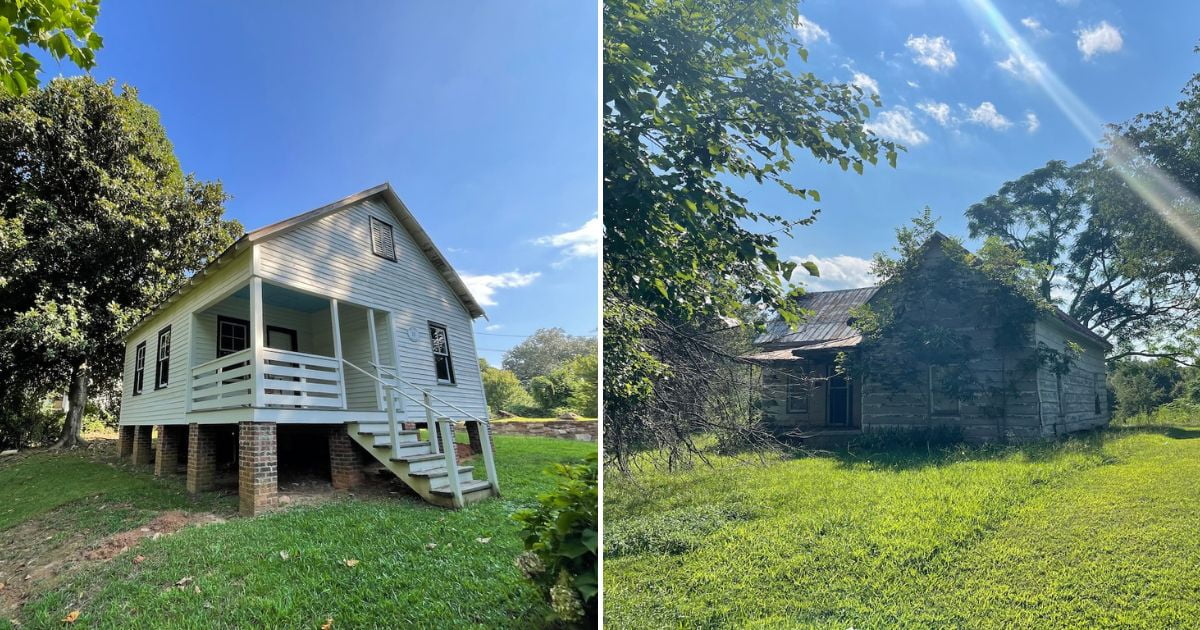
L: Nina Simone’s homeplace in Tryon, NC. R: Earl Scruggs’ homeplace in Boiling Springs, NC. Both photos by Justin Hiltner.
BGS once again co-presented the Earl Scruggs Revue tribute set hosted by Tony Trischka at Earl Scruggs Music Festival, held just outside of Shelby, North Carolina at the Tryon International Equestrian Center in August. On my drive to the festival grounds, I made stops in Tryon proper, to visit Nina Simone’s childhood home, and also in Shelby, to visit the Earl Scruggs Center and to drive by both of the Scruggs homeplaces just outside of Boiling Springs, North Carolina. It was stunning to visit both homes on the same day, to realize the interconnectedness of so much of American popular music. Simone grew up with a view of the Blue Ridge Mountains from her front porch nestled in one of their hollers, yet we place Scruggs as an Appalachian musician and not Simone?
The festival and Scruggs Center, for their parts, did an excellent job of demonstrating how broad, varied, and intricate American roots music is, even while focusing closely on bluegrass, string band, and Americana music. Listeners of our podcast, Carolina Calling, will know how much BGS loves North Carolina music history – the show features episodes on both Scruggs and Simone. Seeing that history in person, while heading to a first-class, banjo-heavy festival was a favorite musical moment of this year, for sure. – Justin Hiltner
East Nash Grass, Last Chance to Win
East Nash Grass seems to be all the buzz on the bluegrass circuit these days and those who have ventured to Dee’s Country Cocktail Lounge on any Monday night since 2017 can certainly understand why. The band’s long-standing residency at the Madison, Tennessee dive bar has taken them from a weekly pick-up band to performing at the Grand Ole Opry, the Ryman Auditorium, and at bluegrass festivals across the U.S. Their sophomore album, Last Chance to Win, captures the band at their very best (albeit, without their lovable stage antics). Following a 2023 IBMA nomination for Best New Artist, it won’t be a surprise if we see this record, and these musicians, sweeping awards in 2024 and beyond. – Thomas Cassell
Alejandro Escovedo at Cat’s Cradle Backroom, Carrboro, NC, November 2023
There are countless good reasons why you should make a point of seeing the Texas punk/soul godfather if he’s ever playing anywhere near you. But what might be the best reason of all is it’s a lead-pipe cinch that everyone in your town worth hanging out with will be there, too – onstage as well as in the crowd. Escovedo was among a dozen stars drawn to the North Carolina Triangle for an all-star “Nuggets” tribute show overseen by Lenny Kaye in November. So, he came a night early and played a solo show, too, ably supported by local luminaries Lynn Blakey and Pinetops/The Right Profile guitarist Jeffrey Dean Foster. The love in the room was palpable on deeply moving originals like “Sister Lost Soul” and “Wave Goodbye.” And when Kaye and R.E.M.’s Peter Buck came on for a closing Velvet Underground cameo of “Pale Blue Eyes” and “Sweet Jane,” the circle was complete. – David Menconi
Ben Garnett, “Open Your Books” (featuring Brittany Haas and Paul Kowert)
Before I’d listened to the complete #BGSClassof2023 Spotify playlist and realized this track was one of our first additions, the app kept recommending “Open Your Books” to me – and it’s not hard to see why. From guitarist and composer Ben Garnett’s debut album, Imitation Fields, the track features bassist Paul Kowert and fiddler Brittnay Haas and is an example of what bluegrass music can be, and what traditionally bluegrass instruments can do.
The tune opens slowly, with guitar and mandola – provided by Molly Tuttle & Golden Highway’s own Dominick Leslie. Fiddle swells, orchestral arrangements, and dreamy acoustic production make for a piece that feels distinctly intellectual. It’s chambergrass, but it’s also highly listen-able. While there’s a strong melodic thread throughout, the surrounding instruments and their players are allowed to wander off up the guitar neck, throwing in trill-y banjo licks, and detouring outside traditional fills and solo styles. The record was produced by Chris Eldridge and also features Matthew Davis on banjo and additional guitar from Billy Contreras. I’d recommend this tune to low-fi lovers, roots music fans, and anyone looking for a chilled out moment. It’s perfect for an introspective drive or a rainy winter day spent drinking hot tea at the window. – Lonnie Lee Hood
Alice Gerrard, Sun to Sun
Never, over the course of her lifelong career in music, has Alice Gerrard stopped, having reached her musical destination. She has challenged herself, time and time again, not simply for reinvention’s sake, but because she is a consummate old-time and bluegrass musician, someone so solidly bitten by the string band bug that making music requires that constant movement, that aspirational looking into the future, girded by songs of the past. But Sun to Sun, her latest – and perhaps final – album, features songs decidedly of the present. A synthesizer of traditional art forms, Gerrard takes textures and colors we relate to “authenticity” and leverages them to serve the messages in these tracks. Aging, mortality, justice, apartheid, gun violence, community are all woven into this collection. Alice is their nexus point, around which the entire project revolves and reflects the cosmic light she continues to shine on all of us – and on roots music subjects too often hidden in the shadows. – Justin Hiltner
A Good Year for Soundtracks – Asteroid City, The Holdovers, and More
Between the Writers Guild and Screen Actors’ strikes, 2023 was a weird year for the entertainment industry. But for those releases that did make it to the screen, it was a great year for movie soundtracks, especially for roots music fans.
First up, Wes Anderson’s western sci-fi Asteroid City. In addition to the usual cadre of Anderson’s cast, the film was peppered with classic country and bluegrass recordings from the likes of Tex Ritter, Slim Whitman, Bill Monroe, and Johnny Duncan & the Blue Grass Boys (you read that right). That’s to say nothing of the incredibly catchy original ear worm, “Dear Alien (Who Art In Heaven)” which felt as classic as those twentieth century tunes of the frontier written decades ago.
Capping off the year was Alexander Payne’s The Holdovers, a beautiful ode to a particular style of 1970s filmmaking that stars Paul Giamatti. Set in snowy western Massachusetts over a lonely winter break in 1970, the soundtrack plays like an old, soft blanket – familiar and warming. Newer tracks from Damian Jurado and Khruangbin weave seamlessly alongside ‘70s AM gold and Mark Orton’s pensive, folksy score. But the real standout of this soundtrack is a rediscovery of British folk artist Labi Siffre. His music has been shamefully overlooked in U.S. folk canon. Hopefully this movie can help start to rectify that.
Finally, it would be criminal if I didn’t mention the key placement of Indigo Girls’ “Closer to Fine” in the biggest hit of the year, Barbie. Here’s to another generation of young women finding themselves in Amy and Emily’s music. Thanks, Greta Gerwig. – Amy Reitnouer Jacobs
Kristen Grainger & True North, “Extraordinary Grace”
Take the anvil from my chest…
I am gasping for breath at this opening line. In her extraordinary, intimate voice, Kristen Grainger is pleading, letting us know she has lost hope. And we are right there with her. Whether we believed salvation came from the church or the Voting Rights Act, we believe no more. We are a fractured world, and it seems there is no bringing us together. Kristen’s melodies pull you in as much as her words, and I sometimes wake with this haunting song emerging from my dreams. Her bandmates’ graceful harmonies and instrumental accompaniment support the stunning words.
I once believed in extraordinary grace I put my faith in saints and saviors In the mirror, I can’t bear to see my heroine Killing time until time returns the favor.
Still, there is cause for hope: the promise of more music from True North. – Claire Levine
Angélique Kidjo at New Orleans Jazz & Heritage Festival, April 2023
“We can’t hear! We can’t hear!” Not what a performer wants to hear an audience chanting – though Angélique Kidjo didn’t hear it for a couple of songs at the New Orleans Jazz & Heritage Festival in April. She was giving it all, singing and dancing with vigor and verve, as she does. But the Benin-born star’s voice and all but the drums and percussion from her band were not reaching the crowd, that had already waited out a 45-minute rain delay. Finally, the stage crew got the message, but it still took some time to get things working. When they did, Kidjo betrayed no frustration – just pure, joyful release as she packed a full set’s worth of spirit into the handful of songs she could squeeze in the remaining time slot, including a few highlights from her re-infusion of Talking Heads’ Remain in Light album. Closing with her idol/mentor Mariam Makeba’s signature “Pata Pata,” she was radiant, as was everyone who stuck around to see and hear her. – Steve Hochman
The Lemon Twigs, Everything Harmony
This album is, without reservation or exaggeration, one of the most beautiful records I have heard in my entire life. Building on inspiration from ‘60s/’70s pop-rock (think the Byrds,Todd Rundgren, the Beach Boys, the Flamin’ Groovies), the Lemon Twigs achieve a layered delicacy of nostalgia and innovation. Their creative impulses are so detailed, articulate, and inspired that the entire album feels unfathomable; how could music reach such timelessness that it tickles at the preterhuman? Brothers Michael and Brian D’addario share the songwriting credits for pieces that feel distinctly matured from much of their earlier work. They’ve pared down the theatrics, tightened the sprawling lyrics, and created from a place that strikes a quintessential balance of self and influence. Their result is something oceanic – music that calls upon its ancestry in a way that is pervasive, striking, and sublimates the query of eternity. – Oriana Mack
Ronnie Milsap’s Final Nashville Concert, October 2023
Ronnie Milsap’s final Nashville concert will resonate with me for many years to come, both because of the multiple memorable performances and because it represented the best of country music from the standpoint of diversity and inclusion. Various performers from across the musical spectrum covered Milsap hits, with songs from every arena – honky-tonk and straight country tearjerkers, reworked doo-wop, R&B, and pop classics, love songs, and slice of life retrospectives. The roster of artists who displayed their love and affection for Milsap’s music crossed racial, gender, and sexual orientation lines, and it was also great to see the legend himself conclude the proceedings. While the Nashville audience and community will miss Milsap’s performances, this last outing provided plenty of wonderful moments and lots of great music that will never be forgotten. – Ron Wynn
New Dangerfield’s Debut at IBMA Bluegrass Live!, September 2023
For years a growing number of Black musicians have entered the trad scene and reclaimed Black traditions key to its development and evolution. Their work has run the gamut from preservation to experimentation. Audiences at this year’s IBMA Bluegrass Live! were introduced to a new Black string band that does it all: New Dangerfield. Made up of powerhouses Tray Wellington, Kaïa Kater, Jake Blount, and Nelson Williams, New Dangerfield has, in their own words, “risen to carry the torch.” In their premiere performance the band delivered an eclectic set of early jazz, early blues — and even a cover of R&B musician H.E.R’s “Hard Place,” led by Kater’s deliciously lush vocals. Each member, proficient instrumentalists in their own right, also showed off their technical chops and drew whoops from the crowd. Their set was something historic, and I’m excited to see what comes next from New Dangerfield. – Brandi Waller-Pace
Railbird Festival, June 2023
Set in the heart of Lexington, Kentucky, under a deep-red Strawberry Moon, the 2023 Railbird Festival was an under-the-radar masterstroke, highlighting the confluence of roots music and the mainstream. Held June 3 and 4 on the spacious lawn of The Infield at Red Mile, a sold-out crowd of 40,000+ enjoyed a non-stop lineup of performers from across the “Americana” pantheon, expertly curated and spread out over three stages. With 32 acts in total, country, rock, folk, bluegrass and more were all represented, as headliners Tyler Childers and Zach Bryan topped a bill including Charley Crockett, Whiskey Myers, Morgan Wade, Nickel Creek, Molly Tuttle & Golden Highway – even Weezer and Sheryl Crow. Combine all that with a well-thought out fan experience and an off-the-beaten path vibe, and the weekend was an ideal kickoff to festival season. – Chris Parton
Sam Shackleton at the Horseshoe Tavern, October 2023
Country fandom has always been ideological, but in the last few years the genre’s politics have felt plainer – clear villains and clear heroes, but also messy interior politics. Through this time, I’ve mostly been listening to folk music far away from the fighting at home, from musicians like Sam Shackleton, a genius singer and banjo player from Scotland. He was supporting the Mary Wallopers, the radical Irish party band, in Toronto in October. Shackleton was great, working the audience, singing his songs, and classic folk tracks. The crowd was restless, the beer he was offered on stage seemed pro forma, but he tried. There was a version of “All You Fascists (Are Bound To Lose)” that gave me hope for a few minutes. We step out for a smoke, and Shackelton is on the patio, nursing a lager. I tell him I loved the show and that I wanted vinyl. He hugs me and thanks me. Walking back in, the room is filled with Irish expats who are singing along to the Wallopers in ways that feel a little hostile. I leave early, going for Chinese food. These couple of hours were country/folk in 2023 for me – inclusive, exclusive, hand shakes, hugs, and isolation – plus enough physical/emotional distance from the world that I didn’t ask exactly how the fascists would lose. – Steacy Easton
Sleeping in the Woods Festival, May 2023
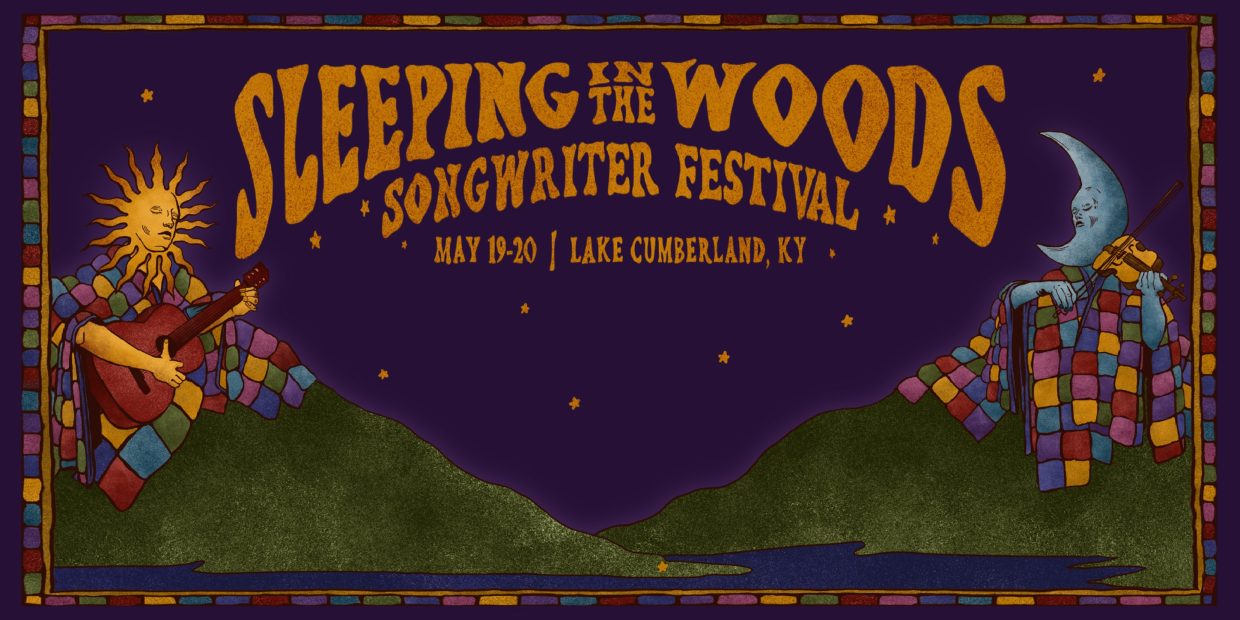
At a time when money in the music industry is at an all time low, and expenses are at an all time high, I have immense gratitude for anyone starting new community projects to showcase and uplift musicians and songwriters. I was lucky enough to get to be a part of Nicholas Jamerson’s Sleeping in the Woods Festival in Cumberland, Kentucky in May of 2023, and this event makes my best-of list. The festival bills itself as songwriter specific and showcases many lesser known Kentucky songwriters and bands. The strategy is to create a listening environment and bring together a Southern audience hungry for more straight-shooting roots music and hard hitting lyrics after becoming fans of Tyler Childers, Sturgill Simpson, and of course, Jamerson himself. After a successful first year, the festival is poised to grow exponentially and become a beloved annual event for all of those involved. – Rachel Baiman
Billy Strings at Bourbon and Beyond, September 2023
After five years of programming the BGS stage at Bourbon & Beyond, the Louisville-based festival has become something of a homecoming for our whole team. But nothing was more special than this year, when we got to see Billy Strings headline the main stage in front of over 50,000 people. It seems like just yesterday (in reality it was more like 2018) that Billy played our own stage inside the Bourbon Tent, a memory made all the sweeter by his surprise appearance this year on our stage during Michael Cleveland’s set. Hopefully it’s one of many happy returns to B&B for Billy, his fans, and BGS for years to come. – Amy Reitnouer Jacobs
Sunny War, Anarchist Gospel
Nobody sounds like Sunny War. As her profile has risen over the past decade, Sunny has held onto her punk rock politics and direct lyricism, grounding her artistry in the blues. Listening to one of her songs is like looking at a diorama of a nearby planet, similar to our own, but with none of human society’s bullshit. 2023’s Anarchist Gospel features Americana heavyweights David Rawlings, Jim James, Allison Russell, and Chris Pierce, but always sounds exactly like Sunny. Her hypnotic guitar work and precise songcraft shine. Her vocals walk a fine line between eerie and inviting. And at the end of a year when riot grrl aesthetics have gone mainstream, Sunny War is a rare reminder of what the real thing sounds like. – Lizzie No
Photo Credit: Angélique Kidjo by Fabrice Mabillot; Billy Strings by Christopher Morley; boygenius byMatt Grubb.
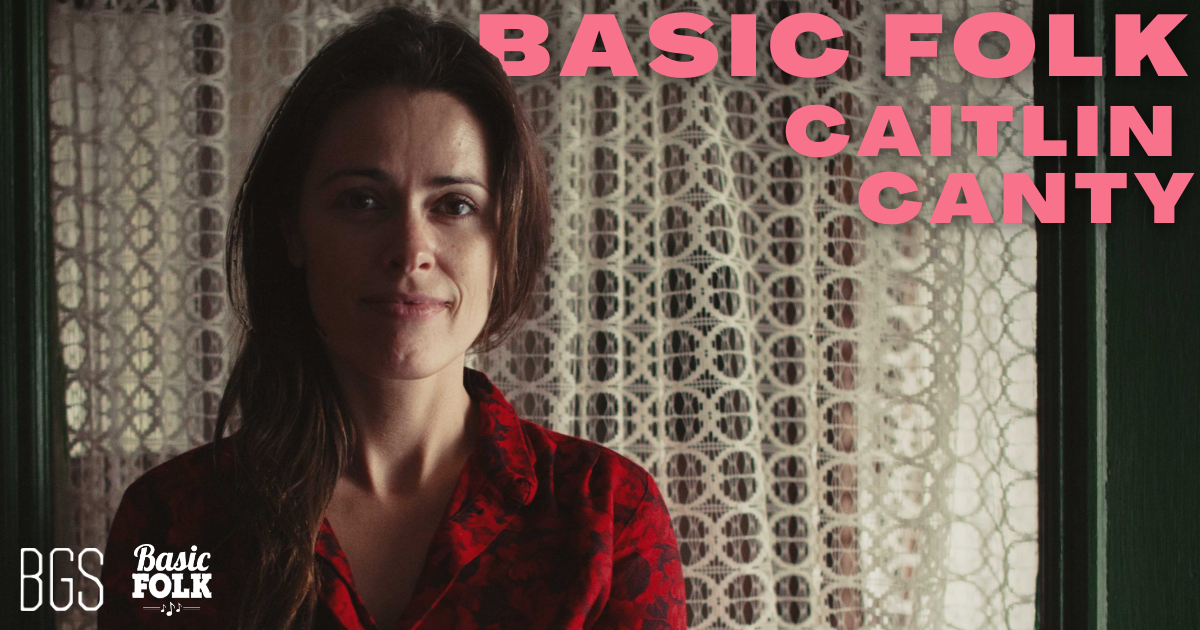
Caitlin Canty is in the middle — in the middle of moving houses (behind her when we connected on Zoom this spring is a Jenga tower of bankers boxes) and in the middle of prepping an album release, which we’re in the middle of talking about when she isn’t in the middle of pushing a pair of overeager dogs from her lap (“These dogs!”), all of which is taking place in the middle of her toddler’s nap.
The moving, the music, and the motherhood are taking place in the middle of her life (Canty turned forty-one in January) and the middle of her career: Quiet Flame, her latest record, is her fourth.
Oceans of ink have been spilled on beginnings and endings, on best new artists, and lifetime achievements. We rarely think about the middle, write about it, or sing about it. But Caitlin Canty does.
Quiet Flame is a dispatch from — and a celebration of — the middle; it is a testament to the in-between, to the precious spaces between day and night, birth and death, here and home. It is also a rallying cry, a call not to run from middle moments, but to revel in them. “Breakneck boy goes speeding by / In a hell-bent race to some finish line,” Canty sings on the album’s opening track, “Blue Sky Moon.” “I ain’t going with him… Gonna take my time in the middle of the road.”
This is a new message for Canty, one that asks the listener not to “get up before the road pulls you under,” as Canty sang on 2015’s Reckless Skyline, but to accept the road as it is, accept that it may pull us under, and enjoy the ride. “If the pandemic and [2020 Nashville] tornado taught me anything,” Canty says, “It’s all the things I thought I could control are out of my control. The natural world is beautiful. It’s also terrifying,” she exclaims with a half laugh, “it can just crush you in a second.” (That tornado missed her house by thirty feet.)
This new vision, however, hasn’t diminished Canty’s optimism. With a heightened sense of all that is lost and lose-able, Canty offers not less hope, but more. “Let it roll, let it ride / Let your sweet heart open wide,” she sings on “Pull the Moon.”
“I let go of a lot of things I thought were my fault, or my responsibility, things I thought I could do everything about, or take care of, or succeed at,” she explains. “And what I found was an ability to be happy in devastating moments in time. Even when it gets dark and troubled, to find a way not to ignore that — to address it — but to stay buoyant.”
It is this clear-sighted courage — what amounts to Canty’s profound musical and lyrical authenticity — that not only sets Canty apart, but draws so many of the acoustic world’s greatest artists into her corner. “Caitlin just has such a magnificent view of the world,” Grammy Award-winning guitarist and Quiet Flame producer Chris Eldridge says. “It’s so strong and true and clear and honest. You just believe it.”
Among those drawn to Canty’s vision — to her clarity, honesty, believability — are some of the greatest artists in contemporary music, making the Quiet Flame band a bona-fide acoustic supergroup: on banjo, mandolin, and harmony vocals you have singer-songwriter Sarah Jarosz (another Grammy winner); on bass, Paul Kowert of Punch Brothers and Hawktail (yet another Grammy winner); and on fiddle, Brittany Haas (also of Hawktail and the newest member of Punch Brothers), who is widely considered the greatest fiddler of her generation.
“Every artist has a vision,” Kowert says, “But I specifically would say I believe Caitlin. I believe her about what she’s seeing in the songs.”
“There’s such conviction,” Haas adds. “It’s so clearly from the heart.”
For Jarosz, Canty’s super-distinction is the totality of her authenticity and an unusual ability for Canty to “sound like herself” in every domain of her artistry. “Her ability to be herself within her songs has always been very obvious to me, before I even knew her,” Jarosz says. “My favorite singers sound like themselves when they’re talking — their singing voice is a genuine extension of them, their personality. Tim O’Brien has that, Gillian Welch has that, Caitlin has that. It’s almost like Caitlin’s voice is so true —it’s like it’s not an option for her to be anyone but herself. And the songs are also that way.”
The songs of Quiet Flame mark not only a musical achievement, but an achievement of spirit. “It takes a very self-assured, fully realized human being to be able to make a record that’s this exposed,” Jarosz continues. “The record takes its time. It takes a very mature musician — and person — to have the courage to let these songs unfold the way they do.”
It is no small feat that Canty manages to make this deliberately slow journey, this taking our time in the middle of the road, so arresting. Such is a testament, of course, to the music as music; to Canty’s voice (“Caitlin, in her way, is as good a singer as exists,” Eldridge says); to her effortless melodic sensibility; to what Haas calls the unusual “variety and diversity of what [her] songs are like, what they allow and make room for texturally.” It is also a testament to the production vision of Eldridge, who Canty calls the perfect “co-pilot,” and to his attention to the “big picture.”
Each member of Canty’s bandoffers a tour de force on their instruments. In Canty’s words, Kowert is a “Multi-instrumentalist on his instrument… essential, the strongest foundation… my favorite bass player I’ve ever played with”; Haas is a “Flamethrower! Her fiddle is an electric guitar! It’s grit and mournfulness — not sad, defiant; not sorrowful, defiant”; Jarosz is “Just insanely good — insanely good singer, insanely beautiful instrumentalist — the most solid partner; she held it down!”
In turn, the band is quick to praise the rare musical freedom Canty affords them. “She makes so much space for other musicians in her music,” Haas says. “She’s really good at being like, ‘I hired you to be you,’ instead of, ‘I want you to do this very specific thing that involves only playing these four notes.’”
The result? The band gets to see their true selves in the work — even their best selves. “‘Odds of Getting Even’ is one of my favorite performances I’ve ever played,” Kowert remarks. “My playing on that song is really exemplary of something that I am uniquely able to do, which is bowing the bass that way, driving the rhythm with the bow.” Multi-instrumentalist Noam Pikelny (still another Grammy winner), who is featured on “I Don’t Think of You,” says much the same: “[It’s] easily one of my favorite examples of my playing captured on record.”
Most of all, however, the success of Quiet Flame’s slow burn is owed to the trust Canty engenders in her audience. It is a trust natural to Canty, but made all the more affecting by her decision, for the first time in her career, to make an entirely acoustic record. “Intimacy is just kind of baked into the nature of acoustic music,” Eldridge explains. “You just intuitively understand that what you’re hearing is what can happen in somebody’s living room. So when you commit to doing a string band record, you’re committing to a certain kind of intimacy. It casts the artist, and the songs, in a different light—in a light that asks the listener to lean in a little bit more, asks the listener to be a part of a moment.”
It is with the listener leaning in close, grounded in the moment with Quiet Flame, that Canty offers a vision both audacious and convincing, that she shares the unmistakable and unshakeable sense that all will be well; that even in the face of so many black holes, we too will be okay; that we, like Canty, will arrive “by the highway home” – a lyric after Robert Frost.
“They all told me love could feel this way,” she sings. “I never thought I would see the day.”
It is the peculiar gift of Caitlin Canty that when she says love can feel “this way” – or even that “nothing’s gone, only changed” – one can’t help but think she’s right.
Urgency and patience are the two poles of New England songwriter Caitlin Canty’s magnetism. Her music invites you to quiet moments of reflection with unhurried confidence. When I first heard her song “Get Up” in 2015 I felt like I was receiving a very important magical message. Canty’s subsequent releases have further revealed her uncanny talents for grooving at the right tempo, describing the memorable image, leaning into elegant arrangements, and letting delicate moods hang in the air.
Canty’s new album, Quiet Flame, was recorded live with a string band and no drums. Live tracking has become her signature over the years, and this new record shows the authentic and powerful moments that can only be created in that setting. Produced by Chris Eldridge of the Punch Brothers and featuring collaborators like Sarah Jarosz, Brittany Haas, and Paul Kowert, Quiet Flame is not only a showcase for Canty’s unmistakable voice and songwriting, but also a celebration of her impressive artistic community.
Caitlin knows a thing or two about teamwork after many years of team sports. She was a soccer player and heptathlete through her college years, and I have a hunch that her athlete-brain and her musician-brain share a particular wisdom. Pacing, collaboration, focus, and graceful movement characterize her unique body of work. It was a true delight to talk about writing, friendship, family, touring, humility, and self-belief with this gem of a musician.
(Editor’s Notes: Headline image of Béla Fleck & the Flecktones. Scroll to see a photo gallery.
To mark Planet Bluegrass’s 50th annual Telluride Bluegrass Festival, we asked author and music journalist David Menconi to reflect on its impact – and the vibrant community that’s grown up around this iconic roots music event.)
The circuit of roots music festivals in America has some similarities to the Professional Golf Association. There’s at least one festival as well as one golf tournament pretty much every week of the spring, summer and fall. But a few stand out as special and even career-making – golf’s four major championships, and the handful of prestigious main-event music festivals. North Carolina’s MerleFest is like The Masters, the early-season springtime kickoff each April, while late-season festivals like San Francisco’s Hardly Strictly Bluegrass line up nicely with the British Open.
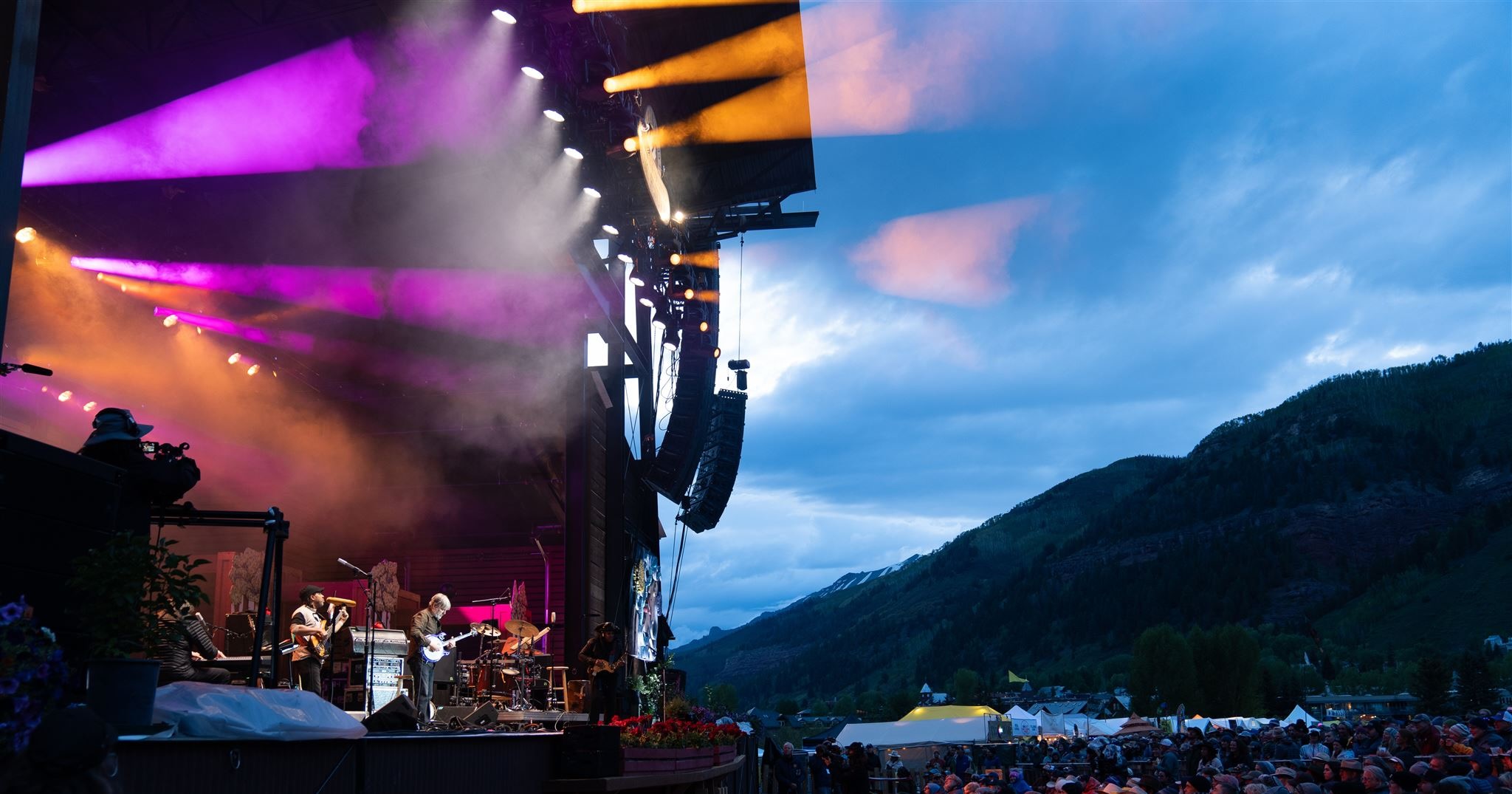
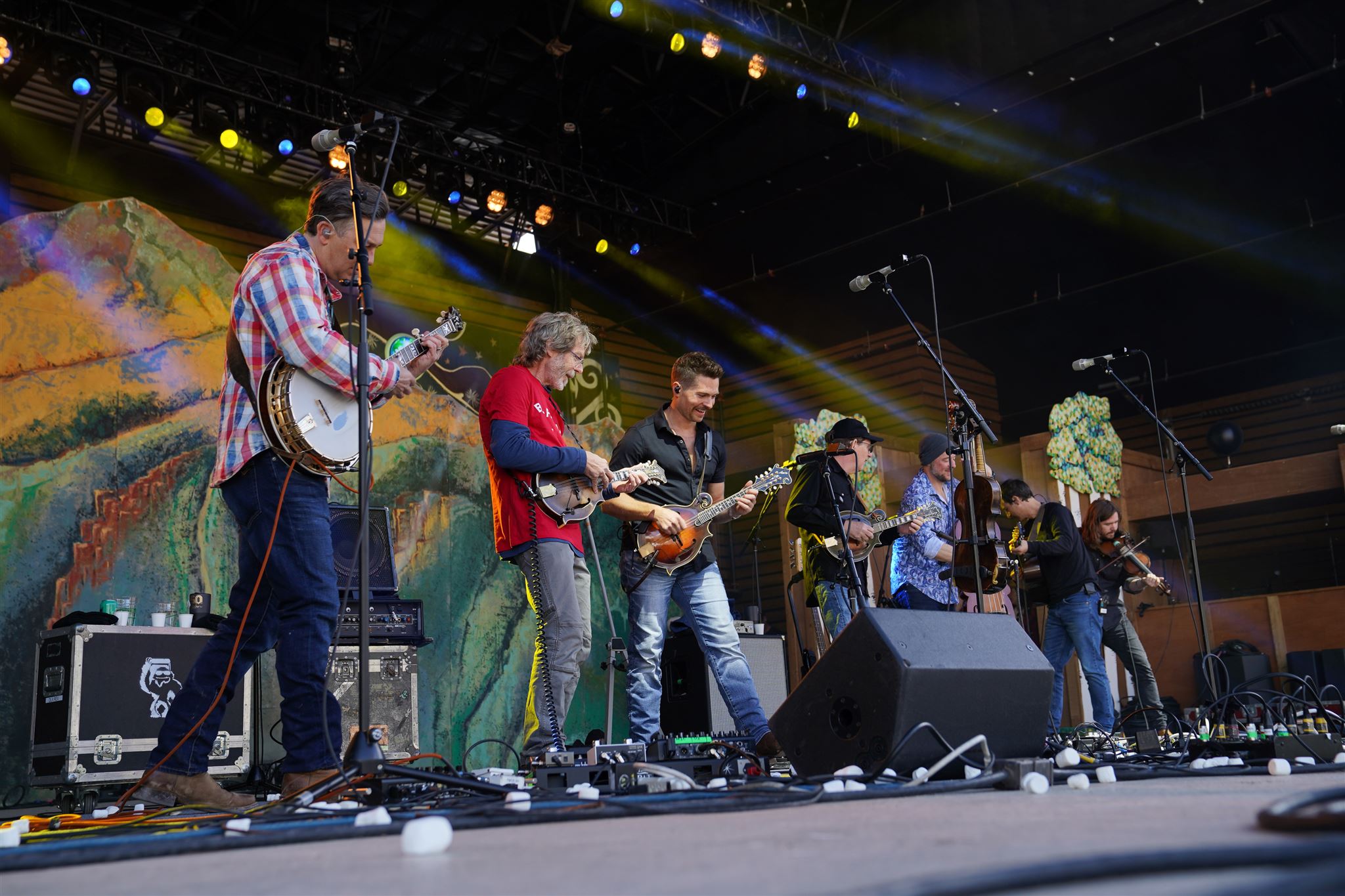
But there’s no question which music festival stands as the summit of the circuit, and not just because it’s in the mountains of Colorado. That’s the Telluride Bluegrass Festival, which marked its 50-year anniversary with the 2023 edition last weekend, June 15-18. The fact that Telluride has prospered for half a century makes Telluride something like golf’s U.S. Open championship, the big one that everybody wants to be a part of. Telluride’s status is something that the musicians who play it are well aware of.
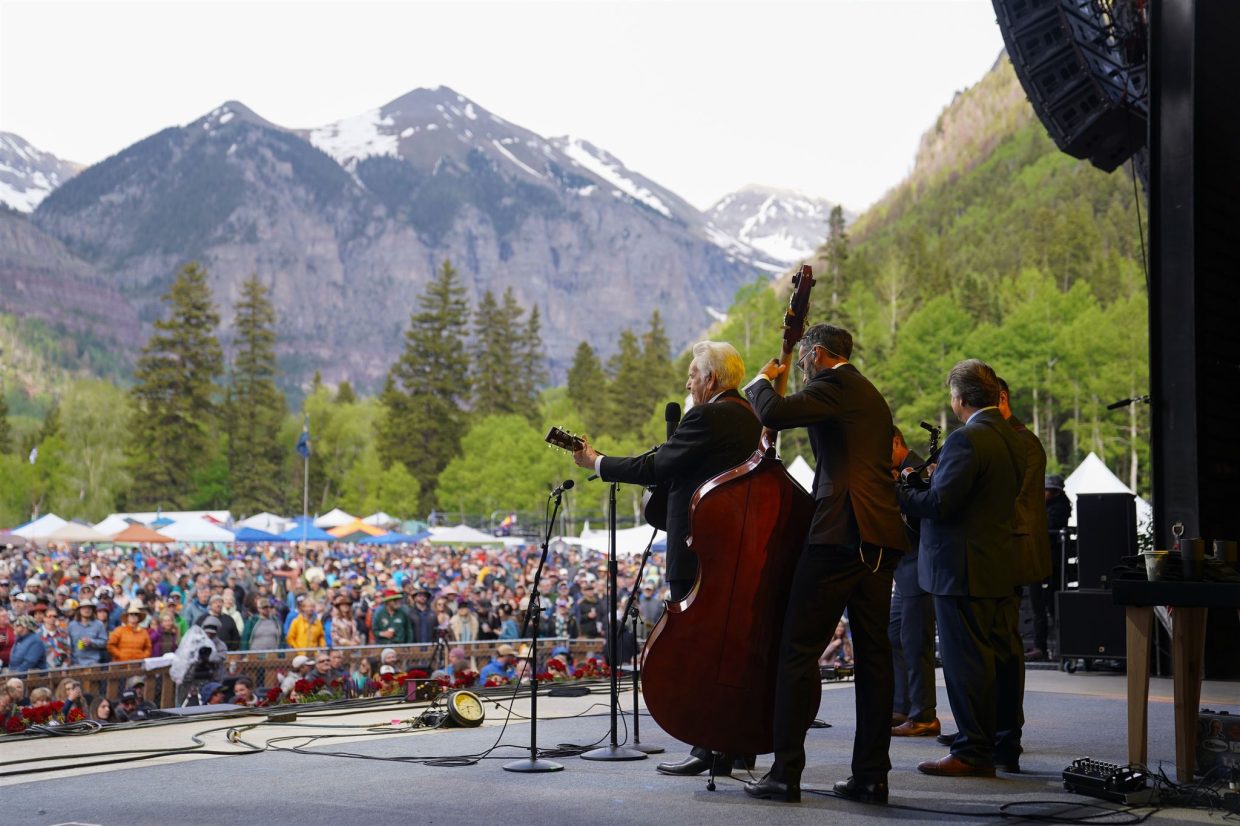
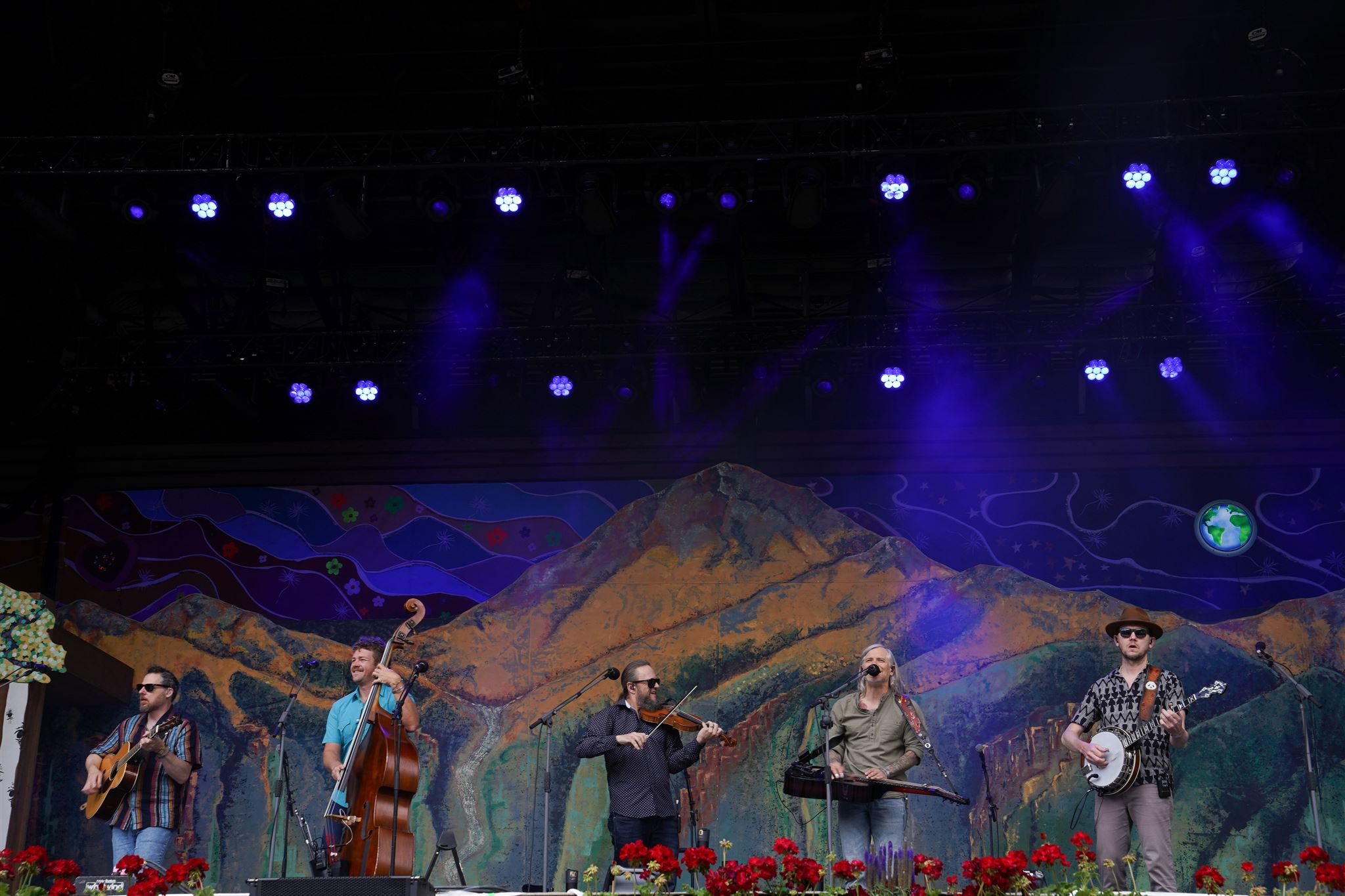
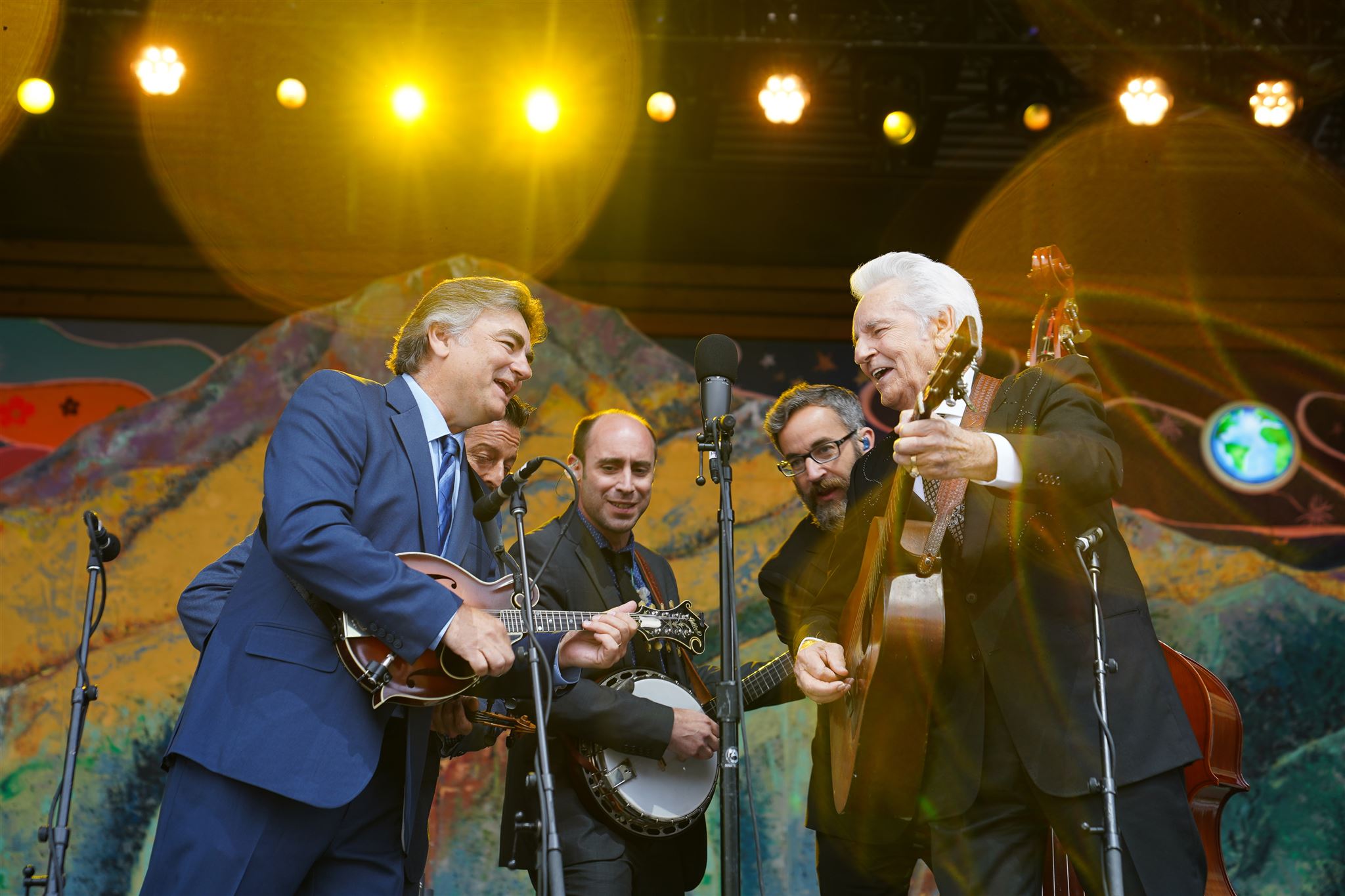
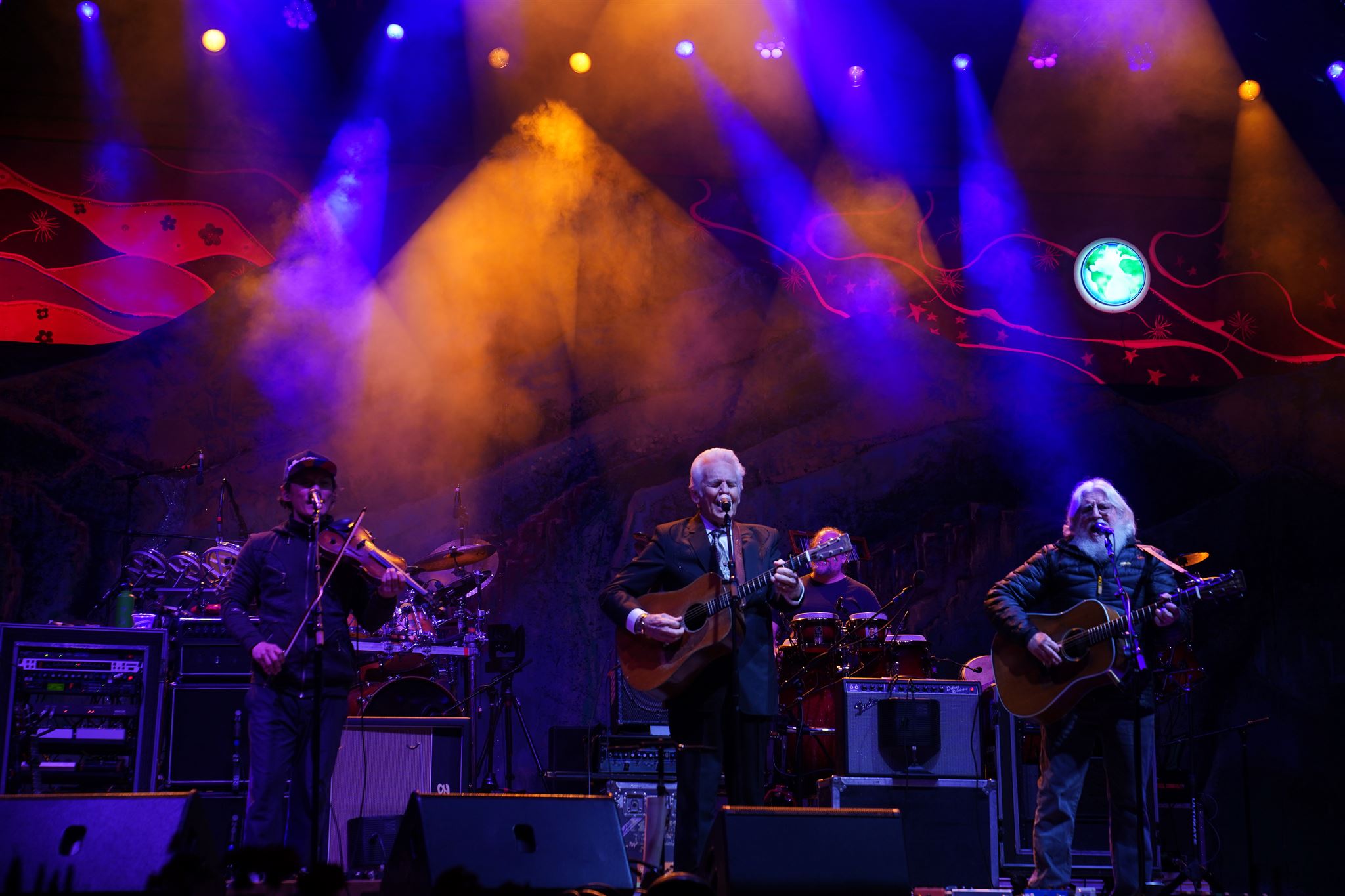
Del McCoury Band performs Thursday, June 15, at the 50th Annual Telluride Bluegrass Festival.
“Festivals and musical trends come and go, and acoustic music has been through some serious peaks and valleys the last 50 years,” says Chris “Panda” Pandolfi, banjo player for Telluride regulars The Infamous Stringdusters, who were on this year’s lineup. “The one mainstay throughout has been Telluride Bluegrass Festival. When we started out, Telluride was the place to be and the definitive crossroads we aspired to, and it still is. Lasting 50 years is an amazing testament to its importance. Bluegrass is more popular than ever now, and Telluride is a big part of that.”
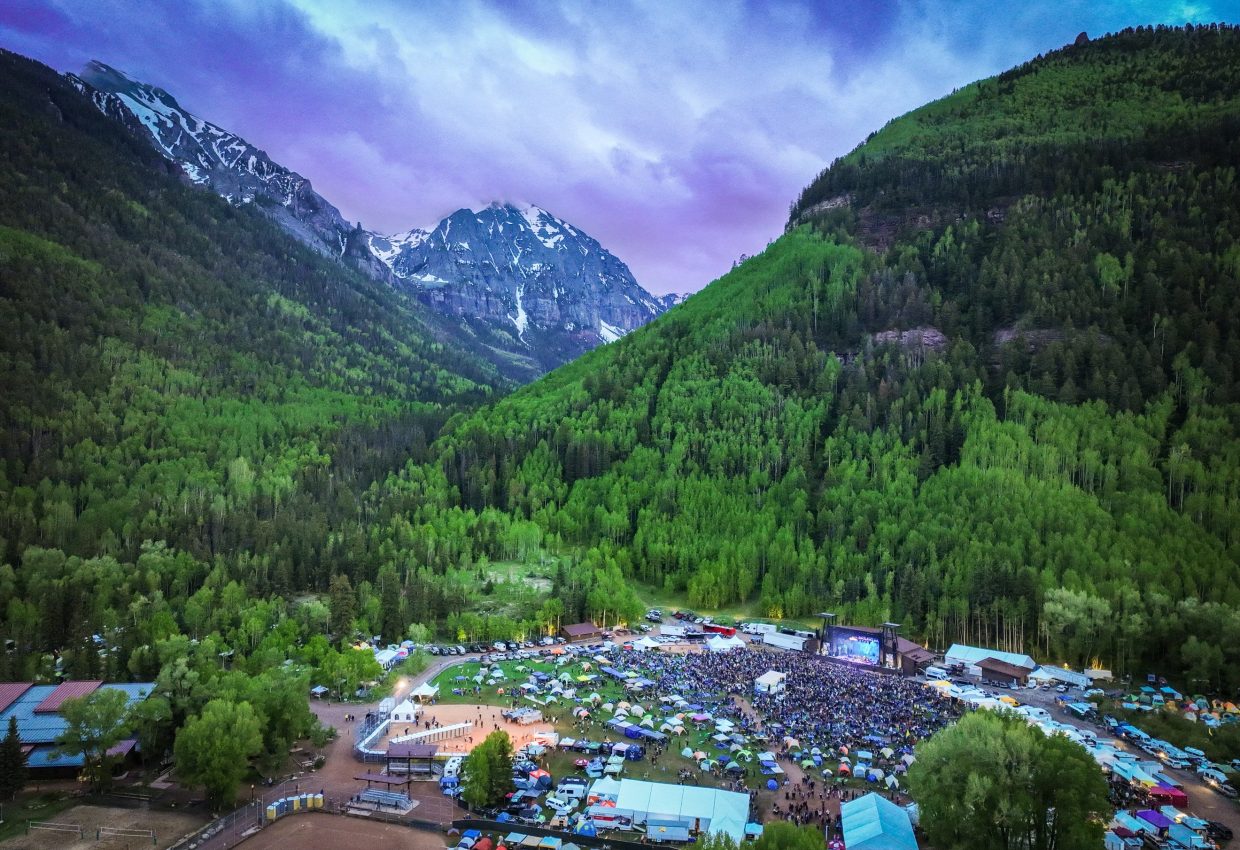
There are literally hundreds of music festivals spanning every style imaginable nowadays, including massive annual gatherings like Bonnaroo in Tennessee and Coachella in the California desert. But there were just a small handful of festivals when Telluride Bluegrass Festival started up in 1973 in the scenic Colorado mountain town that bears its name. And even though Telluride’s daily capacity of 10,000 fans is significantly smaller than a lot of the other major festivals on the circuit, it has still maintained its prestige status.
A drone shot of the festival grounds of Telluride Bluegrass Festival.
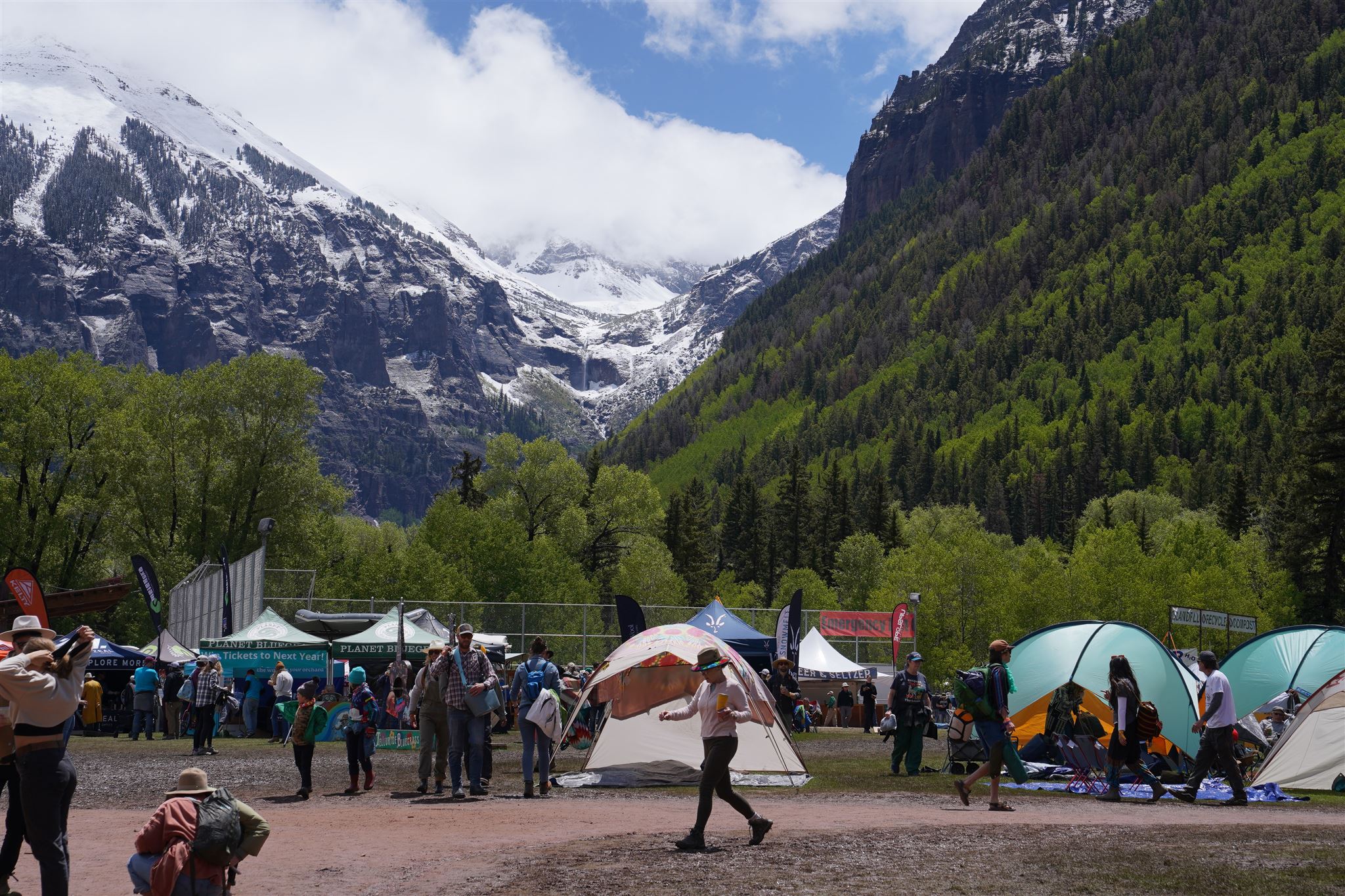
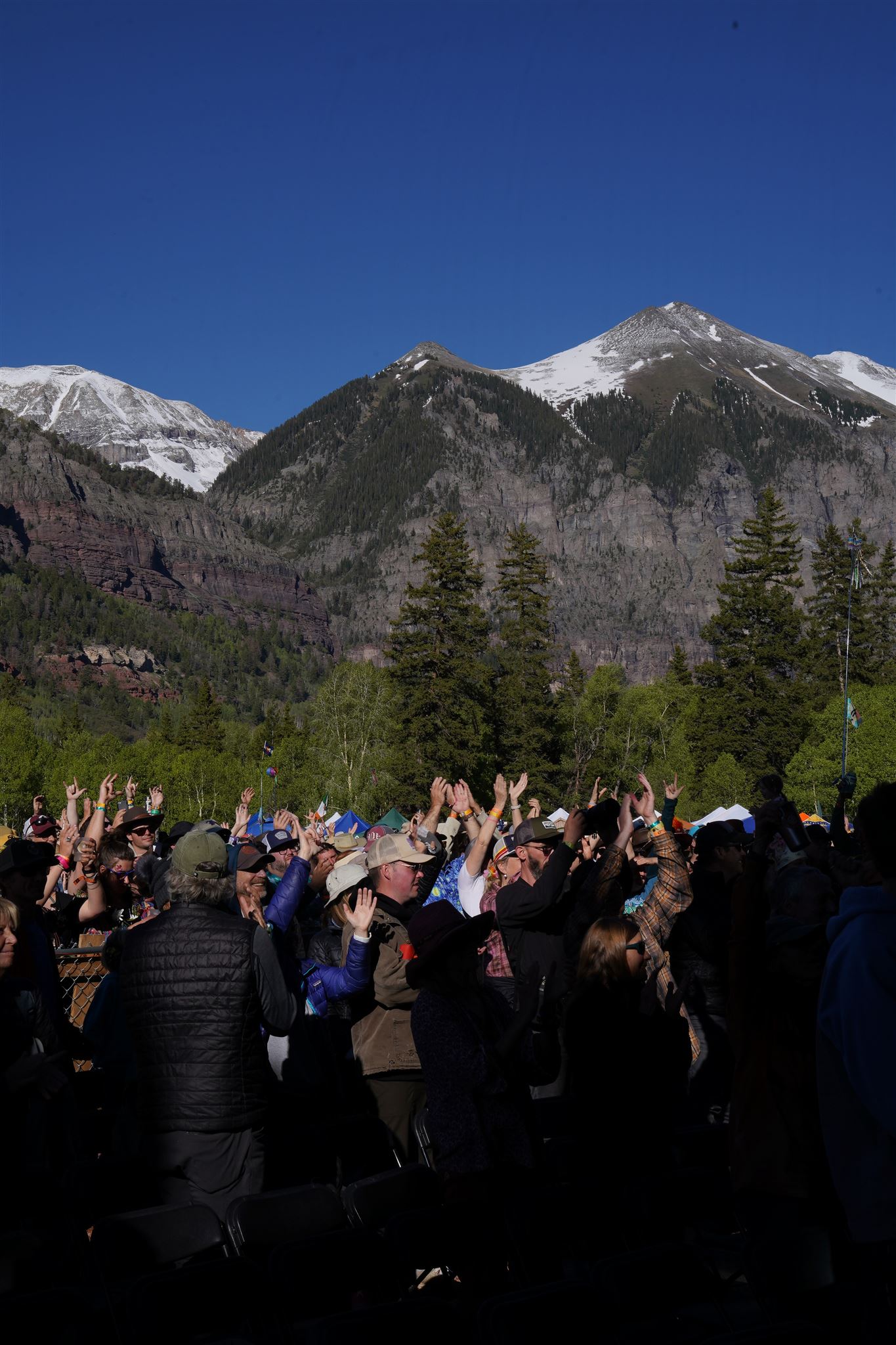
In spite of that smaller size, Telluride does have a few structural advantages that set it apart. One is a picturesque setting of surpassing natural beauty on the western edge of Southwestern Colorado’s San Juan Mountains. For performers as well as attendees, there’s not a better view anywhere than what you see at Telluride.
“The view from the crowd is amazing, but from the stage it’s the most incredible view imaginable as an artist,” says Pandolfi. “It’s this multi-layered inspirational snapshot of some of the best music fans, at the best-run festival, in the most beautiful environment in the world. I think a lot of people have this experience, knowing of Telluride as this iconic festival with an outsized reputation, but it more than lives up to the hype. First time we played there, I remember feeling intimidated because so many heavy-weight players we looked up to were there. But as soon as we got onstage, everything clicked.”
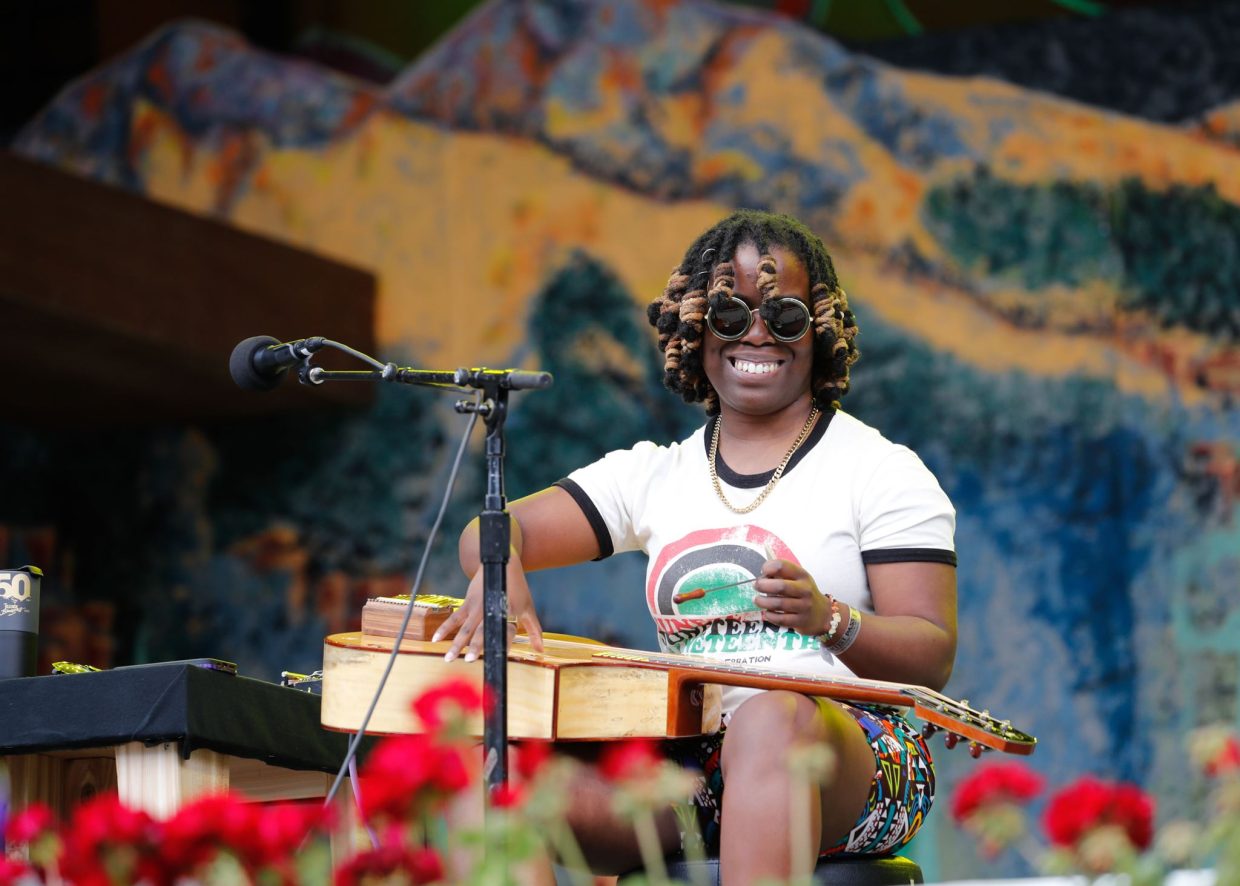
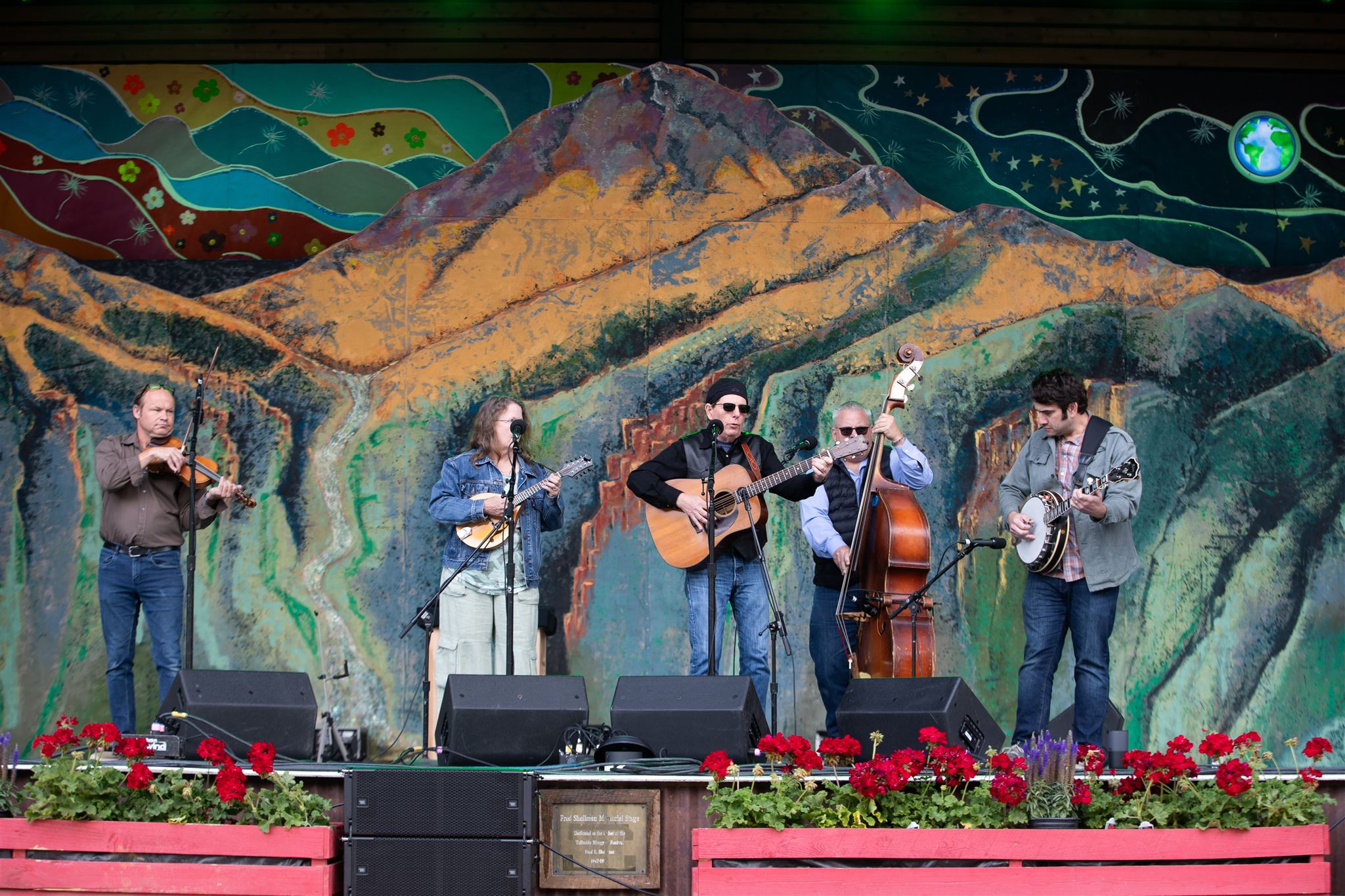
Yasmin Williams performs on Telluride Bluegrass Festival’s main stage – its sole stage.
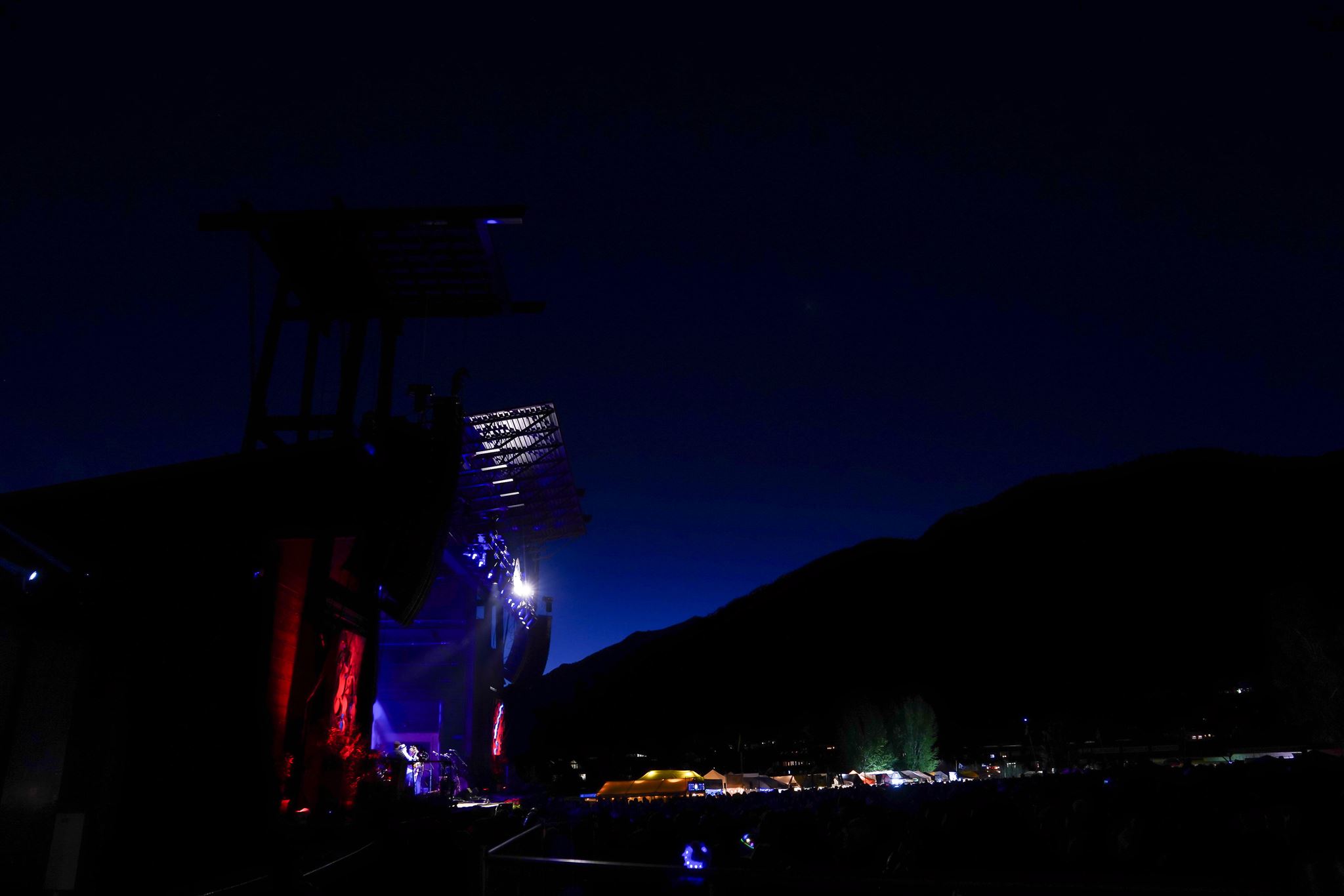
Another major difference between Telluride and its festival peers is scale, and not just in terms of the size of the crowds. Most festivals cram as many performers onto as many stages as possible, all of them running simultaneously, resulting in sensory overload as well as the fear that you’re missing out on something elsewhere. By contrast, Telluride still has just one stage. Every act gets a solo spotlight at Telluride.
“Every year’s festival lineup is an interesting thing,” says Craig Ferguson, who oversees Telluride Bluegrass Festival under the auspices of Planet Bluegrass. “I’ve always said, just watch and it will book itself, and that’s really true. Our process is unique because we have just the one stage and not a bunch of bands, so everybody in the crowd gets to have the same experience. There’s not 18 different stages, so we can create one festivarian experience that everyone shares. We do the booking one act at a time, and we often wind up with interesting combinations.”
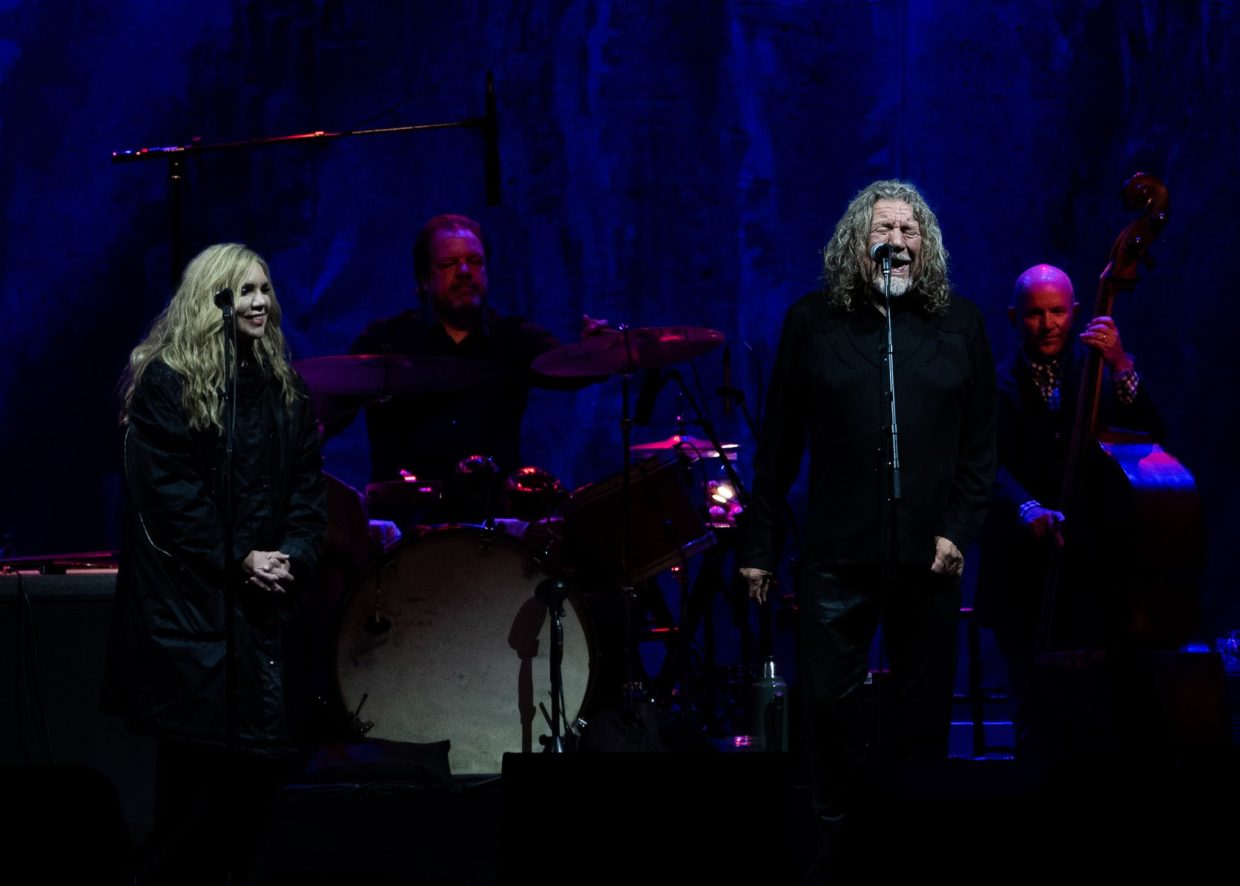
Robert Plant & Alison Krauss perform at Telluride Bluegrass Festival.
Indeed, those interesting combinations can venture well beyond what you see at a typical folk or bluegrass festival. Along with Sam Bush, Emmylou Harris, Peter Rowan, Del McCoury and The Infamous Stringdusters doing a Sunday morning gospel set, this year’s lineup features ringers like the West African ngoni master Bassekou Koyate and the venerable jam band String Cheese Incident. Some of the anomalous acts from previous years include pop-star jazz pianist Norah Jones, the comedic folk duo Tenacious D and even singer/rapper/actress Janelle Monae. Even with the unlikely acts, the Telluride experience sells itself. It doesn’t take much convincing to get any artist to play.
“Janelle Monae was the most interesting person to talk to,” Ferguson says. “I snuck into her RV just as she was sitting down to a meal by herself, and I was able to sit and talk to her for an hour. I think she would’ve signed up to play every year if she could have, she was so enthralled by the fact that there were elk in the park. It was the most wonderful conversation, and she was great. We’re famous for our curveballs and she was the oddest, I’ll give you that.”
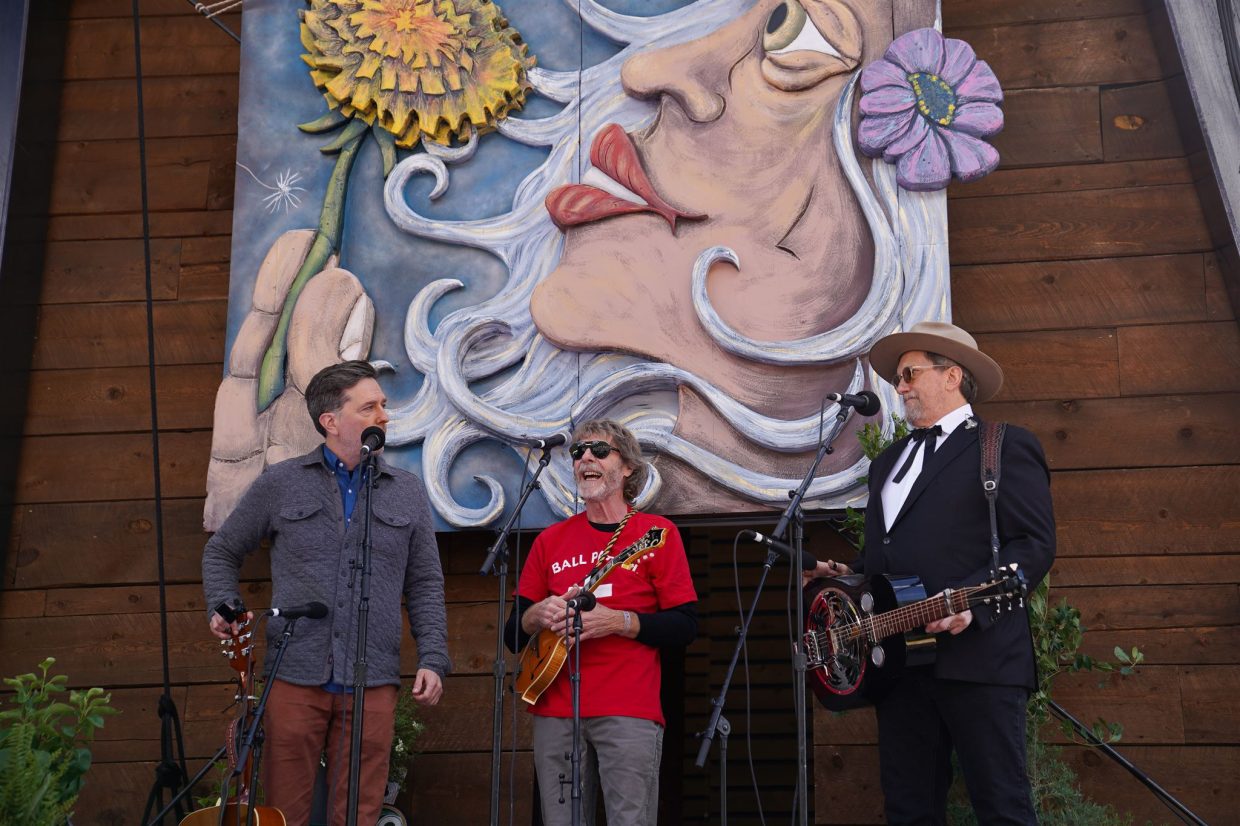
BGS’s own Ed Helms with Sam Bush and Jerry Douglas at Telluride Bluegrass Festival.
Apart from the change-ups, multiple generations of musicians in the world of acoustic music count Telluride among their major artistic, career and personal milestones. One of them is Sarah Jarosz, a four-time Grammy winner who first went to Telluride as a fan at age 14 and played it herself for the first time two years later. Telluride is where Jarosz first connected with idols and future peers like Gillian Welch and Abigail Washburn. It’s also where Gary Paczosa saw Jarosz for the first time at her 2007 Telluride debut. He subsequently signed her to Sugar Hill Records and produced her first four albums.
“It’s the quintessential place to see your heroes, and even get to jam with them,” says Jarosz, who is back on this year’s lineup. “You’ll hear, ‘There’s a jam at this house down the street after the shows.’ So I brought my mandolin and before I knew it, Chris Thile was showing up. Also Jerry Douglas, Tim O’Brien. That was really life-changing, this proximity to heroes that allowed me to become friends with them. And even though Telluride is rooted in bluegrass, they always bring in artists from beyond that world – Janelle Monae, Decemberists, Alison Krauss and Robert Plant. It feels like anything can happen, and the audience that goes is very supportive of that.”
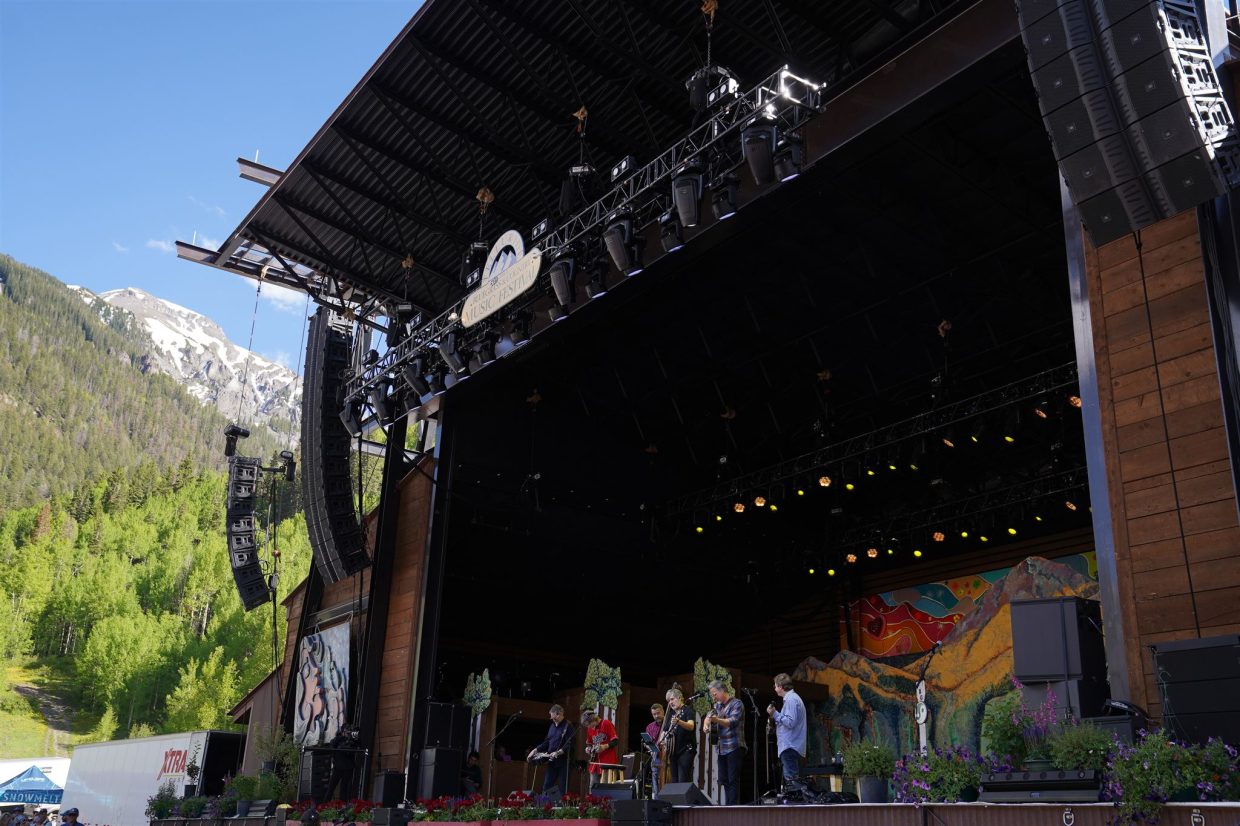
The stalwart House Band of Telluride Bluegrass Festival.
Still, no matter how far afield the lineup wanders, Telluride is ultimately rooted in bluegrass.
“Bluegrass is a fable, and a team sport,” says Ferguson. “That informs how we create the lineup. Looking to the future, socially as well as musically, we think of bluegrass as an allegory. It’s a context that is invitational to all these other styles, country or jazz or classical, and it complements all of them. That remains the heart and soul of this festival, surrounding bluegrass with these other complimentary musics. We are fortunate to be of service to the festivarian community. It’s an annual privilege to see how much it brings to people’s lives, the connection to community.”
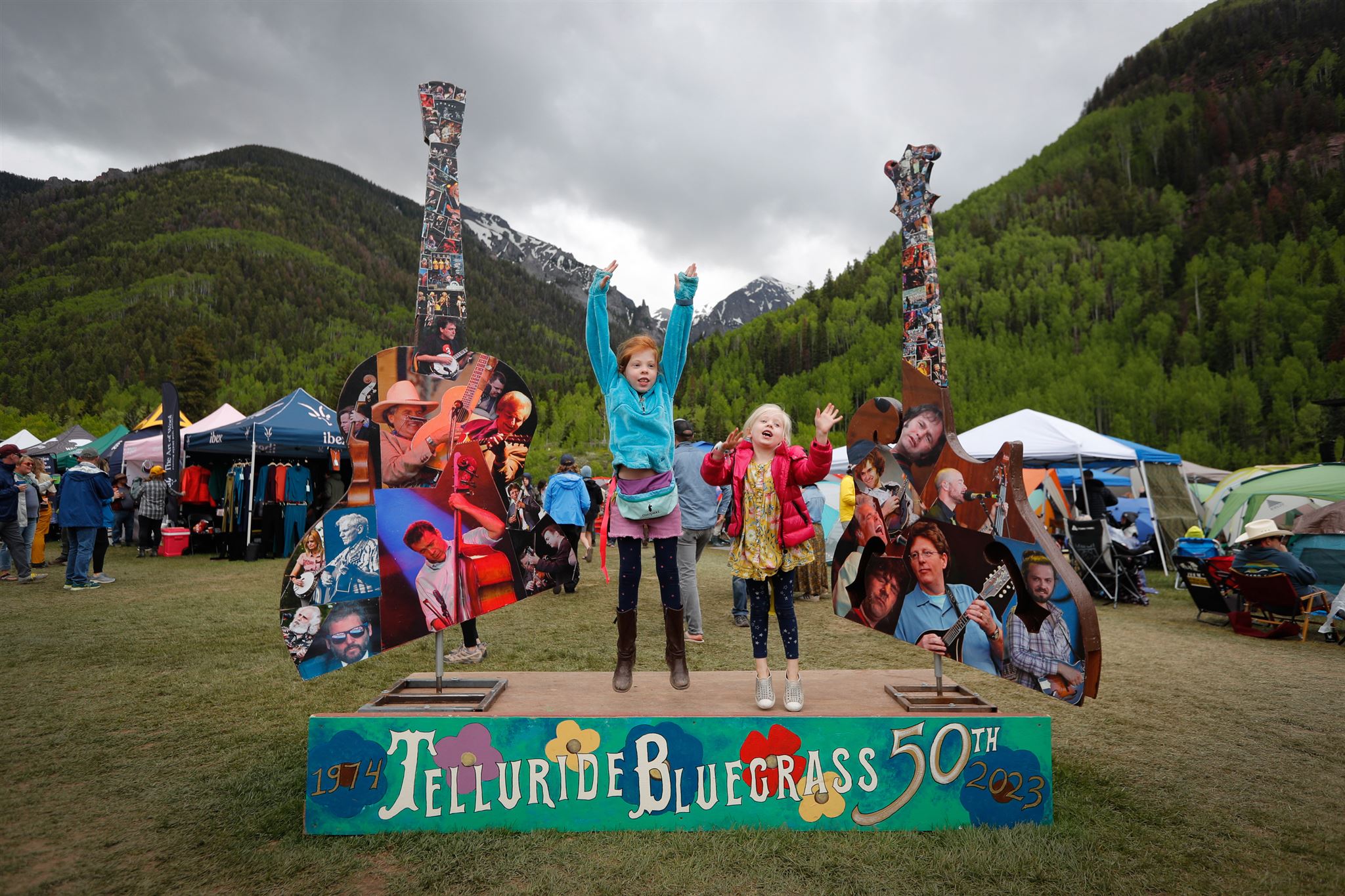
Young festivarians celebrate Telluride Bluegrass Festival's 50th Birthday.
Nickel Creek.
Bassekou Koyate.
Greensky Bluegrass.
Charles Wesley.
Sierra Ferrell.
Mary Chapin Carpenter.
Dierks Bentley brings Long Jon to Telluride and Sam Bush up on stage.
Peter Rowan.
Chris Thile.
Gregory Alan Isakov.
The Infamous Stringdusters.
A gorgeous, though chilly, festival grounds.
Leftover Salmon.
Punch Brothers performed their last sets with Gabe Witcher as a member of the band at Telluride.
Sarah Jarosz.
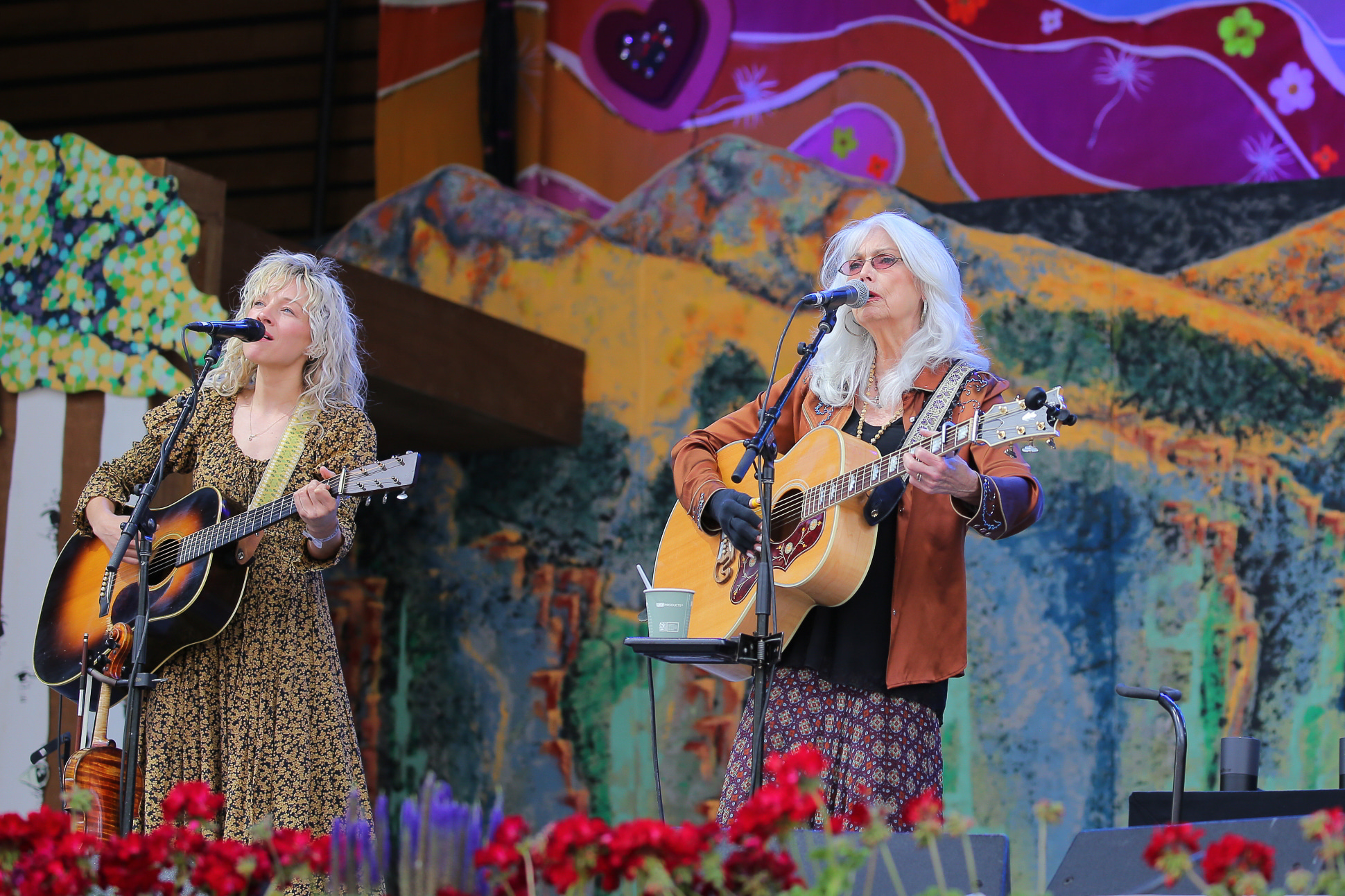
Sam Bush Band with special guest Emmylou Harris.
Del McCoury joins String Cheese Incident on stage at Telluride Bluegrass Festival.
The Earls of Leicester.
Tim O'Brien Band featuring Shad Cobb, Jan Fabricius, Mike Bub, and Noam Pikelny.
Watchhouse was joined by Emmylou Harris.
Yonder Mountain String Band with Sam Bush and guests.
The crowd cheers for Yonder Mountain String Band.
Sam Bush Band backgrounded by the mountains and evening sky.
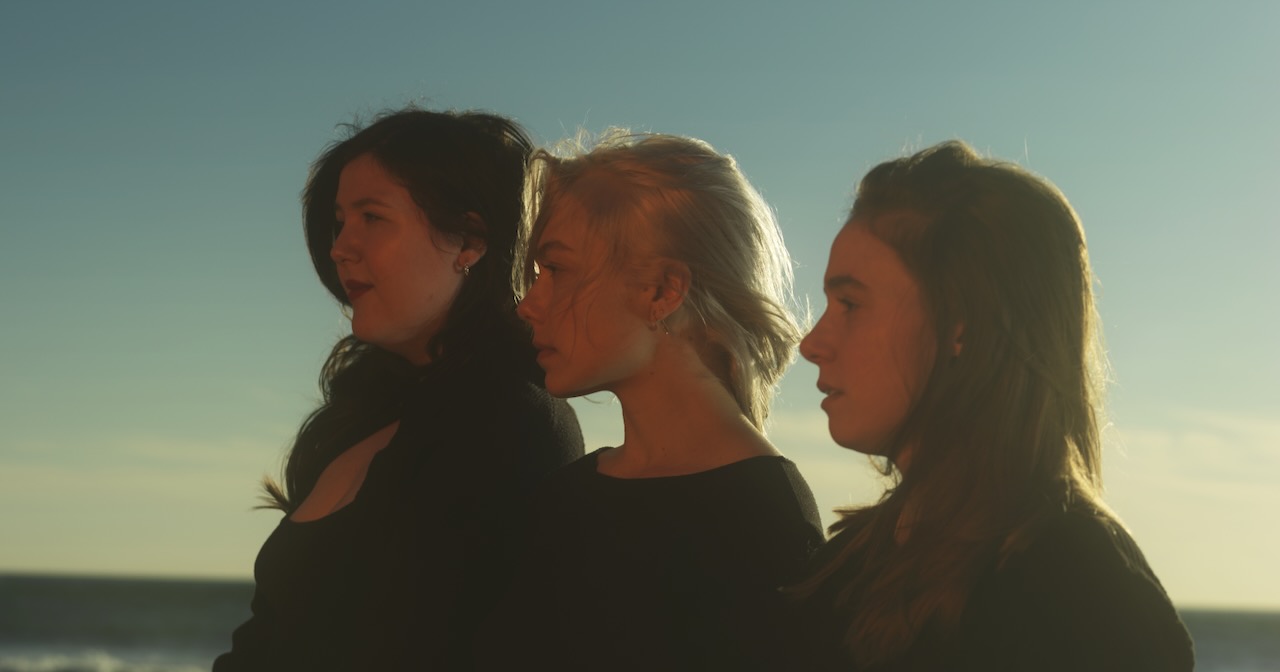
Can’t get enough of the record by boygenius?We understand and empathize. Did your ears perk up immediately when you heard the twinkle of the banjo on “Cool About It?” Do you rewatch the video of Julien Baker, Lucy Dacus, and Phoebe Bridgers performing The Chicks’ “Cowboy, Take Me Away” over and over and over again? If so, this list is for you.
It’s not hard to place boygenius within the universe of folk music and its endless variations, with their perfectly blended, nearly familial harmonies, their lyrics and song structures that are so singable, cyclical, and relatable, and the way, together, they exceed the sum of their individual parts by leaps and bound. Comparisons to other iconic supergroups – Dolly, Linda, and Emmylou’s Trio, or Crosby, Stills, Nash, & Young – illustrate further that boygenius are often a string band and always a folk group.
We’ve collected songs from 18 other folk groups that also center female and femme friendship, slippery harmonies, and egalitarian ensemble arrangements in their music. If you adore boygenius, these acoustic bands are for you.
(Editor’s Note: Scroll for the playlist version of this collection.)
The band JOSEPH’s latest release, The Sun, is perhaps their furthest foray into pop- and indie-folk, with a sound that’s not just adjacent to “the boys” of boygenius, but often parallels the genre and aesthetic territories explored by the latter trio. These songs are rich and fully realized, from the tender and contemplative to full-bore rock and roll. Remind you of anyone?
We’ve loved watching this California-based group grow and expand their listenership across the country and around the world, from the Bay Area to Cayamo and beyond. Like boygenius, Rainbow Girls have quite a few joyous, smile-inducing cover videos that are wildly popular on the internet, but the group really shines while singing sad, introspective songs that still make you feel so good.
Since their first studio album in 2004, the Wailin’ Jennys have become one of the most beloved vocal trios in bluegrass, old-time, and folk music, with a robust, devoted international fan base. Perhaps best known for their appearances on public radio, the Juno Award-winning ensemble is in a phase of part-time, infrequent touring while balancing motherhood and solo projects, too. Their cover of “Wildflowers” remains one of the most popular BGS posts in the history of the site.
An important addition to this list – the aforementioned “Cowboy, Take Me Away” cover by the boys notwithstanding – the similarities between the Chicks and boygenius are many. Righteous anger, agency, and collective rebellion, flouting gender roles, “tradition,” and industry norms – the list could go on and on. But perhaps the most striking throughline between both trios are their evident prowess as instrumentalists, whether guitar, fiddle, banjo, or voice. And there’s a tambour to Phoebe and Julien’s vocals that certainly conjures the crystalline, one of a kind singing of Natalie Maines.
What would boygenius be, together or separately, without longing? Without lost or waning or fading or burning or lustful or ethereal love? Love that’s sexual and romantic and hungry, but love that’s tender, platonic, and eternal, too. Mountain Man, who describe themselves as a “trio of devoted friends,” conjure all of the above within their catalog and certainly on “Baby Where You Are,” with a vocal arrangement that could have been pulled right from the record.
Country-folk duo Plains, a duo made up of Katie Crutchfield (Waxahatchee) and Jess Williamson, could be described, in a boygenius-centric way, as sounding like that band dragged through… well, the plains. There’s an agnostic, informal country aesthetic here that sounds just like the prairie of which they sing on “Abilene.” And, their origin story matches the boys’, as well, with Crutchfield and Williamson first admiring each other’s music before joining forces. There are far worse impetuses to start a band than mutual admiration.
Does the transitive property apply to trio supergroups? Because, if I’m With Her is a band of bona fide bluegrassers playing delicious indie-folk and folk-rock, then that makes boygenius, a delicious indie-folk and folk-rock band that much closer to being bluegrass, right? Right? Okay, it’s nonsense, but genre is dead. (Long live genre!) We love how our friends in I’m With Her, Sarah Jarosz, Aoife O’Donovan, and Sara Watkins have colored outside the genre lines across their entire careers, not just in their collaborations together. Now, for a collaboration between I’m With Her and boygenius. Please.
Trio
While Dolly Parton, Emmylou Harris, and Linda Ronstadt collaborated on Trio and Trio II at the heights of their careers, boygenius came together as a supergroup when each of its members were on steep ascents, launching into the stratosphere. Somehow, as with Trio, the collective art boygenius has created supersedes even their heightening fame, not just as artists and musicians but as celebrities, too. These are just some of the reasons Trio comes to mind in the same train of musical thought as boygenius. Another is the “True Blue” friendships underpinning both groups.
case/lang/veirs
Our hearts, be still, because a few short days ago kd lang shared a photo on Instagram with Laura Veirs captioned: “Waiting on Mr. @nekocaseofficial to bring the love…” Whatever they’re working on, it will be must-listen and anxiously awaited! There are so many connection points between this incredible assemblage of musicians and the boys. Queerness; ethereal production; poetic lyrics; swapped lead vocals; oh-so-much text painting. If you’ve never given case/lang/veirs’ 2016 self-titled album an in-depth listen, there’s no better time. But the lead track, “Atomic Number” is an excellent audio swatch for the entire record.
Though on indefinite hiatus, Lula Wiles remains one of BGS’ favorite folk groups to emerge from the New England / northeast string band scene in the 2010s. Like boygenius, Isa Burke, Eleanor Buckland, and Mali Obamsawin each have vibrant and widely variable (while interconnected) solo careers, so despite their music making as a group being on pause, there’s a wealth of music in their combined and individual catalogs to binge your way through. We suggest starting with “Hometown,” a track that’s stuck with us since its release on What Will We Do in 2019.
One in the solidly pop/pop-rock category, Lucius still have dabbled often and intentionally in Americana, folk, and country, as demonstrated by this track from their latest album, Second Nature, which features their friend and tourmate Brandi Carlile and country star Sheryl Crow. It listens more similar to Phoebe Bridgers’ or Lucy Dacus’ genre aesthetics overall, but still calls on two roots musicians and vocalists, highlighting the mainstream success such cross pollinations attract.
Known for their iconic, self-titled 1975 album Kate & Anna McGarrigle, often referred to as the McGarrigles or the McGarrigle Sisters, epitomized the post-folk revival appetite for sincerity, authenticity, and literature in song, but their music never felt trope-ish, cheesy, or painfully earnest at the same time. Instead, its impact comes from its vulnerability and raw emotion, as in “Go Leave,” a song written by Kate for her unfaithful husband (Loudon Wainwright III). The lyrics drip with an indelible pain, reminding of Lucy, Julien, and Phoebe all, who for ours and hopefully their own benefit, often bare their entire souls in song.
There’s a quality to boygenius’ music that reminds of church, of songs intentionally crafted for group singing and raising our voices up together. Perhaps it’s their bond as friends or their love of seamlessly blended harmonies and unisons, perhaps it’s their own histories with and upbringings in/around the church, perhaps it’s the relatability of their lyrics, but whatever it is their music begs to be joined. The same is true for Songs of Our Native Daughters, by roots music allstars Rhiannon Giddens, Leyla McCalla, Amythyst Kiah, and Allison Russell. You can hear their voices twining not only in sound, but in message and mission, and listeners can’t help but feel the urge to sing along. Music by community and for community, that centers and celebrates the friendships of those creating it.
The Secret Sisters have a penchant for the macabre, the spooky, the longest shadows and the darkest nights, often sung to a gritty minor key. They highlight the classic Southern Gothic aesthetics of their Alabama homeland with a groundedness and hair-raising realism. It’s not difficult to picture them, say, wearing rhinestoned skeleton suits. This collaboration with their friend and (sometimes) producer Brandi Carlile soars, highlighting the similarities between Laura Rogers’ and Lydia (Rogers) Slagle’s and Lucy Dacus’ voices.
Now, from which folk and acoustic group can you get the rock and roll, shredding guitar solo, writhing on the ground, leaping into the crowd, pyrotechnic, Julien Baker-sprinting-across-the-stage, grand finale level energy for which boygenius is becoming known as they tour the record? It’s that caricature of a caricature of rockism that boygenius do so well. Look no further than blues duo Larkin Poe, made up of sisters Rebecca and Megan Lovell (who, the diehard fans will remember, began their careers as a family bluegrass band). Every song on their albums or in their live sets is dialed to eleven on the face-melting meter. They skewer the performative masculinity of the genres they inhabit – just like boygenius – not by mocking, but by doing it better. And we love the genderfuckery and queerness they bring performing a lyric like “She’s a Self Made Man.” Again, just like boygenius.
The Roches
What could be more archetypically boygenius than exploring familial trauma? A gutting hook standalone, taken in this context sung by sisters Maggie, Terre, and Suzzy Roche, “Runs in the Family” is jaw-dropping. Another group lauded and adored for their releases in ‘70s and into the ‘80s. Their music runs in the family, too, with Lucy Wainwright Roche (daughter of Suzzy), who is an accomplished singer-songwriter. Keep Dacus’ “Thumbs” and the record’s “Without You Without Them” in mind as you listen.
Fuzzy, full, and angry guitar is the sound bed for this, the title track from The Burney Sisters’ latest album, Then We’ll Talk. One of the hallmarks of boygenius’ generation of women and femme rockers is that their expressions of anger, justice, agency, and self advocacy feel real, not just like costuming for a genre that prides itself on counterculture and middle fingers literal and proverbial. When you hear women express anger in rock and roll, it doesn’t feel affected or constructed, and that’s one of the main reasons why women continue to lead – and revive – the genre.
Part of the appeal of a group like boygenius, and Shook Twins as well, is the beauty in lyrics simply stating exactly what they mean. These songs are accessible, listenable, resonant, and thereby incredibly impactful. “Safe” by Portland, Oregon-based twin sisters Katelyn Shook and Laurie Shook is one of their most popular numbers – especially their acoustic version. The singer cries out to be seen, heard, and loved. A common refrain for Phoebe, Lucy, and Julien as well.
Photo Credit: Matt Grubb
This website uses cookies to improve your experience. We'll assume you're ok with this, but you can opt-out if you wish.AcceptRejectRead More
Privacy & Cookies Policy
Privacy Overview
This website uses cookies to improve your experience while you navigate through the website. Out of these, the cookies that are categorized as necessary are stored on your browser as they are essential for the working of basic functionalities of the website. We also use third-party cookies that help us analyze and understand how you use this website. These cookies will be stored in your browser only with your consent. You also have the option to opt-out of these cookies. But opting out of some of these cookies may affect your browsing experience.
Necessary cookies are absolutely essential for the website to function properly. This category only includes cookies that ensures basic functionalities and security features of the website. These cookies do not store any personal information.
Any cookies that may not be particularly necessary for the website to function and is used specifically to collect user personal data via analytics, ads, other embedded contents are termed as non-necessary cookies. It is mandatory to procure user consent prior to running these cookies on your website.