No matter where you look in the history of country music, you’ll find some common themes – working-class stories, banjos, an appreciation for the simple life. But there’s something else fans of country music then and now all seem to love, and that’s a deep, rich singing voice.
In this roundup, we’ve gathered just 10 of the all-time best deep voices in country music, from smooth baritones to booming basses. Whether you’re a fan of outlaw country, pop country, or something a bit more classic, there’s a voice for you on this list.
Amythyst Kiah
Combining elements of Americana, old-time, folk, and country, Amythyst Kiah has spent the past decade proving she has one of the most powerful deep voices in roots music. Whether she’s sharing an arrangement of a traditional ballad or innovating Americana, Kiah brings her unique, rich, and haunting voice to everything she does. Her song “Black Myself” even earned her a Grammy nomination in 2020 for “Best American Roots Song.”
Accompanied only by banjo, Kiah’s take on the traditional ballad “Darlin’ Cory” highlights the literal and emotional depth of her one-of-a-kind voice.
Waylon Jennings
Known as a pioneer of outlaw country, Waylon Jennings got his start in country music when he was just a 14-year-old kid in Texas. He then spent six decades gracing the world with his soothing baritone voice, earning himself a permanent place in country music history – and the Country Music Hall of Fame. Alongside frequent collaborators Willie Nelson, Kris Kristofferson, and Johnny Cash, Jennings recorded some of the most legendary songs in the modern country canon, including “Highwayman” and “Mammas Don’t Let Your Babies Grow Up to Be Cowboys.” Jennings passed away in 2002, but his deep and powerful voice remains one of the most recognizable sounds in country music.
Scotty McCreery
Newer to the scene, North Carolina-born Scotty McCreery got his industry start in 2011 after winning the 10th season of American Idol. Since then, he’s enjoyed a successful career as a country singer-songwriter – he even became a Grand Ole Opry member earlier this year – thanks largely to his smooth, deep vocals. Fitting in perfectly with the modern Nashville sound, McCreery’s most recent single, “Cab in a Solo,” showcases this young country star’s keen skill as a baritone crooner.
Orville Peck
A mysterious character in the alt-country realm, Orville Peck has one of the most stunning deep voices in country music, genre-wide. Boasting an impressive vocal range (baritone to falsetto), Peck is best known for his resounding lower register. Teaming up with country stars like Midland and Sheryl Crow, Peck has quickly made a name for himself since the release of his debut album, Pony, just five years ago. Inspired by ’60s- and ’70s country (à la Jennings and his collaborator, Willie Nelson), Peck’s brooding, emotive, and theatrical voice is a must-hear for appreciators of high-quality baritone country singers.
Trace Adkins
First rising to fame in the mid-’90s, Trace Adkins continues to reign as a big name in pop country. His gruff-yet-soothing voice sounds like a day on the farm in the hot sun — and that’s exactly why he’s on this list. A songwriter, singer, and dynamic performer, Adkins wields an unmistakable baritone voice that helped shape the sound and direction of Nashville in recent decades. If you’re looking for a chance to relive the glory days of early pop country, Adkins has the voice you’re looking for.
Randy Travis
One of the most popular country singers of all time, Randy Travis is known for his earnest songwriting style and velvet-smooth baritone voice. After getting his start in the 1980s, Travis recorded over 20 albums and charted on the Billboard Hot Country Songs chart over 50 times. In 2013, he experienced a tragic, life-altering stroke, affecting his ability to sing and perform. With the help of AI, producers recently teamed up with Travis to record and release his first new single in over a decade, “Where That Came From.” Using AI to combine past existing recordings of Travis’s vocals with contributions from another singer, James Dupre, the new single captures the singer’s spirit and depth, giving listeners a newfound opportunity to appreciate a living legend.
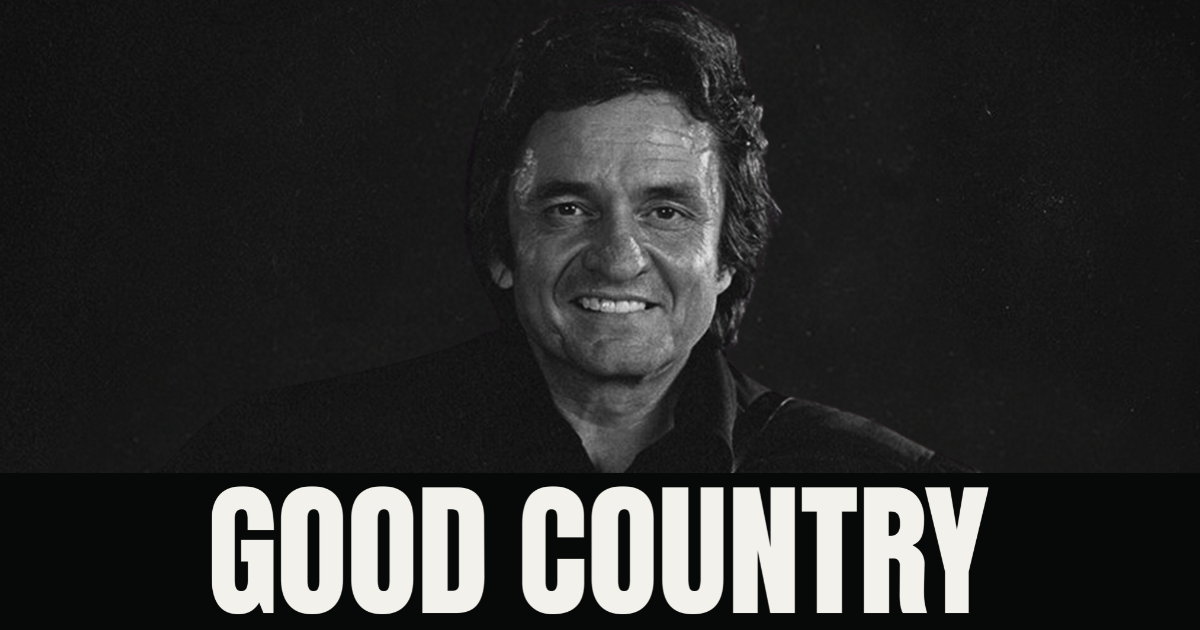
Johnny Cash
Let’s be real: This list would not be complete without Johnny Cash. Arguably the most famous country music star to ever live, Johnny Cash is known near and far for his deep, rich voice that straddled the border between baritone and bass. Cash had a storyteller’s voice, and he used it proudly to tell the stories others weren’t telling. As time went on, Cash’s voice settled into its lower register, which can be heard on his final non-posthumous album American IV: The Man Comes Around. But there’s no better way to showcase the rumbling voice of Johnny Cash than through his infamous recording of “Folsom Prison Blues,” recorded live at Folsom State Prison in 1968.
Jim Reeves
One of the forefathers of country music, Jim Reeves wielded one of the most beautiful baritone voices in the genre. A true crooner and country & western artist, Jim Reeves’s voice is smooth, deep, and unforgettable. Arguably the most technically accomplished singer on this list, Reeves topped the country charts throughout the ’50s, ’60s, ’70s, and ’80s. A dynamic and masterful baritone with a gentle stage presence, Reeves played a huge role in shaping the sound of Nashville and his influence is still felt today.
Colter Wall
Canadian singer-songwriter Colter Wall released his first single, “The Devil Wears a Suit and Tie,” in 2015 when he was just 20 years old. Showcasing Wall’s impossibly deep and weathered voice, the single swiftly launched the young artist into the limelight, mostly via a live performance video on YouTube. Treading the country and Americana borderlands, Wall has one of those voices that makes you think, “How is that sound coming out of that person?”
Since his debut, Wall has released five full-length albums, including his 2023 release, Little Songs. Throughout his catalogue, Wall never misses a beat or fails to remind us that he has one of the deepest and richest bass voices in country.
Josh Turner
For Josh Turner, bass singing is old hat. He grew up singing bass parts in church choirs and gospel quartets, then debuting at the Grand Ole Opry when he was just 24. Now in his 40s, Turner has spent over half his life making waves in the industry as one of the only true bass singers in the genre — and a top-notch one at that. In May 2024, Turner released a brand-new single, “Heatin’ Things Up,” proving he still deserves the title of the man with the most satisfying deep voice in country.
Photo Credit: Johnny Cash courtesy of JohnnyCash.com.
Few words stir up conflict in country music circles the way “authenticity” does. While debates over authenticity rage within every corner of the arts, the tension is especially potent in country, whose unofficial tagline is, after all, a commitment to honest simplicity: “Three chords and the truth.” While “truth” can be a broad umbrella to work under, within country music it tends to encompass a longstanding commitment to sharing the stories and experiences of everyday people, in particular those of the rural working class.
Accordingly, an adherence to and celebration of the very concept of authenticity – nebulous as it may be – is as baked into country music culture as an anti-establishment sentiment is inherent to punk music. Listen to country radio, though, and you might have a hard time finding it, particularly as the bro country of the mid-teens, though finally waning in popularity, still dominates the majority of terrestrial country airwaves.
It’s 2024, though, and it’s way past time to declare that country radio is irrelevant. Glance at Billboard’s Hot Country Songs chart, which includes sales and streaming data alongside airplay, and you’ll see the top spot isn’t occupied by one of the usual radio favorites like Luke Bryan, Morgan Wallen, or even Luke Combs, the latter of whom has notably found a way to straddle the line between commercial success and critical acclaim.
Rather, at the time of this writing the number one country song in America is “I Remember Everything,” a duet between the relatively new artist Zach Bryan and one of the genre’s more adventurous stars, Kacey Musgraves. As a song, “I Remember Everything” isn’t necessarily groundbreaking. Bryan’s and Musgraves’ voices play nicely off one another, with his achy grit contrasting sweetly with her smooth twang. The production is simple, underdone even, and lyrically the track travels well-trod territory: romantic heartbreak.
So, what, then, has kept “I Remember Everything” firmly situated in that top spot for 14 straight weeks (and counting)?
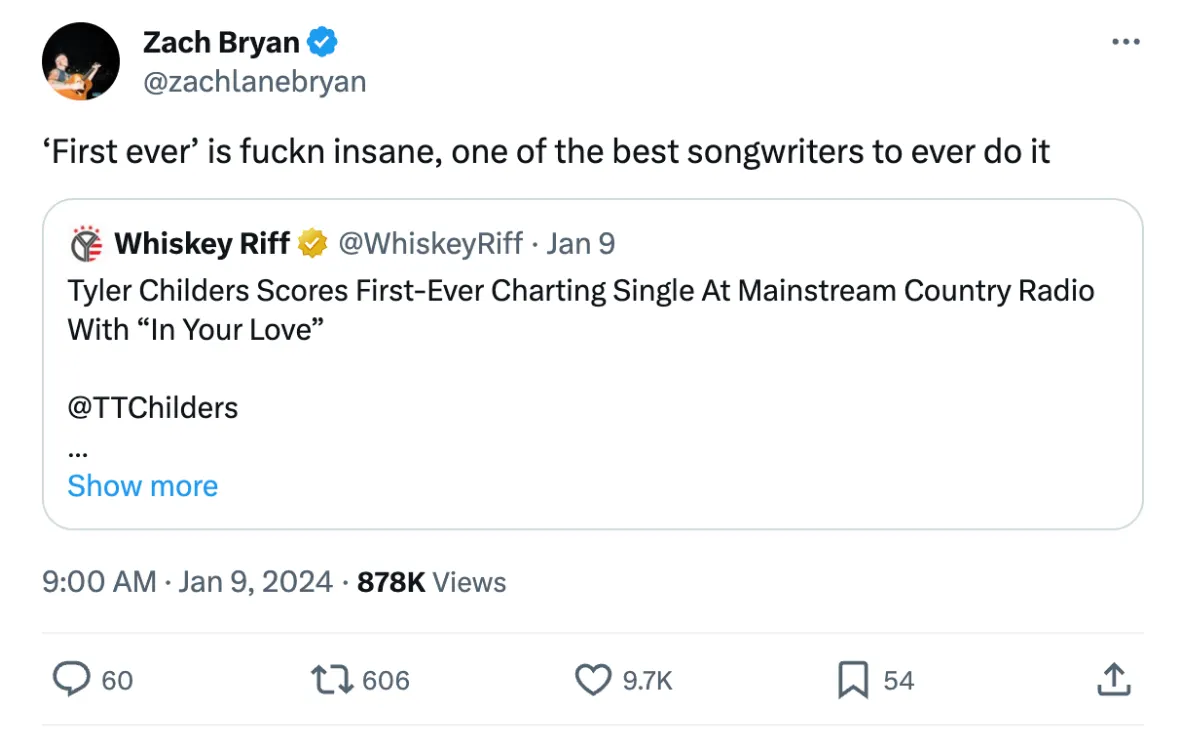
If you’ve paid even the least bit of attention to country music in the last couple of years, you’ve no doubt encountered Zach Bryan and his genuinely singular approach to the genre. With his raw sound, confessional lyrics, and decidedly DIY approach to business, Bryan radiates the kind of authenticity that fans crave. He joins a host of other recently established and emerging artists – including but not limited to Tyler Childers, Lainey Wilson, Colter Wall, and Billy Strings – who found success by foregoing the traditional route to country stardom, one that typically involves following an out-of-date formula honed over time by profit-driven record labels.
Zach Bryan debuted with DeAnn in 2019, finding an audience online thanks to the viral success of “Heading South” on DeAnn’s follow-up Elisabeth. He quickly built a fanbase on TikTok and YouTube before releasing his 2022 breakout LP, American Heartbreak, which had more opening week streams than any other country album that year. In the lead-up to American Heartbreak, Bryan, who served as an active-duty member of the U.S. Navy for eight years, was honorably discharged in 2021 so he could pursue music in earnest.
In addition to topping charts, American Heartbreak set itself apart from the rest of the year’s crop with its unadorned production, heavily narrative songwriting, and sheer ambition – the record clocks in at a lofty 34 tracks, with less filler than one would anticipate. The album’s biggest single, “Something in the Orange,” earned Bryan a Grammy nomination for Best Country Solo Performance and, for a time, landed him atop Billboard’s Top Songwriters chart.
That record, along with a handful of EPs and loosies released in between, teed Bryan up for his 2023 self-titled LP, a much more focused effort (a mere 16 tracks!) that found Bryan firmly situated as a real-deal country star, one who can tap the likes of Musgraves, the War and Treaty, Sierra Ferrell, and the Lumineers to come join the proceedings. While it no doubt shows the depth of his rolodex, that guest roster also points at the breadth of Bryan’s influence, as each artist comes from a different part of the broader country/Americana ecosystem.
And while he considers himself a country artist, Bryan’s roots are more indebted to the folk-rock revival of the late-aughts and early teens, when acoustic acts like Mumford & Sons and the Lumineers grew so big as to cross over into Top 40, eventually helping spur an explosion in popularity for Americana and roots-adjacent music. It’s fitting, then, that the Lumineers feature on Zach Bryan, joining on the track “Spotless” so seamlessly it isn’t always easy to tell who is singing: Bryan or Lumineers frontman Jeremiah Fraites.
It’s on these collaborations, in particular, that you can hear Bryan’s joy at being able to do what he loves. His vocals are raw, but never phoned in; in fact, sometimes he seems to be straining so hard to communicate a particular emotion that you worry his voice will give out. It never does.
In other words, Bryan is a fan’s musician, one who geeks out about his favorite artists the way his own fans do about him. In a post about the duo the War and Treaty, who joined Bryan on the standout Zach Bryan cut “Hey Driver,” he writes, “I can tell you the first time I heard War and Treaty live and I looked to the person next to me and said, ‘Are you hearing this?’ I talked to them later that night and they were the kindest couple I’d ever met.” In the same post, he says of the Lumineers, “I can tell you about how when my Mom went on home I got the Lumineers tattoo on my tricep after hearing ‘Long Way From Home’ for the first time and how Wes [Schultz] and Jeremiah are some of the most welcoming humans I’ve ever met.”
This post points to a major piece of both Bryan’s appeal and the air of authenticity that surrounds him: His direct line of communication with his fans. He manages his social media accounts himself and is no stranger to getting vulnerable in his messaging, often posting progress updates on new songs he’s working on or taking a moment to express gratitude for his success. For fans, it’s almost like there are no barriers between them and Bryan, which reinforces the relatability at the core of his music.
The beating heart of Zach Bryan, for me, is “East Side of Sorrow,” a song that grapples with hope and religious faith by connecting the grief Bryan felt after losing his mother to his time being shipped overseas while serving in the Navy. Despite – or perhaps because of – these vivid references to specific experiences, like being “shipped… off in a motorcade” and losing his mother “in a waiting room after sleeping there for a week or two,” the song is deeply emotional and relatable, a wrenching but empowering anthem encouraging the hopeless to try to keep it moving. These days, you’d be hard-pressed to find someone who couldn’t use such a message, this writer included – Apple Music tells me it was my most-played song of 2023.
It would be – and for a lot of folks, already is – easy to accept Bryan’s every word, to believe that his hardscrabble songs about “rot-gut whiskey” and manual labor are honest reflections of the life he’s lived and the person he is. Then there’s the cynical interpretation, that Bryan’s anti-marketing is, actually, still marketing, that a young musician could only know so much of the realities of the struggle of the working class, that it’s the same twang to a different tune. Bryan has, after all, had a few bumps along his road to fame, including some less than flattering encounters with police that negate his humble personal.
But the truth, as it so often is, is likely somewhere in the middle. With such personal material, it’s easy to trace one of Bryan’s songs to its point of inspiration – “East Side of Sorrow,” for example, is undoubtedly ripped right out of his lived experience. And Bryan isn’t afraid to admit the gaps in his experience, like when on “Tradesman” he sings, “The only callous I’ve grown is in my mind.” Compare that to, say, the sheer tone deafness of a song like Blake Shelton’s “Minimum Wage” and Bryan’s instances of stretching the truth feel trivial.
Bryan is only the latest in a long line of country artists for whom authenticity is both a blessing and a curse. Genre giants like Johnny Cash and Waylon Jennings are often held up as unimpeachably authentic pillars of the genre, despite weathering their own brushes with the authenticity police earlier in their careers. And these debates, which tend to center white, straight, cisgender men, aren’t nearly as hostile in their scrutiny as they are for marginalized artists, against whom the idea of authenticity is typically wielded as a gatekeeping weapon.
Wherever you fall on Zach Bryan, it’s hard to deny that the gravel-voiced, baby-faced boy from Oklahoma has changed the very fabric of contemporary country music. What he does with that power moving forward could break the genre open for good, making space for artists with unusual paths, atypical backgrounds and a disregard for the flavor of the week. If Zach Bryan is who he says he is, he may very well do it.
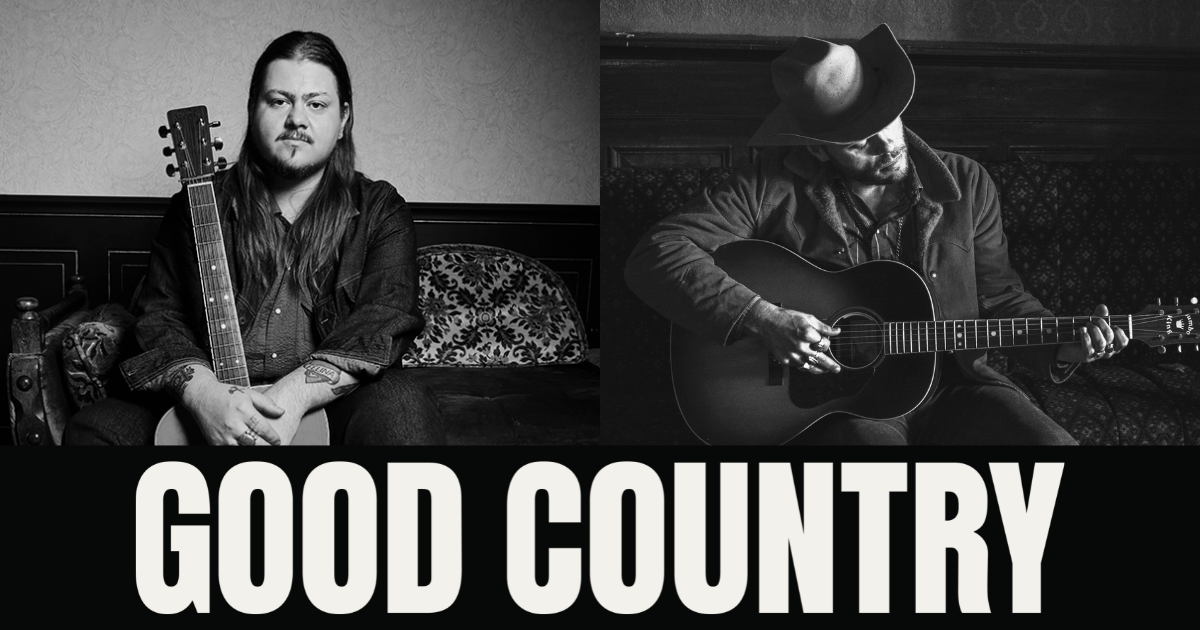
In advance of the release of Vincent Neil Emerson’s latest, critically-acclaimed album, The Golden Crystal Kingdom – which dropped on November 10 – BGS moderated a conversation between VNE and his friend and peer, country & western singer-songwriter and song-interpreter Charley Crockett.
Both artists cut their teeth in music venues in Texas a decade ago. In our conversation, they tell the story of how they came to know each other and discuss ways they protect each other within the business. They talk about covering and cutting each other’s songs and the importance of telling their truths.
Emerson’s new album, produced by Shooter Jennings, veers his sound toward warm ’60s rock and folk influences. He opens up to Charley and BGS about its creation process and what is on the horizon for him.
Charley Crockett: What’s up, Vincent?
Vincent Neil Emerson: What’s up, my boy?
CC: Another day, another dollar.
BGS: Tell me where you both are in the world right now.
VNE: I’m in Asheville, North Carolina, right now, at an Airbnb.
CC: I’m up here in San Luis Valley in Southern Colorado.
Both really nice places to be in the fall.
VNE: You ain’t wrong.
Can you give us a little bit of context about your relationship, where you know each other from, and how long you have been working together?
VNE: Charley, you wanna go?
CC: Oh man, I always tell that story; I wanna hear it from you.
VNE: I met Charley in Deep Ellum. We were playing around town, playing a lot of shows around there and Fort Worth. That was over 10 years ago, maybe?
CC: I was trying to think about it this morning. I think it had to be ’13 or ’14.
VNE: That’s crazy, man.
CC: He remembers it being at Adair Saloon; I remember it being at the Freeman. It really don’t matter, ’cause I’m sure it was both places.
VNE: I’m sure we went and had a drink at Adairs or something like that.
CC: I remember I walked up on him and said, “I like all them Justin Townes Earle songs.” And he said, “I only played one.” I always liked what he was doing, and he used to play solo and do the guitar pools up at Magnolia Motor Lounge all the time. He’d be up there smoking a cigarette, picking through them songs like Townes Van Zandt, and I thought, “Oh lord have mercy, this boy is a force to be reckoned with.”
VNE: Man, I felt the same way as soon as I heard you, brother. I remember a couple of nights I saw you at the Freeman with this band. You had a bunch of guys up on that tiny little stage, and you were just ripping through all these songs, taking all these old honky tonk songs and flipping them on their head and turning them into blues and vice versa. I always thought that was so cool, man.
CC: I don’t remember that well, but I guess you’re right. In those days, every gig we played for both me and Vincent, we ended up getting booked by the same folks, or they were all standing together in some bar, no matter if it was Ft. Worth or Nashville or Los Angeles. One way or another, all them same business folks been standing pretty close to me and Vincent. And that’s the truth.
Well, that’s convenient if you like to work together, I guess. Charley, do you have questions you want to dig in on?
CC: You know, Erin, I don’t even know what the hell we are doing?
Let’s talk about the release of Vincent’s new album.
CC: Well, let me just do this then. Everything he’s been putting out with Shooter [Jennings], like everything else he’s ever done…If you sit there looking at Vincent and he surprises you, it’s like, “Oh damn, I didn’t know old boy was gonna do that.” The very next thing he does, it just happens again — every single time. I remember when he was playing “7 Come 11” way before anybody gave a damn about him and was looking out for his interests or his career. He had all them songs in his pocket way before anybody had ideas or designs on him and his business. I’ve said for a long time that “7 Come 11” is one of the best folk songs written out of Texas in 20 years. Remember Central Track, Vincent?
VNE: Yeah, they did a lot of write-ups on music.
CC: I will never forget that stuff when you did that record and what you were doing live. Erin, he was playing for 50 bucks and a case of Lone Star in them dive bars in Fort Worth, you know? He was living in a 10×10 room. He was hardly ever even standing inside of the damn joint.
A handful of us showed up at the same time, and we are all moving on our own paths, but we’ve all stayed pretty close, or we damn sure weave it together quite a bit even if we get way out there, you know, in the territories, we always come back to each other. I think I met Leon Bridges right around the same time that I met Vincent. I met him in Deep Ellum, too. There is a guy who plays guitar with me now named Alexis Sanchez. He had a band back then, and he was playing at Club Dada there for some little festival, and Leon Bridges was standing there in a trench coat and a bowler hat. I venture to guess that me and Leon and Vincent met each other damn near about the same time. There were a lot of other folks like that. Ten years later, especially for some Texas guys, you know, we’ve all grown a lot, and I think we have always supported each other and loved each others’ music. That’s only grown, and Vincent is standing there as one of the premier, original, authentic talents to come out of Texas since the turn of the damn century. I’m not blowing smoke. I’m just stating what is already happening.
VNE: Man, that is high praise. I appreciate you sayin’ that, Charley.
CC: Well, they want all this shit to write about it, but that’s just the truth. He was playing in Fort Worth and like I said, playing for all that low money. They were calling him Lefty. Why did they call you Lefty? I figured it was because you had a black eye or something.
VNE: Yeah, I had my left eye knocked out of the socket one time, and the nickname stuck for a while.
CC: I remember they wrote about you pretty salaciously there in the Fort Worth Weekly. I know a thing or two about that myself.
VNE: I would say it was because they were trying to sell papers, but it was a free publication.
CC: Shit, they are selling advertisements. I think the Dallas Observer is still doing that to me.
He was playing them bars, we were playing them bars. I don’t know which one of us is which, but more often than not, he sure seems like if I’m Waylon, he’s Willie. I have felt like that for a long time. You could change the names. I think about this stuff a lot. The business folks, it is always hard to tell what they are doing, but you can be sure they are rolling dice and betting and gambling on folks. It ends up being, a guy like Vincent that somebody like me can lean on a lot more. We can trust those guys, and I’m real happy with who I’m working with, and I’m sure Vincent is, too. It is the other artists living life for the song that gets us through. I know I feel like that about Vincent, and I feel like that about a lot of other guys I don’t know as well as him.
Kind of like Johnny Cash said, “We are all family, even though some of us barely know each other.” I think it is because we can see each other and know we are in the same boat and in that way, care more for each other than other people would. I think it is pretty serious. It is life and death.
VNE: That’s a good feeling to not feel so alone in that way and have people out there and doing things similar to you. They probably think a lot of the same thoughts. Me and you are good buddies, Charley, and I feel that way, too. I feel like some guys out there like Tyler Childers – I really respect him, and I feel like he is in the same boat as us. I’m not as well known as you guys, but I think none of that really matters. I think what it comes down to is that we are all songwriters trying to make our own stories happen and be true to ourselves and honest to the world. I think that the reason we can relate to each other is the same reason the fans can relate. Honesty will cut through anything and bring people together.
CC: One way or another, them folks we are selling tickets to, they know.
VNE: You can’t fake the funk, I guess.
CC: Eventually, it comes through. Speaking of Tyler Childers, we ended up on the same plane flying from Nashville to Austin recently… I was there for the Country Music Hall of Fame induction and I didn’t want to go. I get real antisocial and want to hide out from everybody and shit, and I went to Nashville kicking and screaming. Tanya Tucker was getting inducted to the Hall of Fame with a couple of other people. Patty Loveless and Bob McDill, who I wasn’t that familiar with. I had thought that he’d written the Jimmy C. Newman song, “Louisiana Saturday Night”, which I know real well. To be honest with you, it is the only reason I agreed to go out there, ’cause I love singing that song. I made a lot of money writing songs off of that song, so I figured I owed whoever the songwriter was. Long story short, there in the last week, I found out it was a different “Louisiana Saturday Night,” regularly mistakenly attributed to Bob McDill cause he wrote a totally separate song called “Louisiana Saturday Night” that Mel McDaniel had a big hit with, and that’s the one that goes,
“Well, you get down the fiddle and you get down the bow Kick off your shoes and you throw ’em on the floor Dance in the kitchen ’til the mornin’ light Louisiana Saturday night”
That was a big ol hit, right Vincent? He did “Baby’s Got Her Blue Jeans On,” and a bunch of shit like that that I just didn’t realize. My naive, ignorant ass goes up there to Nashville kicking and screaming, and that’s how I feel. A horse gets led to water or something like that. I saw Tanya get inducted. I damn near built my career off of my version of “Jamestown Ferry” when I was younger, and I realized that she had blazed that trail for me, and I had not shown her enough respect. I really hadn’t. Same thing with Bob McDill. All those songs he wrote and the advice he gave in his speech, and my dumbass could really shut up and pay attention to these folks.
Then I ran into Tyler going from there. He was flying to Austin to do a John Prine tribute. That’s how it is. When I see Tyler, I’m on a plane. When I see Vincent, it is at Monterey Fairgrounds. We are ships passing in the night. All these guys like Tyler, Colter [Wall], Leon, Vincent. Whenever I see them, they got a big light around them, and it is shining. You just want it to keep shining for them, and for myself, to keep it going,
I don’t know exactly where you want to go with this, Erin, but I’m excited about this record. Shooter was telling me about your songs and offered to send them and I was like, “No, I ain’t gonna do that. I wanna be like everyone else.” I wanna watch this thing get rolled out, and I wanna be excited. I’m looking forward to going through the songs.
Vincent, can you tell us about working with Shooter on this record?
VNE: I met Shooter a few times. Me and Charley were at this festival in Iowa hanging out, and Shooter came up to me and tapped me on the shoulder. I’d met him before at another festival but I’d never talked to him. He turned me around and said, “Hey man, I really like that thing you did with Rodney Crowell.” He paid me a lot of compliments, and since then, we talked, and when it came time to make another record, Shooter was the first guy I thought of. I thought it would be such a cool idea to work with him on an album. One thing about him is he really is one of the nicest people I’ve ever met, and he is a genuine fan of music. He’s trying to make cool things happen. I’m so lucky I got to work with him on it. That is the big takeaway from the whole thing for me was making a real good friend like that and meeting someone who gets me excited about songwriting and about making an album and making music in general.
Since Charley cut “7 Come 11” and you cut one of Charley’s songs for this record, can you talk about what prompted “Time of the Cottonwood Trees” winding up in this pile of songs?
VNE: Oh man – that song. Me and you were on tour together for three months, was it last summer? We did a bunch of dates, and we were on the road a long time, and I was listening to Charley do that song every night. It was a brand new song that hadn’t come out on his record yet. I got to hear him sing that song every night by himself, and I just think it is one of the best songs I’ve ever heard. It is one of my favorites from you, Charley. I think it is a fine example of songwriting. When it came time to make this album, I always wanted to pay tribute to you and cut one of your songs on a record because you cut “7 Come 11.” That really ties back into that whole Willie and Waylon and all those old timers who cut each others’ songs and lifted each other up like that. I just wanted to pay tribute to you, and that’s why I put it on the album.
CC: Shit, I appreciate it. I’ll be excited to get the check in the mail. You surprised the hell out of me with that one, you really did. I’ve always wanted people to cut my songs. Sometimes, I think I’d be better off that way. I have so many. I’ve always cut a lot of songs that weren’t mine, probably about half of them. And I got about a 250-song catalog of published shit. I would guess about 40-50% are songs I didn’t write. I feel like I’ve caught a lot of heat for that. People have an idea about me that I never wrote a single song. I think that’s because we live in an era where, like what Vincent was talking about, where all those folks back in the day, across genres, and it wasn’t just country it was pop, folk, soul, R&B. It was everything. Everyone was cutting each other’s songs. I just really think that to write a great song, you have to learn great songs from other people.
You have to watch out for these publishers these days. They’ll just put any piece of junk out as long as they’ve got control over it. They figured out they can make money selling junk. If you can make more money than ever before selling junk and you aren’t principled, and you aren’t that close to the music, well, they don’t see the reason not to do it that way. I think it feels like a renaissance.
VNE: Specifically in the genre of country music, there is a lot of junk out there. I don’t want to put anyone down. Most of the time, I just try to ignore whatever I don’t like. I think that’s the best way to go about it. I think there is room at the table for everybody, whatever you are into. I just think it is so cool that Sturgill and Charley and Colter and Tyler, all these other guys that are out here putting out real, honest-to-goodness songwriter songs. And not just that, but real country music. It doesn’t matter if it is your song or someone else’s; if you are telling that story honestly, I think that’s great. I’ve always appreciated you for that, Charley. I think you are a great interpreter of songs, and I think you are an even better songwriter, man.
CC: Damn, I’m glad I talked to y’all this morning. I feel better.
I’m glad that we are talking about cutting songs because that is such a huge part of country music, interpreting other people’s songs or reinterpreting a song. It feels like that art was lost in the past 20 years or so and it is having a resurgence. I’m excited that you guys are at the forefront of that, because great songs have more than one life. And it is an opportunity for songwriters to make more money.
VNE: I think it is one of the greatest compliments that a songwriter could receive – to have an artist who they love and respect cut one of their songs.
CC: There is no question about that. That is the best feeling.
VNE: It is, cause you know that your songs has legs and can go places that you can’t, which is a great feeling.
CC: It really is. It is such a political world, and it is so divided. There is a lot of pressure on people that you step out there into the great mirror of society, and the more out there in front of the public that you get, there is a mirror that starts projecting on you, and it is tough to deal with. It is hard to know what to do, but the thing about it is – being able to write honest songs and tell the truth in your writing; that is the most rewarding feeling. That is why I always look forward to what Vincent is doing. There aren’t a whole lot of people that I anticipate their new works as much as him, if anybody really. That’s the whole deal. You look over, and he’s writing better and better, and it makes me want to write better, too.
Speaking of, Vincent, can you talk a bit about your writing process for this record?
VNE: I kind of pieced together songs over time. Sometimes they jump out real fast; sometimes it takes a while. And thanks for saying that Charley, brother. Damn.
CC: I’ve been saying it for 10 years.
VNE: That’s kept me going a lot of times and I don’t think you realize that. These songs – damn, what was I saying?
CC: You were saying sometimes they come quick, sometimes they come slow.
VNE: I’m very influenced by the music that I’m listening to and that is why I try to be real careful about what I listen to. I think it is like if I’m making a smoothie. I gotta put certain ingredients in my brain, and it comes out me on the other end, hopefully. I was listening to a lot of Neil Young and Steven Stills and David Crosby. A lot of the ’60s rock and roll and a lot of Bob Dylan stuff. That’s just where I was in my headspace, so I was taking in all that. I try to put it all together to make it my own. That’s where I was at when I was making this album.
By the way, I’m excited about this rodeo we are playing together, Charley.
CC: Oh shit yeah! At the Virgin Theater there? Yeah man, I’m excited about it, too. Thanks for doing it.
VNE: Thanks for having me on.
CC: When it comes to money and shit like that, just any time, whatever you gotta do to make it work cause I wanna keep playing with you as much as we can and build up. I’ve played in some arenas recently, and I really don’t like it. I don’t know if country music belongs in arenas. And I just mean opening. I can’t sell tickets to no damn arena. And I take a cue from Colter cause he and Tyler and them boys, they could be in arenas all day long if they wanted to be. I would rather play rodeos and municipal auditoriums and really special theaters and stack ‘em up. I think we need to get a goddamned Dripping Springs reunion tour going. A real one.
VNE: Man, that’d be great.
CC: You know what I mean, just do some of our own shit. My aunt and uncle and a bunch of people who haven’t been out to see me play in a long time are coming out to Vegas. I used to live with my uncle when I was a kid in Louisiana and Mississippi and shit. He’s gonna flip his shit when he sees you.
VNE: I can’t wait, man, I’ve heard so many stories about him.
CC: He’s wild. We gonna show these folks what country music actually sounds like. They might not be able to tell who is left or right. Nahhh I’m just kidding it is a bunch of cool people.
Thank y’all for letting me be a part of this. I’m just happy to help out or talk about this. I’m real excited about the album for real. The imagery in your writing, man, it’s like everything you write is getting more and more vivid. You paint such a picture. I’ll stop blowing smoke up your ass.
I’m gonna get back on the trail and Vincent, I’ll talk to you soon.
VNE: Thank you for doing this brother, I appreciate you.
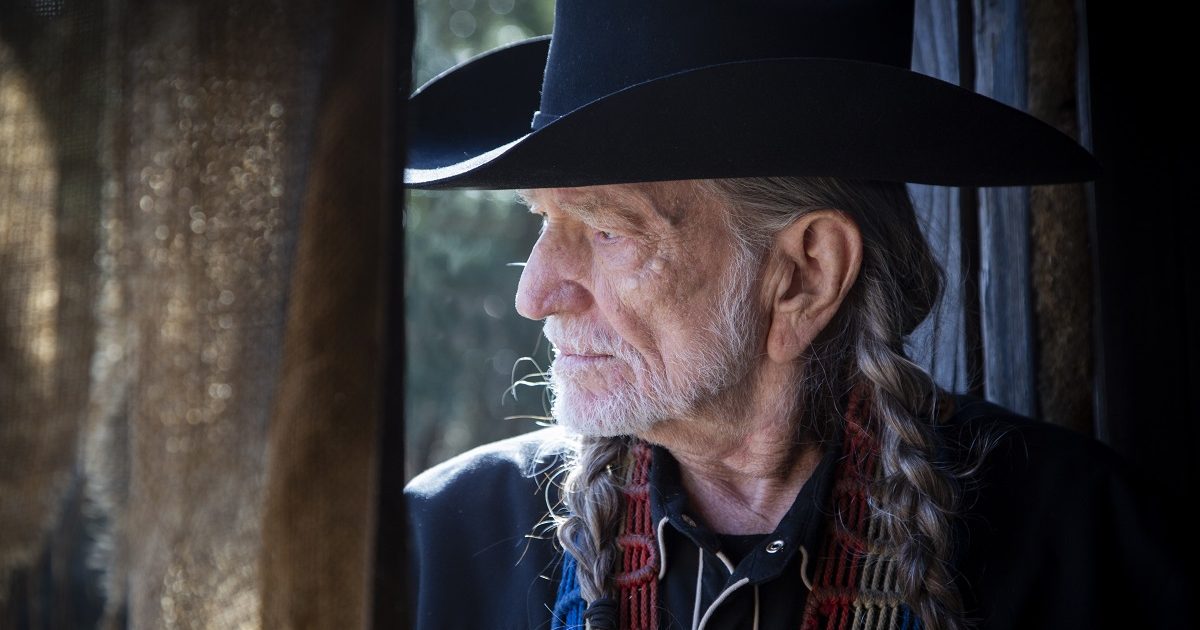
“He was exceedingly cool and easy,” long-time Bill Monroe bassist Mark Hembree remembers about Willie Nelson’s presence at a 1983 recording session where Nelson sang and played with Monroe. “I never had a say in Bill’s mixes, but they had Willie’s guitar way up and as we listened to playback he mentioned it, then turned and asked what I thought,” Hembree wrote in a recent exchange of messages. “I agreed, a little surprised he would ask me.”
People who hear about Willie Nelson’s latest album, Bluegrass, before hearing the music might ask, “Wait, what? What does Willie Nelson have to do with bluegrass music?”
Upon listening, at least two answers come to mind: 1) Much more than you might think. 2) Don’t worry so much.
With tunes by Nelson, one of the best American songwriters, played by notable pickers, the record contains strong music that should sound welcome to fans of Nelson, of bluegrass, and of the field with the loose label, “Americana.”
It’s a given that in more than 60 years of major-label recording, Nelson, 90, has been better known for presenting his own songs, enduring tunes such as “Crazy,” “Hello Walls,” and “On the Road Again,” the last of which is heard here in a new version. But he’s also made his name with notable covers – like “Blue Eyes Crying in the Rain,” “Seven Spanish Angels,” “Blue Skies,” and others – in a welter of styles, including blues, pop standards, and even reggae. Nelson’s core music enfolds ‘40s and ‘50s country, traditional fiddle tunes, four-square gospel, ragtime, some swing flavorings, and definitely a heap of blues. The mix also includes more contemporary pop. Subtract some of that last bit of material, throw in some lonesome mountain banjo and ballads, and you’ll find, in different proportions, foundational bluegrass as designed by chief architects like Bill Monroe and Earl Scruggs.
Legacy Records, the Sony division putting out Nelson’s Bluegrass disc, says the style “was given a name by Kentucky songwriter/performer/recording artist Bill Monroe and the Blue Grass Boys, whose post-war recordings profoundly influenced Willie’s songwriting sensibilities and the direction of American country music in general.” They go on to say, “Willie chose songs combining the kind of strong melodies, memorable storylines and tight ensemble-interplay found in traditional bluegrass interpretations of the roots (from European melodies to African rhythms) of American folk songs.”
And it’s pretty much on target. But what else speaks to Nelson’s involvement with bluegrass?
Let’s return to the early ‘70s, when he famously abandoned a Nashville scene where he had achieved songwriting fame and a recording career. But Music Row had flagged in creativity and opportunity, he and others thought. And yes, at the end of 1969, his house had burned down. By 1972, Nelson’s persona was changing as his new approach revisited his Texas roots. The year saw new-breed stars like Kris Kristofferson showing up at the first Dripping Springs Reunion, a Texas country music festival. The show, which was to morph int0 a string of outdoor throwdowns known as Willie’s Fourth of July Picnic, presented a bluegrass contingent led by Monroe, with foundational figures Earl Scruggs and Lester Flatt leading their post-breakup bands, as well as additional notables including Jimmy Martin.
Jo Walker, executive director of the Country Music Association, told the Austin-American Statesman that the trade group was delighted to hear about the Dripping Springs Reunion. “So many of the rock festivals and similar events have reflected so unfavorably on the music industry that we are particularly happy that your reunion will be a Country Music show.” But with Nelson embracing a new, youth-driven fan base and a long-haired, bandana-ed look, what did country music even mean?
There was a growing correlation, it seemed, between the increased popularity of bluegrass and the emergent outlaw (read: long hair, free-thinking, whiskey-drinking, dope smoking, etc.) movement in country music, led by Nelson and Waylon Jennings. Its bluegrass surge was sparked in part by the Earl Scruggs Revue’s broad acceptance in non-traditional venues like college campuses and hot sales for the Nitty Gritty Dirt Band’s Will the Circle Be Unbroken. Back in Nashville, in 1973, wider acceptance of bluegrass also meant that Monroe, his former Blue Grass Boy Flatt, the brilliant wildman Jimmy Martin, and the great brother team of Jim & Jesse McReynolds would join Nelson amid the crowd of stars at CMA’s second annual Fan Fair celebration.
In 1974, both Scruggs and Monroe, as well as Grand Ole Opry stars Ernest Tubb, Jeanne Pruitt, and Roy Acuff appeared on stage singing with another wildman, country-blues rocker Leon Russell. That’s documented in a photograph of this period, likely from a Willie’s Picnic. Quite a lineup.
A version of the picture found on the web says the shot is from A Poem is a Naked Person, a documentary on Russell by esteemed filmmaker Les Blank shot between 1972 and 1974, but not released until 2015. Nelson appears in the movie to sing “Good Hearted Woman” – also on this new album – playing guitar bass runs that would work fine in bluegrass. He also backs up fiddler Mary Egan, of the Austin “progressive-country” band Greezy Wheels, on an energetic version of the bluegrass-country perennial “Orange Blossom Special.”
In 1974, Nelson went to work in the soul-music capital of Muscle Shoal, Alabama, to record a milestone disc on his road to making records his own way. The album, Phases and Stages, which won over both fans and critics, contains prominent five-string played Scruggs-style on the hit “Bloody Mary Morning,” which also returns on Bluegrass.
The 1983 Bill Monroe session referenced above came after a last minute February 22 phone call from Nelson to let Monroe know he was available to appear on the in-progress Bill Monroe and Friends album for MCA Records. That’s according to a passage in the indispensable book, The Music of Bill Monroe, by bluegrass scholars Neil Rosenberg and Charles Wolfe.
“[Engineer, Vic) Gabany recalls that on February, 22, 1983, Monroe called the studio and asked if it was free that afternoon,” Rosenberg and Wolfe write. “Willie Nelson was in town, and he wanted to rush in and cut the duet with him. Fortunately, it was. Moreover, the Blue Grass Boys were all available, and Haynes was able to round up studio musicians Charlie Collins and Buddy Spicher.”
Monroe’s original tune with Nelson, “The Sunset Trail,” shows the impact of another style, cowboy music, that both men favored. Nelson reaches into his upper range to sing below Monroe, who’s going way up there, as was his wont. “It’s a thrill of my life to be here with you,” Monroe says as he and Nelson exchange praise in the track’s introduction.
In 1990, Monroe accepted Nelson’s invitation to perform at the April 7 Farm Aid IV concert in Indianapolis. “We’re glad to be here with Willie Nelson!” he said to kick off a set marked by powerful singing, crisp mandolin picking, and a little crowd-pleasing buck dancing. The show placed Monroe, 79, in a lineup that included stars such as Elton John and Lou Reid. The Indianapolis Star estimated the crowd at 45,000.
During Monroe’s last years — he died in 1996 — he often spoke to Nelson on the phone, according to a person who didn’t want to be identified, but often spent time at Monroe’s home on the farm outside Nashville during that period. “He valued their friendship immensely,” the person said.
Bluegrass‘s 12 songs contain several Nelson compositions that became standards of his repertoire, along with less familiar tunes that also fit in the recording approach overseen by Music Row’s Buddy Cannon. A songwriter and producer, Cannon is known for delivering big songs, like “Set ‘Em Up Joe” for Vern Gosdin, and chart hits for more recent mainstream acts such as Kenny Chesney, John Michael Montgomery, and Reba McEntire. A frequent Nelson collaborator, Cannon assembled a list of Nashville co-conspirators: Union Station members Barry Bales, on bass, and Ron Block, on banjo; former Union Station member and current rising star Dan Tyminski on mandolin; fiddler Aubrey Haynie; Dobro man Rob Ickes; Seth Taylor also on mandolin; as well as harmonica player Mickey Raphael, who’s worked for decades in Nelson’s band.
The music mostly doesn’t come off as hard-core bluegrass in the mode of, say, the Stanley Brothers. But it leans on the elements that Nelson has in common with the style — lonesome melodies, classic country, swing and blues.
The mournful “You Left Me a Long, Long Time Ago,” from 1964, reflects the straight-country songwriting to which Nelson and others brought a terse, modern beauty in the late ‘50s and early ‘60s. It was a time when bluegrass enjoyed a closer co-existence with mainstream country, as opposed to straining against the tight format borders that limit today’s music business. Among the many artists who crossed back and forth freely were guitarist-songwriter, Carl Butler, fiddler Tommy Jackson, and Cajun star Doug Kershaw. They all worked with Monroe.
A new version of “Sad Songs and Waltzes” mourns in tones not too different from Monroe favorites ranging from “Kentucky Waltz” to “Sitting Alone in the Moonlight.” The song also recalls the 3/4 time Lone Star tunes that Nelson might have heard at the Texas Fiddlers Contest and Reunion.
That show got going in 1934 in Athens, Texas, just one year before Nelson arrived on the scene in Abbott, less than 90 miles away.
The fiddle contests that influenced so much of Texas music beginning in the 19th century, had parallels in the 18th century Southeast, where contests featured both the fiddle and the banjo, with its African roots. This music went around, and it still comes around.
The sock-rhythm backing of “Ain’t No Love Around” recalls early Blue Grass Boys recordings such as “Heavy Traffic Ahead,” recorded September 16, 1946, and featuring Earl Scruggs’ first recorded banjo solo. Elsewhere, the laidback favorite, “On the Road Again,” gets a more intense reading from Nelson, with some vocal and instrumental improvisation to spice it up. The mystical “Still is Still Moving to Me” leaves plenty of room for pickers to range far and wide on banjo, mandolin, fiddle and Dobro.
“You give the appearance of one widely traveled,” Nelson sings in “Yesterday’s Wine.” He’s singing from a faraway spot in time, in myth, in history. It’s a stance that’s earned a place on bluegrass playlists for more recent songwriters such as Guy Clark, David Olney, and Gillian Welch.
“Bloody Mary Morning,” from Phases and Stages gets the most recent of several revivals from Nelson, who led a jam-grassy version in the 1980 film Honeysuckle Rose and later sang it in a duet with Wynonna Judd. The song’s forthright tale of fighting the blues by having a highball on a plane seems somehow classier than the constant tales of beer and pickups that populate country radio.
In the end it seems clear that for decades, both Willie Nelson and bluegrass music have served, in different ways, as a conscience of country music. Just as the Solemn Old Judge, WSM radio announcer George D. Hay, commanded, they “Keep her close to the ground, boys,” although their paths have diverged, at times.
In any case, this new collection brings Nelson together with bluegrass pickers for music that might even work to serve that same worthy purpose.
Artist:The Waymores Hometown: Atlanta, Georgia Song: “Under Your Spell Again” Album:Greener Pastures Release Date: August 25, 2023 (album); July 21, 2023 (single) Label: Chicken Ranch Records
In Their Words: “‘Under Your Spell Again’ was originally recorded by Buck Owens in 1959. It’s been covered lots of times since, but not by anyone in a very long time. This was the first song that we recorded in these sessions. Shel Talmy sent a long list of old standards for consideration and when we saw this one listed, we knew we had to choose it. We did our best to try and combine the original Buck version with the Waylon Jennings and Jessi Colter version because we’re The Waymores and if Waylon did it, we kinda have to. Lyrically, it’s near impossible to NOT relate to – and the hook in this song is really hard to let go of. Ask my Mom, who’s had it in her head since we recorded it in July of 2022.” – Kira Annalise
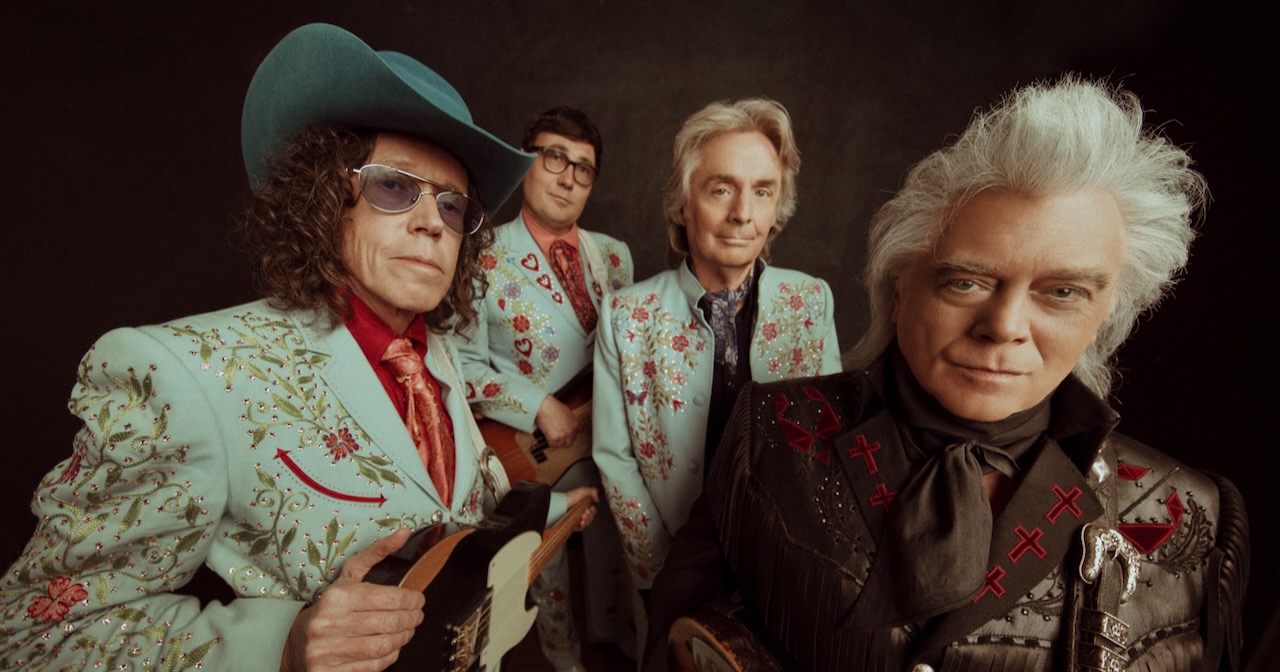
Told that a song on his new album brings to mind The Doors, Marty Stuart is bemused, but open to the idea.
“Did it?” he responds during an interview. “That’s fine. If so, why not?”
“Nightriding,” from new album Altitude by Stuart and His Fabulous Superlatives, kicks off with droning guitars, then evolves to a riff somewhat like that of Jim Morrison’s “Roadhouse Blues”
“Cadillac, sundown,” Stuart intones. “Think I’ll investigate this town.”
To be clear, most of the cuts on the Altitude are more evocative of The Byrds than The Doors. So, is Marty Stuart really a country music traditionalist, as many people perceive him? Yes. And also no.
“I’m totally fine with it,” Stuart says when asked if the country music purist reputation is OK with him. “It’s a self-appointed mission. But my comment would be that country music has broad shoulders.”
Dante Bonutto, who heads up Snakefarm Records, which is releasing Altitude, says that Stuart has earned the right to experiment.
“Since he’s definitely someone who pretty much invented the wheel, he’s allowed to put different spokes on it when he wants to, I think,” Bonutto said.
Stuart, who’s been a bluegrass prodigy, a mainstream country music star, and remains a prodigious collector of country music artifacts, was born in 1958, making him a child of the 1960s, with all that comes with it.
“I still think of when The Byrds and Bob Dylan and all those guys came to Nashville to make their records in the late ‘60s,” he says. “That is like contemporary stuff to me. …That was the stuff that touched me when I was growing up, so it was just a part of country music to me.”
At a recent benefit concert for Northwest Mississippi Community College, Stuart’s base was definitely country — he and the group appropriated the whole history of the genre as their back catalogue, doing songs by Merle Haggard (“Brain Cloudy Blues”), Marty Robbins (“El Paso”), Waylon Jennings (“Just to Satisfy You”) and Stuart’s own hits from the early 1990s such as “The Whiskey Ain’t Workin.’”
The casually virtuosic Fabulous Superlatives band (Kenny Vaughan on guitar, Chris Scruggs on bass and Harry Stinson on drums; all of them sing) wore matching glitter-flecked black suits, and Stuart’s performing style still owes a debt to his former boss and mentor Johnny Cash.
But that wasn’t all. During the hour-long set before a well-heeled audience dressed in tuxedoes and evening gowns, there was also a Woody Guthrie indictment of the rich, a mandatory gospel number, and a big helping of surf rock, obviously a favorite of Vaughan in particular.
“We hereby declare Senatobia, Mississippi, as the surf capital of the world,” Stuart announced before Vaughan launched into a Telecaster version of “House of the Rising Sun.” Also, “Wipeout” was played by Scruggs solo on the upright bass, with Stinson slapping out the drum solo on the cheeks of his face.
“Well, it doesn’t really matter how people categorize us,” Stinson said. “If anybody’s interested in what you’re doing, then they listen a little bit deeper and find a much wider spectrum, in terms of the music. I think Marty is much more than just a traditional country artist. He came from that world and uses that as a place to plant himself, and then branches out in different directions.”
Possibly because the Altitude album hadn’t been released yet during the March 25 concert in Mississippi, that audience didn’t get a taste of its cosmic, sometimes psychedelic country music.
The album’s beginnings go back to 2018, when Stuart, Vaughan, Stinson, and Scruggs toured with Roger McGuinn and Chris Hillman to celebrate the 50th anniversary of the pioneering country rock album Sweetheart of the Rodeo by The Byrds. McGuinn and Hillman were original members, along with the late Gene Clark, David Crosby, and Michael Clarke.
“That was Roger McGuinn’s idea,” Hillman recalled. “Roger had done some dates with Marty; he knew him really well. …He knew the Superlatives would be right on the money because he had done a couple of Byrds songs with them onstage.”
Hillman rates the Superlatives as “the best band probably in this country right now, if not the Western Hemisphere.”
“We had so much fun doing the Sweetheart of the Rodeo Tour,” said Hillman, who was also a member of the Flying Burrito Brothers and Desert Rose Band. “The arrangements were the same as we did on the album in 1968,” he said. “We played the songs better, but we didn’t change anything. It was a joy to go back out and do those songs, especially with the Superlatives.”
Stinson says the tour with The Byrds was “a joyous experience.”
“I got to play with some of my heroes,” he said. “I grew up on those records and so to get to play that music, especially the Sweetheart record, which was kind of groundbreaking. I got to go back through it and really dissect it, and then put it on stage. It was surreal for me.”
The Sweetheart of the Rodeo Tour, coming around the same time Stuart and the Superlatives were opening for Chris Stapleton and the Steve Miller Band, had a profound effect on Stuart’s songwriting.
“It got me in the mood to write songs with all the sounds that were left hanging around in my head,” Stuart said. “We were hot on those ideas, and I just carried the inspiration in with me.”
Like a lot of albums released in the past year, Altitude was recorded while COVID-19 was at its height.
“We rehearsed,” Stuart said. “Most of the producing of this record was done in dressing rooms and at soundcheck and trying songs out there in shows before we ever went to the studio.” The original plan to record was ruined by the coronavirus.
“We were hot, we were ready to go to Capitol Studios in Hollywood (California), and make a record,” Stuart said. “Well the pandemic crashed and Capitol Studios shut down, so we found East Iris Studios (in Nashville). We put on our masks and stood 6 feet apart and soldiered on.”
“I’m glad everybody agreed to do that, because I think this record would not have sounded like it does if we would have had to wait several months and relearn it.”
The album’s Byrd-like sound, complete with the jangling guitars that are McGuinn’s trademark, has Hillman’s endorsement.
“What they’ve done is not a tribute to The Byrds,” Hillman said. “It just has a few little nice, ever-so-tasty hints of what we did.”
Hillman thinks the driving “Country Star,” which also owes a debt to Chuck Berry, has the feel of Byrd’s songs such as “So You Want to be a Rock ‘n’ Roll Star.”
“There’s a lot of influence there — not overtly, but it just is there. Marty doesn’t stray far from the well, meaning the bluegrass well. I never did either.”
Stuart’s ability on mandolin shouldn’t be overlooked, Hillman said. “Marty is an unbelievably gifted musician,” he said. “I love Ricky Skaggs’ playing and Ronnie McCoury,” he added. “But I told Marty when we were on the road, ‘You got that machine gun hand.’ He says, ‘Yeah, that’s Everett Lilly.’”
Lilly (1924-2012), played mandolin and sang tenor with the Lilly Brothers and Don Stover. He also spent a couple years with Flatt and Scruggs.
“(Lilly) had that cool right hand and when he took a break on ‘Earl’s Breakdown,’ when he played with Flatt and Scruggs, it was great,” Hillman said. Factor in Vaughan on guitar in the Superlatives, and “you can’t get any better,” Hillman says. “But it’s two different approaches to music.
“Marty really grasped ahold of the pulled string stylings of Clarence White (who played with The Byrds and Kentucky Colonels before his 1973 death)”, and then Kenny “is so good, all over the place.”
“He doesn’t overblow; he plays just what is needed,” Hillman said of Vaughan.
While Stuart released his last album, Way Out West, on his own Superlatone Records, he’s partnered with Snakefarm, a subsidiary of Universal Music Group, for Altitude.
Bonutto, a journalist and record company executive, heads up the roots-rock focused Snakefarm and its sister label Spinefarm Records, which specializes in heavy metal. In addition to Stuart, Snakefarm has acclaimed Southern rocker Marcus King on its roster.
“(Stuart is) obviously an artist I’ve always been aware of, because I love country music and I’m aware of its legacy,” Bonutto said. “The first time I saw him was when he played the Country to Country (music festival) in London, which is a big annual country music event. I thought his personality was fantastic and his playing is obviously unbelievably good.”
Bonutto wrangled a quick meeting with Stuart at the festival, but had to wait a while before Stuart and his management were ready to sign a new record contract.
“I’m trying to build the Snakefarm label into a global entity [in Americana music],” he said. “The best way you can build anything is to attach yourself to people who are legendary and iconic. Hopefully you do an amazing job for them and they speak well of you and they become part of the fabric of what you do.”
Bonutto noted that Stuart, who is also a photographer and working on a facility to display his country music artifacts, is not “a one-dimensional character.”
“He’s a man with a fantastic vision,” Bonutto said. “I think that comes across in the other things.”
Stuart is a leading collector of country music memorabilia, and he’s working on a $30 million museum to display it in his hometown of Philadelphia, Mississippi. A 500-seat theater is already open, and 50,000-square-feet of exhibit space for 20,000 artifacts will be the second phase. An education center is planned after that.
“I was a fan, going back to those country or gospel groups or bluegrass groups who come through my hometown when I was a kid,” Stuart said. “I’d always buy a record and ask for an autograph or ask one of the pickers if I could grab a pick.”
In the 1980s, he observed that “old timers, the pioneers, the people who had raised me, were being disregarded.”
“Their treasures, their personal effects, their guitars and costumes, were winding up in junk stores around Nashville,” he said. “I found Patsy Cline’s makeup kit for 75 bucks in a junk store on Eighth Avenue in Nashville. I couldn’t believe it.”
Stuart met Isaac Tigrett of Hard Rock Café in London, and he showed Stuart how that restaurant chain was investing in and exhibiting rock music memorabilia.
“Even though it was a hamburger joint, I understood the importance of them collecting and curating stuff from The Beatles and the Stones and The Who. … Beyond the Country Music Hall of Fame, I didn’t see anybody doing it, so it just became a self-appointed mission to start rescuing a lot of those things that were winding up in junk stores.”
Stuart’s collection includes treasures such as the handwritten lyrics of “I Saw the Light” and “Cold, Cold Heart” by Hank Williams Sr., the boots Patsy Cline was wearing during her 1963 fatal plane crash and Cash’s first all-black performance outfit.
Speaking of country music history, Stuart began his career in bluegrass backing up Lester Flatt before joining Cash’s band. He’d like to return to those roots and record a bluegrass album.
“I need to, I need to,” he said. “But it needs to be authentic. It needs to be the real deal, blood-curdling bluegrass.”
6:35pm – Billy Strings kicks off Night Two at the Hollywood Bowl with “Whiskey River.” It’s the same song as the first night but it’s a welcome repeat number (and face).
Billy Strings by Randall Michelson
6:39pm – Ethan Hawke opens the show, saying “Willie has always stood for equality,” so it’s no surprise to see the next guest…
6:40pm – It’s Orville Peck in a sleeveless vest (Aren’t his arms cold?! It’s freezing tonight) and his classic fringed mask. Performs “Cowboys Are Frequently, Secretly Fond of Each Other.” Makes use of the full Hollywood Bowl stage – he is owning this moment.
6:45pm – Charley Crockett. “Yesterday’s Wine.” Lady in box next to me states loudly, “Now this is real country.”
6:49pm – Allison Russell and Norah Jones do “Seven Spanish Angels.” These two voices are so perfectly in sync… please call me as soon as they do a duet record together.
6:56pm – Chelsea Handler introduces Dwight Yoakam for “Me and Paul.”
7:05pm – Waylon Payne and Margo Price take the stage together for “Georgia On A Fast Train.” These two are having the absolute best time together. Their chemistry is off the charts. From the box next to me, I hear a fan whisper under their breath, “MARGO IS MOTHER.” Couldn’t agree more.
Margo Price by Randall Michelson
7:14pm – Particle Kid (aka Willie’s younger son, Micah) along with Daniel Lanois. “I went to the garage and got high as shit and wrote a Willie Nelson song.” The lyrics come from a phrase his dad said one day: “If I die when I’m high I’ll be halfway to heaven, or I might have a long way to fall.”
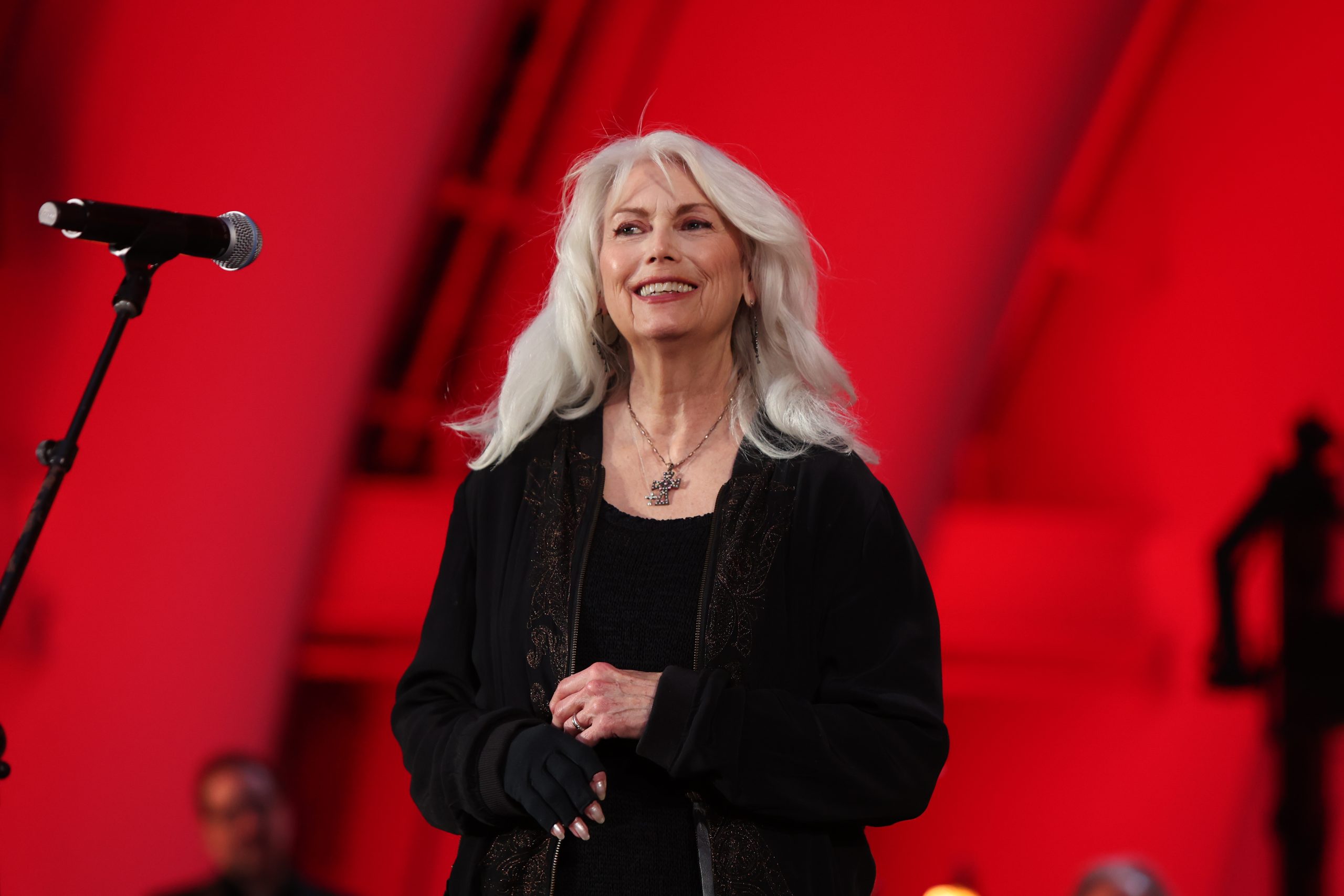
7:19pm – Dame Helen Mirren (!) introduces Rodney Crowell. Emmylou joins mid-song for “‘Till I Gain Control Again.” Crowd goes bananas.
Emmylou Harris by Randall Michelson
7:33pm – Rosanne Cash does “Pancho and Lefty.” Totally different interpretation compared to Night One (where it was performed by Willie and George Strait), but a universally beautiful song nonetheless.
7:46pm – Lyle Lovett melting hearts and brains on “My Heroes Have Always Been Cowboys”
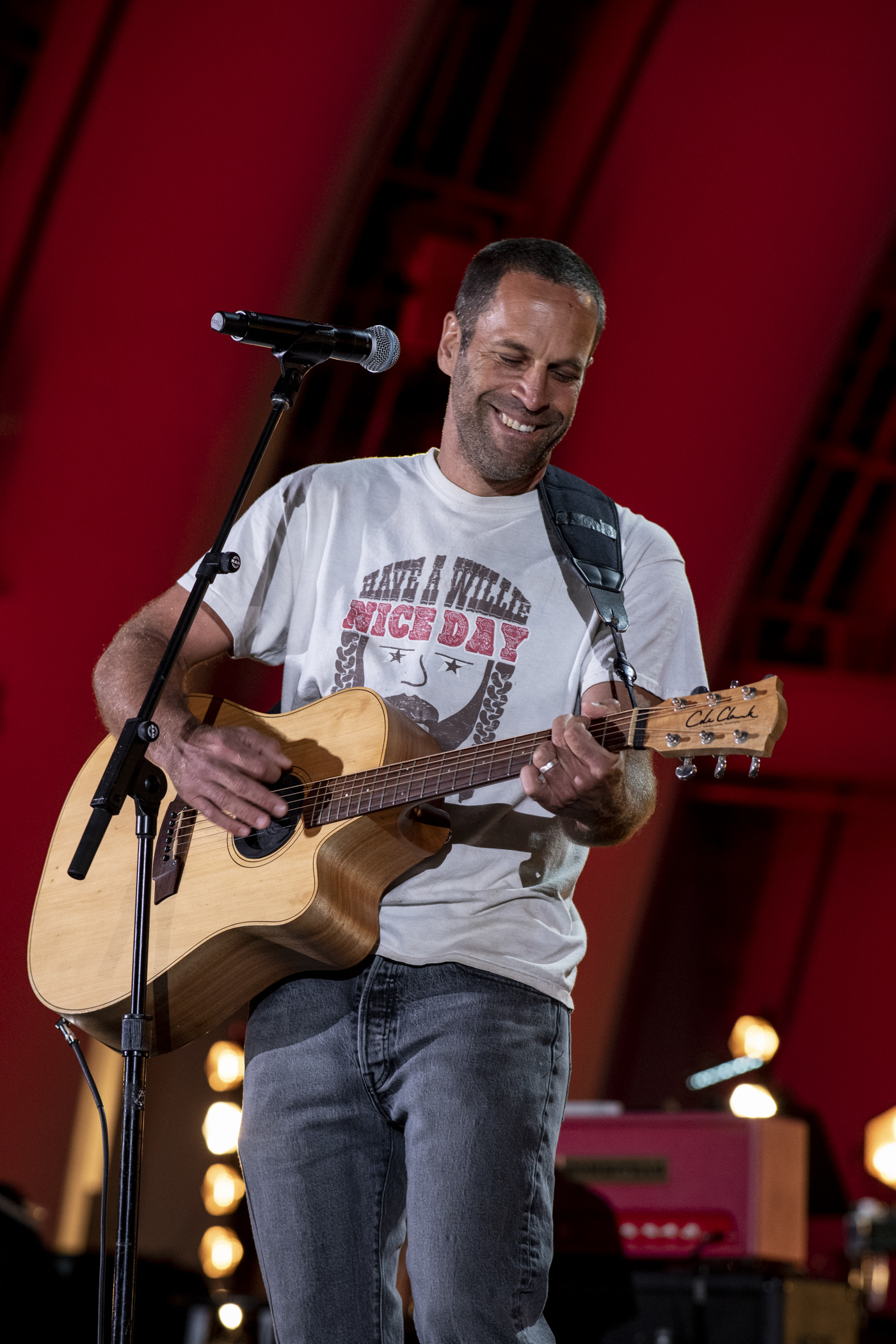
7:53pm – The “Aloha State Statesman” Jack Johnson performs one of the only non-Willie catalogue songs of the night, “Willie Got Me Stoned and Took All My Money.” He wrote it after Willie got him stoned and took all his money (in a poker game).
Jack Johnson by Jay Blakesberg, Blackbird Productions
7:57pm – Beck (in sunglasses). First artist to acknowledge the unreal house band. “Can you imagine waking up in the morning and opening your eyes and realizing ‘I’m Willie Nelson’? It’s already a great day.” Performs “Blue Eyes Crying In The Rain.”
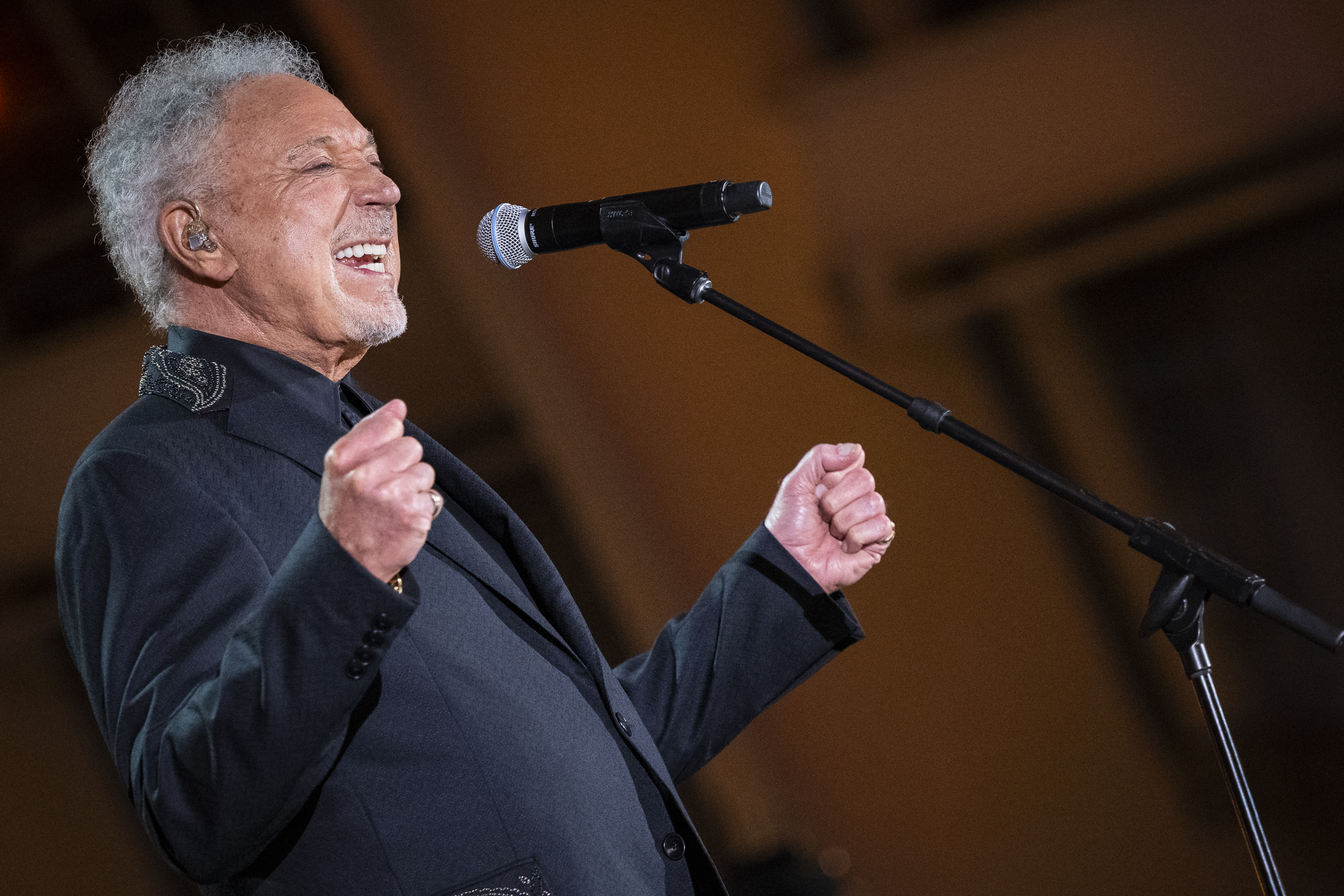
8:03pm – TOM JONES! One of the most unexpected joys of the night. His love for Willie shines through in his performance of “Across the Borderline.”
Tom Jones by Josh Timmermans
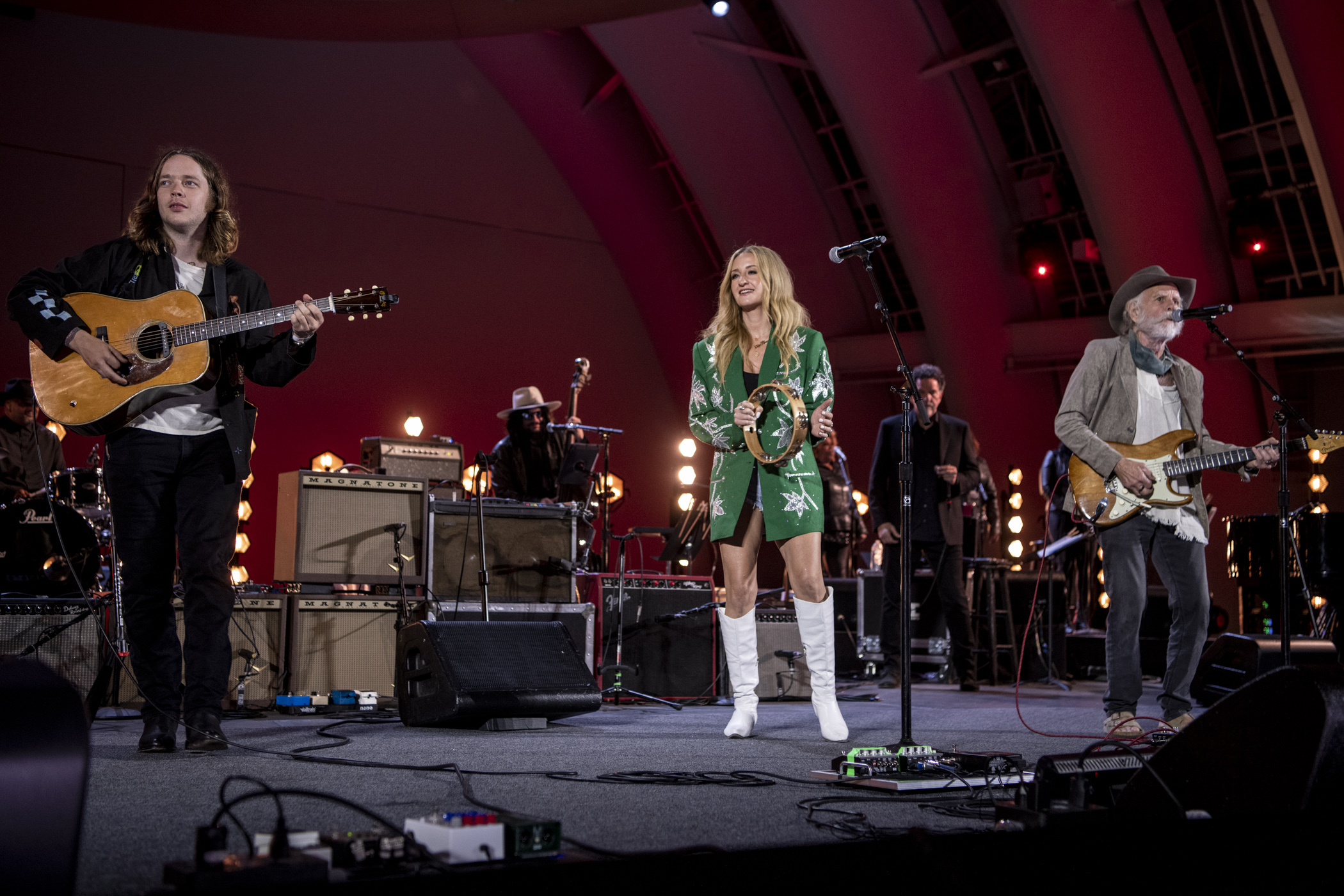
8:12pm – Surprise guest host Woody Harrelson takes the stage. “Not to self-promote, but just so you guys know, I did open a dispensary… seems like the right audience.” He introduces the legendary Bob Weir. Billy Strings and Margo Price join Bob on stage for a fun and enthusiastic “Stay All Night (Stay a Little Longer).” Margo is having the most fun tonight.
Billy Strings, Margo Price, Bob Weir by Jay Blakesberg, Blackbird Productions
8:18pm – Shooter Jennings and Lukas Nelson together! The next generation doing their fathers proud with own rendition of “Good Hearted Woman.”
Shooter Jennings, Lukas Nelson by Randall Michelson
8:22pm – Lukas performs a heart-wrenching version of “Angel Flying Too Close to the Ground.” Sounds so much like his dad yet simultaneously unique to himself. He has all 18,000 attendees in the palm of his hand.
8:29pm – The Avett Brothers. Wow. They sound so good, and fresh off the MerleFest stage just 48 hours prior. It’s been a few years since I saw them and gosh I missed them.
8:40pm – Chelsea Handler introduces Norah Jones, who performs an instrumental ode to Bobbie Nelson.
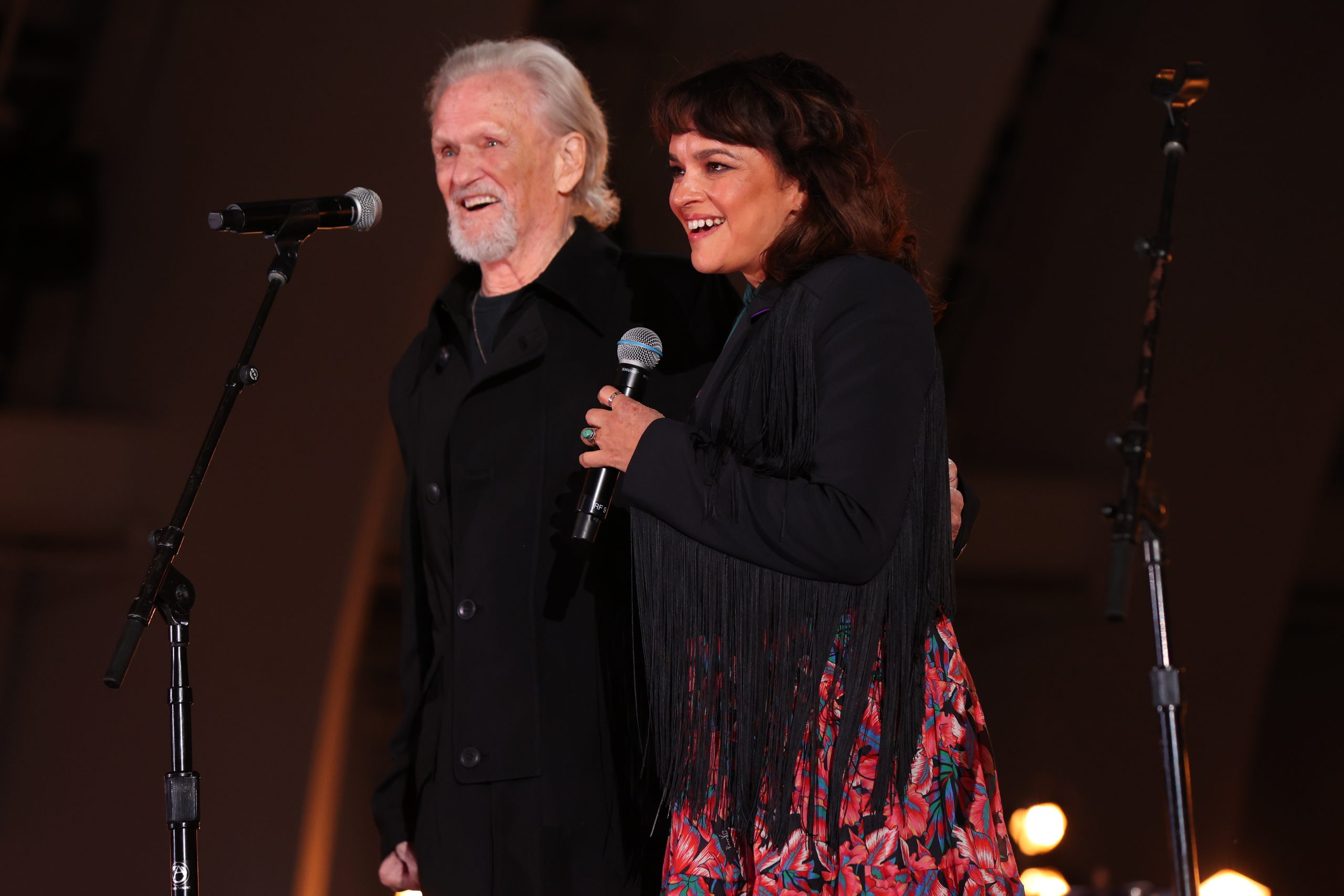
8:43pm – Norah brings on Kris Kristofferson (!) and helps him through “Help Me Make It Through the Night.” There’s not a dry eye in the house.
Kris Kristofferson, Norah Jones by Randall Michelson
8:49pm – Ethan Hawke introduces Nathaniel Rateliff. Not unlike the first evening (where he performed “City of New Orleans”) he steals the show with “A Song For You.” Rateliff is a national treasure who should be protected at all costs.
8:54pm – Sheryl Crow does “Crazy.” Crowd (rightfully) goes Crazy.
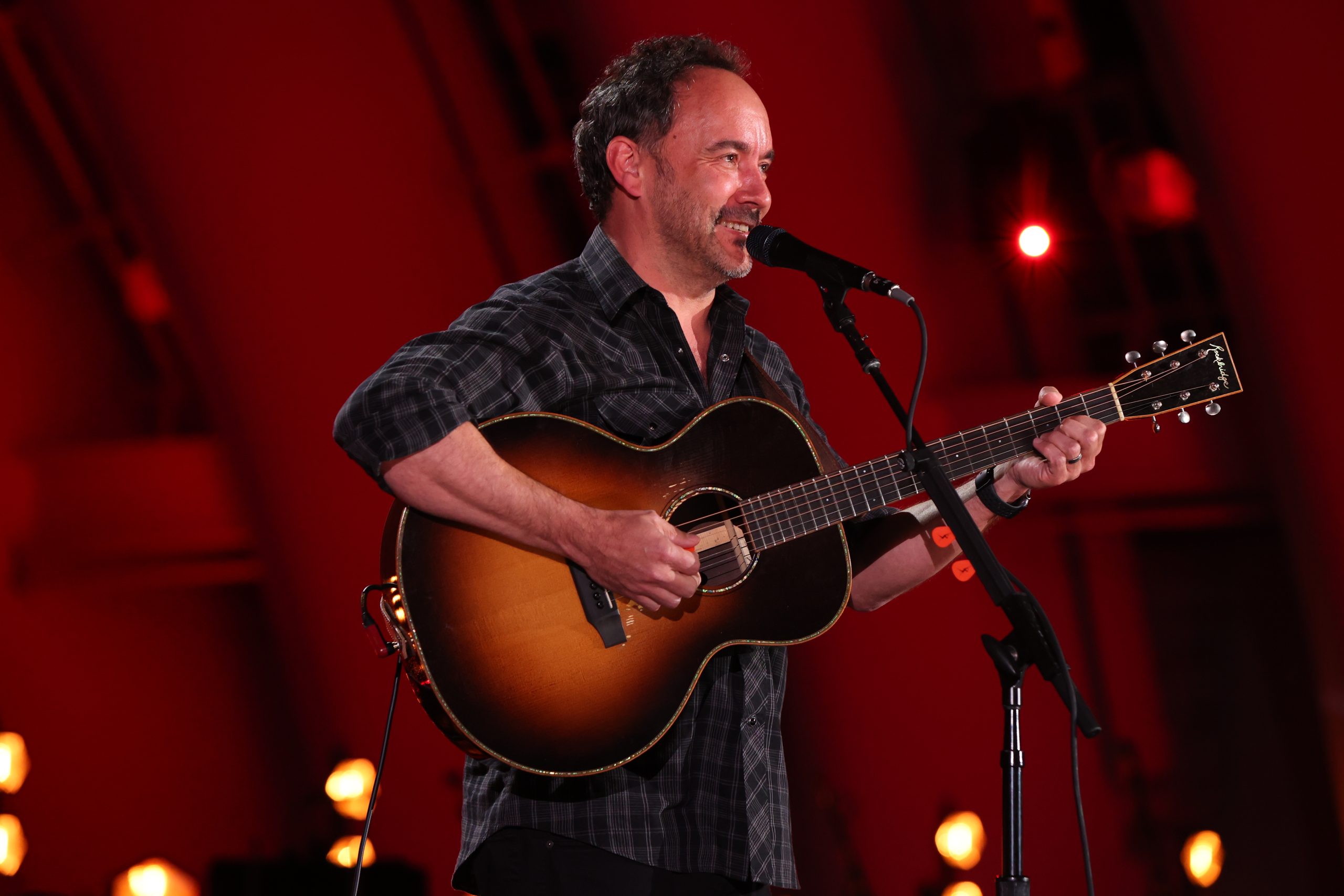
9:02pm – Dave Matthews, overflowing with sheepish charisma, tells an amazing story about getting high with Willie on his bus and how proud his mom was of that moment. The photo of that night is still prominently displayed on her mantle. He performs “Funny How Time Slips Away,” a song that seems to be the theme of the night.
Dave Matthews by Randall Michelson
9:18pm – Jamey Johnson and Warren Haynes perform “Georgia On My Mind.” From the first word Jamey sings, the audience goes wild. These two bring down the house.
9:28pm – The Children of the Highwaymen, including Lukas and Micah Nelson (Particle Kid), Shooter Jennings, and Rosanne Cash. One of the few moments during the show with technical difficulties.
Woody Harrelson, Willie Nelson by Randall Michelson
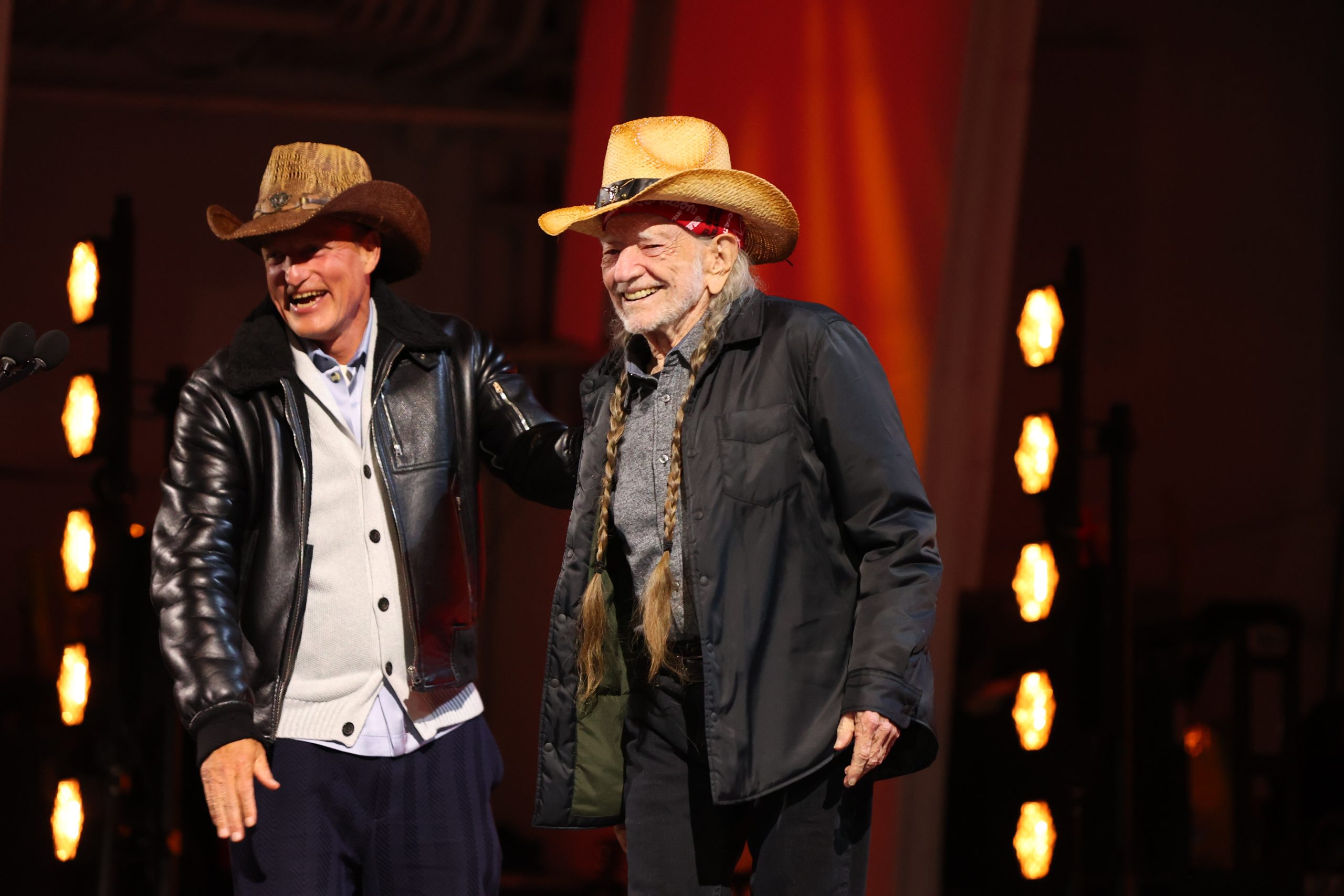
9:35pm – Woody Harrelson returns to the stage to introduce Willie. The man of the hour finally takes the stage. Willie performs “Stardust.” It is perfect. I am crying.
9:53pm – Willie duets with his longtime studio producer, Buddy Cannon, on “Something You Get Through” (which the two wrote together).
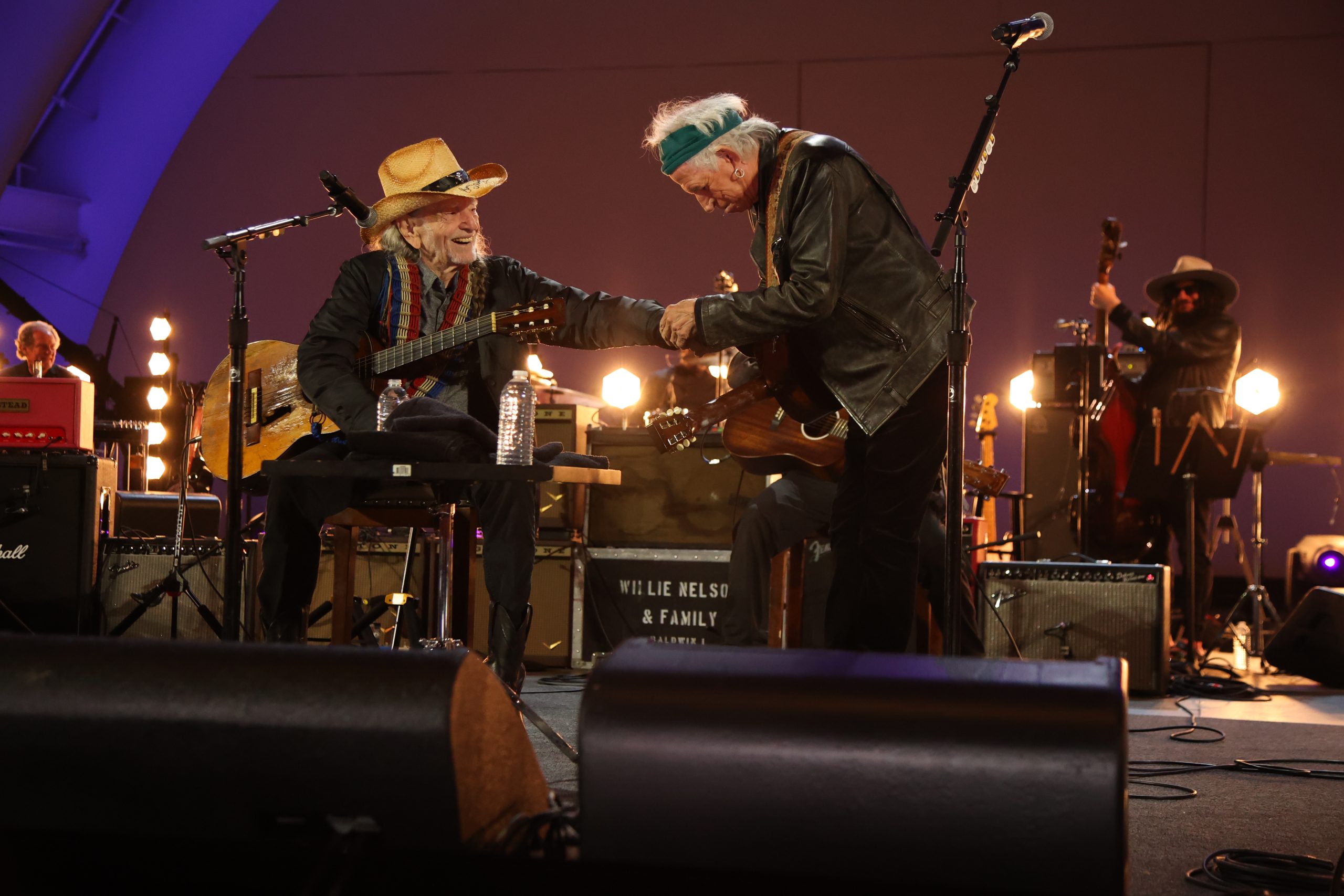
10:02pm – KEITH RICHARDS JUST WALKED OUT. I AM DECEASED. It’s hard to even remember what they performed because everyone is in such shock. (They performed “We Had It All” and “Live Forever”).
Willie Nelson, Keith Richards by Randall Michelson
10:10pm – All skate. “On the Road Again” of course. Willie wraps up the night by taking us all to church, ending with a medley of “Will the Circle Be Unbroken” and “I’ll Fly Away.” It’s going to take an awfully long time to process everything from this weekend.
Back when cowboys were king, ranchers used to have to make regular pilgrimages across long, winding trails to sell their cattle at stockyards and make their living. One such trail, known as the “Goodnight-Loving Trail,” extended all the way from central Texas to Cheyenne, Wyoming, and has been immortalized many times over in movies and songs. The journey involved with moving these cattle countless miles on horseback was known as a cattle drive. This fall we’ll be hitting the road on the Kitchen Dwellers and Daniel Donato tour, and we’d like to think of it as a bit of our own “Cosmic Cattle Drive.” We hope you enjoy and hope to see you out on the road this fall.
Selections 1-6: Torrin Daniels, Kitchen Dwellers Selections 7-12: Daniel Donato
Colter Wall – “Cowpoke”
One of the oldest and most famous cowboy songs to date, this one tells the story of the life of a ‘cowpoke.’ Colter Wall did a damn fine version here, with each country-western instrument beautifully represented — but what really sells it is the ‘cattle call’ in the chorus.
Daniel Donato – “Justice”
This tune was my introduction to Daniel’s music, way back in the spring of 2020. Nothing screams western psychedelia quite like that opening guitar riff, and right off the bat it shows that these boys are masters of their realm in a place of no space and time. Plus the chorus got that Gangstarr reference.
Gram Parsons – “Return of the Grievous Angel”
Gram Parsons is the father of country-rock and maybe the first person to coin the term “cosmic country.” With references to “truckers, kickers, and cowboy angels” and “lighting out for some desert town” — as far as road songs go, this one’s got it all.
King Gizzard and The Lizard Wizard – “Billabong Valley”
“Outlaws on the run, faster than a stolen gun.” KGLW are gurus of many things across the musical spectrum, but above all, they have mastered the dark art of “evil guitar.” That same style of gained up, tremolo-drenched guitar which can be heard across the soundtracks of countless western movies.
Billy Strings – “Heartbeat of America”
As a musician on any road trip, it’s an inevitable fact that you’re eventually gonna start listening to your buddies’ music. Billy and the boys really knocked it outta the park with this one, with instrumental sections that are both bluegrass-laden and psychedelic in nature. We can only hope that once we embark on our journey, we may begin to hear the heartbeat of America out there on the road.
Chris LeDoux – “Horses and Cattle”
Chris Ledoux was sort of a family friend of ours growing up. I was going to his shows long before I was old enough to realize the legend that he was. I honestly don’t know of any other country musicians that can hold both a Grammy nomination AND a Pro-Rodeo Bareback World Championship as accolades. The guy was as western as it gets, and so is his music.
Kitchen Dwellers – “Guilty”
This song is a prime example of how music can be a harmony of light and dark, hard and soft, and reflective and joyful. Emotional content not considered, the arrangement and musicianship The Dwellers play with is inspiring and transcendent.
Jimmy Wakely – “Moon Over Montana”
This song is a transportation device into a Tarantino movie taking place in a spacious and vast unknown Big Sky prairie where the search for the light through the darkness of troubles and sorrow every hero finds on their journey is about to begin.
Waylon Jennings – “T For Texas”
There was a time when country was astonishing in its danger and sensibility of pocket and edge. This live track should satiate any live music experience fix of that special vibe that a listener should have, but in a musical context that is Honky Tonk and Twangy.
Marty Robbins – “Big Iron”
The story is the framework for dark and light, love and sorrow, and life and death. The story that creates the experience that is within this song is pungent and captivating. Also note the fantastic Grady Martin picking the nylon string guitar throughout the song and story.
Khruangbin – “So We Won’t Forget”
There are few things more magnetic than music being made live by a band that understands listening and arrangement, in a format that is easy to access and feel. This song captures a myriad of emotions that feel like nostalgia, joy, and vulnerability.
Little Feat – “New Delhi Freight Train”
Lowell George was a genius in capturing a feeling, and communicating it through his sensibility of arrangement, orchestration, and singing, with these lyrics written by Terry Allen. This song feels like an adventure, like something new is on the horizon, and for all of us, this is the case in this very moment.
Artist:Jesse Daniel ft. Jodi Lyford Hometown: Ben Lomond, California, and Austin, Texas Song: “You Asked Me To” (written by Waylon Jennings and Billy Joe Shaver) Release Date: February 4, 2022 Label: Die True Records
In Their Words: “Everyone has a ‘song’ … A tune that brings them back to the time they met a significant other and fell in love that stays with them through the years. People play these songs at weddings, on anniversaries and to even rekindle that old feeling long after the fire is gone. Love songs bring out such pure human emotion in us and that’s what makes this song special for Jodi and I. It was one that we just had to record at some point and I’m glad we did.” — Jesse Daniel
Artist:Mike and the Moonpies Hometown: Austin, Texas Latest Album:One to Grow On Personal nicknames: The Moonpies
All answers by Mike Harmeier
Which artist has influenced you the most … and how?
It would be impossible for me to narrow it down to just one artist. Early on, I was heavily influenced by George Strait and ’80s/’90s country artists, in general. I really thought that was the path I would take — a very commercial approach to country music. I would later gain a new perspective when I started listening to more songwriters like Guy Clark and John Prine. It was then that I wanted to add more depth and sincerity to my music. When I moved to Austin in 2002, I started to get more into the art of record making and that process was heavily influenced by bands like Wilco and Radiohead. Lately, I’ve kind of melded all that into an approach that’s more along the lines of Jerry Jeff Walker. Freewheeling records with thoughtful lyrics and just having fun playing music with my friends.
What’s your favorite memory from being on stage?
I’ve had countless moments that stick out in my memory from being on stage. Most of them include our artist friends joining us on stage. From the big jams we usually host at Mile 0 Fest in Key West, to our encores with the opening bands joining us for a cover song to end the night. Most recently, Jerry Jeff Walker’s son Django joined us on stage in Alpine, Texas, for our rendition of “London Homesick Blues.” It’s a song written and performed by Gary P. Nunn and made famous on Jerry Jeff’s Viva Terlingua record. We cut it in London at Abbey Road Studios for our Cheap Silver and Solid Country Gold record. That was a very special moment and felt like a culmination of a lot of things for us. You never know who will join you or when, and that excitement always makes for a memorable show.
What other art forms — literature, film, dance, painting, etc. — inform your music?
I’ve always found a lot of inspiration in film. Especially when that film uses the right music for a particular scene. I can’t tell you how many times I’ve hit pause on a movie to write a song. Some songs can take on a whole new meaning when you put them behind the right scene or character and I will sometimes use those character’s emotions to inspire a new subject to write about. I’ve written quite a few songs just off one line I heard in a movie or TV show.
What’s the toughest time you ever had writing a song?
I actually had a lot of tough moments writing songs for this record. I had more time than normal to write and rewrite these songs. There were countless edits and rewrites and versions of the songs that we just scrapped and then started over. While I think these are some of the best songs I’ve written, it really took much longer to get to a place where I was happy with them. I think if you spend too much time on one thought it can be a dangerous game to play. I’m still learning when to put the pen down and be satisfied with what came naturally. It’s a fine line.
How often do you hide behind a character in a song or use “you” when it’s actually “me”?
I think I have subconsciously done this a lot with many songs in our catalogue. Not until this record have I made the conscious decision to write from a character’s perspective. While I was experiencing or have experienced a lot of the feelings and virtues of the character on this album, I tried to take myself out of it as much as I could. I wanted to broaden the scope and viewpoint beyond my own personal experience so I strayed away from talking too much about road life or really much to do with my personal experience with my work as a musician. I wanted to project a world view from the perspective of an everyday nine-to-fiver and play with how that intersected in my own personal experience. While there is a lot of myself in these songs, I think it translates to the everyman in a very relatable and accessible way. At least to anyone that works hard to get where they want to be.
Photo credit: Lyza Renee Photography
This website uses cookies to improve your experience. We'll assume you're ok with this, but you can opt-out if you wish.AcceptRejectRead More
Privacy & Cookies Policy
Privacy Overview
This website uses cookies to improve your experience while you navigate through the website. Out of these, the cookies that are categorized as necessary are stored on your browser as they are essential for the working of basic functionalities of the website. We also use third-party cookies that help us analyze and understand how you use this website. These cookies will be stored in your browser only with your consent. You also have the option to opt-out of these cookies. But opting out of some of these cookies may affect your browsing experience.
Necessary cookies are absolutely essential for the website to function properly. This category only includes cookies that ensures basic functionalities and security features of the website. These cookies do not store any personal information.
Any cookies that may not be particularly necessary for the website to function and is used specifically to collect user personal data via analytics, ads, other embedded contents are termed as non-necessary cookies. It is mandatory to procure user consent prior to running these cookies on your website.