Turning 30, eTown Plans b’Earthday Show and Enters Colorado Music Hall of Fame

The long-running radio series eTown is famous for its finales, but upon reaching its 30th year, the focus is shifting to an upcoming all-star virtual b’Earthday concert on April 22 and the program’s deserving induction into the Colorado Music Hall of Fame. Of course there’s also an eagerness from everybody involved — staff, artists, and audience alike — to get back to staging shows at the beloved eTown Hall, a repurposed church that stands as a centerpiece of Boulder’s cultural community.

Community is key to Nick and Helen Forster, the founders of eTown. Their marriage has proved to be as sustainable as the environmental causes they support, and by never wavering from musical integrity, they have created a destination for musicians and music fans of every stripe. Helen carried a love of theater to eTown following her work with the early years of Telluride Bluegrass Festival. Nick Forster, who found acclaim in the band Hot Rize just before eTown launched, can recall browsing through microfilm in the library to do research for his guest interviews. Now, thanks to the internet, the whole world can feel part of the eTown tribe.

Calling in from Boulder, the Forsters filled in BGS about their ongoing creative venture, the common thread that all eTown artists share, and the warm family feelings behind the scenes.

BGS: What was the musical landscape of Colorado like back 1991?

Nick: In ’91, there were a lot of things that had come into their full power, including Telluride Bluegrass Festival, which is where Helen and I met. There was a pretty vibrant music scene in both Boulder and Denver, but if there was such a thing as the sound of Colorado, it was something around that lineup of the Telluride Bluegrass Festival or RockyGrass or Folks Fest. A loosely defined Americana vibe, with a little bit of a hippie slant. Colorado has always had that progressive, acoustic [feel]. … From John Denver on down, there has been a sense of Colorado being a place where a natural approach to music makes sense.

Helen, what drew you to bluegrass music?

Helen: You know, everything back then in Telluride was so organic that if you didn’t have a radio station, you got together and you started one. The festival started because these guys came back from the Walnut Valley Festival in Winfield, Kansas, and they loved it and said, “Why don’t we do this here?” So they did a Fourth of July celebration and a couple hundred people came. I think there were two or three local bands, and from that it grew into become an actual festival. By the second year of that, a couple of the founders had pulled out and I jumped in to just help, I guess. …

When I first got to Telluride, there were very few places to go, other than the bars. And there were some local bluegrass bands. That’s how I first discovered bluegrass. I was in my early 20s and we’d all jam into these basement bars and listen to the bluegrass. It caught my heart. It’s a beautiful form of music and I was so impressed with the talent and the ability of the players. Not only to play, but to jam. It was almost like jazz, in a sense, and it caught my attention then.

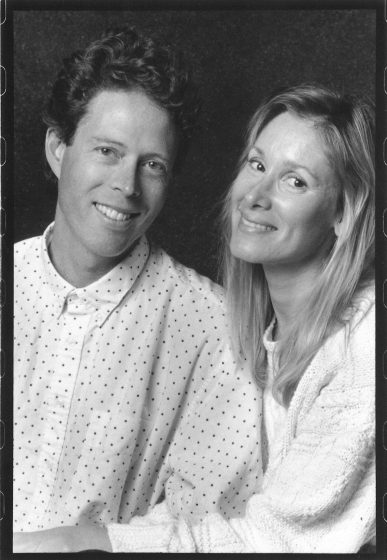
Nick and Helen Forster, 1991. Credit: Laura Lyon

Nick, around this time you had made your mark in Hot Rize, which was the first IBMA Entertainer of the Year back in 1990. So, with your background as a performer, how did you make touring artists feel at home at eTown?

Nick: I was in a unique position being on the road with Hot Rize for years. I had an understanding of what it was like from an artist’s perspective. We’d been lucky enough to play on the Grand Ole Opry, Prairie Home Companion, Austin City Limits, Mountain Stage, and all these shows. I was really enamored with live radio in front of an audience. And when I thought about all the gigs I played with Hot Rize, there were four things that I usually remembered: How was the sound? Was there a decent place to stay? Was the food good? And did the crew have a good attitude?

So, we started with that at eTown, recognizing that we were trying to do two different things. One, we were trying to help these artists basically promote their new records, because everybody who came to eTown was out there with a new record. But we also wanted to have the mission of why we were doing eTown be something they would connect with. And to be inspired by, or at least informed by. So the piece of our show that included conversation about climate change or community or sustainability was another thing that most musicians were really into. Musicians who were traveling have a good world view. A lot of them are avid readers and up to date on world affairs. This was not a giant leap for them to connect with the mission-related part of it.

Tell me about the spirit of collaboration at eTown. What do you like about having more than just the two of you putting a show together?

Helen: It’s interesting, because when I was a little kid, I was doing a lot of theatre. I came from that model that it’s not just the performers; it’s the stage manager, and the props mistress, and the person who manages the set changes. Everybody works together. It’s like a team experience when you do theatre, and having the great crew that we’ve had, I think it’s a great testament to eTown and the model that we created there of being open and [receptive] to our guests. …

That’s what a lot of artists would mention: “My gosh, what a breath of fresh air! We’ve been on the road dealing with disgruntled monitor mixers, then we come here and it just feels like family,” like you’ve been welcomed in. And quite frankly, since we closed the eTown Hall temporarily, now for over a year because of COVID, we all miss each other. Nick organized a Zoom call a couple of months ago so we could catch up and see each other. I know that our crew is really anxious for the hall to re-open so we can all come together again. It’s like a big, extended family.

What are you looking for when it comes to booking artists for eTown?

Nick: We’ve always tried to aim for music that is soulful. That’s music that has integrity, good songwriting, not too many bells and whistles. Not stuff that is overproduced, so you can feel the personality of the songwriter and the singer come through. Our booking philosophy was always, from the very beginning, about featuring some diversity. But for the first 600 or 700 shows that we did at the Boulder Theatre, that’s 800 or 900 seats that we tried to fill. So, sometimes it helped when we had people with name recognition as one of our guests.

We always tried to have one artist with name recognition and one artist that was emerging, and beyond that, maybe one band and one solo. Or one person is playing Americana music, and the other one is playing Celtic or Hawaiian or Afro-Cuban music. The diversity of artists was really important to us, particularly because of our finale. The end of the show was always a joint effort between our musical guests and a lot of times they didn’t know each other. They didn’t have a lot of common ground.

I come from the bluegrass world where, yeah, you’re just going to pick and jam and find a song and play. But particularly for songwriters who have been hiding in their bedrooms writing songs for three years, and then they come out and say, “I don’t know any other songs….” But the finale was always, in some ways, not just an opportunity to have something in real time. It had to be created that day, with those people, under pressure, to find a song, find a key, arrange it, split the words up, and rehearse it, then perform in a few hours later. It was pretty intense! But the other part of it was, eTown’s goal has always been about using music as a way to build community, and to remind people that our community is larger than we might think it is.

Over the last 30 years, music and technology have changed so much. When it comes to eTown, what would you say has remained the same?

Helen: There’s been an agreed goal of maintaining a certain amount of integrity and a certain amount of quality in the ultimate product that we have been putting out all these years, which is the radio broadcast and now podcast. Whether it’s the technical sound end of it, all the way to the content itself. I think that’s what’s kept it going as long as it has. There is this underlying devotion and striving toward excellence.


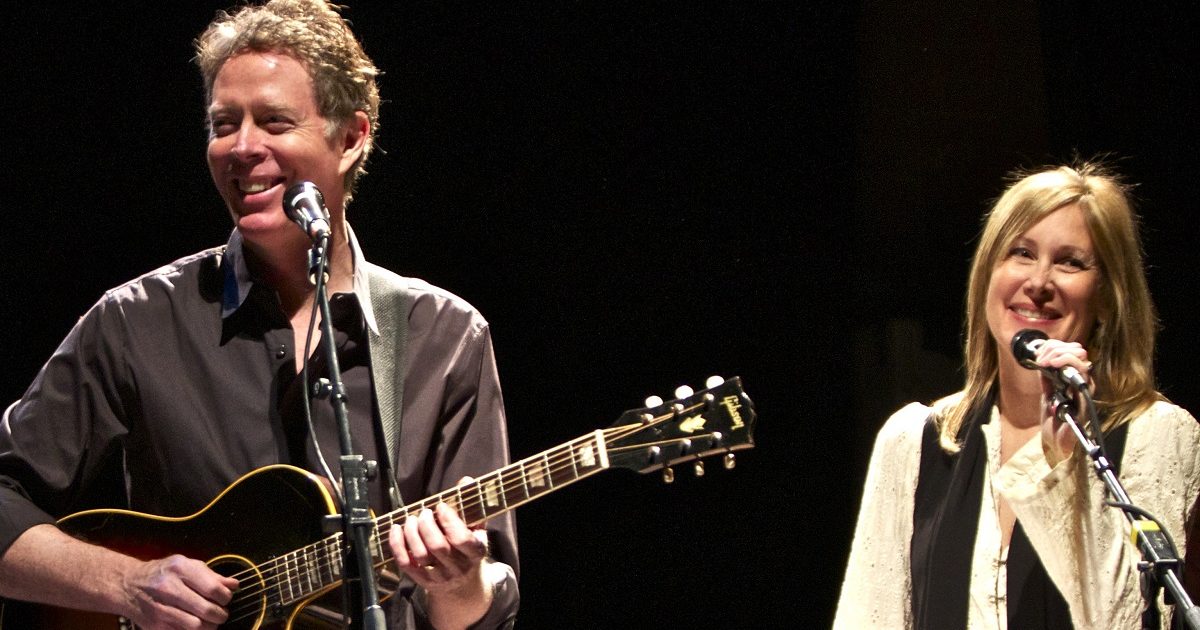
Lead photo of Nick and Helen Forster by Tim Reese

WATCH: Annie Moses Band, “In My Grandpa’s Pulpit”

Artist: Annie Moses Band
Hometown: Nashville, Tennessee
Song: “In My Grandpa’s Pulpit”
Album: Tales From My Grandpa’s Pulpit
Release Date: April 16, 2021
Label: Gaither Music Group

In Their Words: “My grandpa was a larger-than-life man. His life was the backdrop for the project, Tales From My Grandpa’s Pulpit. D. Riley Donica was a crack shot, expert horseman, bush pilot, armchair historian, a deputy sheriff, and the preacher at the same mountain church for 50 years. He grew up in a place riddled with violence. He lived through the murder of his father and, many years later, his stepfather. In the prime of his life he was responsible for having a sheriff brought to the area to help with the issues of crime. The sheriff was murdered within a week, leaving behind a widow and three young children. There was an eye witness to the murder, but no one would testify out of fear. The killer was a known quantity and hired by a crime boss that ran all manner of illegal filth between four states — Arkansas, Oklahoma, Louisiana, and Texas. Their headquarters was a place called Dogpatch and it sat right where these four states met and only a couple of miles from my grandpa’s brand new church house.

“So Grandpa picked a fight with the bad guys by writing in his weekly newsletter and preaching against the silence and cowardice of the community that allowed a safe haven for these murderers. One week later the new church house was burned to the ground. The close of this story involves a few steely-eyed, Clint Eastwood-style confrontations, the Oklahoma Bureau of Investigation and the murderer being convicted and put in prison, because my grandpa was courageous. Through the years he became known as a minister of the gospel who taught with his Bible on top of the pulpit and his gun on the shelf below. He frequently and famously said, ‘It ain’t right to do nothing when something ought to be done.’ The song ‘In My Grandpa’s Pulpit’ is a snapshot of his story.” — Annie Dupre


Photo credit: David Bean

WATCH: Garrison, Gordy, Hargreaves, Walsh, “Sports”

Artist: Garrison, Gordy, Hargreaves, Walsh
Hometown: Brooklyn, New York/Denver, Colorado/Portland, Maine
Song: “Sports”
Album: Bluegrass and the Abstract Truth
Release Date: April 16, 2021

In Their Words: “Instrumental tunes are wonderfully subjective, like little movies whose narratives and meanings can transform and reflect the places they’ve seen. ‘Sports’ started as a little tune in my head riding the D train home from Manhattan to Brooklyn, and had its first public appearance on a local jazz gig. It followed me around, enjoyed some unveilings in the UK under a few different titles — I think I even took a fruitless audience survey to come up with a fitting appellation. When we went into the studio to record this group, its true title came to light and Joe, Alex, and Greg expressed its shifts of mood and character masterfully. We were so delighted to see our friend Danny Barnes’ take on what ‘Sports’ was communicating, and the video he made couldn’t have been a better fit for the mood of the piece.” — Grant Gordy


Photo credit: Dan Cardinal

The BGS Radio Hour – Episode 204

Welcome to the BGS Radio Hour! Since 2017, the weekly show has been a recap of all the great music, new and old, featured on BGS. This week, we bring you old bluegrass newly recorded by the Infamous Stringdusters, music from our Artist of the Month, Peggy Seeger, and so much more! Remember to check back every Monday for a new episode of the BGS Radio Hour.

The Brother Brothers – “Circles”

Celebrating their upcoming Calla Lily (available April 16), Adam and David Moss of the Brother Brothers joined us on a recent 5+5. We talked John Hartford, writing music for dance, and the inspirations and songwriting techniques behind these two brothers and their new album.

Johnny Chops – “Trouble With the Truth”

Austin-based Johnny Chops brings us a song this week from his upcoming Yours, Mine and the Truth EP. This song pretty much fell out of the sky and onto Chops’ paper in his writing room one morning. The video continues to tell the story of the song, building a dark and bleak vibe through dramatic and abandoned filming locations.

Sinner Friends – “Unforgivable You”

Sinner Friends don’t just sound like vintage bluegrass: they record like it too, down to just a few microphones, no editing, everything done right then and there. Recorded and released by Bigtone Records, the result is on par with those early bluegrass recordings that defined the genre. This week, they bring us a song from their newly released Sinner Friends Miss You (The Quarantine EP). 

Keb’ Mo’ – Yamaha x BGS Artist Session

For 2021’s Folk Alliance International and SXSW conferencesBGS teamed up with Yamaha to film performances from some of the artists we’re most excited about. Our first segment is from none other than Keb’ Mo’, playing a Yamaha FGX5 – modeled after the vintage FG180, Keb’s first guitar which he unfortunately lost in the Nashville flood of 2010. Aren’t we all just waiting on the medicine man these days? Keb’ performs two songs for us, “Every Morning” and “The Action.”

The Gina Furtado Project – “Kansas City Railroad Blues”

Gina Furtado brings us the “magic fire” of the banjo on this new single, finding the sound that first made her fall in love with the instrument. It’s the latest single in an exciting and excellent batch from Furtado and Mountain Home Music Company, produced by banjo phenom Kristin Scott Benson, and accompanied by Drew Matulich, Wayne Benson, and siblings Malia and Lu Furtado.

Ervin Stellar – “Nothing to Prove”

From Grand Rapids, Michigan, Ervin Stellars joined us on a 5+5 last week – that is, 5 questions, 5 songs. We talked everything from Wes Anderson and the Coen Brothers to waves and mountains. And let’s not forget his new album, Nothing to Prove.

Mimi Naja – “All You Know of Me”

Known for her work with Fruition, Mimi Naja recently dropped Nothing Has Changed, her first solo release since 2014. We caught up with Naja to talk about songwriting, inspirations, and a dream meal pairing of Thai with Khruangbin.

Peggy Seeger – “The Invisible Woman”

Peggy Seeger is our Artist of the Month for April here at BGS! Her just-released First Farewell is a goodbye to recording and the road, but she is not leaving that lineage behind. Coming from a musical family including the likes of Pete and Mike Seeger, the traditional continues, as Seeger enlists her sons Neill and Callum MacColl on the new album. Stay tuned all month long where we’ll be featuring Peggy Seeger!

The Alex Leach Band – “The Turntable”

Alex Leach has been adored by the Eastern Tennessee bluegrass community since he first started appearing at the WDVX radio station in Knoxville as a small child. Through the years, he’s played with Ralph Stanley, hosts a weekly show on WDVX, and now has his newest endeavor, The Alex Leach Band, who just released their latest album (produced by Jim Lauderdale), I’m the Happiest When I’m Moving. 

Acoustic Syndicate – “Sunny”

Acoustic Syndicate has been making music in Western North Carolina’s jamband scene for over two decades, but their latest studio endeavor is the first in seven years. “Sunny” is a promising first release with Organic Records, the band joined by Brian Felix on piano and Lyndsay Pruett on violin.

Elizabeth King – “Living in the Last Days”

Memphis-based Elizabeth King brings us this deeply thought number this week from her latest album of the same title. “Living in the Last Days” is about the trouble that so casually surrounds our current days, and King sings about it with a lot of conviction. The song should inspire us all to look a little more closely at what surrounds us, and what we can do to make this world a better place for all.

Bobby Osborne – “White Line Fever”

“White Line Fever” was a hit for Merle Haggard in the 60s, but had never been cut as a bluegrass song. That is, until Alison Brown and Bobby Osborne got a hold of it. One thing leading to another, and Jeff Tweedy wrote a second verse about Bobby (being the voice of Rocky Top) and his 60 years on the road as a musician. Mixing all of this with some A-list bluegrass musicians like Sierra Hull and Stuart Duncan, well… this is the result! As Brown says, “it was hard to believe the song hadn’t been a bluegrass standard all along.”

Cha Wa – “My People”

Joseph Boudreaux Jr, vocalist for Cha Wa, teaches us about ‘ancestral recall’ with this song, a phenomenon where people consciously or subconsciously draw on the experiences and lives of their ancestors to perpetuate a certain lifestyle or culture. “‘My People’ reminds us that no matter who you are — rich or poor, big or small — we’re all in this together as humans,” Boudreaux told BGS. “Cause one day we gon’ all be in the same boat.”


Photos: (L to R) Keb’ Mo’; Gina Furtado by Sandlin Gaither; Peggy Seeger by Vicki Sharp

LISTEN: Miles Gannett, “Thunder River, Tumbling Down”

Artist: Miles Gannett
Hometown: Baltimore, Maryland
Song: “Thunder River, Tumbling Down”
Album: Meridian
Release Date: April 16, 2021

In Their Words: “I heard the melody and a few of the lyrics, including the lines ‘Thunder River, tumbling down; catch your babes before they drown’ in a dream, and I woke up and sang what I could remember into my phone. It kind of creeped me out, so it sat around for a couple years until I figured out where to go with the rest of the lyrics. It contains a lot of trippy apocalyptic imagery and I guess quasi-religious commentary. Musically, I was inspired by the vibe of some of my favorite late ’60s and early ’70s progressive bluegrass artists, especially Dillard & Clark, who combined bluegrass and psychedelic folk rock in a way that I think is really cool, and J.D. Crowe & the New South, who used drums and pedal steel on their Bluegrass Evolution album, which I love even if Tony Rice didn’t (ha ha). I was honored to have such great players on the record, who could help me achieve the sound I was searching for. Ron Stewart of the Seldom Scene played banjo on the track, which, along with Eric Selby’s drumming and Joe Martone’s bass, really propels the song and creates a solid foundation for Dave Hadley’s pedal steel and Sean P. Finn’s fiddle. I did my best to keep up on acoustic guitar!” — Miles Gannett


Photo credit: Chancey June Gannett

Sara Watkins Finds a Dreamy Rhythm With ‘Under the Pepper Tree’

The Schinus molle — more commonly known as the California pepper tree — can grow up to 45 feet high and 50 feet wide, producing small yellow flowers and rose-colored berries, and bringing shade to everything within reach. For Nickel Creek originator Sara Watkins, the pepper tree brings about memories of family, youthful fun, and inspiration for her latest record, Under the Pepper Tree. Produced by Tyler Chester, the 15-song album is a personal project for Watkins, including songs from her own childhood alongside a few original compositions. Reuniting Nickel Creek, I’m With Her, and a range of guest performances, she tackles favorite songs such as “Pure Imagination” (from Willy Wonka and the Chocolate Factory) and “Blue Shadows on the Trail” (from The Three Amigos).

BGS caught up with Watkins from her California home to talk about the inspirations behind Under the Pepper Tree, and the experience of making a record like this during the COVID-19 pandemic.

BGS: Was the making of this album a different experience from those you’ve done in the past?

Watkins: Yeah, and not just because we did it during COVID. That was a huge appeal in working with Tyler Chester — he can play so many instruments so well. His musicality comes out on each instrument really well. Other than that, I knew early on that it would be necessary for the songs to weave together. As I was collecting these songs, realizing that so many of them are kind of dreamy and mellow, I wasn’t dealing with the typical balance of “up” songs, “down” songs, “sad” songs, “happy” songs, the way those things can affect the sequence of a normal album. Because of the nature of this material, a lot of the songs had a similar dreamy quality, so I thought by connecting them all, that would let the album kind of drift along, and hopefully sweep you up in a way that might not happen if they were all just 15 individual tracks. 

Before going in to record the project, we did a bit of a practice swing, just to see how the sequence might work together. We made some changes to the sequence and adjusted the transitions accordingly, so that everything went together as well as possible. This is the first time I’ve sequenced an album before going in to record, and I really enjoyed the result and how it affected the process throughout. It’s definitely something I’m going to bring with me into my future projects, even if I don’t do it exactly the same way. I’m going to consider it very seriously before starting records. 

How did getting to be home during the pandemic influence your day to day, and outlook on this album?

If affected it completely. I don’t think I would have made this record without the experience of just being home, and realizing that I needed some kind of rhythm, needed something that would tell me that today was passing. I’m new to being home, the way that all musicians are. That, combined with having a toddler now, was a new experience. The first couple years of being a mom I was on tour, and the rhythm of tour life is built into the work, the way that most people’s jobs provide a rhythm for their life. I think a lot of [musicians] were discovering that we needed to create those rhythms, by taking morning or evening walks around the neighborhood, by spending more time making meals or cooking, or doing whatever it is that helps cycle you in to the next part of the day. 

I was digging through my old record collection, and I would listen to five a day, and decide whether or not I wanted to keep them or whether I was done with them. A big part of me creating Under the Pepper Tree with vinyl in mind was because of this wonderful freedom that it gave me to put on a record and not have to make a choice for a while. I could just listen to it and not have to worry what song came up in the algorithm next, or decide whether or not I wanted to skip ahead. That freedom of just making one choice and being able to go about the rest of the things that I needed to do, it felt really liberating, like a kindness that I could do to myself. 

That also played into why I wanted to make this album with record listening in mind. It works great on digital too, but I imagined it being an A and B side. If you only listen to side A, you can get a full arc and it can send you into dreamland. And if you want to listen to it altogether, that’s another experience. 

Like with Nickel Creek on “Blue Shadows on the Trail,” were any specific guests important to certain songs?

“Tumbling Tumbleweeds” with Aoife [O’Donovan] and [Sarah] Jarosz, my I’m With Her bandmates, was just as important, because I really wanted both of those bands on this record. I feel like this album in a lot of ways celebrates this time in my life, and the music that I grew up with. For me also, it was an incredible way to get those two bands together on an album, because they’re both so meaningful to me, and have played such huge roles in my life, and in my growth and development as a person, as a mom. So it was incredibly meaningful to get to have them on it. 

All of the players on the record mean a lot to me, but I really also loved having Davíd Garza on this record, who is a dear friend. In particular, he plays this beautiful solo on “Moon River.” There’s a song on Emmylou Harris’ record Roses in the Snow when Willie Nelson comes in with a guitar solo, and then it sounds like he just goes away. When I first heard that record — I think it was in my early 20s — it was pretty informative to me about how a lot of times musicians can be known for one or two things, but they might not often get asked to just be a musician on somebody else’s record. I just love that [Harris] didn’t get Willie to sing on it, she got him to come in and play a guitar solo. That was really eye-opening for me, and changed the way I thought of playing with people. 

On “Moon River,” I specifically had that moment in mind where Willie comes in and plays a solo and goes away, and so Davíd graciously agreed to be my Willie Nelson on this song, and he does a wonderful job. 

Having a couple of original tunes on the record, what was your process behind writing something that incorporates naturally with these classic songs?

I felt like there should be a spot for fiddle on this record. I knew that I wanted to have an instrumental on here, and I knew that I wanted to write it. It was important to have a little break in the lyrics. It was great to expand my childhood story with the title of the [instrumental], “Under the Pepper Tree.” That has very personal weight to me. A lot of instrumental titles are pretty arbitrary in my experience, but this was an opportunity to share a little bit about my own childhood. 

There’s a tree that I spent a lot of time growing up with, playing in and imagining in. There are several very important pepper trees in my life. One of them is at my aunt’s house, where my grandma used to live. There were two huge family reunions under that pepper tree. I just remember running around with my cousins, playing tag, listening to my aunt’s laugh, all that stuff. It’s a really beautiful thing, and I think that had a natural place on the album. 

The other song [“Night Singing”] was a poem that I wrote, that eventually fell into a guitar part. Originally, I thought that this record would be a lullaby record, but my goal for the record changed. It was to make something a little more deeply transitional for people of all ages. But “Night Singing” is a true lullaby, for my daughter, for myself, and for my friends. 

Do you have any specific plans you’re looking forward to taking on when we climb out of this pandemic? 

This fall, my brother [Sean Watkins] and I are going to do some touring behind our Watkins Family Hour album brother sister, which came out a year ago now. We weren’t able to tour it, but a lot of the dates we had for last fall have been rescheduled for this fall, 2021. We have some dates on the books starting in August, which is kinda hard to believe! So this fall we’ll be able to do some in-person shows, and I’m really looking forward to it. 

I feel very stopped up in terms of creativity, because we wrote the brother sister record, recorded it, and put it out, and haven’t really been able to celebrate it with an audience. Then I put together Under the Pepper Tree, recorded that, released it, and I haven’t been able to do shows for it. There’s been writing for other projects, but I honestly feel a little bit stopped up creatively. I think I just need to perform some of these songs, and get them out of my body, so that I can put more stuff in. As alienating as this whole thing has felt for us, and as isolating as it has been, there has been to some degree a shared experience, and the universality of that has been reassuring at times for me. 


Sara and Sean Watkins, as Watkins Family Hour, are coming to Colorado in March 2022! Grab your tickets here.

Photo credit: Jacob Boll

LISTEN: Jason Davis, “Modern Day Jezebel” (Feat. Dan Tyminski)

Artist: Jason Davis
Hometown: Galax, Virginia
Song: “Modern Day Jezebel” (Feat. Dan Tyminski)
Release Date: April 13, 2021
Label: Mountain Fever Records

In Their Words: “I first got the demo of this tune four or five years ago from Daniel Salyer. I loved it the first time I heard it and knew I’d like to cut it for my next record. Luckily, nobody had put it out in the meantime. To me it’s a great modern bluegrass tune. I think it’s a cool way of telling the story of a love gone wrong and I really liked the chord progression and melody. Dan played guitar on the session and I was especially excited when he wanted to sing it. It was an honor to get to track with all the guys (and gal). They really knocked it out of the park on this one. They killed it!” — Jason Davis


Photo credit: Donn Jones

WATCH: Andrew Adkins, “This Old Knife”

Artist: Andrew Adkins
Hometown: Fayetteville, West Virginia
Song: “This Old Knife”
Album: April in Your Eyes – A Tribute to the Songs of John Lilly
Release Date: April 16, 2021
Label: Diamond Ranch Records

In Their Words: “I’ve always admired John Lilly as a person and as a songwriter. The first or second time I saw him perform, he played ‘This Old Knife’ and I was in love. I literally stuck my hand in my pocket and held the knife that my father gave to me. When asked to be a part of this album, I knew exactly what song I wanted to sing, because I’ve sang it so many times since I first heard it that night.” — Andrew Adkins


Photo credit: Tara Fowler

BGS 5+5: Giri Peters

Artist: Giri Peters
Hometown: Nashville, Tennessee
Latest Single: “Fallin'”

Which artist has influenced you the most … and how?

I am inspired by so many amazing musicians, but if I had to choose one it would be John Mayer. It is super inspiring for me to see someone who incorporates a hint of blues and folk music in their style become one of the world’s biggest artists. It is not often where you find people of his caliber carrying on the sounds of authentic music and incorporating it into their own songwriting and musical style. I also love the way he uses his instrumentation in his songwriting, and that is something I aspire to do as well. In my mind, he is one of the greatest guitar players alive. While his songs aren’t all super complex he succeeds at creating hits with simple soulful music. He does just enough to get the point across. I also love watching him blur the genre boundaries within the mainstream music industry, and that is something that I think about often too because I am inspired by so many different musical styles.

What’s your favorite memory from being on stage?

My favorite live performance I have done was a Ted X showcase at the Schermerhorn Symphony Hall here in Nashville. Even though that performance was a couple years ago, and I have improved so much musically since then, it was such a special memory. I had gone to the symphonies ever since I was 2 years old. I remember one time going to the Schermerhorn to watch the symphony perform, and after I got to meet some of the players. I was always in awe of that stage, and I never would’ve imagined getting to play it some day. I had gone to see Punch Brothers and some other amazing acts perform on that stage when I was a little older. For me, when I got on stage I was so nervous just knowing that this was the exact same stage I had idolized since I was around 4. It was an amazing show that I will never forget, and it gave me inspiration to keep going knowing that I was able to make a dream come true.

What was the first moment that you knew you wanted to be a musician?

I have been a music lover ever since I was born. I moved to Nashville when I was 4 years old, and I started taking violin lessons as soon as we moved. I then picked up mandolin, and later the guitar. I eventually moved away from classical music and I have been experimenting with different styles ever since. Only recently have I felt like I truly found my sound and style. Most of the music I write is within the folk/Americana genre with influences from other styles and sounds. I was around 4 or 5 when I first started going to concerts and as soon as I watched amazing artists, I knew that I was going to be a musician. My mind to this day has never changed. It was only when I started getting older, and when I began venturing into different styles such as bluegrass that I decided I wanted to be a touring musician. Someday I hope to tour the world with my guitar and my violin, and share my songwriting across the globe.

If you had to write a mission statement for your career, what would it be?

There was one time a few years ago when I was getting down about wanting to be a musician. At the time there were many problems going on within the world, and I wanted to do something about it. I felt like my life would be useless unless I could help the world, and leave a mark somehow. At the time, I was lost regarding how I was going to do that with my music, but right around that same time I discovered songwriting. Ever since that day, I decided I would write about real world problems, and that when I didn’t write directly about world issues, I would use my music as a platform to do my part in making this world a better place. Even though I am still at the beginning of my journey in doing that, I will never lose sight of that vision. My songwriting is also my way of coping with life and the experiences I go through. Often I find that many other people feel the same way or have been through similar experiences. It is so amazing to me how songwriting has the ability to connect everyone no matter who they are, where they live, what they believe, or what they look like; and I believe that it is the greatest tool we can use to help connect human civilization.

Which elements of nature do you spend the most time with and how do those impact your work?

I love the sun. Light gives me so much inspiration and happiness. There is something so inspirational about watching the sunrise and the sunset everyday. For me it never gets old. Especially while watching the sunset, I have found that I create my best work. It is a small reminder of how beautiful the world is out there, and it is hard to remember that nowadays because most of us have been stuck in our homes for more than a year. I love writing songs during the sunset, and I get the perfect view of it everyday from my room. I always try to get as much writing or recording done while the sunset is happening simply because it brings out the best artist in me.


Photo credit: Uma Peters

WATCH: Nefesh Mountain, “Wanderlust”

Artist: Nefesh Mountain
Hometown: Montclair, New Jersey
Song: “Wanderlust”
Album: Songs for the Sparrows
Release Date: June 11, 2021
Label: Eden Sky Records

In Their Words: “The idea for this song came from the Traveler’s Prayer — these age-old words that our ancestors have spoken for centuries. ‘Wanderlust’ and this new album are very much a celebration; about adventure and endurance and pushing through the difficult times. We’re looking at some painful things in these songs, but it always comes back to the idea of persevering and letting love be your fuel.” — Doni Zasloff, Nefesh Mountain


Photo credit: Lawrence Rickford