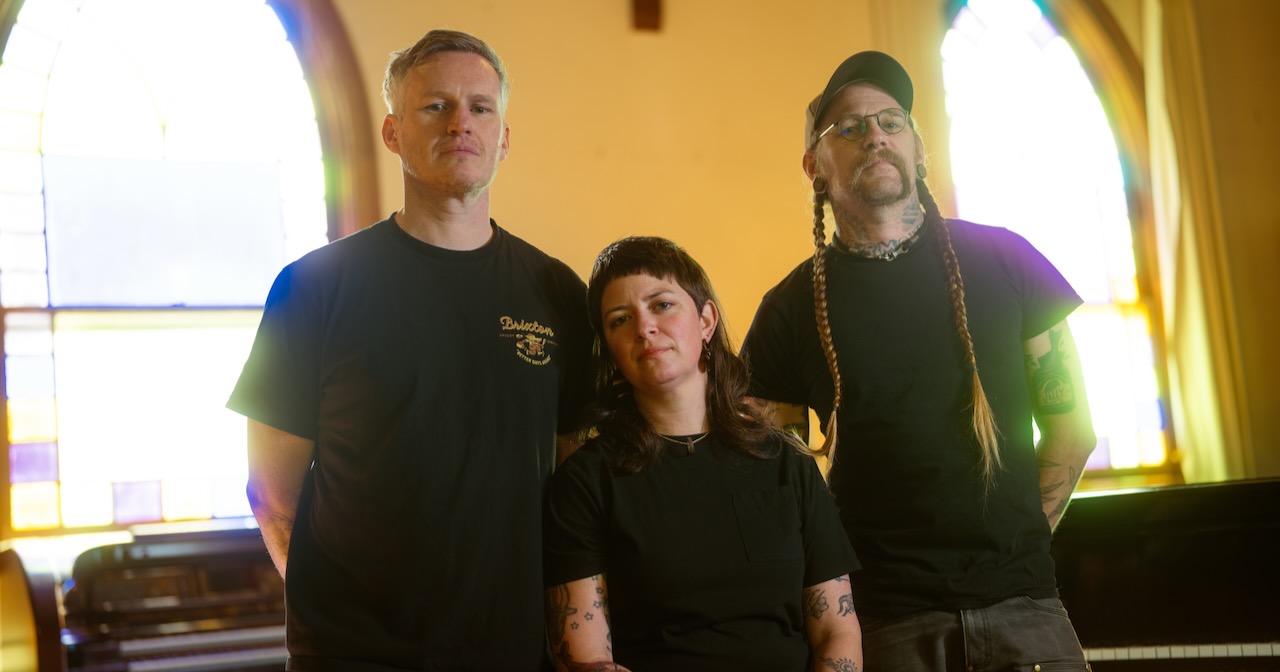
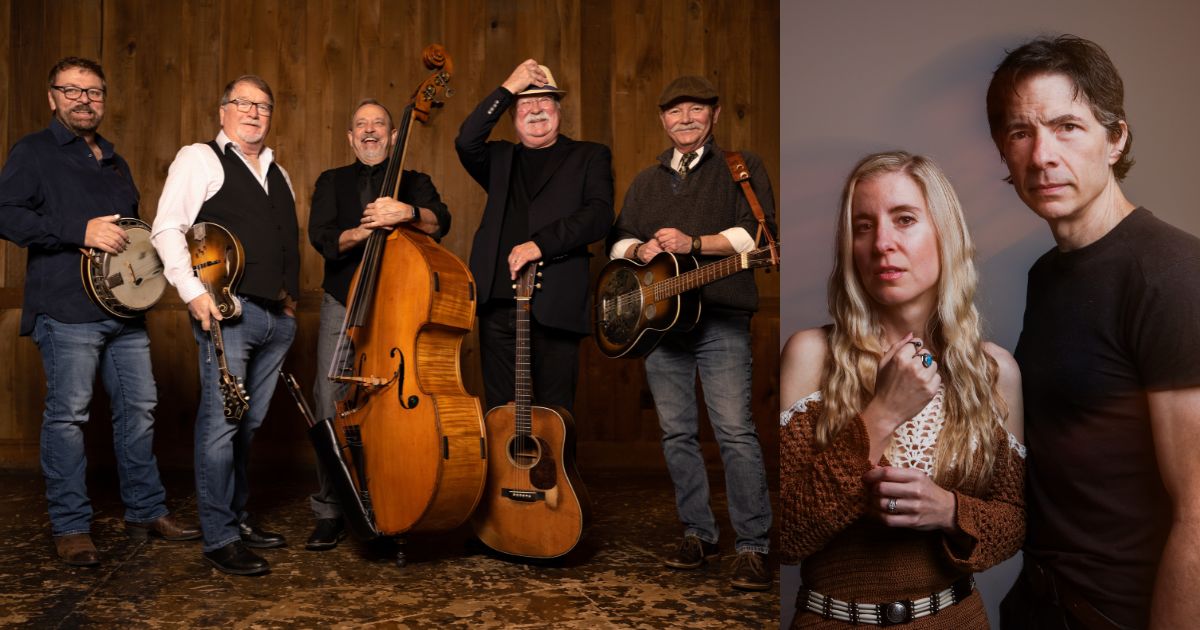
Artist:The Devil Makes Three Hometown: Santa Cruz, California Song: “Ghosts Are Weak” Album:Spirits Release Date: January 22, 2025 (single); February 28, 2025 (album) Label: New West Records
In Their Words: “‘Ghosts Are Weak’ is about breaking free from destructive habits and patterns. It reflects on how leaving behind a substance or lifestyle often comes with losing certain friends along the way. The song also carries a warning– escapism only works for so long. Sooner or later, the drugs lose their grip, but the ghosts of those choices grow stronger. Through raw lyrics and a haunting melody, ‘Ghosts Are Weak’ captures the struggle of moving on and the shadows left behind.” – Pete Bernhard
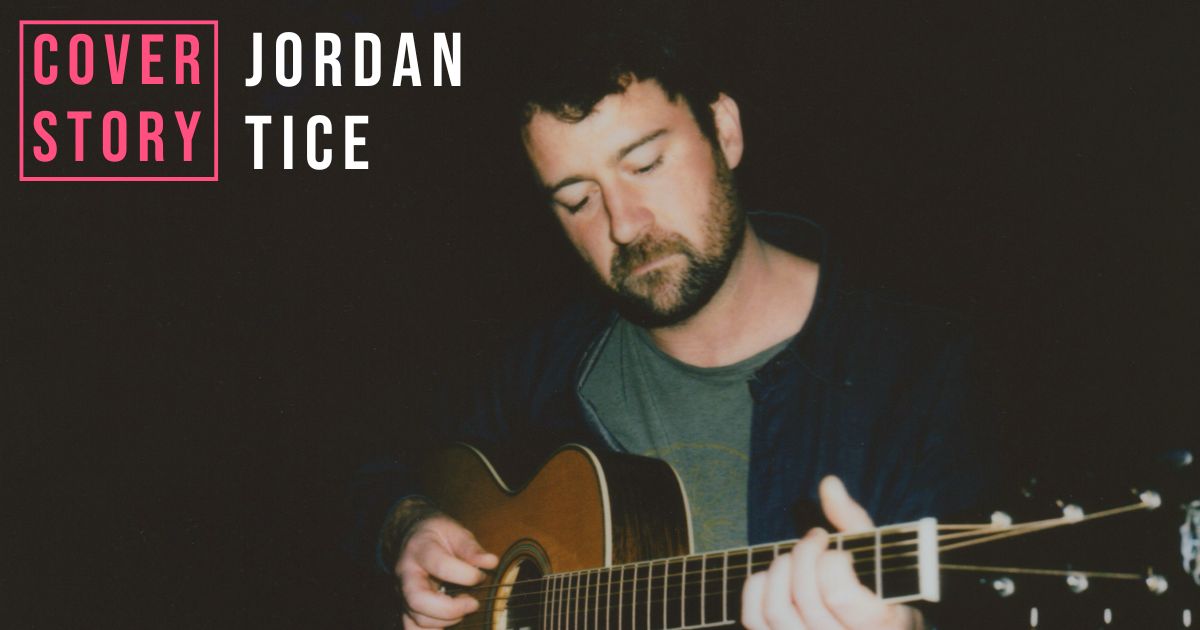
Bluegrass. Newgrass. Chambergrass. Jamgrass. Thrashgrass. So many sub-genres, so little time. For guitarist Jordan Tice – solo artist and longtime member of Nashville-based Hawktail – there’s no time at all, because labels don’t define art and they don’t factor into his creative process.
“I don’t necessarily think about it,” he says. “I mostly do what I feel like doing and incorporate sounds that feel relevant, that I have a personal connection to and an excitement to explore, and the ability to replicate and share. I’d like to think that personality can unite disparate things if the heart is pure.”
Tice weaves a thread of musical connectivity on his new release, Badlettsville. The EP features two covers, Bob Dylan’s “Tryin’ to Get to Heaven” and Randy Newman’s “Dayton, Ohio – 1903,” as well as the originals “Mean Old World” and the instrumental title track. The four are staples of his live shows, but only now have they been committed to recordings.
“They’re all fundamental to my show and are requested as much as my other songs, but they didn’t have a place on either the last record or the next one, so they belonged in Badlettsville,” he says. “They fit together sonically as well. As soon as we got those four things down, I was like, ‘This is something.’”
Ever busy, Tice isn’t slowing down in 2025, although the emphasis is shifting somewhat. After two hectic years, Hawktail is dialing back a bit on gigging and Tice is devoting time to another solo album. “Hawktail has an EP in the can that will hopefully get out sometime soon,” he says. “We’re doing a few festival gigs but taking a much lighter year. I’m doing some dates in support of [Badlettsville], in addition to festivals with Hawktail. But I’m trying to take a little bit of a step back to focus on making this new record.”
Your website bio begins, “Jordan Tice is a musical seeker of the most dedicated sort.” What does the term “musical seeker” mean to you?
Jordan Tice: I’m always exploring my own interests and creativity, and also exploring the music that I do play, the roots of that. I want to understand myself and everything I do, and everything that came before me, better.
Part of the art of music is communicating to anybody, not particularly musicians. The more you understand about music in general, the more you understand what works and what doesn’t. The more you do it, get out there, and play and make records, the more you understand how things register and land with people – different types of thoughts and sentiments, things like that. Music is the art of sculpting sound within a given amount of time for someone who’s giving you their ear.
How has that manifested itself over the course of your solo albums and Hawktail?
With everything you do, there’s something you want to repeat about it, but there’s also things you want to do differently. I mostly grew up writing instrumental music and Hawktail is entirely instrumental. Long about 2015 or 2016, I started writing songs like crazy, just out of nowhere, and I realized I needed an outlet for that. But the instrumental stuff is still near and dear. Keeping a foot in both doors allows me to scratch this itch and this love for both of these things I do.
Did moving to Nashville have something to do with your songwriting?
I think so. I can’t provide concrete evidence, but the coincidence is too great – the fact that I started writing songs right when I moved to Nashville. So the answer is yes, but I couldn’t tell you exactly how. I also started hanging out with a lot more songwriters. My community was more instrumental-based in Boston and New York, where I lived before, so there’s definitely the influence of some new friends I made upon moving down here.
You’ve been playing guitar since you were 12. Does it sometimes feel the same today as it did then?
Yeah. I actually started taking lessons again, from a classical guitar teacher, just because I have some time off the road this winter. There’s things I wanted to improve and I decided I needed some help. I’m always trying to improve, always listening to things, and even in the music I love, there’s still the same sense of mystery of, “How did they do that?” The breadth of everything you’re aware of and assimilated expands, but at the same time it’s the same old [thing].
What led you to classical training?
We’re not doing classical music per se, I should clarify. But a lot of the things I was hoping to work on were technical-based, and classical guitar has such a codified, rigorous, technical study and a pedagogy related to technique in a way that other genres don’t necessarily have.
I’ve studied a lot of facets of music, but I’m not formally trained by any stretch. I took some jazz guitar lessons here and there, and I studied composition, but in terms of guitar I’ve never had formal technical training. I felt I was up against some roadblocks and walls with my playing and decided I needed the help of an expert, a teacher. This [teacher] came strongly recommended from my friend Chris Eldridge from Punch Brothers, and it’s been rewarding to expand the technical facility side of things.
You played a Preston Thompson Brazilian Rosewood and your main guitar, a Collings, on Badlettsville. Tell us about those guitars.
I was at Laurie Lewis’s house in Berkeley with Brittany [Haas] from Hawktail. We were in town playing and we were helping her move some furniture. She had this Preston Thompson in the corner that she was trying to sell and I was interested. It’s from 2016. She hand-selected the cut of Brazilian rosewood, a beautiful piece of wood, and had them make it with this wood that she had sourced. I absolutely love it. It’s going to be my main touring guitar for my solo stuff coming up.
The Collings is a D1A mahogany dreadnought that I bought in 2014. It’s perfectly balanced. It almost sounds like an old guitar. The overtones are exactly right. I have a relationship with Collings, but I bought this one at The Music Emporium in Boston because I liked it so much. It’s been my main axe for the last ten years. It’s what I play in Hawktail and what I recorded my last solo record on.
I brought both of those guitars to the studio, in addition to this new Yamaha FG Indian rosewood guitar that I’ve been working with them for the last couple years to promote and develop. They’re great guitars, and it was a fun process getting to work with them and help get the word out. They’re really fantastic.
How do your picking styles with Hawktail, on your solo work, and with other artists come together to create your style?
I write a lot of music, so my identity as a writer maybe puts those things in the same world. So I would say that it’s filtered through the same mind, and also the conceit is that it’s my music. Hawktail is collaborative, obviously, but it’s part of the same musical world.
I’ve always looked up to Norman Blake and Doc Watson. Norman Blake does a lot of different things, but you don’t really think about it. He plays fingerstyle, flatpicking, traditional music, writes his own music, but it all makes sense in the context of his world. I’ve always admired that as an archetype for a folk musician. He’s himself first. He’s not a historian. He picks and chooses things that work in his musical world, as opposed to something outside of himself. He’s an artist that happens to combine all these folk music techniques and sources into something that’s his own.
You’re thought of primarily as an acoustic player, but you also play electric guitar. Which ones?
I grew up playing rock and roll, in addition to bluegrass and things like that. My first music was the Allman Brothers. I got together with this guy in my church and he showed me the twin lead thing. We’d learn the two leads and then we’d switch. That music is near and dear to me – Jimi Hendrix, the Allman Brothers. So I’ve always played a little electric too. I think it’s going to work its way into the next album.
My main electric is an American Standard Telecaster that I swapped out some of the pickups and modified a little bit. I put a higher-output Seymour Duncan pickup in the neck position and I made it a four-way switch, so you have the humbucker setting in addition to the normal three settings.
Also I have a Yamaha Revstar Professional that they just sent that I’ve been having fun with as well.
What do acoustic and electric guitar each bring out in your playing?
An electric allows you the opportunity to fill up a room with less effort. You can saturate a room with sounds with less notes, with less physical effort. An acoustic is a parlor instrument. It’s meant to be played in a small room with your head right up against it. As soon as you stop making noises with your hands, the noise goes away. With electric, a lot of times less is much more, and with acoustic, a medium amount is a medium amount.
With this new record, I’m going to do it with drums, so I’ve been messing around with pickups on electrics and … I don’t want to say effects, but ways to expand the breadth of the sound, get a little bit of that electric expanse, but still treating it like it’s an acoustic. That’s been a fun and interesting pursuit.
How does collaborating with other musicians push you musically?
I have a little home studio setup, but I love going to the studio. I love there being, “This is the time that we’re making the record. What happens, happens.” I think that urgency puts you into a superpower mode. Also the camaraderie. There is truly no substitute for live chemistry. AI can try all it wants, but it will never get it. The communication and sound that happens … there’s so much subconscious and physical factors that are changing constantly. You can’t substitute it.
I love the element of not trying to perfect things, of a record being a snapshot in time. Treating it that way helps you bring your A-game because it’s, “I need to be able to do this at any given time.” It makes you focus on delivering a performance, crossing all your T’s and dotting your I’s, so that it’s all there when it’s time to push “play,” or when it’s time to play with other people, or time to get in front of people.
What snapshot does Badlettsville represent?
The tunes weren’t created or arranged with the idea that they’d be on a record, so in some ways it’s like a snapshot of the live show I’ve been doing over the last couple of years. It’s really organic in that regard.
All these arrangements came about from playing live, specifically with Paul Kowert and Patrick M’Gonigle. Patrick’s been playing a lot of shows with me, and Paul is my BFF partner in crime in Hawktail and beyond, so it represents my relationship with those two guys in a big way.
Also my interests, the fact that there’s cover songs by Randy Newman and Bob Dylan. If I had to pick my two favorite songwriters, it would be them. It’s a snapshot in time of the manner in which I’m playing and thinking about music and the people I’m doing it with right now.
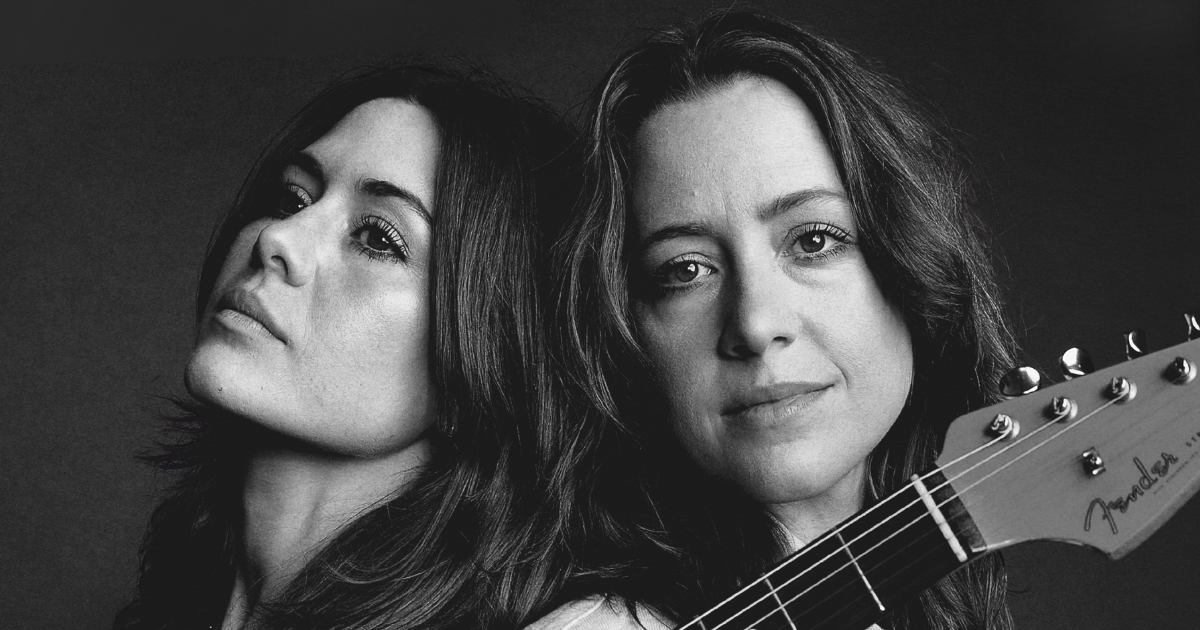
Megan and Rebecca Lovell are Larkin Poe, a band that nestles into a myriad of genres – and the sisters are good with that. Their newest full-length album effort, Bloom, out January 24, comes fresh off the heels of a GRAMMY win for Best Contemporary Blues Album with last year’s Blood Harmony. They also landed Duo of the Year at 2024’s Americana Honors & Awards, proving that by digging into their own stories, collaborating even when it isn’t easy, and filtering it all through what the music will feel like on stage, they carve a sound that knocks down doors into multiple genre territories.
Independent spirit permeates everything the sisters do, from the way they write and produce the music to how they map out the aesthetics of how they present the work. Bloom is no exception, finding the women delving deeply into personal and social themes in a way they say they have not before, the result of getting real with each other and learning how to collaborate through the writing process.
In “You Are the River,” we find them contemplating a common theme throughout the album, that sometimes the best and the worst are married inextricably and tie us to each other.
The sand in the oyster The pressure on the coal The sum of the parts is greater than the whole A chain of reactions A butterfly’s wing My hand holding yours to form another link
For our Artist of the Month interview, BGS spoke with Megan and Rebecca via Zoom from their respective homes in Nashville. The Lovells discuss the challenges and joy of writing together, the evolution of their relationship with their fans, and the pressures of public life in the age of social media.
You all have been lauded in multiple genres, from blues to Americana. You are also identified as a rock and roll band and here we are talking on a bluegrass outlet. What do you think about genres in general, and do you consider them at all during creation of the music?
Rebecca Lovell: One of the greatest pieces of advice that we’ve ever received was from Mr. Elvis Costello. Many, many years ago, he advised us to defy the temptation to put ourselves into a genre box. He has lived up to that creed himself, having made bluegrass, gospel, country, punk, rock records, operatic records, and musical records.
For us, having been able to sample all the different facets of who we are as people and music lovers allows us to connect with the people who are consuming our music. I think increasingly, all of us consume music from a wide range of genres. I do think that that’s one gift of streaming platforms. The very barest of silver lining is that it opens up your mind to the fact that there is great music to be found in every genre, and I think genre-blending is the way of the future.
So we call what we do roots rock and roll, which is intentionally very vague because we get great joy out of letting the many flavors of our musical heritage be represented. That allowed us this past summer to play at a bluegrass festival and then play at a world music festival, play at a pop festival, a rock festival, a country festival, and it keeps it fresh. It keeps it exciting.
You’ve won awards in multiple genres, especially in the past few years. I was curious: are awards ever a motivator for you? Do you ever think about them when you’re creating?
Megan Lovell: Winning awards is a very new thing for us. We’ve always made music with a different focus, because we’ve always felt that the real reward is people being willing to stand in line or travel and buy a ticket and wait at the venue for us to come and play. So that’s always been our focus. Not to say that winning an award isn’t a cool experience, and definitely something we’re super appreciative of, but I don’t think it’s something we consider when we’re writing or recording.
We’re definitely thinking about our live show. We’re really writing intentionally, thinking about how it will feel when we’re touring. Because that’s what we do most of the year is tour.
Tell me about your writing process, both when it’s just you two as sisters, bandmates, and business owners and then also when you bring in other folks to collaborate.
RL: I think Bloom represents a really cool point in our evolution as creative collaborators. Since the ground up, Megan and I have been projecting together since we were little kids. It’s felt like [there was] a lot of foreshadowing in our childhood that we would work together, because we’ve always been so collaborative. But songwriting was one of the last holdouts of our working relationship that there was friction in. I’m sure it has to do with the fact that there is a piece of this sibling rivalry thing. But getting older, being more comfortable with and accepting your flaws, and being able to then have the self-confidence in a writing session to throw out ideas – that inherently, because they are ideas, they’re not fully fledged. They can be misunderstood or sound stupid.
I think we’d had some writing experiences in the past where we had not had the best of times. It just felt like a lot of false starts. We typically had written separately, but something clicked in the last 6 to 8 months leading up to the writing process for Bloom. We made the commitment to and had many conversations about writing the record together, and I really think you can hear the progress that we made as a team in manifesting that true creative collaboration. I think the songs are so much better.
There was a real commitment to being very intentional with everything that we said on this record. Being a songwriter and a performer, there is always this temptation to self-aggrandize, or build a character for yourself, or be the movie theatrical version of who you are and what your life feels like. I specifically have written from that space in the past and listening back, we wanted to do something different this time. That was our consensus. We went through every song, every lyric on this record with a fine-tooth comb, to ensure that real vulnerable authenticity was represented in the lyrics. That took a lot of courage and I am really proud of us for making that commitment, and being able to actually pull it off with this album.
ML: You know, what’s funny is, when we were thinking about bringing in a third collaborator, did we go outside? No, we actually end up working with Rebecca’s husband [Tyler Bryant] a lot. So we have that sibling dynamic and the husband-and-wife dynamic. We really like to complicate things.
RL: There is a certain shorthand that exists when someone knows you really well, when you know someone really well, and especially between Megan and myself – and also Tyler. We all have very closely mirrored musical upbringings and we have a lot of kindred spirit energy in the records that we’re all referencing for the production and the songwriting.
It does create this space, when handled correctly, for being really truthful, being really genuine, and allowing yourself to actually go to those spaces. I was the big crybaby on this record. I was weeping in these co-writes, like inconsolable. But that allows you to really channel some specific, detailed stuff from your own experience. The more specific you’re able to get with yourself, the more likely it is you’re going to be able to connect with other people. And that is our biggest motivator.
That’s so wonderful. Speaking of, what is your relationship with your fans like? And do you see it evolving as you change your process and become more open that way?
ML: We have a lot of musically deep music lovers and they’re really cool, knowledgeable people. I think because we’ve kind of always been a little bit left of center, we’ve attracted a cool audience; people who appreciate the do-it-yourself attitude and people who just really want to support a grassroots effort.
We’ve had people who have been following now for decades, which is strange to be able to say, but they’ve really stuck with it. Of course, those relationships do shift over time. And certainly through the pandemic. That was a huge shift in the way that we related to people, because we were using the internet to connect. We had these pretty spiritual conversations with people that I’m not sure would have happened if we hadn’t been online and talking all of the time. We came out of the pandemic with a lot more intimate fans.
Can you talk about the recording process? Where did you cut this record? How did you decide to bring in your husband as co-producer?
RL: I do think the pandemic played a big role in the shift of Megan and myself bringing Tyler Bryant in as a co-producer because, for the last 10 years, we’ve been self-producing our records. At Megan’s behest as the big sister, she was like, “It’s time. We need to self-produce our records.” That was very scary at first, but we got our feet wet and got our bearings.
Ultimately, we’re so grateful that we made that shift, because it allowed us to hold the reins in the studio and steer the music in the direction that we wanted to go. Through the pandemic, we built a state of the art recording studio in the basement of our home, and we wanted to make records. We didn’t want to hold up our creative process. We were still distancing in our bubble. But it was the group of us, and by necessity we started recording in that home studio; we’re kind of blown away at the sounds we could get. There was an effortless nature of being in a really safe home environment.
When Megan and I tour with our band, we’re a four-piece, so we set up as a four-piece in the studio and went for it. Hopefully, that will allow our records to age gracefully because they are very true and very stripped down to who we are as a band.
ML: But honestly, when we were going to studios, we were experiencing a lot of Keurig machines and we like really nice espresso machines. So we made the decision to stay home.
Let’s talk about the song “Pearls.” It seems to be built around the idea of maintaining a sense of self while you’re navigating the world that’s constantly reflecting you in such a public way. I wanted to know, as family and as bandmates and business partners, how do you navigate the ever-changing and tumultuous world of being in the public eye, especially in the age of social media?
RL: I think it’s one of the hardest things. It is so challenging to exist in a space where you need to have just enough ego to get on stage and perform. But you can’t identify too much with that ego, because then you’re creating a very limited, narrow lane for yourself. But don’t have too big of an ego, because then you’re going to be a bitch and nobody’s gonna like you. So it’s this weird straddling of all these different elements of our identities. And then we’re having to do that together.
With so much shared experience between us, Megan knows the true me. I think that you and I have cultivated a great deal of grace, allowing that true nature to evolve. Who we were when we were 5, is simultaneously the same as who we are now, and also very, very different. Allowing that leeway for ourselves is only something that we’ve started really engaging with in the last 5 years. Right, Megan?
ML: Yeah, we’ve had a lot of conversations over the last couple of years. We are coming to more of an understanding of where the tension was coming from, from who we are as people, and then who we expect ourselves to be on stage. Then also that sort of external pressure that everybody has that we also felt from a very young age from the people around us. There are people in the industry who expect us to be something and then fans who come and meet us. There are a lot of opinions flying around, but you really don’t have to take anything on board that you don’t want to.
Whether it’s that one negative comment on a post that you for some reason have to obsess about, even though there are 99% positive comments. You just can’t get that negative comment out of your head and I don’t even know if I trust that person’s opinion. It’s a good reminder to just steer your own ship.
You mentioned different kinds of festivals, different genres of festivals. When you think about your tour, what kind of stage do you feel the most at home on? Is it a festival? Is it a club or theater? Is it a genre of festival?
ML: 2025 is going to be a big year for touring. Last year we played a lot of festivals. This year we are playing a lot of headline shows and we’re going to start in the U.S. and go through the spring. Then we’re gonna do a big fall European tour. And it’s shaping up to be really, really amazing. We have a really substantial following over in Europe. We have done a lot of work over there. There’s some bucket list venues that we’re gonna play.
I love a headline show. You know, where the place is packed, and there’s that energy in the audience, and everybody knows the lyrics. There’s nothing that beats that vibe and you can find that anywhere. You can find it in a tiny rock club to an arena or a festival. The important thing is that people are engaged from the stage to the audience, and vice versa.
Same for you, Rebecca?
RL: Yeah, I agree. I love a headline date, I think, especially because Megan and I are album people. We like a body of work. I like to sit down and listen to an artist’s album from the beginning to the end to try and get a sense of where they were at when they were writing the record. Megan and I, when we make our records, we obsess about the content, about the story arc, about the sequencing of the record, about the packaging, about the font.
And I think we get that same kind of energy in a headline show because we’re thinking about the colors of lights and which of the songs we are going to include and how much of the old material. We really want to have that space with the music and the emotional content of the music, and you feel that energy, and you feel that resonance. If everything goes right and everyone has their hearts open, you gain access to this portal where I think a lot of transformative change can happen between humans. And that’s what we seek.
You’ve reached the end of the week! For a little treat, how about a few brand new songs and music videos? You Gotta Hear This!
If you’re looking for bluegrass, we’ve certainly got it this week– Chris Jones & The Night Drivers share their first recording of a Tom T. Hall original, “Mama Bake a Pie (Daddy Kill a Chicken),” since their dear friend and Bluegrass Hall of Famer passed away a few years ago. Plus, bluegrass legends Seldom Scene preview their upcoming album, Remains to Be Scene, with a new single, “Last of the Steam-Powered Trains.” And, wrapping up our bluegrass trifecta, banjo player Max Wareham pays tribute to NHL team the Boston Bruins with an excellent shredding instrumental tune, “The Black & Gold.”
From elsewhere across the roots music landscape, duo Swearingen & Kelli offer “Break Me Down,” a powerful acoustic number with plenty of grit, slide guitar, and blues influence. Plus, don’t miss Justin Wells’ new music video for “Sad, Tomorrow,” a contemplative slow burn of a song that focuses on mental health, melancholy, and forging ahead.
It’s a lovely collection of new roots music to take you into the weekend, and you know what we think – You Gotta Hear This!
Chris Jones & the Night Drivers, “Mama Bake a Pie (Daddy Kill a Chicken)”
Artist:Chris Jones & The Night Drivers Hometown: Nashville, Tennessee Song: “Mama Bake a Pie (Daddy Kill a Chicken)” Release Date: January 17, 2025 Label: Mountain Home Music Company
In Their Words: “This is an old and lesser-known Vietnam War-era song of Tom T. Hall’s and the first song of his I’ve recorded since his passing a few years ago. I think I didn’t feel ready to until now. He had a unique ability to incorporate bits of humor into a sad story, and this is definitely one of those. This song is vivid and poignant in a way that is vintage Tom T. I was going to record this several years ago, but when I brought it up to Tom T. and Dixie, they wrote ‘Hero in Harlan’ that very day to give me something new to do instead.” – Chris Jones
Seldom Scene, “Last of the Steam-Powered Trains”
Artist:The Seldom Scene Hometown: Bethesda, Maryland Song: “Last of the Steam-Powered Train” Album:Remains to Be Scene Release Date: January 14, 2025 (single); March 14, 2025 (album) Label: Smithsonian Folkways
In Their Words: “This song was written by Ray Douglas Davies and recorded by the rock group The Kinks in the 1960s. The Scene has always looked outside the box for material, and we thought this one fit the bill.” – Lou Reid
Swearingen & Kelli, “Break Me Down”
Artist:Swearingen & Kelli Hometown: Nashville, Tennessee Song: “Break Me Down” Release Date: January 24, 2025 Label: Gone Rogue Music
In Their Words: “I wrote this song a few years back, but it never really got its due. I was also really obsessed with slide guitar at that time. It’s a little gritty, and when Jayne added her vocals on top, I thought, ‘Ok, this is exactly what this song needs.’ I love the discovery process of writing and recording. Sometimes it takes a while to find the exact combination of sounds with an arrangement to tell the story the way you really want to.” – AJ Swearingen
Track Credits: AJ Swearingen – Guitars, drums, percussion, bass, vocals Jayne Kelli – Vocals, organ
Max Wareham, “The Black & Gold”
Artist:Max Wareham Hometown: Boston, Massachusetts Song: “The Black & Gold” Album:DAGGOMIT! Release Date: January 17, 2025 (single); February 21, 2025 (album)
In Their Words: “Sports and music might have more in common than we think – this tune is a tribute to the Boston Bruins’ legendary ’22-’23 season, during which they broke most NHL records. Musically, the A part was inspired by Bill Emerson and the B part is a nod to the style of banjo legend, Rudy Lyle.” – Max Wareham
Track Credits: Max Wareham – Banjo Laura Orshaw – Fiddle Chris Henry – Mandolin Chris Eldridge – Guitar Mike Bub – Bass Larry Atamanuik – Snare
Justin Wells, “Sad, Tomorrow”
Artist:Justin Wells Hometown: Lexington, Kentucky Song: “Sad, Tomorrow” Album:Cynthiana Release Date: January 15, 2025 (single); February 20, 2025 (album)
In Their Words: “The title of the song comes from a story Nicole Kidman told Marc Maron on Maron’s podcast, WTF. Kidman talked about how she often took her characters home with her, acting in front of a mirror. Her young child had grown accustomed to seeing and hearing her mother work on these roles. A day or so after Kidman’s father died, she was grieving at home, and her kid heard this. Her kid asked ‘Mom, why are you crying?’
“‘Well, I’m crying because I’m sad, because Papaw died.’
“Her child, accustomed to seeing her Mom go in and out of emotions while working on her acting, replied, ‘Well, are you gonna be sad tomorrow?’
“I wanted to write this song about that feeling of helplessness you have when a friend is struggling with depression, when the only thing you can do sometimes is just be there. I ended up asking my dear friend Adam Lee to help me finish it, which was considerably apropos, because we’d both been each other’s therapist through lockdown, when we were kinda losing our minds. Considering all of the above, the song carries an even bigger weight because it’s one of the last songs that my friend Robby Cosenza played on before he passed. Robby was a Lexington icon, playing on hundreds of albums including a Ringo Starr record as well as my debut album, Dawn in the Distance, and he was instrumental in helping me get my legs under me when I started my solo career.” – Justin Wells
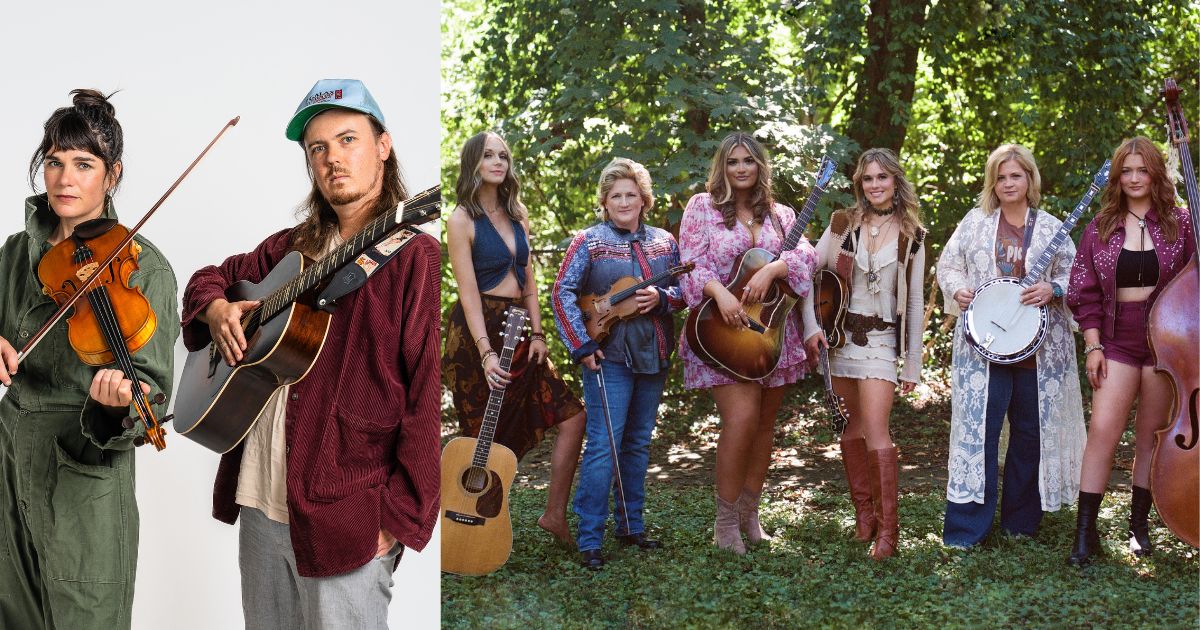
Photo Credit: Seldom Scene by Jeromie Stephens; Swearingen & Kelli by Daniel Shippy.
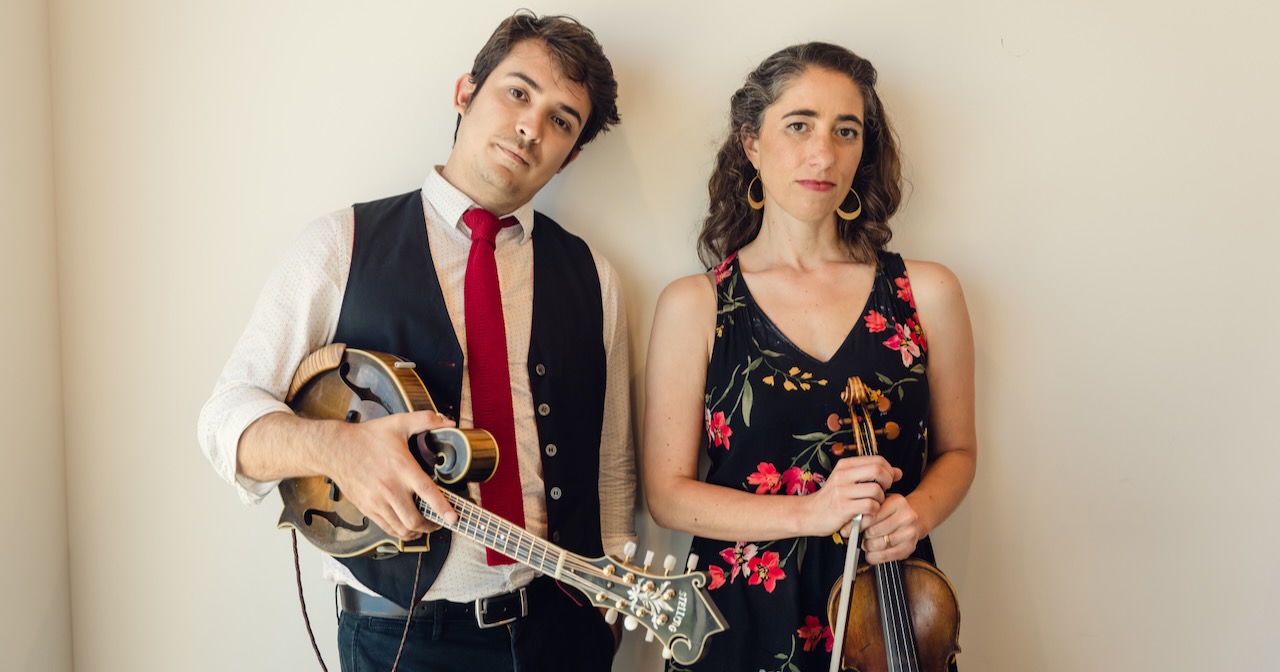
Acutely expressive, profoundly innovative, and ceaselessly gripping, Scroggins & Rose are masters of sonic storytelling. The project consists of Alisa Rose (violin) and Tristan Scroggins (mandolin), both virtuosic talents with a sprawling list of credits each in their own right. While Scroggins primarily forays in the bluegrass sphere and Rose spent her musical upbringing largely studying classical music, the two alchemize a blend of genres to achieve their distinct style.
The duo’s third collection, Speranza, relays a moving dialogue between fiddle and mandolin, drawing upon a diverse range of musical influences to weave together a thoughtful assortment of colors and textures. Initial ideas for the project began back in the quarantine days of 2020, and Speranza – which consists of six immersive instrumentals, a dynamic assortment of original and familiar tunes – now arrives nearly five years later in a moment where its intonations of hope feel just as crucial.
BGS had the pleasure of sitting down with Scroggins & Rose to discuss their origins, influences, and the percolation of their most recent release.
Congratulations on the album release! To start us off, could you talk about how the two of you came into playing together?
Alisa Rose: We both taught at NimbleFingers, which is a camp in British Columbia.
Tristan Scroggins: It’s a bluegrass week of workshops that has been going on for a couple decades. I always describe it on stage as “sleepaway camp for adults who want to learn how to play the banjo and drink.”
AR: There’s a really nice feel at that camp. Tristan was in a band with his dad at the time, so I did some shows with them there. Then one night, I remember the two of us improvising by a picnic table and we just had a really nice musical chemistry where we follow each other’s ideas around. Immediately it felt like, “Oh, this is a good musical fit.”
TS: At that time I was playing with my dad in Jeff Scroggins & Colorado, and we were touring full-time. So I just ended up in California a lot and I would tack on extra time to come hang out with Alisa. And we started writing music and playing shows. I live in Nashville now, so these days it’s more of a deliberate effort when I come out to collaborate.
At this point you’ve been able to flesh out that musical chemistry over the course of three collections. What would you say unites your musicality or differentiates it?
AR: I think when we improvise, it’s playful and creative and experimental – we’re not afraid to leave what may be reasonable behind, and sometimes that takes us to good places, and sometimes we fall on our faces. We also have a similar sense of rhythm and how we respond to it. It allows us to improvise freely because we feel rhythm in the same way. So that’s where we unify, but we have really different musical backgrounds.
Could you tell me more about that?
AR: Sure. Growing up I played a little bit of fiddle, but mostly I grew up in the classical world. I was a Suzuki kid, so I learned by ear initially, which I think has allowed me to play a lot of different music, but I was learning primarily classical violin growing up. Tristan grew up very much in the bluegrass world, and I’ve studied bluegrass and I’ve played in bluegrass bands, but I still have a different sense of melody and expressiveness. I think a lot about how to make music really expressive emotionally and I play with timings – those two things are less common in the bluegrass world.
TS: I think it’s been really valuable for me, generally musically and especially in the context of this project, to be exposed to those different ways of thinking about playing. I grew up playing with my dad, and in mandolin contests just learning how to play bluegrass, which does instigate this question of, is bluegrass expressive or not? I think it is sort of, but it’s so different from how classical music is expressive or how jazz is expressive. I’ve had to work a lot on navigating that challenge, because for me, I didn’t go to school at all for music. So much of how I play is very instinctual and this project often has me figuring out how to adapt those instincts in order to have more options, especially since there’s just two of us. We have to really be on the same page a lot of the time and work together to fill in spaces or leave holes where we want them to be – they have to line up, and it’s really obvious if they don’t.
Speranza does an excellent job at combining those classical and bluegrass sensibilities to achieve expression while still leaning into roots-like melodies. Can you tell me about the impetus behind your latest release? What drove you to create this third collection?
AR: So our first collection, Grana, was very improvised and we were a new duo. Basically we set out to make a demo – we wanted to record, like, three tunes and get some gigs. We got an Airbnb, rented some recording equipment, had our awesome engineer friend set it up for us, and we just hit record over and over for a weekend. By the end it seemed like it was an album, so that’s how that one came to be. Very improvised, very sort of exploratory. There were like 1000 takes of everything. Well, not actually 1000 because we didn’t have that long, but there was definitely a sort of trial and error of figuring out what we wanted to create.
And then for the second album, Curios, we worked out everything. We rearranged everything and really sought to emphasize the strength of melodies. A lot of that album was about making the melodies come out. To me, it’s also an exploration of different sound colors. We worked with Wes Corbett on that one and he helped bring that out in that album. We really tried to shape each tune into a little story, so they’re more composed. Some have solo sections, but they’re more like little pieces and arches – I mean, I would call them miniatures, but really they’re sort of standard length for bluegrass. In the classical world they might be considered miniatures– little, crafted, sparkly gems.
But we put [Curios] out in the pandemic, which was very anticlimactic. We were supposed to have a release tour and we worked really hard on that album for a long time. We had received a great grant from FreshGrass and were able to do a lot of things in the way we wanted. We worked with Dave Sinko as our engineer, who was awesome, and recorded in this pretty church in Nashville with Egyptian stained glass.
So the third one, Speranza, is more organic. We’ve grown as a duo in terms of creating, so we decided that instead of writing a whole record of stuff we would write and record as we went, or write and improvise as we went, and do some of both. So I believe this album combines the freedom of the first album and the shape and craft of the second album. And the material for Speranza came out of the pandemic – that was such a crazy time. Life seems sort of normal now, but a lot of the tunes started in that time and then we finished them once we could get back together.
TS: I think that in a lot of ways Speranza feels very shaped by the reality of the pandemic, 2020, things getting shut down – the first stuff that we worked on remotely, because we had to. It feels wild that we’ve been working on this for years now. It’s funny, similarly to the pandemic, it doesn’t feel like that was five years ago. We recorded it over different sessions and then mixed it over different sessions.
AR: “Pandemic Buddy” and “Reaper” are the darkest ones – those I did write in like that first month of the pandemic, but I just came up with the beginning idea and then as a duo, over two or three or four visits, we finished writing the pieces together. We’re often coming up with ideas, kind of sitting with them, and then recording voice memos and listening to them. It takes us a fair amount of time to do it and we really flesh out the arrangement and how our parts fit together in person. That tends to be pretty time-intensive. Basically we’re writing the pieces, but we’re memorizing them at the same time, with space for improv – everything is fluid, but the basic composition is pretty worked out. So our compositional process is pretty spacious and lengthy.
What was inspiring you during the composition of these pieces? Any art that you were ingesting or other cultural touchstones of during that moment?
AR: In the beginning of the pandemic, Tristan did a tune challenge, which is where some of these songs started. There was a word prompt every day to write a tune about. For example, “Reaper” began with the prompt “death.” “Pandemic Buddy” was for the prompt “friend.” It was a really nice way to channel energy at the beginning of the pandemic, when everything was crazy. I spent hours every day writing these tunes and trying to get a good video, and I think I got a little better at them as I went.
TS: I mean, it’s sort of an obvious one, but we talk a lot about Mike Marshall and Darol Anger. It’s the same mando and violin pairing, but I love listening to them and listening to other people who do this kind of new acoustic music/composing. I spend a lot of time in Nashville with Wes Corbett. Wes produced our second album, but he’s also a friend of mine, and I helped him with publicity for his first album, which has a lot of really beautifully written instrumental pieces.
It’s interesting – we spent so much time working on this in chunks and that was a very different part of my brain than the part of that was working very hard on, like, Texas-style fiddle tunes. Those weren’t crossing over, exactly. I think rather than being influenced by something specific, it’s more that I try to cultivate something within myself by listening to both stuff I like and new stuff. Absorbing all of that, letting it ferment inside, and then figuring out how to express that all together, rather than trying to emulate any one thing.
AR: I tend to think that when composing, everything you’ve ever listened to, everything that ever resonated with you and definitely anything you’ve ever played with your body or had in your body – whether you danced to it, or you physically played it – is a part of your musical sensibility. I don’t know what I was listening to when I was writing these tunes, but I definitely love Darol Anger and Mike Marshall. I also love Schubert string quartets, I love Beethoven piano sonatas, and I love Debussy piano music – I love a lot of different kinds of music, and I think all of that is part of what comes out. That’s all part of what’s in my head when I’m conceiving of new material.
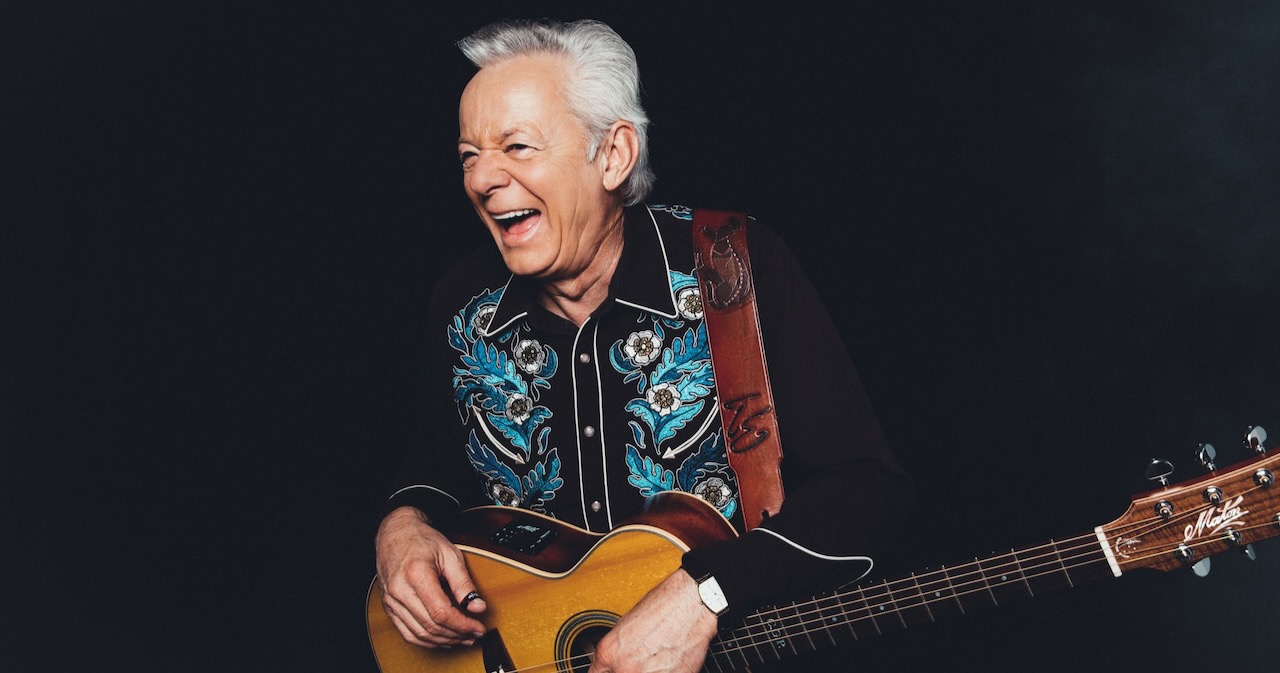
In a black ruffled shirt on a brightly colored stage, Tommy Emmanuel sits with his guitar and, like always, amazes the audience with his music. His latest video, “Gdansk/Tall Fiddler (Live at The Sydney Opera House)” is an upbeat and beautiful showcase of his songs that demonstrates the excitement and ease Emmanuel brings to his music. The medley is a single from his forthcoming album, Live at the Sydney Opera House, out March 21.
The clip starts off with a new original, “Gdansk,” named after Gdansk, Poland, where Emmanuel wrote the tune. It’s soft yet energetic, emulating the feeling of calm ocean waves on a sunny day that at the same time brings energy and joy to the music. The peaceful and uplifting melody might make you want to get up and dance.
“Gdansk” then beautifully leads into another tune of Emmanuel’s entitled “Tall Fiddler,” a number off Emmanuel’s 2006 release Endless Road that was inspired by the great fiddler Byron Berline. With fast licks and a rock and roll feel, he effortlessly transitions between a bluegrass fiddle tune and a heavy, rocking vibe.
It’s easy to see the excitement Emmanuel brings to playing and performing. The way he just “goes for it” is utterly inspiring – you can see how the music takes over him as he becomes the vessel that brings it into fruition.
As usual, it’s Friday and we’ve got a handful of videos and tracks you gotta hear this week!
Kicking us off, bluegrass and old-time duo Golden Shoals offer their fresh, topical take on a classic from the American songbook with “New White House Blues.” Then, singer-songwriter Heather Maloney brings us along through a “Labyrinth in the Weeds,” a nostalgic track about the circuitous, non-linear quality of grief and loss.
GRAMMY-nominated bluegrass supergroup Sister Sadie return to the round-up with a new single, “If I Don’t Have You,” a Dani Flowers-penned love song that’s as good as love songs get – because it keeps it simple. To wrap up this edition, Evan Westfall (who you may know from CAAMP), debuts a fascinating and ethereal instrumental, “SISDM,” that’s timeless and modern all at once.
They’re all right here, on BGS, and you know what we think– You Gotta Hear This!
Golden Shoals, “New White House Blues”
Artist:Golden Shoals Hometown: Nashville, Tennessee / Vancouver, British Columbia Song: “New White House Blues” Album:The Dream and the Hunger Release Date: January 17, 2025 (single)
In Their Words: “At the center of a Venn diagram featuring history, politics, and bluegrass music is a special kind of nerd. ‘White House Blues’ has always been a favorite of mine and I wanted to dive deeper into the story behind the McKinley assassination. The culprit, Leon Czgolsz (who is unnamed in ‘White House Blues’), was disillusioned by the inequity of the Gilded Age, and felt his actions would usher in a revolution for the working class. He truly was the Luigi Mangione of his day. The consequent presidency of Teddy Roosevelt looks like a win for the common man, but that idea is a house of cards. The motives of these assassins resonate with me, but these moments highlight this fact: without collective action, true and lasting change will never come. Through this 10-verse murder ballad, we pay tribute to Charlie Poole’s initial recording of ‘White House Blues’ by gradually speeding up, which builds tension and atmosphere.” – Mark Kilianski
Heather Maloney, “Labyrinth in the Weeds”
Artist:Heather Maloney Hometown: Northampton, Massachusetts Song: “Labyrinth in the Weeds” Album:Exploding Star Release Date: January 31, 2025 Label: Signature Sounds
In Their Words: “This song is an ode to one of my earliest and most favorite memories at my childhood home, which was at the edge of the Appalachians in northwest New Jersey. My dad would let the grass in the field grow until late summer. When it came time to mow, he didn’t cut it down all at once– he’d weave through on the John Deere, making a sort-of maze for us kids and we’d follow behind.
“I remember how it felt so viscerally; the smell of the grass, the crunch under my feet, and especially the giddy feeling of losing sight of him when he rounded a new corner. After he died this actually came to mind. I had a sense that my dad, who was always making a game out of things, had just rounded another kind of new corner I couldn’t yet see past. It was a comforting thought and the inspiration for the song.” – Heather Maloney
Sister Sadie, “If I Don’t Have You”
Artist:Sister Sadie Hometown: Nashville, Tennessee Song: “If I Don’t Have You” Release Date: January 10, 2025 Label: Mountain Home Music Company
In Their Words: “I don’t write too many love songs. Most of the songs in my catalog are admittedly pretty depressing. But ‘If I Don’t Have You’ is just that – a love song about loving someone so much that everything you’ve ever wanted or hoped to accomplish now pales in comparison to the need you have to be with that person.” – Dani Flowers
“Dani Flowers came to me with this sweet melody and the first two lines of this song. We finished it that day. This is my favorite kind of love song; simple melody and simple lyrics. It doesn’t get much better than Dani’s angelic voice singing about how going through life and experiencing the most amazing things wouldn’t mean half as much ‘If I Don’t Have You.'” – Deanie Richardson
Track Credits: Dave Racine – drums Deanie Richardson – fiddle Gena Britt – banjo Mary Meyer – mandolin, piano Maddie Dalton – Upright bass Seth Taylor – Acoustic guitar, electric guitar Dani Flowers – Lead vocals Jaelee Roberts – Harmony vocal
Evan Westfall, “SISDM”
Artist:Evan Westfall Hometown: Columbus, Ohio Song: “SISDM” Album:Is This Our Exit? Release Date: January 8, 2024 (single); January 24, 2024 (album) Label: Super Sport Records
In Their Words: “This song came together by accident after I started tuning my guitar with no direction and stumbled into the tuning of EBEF#BD#. This song title is a reference to an essay by the Columbus-based poet Hanif Abdurraqib about the transition from summer to fall. You can really feel that shift in seasons here in Ohio, the excitement that comes with the fresh start of something like a new school year or football season, even though that season ends up in bare trees and cold grey skies. It’s a hopeful melody, but overly dramatic.” – Evan Westfall
Track Credits: Evan Westfall – Guitars, banjo, drums Dan Alvarez – Guitars, banjo, bass, drums Jordan Dunn-Pilz – Guitars, drums
Photo Credit: Golden Shoals by Mike Dunn USA; Sister Sadie by Allister Ann.
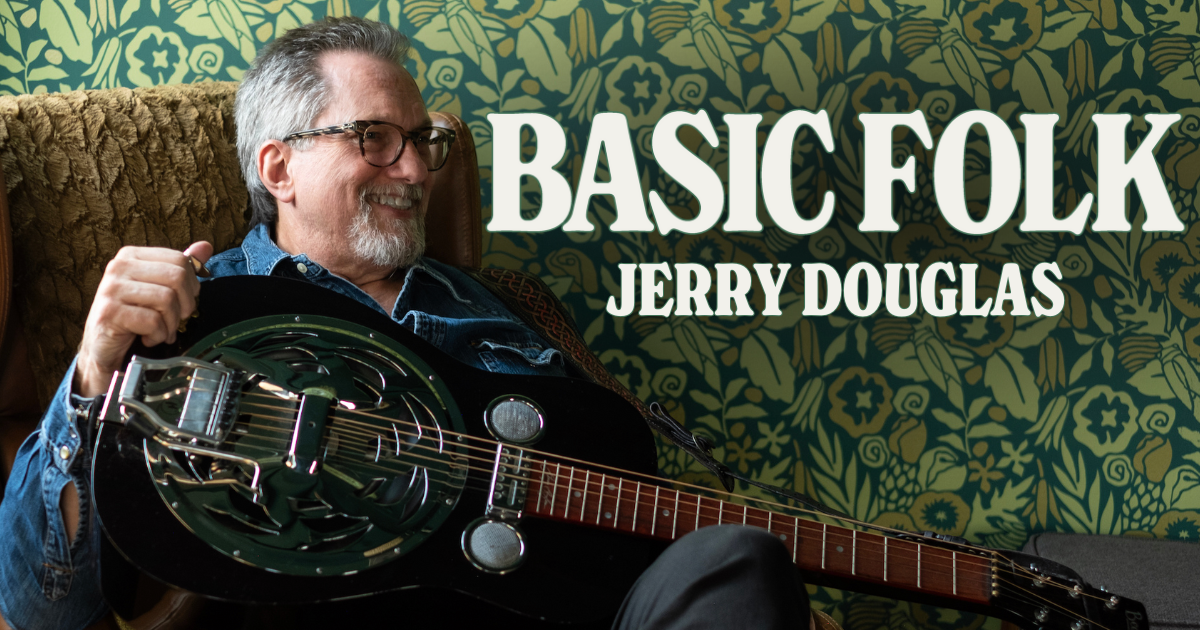
Jerry Douglas is widely regarded as the best Dobro player in the world. Alison Krauss, Emmylou Harris, and James Taylor are counted among his many collaborators and his four-decade career has earned him 16 GRAMMY Awards and numerous other accolades. In our Basic Folk conversation, he shares stories about his upbringing in Warren, Ohio, where his father’s steel mill job and love for music instilled in him a strong work ethic and a passion for playing. He also talks about getting scouted as a teenager by The Country Gentlemen, one of the greatest bluegrass bands ever, who eventually took young Jerry on tour.
In addition, we discuss Douglas’ latest album, The Set, which showcases his mastery of the resophonic guitar and features a unique blend of bluegrass, country, and Americana sounds. He also opens up about his experiences working with Molly Tuttle, John Hiatt, and other notable musicians, highlighting the importance of collaboration and creative freedom. Our chat offers a glimpse into Jerry Douglas’ life, influences, and artistic approach through his humility, humor, and dedication to his craft.
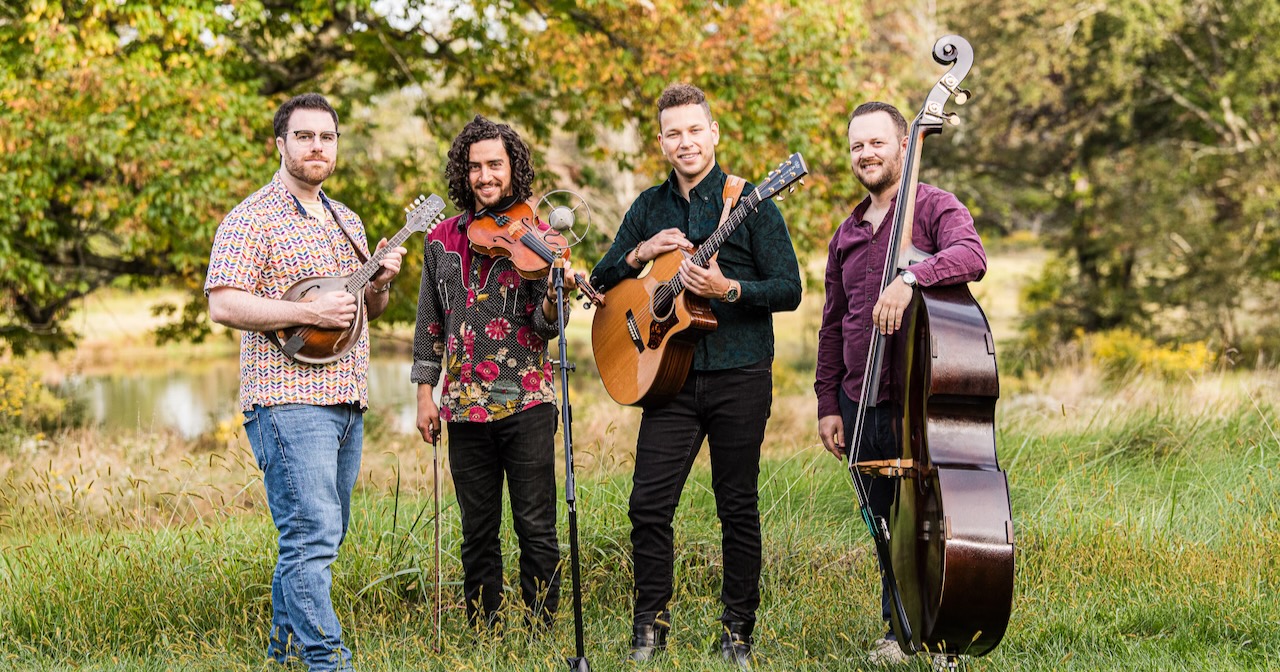
While Boston may claim its title as the bluegrass capital of the Northeast, acoustic quartet On the Trail is living proof that the Connecticut bluegrass scene is not only alive and well, it is thriving. Composed of four impeccable musicians who each attended Western Connecticut State University to earn vastly varying degrees, On the Trail weaves together an uncommon collection of backgrounds to deliver a unique sound.
Drawing inspiration from opera to the Beatles to jazz, these four achieve a sonic richness that will leave listeners edified and enamored. True to their band’s name, they trailblaze full force with the release of their first full-length album, Where Do We Go from Here.
BGS recently had the pleasure of sitting down with Tom Polizzi (mandolin, guitar, vocals), Matt Curley (bass, vocals), Charlie Widmer (guitar, vocals), and Austin Scelzo (fiddle, vocals) to discuss all things On the Trail.
Congrats on the new album! Will you tell me a little bit about how you all ended up in a bluegrass band together?
Tom Polizzi: Well for me, I was a really, really serious jazz guitar player for a number of years – it was my whole life. Then around the end of high school I started to get a little more disillusioned with what jazz was about and where that could take me in life. I knew about Chris Thile, though weirdly I didn’t know about mandolin’s association with bluegrass, but I knew I was really interested in mandolin, the tone and potential of the instrument. I got a little $400 scholarship from the music department at my high school and bought myself a mandolin as a graduation gift for myself.
I learned to play walking around a camp that I worked at that summer with the thing on my back, playing while I walked anywhere around the camp. I remember standing somewhere at that camp with the mandolin and someone asked, “Do you want to play a bluegrass tune?” I was like, “A what?” And then they taught me “Cherokee Shuffle.” From there, I just started learning fiddle tunes and while in college I pretty much gave up on jazz aspirations. Even though I got my scholarship to school with jazz, I just kind of started playing Doc Watson and bluegrass tunes and the rest is history.
Austin Scelzo: My background was in classical violin. I learned to read [music] growing up in school orchestra and then went on to study it in college. But in the summers of my later high school years, I got sent to those iconic fiddle camps that get so many people in the door and that opened up my whole world to non-classical playing, which eventually propelled me into spending my summers in college exploring different music camps and festivals. My freshman year of college I went to Grey Fox, my first bluegrass festival. And throughout college, I started playing in a bluegrass country group locally. I would play classical music in school systems and then spend summers floating from festival to festival, living out of my car and really digging into the bluegrass stuff, which over time grew to become my primary musical expressive tool. So between the classical/arranging mindset and my investment in traditional bluegrass, that’s kind of where my musical tastes lend themselves to this group.
Charlie Widmer: Austin and I met when I was 19 years old – he’s actually the one that married my wife and me; he got ordained for it. We’ve known each other for such a long time. I had auditioned on a whim for a musical at 16. Didn’t know I could sing. They were doing Grease and I had a crush on a girl at the time. I went into that room and I met my now-wife, that same day at the audition, and I ended up getting the lead role. And then that kind of spiraled into more musical theater and trying to get into music school.
When Austin and I met, I was in school for classical singing and we were both interns at a church in Ridgefield [Connecticut], where we were both paid section leaders in the choir. After about a year of working together, somehow we ended up sitting next to each other. You know, we were in an a cappella group together, lots of different choirs, all these classes, but we just hadn’t connected. But as soon as we sat next to each other it was clear that we were getting along.
And so, fast forward five years, I was in the middle of a gig with my hip-hop soul band. I’d been doing stuff as a front man for a hip-hop soul group and it was awesome. I’m drenched in sweat, and Austin and I are talking in the break and I say to him, “Hey, man, I’ve been listening to Chris Thile and his group, Punch Brothers, and they’re sick, man. If that’s, like, a possibility in bluegrass, I’d love to do something where I’m playing guitar – let me know if a gig pops up.” We kind of agreed that he needed another year to finish school and get settled into being a teacher and everything. And a year later, almost to the day, he said, “I got us something if you want to drive.” It was perfect timing. My other group was falling apart. When this started, it just kept working and going. I don’t think any of us ever thought at that point, six years later we’d be here with an album.
Matt Curley: I was the last member to join On the Trail and I’ve been in the group for about three-and-a-half, four years now. I started playing guitar when I was in middle school and in early high school, I was playing in punk rock bands. When I got to high school, I really wanted to play in the jazz band playing guitar, but the guitarist was very good, So I thought, “I’ll play bass. It’s easy, it’s four strings.” Then the band director points to the upright bass. I remember thinking, “No, no, not that one!” So during that rehearsal it was the first time I ever played upright, and I eventually came back to the bass.
I’m the kind of guy who’s switched instruments several times. I switched to percussion, joining the drum line. I ended up marching drum corps for a few years, which led me to majoring in percussion at WestConn and then to get my master’s degree in Tennessee, right outside of Nashville, in classical percussion performance. For a while I thought I was going to be in professional orchestras, as I was training and practicing to take auditions for triangles and cymbals. Glad I didn’t do that. Then I started teaching band down there in Tennessee and I ended up moving back up here. I was teaching and Austin was the orchestra teacher in the same school, so we started jamming. Up to this point, I knew nothing about bluegrass. Even living in Nashville for a while, I knew nothing about bluegrass. Then I just happened to own a bass, so that led to me showing up to an On the Trail rehearsal. Here we are, three and a half years later.
CW: We also had a banjo player with us for the first three years, Chet, who was from Mississippi and originally grew up in Nashville. Chet lent a hand on some of the songs, even on the album. He got a doctoral offer to go down to Florida and get his doctorate in philosophy. He’s a genius, really such a smart guy – we always hope that Chet will join us again. We just always have a lot of fun together. I think that can be rare in groups.
Absolutely. Y’all have amazing chemistry and it’s evident. You recently released the band’s first full length album, Where Do We Go from Here. What are you each proudest of on the album?
TP: I think the fact that I actually wrote songs with lyrics and they made it somewhere. After I finished school with an audio engineering degree, I did our whole first EP – all of the editing, mixing, mastering – myself. And with this record, I felt like that kind of stuff culminated in a different way, where I knew how to be on the other side of the booth, so to speak, in a way that was productive. I think I was able to help us keep the sessions thoughtful and productive throughout, from a perspective of final product.
I also love that I’ve got a couple of very sad or introspective songs on the album, one of which my fiancée didn’t know I had written. We were on the phone with her mom and she was talking about “Help Me” on the album. She said something along the lines of, “This is so devastating. Tom, you really wrote something beautiful.” And Claire goes, “You wrote that devastating song about heartbreak and loss?!” I had all these things written years ago after I broke up with my ex-girlfriend. Claire had never heard it because I don’t sing it – Charlie sings it on the record and we don’t play it at shows very much. She didn’t know I was capable of even having such sad words in my brain.
AS: I love that this album captures three or four original songs from each of us. My three songs all have a really different feel than anything else I’ve put out and they all mean something really powerful to me. They each capture a timestamp of a part of my life. The title track, “Where Do We Go from Here,” was one of the last songs we recorded, and one of the last songs that we even talked about putting together. It almost didn’t make the album at all. But we’re so proud of that track. That’s the song I’m by far the most pleased with. I also really like the way that “Trouble in My Soul” captured a different side of my voice that I’ve never captured on a record. It’s a lot more gritty, which is kind of cool, and then “Can’t Get You Out of My Mind” has some really nice moments too.
CW: For me, honestly I think the whole album is the pride point. When we did our first record, we had no clue what we were doing. I was really green to bluegrass in so many ways. Those first couple years were trial by fire, where I had no clue about any artists or vernacular and I was constantly terrified of every gig and jam. It felt like everyone was speaking a language. This record feels very full circle – we’d been talking about it forever. It really captures who On the Trail is. As songwriters, I think all of us have gained some confidence, though so much of that has come from just performing these pieces and getting positive feedback from the audience the last six years. When we started we didn’t know we had something, but our friends and family and even strangers told us to keep going. It just kept fueling us, you know? So, yeah, when I think about the proudest thing, it’s that we have this collection.
Given the diversity of musical backgrounds you each come from, where do you feel like your aligned priorities are? Do you have through lines about what you all prioritize and value musically?
TP: I would say one of the biggest factors that held us together is just that joy of making music. One of our biggest frictions, probably, is that diversity of background – even now, in the background of this interview, I’m just wrapping up my marketing job, my day gig, Matt’s driving home from teaching school, and Charlie and Austin both freelance more and do more things that are full-time music. A lot of it has been about finding that balance that brings us all joy and keeps us believing in what we’re doing. But you know, on our toughest days, what drives us ahead is that we love making music together, we love making music on our own and sharing it with one another.
CW: Yeah, as any musician knows, we’re always just chasing that incredible moment. We all share a true appreciation of music, and we are all deeply aligned regarding what exciting music feels like. When something’s hot, we all can agree immediately – it’s not even so much of a discussion.
AS: We’re all also pretty consistent with the vocal harmony, regardless of the song. No matter the arrangement, we value strong vocal harmony and strong vocal presence. So a big part of this group is understanding harmony to a point where we can get really good three-part and other types of arrangements.
TP: For probably the first year and a half, I didn’t sing a note in the band. Vocals have become such a big thing. I learned from these guys, who are and always will be better singers than I, but they coaxed it out of me.
MC: Same for me. I’ve never taken a voice lesson or anything and now I’m singing four or five songs. It’s incredible.
For our final question – you’re our One to Watch, but who are you watching right now? Any creatives, musical artists, or otherwise that are inspiring you right now? Could even be a TV show or a Tik Tok creator.
TP: I’m sure they’ve been featured here a lot, but someone who’s been talked about a lot in our band is AJ Lee & Blue Summit. We love them. We’ve played with them. We’re inspired by them. Lots of our friends just around here, you know, keep us moving. The Ruta Beggars are doing fantastic things. Cahaba Roots, High Horse – all of those guys have so much going on. And if you’re looking for a good TV show to watch, watch Shrinking, because it’ll just rip your heart out. Oh, and one sleeper album – if you love all the music that we’ve talked about, this is an album I’ve heard no one else talk about. Maybe I’m just not talking to the right people, but it’s an album called Passages by Ethan Sherman. It’s got Wes Corbett on the banjo, and Thomas Cassell plays amazing mandolin on that album. I found it very inspiring.
CW: For me, a constant, big influence in songwriting and sticking to your vision and making it work has been Theo Katzman, who’s one of the guys from Vulfpeck. His last record especially resonated incredibly. All of his records have, but that one was during the process of making my album, as well as On the Trail’s album, and it empowered just feeling brave enough to do what we felt was right for the music. He was a big inspiration.
Allen Stone is also a huge inspiration for me as a singer and as a songwriter and he just dropped a new project. I always come back to Nickel Creek and Punch Brothers. Nickel Creek’s last album, I thought, was stunningly brilliant and beautiful.
MC: It’s really a great time for bluegrass, country, and folk music, even in the Northeast, not just down south [or] in Nashville. There are a lot of groups that are getting really big here. I mean, we have a Connecticut group, North County Band, that is doing some good things. Another group that I played with this summer, Raquel and the Wildflowers, from the Poughkeepsie area, are also doing great things. Shout out to the Rock Hearts, the other group Austin fiddles with. They’re great too.
AS: I mean, I would definitely have to reiterate the bands that Tom mentioned. We’re so steeped in the New England scene, we play so many shows, and my best friends are in so many of these bands. We’ve been friends with the Ruta Beggars forever. I mean, they were my earliest experience seeing young people play bluegrass music at Grey Fox. I just love those guys – they are so hardworking. They just got signed this year and are doing awesome stuff.
I go to IBMA every year with the Rock Hearts and I see some of the upcoming bands, and every once in a while one will really strike me, and the one that struck me this year was Never Come Down. I got to hang out with them in Colorado and I was hanging with the Stillhouse Junkies, who have a new player from New England that just joined them this year, so they’re a quartet now. They’re doing some really cool new stuff. Another band is Della Mae, and they’ve been around for a really long time, but they’re still producing amazing new songs. I mean, some of the songwriting that comes out of the group has absolutely made me weep, multiple times. Some of the songs are unrecorded—they’re still building a repertoire that’s really meaningful and really powerful.
I think we always have an eye on Twisted Pine, too, who just came out with a new album, and they have all these really fun videos, too. They’re doing something that I think we hope to do as well, which is kind of keep a foot in the bluegrass door, but also step into spaces that bluegrass music hasn’t been to. I think our music is suited for that, to get it outside of the traditional festival circuit, the traditional concert series, and preserve the tradition we’re so grateful for while also being innovative.
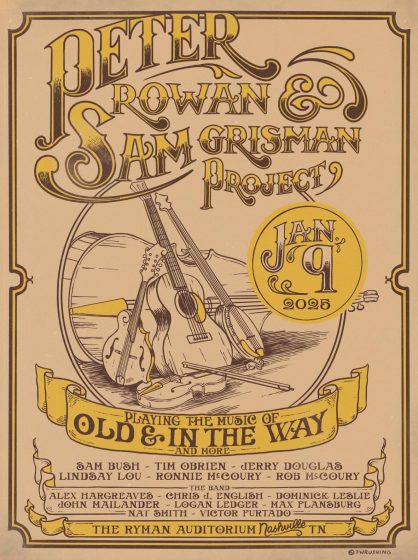
On January 9, 2025, there will be a special performance – more so a once-in-a-lifetime celebration – of the groundbreaking music of Old & In the Way at Nashville’s famed Ryman Auditorium.
Led by the “Bluegrass Buddha” himself, Peter Rowan, the legendary singer-songwriter and founding member of the group will be backed by the Sam Grisman Project. The gathering will also feature a murderers’ row of talent: Sam Bush, Tim O’Brien, Lindsay Lou, Ronnie & Rob McCoury, and more.
“In bluegrass, you just do the beautiful grace of presenting the music, being good neighbors and all that stuff,” Rowan told BGS in an exclusive 2022 interview. “But you could hear us in the band going, ‘go, man, go.’ Go for it, that’s where we came from. That’s what Old & In the Way was – the ‘go for it’ signal to everybody.”
To preface, Old & In the Way started as impromptu pickin’-n-grinnin’ sessions in the early 1970s between Rowan, his longtime friend, mandolin guru David Grisman, and Jerry Garcia, iconic guitarist for the Grateful Dead, who reached for his trusty banjo during the gatherings at Garcia’s home in Stinson Beach, California.
“We started picking every night after supper [at Jerry’s],” Rowan remembers. “We went through old song books and learned a bunch of material.”
At the time, Garcia was searching for new avenues of creative exploration, seeing as the Dead were in the midst of taking a much-needed hiatus after years of relentless touring and recording. He was also, perhaps subconsciously, trying to tap back into his roots before the Dead, this landscape of the late 1950s/early 1960s where Garcia was heavily involved in the San Francisco Bay Area folk scene.
“And you realized that Jerry was an intergalactic traveler, just dropping in on the Earth scene for a little while, but he was totally at home,” Rowan says of Garcia’s restless penchant and lifelong thirst for acoustic music.
When Old & In the Way formed in 1973, the trio recruited bassist John Kahn, as well as a revolving cast of fiddlers (Richard Greene, John Hartford, Vassar Clements). Sporadic gigs were booked around the Bay Area, with the vibe of the whole affair casual in nature – the ethos one of camaraderie and collaboration, but without expectations or boundaries.
“I remember singing the ending of ‘Land of the Navajo’ at the first rehearsal and I looked over at Jerry,” Rowan recalls. “He kept nodding his head like, ‘go.’ It was like Jack Kerouac at Allen Ginsberg’s poetry reading at City Lights Bookstore – ‘go, man, go.’ Encouragement, encouragement.”
By 1974, Old & In the Way simply vanished into the cosmic ether, but not before capturing a handful of live performances that have become melodic sacred texts of a crucial crossroads for acoustic music. To note, Old & In the Way’s 1975 self-titled debut album went on to become the bestselling bluegrass album of all-time – until it was dethroned by the O Brother, Where Art Thou? soundtrack released in 2000.
As it stands today, Rowan, now 82 years old, is the only remaining member of Old & In the Way still actively performing. Garcia, Clements, Kahn, and Hartford have all sadly passed on, with the elder Grisman and Greene retired from touring. Grisman’s son, standup bassist Sam Grisman, is now carrying his father’s bright torch.
And although the tenure of the Old & In the Way was short-lived, the ripple effects of the band’s ongoing influence and enduring legacy remains as vibrant and vital as it was those many years ago, when a handful of shaggy music freaks kicked off a jam that will perpetuate for eternity.
In preparation for the upcoming Old & In the Way showcase at the Ryman on January 9, BGS recently spoke with Sam Grisman, who talked at-length not only about his continued work with Peter Rowan and the intricacies of Jerry Garcia, but also why a band Grisman’s father started over a half-century ago still captivates the hearts and minds of music lovers the world over.
You were five years old when Jerry Garcia passed away. You were really young, but do you remember anything that you hold onto?
Sam Grisman: Yeah, I have a very vivid memory of what our house felt like, smelled like, and just what the energy was like when Jerry was around. And I remember that sort of ease, just the way that he made people feel. It seemed like my parents were at ease when he was around.
And he probably felt at ease being around them. It was probably a safe haven at that house.
Definitely. And, you know, my parents smoked weed in the house. But, my mom was pretty strict about cigarettes. [She] wouldn’t let anybody smoke cigarettes in the house. But, when Jerry was around, he smoked cigarettes in the house. So, part of this smell in my blurry five-year-old memory is the smell of cigarettes. And Jerry would sometimes wear a leather jacket, maybe the smell of leather.
I remember the sound of his laugh. I remember all that music, and some of it I remember so vividly that I just know that part of that memory is reinforced by being there as a little toddler when they were working up [music]. Because they would often work on tunes upstairs in the living room and then take them down to the studio, put them on the mics and pull them.
You just wanted to be around it all and soak it all in.
I was a really curious kid.
With the Ryman show coming up, there’s been a lot of celebration of Old & In the Way as of late, especially with you touring with Peter Rowan and the current Jerry Garcia exhibit at the Bluegrass Hall of Fame & Museum. You’ve been around those songs your whole life. But, when you think about the context of Old & In the Way, and what you’re doing at the Ryman, what really sticks out with why that was such a special time in not only bluegrass, but in the lives of those people?
I mean, what a lightning-in-the-bottle chapter of all those people’s lives, you know? I think 1973, ’73/’74, was a particularly fertile time for Jerry. He was playing a full schedule with the Dead. He had Jerry Garcia Band stuff. He was playing in Old & In the Way. He was playing pedal steel with the New Riders of the Purple Sage. It seemed like he really had an itch to go back to where his roots were, especially when you look at [the Grateful Dead album] Workingman’s Dead [that was released a] couple years prior.
For all of us, who are looking back on it 50 years in the future, it seems like this momentous, heady time that was just meant to be. But, for those guys in the moment, it was just total serendipity. And the quintessence of just going with the flow – Stinson Beach, California, vibes. They just kind of stumbled into this reality.
“Y’all wanna play?” “Sure, why not.”
Yeah, where it would just be really fun to have this bluegrass band that they didn’t take super seriously, which I think really comes across in the recordings, you know? Because there’s all this joy in that music that might not necessarily have been there if those guys were taking it super seriously or if they needed it to pay their bills. It was a very interesting circumstance.
And for them to call their hero Vassar Clements into the mix, on a sort of whim because Peter found his number on a card in his wallet. It was sort of like a fantasy camp for these guys. Like a bunch of hippies sitting around on the beach, smoking a joint, thinking: “Wouldn’t it be great if we had the world’s greatest fiddle player just show up?” “I bet you we could book a gig.” “Hey Jerry, you got these legions of people following you around, you could probably get us a gig, right?”
And that’s kind of how it happened. Those gigs were so magical, because they happened mostly for all of these Deadheads in Marin [County, California], for like 16 months or something.
So, if you really had your finger on the pulse of it and you were going to the Keystone [music club in Berkeley, California], to see [the Jerry Garcia Band] and you loved what the Dead were doing, you knew that they were going to take this time off, but you just saw Jerry the week before and he never took his guitar off. He just finished the [Jerry Garcia Band] set and walked backstage with his guitar on and was smoking a cigarette, and then you saw him 30 minutes later talking to somebody off the side of stage, still had his guitar on — you’re thinking, “Gee, this guy’s not going to stop playing music this year, so I better keep my eyes peeled for what’s next.” And they played all these little gigs mostly around the Bay Area — they kind of captured some lightning in a bottle.
With playing these Old & In the Way melodies not only throughout your life, but also extensively nowadays with Peter Rowan, what’s been your biggest takeaway on what makes those songs and the ethos/history behind them so special to you? What about in terms of musicality, technique, and approach?
It’s hard to articulate how special it is to be exploring these beloved songs that mean so much to so many folks, myself included, with Peter and a cast of some of my best friends and favorite musicians. It’s a catalog that’s got a lot of depth.
Old & In the Way would play anything from songs by bluegrass heroes like Bill Monroe, The Stanley Brothers, Reno & Smiley, and Jim & Jesse to Vassar [Clements], Jerry [Garcia], and my pop’s instrumentals, to the tunes that Peter was writing at the time, which are some of my absolute favorite songs ever written.
Songs like “Midnight Moonlight,” “High Lonesome Sound,” and “Panama Red.” Playing these tunes with Uncle Peter makes me feel connected to the times he spent with David and Jerry in Stinson Beach in the early ’70s.
I grew up in Mill Valley and loved going to Stinson Beach with my friends, so I have a pretty vivid image in my mind’s eye. They played tunes, hung out, relaxed, took in the sea breeze, smoked a bunch of great weed, and developed a highly individuated “West Coast” approach to playing and singing this bluegrass music that they all loved and respected so much.
And then, they called one of my bass heroes, John Kahn, and their fiddle hero, the inimitable Vassar Clements and gave the world about one glorious year – I think around 50 shows – of a rare and lovable breed of bluegrass.
So much of everyone’s personality comes through in the music, and you can hear their camaraderie in the recordings. I guess my biggest take away from getting to play this music with Peter is how important it is to bring your own approach to these timeless songs that we love, while still honoring what it is that makes us love them in the first place.
You’ve known Peter Rowan since you were born. But, what has this latest endeavor together meant to you, to play the Old & In the Way catalog to not only lifelong fans, but also a whole new generation of acoustic music fans and bluegrass freaks?
It means the world to me to get to spend some time out on the road sharing space and time in service of this music with Uncle Peter. Getting to meet all of these folks who care so much about this music and feeling their appreciation and gratitude for Pete has been truly special.
There are so many people from so many different ages and different walks of life for whom this music has been the soundtrack to many fond memories, and I’m honored to be one of them. It’s also been a joy to see fresh faces in the audience and some folks taking in this music with a new perspective.
In your honest opinion, what is the legacy of Old & In the Way when you place it through the prism of the history of bluegrass and the road to the here and now, especially this current juncture where the torchbearers are selling out arenas and creating this high-water mark for acoustic, traditional and bluegrass music?
For many folks who know and love the music of Jerry Garcia and the Grateful Dead, Old & In the Way has been their first exposure to bluegrass. So many people over the years have told me how listening to Old & In the Way led them to further explore bluegrass music and its roots and branches. And others have told me how it inspired them to become pickers and start bands of their own.
I think Old & In the Way has been pivotal in bringing a wider audience with a more adventurous musical palette into the bluegrass universe. The legacy of Old & In the Way is one of exploration and preservation, and they certainly paved the way for many of us to walk a similar path — honoring the music that we love, while exploring its boundaries and finding our own voices and approaches.
It’s wonderful to see my friend Billy Strings out there playing for so many folks on such a big scale simply being himself, playing his own songs with a great group of friends, and also honoring the material that made him the musician that he is — maybe that’s a part of the legacy of Old & In the Way.
Photo Credit: Elliot Siff Poster Credit: Taylor Rushing
This website uses cookies to improve your experience. We'll assume you're ok with this, but you can opt-out if you wish.AcceptRejectRead More
Privacy & Cookies Policy
Privacy Overview
This website uses cookies to improve your experience while you navigate through the website. Out of these, the cookies that are categorized as necessary are stored on your browser as they are essential for the working of basic functionalities of the website. We also use third-party cookies that help us analyze and understand how you use this website. These cookies will be stored in your browser only with your consent. You also have the option to opt-out of these cookies. But opting out of some of these cookies may affect your browsing experience.
Necessary cookies are absolutely essential for the website to function properly. This category only includes cookies that ensures basic functionalities and security features of the website. These cookies do not store any personal information.
Any cookies that may not be particularly necessary for the website to function and is used specifically to collect user personal data via analytics, ads, other embedded contents are termed as non-necessary cookies. It is mandatory to procure user consent prior to running these cookies on your website.