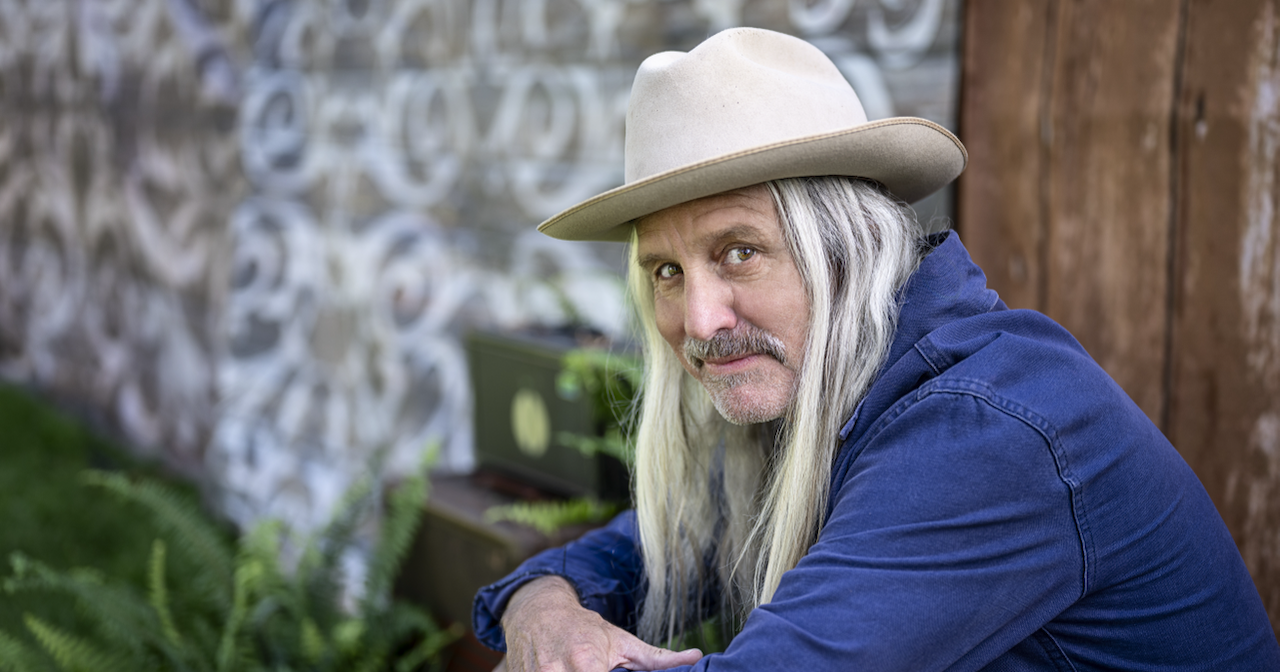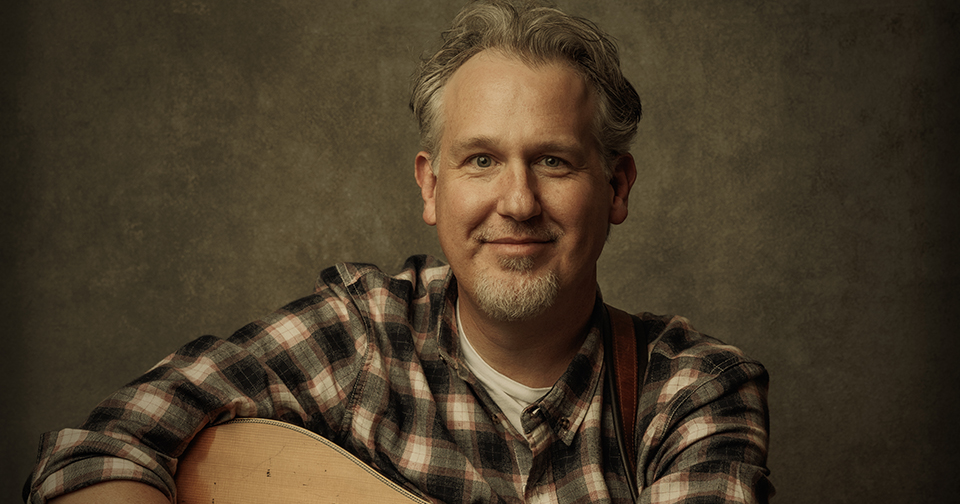
Bill Frisell Invites All of Us Inside His Guitar Dreams

The first time Bill Frisell played guitar in front of an audience was typical for the time. It was the summer of 1965 and he was 14. He’d saved up money from a paper route in his Denver-area neighborhood so he could buy his first electric.

“Oh man, I can still just…” He pauses, lost in nostalgic reverie, on a Zoom chat from his now-home in Brooklyn.

“I opened the case and I can just smell it,” he says. “It’s amazing.”

His face bears a beatific smile, his voice a genial, gentle tone – things that he’s known for nearly as much as his astonishing musical talents.

“I got a Fender Mustang and a Fender Deluxe amp,” he continues. “And then my other friend, he got an electric guitar and this other guy across the street played drums. We learned like three songs. And then within a couple of weeks we were playing for a party in somebody’s basement.”

He’s not sure what they played – “probably ‘Louie Louie’ and I don’t know what else.” But the feeling?

“I guess in a way, that’s kind of what I kept on doing,” he says. “Get with my friends, learn a couple of songs and then go play for people. And that’s all I’ve done ever since.”

It’s exactly what he did on a recent Wednesday at the new Blue Note jazz club in Hollywood at the start of a several-week “75th Birthday Celebration” tour, that milestone coming on March 18. The friends joining this night were bassist Luke Bergman and drummer Tim Angulo.

The set was more than three songs, of course, played, as is his frequent style, in a continuous, hour-long stream, moving through originals, jazz standards, and movie score themes, as well as an ethereal “Moon River,” a tremolo-inflected “Shenandoah” and, closing, Burt Bacharach’s ever-timely “What the World Needs Now Is Love.” Wrapping it up was a somber yet hopeful encore of “We Shall Overcome.” Throughout the show, he and his trio-mates play with remarkably fluid connections. The approach could be delicate or heavy, buoyant or somber – or somehow all at once.

And with each note, even amid immeasurable harmonic complexities, melodic sophistication, and the nimble skills he’s gained through the decades, there was that kid from 1965, his beaming smile and twinkling eyes revealing his utter, still-fresh delight.

Frisell approached every measure as fresh territory, ripe for discovery, for exploration, curious where an old melody might reveal something new, reveling in its beauty or finding richness in dissonance he adds. Sometimes he’d play around with a short, simple phrase for a bit, like a new toy. Occasionally he’d fiddle with effects to enhance his pointillistic Telecaster touch (he moved on from the Mustang years ago). He throws in a cluster of sonic fireflies here, some “backwards” sounds there. He even giggled a little once when he hit a bad note.

“It’s weird,” he says in conversation a few days before the concert. “I still feel like I’m just beginning. And I’m not kidding. I mean, I know I’ve been playing for a while, but it’s still that feeling [that] never goes away. I’d be fooling myself if I thought … “

He paused again, looking for the right words.

“You just can’t feel as it you finished anything.”

This all comes through profoundly on his new album, In My Dreams, his 45th (plus many dozens of collaborations, group, film and TV scores and sideman projects), released on February 27. It also features a trio (longtime collaborators Thomas Morgan on bass and Rudy Royston on drums joining him) plus a string trio (violinist Jenny Scheinman, violist Eyvind Kang and cellist Hank Roberts), as well.

The title references an actual dream he had years ago in which a group of mysterious, cloaked figures allowed him to experience things beyond our normal perception. First they showed him colors – intense and beautiful – and then music in which all the things he’s loved, from Nino Rota to Hank Williams to Jimi Hendrix to Thelonious Monk, lived together as one glorious sound.

The album, mostly recorded live in three concerts last summer, shows him pursuing that sound himself, with approaches that might be termed jazz, classical, and folk-Americana braided through originals sometimes tender, sometimes dark and intense. Also included are interpretations of the Duke Ellington/Billy Strayhorn classic “Isfahan,” Stephen Foster’s “Hard Times” and, to close, “Home on the Range.” The latter is previewed earlier in the album with his own fantasia on themes from the song that he calls “Give Me a Home.” And for the title song, fittingly, he created an anxious soundscape inspired in part by Bernard Herrmann’s Alfred Hitchcock scores.

Still, the dream remains a dream for him, something ever out of reach, but ever-alluring.

“I don’t even know when it was, 30 years ago when I had it or more,” he says. “And music in general is always something that you can’t quite…. “

He stops to choose his words again.

“It’s always a little bit past what you can get to,” he says. “But the dream was like that. It’s like, I don’t know if I’ll ever get there, but just keep trying.”

In My Dreams is a hearty grab at that ring, though that very elusiveness is a key part of his art.

“With these people, we’ve been playing together so long,” he says, noting that Royston and the string players all were together on his 2013 album Big Sur. “There’s this thing that started happening quite a while back where, for me, I just love the line between arranging and orchestration and composing. The lines get all sort of blurred. We’re all seeing the same information, like what I write could look like a piano score or something. And we figure out some stuff, but basically everyone is free. The cello doesn’t always play what’s on the bottom and the violin doesn’t always play what’s on the top. And there’s a thing that happens spontaneously amongst them, amongst all of us, dropping out or coming in or switching parts that’s really the exciting part of it for me.

“So it’s like you’re improvising with the whole texture of everything. It’s not like they’re playing some part and then I’m playing a solo on top of it. Ideally it’s like an ongoing conversation amongst all of us. I never want it to be predictable. Hopefully it’s always in a state of uncertainty. I mean, I want it to be strong, but at the same time I want everyone to feel safe that they can fall off the edge, and then we’ll come back and pick it up, because that’s where the good stuff happens.”

That, of course, goes back to the avant-garde settings in the New York downtown scene of the 1980s and ‘90s, where he made a name as part of boundary-pushing sax player John Zorn’s unpredictable jazz-metal ensemble, Naked City. But the sensibility remains core to him even in his frequent trips into folk, Americana, movie scores, and unabashedly romantic pop-rooted material. His 1992 album, Have a Little Faith, a musical portrait of America spanning from Foster and Sousa to Ives and Copland, from Muddy Waters and Sonny Rollins to John Hiatt and Bob Dylan to Madonna, remains a landmark in his vast catalog. And he’s recorded and performed with many Americana singer-songwriters including Paul Simon, Lucinda Williams, Joe Henry, Bonnie Raitt, Buddy Miller, and Shawn Colvin. He simply loves a good song with a good melody.

“I can’t help it,” he says. “I was born in 1951 and I grew up in Colorado, just as television and rock ‘n’ roll were all happening. It’s not a conscious thing. [But] at a certain point, I realized, ‘Wait a minute, I gotta not be afraid to show that that’s where I come from.’ I think when I was younger I was more worried about, ‘Oh, are people going to think this is not cool?’ But then after a point it’s like, well, wait a minute. This is what I am. This is where I came from. And if I’m really honest, I do like that melody. I like when Burt Bacharach wrote a really beautiful song and it’s not corny if you look at it a certain way.

“I think I learned that from the people I thought were the coolest, like Sonny Rollins. He would play songs that he heard when he was a kid, or that he saw in a Broadway show or whatever. And I realized he’s doing that because that’s his experience and his life. So it’s okay for me to play a Beach Boys song or a Beatles song, because that’s what I heard when I was growing up. And ‘Home on the Range,’ I mean, [I] probably heard it when I was in my mother’s womb or something, you know?”

Arguably, the latter is the emotional keystone of In My Dreams, particularly in tandem with his “Give Me a Home” musings on its melodic theme earlier on the album, the strings following him as he steps through and around the familiar melodies, clearly with Copland hovering over.

“I was messing around with ‘Home on the Range,’ I wrote all these different versions and then that particular one, it’s just a phrase from the song, doesn’t even get through the whole song. And then the title.” He laughs.

“When you think of what’s going on in [the world]. I mean, we play ‘Hard Times’ on there, too. It’s like, folks without a home. Where are we now? What is going on around here?”

Those questions come to the fore again on the full “Home on the Range” later. The song starts relatively straightforwardly, but after a couple of minutes it goes into a dark, abstract zone. That is how the album ends.

“I didn’t have that planned out,” he says. “The stuff just happens organically and then we piece it together, and that’s what it is. But then you see how the music reflects the place we’re at. I didn’t have a preconceived idea. It’s always easier after the fact to make a story out of it somehow.”

The story of Bill Frisell, inevitably, touches on his generous, easygoing manner. It seems to be mentioned every time someone talks or writes about him. Does he ever get tired of people saying how nice he is?

He hesitates.

“No,” he says, sheepishly. “I don’t know if I’m really that nice. I try to be a good person, but I don’t know. I mean, there’s a lot going on underneath the surface.”

He laughs, clearly uncomfortable with the topic.

“I get upset,” he says. “I have to wake up and look at the news every day and that doesn’t help, you know?”

He pauses one more time.

“But I guess that’s all the more reason for us to try to be good to each other.”


Photo Credit: Marko Mijailovic
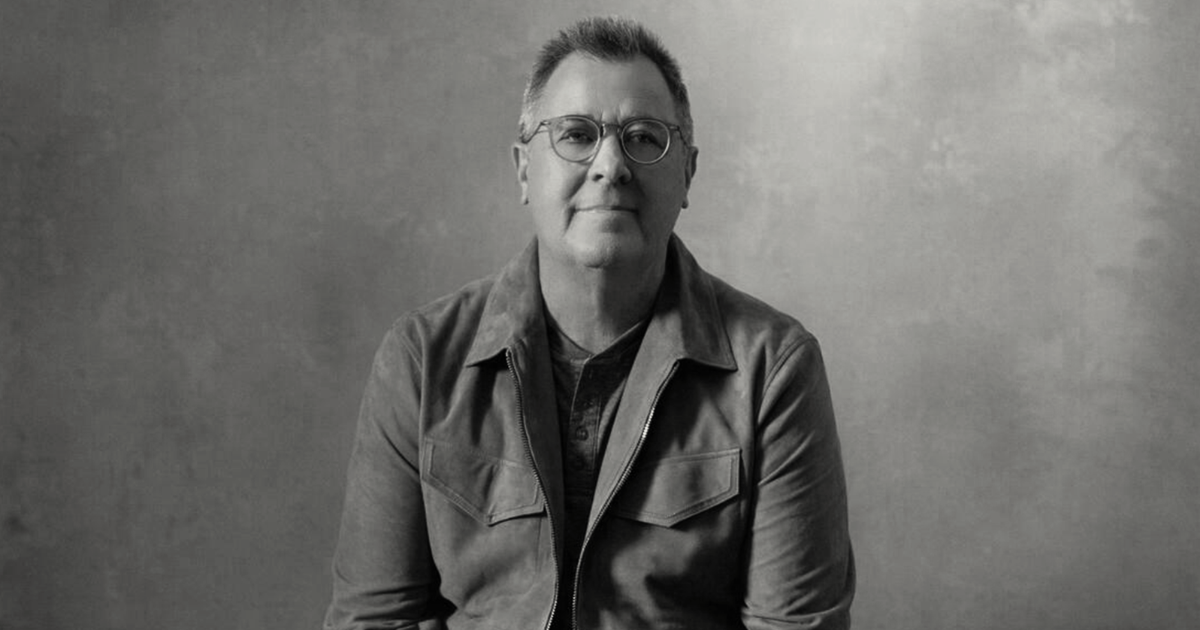
Vince Gill Has Done It All (Part 2)

Poaching from Elvis, well over 50,000,000 Vince Gill fans can’t be wrong.

The longevity Gill discussed in Part 1 of this interview has taken him from bluegrass beginnings to a genre-inclusive 50 years as one of country’s most beloved and sought-after artists.

It’s not always been easy, however. No one, regardless of talent or fan loyalty, is immune from freedom of the keyboard and Gill is no stranger to the highs and lows of public opinion. Mostly it’s outpourings of gratitude from the millions whose lives his music touches. Sometimes it’s claptrap about his now decade-long tenure in the Eagles, or venomous spewing over songs like “March On, March On,” from Secondhand Smoke, the second in his series of retrospective EPs being released monthly.

In Part 2 of his conversation with Good Country, Gill discusses, among other things, the aforementioned decade-long tenure with the Eagles, bullying – with a few choice words for those who inflict it – his scrolling habits, and he indulges us in a rapid-fire round of closing questions.

In the arc of this 50-year project, it is not unnoticed that Hotel California turns 50 this year. Do you have memories of listening to that album as a young man, as you now find yourself onstage playing those songs?

Vince Gill: I had all the Eagles records. We did a lot of their songs in my bluegrass days, and it’s completely surreal. I’m starting my tenth year of being in that band and continuing that legacy of songs. What I value most about getting to play with these guys, what I’ve learned most, is how important songs are – all the notes, all the licks, all the riffs, all that stuff. Getting to relearn that at this stage of life has been pretty profound in the way that I’m trying to write songs. I’m patient in the way I write. I’m patient to wait for it to come – the right words, to not settle on anything, and really edit and work and edit and work and continue to try to be mindful of how important the song is.

What I’m mindful of with the Eagles is the tragedy. More important than the fact that I get to do it is that if Glenn had not passed away, I would not have gotten to do this and I’m grateful I’m the one they called. I met all those guys in, I think, 1980, when I was living [in California]. In a million years, would I have ever thought this would have happened? No. But I am careful of how I couch everything, because it came from something tragic and I am respectful of that.

Glenn was a really good friend of mine, actually, and his son Deacon is doing a great job up there of carrying on his dad’s tradition. I think I’m a great fit for them in the way I play guitar and sing, and sing harmony, and play all the instruments I do. I’m not saying I’m better than anybody else they could have gotten. I’m just saying what I do suits them really well.

Jedd Hughes described you as “one of the greatest band leaders I’ve ever worked with. He’s listening to everything and everyone, always, so you can read his cues pretty easily.” First part of the question: Where did you learn to lead?

Because I’m a musician, I think I come at it different and I operate under the mindset that every note is equal. You’re not more important because you’re the lead singer. You’re not more important because you play the lead solo in the song. I value every note the same. Spending my life in the studio like I have, knowing what you play and do has to sit well and play well with others, you have to listen to everybody else.

It’s amazing what you can accomplish if you don’t care who gets the credit. Sometimes people play only to be noticed and that doesn’t necessarily constitute the right thing for the song. They say in Nashville all the time, “Just serve the song.” That’s all I’ve ever tried to do. If someone’s playing something and doing something, don’t do something to distract it. Do something to enhance it, to support it.

Second part: How does that translate to arrangements and contributions from the musicians you work with?

Great players all listen to each other and you’re dealing with a caliber of musicians that already know what not to do, so you don’t have to waste time going, “Hey, don’t play that, that’s too much, that’s not necessary.” Every time I’m in there playing, I take every note, examine it, and make it move me, make it sit just right.

Once again, if you’re playing with that caliber of people, which I fortunately am – my band is usually made up of a lot of studio musicians and amazing players – they like playing with me because I’m a player, too. I’m not just someone up there singing the songs. So I think I have their respect, and that points you once again towards, “What’s the best thing for the song? What’s the best arrangement idea? What’s the best part to play? What’s the best part not to play?” That’s it in a nutshell.

I’m surrounded by musicians that can all play me under the table, straight up. That’s the truth. I’m grateful to have them, grateful to get to play with them, and it makes for a very democratic spirit. Even in the way we record, I’m not heavy-handed. I’m not telling people what to play. Oftentimes we’ll be in there and they’ll say, “Do you like this?” I go, “I don’t have any idea. I’ve never even heard this song before. I know I wrote it, but we’re in here trying to figure it out, so we’re just going to figure it out all together.”

It creates a great spirit in there if everybody feels like they’re all walking on equal ground, everybody has a right to an opinion, everybody has a right to try something, nobody gets shut down, nobody gets put off. It’s an amazing experience. I don’t ever do demos with my songs. I just write them and then I show them to the guys on the floor. I go, “This is how it goes. Let’s figure it out.” They naturally gravitate towards something great and you just follow them off the cliff! It’s wonderful to watch other people’s gifts.

Earlier you described yourself as “the happiest son of a bitch in the world” who just loves sad songs. In that happiness, however, you have experienced much grief. Your faith is strong. Have you ever lost or questioned it during times of loss?

When I think about faith, I don’t think of it so much [from] the religious point of view. I think faith in humanity – more than Baptist or Methodist, or heaven or hell, or any of that stuff. None of these questions have ever been answered, so to pretend you know the answers seems a little, I don’t know, pretentious almost. That might not be a good word. But, no. It all comes from loving deep. The people I love, I love them deeply. They matter to me.

Music is where I go to grieve. It’s where I go to get through loss. It’s where all those things are. I tell everybody it’s cheaper than therapy. I just write about it.

I never feel the need to fix everything in my life. My relationship with my dad, if it was funky or whatever, I said, “It’s not my place to change him. It’s my job to accept him.” Once I could do that, we had a great relationship. You don’t have to be like me for me to like you. You don’t have to think like I do for me to like you.

I’ve been told more often than not, “Why I like your songs is you are able to say what I wish I could say. You are able to express feelings I have that I don’t know how to.” Maya Angelou sought me out and asked me to come and meet her when she was in Nashville years ago. She told me, “‘Go Rest High’ was a lifesaver to me. It helped me get through the loss of my brother.” Those kinds of things make you go, “I’m going to try to find a way to be emotional about things and not only help myself, but help other people too.” I think if you can portray in a story what someone’s going through, you have a chance to make people feel better.

You can’t name-drop Maya Angelou and just go on to the next question! We need to back up a little bit.

She was speaking at Vanderbilt and wanted to meet. [My wife] Amy [Grant] and I went and afterward we got to go back and say hi. She said, “You mean a lot to me, because your song helped me get through one of the hardest times of my life.” It was a great visit.

You’ve released the fourth EP in your series. Which chapter is this and do you know what’s to follow?

It’s uptempo-y and groove-y, kind of like “Liza Jane” and “One More Last Chance” and some of those fun songs. Each record is, on purpose, similar-driven. The record after this fourth one will be a lot of real country-country stuff, real traditional stuff. The one after that is going to be more like “I Still Believe In You” and “Don’t Let Our Love Start Slippin’ Away,” from a more rocking side. I don’t want to say the word “pop,” but it is. It feels like an Eagles record or a Fleetwood Mac record at times. The inspirations are all in there.

The one after that is real bluesy R&B-ish. Are you hip to Lamont Landers? He’s a soul singer from Alabama. You look at him and go, “There’s no way this voice is coming out of that dude.” He does all these really cool things. I found him and I got him to come and sing on one of my songs that’s coming out later in the year. He’s just such a cool dude. I’ve been trying to turn people on to him.

How did you find him?

Scrolling.

You’re a scroller!

Oh, heavily guilty. I tell Amy it’s my TV now instead of channel surfing. Once in a while you’ll come upon a great young musician, or a great young singer, or a great comedian. There’s so many options, and if you stop on something, it’ll start giving you hundreds of things just like that.

The algorithm gets you.

Yeah, exactly. But it’s entertaining, and I found a couple of people to track down and
have them sing on my record because I like what they do.

What do you scroll?

YouTube, Facebook, Instagram. Most of the stuff is pointless, but there’s a nugget once in a while.

How do you handle the cruelty of social media? It can get to anyone, especially when it’s directed toward you.

It can, if you let it. That’s the life we live in now. You can’t go perform and not have everybody have a camera out and put it up and showing it and seeing it. You have a bad night and everybody’s going to rip you for it. It’s like, “How much negativity can you continue putting out there, saying negative things?” It’s never going to stop, you know that, but it’s still entertaining to read.

I read it to be informed and I don’t mind taking it. I’ve lived with critics being critical of everything I’ve ever done. It comes with the territory. If you’re brave enough to stand up there and speak through a microphone, you know you’re going to get judged to some degree. Once in a while, somebody will say something and I say, “That’s fair. That’s truthful.” Other people will say things and I go, “You don’t even know what the hell you’re talking about, but you have an opinion that’s inflammatory towards me, and you couldn’t be more wrong.” I know that, so it doesn’t have an impact.

Sadly, people have to get on there, the keyboard warriors. They think they finally have a voice. Being able to post and have an opinion, they think that gives them a voice. But in the grand scheme of things, it doesn’t. I know that, so I just take it with a grain of salt and move on.

Perhaps being 68 years old with experience and success makes that easier than for a young person just starting out.

People are still critical of me being in the Eagles. They say, “Now it’s a cover band and you shouldn’t be there,” blah, blah, blah. You know it’s coming, so press on. Say whatever you want. Say it to my face and see what happens to you!

I can’t control any of it. I can control me. I can control my heart, what my heart thinks, what my heart feels. If you hate what I do, that’s okay. A lot of people don’t like what I do. I’m used to that. You’re not going to stop me.

Earlier we talked about hope. I just hope people respond. I don’t mind if they respond negatively. You don’t want that, you’d rather not, but it’s funny how you can get a hundred good reviews on a record and one bad and you only remember the bad one. That’s human nature. It’s not a weakness. It just goes to show how being cruel and negative towards someone has an impact.

I think about the times I was in school and was talked to in a negative way, and how it lasted. I remembered it forever. There was a girl I was in a band with for a little bit. She sang in this choir at the school that was really well thought of, and the choir director told her, “You are wasting your time with that guy and his banjo and bluegrass. He’s a fool.” And I just want to go, “Na-na-na-na-na!” But you remember it. And an English teacher that kicked me out of the class for saying something she didn’t like and painted me a certain way. You remember it.

My own kids, one teacher said to my youngest daughter, “My dog has more manners than you.” Things like that … my hundred-year-old mother is still pissed off about that! She’s still, “I’d like to get my hands on that teacher!” We’ve got a good bit of redneck in us!

I watch my sweet wife take slings and arrows all the time and the way she handles it is so beautiful to watch and so inspiring. It’s helped me do the same thing.

Can you play everything you hear in your head?

Probably. I hope so! It’s funny you brought that up, because being a musician and a singer, people say, “How do you get inspired to sing?” or “How do you get inspired to play?” Well, before I play something, in my head, I’m saying, “How would you sing this?” And when I’m getting ready to sing something, I ask myself, “How would you play this? What kind of rhythm? What kind of phrasing?” All those things.

I think the real difference [between] a good singer and a great singer is the way they phrase. Ray Charles could phrase like nobody’s business. Jerry Lee Lewis, when he sang country songs, could phrase like nobody else. George Jones could phrase like nobody else. You go on and on and look at all the greatest singers, and they’re unique because more so the way they phrased than how many notes they sang.

What is the difference between playing guitar and being a guitarist?

Oh, man. I don’t know if there is. I think it’s the same thing. It all comes from the same heart. It all comes from the same ears. I just play what I think fits. I think that’s what being a great guitarist is – playing what fits.

I saw something the other day that said, “I refuse to name who I think the greatest guitar player is,” and it makes sense to me because there’s no such thing. Everybody goes at it in a different way and has a different spirit about it, has a different way they want to play and statement they want to make. Then it becomes a matter of your preference, of what you like best, that defines what the best guitar player is.

I just like people that are gifted, and people that are musical, and they play what’s in their hearts and what they feel. If you feel it like they do, game over. If you don’t, you move on. Not every great guitar player moves me. It might move you. I think we’re lucky that we can be subjective and not have to all feel the same way about the same things.

Let’s close with a lightning round. Anything goes, whatever comes to mind. An album you wish you had played on.

Hotel California.

A song you wish you had written.

’Till I Gain Control Again” by Rodney Crowell.

A session in which you wish you could have been a fly on the wall.

Together Again” by Buck Owens.

A concert you attended that made your head spin.

Paul McCartney.

A guitar solo you wish you could claim as your own.

Oh, gosh. I might have to go with a Chet Atkins solo, because he’s the first person I ever saw play live when I was a little boy.


Editor’s Note: Check out part one of our Good Country conversation with Vince Gill here.

Want more Good Country? Sign up to receive our monthly email newsletter – and much more music! – direct to your inbox.

Photo Credit: David McClister

You Gotta Hear This: New Music From Brit Taylor, Trey Hensley, and More

Happy Friday! We have new music for you to enjoy and, as always, You Gotta Hear This.

To start us off, Chicago Farmer (singer-songwriter Cody Diekhoff), shares a nostalgic and stripped-down country song, “The Twenty Dollar Bill,” that pays tribute to his grandparents and the “family roots” that he takes with him wherever he goes. The track is from his brand new album, Homeaid, which is out today. Kentuckian country singer, songwriter, and artist Brit Taylor has a new album today as well, Land of the Forgotten. To celebrate, we’re sharing “Done Pretending,” a song from the project co-written by Taylor, Adam Wright, and Jon Decious that decries relationships that are all “take” and no “give.”

There’s plenty of excellent guitar picking included here, too. Bryan Sutton returns to the roundup, this time with blues guitarist Joe Bonamassa in tow. The pair duet on Bill Monroe’s “Blue Night,” acoustic and electric guitars in shred-tastic dialogue on the classic number. The track comes from Sutton’s upcoming duets album, From Roots to Branches. Then, bluegrass and Americana flatpicker Trey Hensley calls on his friend and fellow guitarist Molly Tuttle for his new single, “Going and Gone.” Hensley penned the song with Bobby Starnes and features the bluesy, breakneck picking for which he has become known.

To wrap up, we have a new music video featuring lush and groovin’ Americana from YARN, a genre blurring-and-blending outfit that has been performing and recording for more than 20 years. For a song considering existence, fate, and the rat race at large, “Might as Well Be King” has an exquisite, gritty vibe – an excellent harbinger for the group’s new album, Saturday Night Sermon, arriving in April.

Whether your tastes lean towards bluegrass, blues, country, or Americana – You Gotta Hear This!

Chicago Farmer, “The Twenty Dollar Bill”

Artist: Chicago Farmer
Hometown: Delavan, Illinois
Song: “The Twenty Dollar Bill”
Album: Homeaid
Release Date: March 6, 2026
Label: LoHi Records

In Their Words: “When I was in high school my grandma started giving me a $5 bill to keep in my shoe for emergencies. When I told her I was going to be a musician she upped it to a $10. When I told her I was moving to Chicago she said, ‘You’re going to need a $20.’

“My grandfather lived pretty much his whole life in the same farmhouse that he grew up in. He was a storyteller from a small town and sharp as a tack. Grandma was a city girl, she grew in Peoria, Illinois. The home of Richard Pryor. She rode the city bus and had street smarts. Together, there wasn’t much they didn’t know or couldn’t fix or remedy. Grandpa passed away a few years ago just shy of 102. Grandma will be 98 this summer. They’re farmers, they’re veterans, and they’re my family roots that I take with me wherever I go. In song and in my heart. This song is for them.” – Cody Diekhoff, Chicago Farmer


Trey Hensley, “Going and Gone” Featuring Molly Tuttle

Artist: Trey Hensley
Hometown: Jonesborough, Tennessee
Song: “Going and Gone” featuring Molly Tuttle
Album: Can’t Outrun The Blues
Release Date: March 6, 2026 (album)
Label: Pinecastle Records

In Their Words: “I wrote ‘Going and Gone’ with Bobby Starnes the same day that he and I wrote ‘Can’t Outrun the Blues.’ And I immediately loved both of those songs. It’s one of those story songs that just falls together and paints a picture without spelling out every detail. ‘Going and Gone’ was the first song we recorded for the project – and I was thrilled to get my friend and one of my favorite guitar players and singer-songwriters, Molly Tuttle, to join in on guitar and vocals. We had a blast getting to work together in the studio and I think that comes through in the final recording!” – Trey Hensley


Bryan Sutton, “Blue Night” with Joe Bonamassa

Artist: Bryan Sutton
Hometown: Nashville, Tennessee
Song: “Blue Night” with Joe Bonamassa
Album: From Roots to Branches
Release Date: March 6, 2026 (single)
Label: Mountain Home Music Company

In Their Words: “I couldn’t be more thrilled to have Joe Bonamassa on this duets project. I’ve been a fan of his for a long time. I wasn’t sure what he would play when we cut this song, because all of this was acoustic. I love that he played electric guitar. I love the fact that it’s a different kind of song for this record and being able to interpret an old Bill Monroe song like this was just really, really fun.” – Bryan Sutton

Track Credits:
Bryan Sutton – Acoustic guitar, vocal
Joe Bonamassa – Electric guitar


Brit Taylor, “Done Pretending”

Artist: Brit Taylor
Hometown: Hindman, Kentucky
Song: “Done Pretending”
Album: Land of the Forgotten
Release Date: March 6, 2026
Label: RidgeTone Records, distributed by Thirty Tigers

In Their Words: “I wrote this tune with Adam Wright and Jon Decious – two of the most clever humans I know.

“I don’t know if other women have ever felt this way, but I have been in more than a few relationships that were a whole lot of take and basically no give. Then I realized that once you’ve given all you can give and done all you can do, you reach a point where there’s nothing left. No sadness, no anger, no regret – you are just done. That’s where the character is at in this song. She’s basically emotionless about it. She’s just done and she’s at peace with it.” – Brit Taylor


YARN, “Might As Well Be King”

Artist: YARN
Hometown: New York City, New York
Song: “Might As Well Be King”
Album: Saturday Night Sermon
Release Date: March 6, 2026 (single); April 24, 2026 (album)
Label: 333 Entertainment

In Their Words: “Let the good times roll. We don’t know why we’re here or how any of this existence even works. Is it all fated? Is it all free will? So many folks in competition with each other fighting over some made up ‘green god,’ because they’re taught that is the way. But, it’s entirely up to us as individuals to define our own way. Nothing is law, there are no rules, this is whatever we make it. So the point of this song is nothing more than, don’t put too much stock in these ridiculous systems we’ve created. Have fun being human, embrace your human form and being able to do whatever you want with it; it doesn’t last long.” – Blake Christiana

Track Credits:
Blake Christiana – Lead vocals, guitar
Andy Thomas – Lead guitar, backing vocals
Rick Bugel – Bass
Robert Bonhomme – Drums
Damian Calcagne – Hammond B3


Photo Credit: Brit Taylor by Sammy Hearn; Trey Hensley by Cora Wagoner.

Steve Poltz Loves a Tangent

Steve Poltz has built a career by following each song wherever it wants to go. Sometimes that means a meticulously fingerpicked melody. Sometimes it means a story that veers off into comedy, confession, or absurdity before circling back to the heart of the matter. That tangential nature – equal parts songwriter, raconteur, and road-tested troubadour – has become his signature, especially onstage, where no two of his shows are ever the same.

Poltz’s new album, JoyRide (released January 30, 2026), reflects that same restless curiosity. Trim, deliberate, and capped at 10 songs, it distills decades of touring, collaboration, and lived experience into a tightly sequenced record designed to be heard in one sitting. From satirical observations about modern life to deeply personal reflections shaped by years on the road, JoyRide captures Poltz at a moment of clarity – still chasing the perfect song, still trusting instinct over plan, and still finding meaning in the long way around.

Long before JoyRide, Poltz earned his reputation the slow way – by logging miles, swapping verses with fellow songwriters, and learning how a room breathes. Founder of the San Diego-based rock band the Rugburns and co-writer of Jewel’s breakthrough “You Were Meant for Me,” he has never been defined by that early success, instead carving out a singular path marked by humor, humility, and an almost reckless openness.

In a conversation with BGS, we spoke with Poltz about the making of JoyRide, the longtime relationships that have sustained him, and the zany, unpredictable ride that has been his career. Whether sharing a bill with old friends or holding a crowd rapt with nothing more than a guitar and an improvised aside, Poltz approaches music less as a performance than as a conversation – one where the destination matters less than the unexpected connections made along the way.

Let’s start with early memories. Was there a moment when music really clicked for you?

Steve Poltz: I remember when I was in second or third grade, I stuttered, had asthma, eczema, and I didn’t hang out with many people. I started playing guitar when I was six. So I brought the guitar to school for show and tell. And I sang the song “Sloop John B” in class. And other kids brought snakes, brought their moms who were nurses or doctors or firemen, and their dads and stuff. I sang a song on guitar. I went out and sat alone. I remember I opened my lunch and I looked up and there were six girls around me. I thought, “This is all I have to do!” That was it. That was the plan.

I had a friend who was a DJ at San Diego State University [radio station] KCR, and she moved in with these roommates. They had brought this record by that had just come out by this woman named Rickie Lee Jones. It was her eponymous debut LP. And, oh my God, I listened to that record nonstop. There was a song called “On Saturday Afternoons in 1963,” which is still one of my favorite songs. It was in the movie Stripes with Bill Murray.

Man, two years ago I played Byron Bay Bluesfest in Australia and Rickie Lee Jones was on after me. Just the way the world works and the universe works, I knew her percussionist who plays the vibes, Mike Dillon. He sees me, and he’s sitting with Rickie Lee Jones, who’s like my hero. She’s one of my favorite lyricists ever. I’m a Dylanologist, and still, Rickie Lee Jones – those first two records especially – her poetry, the way she puts the songs together, I put it at the top of my whole pyramid.

[At Bluesfest] I told her I’d do a cover of “On Saturday Afternoons in 1963” and I segue into it from John Hartford’s “Presbyterian Guitar.” She loved John Hartford, too. She comes out during the song in front of 5,000 people, sings the second verse, and I just started crying. It was one of those full circle moments. These are the people that are my heroes.

You’ve become very deliberate about keeping your albums, like JoyRide, short and sweet. Why?

We’re just in such a quick world, where people don’t have the attention span. I’ve come to this conclusion that 10 songs is the perfect amount of songs to have on a record. Leave all these other ones on the cutting room floor. Put them out later on B-side compilations or something. Keep it under 33 minutes. It fits on vinyl perfectly. It doesn’t lose any of the resolution. If people are into you, it’s not too hard to give 32 minutes of your time. My hope is they go, “Let’s hear it again.” That’s my fantasy. One day I’ll get it right.

You’re known as a road warrior. What still thrills you about touring?

I feel like I’m kind of like the Grateful Dead in that I’m better experienced live than on record. Live, there’s magic. I’m still looking to make the perfect record. Maybe when I’m 80. I can’t believe Bob Weir just died, I mean he’s so young, 78. I’m like, “God, that’s like 12 years older than I am, I better get my shit together.”

I love it when things don’t work on the road. When something goes wrong, when animals attack. It took me a lot of years to get there, but sometimes things are really good when they don’t work. It messes with the audience. It’s like mental jiu jitsu.

Perhaps not surprisingly, you often reference comedy as an influence. How important is humor to your music?

I loved Andy Kaufman. I loved Richard Pryor. The early Steve Martin albums, Cheech and Chong – I memorized all that stuff. When I heard Allan Sherman sing “Hello Muddah, Hello Faddah!” I remember thinking, “Why can’t every song be like this?” Same thing with listening to the Dr. Demento [radio] show. Dr. Demento was huge. He played the Rugburns [on his show]. “Weird Al” Yankovic used to come to our shows and loved [our 1995 record] Dick’s Automotive. Because of that song, he wrote “Albuquerque.”

What are some of your earliest musical memories? You mentioned Rickie Lee Jones earlier. What are some other early prominent memories of being moved or touched by a song? Where were your first performances?

My uncle took me to see Julian Bream at the Hollywood Bowl. Classical guitar. That was it. I wanted to learn classical guitar. You know, with my left foot up on a stool, with a nylon string guitar, the way you hold it all in the proper classical way. I learned to read music. Fernando Sor’s etudes. My first gigs were in Mexican restaurants in San Diego. Four hours of classical guitar. Free meals. One night I got the courage to sing “Time in a Bottle.” The waitress said, “I didn’t know you could sing.” That night ended with me running out a window and leaving my left shoe behind. I never went back to that restaurant.

And then there was another one in El Cajon and it was called El Amigo. The El Amigo Ballroom. Then I got a job at Round Table Pizza in La Mesa. I got fired because I sang on the mic and I sang “The Rodeo Song.” One night, I got really drunk with the manager and I didn’t know the owner was in the audience. That was where I kind of learned mic control, because the manager was like, “Man, you’ve got a good voice for speaking. I want you to be the guy who says, ‘McDonald, party of four, you’ve got a large pepperoni pizza.’”

One night the manager got me really drunk. He was a younger guy. I started singing “The Rodeo Song,” which was this Canadian song that went, “Well, it’s 40 below and I don’t give a fuck, got a heater in my truck and I’m off to the rodeo.” And the chorus goes, “You piss me off, you fucking jerk, you get on my nerves.” It’s like a really juvenile song that was played on the radio in the late ‘70s. They would have all these bleeps where the cuss words were. And I sang it on the mic. Then the next morning I got a call from the manager. He’s like, “You need to come in and pick up your check.” I said, “We’re getting paid early.” And he goes, “No, you’re fired. We need pizza makers, not entertainers.”

Let’s talk about JoyRide. Tell us about the opening song, “If It Bleeds, It Leads.”

It started with a guitar riff. A major seventh chord. Then the melody. Then the words came. And the next morning when I woke up, I was kind of laughing. I always saved ideas, it’s like a junkyard of melodies, words, everything in my iPhone on my notes page, and then also in my voice memos. And I went, “Oh, this fits.” [Quotes:]

I can never watch the news with you because you yell back
You scream like they can hear you in the television set
What am I to do when all you’re doing is yelling at the top of your lungs?
You’re even scaring all the pets.
You’re scaring all, you’re scaring all, you’re scaring all the pets.

And it just worked out perfectly. You just kind of shave off syllables and fit it into this sort of Sudoku puzzle or something.

And next thing you know, it’s like you’re fishing and you have this song on the line. Like, where do I want it to go next? You can say, “I remember one time when you went and grabbed your pistol.” And so that harkens back to Elvis Presley, who I was lucky enough to meet when I was nine years old. He put me on his shoulders. I’m like, “I gotta name check Elvis in this.”

The songs comprising JoyRide seem especially quirky, even by your standards. Can you tell us about some of the ones that you have the most affection for?

“Petrichor,” which is track two, I really love because it’s really fast fingerpicking. I wrote that with Gary Nicholson, who wrote a bunch with John Prine and toured with Guy Clark. He’s just a wonderful songwriter. I went over to his house and I was like, “I have this idea for this song called ‘Petrichor.” I showed him the guitar riff, we wrote that song, and it’s a banger. I love playing that live. There’s one called “At It Again” that I wrote with Jim Lauderdale that I love playing live, and I love playing “Love a Little Bigger.”

There’s a song called “Hair Lift,” where I learned a tuning from Richard Thompson. It’s just my E string goes down to C and my A string goes down to G, and everything else is the same. He uses that tuning in “1952 Vincent Black Lightning,” but he capos it up. So I took that tuning and wrote this song called “Hair Lift.” I love singing that song because it’s got lines in it that are just so goofy, they still make me laugh. Stuff that I find funny, not everybody else does, which makes me laugh even harder.

My favorite one to do live is called “The Son of God,” and that’s because I get to play myself and Jesus. I’m having a conversation with Jesus, and that whole song came about because when I was a kid – it’s one of my fondest memories – [there] was this door-to-door salesman [that] came to our house. He was selling Funk & Wagnalls encyclopedias. Dude, it was like a new iPhone. All the answers to everything were in this set of encyclopedias, and I begged my parents to get them. I begged them and they got the Funk & Wagnalls encyclopedias for me.

My mom said, “You gotta read every one of them cover to cover.” And I did. Every day I would just read the encyclopedia, because I found all this knowledge so fascinating about everything. Words I’d never heard of and countries I’d never heard of. Niger! I mean, come on. And I’d want to read everything about it. So I was thinking when I made up this song, “The Son of God,” like, “Hey, whatever happened to all those Funk & Wagnalls encyclopedias?” I had this fantasy that Jesus called me up and he was trying to get rid of them, because you have to have a storage unit in heaven.

What came together perfectly on this record?

It’s hard to get me into the studio, so just that it happened is like a dream. I’m always on the road. But I recorded at this guy’s house in Nashville. The vibe was good. That’s everything to me. I wrote songs with Jim Lauderdale. One with Vince Herman. It all came together naturally.

You spent ten years in Nashville before returning to San Diego. What did that city give you?

From the moment I got there, it was where I was meant to be. Everywhere you go, you’re making contacts. Coffeehouses are where everything happens. People are polite. You don’t know who anyone is. Your Uber driver might get you a record deal. I remember I was at this coffeehouse and I looked over and there was Lisa Loeb, who I hadn’t seen in years because I toured and opened for her back in the ‘90s. I hadn’t seen her since that tour and she just happened to be in town and I was in this coffeehouse and she was like, “Steve?” “Lisa?” And she said, “You know, I always come here to write and hang out.” Then, the same coffeehouse, there is another amazing person just a week later. And then at a different coffeehouse, Jim Lauderdale. Then me and Jim became really close – and must have like 30 songs [written together] – and it just went on and on and on. Like wherever I went, I was just making contacts.

Circling back to where we started our conversation, some people don’t want humor or irony or banter in their music, staples and bedrocks of JoyRide and perhaps your entire career. How do you continue to approach and navigate those variables?

Luckily, there are hundreds and thousands of artists for everything. Some people want to slam dance or listen to really serious bluegrass. Some want to cry. My audience wants stories. They want to laugh and to cry. They want to hear some guitar playing. In today’s world, part of the whole thing is you got to be consistent, you’ve got to get out there, and you got to keep doing it, because nobody’s going to just tap you on the shoulder and say, “Hey, kid, I’m going to make you a star.” It just really doesn’t happen.

I like small rooms. Low ceilings. Shoulder to shoulder. Quiet listening rooms. Tangents. That’s the ultimate job.


Photo Credit: Jay Blakesburg

Yamaha’s Atmosfeel Was
Created by Musicians for Musicians

The great Doyle Dykes once remarked, “The Bible says, ‘Sing unto the Lord a new song and play skillfully with a loud noise.’ Of course, I guess it helps to have a good amp to do that!” The team at Yamaha Guitars has taken that theory a step further to include a good pickup/preamp system. That’s why they designed Atmosfeel.

Atmosfeel is user-friendly, easy to use, and available in the X models of Yamaha’s exquisite FG Red Label acoustic guitars and concert-size FS series. Its 3×3 concept – three elements, three knobs – may appear simple, but in fact it was almost five years in the making.

According to Yamaha Guitars marketing manager Brandon Soriano, development of the Atmosfeel system began in 2014, prior to its original launch, plus an additional three years leading up to the FG/FS9X guitars.

Like all Yamaha products, Atmosfeel was created with the musician in mind, says Soriano. “Yamaha’s consistent process is that we include a lot of feedback from artists, from our internal employees, and from partners we work with. This pickup system was geared toward artists and performers from the very beginning, so their feedback was essential in crafting this system.”

There is no shortage of choices when it comes to acoustic guitar pickups and preamps. What makes Atmosfeel different? Once again, says Soriano, it comes down to R&D by musicians, for musicians. With guitarists often searching and settling for what he calls the “least bad” option, Yamaha was determined to offer “actively good” the first time, every time, with technological advancements that don’t require an engineering degree and 200-page manual to make the magic happen.

“What we noticed is that the pickups on the market tended to not sound like your guitar,” says Soriano. “There was the sound of your guitar in the room, and then this other sound that happens when you plug it in. Our goal was to make a pickup system that sounds natural – a true representation of the guitar you have, of your tone onstage, while keeping it simple enough to use and easy enough to make changes on the fly, and to have the same sound in the room and through the speakers when you plug it in.”

Atmosfeel was developed alongside the FG and FS guitars, which allowed Yamaha to voice the pickup system to specific models within the series, guaranteeing accuracy and precision at every level. “Our process is so in-depth that we leave no stone unturned,” says Soriano. “For example, the 9 grade FG and FS guitars have Adirondack tops, which are a different stiffness than the Sitka tops you’ll find on the 3 and 5 grade guitars. The [more recent] 9 level guitars have a slight taper going on, where the outer edges are about .2 millimeters thinner than the center point.

“We have exact measurements of how each of those tops resonate, how they vibrate, what their headroom looks like. We have all of these [minute] details at our disposal because we made the guitars. We know that the back and sides might have a slightly different thickness between rosewood and mahogany. We know that the stiffness of Sitka and Adirondack is different to this exact measurement.

“When we’re crafting the pickup system, we take all those things into account and modify the voicing accordingly, with the ultimate goal of all these guitars outputting the most accurate sound we could possibly come up with, compared to what the guitar sounds like acoustically in the room. The guarantee is that we spent years developing this system and specifically voicing each model’s pickup system to that guitar.”

The onboard electronics and Atmosfeel system of a Yamaha FG9 MX guitar.

To further dial in accuracy and ensure that Atmosfeel could deliver anywhere, at any time, the system was thoroughly artist-tested prior to its debut.

“We come up with a voicing we’re really confident in and then we’ll bring in artists to do evaluations,” says Soriano. “In real time, we have the guitar hooked up to a computer, and a person is behind the keys adjusting the voicing based on the feedback the artist is giving us. We do this with a number of artists until we arrive at something that works for them and is the most versatile for all their different styles.”

How does Atmosfeel work, why does it work, and how does something so advanced remain simple and easy to use? This brings us back to the 3×3 concept, which was not a coincidence, says Soriano, but instead a carefully thought-out design balance between “How much is too much?” and “How little is too little?” One knob means few, if any, options, while an assortment of knobs becomes cumbersome and tricky, especially for guitarists who need quick-touch adjustments.

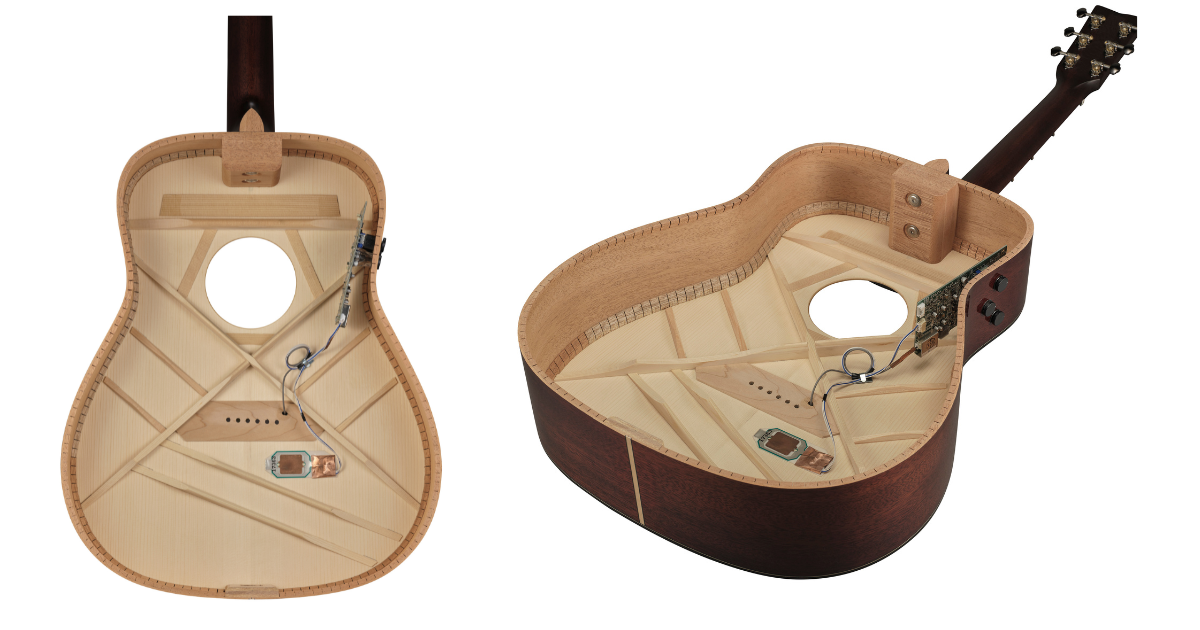
Atmosfeel is comprised of three elements: an under-saddle piezo pickup for low end, miniature condenser mic for mids, and proprietary, whisper-thin but deceptively strong, transducer contact sensor for overtones and clarity.

“Our approach was, first of all, to find out what are the strengths and weaknesses of all three elements,” says Soriano. “The under-saddle piezo pickups do a great job of capturing a bold and consistent low end. The weakness is that the high end has a tendency to sound unnatural to guitar players. That’s where you start to get a different sound than what your guitar is like in the room.

“The contact sheet, which is under the top wood of the guitar, is the inverse of that. It’s a paper-thin sheet that has a positive and a negative, and it captures the vibrations of the top. It’s really good at capturing air, high-end presence, and sparkle, and the low end is not as resonant.

“We’re taking the low end of the under-saddle and the high end of the contact sheet and creating what we consider to be the ideal blend between those two. That was the first step. Of course, neither of those technologies independently are completely new. Under-saddle pickups have been around for a long time. But the combination of the two, and the detail of how we blend them together, is what’s new in this system. That has created a new approach.

“The microphone, aimed at the side wood at the upper bout of the guitar on the low E string side, covers the mid-range character of the guitar, whether you choose mahogany or rosewood. Essentially, the system lets you have an ideal low end, an ideal high end, and you can blend the microphone in so that you get a mid-range to taste. We figured out how to take existing technologies to the next level and optimize them.”

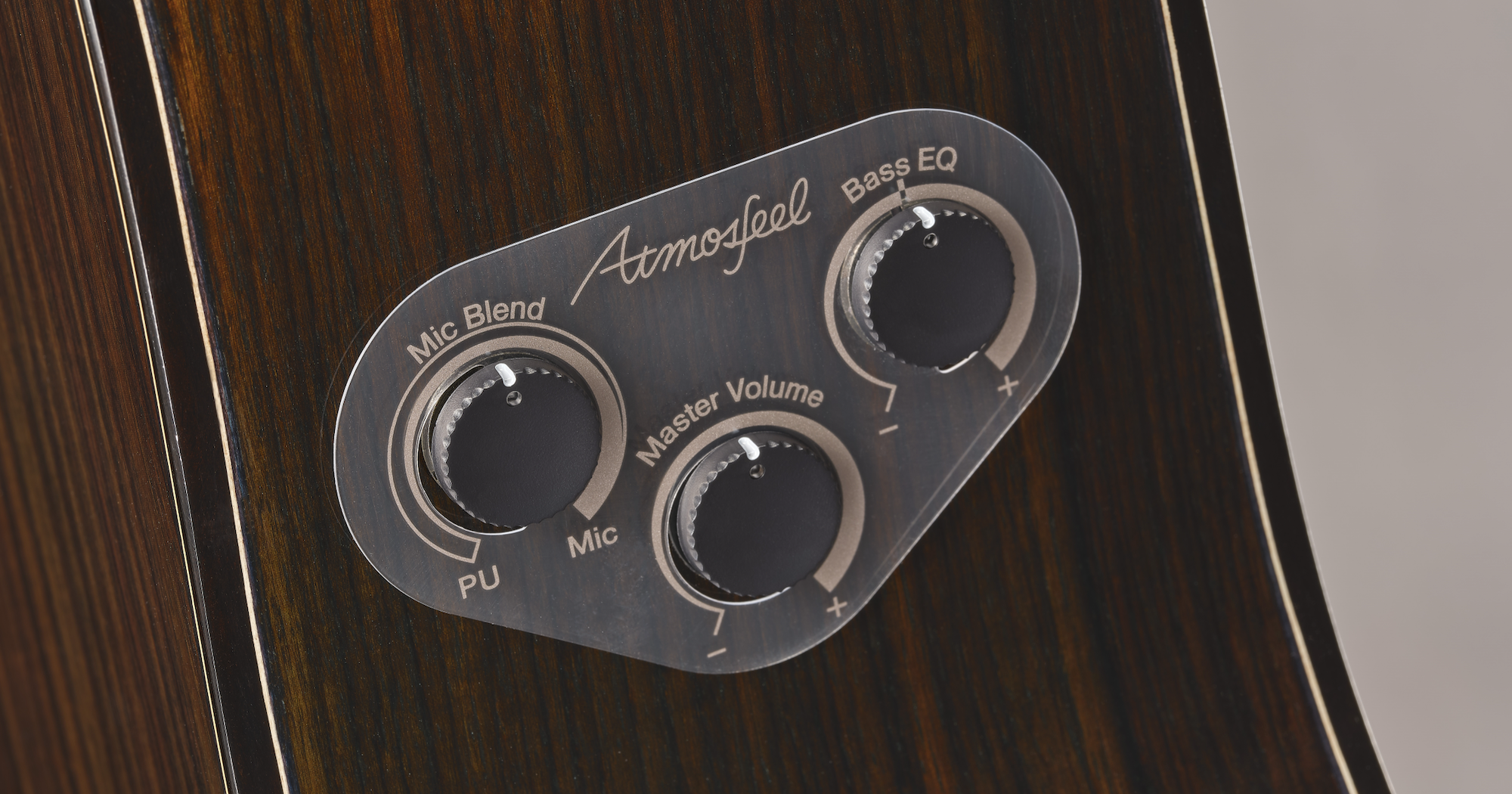
All of this is controlled by three small knobs. “You get a Microphone Blend, which is really effective for shaping your midrange and overall character,” says Soriano. “You get a Master Volume, which is essential, and then the Bass EQ is really interesting.

“When you’re playing live, a lot of feedback can happen in the bass frequencies. The Bass EQ is a cut or boost knob, which can help with controlling feedback or warming up your signal. If you’re playing solo and need to take up more room in the mix, you can crank that Bass EQ knob. Vice versa is true as well. If you’re playing with a band and there’s a bass player, you don’t want to step on their toes, so you’re probably going to want to roll off some of that bass.

“The Microphone Blend can be used to pop in and out of featured parts or solos. If you need a smaller, more compressed sound just to be in the background, you might use less of the Mic Blend. When it’s time for you to step out and take your chorus, you can crank that microphone up, stick out in the mix momentarily, and turn it back down when the time is right.”

Atmosfeel was designed for player flexibility – style, genre, attack, in the studio, onstage, on your own, with a band. Wherever you go, whatever and however you play, the system’s versatility works with you and for you.

“If you’re an arena- or stadium-level act, chances are you have a pretty silent stage,” says Soriano. “Those acts today are using a lot of in-ear monitoring. You can get away with a lot of Microphone Blend in that setting, because you don’t have sound coming back at you with an onstage wedge, and the risk of feedback is probably lower. Also, in a larger space, the sound has more room to dissipate.

“If you’re in a coffee shop, you have a floor wedge aimed at you, and the room is small, your risk for feedback might be pretty high. In that instance, you want to reduce the Microphone Blend and maybe the Bass EQ to accommodate for those things.

“And, of course, everything in-between exists as well – clubs, mid-sized venues, things like that. The system lets you tailor your settings to each of those without being too complicated. It’s just three knobs. If you know how to use them, you can optimize your sound for whatever setting you’re in.”

Yamaha designed Atmosfeel with musicians’ peace of mind foremost, meaning durability on the road and reliability onstage and in the studio. Choose your settings and rest assured they will remain in place, even if you don’t. “The Bass EQ knob has a notch at 50 percent,” says Soriano. “When you get to that spot, it locks you into place. Of course, it’s not too hard to move out of that space, but it certainly will not move on its own.”

Best of all, the 3×3 setup means easy to use, easy to remember. “Even the highest level of professional musicians are human,” says Soriano. “When you’re onstage, you have adrenaline going, and you have to make quick decisions, you don’t want to pause and remember which one of your seven knobs does what. You want to reach down and do what you need to do quickly so you can get on with the performance. The three-knob system is extremely user-friendly for that. You don’t have to spend time thinking about it before making an adjustment.”

Atmosfeel is perfect for recording in a pro studio, home studio, or on the road. “The vast majority of the time, if you’re recording an acoustic guitar, you’re putting a microphone on the guitar,” says Soriano. “Nowadays, especially with the rise in home recording, a lot of people might have trouble getting a clean signal with a microphone in front of their instrument, especially if your room has a lot of reflections in it.”

What does this mean for bluegrass players?

“A lot of artists we work with are primarily bluegrass players,” says Soriano, “so bluegrass was absolutely a primary focus in the development of the FG9X guitars. Bluegrass players most commonly use dreadnought-style guitars, so when we were voicing the pickup system in the FG9’s, we knew they had to be able to use this and be happy with it. That was a big part of our testing.

“Bluegrass tends to be quite guitar-forward, especially if there’s a solo section, for example. Bluegrass players are discerning when choosing their instrument. A lot of players have a strong preference. They want rosewood or mahogany, and there’s a reason behind that. If you’re going to make that decision, and it’s going to show your artistry and your taste, you should be able to have that come through when you’re performing live, even with a pickup system.

In a world of bells and whistles, where everything has to be shiny with lots of buttons and gizmos, Atmosfeel is deliberately stripped-down – no flash, no glitter, just durability and refreshing beauty in its simplicity.

“When you have a minimal setup that’s well dialed in, well executed, and well developed, when you put that work in on the front end, you earn the ability to have a simpler user interface,” says Soriano. “Because we are so confident in the voicing of this system, and in the fidelity and quality of the components, we didn’t have to put a million knobs on the guitar. We could afford to keep it simple and be confident that it’s going to sound great.”


This content is brought to you in partnership with Yamaha Guitars. All images courtesy of Yamaha Guitars.

You Gotta Hear This: New Music From Foy Vance, Rissi Palmer, and More

We have new music for you, as always, to herald the end of the week and beginning of the weekend. You Gotta Hear This!

From just outside of Washington, D.C., singer-songwriter Connor Daly releases a new single today, “Echoes of Midnight.” An Americana “fast waltz” with a melancholy tinge, the track is clean but gritty. Daly thinks it’s the best song in his catalog to crank through a loudspeaker, and we agree. A longtime friend of BGS and Good Country now, Rissi Palmer releases her brand new EP Perspectives today, so we’re celebrating by sharing a new song from that collection, “Good to Me.” Written with Shannon Sanders and Hilton Wright II, the song finds Palmer much more assured in what she wants and needs from a life partner than she was in her 20s. (Stay tuned for an upcoming interview with Palmer about the EP, coming next week right here on BGS.)

Also in a country space, roots music renaissance man Jim Lauderdale announced a new upcoming album today, Country Super Hits Volume 2. He certainly has plenty of “super hits” to celebrate; we’re kicking off the countdown to the new LP by sharing “Everybody’s Got A Problem.” There’s a kernel of truth in that hook somewhere, isn’t there? Relatable, charming, and effortlessly traditional country, it’s another Lauderdale banger. Then, from across the Atlantic, Foy Vance launched a brand new, homemade music video earlier this week for “Hi, I’m The Preacher’s Son.” With sonics gleaned from the intersection of folk and outlaw, the song is well matched by the trippy and fun video that combines animation, stop motion, and many other forms and styles into a unique visual journey. His dad was a preacher and fond of a parable; the track and video suit their inspiration perfectly.

Don’t miss Bryan Sutton unveiling another tune from his upcoming duets album, as well. This time he’s partnered with fellow guitar picker Jake Stargel on an acrobatic and oftentimes jaw-dropping rendition of the popular fiddle tune-guitar instrumental “Crazy Creek.” These are two of the most personality-rich players and stylist on six strings, doing what they do best. Each single from the album, From Roots to Branches, has been stellar – this latest outing continues that trend.

There’s plenty to enjoy below! Scroll to listen, ’cause You Gotta Hear This…

Connor Daly, “Echoes of Midnight”

Artist: Connor Daly
Hometown: Ashburn, Virginia
Song: “Echoes of Midnight”
Release Date: February 6, 2026

In Their Words: “As soon as I started writing the first pieces of ‘Echoes of Midnight,’ I knew exactly what kind of production I wanted for the song. Going into the studio with David Dorn at Farmland Studios in Nashville, it didn’t take long for him to understand the vision. Big drums, wide acoustic guitar arrangements, and energy pushing through every line. It’s one of those songs that was clearly meant to be played live and I knew I needed to hear it fully take shape in the studio. Lyrically, ‘Echoes of Midnight’ captures a very now-or-never feeling of young love that has always stood out in my catalog. If I could choose any of my songs to play through a loudspeaker, this would be it.” – Connor Daly

Track Credits:
David Dorn – Keys
Shaun Richardson – Acoustic guitar
Tim Denbo – Electric bass
Dave Racine – Drums
Justin Ostrander – Electric guitar
Connor Daly Steggerda – Songwriter, vocals


Jim Lauderdale, “Everybody’s Got A Problem”

Artist: Jim Lauderdale
Hometown: Troutman, North Carolina
Song: “Everybody’s Got A Problem”
Album: Country Super Hits Volume 2
Release Date: February 6, 2026 (single); March 27, 2026 (album)

In Their Words: “This song relates to the common experience of going through difficult times and that very few of us are immune to that; it’s one thing we all have in common.” – Jim Lauderdale


Rissi Palmer, “Good to Me”

Artist: Rissi Palmer
Hometown: Durham, North Carolina
Song: “Good to Me”
Album: Perspectives (EP)
Release Date: February 6, 2026

In Their Words: “I started this song with Hilton Wright II and completed it with Shannon Sanders (producer of the project). I sat on this chorus for three years, in the midst of a divorce, not sure what I wanted to say. On this side of things, I’m a bit more clear about what I want from a partner. The things that 29-year-old Rissi wanted are very different from what 44-year-old Rissi wants. We had a really good time writing this…” – Rissi Palmer


Bryan Sutton, “Crazy Creek” featuring Jake Stargel

Artist: Bryan Sutton
Hometown: Nashville, Tennessee
Song: “Crazy Creek” featuring Jake Stargel
Album: From Roots to Branches
Release Date: February 6, 2026 (single)
Label: Mountain Home Music Company

In Their Words: “Ever since Jake Stargel came on the scene, I’ve been fascinated and inspired. I think his playing is continually creative and powerful. He was the one that actually suggested ‘Crazy Creek’ and part of my goal with this duets project was just to try to capture musical conversations with my friends. We definitely do that here with ‘Crazy Creek.'” – Bryan Sutton


Foy Vance, “Hi, I’m The Preacher’s Son”

Artist: Foy Vance
Hometown: Bangor, Northern Ireland
Song: “Hi, I’m The Preacher’s Son”
Album: The Wake
Release Date: February 4, 2026 (video); March 13, 2026 (album)
Label: Rounder Records

In Their Words: “Being a preacher, my Dad was fond of a fable. Parables and philosophies poured out of him on a good day. I couldn’t fully appreciate them at the time, but I would learn to cling to the little wisdoms he shared. So much of him has influenced what I do. Seeking ways to say something concisely.

“I’m glad of that influence. I am also glad to be free of any certainty that gives someone the desire to be a preacher. Even if I felt certain about whatever God might be, I reckon the desire to become a preacher should never allow you to become one!” – Foy Vance


Photo Credit: Foy Vance by Gregg Houston; Rissi Palmer by Dire Image.

Sammy Brue Offers His Heartfelt Take on Justin Townes Earle

By the time Sammy Brue finished recording The Journals, he already knew something unsettling: this might be the most meaningful work he ever makes. Not because it would be his last, but because it arrived fully formed, heavy with inheritance, responsibility, and grief.

“If I never made another album again,” Brue said, almost laughing at the impossibility of topping it, “this was it.”

The Journals (out January 23 on Bloodshot Records) is a spare, intimate record built from the handwritten notebooks of Justin Townes Earle – Brue’s mentor, hero, and one of the most restless, brilliant American songwriters of his generation. Earle died of an accidental drug overdose in 2020 at age 38. What he left behind, scattered across hotel rooms, trains, taxis, storage units, and decades of living, was a vast, unfinished body of work. Hundreds of pages of lyrics, fragments, revisions, false starts, and songs carved and recarved like stone.

Entrusted with those journals by Earle’s widow, Jenn Marie Earle, Brue didn’t approach them as artifacts. He approached them as living documents. “I never got to write a song with Justin,” he said. “And then I thought – maybe I could.”

The result is neither a covers album nor an act of ventriloquism. Some songs on The Journals emerge directly from lyric sheets Earle left behind. Others are co-writes in spirit, with Brue completing ideas Earle had shaped over years. A few are Brue’s own songs, written from compilations of Earle’s images and themes. One track, “For Justin,” is entirely Brue’s – a quiet, aching letter written two years after Earle’s death, “by a Justin fan for Justin’s fans.”

The record was made quickly, almost violently so. With GoFundMe money raised to finish the project, Brue booked two days in Muscle Shoals, Alabama, a nod to the sparse manner that Earle once cut Yuma, his breakthrough 2007 debut. Brue wanted to honor that lineage directly: no band, no overdubs, no safety net. Just voice, guitar, microphones.

“I wanted it all live,” he said. “No tracking. No instrumentals. Just me.”

Brue practiced obsessively for months, then walked into the studio and recorded ten songs in a single day. When nerves crept in, he leaned on a conversation with Joshua Black Wilkins, Earle’s longtime collaborator, asking how Yuma had been made so quickly, so ferociously. “He said Justin was desperate,” Brue said. “He had to make it happen or he was going to sink.” That urgency – career, life, survival – became Brue’s template. The next day, they listened back, drank, and let the record sit where it landed.

Brue has been playing these songs live since the moment they were finished. Unlike most of his own catalog, they haven’t worn thin. “I’ll never get sick of playing these,” he said. “I’ll play them until my demise.”

To understand why requires also understanding what Earle represented to Brue long before the journals ever entered the picture. Brue grew up in a household steeped in American roots music – Justin Townes Earle, the Avett Brothers, Old Crow Medicine Show, Dave Rawlings. As a child, he assumed Woody Guthrie and Lead Belly were simply what came on the radio. At 10, he asked his father to take him to see Earle play in Salt Lake City, only to discover the show was 21-and-over. Fate intervened: Earle was outside the venue, smoking, when they pulled over. He signed Brue’s guitar. Years later, Earle invited him to open shows, tour, and appear on the cover of Single Mothers as a kind of “mini-Justin.”

They stayed connected. Brue watched Earle fall in love with Jenn, watched his life oscillate between discipline and chaos, sobriety and relapse. “He always treated me the same,” Brue said. “He put on a strong front for me.”

When Earle died, Brue felt the loss in stages – shock, numbness, then collapse. He later read Earle’s rehab journals but couldn’t bring himself to take them home. The pain on those pages was too raw. “Some of the most heartbreaking stuff I’ve ever read,” he said. “You want it released. You don’t want it released.”

What struck Brue most, beyond the suffering, was the work ethic. Earle wrote obsessively, filling 150-page notebooks song by song, revising endlessly. Saint of Lost Causes alone contains nearly 80 pages of drafts. “He carved songs like marble,” Brue says. “No wonder they’re undeniable.”

That rigor reshaped Brue’s own sense of craft. Archiving Earle’s journals – more than 800 pages total, still only a fraction of what exists – forced him to confront the fragility of legacy. “I’m looking at my own songs now like, why was I writing in the Notes app?” he said. “I need a box.”

The emotional core of The Journals came together when Brue met with Jenn and Etta, Earle’s daughter, flipping through the notebooks together. Etta clung to Brue’s arm as they turned the pages. “It felt like she was closer to her dad,” Brue said. “Jenn, closer to her husband. Me, closer to my idol.” From that moment on, failure wasn’t an option.

The album arrives alongside renewed attention to Earle’s life and work, including Jonathan Bernstein’s authorized biography, What Do You Do When You’re Lonesome. Together, they suggest something rare: a continuation rather than a conclusion.

“I feel like I’m a link in the chain,” Brue said, naming the lineage he feels bound to – Guy Clark, Townes Van Zandt, Steve Earle, Justin Townes Earle. “It’s rough and tumble right now. Which is perfect.”

For all its weight, The Journals isn’t morbid. It’s alive. It moves forward. Brue knows he doesn’t have to top it. He only has to honor it. And for now, that’s enough to keep the fire lit.


Photo Credit: Joshua Black Wilkins

WATCH: Bryan Sutton, “The Devil Went Down to Deep Gap” with Billy Strings

Artist: Bryan Sutton with Billy Strings
Hometown: Nashville, Tennessee
Song: “The Devil Went Down to Deep Gap”
Album: From Roots to Branches
Release Date: January 9, 2026 (single/video)
Label: Mountain Home Music Company

In Their Words: How do you see Doc’s playing influencing both yours and Billy’s?

“I think beyond the specific influence of Doc’s guitar playing that informs most every note Billy or I may play, I know that we both are students of Doc’s complete artistry. To say Doc is just the most influential flatpicker ever is limiting. He brought so much to the table in his honest and emotional singing, his song choices and writing, banjo and harmonica playing, and Travis-style fingerpicking. He was not comfortable being labeled or limited within a specific genre. His onstage persona was true to him. Without being a ‘showman,’ he was informational when the song needed it and willing to share whatever emotion he might be experiencing. It’s also important to note that Doc and Merle’s duo playing has been a huge part of the overall focus for things Billy and I have done together. I know for both Billy and I, Doc provides a lifetime of inspiration, influence, and learning.”

How do you pay tribute to that in this song and video?

“First and foremost, this is kind of a silly or fun thing, along with being a somewhat serious tribute to Doc Watson. I wanted to use the song to have fun with the guitar shredding and good versus evil battle, but also imagine an origin story of how Arthel Watson could have become the ‘Doc’ we all have loved. Maybe it’s a gospel song in the way that Doc, even and especially in his blindness, can ‘see’ through the Devil’s lies. Ultimately, Doc carries his triumphant message to the world, and influences us all with wonderful and heartfelt music.”

It sounds like you had this concept before talking with Billy about it. How did the concept and song come to be, from start to finish?

“It was listening to Charlie Daniels’ original ‘The Devil Went Down to Georgia’ with my youngest daughter, Lily. She has very eclectic and broad musical tastes. I’ve loved sharing music with her and checking out what she has discovered. We found some other covers of the original and one that stuck with me was Jerry Reed’s interpretation, where he makes Johnny a guitarist instead of a fiddler. I have been working on a duets record for some time, collecting recordings here and there with my pals, and knew I wanted to do something different with Billy, as he and I have a whole record of duet playing.

“Billy and I also share a love for heavy metal. I was trying to think of a way he and I could do something connected to this duets project that would allow us to play acoustic and electric. It all kind of came together when I realized this song would allow for that. The Doc origin story came about thinking how to make this not just a cover, but more personal and fun. It’s also another subtle tribute to Doc, who would oftentimes change or add lyrics to a song in order to make it fit for him. I fashioned the story, made a little demo, and sent it to Billy. He was into it and we were off.

“I feel fortunate that Del was into playing the Devil. I also am so happy to have T. Michael Coleman and Sam Bush on the track, who played many years on the road and studio with Doc. My pal Jerry Roe, who is Jerry Reed’s grandson, plays the drums, connecting to the Reed version that inspired me. Once I had the concept and demo for the song, I knew it had to be an animated video and discovered Pat Bradley of Springshoe Animation. It was wonderful working with him to take what had been in my head and be able to visualize it. Ultimately, all this came about a little piece at a time, and I’m so happy to share it with the world.” – Bryan Sutton

Track Credits:
Bryan Sutton – Acoustic guitar, electric guitar, vocal
Billy Strings – Acoustic guitar, electric guitar, vocal
Del McCoury – Vocal
T. Michael Coleman – Electric bass, harmony vocal
Sam Bush – Mandolin
Jerry Roe – Drums

Video Credits: Animation by Pat Bradley, Springshoe Animation.


Lead image courtesy of the artist.

Michael Daves Reconstructs R.E.M. Bluegrass Style

Although he lives in New York now, Michael Daves’ Southern roots permeate his music. That characteristic goes further than ever before on the newly released Fables, a six-song EP that reconstructs songs from fellow Georgia band R.E.M.’s 1985 album Fables of the Reconstruction.

In celebration of the record’s 40-year anniversary, Daves enlisted his longtime quartet bandmates – fiddler Alex Hargreaves (Billy Strings), mandolinist Jacob Jolliff (Béla Fleck, Yonder Mountain String Band) and Erik Alvar (Nefesh Mountain, Billy Strings) – and others to reinvent songs like “Green Grow The Rushes,” “Wendell Gee,” and of course, “Driver 8.” Together, they turn each track on its head, fully leaning into their bluegrass prowess while continuing to hold each song and their original formats in high regard. It’s something that Daves has plenty of experience with, having released the dual acoustic and electric bluegrass covers compilation Orchids and Violence in 2016 and Early Morning Sun – an EP of bluegrass and country standards from Ola Belle Reed, Dolly Parton and others – in August 2025.

“It was really important for me to try to make something that would stand on its own, even if people didn’t have any connection with R.E.M. or don’t even like them,” explains Daves. “I tried to make something that just works by its own logic as much as it’s paying homage to the original.”

During a Zoom call with BGS on release day in December, Daves spoke about his motivation for doing this cover EP, how he decided which songs to include on it, the plans for his label Wild Geranium Records, and more.

What motivated you to not only make an EP of R.E.M. covers, but to do it with songs from Fables of the Reconstruction?

Michael Daves: It’s an album I grew up with. R.E.M. was one of my first musical obsessions. I first discovered them in the late ‘80s at summer camp in Toccoa, Georgia, not too far from Athens where R.E.M. was from. All my camp counselors were [University of Georgia] kids, so I fully downloaded their musical tastes, which fortunately were pretty good.

As far as taking on the Fables thing now, there were a couple inspirations. For one, it’s the 40th anniversary of that record and it’s one that I don’t feel like a lot of younger people have heard or appreciated. People seem to know more of R.E.M.’s pop stuff from the ‘90s and beyond, but that ‘80s stuff was so good and weird. I also have this quartet I’ve led since about 2019 with Alex Hargreaves, Jacob Jolliff, and Erik Alvar in New York. They’re all incredible musicians who are very well versed in traditional bluegrass but also very adept at adapting music from outside the fold. We’d done some other projects over the years – like we did a whole mini set of Jimmy Webb songs one time including “MacArthur Park,” “Wichita Lineman,” and “Galveston” – and they learned that stuff in one rehearsal and just rendered it so beautifully. It made me realize that this is a quartet that really can handle a challenge.

The Fables idea came up because of the anniversary, but also because in August I had done a tribute along with Peter Rowan to the 1973 Muleskinner record that he was a part of. Initially he united with Bill Keith, Clarence White, David Grisman, Richard Greene, and Stuart Schulman to share a TV show with Bill Monroe, but Monroe never showed up. His bus broke down, so they ended up having the whole show to themselves and wound up getting an album deal out of it. Then they made this record that didn’t go anywhere because Clarence White died before it came out.

I taught a class about Clarence’s guitar playing on that record and through that became inspired to do a tribute to it with Peter at Vermont’s Green Mountain Bluegrass & Roots Festival this past August. When studying that Muleskinner record I discovered it had the same producer as R.E.M.’s Fables, Joe Boyd, who’s also worked with everyone from Nick Drake to Fairport Convention and Pink Floyd. That strange coincidence led to a Fables tribute show, which is then where the idea for this EP really came to life.

How’d you go about dwindling the original Fables of the Reconstruction down to the six tracks that are on this EP?

It was an interesting process choosing which songs to do. It was a combination of practical considerations, because when the quartet and I worked up this music for that one-off show in Brooklyn I initially picked songs that I thought were achievable on our tight constraints and would translate well to a bluegrass ensemble. There were definitely other songs on the original record that would have worked, but I’m feeling good about the song choices we made because the original record is sort of sprawling with a lot of digressions. There’s a lot of dreamer logic and a Faulknerian non-linearity in the writing, so to pare that down into what I think works as a distillation of the original recording that probably is more of an interesting statement on the original than if I just recorded the whole thing, you know. As my wife put it, we took it from a sprawling Faulknerian epic to more of a Flannery O’Connor gut punch.

Do you have any specific favorites of the six songs making up this project?

As far as song selection, I kept the first and the last songs from the record in their normal position. The record opens with “Feeling Gravity’s Pull” and ends with “Wendell Gee” so I kept those because the beginning and end of the story just felt right.

There’s something about the song “Good Advices” that just always just gets me with its meditations on mortality. It’s classic R.E.M. in the sense that it can be hard to parse the lyrics because they’re based more in dream logic than confessional writing. However, they still carry a lot of emotional weight and a sense of meaning that’s oftentimes hidden. For some reason, that song is the one that just always gets stuck in my head and gives me all the feels.

Part of this is due to the structure of the song, which is repetitive and drony. The bridge is basically four measures of the G chord and then it’s out, which I think is just brilliant how that works in the song. It was those repeated drone lines that Alex played over while the rest of the band had these repeated melody things going on. For me it’s the quintessential song off of the record. I don’t think it was a hit or anything at the time – that goes to “Driver 8” – which I almost didn’t include because it was the best known song off of that record.

The opening track, “Feeling Gravity’s Pull,” is one that was never my favorite track from the original record, but in rendering it I started liking it a lot more. I particularly like what Duncan [Wickel] brought to it on cello as well as the background vocals on it, especially at the end. That’s Jefferson Hamer from The Murphy Beds and Sean Cahill from The Next Great American Novelist. The parts they added took the song in this almost metal-like direction, which felt really good and different from the original, especially considering we’re all acoustic musicians. The whole experience with that song felt really cathartic. There’s an intensity that I always want out of bluegrass but don’t always hear, so I ended up being really happy with how that one came out.

This is the second release on your own label, Wild Geranium Records. What are your plans with that?

This is the second release on Wild Geranium. The first was my EP Early Morning Sun, which came out in August and was just a solo recording. The third one is coming out in March and is a full-length duo record with me and Jacob Jolliff where we’re paying tribute to Jim & Jesse, [who] are part of the first generation bluegrass legends. But most of what I do under Wild Geranium will be EPs and other shorter recordings.

Do you plan to record other folks on the label, or just your own projects?

It’s intended as a platform for various collaborations that I’ve had as well. All of the releases I’ve put out so far have zero original material, but some of that will be coming soon, too.

You’re also releasing Fables on cassette? What’s behind that decision?

The cassettes were part of the concept of Wild Geranium from the beginning. Cassettes first came back within the indie rock world almost 10 years ago, but to my knowledge isn’t something that’s been done much in the bluegrass world. I’ve had people joke with me and say, “Oh gosh, I’ve got to dust off my ‘78 Dodge Charger to play this!” [Laughs] In the age of streaming, I think having a physical item that is a little more affordable, easier to produce and keep in stock than vinyl is more important than ever.

The idea was to also include at least one song on each cassette release that’s not available digitally. On Fables that’s actually two bonus tracks – a duo version of “Green Grow The Rushes” with me and Jacob Jolliff and the other’s a live version of “Can’t Get There From Here,” which was from a full-band show back in August where we debuted the material. I just wanted to offer something unique and special to the listeners who care. If you get the cassette, you’re gonna have something that no one else is gonna have. It’s not bouncing around the internet, you have to have the physical thing. From a production standpoint, it’s an opportunity to tell a slightly different story than the digital release.

Do you have any other cover EP/album ideas up your sleeves?

Aside from the Jim & Jesse project, I also have some original material on the back burner. It’s fully demoed and is all music connected to Ponce de Leon Avenue in Atlanta where I grew up. It includes some stuff that I’ve written and co-written along with songs by family members and friends from that area and era. I’ve been performing music from that project for quite some time now, but haven’t made the record yet. So that’s something I’m hoping to make happen that would be another full-length, full band record.

What has bringing this R.E.M. covers EP to life taught you about yourself?

This R.E.M. stuff was among my first musical obsessions, so for years that’s just been baked into how I hear music in an uncritical way. So to actually get in there and break down what went into this record and think about how to render it in this other context was really interesting for me and fun to make a statement with that’s not based in nostalgia.

I also enjoyed getting to explore my feelings about how I want string band music to work. On my last full-length record Orchids and Violence I utilized a double-record concept where each disc had the same track list, but the first one was a very straightforward bluegrass record and the second disc is like all electric, experimental rock renderings of the thing. Fables was a little bit more like uniting both sides of Orchids and Violence into a string band expression, which is something I’d be open to doing more of in the future.


Photo Credit: Manish Gosalia

Watch Molly Tuttle Perform on Jimmy Kimmel Live!

Molly Tuttle kicked off the new year in style, appearing on Jimmy Kimmel Live! on January 5 to perform a GRAMMY-nominated song from her GRAMMY-nominated album. “That’s Gonna Leave a Mark” was released on So Long Little Miss Sunshine in August of 2025. The track was nominated for Best Americana Performance while the LP gained a nomination for Best Americana Album. Featuring her signature clawhammer guitar picking style and impassioned, heart-wrenching vocals, “That’s Gonna Leave a Mark” is a standout track from So Long Little Miss Sunshine, having held the No. 1 slot on the Americana radio charts for four weeks and having climbed to #13 on the AAA charts, as well.

On the Kimmel stage, Tuttle and her band – Ellen Angelico (guitar), Megan Jane (drums), Vanessa McGowan (bass), Mary Meyer (keys) – demonstrate the genre-blending style that’s also a hallmark of her most recent album. Clawhammer guitar builds a rich foundation for pop-steeped Americana, polish and grit combining in intricate and intriguing ways. Tuttle’s percussive right hand reminds of piano key strikes in similar singer-songwriter (but keys-centered), pop and adult contemporary styles. It may be surprising that old-timey and bluegrass textures could fit so well in this musical context, but this is an intersection of styles Tuttle has long been comfortable with.

Molly Tuttle will vie for the Best Americana Performance and Best Americana Album GRAMMYs on February 1, when the awards will be handed out in Los Angeles, before going on tour with Marty Stuart & His Fabulous Superlatives for Molly x Marty: Guitars on Fire — The Cosmic Twang Tour in the South and Northeast in February.


Photo Credit: Lead image courtesy of ABC/Jimmy Kimmel Live!; alternate image courtesy of ABC, shot by Randy Holmes.