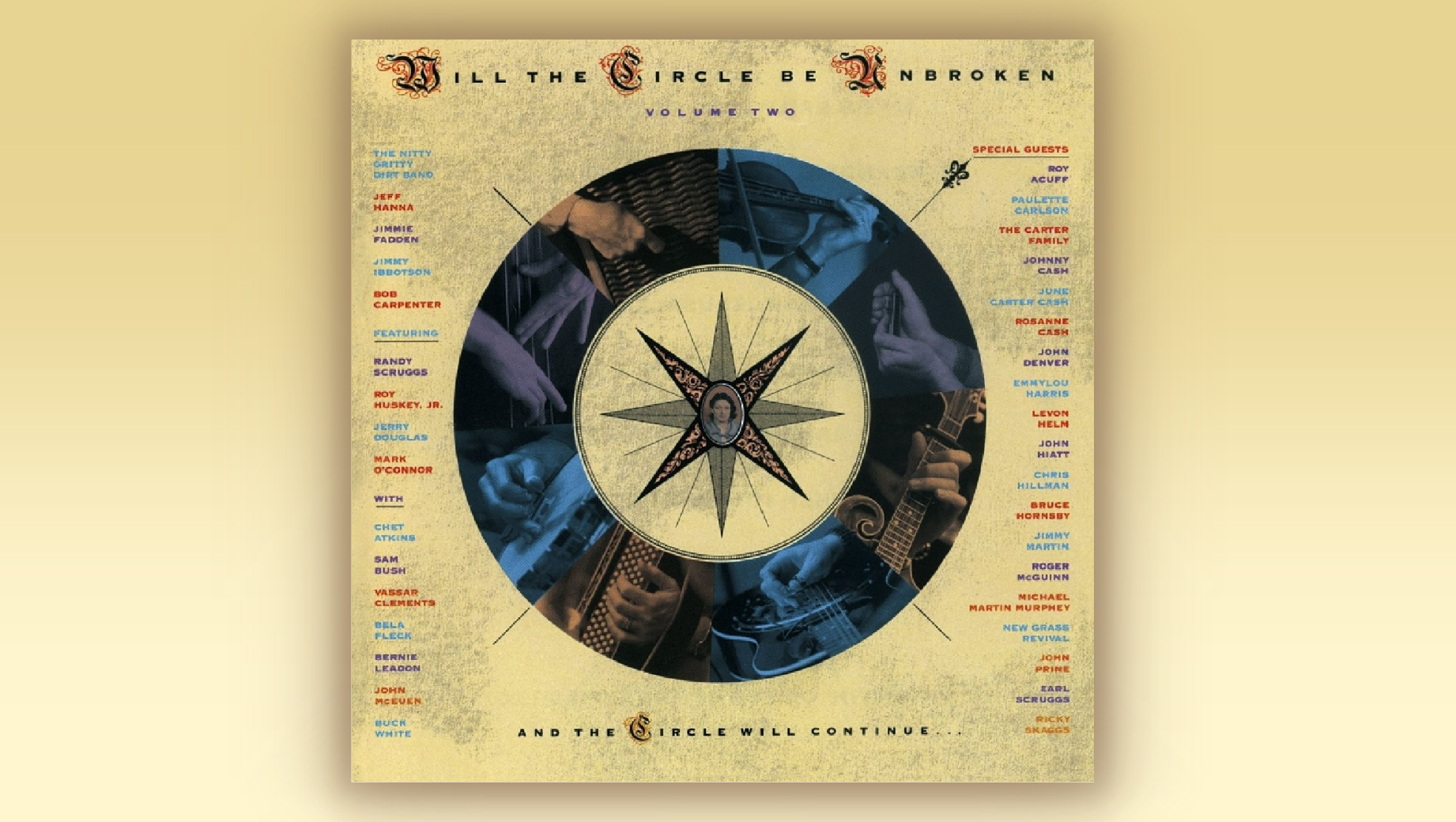
Nitty Gritty Dirt Band’s Jeff Hanna Reflects on ‘Will the Circle Be Unbroken, Volume Two’

Why mess with a classic? That was the original thought from a few members of Nitty Gritty Dirt Band when the idea was presented to record a sequel to their seminal 1972 album, Will the Circle Be Unbroken.

However, with encouragement from one of the group’s biggest fans, the legendary June Carter Cash, the recording sessions for Will the Circle Be Unbroken, Volume Two commenced in the winter of 1988, with a cast of accomplished musicians who are now considered cornerstones of Americana music.

Often referred to simply as Circle 2, the acclaimed project was released in 1989 and went on to win three Grammy Awards and a CMA Award for Album of the Year. To commemorate its 30th anniversary, Jeff Hanna shares its back story with the Bluegrass Situation.

Editor’s Note: Jeff Hanna and guest Sam Bush will participate in a screening of clips from a documentary film, The Making of Will the Circle Be Unbroken, Volume Two, at the Country Music Hall of Fame and Museum in Nashville on Wednesday, September 11 at 11 a.m., during AmericanaFest.

BGS: Can you explain why Circle 2 is such an important album for the band?

Hanna: It’s important in our history because at that point, we were no longer just the kids. We were all in our early 20s when we did the first Circle record, making music with those revered folks. And so we had a different point of view, somewhat. Here we were in the midst of our mainstream country career, and we still revered the first album.

The way we viewed Circle 1 was like something untouchable – just leave it. It is what it is. As time went on and as that project matured, it mattered a lot to a lot of people, including us. So we resisted the concept of doing another Circle record. Especially me, Jimmy Ibbotson, and Jimmie Fadden. Bob Carpenter was like, “I didn’t get to play on the first one! I wasn’t in the band! I want to do it!” He was pretty excited about the concept, and Chuck Morris, our manager at the time, brought it up a bunch. But we waited a while, and by the time it came out, it was 17 years between the releases.

When did you decide to move forward with it?

We were on tour with the Johnny Cash show, which included the Carter Family, and we were in Europe. I think it was in 1988 in Switzerland. June came into our dressing room — and she would visit us a lot. She was really sweet and she loved to talk about Mother Maybelle, and how much she loved us. She called us “them dirty boys.” I love that. And at the end of the conversation, she said, “You know, if you all ever thought about doing another Circle record, John and I would really love to take part in it.”

That was the tipping point. If you have that sort of endorsement from folks we idolized, and who were so important in the history of this music – and music in general — we thought, “Well, there you go.” That’s what we did. The winter of ’88, we started making calls.

How did you come up with the guest list, so to speak, for this one?

Our approach was to delve more into the next generation of folks, like New Grass Revival, and certainly a lot of our singer-songwriter buddies, like Bruce Hornsby, John Hiatt, Rosanne Cash, and John Prine. We had only recorded a little bit with Emmylou Harris and we really wanted to work with her. And we were really excited to do a record with Levon Helm. That was one of the highlights.

I think the collaborative spirit of this album really shines through when Bruce Hornsby is playing “Valley Road” with you guys.

I’d never met Bruce Hornsby but I was a huge fan of his music. I heard “Every Little Kiss” on the radio and it just blew me away. But then I’m reading an article in a magazine, and it was a “desert island disc” thing, talking about the records that you’ve gotta have, and he mentioned Will the Circle Be Unbroken. It was like, WOW! So I somehow got his phone number, I called him up — cold-called him — and he said, “Oh yeah, man, I love that record, I love you guys.” I said, “You’ve seen us play?” He said, “Yeah, my brother and I sneaked in.” We were playing a college show in his hometown, and those guys started carrying amps into the venue. We were unloading the truck and they started carrying gear in, and ended up sort of hiding behind the bleachers, and when the show started, came out and watched the show.

We hit it off right away, so there’s a direct line to Circle 1 right there. And when we were putting together our core band for the sessions, of course we included our buddy Randy Scruggs (who was on the first Circle album), Roy Huskey Jr. (whose dad Junior Huskey played on the first album), Jerry Douglas, Mark O’Connor… It was so much fun walking in and making music with those guys every day. Chet Atkins is on a track and played one of my guitars, which I liked. I know I’m never selling that guitar.

One of the coolest tracks on there is “You Ain’t Goin’ Nowhere.” How did that come about?

We brought in Roger McGuinn and Chris Hillman, because the Byrds and the Flying Burrito Brothers were so important to us. The Byrds had done Dylan’s “You Ain’t Goin’ Nowhere,” but they wouldn’t play it on country radio, so we cut a version of “You Ain’t Goin’ Nowhere” with Roger and Chris, and it became a Top 10 country single, which we thought was cool redemption. We were really excited about being on the track with them. We still play that tune now and again. That’s one of our favorites. We’re really happy to have a good excuse to play it, because for years we played it in sound checks anyway.

It’s been 30 years now, but what do you remember about how Circle 2 was received upon release?

Perhaps because we had the platform of being a hit country band right about then, the label promoted the heck out of the record when it initially came out. And it had hits on it, that’s the other thing. Circle 1 didn’t really have any radio impact, whereas Circle 2 had “You Ain’t Goin’ Nowhere,” and we had a song called “When It’s Gone” that was a Top 10 single.

It’s a significant record and it’s funny, having been there from the get-go with this band, and having that first Circle record so deeply ingrained in my DNA, I sometimes forget how important Circle 2 was to a lot of folks. I’ve had more than one songwriter and musician tell me, “That’s what got me into you guys.”
 

BGS Presents 30 Years of ‘Will the Circle Be Unbroken, Volume Two’ at Americanafest

What started as a music video concept for the Nitty Gritty Dirt Band evolved into a 1989 full-length film documenting the all-star recording sessions for Will the Circle Be Unbroken, Volume Two. Nitty Gritty Dirt Band co-founder Jeff Hanna will present a rare screening of clips from The Making of Will the Circle Be Unbroken, Volume Two at the Country Music Hall of Fame and Museum on September 11 at 11 a.m., during AmericanaFest.

Hanna will be joined by bluegrass virtuoso Sam Bush, who appears in the film and on the album with New Grass Revival. Craig Shelburne, managing editor of the Bluegrass Situation, will moderate.

Produced by Joanne Gardner Lowell and Rosanne Cash, the film captures the band in the studio recording their groundbreaking project. Select clips will show performances by Johnny and June Carter Cash; Jerry Douglas; Emmylou Harris; Bruce Hornsby; Jimmy Martin; New Grass Revival; John Prine; Earl Scruggs; Randy Scruggs; Ricky Skaggs; and others. Will the Circle be Unbroken, Volume Two won three Grammy Awards as well as the 1989 CMA award for the Album of the Year.

Three decades after its release, Joanne Gardner Lowell offered some keen perspective on the film through an email interview with the Bluegrass Situation.

BGS: What was it about the Nitty Gritty Dirt Band and this project that made it a compelling film subject for you?

JGL: ACME Pictures was contracted to make a video for the title track. This is pretty common. We signed the contract and when I asked what day during the multi-week schedule this song would be done, Jeff said, “All of them.” When I realized we would need to go to the studio every day for weeks to get this song, it seemed obvious we should shoot the whole experience — so we did.

How would you describe the mood, or the vibe, in the room during these sessions?

It was joyful in the studio. Each day the musicians came so ready to create and collaborate. We were honored to be in the room with it all. Being live made everyone really stay on top of their game. It felt like a family reunion on many days, and there was always a lot of humor and laughter. Our primary director, Bill Pope, captured so much of the mood with his amazing camera work.

It was also shot during the holiday season, so people were in a happy mood. Emmylou brought a handmade Christmas ornament you can see hanging in some of the shots. And my partner Rosanne Cash came into the studio with her newborn Carrie. I don’t think she was even two weeks old. Rose handed her to me and I held her tight while running sound for the track Rose and John Hiatt did together. Carrie never made a peep!

It was crucial to capture the acoustic nature of these sessions. What was your audio setup like?

I had a simple Nagra tape recorder just to have an edit track to work from and to record interviews. I had a single mic that I would place in the room to catch all the conversation, as some of that was obviously not recorded for the album and we wanted it for the film. Although, during our interview with Emmylou Harris, the band loved what she said so much that those comments ended up on the album.

Do you remember any particularly fun encounters with the legendary musicians in the film?

We caught some great moments and they’re in the film. The ending of a fast-paced “Valley Road” with Bruce Hornsby was a favorite. The band all stops for a second to look at each other — then they realize they got it and they all start shouting and cheering.

After Jimmy Martin’s session one day, he went out for some cocktails and came back into the studio while Ricky Skaggs was working. We captured Jimmy (feeling no pain and wearing a coonskin cap) as he and Ricky ripped into a spontaneous version of “The Old Crossroads.”

This film was Mr. Acuff’s last filmed appearance and that was special. I have to say — each time the song “Will the Circle Be Unbroken” was performed, it was magic. Every single time.

The Dirt Band did a masterful job of keeping things upbeat and fun for everyone. Every one of them was so engaged in each song — and brought individual songs or artists to the project. They were like marathon runners, giving their all each day and then coming back the next day to do it again.

What were some of the hurdles you faced in the film’s creation and release?

The very existence of this film was due to a California record company exec telling me that we would be in breach of contract if we didn’t deliver this video for the agreed-upon budget. When I explained this “song” was going to require us to shoot for several weeks, this delightful woman didn’t seem to care. I think it was meant to be — we HAD to make it work.

Bill couldn’t figure out how to light the dimly lit studio without a pile of light stands in every shot — and in everyone’s way. So, he created a giant light box and hung it from the ceiling. You don’t see a single light stand.

We didn’t have any money to sync up the video with electronic slates or fancy editing gear. I moved a cuts only 3/4″ video editing system into my office and had to sync the shots up by eye more than once… if we didn’t have an audio track running. Watching Mark O’Connor’s fingers or Earl Scruggs’ fingers to make sure you lock each note made for some very long nights. Those fingers were flying!

Rosanne and I sold 50 percent of the film rights to a company who released it on home video. Unbeknownst to us, the entire archive of that company was acquired by another company that isn’t interested in letting us buy the remaining rights, so we remain in limbo.

What do you hope a modern viewer will experience when watching these clips 30 years later?

This is a piece of living history. The first Circle album influenced every single musician I know. Watching the creation of the second — especially thirty years on — reminds you what kind of power music has.

It makes me sad to count off how many artists from this project are gone now: Johnny Cash, all of the Carter Sisters, Earl and Randy Scruggs, Vassar Clements, Chet Atkins, Levon Helm, John Denver, Roy Acuff, and dear Roy Huskey, Jr. In this world of instant technology, I think this 30-year-old film puts the viewer right into the studio for a front row seat at this amazing recording. I’m very proud of it.

22 Top Country Duos

Country music was made for duets. Not only because those tight, tasty harmonies are a foundational aspect of the music, but also because country accomplishes heartbreak — and every other make and model of love song — better than almost any other genre. (Thought quite possibly better than all other genres.) It just makes sense to have two singers, one to play each role in a lost, soon-to-be-lost, or (rarely) divine, never-perishing romance. But the format isn’t restricted to lovers or their placeholders, it can just as seamlessly fit heroes and acolytes, parents and children, siblings, peers, fellow pot smokers, and on and on.

Take a scroll through these twenty-two country twosomes:

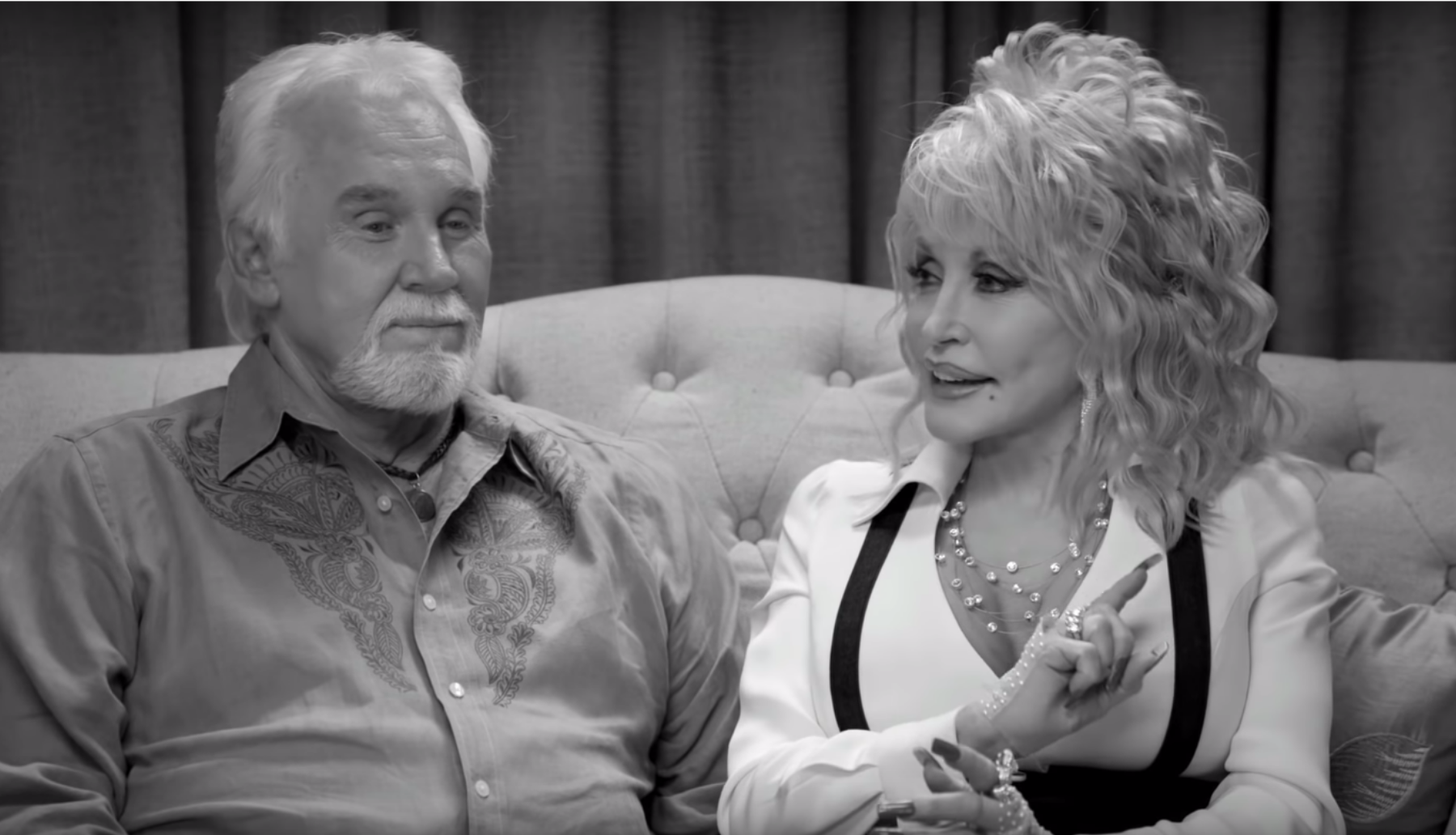
Kenny Rogers & Dolly Parton

We couldn’t have this list without these two. They should be the start, middle, and end of any definitive list of country duos. So we’ll just make the easy choice and kick it all off with Kenny and Dolly — that extra intro about their friendship and the years they’ve known each other? Swoon.

Loretta Lynn & Conway Twitty

After saying what we did about Kenny & Dolly we knew this pair needed to come next — so as to not rile anyone. Out of countless duets we could have chosen, how could any top “You’re The Reason Our Kids Are Ugly?”

Willie Nelson & Ray Charles

For inexplicable reasons people tend to forget Ray Charles’ incredible forays into country. His collaborations with Willie are stunning for the extreme juxtaposition of their voices and styles — they feel and swing so distinctly and differently, but all while perfectly complementary. “Seven Spanish Angels” ranked a very close second to this number in our selection process.

Glen Campbell & John Hartford

The most-recorded song in the history of recording? It’s said “Gentle On My Mind” holds that honor. And goodness gracious of course it does. Here’s its writer and its popularizer and hitmaker together.

Lee Ann Womack & George Strait

Together, Lee Ann and George were beacons of the trad country duet form, especially in the ’90s and early 2000s. This one from the jewel in the crown of Lee Ann’s discography, Call Me Crazy, is crisply modern, but with decidedly timeless vocals.

George Jones & Tammy Wynette

A broken, country fairy tale of a love story, George and Tammy’s relationship was infamously fraught, but damn if that didn’t just make their duets ever more… ethereal. Which doesn’t justify that Tammy Wynette kinda pain, to be sure, but it does remind us that if country can do anything better than all other genres, it can be sad.

Reba McEntire & Linda Davis

One of the best country songs, duets, and music videos EVER MADE. Theatrical and epic and a little silly and downright catchy and Rob Reiner and… we could go on forever.

Tanya Tucker & Delbert McClinton

Tanya is back with a brand new album and its well-deserved level of attention has been helping to re-shine the spotlight on her expansive career. Forty top ten hits across three decades. Who does that? Here she duets with Delbert McClinton on their 1993 hit, “Tell Me About It.”

Alan Jackson & Jimmy Buffett

Hey, if this has to be stuck in our heads for the rest of the month, it should be stuck in yours, too. Fair’s fair. It’s only half past [whatever time it is], but we don’t care.

Johnny Cash & June Carter Cash

One of the most recognizable duos in the history of the genre, immortalized not only in their discography but in a film adaptation of their love as well, Walk the Line. We all know “Jackson” as familiarly as the ABC’s, so here’s a slightly lesser-known beaut. (Keep watching til the last verse for an adorable bit from June.)

Eric Church & Rhiannon Giddens

Country is at its best when it surprises us. This collaboration is certainly, on the surface, unexpected, but the message of the song isn’t the only way these two artists can relate to each other. Over the course of their careers they’ve both fought their way from the fringes to the centers of their respective scenes. More of this, please.

Dolly Parton & Porter Wagoner

Dolly got her start with Porter Wagoner on his television show in the 1960s. They can certainly be credited with pioneering, popularizing, and epitomizing the country duet format. One of her most famous hits, “I Will Always Love You,” was written for Porter as she lamented leaving their act to go totally solo. (We’re a little glad she did.) You can tell they sang this song just a few gajillion times together, give or take.

Pam Tillis & Mel Tillis

Father/daughter duos in country aren’t as common, but they certainly aren’t unheard of. Pam and Mel are a perfect example. (The Kendalls are another.)

Patty Loveless & Ralph Stanley

Patty Loveless received the first ever Ralph Stanley Mountain Music Memorial Legacy Award in 2017 at Ralph’s home festival, Hills of Home, in Wise County, Virginia. Patty and Ralph were longtime friends and collaborators during his lifetime and even through her mainstream country success she referenced bluegrass and Ralph as influences — and she cut a few bluegrass records as well.

Alison Krauss & James Taylor

It’s. Just. Too. Good. Like butter. Like a warm bubble bath. Like floating on a cloud. Two voices that were meant to intertwine.

Charley Pride & Glen Campbell

These two were made to sing Latin-inflected harmonies together, weren’t they? Charley Pride gets overlooked by these sorts of lists all too often. But dang if he didn’t crank out some stellar collaborations, too!

Gram Parsons & Emmylou Harris

“Love Hurts” and boy, if Gram and Emmylou don’t make you believe it heart and soul and body and being. The definitive version of this Boudleaux Bryant song? Perhaps.

Willie Nelson & Merle Haggard

Icons being icons. And friends. And amazingly talented, ceaselessly musical comrades. You love to see it. (We could’ve/should’ve chosen “Pancho & Lefty.” We did not.)

Vince Gill & Amy Grant

There are quite a few reasons why the Ryman Auditorium basically hands this husband and wife duo the keys to the place each December. Basically all of those reasons are evident in this one. It’s fitting that this video came from one of those Christmas shows, too.

Dolly Parton & Sia

Dolly literally outdoes herself, re-recording “Here I Am” for the original soundtrack for her Netflix film, Dumplin’, after she first cut the Top 40 country single in 1971. Clearly she and Sia have much more in common than an affinity for wigs; their soaring, acrobatic voices seem so disparate in style and form until you hear them together. Listen on repeat for the best therapeutic results.

Robert Plant & Alison Krauss

[Insert entire Raising Sand album here, because how could we ever choose?] Lol jk, here’s “Killing the Blues.”

Carrie Underwood & Randy Travis

Cross-generational, meet-your-hero magic right here. Little did we know what was in store for Carrie Underwood then. But the way Randy looks at her up there, you can tell he knows she’s goin’ places.

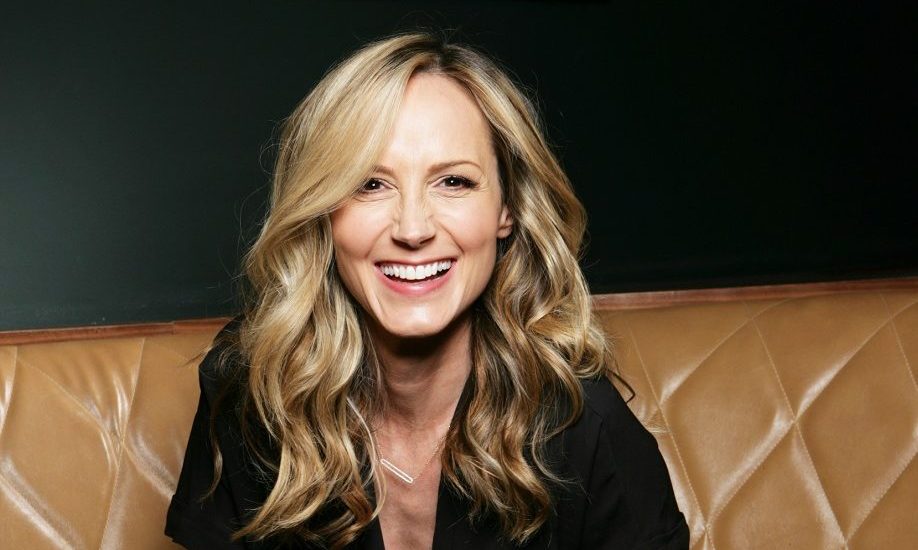
BGS 5+5: Chely Wright

Artist: Chely Wright
Personal nickname: Chels

What other art forms — literature, film, dance, painting, etc — inform your music?

I don’t mean to sound like I’m too cool to acknowledge that books, films, and paintings affect me (of course they do), but I think the single biggest influence on the work I do comes from human interaction and my observations of it. I absorb communication (spoken and non-linguistic) between people — whether it’s firsthand or from the sidelines — in the ways that one might go to the Met to see their favorite Degas. I do think, at times, that the way people interact is a form of art, because the composition matters and because it requires context and begs for interpretation.

What was the first moment that you knew you wanted to be a musician?

When I was just a little kid, I’d sit in front of stacks and piles of my parents’ vinyl record collection as my mom would curate the playlist of the day. Buck Owens, Loretta Lynn, Emmylou Harris, Bobbie Gentry, Conway Twitty, Hank Williams Sr., Elvis, and The Beatles… those were some of the artists in heavy rotation in our household. I remember being four years old and all I wanted to do was listen to those records. I was learning to read at that time too and my mom would help me as I sounded out the words written in the liner notes. I recall saying to my mom, “I want to do this. I want make my own records.” To which she replied, “You can.” And in that moment I really believed that I could and that I would.

If you had to write a mission statement for your career, what would it be?

Mission Statement: Find joy in every part of the work. The music. The people. The solitude. The airports. The chaos. The struggle. The triumph. The songs. Find The Joy.

Which elements of nature do you spend the most time with and how do those impact your work?

I try to walk a lot wherever I am. I’ve always cherished the experience of putting my feet down on dirt, gravel, pavement, and stone in places where I’m pretty sure I’ll never walk again. There’s something profound about it for me. Like most folks, I do my best thinking on my walks. Usually, on these walks, I don’t think about melodies or lyrics, but rather, I think about characters. The characters I consider (mostly fictitious) have free reign of my imagination for 1-2 hours to share their monologues or dialogues with me. I remember being a kid on my paper route and doing the same thing. I don’t know why I enjoy it, but I do.

Since food and music go so well together, what is your dream pairing of a meal and a musician?

I’m not a big foodie and I’ve never answered questions about the intersection of food and art with any style or substance, to be honest. I can say this though– if you give me a night of Rodney Crowell and Joe Henry together on stage, I’d be pretty damn happy with a peanut butter and jelly sandwich.


Photo credit: Matthew Rodgers

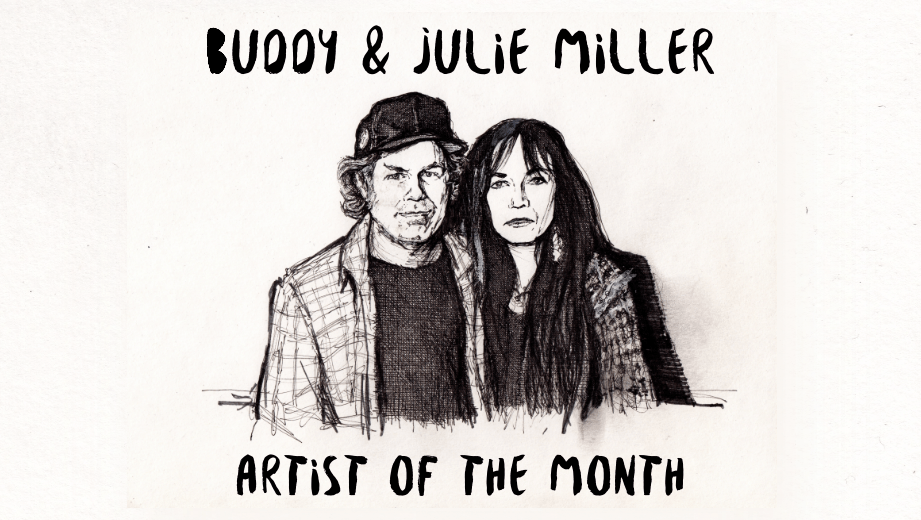
Buddy & Julie Miller Get Back on Track With ‘Breakdown on 20th Ave. South’

There’s a bit of dramatic license baked in to the title of Buddy & Julie Miller’s new album Breakdown On 20th Ave. South. The wheels are not coming off this epic 35-year marriage, most of which has been spent on that very street in Nashville’s Belmont neighborhood. But the long haul doesn’t come without strife and tests, as older married folks know. And when a songwriter as unguardedly emotional as Julie Miller began to express her feelings about being sidelined during the busiest-ever stretch of Buddy’s long and fruitful career, the results were bound to be provocative.

“We started out writing a record and my brother died right in the middle of it and I just sort of fell apart,” said Julie in late May in an interview in the home in question. “And I had fibromyalgia, so combine the two, and you’re not good to go. I just sort of went to pieces. So Buddy went and made a living.”

“And I kind of shut her down in some ways,” Buddy said. “I took that opportunity, which I shouldn’t have done, away from her to make Universal United House of Prayer at that time and then took every gig that came along for the next 12 or 13 years. She was kind of put on…”

“I took care of dogs,” Julie said with a wistful laugh.

Thus the songs on Breakdown — songs of yearning, of incompleteness and the striving for connection — have that specific power that comes from being both personal and universal.

Buddy Miller has been as in demand as any musician in Americana for more than a decade. He produced stellar albums for Richard Thompson, Shawn Colvin & Steve Earle, and others. He steered the music on the television show Nashville for multiple seasons. He hosts a radio show for SiriusXM with Jim Lauderdale. It’s evidence of the respect and the singular place Buddy has carved out since picking up the guitar in the early ‘70s and heading to the ferment of Austin, Texas.

That’s where he met Julie Griffin, and soon he was auditioning for her band and then for her hand. Julie recorded a handful of solo albums for a Christian music label in the ‘90s, and Buddy’s been releasing music nearly as long. Yet when the Millers started to focus on recording as a unit, the results have been particularly spectacular. Their self-titled duo debut in 2001 earned the Americana Music Association’s first-ever Album of the Year award. Eight years later Written in Chalk took the same honor, though Buddy concedes that was part of the difficult time for Julie and it was not truly a 50/50 creation.

If anything, Breakdown is a Julie-dominated project, written by her on her timetable, recorded over a long stretch in unusual circumstances. That’s where we pick up our conversation with the first couple of Americana music.

Buddy: After [Nashville] was over we just spent time together, just sitting together watching TV, something we’d never done before — or for a long time. Then slowly, we started approaching music at her speed, whatever that was. When we started recording, we didn’t record it in here [his much-admired home studio on the main floor]. We recorded in a little corner of the bedroom. She’d write a song and I’d slowly bring up little pieces of gear and something to record on — a laptop. Instead of live players we’d just play the two of us and build tracks.

BGS: Were you trying to sort of trick yourselves into recording, instead of the full production with everybody coming over at a set time?

Julie: Exactly! It was like, let’s pretend we’re not really doing it. We’re just having fun!

Buddy: We would say we’re not doing a record. We were getting the songs recorded but we would never say we’re doing a record. But we like how it sounded. … I want to look at somebody if I’m making a record. I love playing with players and having a drummer to look at and play off of. And upstairs I was looking in the dog’s face this far from me. But it was a really great experience doing that.

Julie, respecting your privacy, what can you say about your fibromyalgia and how you’ve been feeling lately?

Julie: Well I’ve had it since 1978 maybe — a really long time — more than half my life. And you get sort of used to a certain amount because it’s always there. But it gives you wallops now and then. And being on the road with fibromyalgia is such stress. It’s indescribable. And Buddy, because I’d always been heave ho you know, he didn’t get it. I could say it, but it didn’t click. Which is understandable. You have to be sick to get it, you really do. It’s progressively gotten more painful over the years, so it’s pretty painful at this point. But I’m never pessimistic about it. God will do something. The medical professional will acknowledge something.

I understand that’s a big challenge of this disease — getting validation from doctors.

Julie: It was incredible how many years I had it with doctors going ‘I guess you’re crazy’ in so many words. And that was making it twice as bad. You know good and well you’re in pain and you’re crying and you’re not crazy – or maybe you are crazy, but crazy people can be in pain, too. [Laughs]

Is there a connection between music making and the creative headspace, and feeling relief?

Julie: You know what? That’s interesting you’d say that because when I was writing I could focus on one thing. I could focus on the writing or the fibromyalgia. And I was just lost in the writing, so I was oblivious to so much — [to] a degree of my fibromyalgia. It made me realize I was meant to write songs.

Was there a stretch when you were estranged from the writing process?

Julie: There was a long time I was estranged from it. In fact, ten years or more after we’d signed with New West and I’d gotten sick and my brother had passed, I thought they were done with me. And Buddy said, ten years later, “No they’re just waiting for a record!” I was like what? They’re willing to take a record now? “Yeah, they’re just waiting for it.” So I was so excited. And ten years before I had written a lot of songs for the record, but they didn’t make it on this record. In fact the songs I wrote for this record didn’t make it. Accidentally other songs came that ended up on the record, so I’ve got a lot of songs.

Buddy: We started with a whole different list. When we knew we were working on a record, the list would change on a weekly basis because she’d write a new song. And it’s just the two of us working, and it’s hard to have a perspective on what we’re doing when it’s just one bouncing it off the other. She’d write a song and we’d record it that day.

So you have a lot of work tapes and demos.

Julie: Oh, you wouldn’t ever want to ever hear ‘em! There are so many of ‘em that you’d lose your mind.

Buddy: And some of them are on the record.

Julie: For the first six years, from 18 to 24, I’d try to write a song and I’d get so disgusted with how bad it was, I’d write it and throw it in the trash. But after I came to know the Lord… Here’s what the big thing was with him — he loved me and accepted me whether my song was good or not, and that enabled me to learn how to write a song.

Was getting involved with HighTone Records in the ‘90s a real pivot point?

Julie: Well it was really funny because Christians didn’t really like my music! [Laughs]

Buddy: There was that too — I meant to say that! That’s one reason it was easy to get out of it, because they didn’t get it at all.

Julie: They kind of let me go, and off I went, and the next people who wanted me to sign up were some Jews from San Francisco! So I just did it, you know? They heard me sing harmony on Buddy’s record. They got Buddy first, and then they got me and so that’s how it happened. I mean, I didn’t leave Christian music. I just went with who wanted me.

Buddy: Yeah, I was playing guitar with Jim Lauderdale. We all met when he moved to New York around 1980. Jim was working in the Rolling Stone mail room and we were all playing together. We moved to LA and I called Lauderdale and I said, “If you need a guitar player let me know,” and that’s when I got back into playing with Jim. HighTone asked Jim if he would do a track on this Points West record [a 1990 compilation of West Coast country music]. He said, “I can’t, but my guitar player would probably do it for you.”

So I did a couple tracks for them and based on that, a couple years later after we moved to Nashville, they must have had a hole in their release schedule, and they asked if I could do a record. I said, “Absolutely, yes.” They said “Do you have the songs?” I said, “Absolutely.” And we didn’t, at all. [Julie laughs] But we got that record together in a pretty quick time. Then they heard Julie singing on a song called “Hole in My Head” on that record that I wrote with Jim. Larry Sloven, who owned the company along with Bruce Bromberg heard her, and he said, “She sounds tough. She’s great.” He liked her voice.

Julie: [Laughing] Just a sweet little girl and they said I sounded tough. I’ll never understand it.

Buddy: At that point, Emmylou Harris had cut Julie’s song, “All My Tears,” on Wrecking Ball, so they knew she was a writer, and they said, “Would she want to do a record?” That was shortly after my first record, I think, and she was happy about it at the time at the time.

Julie: Very happy!

Buddy: They were really supportive. One thing we got with HighTone — and we probably got it because they had no budget so they had no oversight, and we made our records at home — we just turned in a finished record. There was nobody looking over our shoulder. There was no A&R department. They were just encouragers who had hopefully come up with a tiny budget, and they were really good folks over there, in that respect, and they gave us freedom to make whatever kind of records we wanted to make.


This interview was recorded for WMOT’s talk show The String. The full conversation can be streamed here.

Illustration by Zachary Johnson
Photo credit: Kate York

LISTEN: Molly Parden & Hollow Hum, “Why Worry”

Artist: Molly Parden & Hollow Hum
Hometown: Nashville, Tennessee
Song: “Why Worry”
Album: Why Worry: A Collection of Covers
Release Date: June 28, 2019
Label: Independent / Distribution with Tone Tree Music.

In Their Words: “The essence of Mark Knopfler was introduced to me back in 2012 and I wish I could remember which of his songs I heard first. I had no knowledge of Dire Straits or their international stardom, absolutely none. Only this deep, gentle voice with a backing band that sounds like it has been there since the dawn of time, a sole guitar, smooth as butter with intermittent growly tone to let you know Mark wields power, but uses it ever so mercifully. His songs are hymns to me. ‘Sailing to Philadelphia,’ which is basically a musical history lesson featuring James Taylor, nearly brings me to tears. ‘Back to Tupelo’ and ‘Our Shangri-La’ are in the vault, the one that I send to space and then it comes back to my children 50 years later with 10 Things That Mommy Needs You To Have. But this song, ‘Why Worry,’ is a Dire Straits tune off of Brothers in Arms (1985) — I first heard it as a duet between Emmylou Harris and Mark — that has been covered by the Everly Brothers, Chet Atkins, and now I can proudly add my name to the list. Featured on this version is London’s resident guitar aficionado Matt Park. I discovered that he and I share a mutual admiration for The Knopf whilst we together were on tour with Sam Outlaw in the summer of 2018.” — Molly Parden

“This song was new to me, Molly played it for me once, and of course I wanted to cut it with her. It’s just one of those timeless songs that brings an immediate exhale and sense of comfort. The simple arrangement lets the vocal sit out front and really communicate the message of the song, which I love. Because it’s not such a well-known track, I hope some new ears discover this beautiful tune.” — Hollow Hum


Photo credit: Marcus Maddox

BGS 5+5: Doug Seegers

Artist: Doug Seegers
Hometown: Long Island, New York
Latest Album: A Story I Got To Tell (BMG)
Nicknames: Duke the Drifter (from the days on the NY music circuit, in the band Angels in Overdrive)

What was the first moment that you knew you wanted to be a musician?

I was born a musician and singer — genetically. At 16 I wanted to be a performer. My grandfather put me up on the bar at age 5. My feet dangling down swinging back and forth, he had me singing Elvis songs on the bar.

Singing was always beautiful to me and it was encouraged by my grandmother. Her singing with me provided comfort and supported me. Her encouragement was like water on a flower. She was watering my flower – see, the beauty of the vocals. My grandmother was an important part of my childhood, especially as it related my music and singing. She could hear a song and tell me how to play it on the guitar – she heard the music perfectly.

That support is what helped me know I wanted to be a musician; it was early. Performing gives me a great feeling and a huge smile now. I saw that in using melodies, the melodies come from our head and from God. Paul McCartney’s melodies are incredible and magical. David Crosby jokes about making “A bad song with good melodies and it will be a hit.”

What other art forms — literature, film, dance, painting, etc. — inform your music?

Religion. Poverty. Growing up poor. I don’t know how to put this into words, about how this informs my art and songs. My mom tried to talk me out of music as a career because of what happened to her. [Editor’s Note: Her husband abandoned her to play music.] My grandmother [was] a big influence for me. She loved the Beatles. In my eyes as a younger man, my granny was the first person to recognize the Beatles for their talent. We had a radio on the wall in her kitchen and so I remember we were waiting for the first Beatles record.

Our family did not have a record player. I remember me, my brother, and mother all chipped in and bought a record player because we wanted to play the first Beatles record. We looked in the Buylines, a newspaper with categories of things for sale. On the “stereos” headline, we found one real cheap. A monaural record player — one speaker. My older brother listened to that record player for at least ten years. We played the 78s, and I played the Hank Williams 78 my dad left behind. That is how I learned to play the guitar.

I am working on another song for my next record. A cover song by Sherry Cothran, “Tending Angels.” I want to do it out of respect for her. She ran a soup kitchen. We had dinners on Thursday nights – she would be there, I got to know her. I have been speaking to her on text. Here is something I wrote to her, ‘Hello Sherry, my name is Doug Seegers, and I used to eat at the Thursday night dinners. A friend was telling me that you are a singer-musician, I just wanted to tell you I spent this morning listening to your music. I wanted to tell you how much you have lifted my spirit this morning. The strength of your humbleness is probably one of the world’s best-kept secrets. I wish you peace and tranquility ‘til the day after forever.” Guess that was a little too much for her, she responded with ‘Thank you for your kind words.’’

How often do you hide behind a character in a song or use “you” when it’s actually “me”?

In some of my songs, I am clear it is me, like in “Out on the Street.” It’s a story about my brother and me. The song starts with Well, I found my wisdom when I was a child out on the street / growing up without my father made my life so incomplete.

This sets a foundation for another song, “Angel from a Broken Home.” This song is important to me. It is a message for fathers to pay attention to their precious children. The song is written about an 8-year-old little girl whose father left her all alone. The lyrics are:

She always got a busy tone
Calling her daddy on the phone
How could he ever treat his girl this way?
She is 8 years old with a broken heart.
How could her daddy be so hard?
Yet every night she forgives him when she prays.
Well she’s an angel from a broken home
Growing up with a heart of stone
Lost her love for her daddy
When he left her all alone.

This is my story. My father left me when I was 8 years old, but I wrote it about a little girl.

Which artist has influenced you the most … and how?

Gram Parsons influenced me. I was listening to all of the early country-rock bands, and Gram was a member of the Flying Burrito Brothers. I particularly like Gram Parsons when he did that song “Do Right Woman.” I thought that was an awesome song. It is an Aretha Franklin song — he turned it around. What Gram was trying to do was fuse different styles together and that is why he was so inspirational to me. I never saw him live but listened to him and knew his songs.

After Flying Burrito Brothers, he did that thing with the Byrds, the Sweetheart of the Rodeo record. That just opened up the sky for me when I heard that record. When Sweetheart of the Rodeo came out, that was the real beginning of me listening to Gram Parsons’ music. And then shortly after that along came Emmylou Harris. They went on the road as the Fallen Angels. That was back when country-rock was being born. It was real inspirational for me.

Then I have always loved duets, you know. I have been listening to and loving duets all my life. I think Gram and Emmylou are like the prettiest duets I have ever heard. Listening to them became an addiction at that point. Their duets that really speak to me include “She” — that is on my first album. I was so pleased to have Emmylou provide vocals and sing on my record. The other two duets that stand out for me are “Hearts on Fire” and of course “The Return of the Grievous Angel.”

One Gram song that rattles around in my head is “Hickory Wind.” Back in the day that is what all the cool guys were playing. When Emmylou came along, the big chart-topper was “Love Hurts.” I still love all of his music. I went to Joshua Tree to visit Gram’s special place. It was a wonderful experience for me. There are some videos of me at Joshua Tree Inn, where Gram passed.

What rituals do you have, either in the studio or before a show?

I want to make sure I am alone when I write songs. I need to get some alone time. Secure privacy and safety. I need to have my own time, space, and privacy when writing. Some will get a cabin in the woods. But not me. I wake up with an idea and a song might be there. I write it when it happens, you just got to get a hold of it then. Someone can react to me — maybe get angry, I can write a song about that.

When I listened to Sherry Cothran’s song ‘Tending Angels,’ I knew it was the right thing to do, and I needed to learn that song and record it. I wanted to pay respect to someone special. I use a notebook and a fine tip marker. That is how I like to write — quiet, alone, with a fine tip marker.


Photo credit: Nelson Blanton

John Paul White Captures the Countrypolitan Era

John Paul White, who rose to prominence as half of The Civil Wars, has just delivered his most fully-realized solo set, The Hurting Kind. When he couldn’t find a modern album that gave him the feeling of his favorite countrypolitan recordings of the ‘50s and ‘60s (think Patsy Cline and early Roy Orbison), White set out to make an album that would capture the aesthetic of that era without going full-on retro. He wrote with some legendary songwriters of those decades still working in Nashville, including Country Music Hall of Fame members Bill Anderson and Bobby Braddock. One of those Braddock collaborations, “This Isn’t Gonna End Well,” is included here as a duet with Lee Ann Womack.

Recorded at his own Sun Drop Sound studio in Florence, Alabama, with producer Ben Tanner (Alabama Shakes) behind the console, The Hurting Kind finds John Paul White going for broke as a vocalist, flexing his creative muscle as a country songwriter, and speaking his mind about what it means to live and work in Alabama in 2019.

BGS: When you were growing up, your father’s record collection contained a lot of classic country albums, but you didn’t gravitate towards those sounds back then?

White: When I was growing up, I hated those records. It was not my cup of tea. I was more of a rock ‘n’ roll guy. I was listening to Black Sabbath and Led Zeppelin and AC/DC — stuff like that that. When I got to college I started listening to Steve Earle and Rosanne Cash and Emmylou Harris. I realized the reason I was digging those records so much is because of all those country records I grew up with. That’s what they grew up with, too, so we had a common DNA. So, I dug back into all those records that I knew by heart and realized how much I loved them. They influenced my decisions musically all the time whether I knew it or not. I finally just fully embraced it.

Over the last few years, you’ve been drawn to music from the countrypolitan era. Why did you want to tap into that for The Hurting Kind?

I think it was just a huge hole in that part of my discography that I was listening to. I was looking for that stuff everywhere. I’d worn those records out, and I knew them backwards and forwards. I was trying to find something in a modern setting that was doing that thing, because that’s just what I craved and what I wanted to listen to.

I then went out and made the record that I was looking for. I decided, “Well, I’m going to find the guys that wrote a lot of those songs.” So I got to write with Whisperin’ Bill Anderson and Bobby Braddock for this album. I got the seal of approval from them that I was on the right track. That’s huge.

You wanted to capture that countrypolitan aesthetic, but you didn’t want The Hurting Kind to sound retro. How did you achieve that?

I didn’t actively do anything to keep it from sounding retro. I wanted it to sound like a modern record, but with those same sensibilities of the string arrangements, vocal harmonies and that country-jazz Chet Atkins-type guitar style. But I wanted to capture it in the way you capture sounds today and not feel like you have to use all old ribbon mics and old RCA microphones that they were forced to use. We have lots more tools at our disposal. If we had finished this record and were just following our guts and it sounded like an old record, then so be it. But I’m glad it sounds like its own thing.

The aesthetic I was going for was really captured in the songwriting process. I arranged all these songs in my head the way that I thought they should sound, and the way they should progress dynamically, before I ever walked into the studio.

“You Lost Me” is such a great cheating song, and one of the most devastating on an album full of heartbreak songs. How are you so good at writing these sad songs?

I’m not meant to write songs to cheer you up. I’d fail miserably because they don’t move me. They don’t make me feel something. My songs aren’t necessarily sad as much as they’ll stir up an emotion. It might be longing or it might be love, but at an angle. Like, “I love you and you’re so horrible for me.” That’s more interesting to me, ‘cause just the straight up love songs, it’s been done. I come at it from a completely different perspective.

Doomed love is also the topic of “This Isn’t Gonna End Well,” a duet with Lee Ann Womack. Why was she the right fit for that song?

I needed a timeless voice — a voice that could straddle genre, but also, I won’t lie, I wanted a voice that would be recognizable. Lee Ann was every one of those boxes checked. She’s really made strides towards creating true, traditional music and sort of separating herself from the typical Music Row stuff. We’ve known each other for a while and have talked about collaborating and never have. I knew, because of Bobby writing it with me, I could be confident enough to walk in the room and ask her out, as it were. She said yes.

You’re singing with a lot of emotion and vulnerability on this album, which isn’t common for a man to do in 2019. Why is that?

Because it’s ain’t cool, I guess. I love Roy Orbison and Marty Robbins — the guys that just put their heart on their sleeve and are not afraid of the drama and bowl you over with it. They make sure you know exactly what they’re feeling with those big notes and the trills and stuff. I think ever since Nirvana came along, so many wonderful things about that whole movement, but it also became so much shoe-gazing. That’s fine, and I like some of that music, but what I really like is a guy up front with confidence putting it all out there and letting you know exactly how he feels and not giving a shit what you think about it.

It’s not easy to pull that singing style off, either. Your voice has really evolved on this album.

I appreciate you saying that. I think it was a confidence thing, too. I think it was a conscious decision to step forward and be counted and give people what I have and not hold back. Not give them 80 or 90 percent. I honestly feel like I’m singing better now than I ever have. I feel like every time I get in front of a microphone or get onstage or am in the studio, I figure something out. I tweak something that makes it a little less hard, a little more comfortable or easier to project — a little better tone, and that’s exciting.

Being an Alabama native like yourself, I’ve found a lot of meaning in the album’s opening song, “The Good Old Days,” with the news coming out of the Alabama state legislature. You’re now performing that song all across the country and overseas and in some ways representing the state to your audience. I have to say, it’s complicated to be from Alabama these days.

It most certainly is. I get it left and right. I’m proud to be known as an Alabamian. I don’t take that lightly. I don’t tend to want to be the preachy guy around here, because I’ve never gravitated towards those sorts of people anyway. The whole proselytizing thing of, “This is what you should believe and this is what you should not believe” does not sit well with me. But at some point around here, it just gets to a fever pitch to where you can’t keep your mouth shut.

That song was definitely a big middle finger to the idea of “Making America Great Again,” because for most people in this country that aren’t white, straight dudes, it wasn’t great. It hasn’t been great. I’m trying every day to teach my children about tolerance and compassion and making sure they know this country was really, really hard on a lot of people that didn’t fit what people considered the norm.

I don’t ever want to see that shit happen again. I don’t want it on their watch. I want to make sure they’ve got their eyes open and that they change things and don’t ever say we should have it back like it used to be. No. I don’t want that for a minute. I want it like it says in the song, “Our best days are in front of us.” I have to believe in that. There are days when I wonder, but I have to have that hope.


Photo credit: Alysse Gafkjen

The Best of Sitch Sessions: 13 Must-See Musical Moments

As we enter the new year, we look back on our favorite moments shared with some of our favorite artists in 2018. Check out our top Sitch Sessions, filmed in Los Angeles, Nashville, Philadelphia, and beyond.


“Ain’t That Fine” – I’m With Her

Fresh off the release of their debut full-length album See You Around in February, Sara Watkins, Aoife O’Donovan, and Sarah Jarosz serenaded us among the palms of the Fairmont Park Horticultural Center in Philadelphia.


 “Mal Hombre” – Rhiannon Giddens

Rhiannon Giddens brought Tejano to East Nashville with her powerful version of the legendary Lydia Mendoza’s classic “Mal Hombre.”


 “Long Gone Out West Blues” – Joe Mullins & the Radio Ramblers

Traditional bluegrass proselytes Joe Mullins & the Radio Ramblers joined us in Nashville, gearing up for the return of Huck Finn Jubilee in Southern California last October.


“The Traveling Kind” – Rodney Crowell and Emmylou Harris

Looking back on their 40+ years of friendship and collaboration, with no intention of stopping, Rodney Crowell and Emmylou Harris claim to be members of an “elite group” of those from their generation still traveling, touring, and performing. They laugh, “We’ve traveled so far, it became a song, at last”.


“Islands in the Stream” – Love Canon

How can you not smile from this bluegrass-inspired version of this Kenny Rogers and Dolly Parton classic?


“Rygar” – Julian Lage and Chris Eldridge

The duo gifted us with the building, joyous “Rygar”, off their album Mount Royal, which they describe as being comprised of “experiments” — songs that allowed them to explore their own capabilities and push the boundaries of what can be done on the acoustic guitar.


“The Restless” – The Lone Bellow

With this stunningly stripped-down rendition of “The Restless,” The Lone Bellow reminded us to keep our heads up and our hearts open in the face of adversity, something to hold on to for a fresh start in the new year.


“Alison” – Jamie Drake

Gearing up to release her solo album Everything’s Fine in 2019, alt-folk singer/songwriter Jamie Drake joined us in Los Angeles and regaled us with her immaculate tune “Alison.”


“Different, I Guess” – Lilly Hiatt

Lilly Hiatt, in the way only she can, ponders the dangers and glories of being vulnerable and allowing yourself to fall in love.


 “Coming Down the Mountain” – Mipso

Mipso muses on retreating from the madness of society in this beautiful song, taken from their 2017 album of the same name.


“Took You Up” – Courtney Marie Andrews

Courtney Marie Andrews’ breathtaking vocals stunned us once again in a solo acoustic version of this track from her latest album May Your Kindness Remain.


“Thirty” – The Weather Station

The Weather Station (AKA Tara Lindeman) gave us the haunting and tense, yet fluid, “Thirty” from their self-titled album. They met us to perform the song at BOK, a historic Philadelphia trade school, closed five years ago, now re-purposed for its space to be used by the community for small businesses, job training, non-profits, and more.


“Firestarter” – Andrew Combs

And to close out the year, we have singer/songwriter Andrew Combs with a solo acoustic performance of this captivating, previously unreleased tune.


Dolly Parton Carries Childhood Memories Throughout Her Career

Back through the years, I go wandering once again
Back to the seasons of my youth…

So begins “Coat of Many Colors,” which Dolly Parton frequently cites as the favorite song she’s written. That 1971 country classic is just one example of Parton’s ability to view the world through a child’s eye, whether she’s writing about her own life, placing a fictional young character in dramatic circumstances, or simply making a connection to a new generation of kids.

The newest example of this gift is Dumplin’ – a Netflix film where an overweight teenager finds solace in Dolly’s music. Leading up to the movie’s release, Parton released a duet version of “Here I Am” with Sia – an ironic choice, as the pop star is famous for singing with her back to the audience. But that anthem of self-declaration sets the tone for the Dumplin’ soundtrack, underscoring one of the reasons that a teenage girl would love Parton’s music in the first place. The heartfelt film is based on a young adult novel by Julie Murphy.

Seeing an early cut of Dumplin’ inspired Parton to write “Girl in the Movies,” a thoughtful song that finds her identifying with that very character — the “girl in the movies.” Parton told NPR that she wrote it for every little boy and girl. The song carries a strong message, she says: “Don’t just live in a fantasy of watching someone else live their lives. You star in your own role. You be the star of your own life.”

Parton has embodied that perspective for 60 years. In fact, 2019 is the 60th anniversary of the first time she released a song she wrote – in this case, “Puppy Love,” composed with her uncle Bill Owens. Parton was 11 years old when she wrote it, 12 when she recorded it, and 13 when it was released as a single on the tiny Goldband Records. She sang locally around Knoxville, Tennessee, and moved to Nashville on the day after she graduated from high school in 1964. Two years later and still chasing her dreams, she married Carl Dean, a lasting union that nonetheless yielded no children of their own.

Yet time and time again she incorporated a child into the storyline of her music. For example, in “Mommie, Ain’t That Daddy,” Parton sings from the perspective of a woman whose kids happen to see their father begging for money. In “Jeannie’s Afraid of the Dark,” Parton describes Jeannie as a child who feared burial; her duet partner Porter Wagoner then reveals that Jeannie dies. “Malena” is another doomed child who dies on the night of her birthday, finally receiving the set of wings she’d asked for.

By 1970, Parton had carved out a solo career in addition to her role on Porter Wagoner’s TV show. Her first No. 1 hit, “Joshua,” tells the story of an orphaned girl who hears about a mysterious man living a good ways down the railroad track. Curious, she seeks him out – and then promptly moves in with him. (“Why, you’re just what I’ve been lookin’ for!” she exclaims.) The poetic “Coat of Many Colors” arrived a year later, serving as a morality tale that still resonates decades later.

Parton employed that same autobiographical approach for “In the Good Old Days (When Times Were Bad),” a gem from My Tennessee Mountain Home. Reflecting on her childhood years, she sings, “No amount of money could buy from me the memories I have of them / No amount of money could pay me to go back and live through it again.” (Merle Haggard identified with the lyrics so much that he recorded a version, too.) Another of the compositions on that album is simply titled “I Remember” and finds her blissfully recalling those seasons of her youth. Of course, as she matured, so did her songwriting, most notably on poignant compositions like “I Will Always Love You,” “Light of a Clear Blue Morning,” and of course, “Jolene.”

Still, if you dig into her albums from this era, you’ll find songs like “Me and Little Andy,” about a poor girl and her dog who wind up on Dolly’s doorstep. She agrees to let them spend the night; by morning, the girl and the dog are both dead. Another one, “Mammie,” is about a midwife who raises a child after the mother dies at birth and then teaches the child to sing and play guitar — but Mammie herself doesn’t live to the end of song. “Silver Sandals” recounts the story of a disabled young girl who couldn’t walk; when she inevitably dies, Dolly and Porter imagine her happily walking up the golden stairs of Heaven.

On a brighter note, Dolly reminisces about a banjo picker she knew as a kid named “Applejack.” Almost like a precursor to Dumplin’, Parton composed “Shattered Image” about sitting on a bridge as a girl and throwing rocks into her reflection in the water. She compares the experience to the way people were shattering her public image as an adult. A 1979 album cut, “Nickels and Dimes,” is a co-write with her brother Floyd Parton, who died in December. While writing it, Dolly thought about how she’d open up her guitar case in downtown Knoxville as a young girl and busk in order to get enough quarters to buy hamburgers. By the time the song ends, she’s a star, but here’s how it begins:

“I used to stand on the corner and sing as a child
And I’d play my guitar and sing as the people went by
The sidewalks were crowded but I’d just sing louder ‘cause I didn’t mind
Spending my time, spinning my rhymes, and singing for nickels and dimes.”

Even beyond her musical output, Parton has kept a strong bond between herself and a younger generation. In 1986, she invested in a theme park in East Tennessee and rebranded it as Dollywood – a gift that keeps on giving, with new attractions added nearly every year. And it’s not all roller coasters. Parton’s mother sewed a replica of the fabled coat of many colors to display in the museum dedicated to Dolly’s life and career.

Nearly a decade later, Parton instituted the Imagination Library, where pre-school children receive a monthly book at no charge. To these lucky kids, Parton is known as “The Book Lady.” Meanwhile, “Coat of Many Colors” has been successfully transformed into a children’s book and an award-winning TV movie, in addition to being recorded by the likes of Eva Cassidy, Emmylou Harris, Joey & Rory, and Alison Krauss & Shania Twain.

When Parton was 70 years old, she secured a No. 1 country album with 2016’s Pure & Simple. One of the most charming songs on it is titled “I’m Sixteen,” where she sings, “It goes to show you’re never old / Unless you choose to be / And I will be sixteen forever / Just as long as you love me.” A year later she released her first-ever children’s album, I Believe in You.

As 2019 begins, Parton is in the spotlight again. On January 6, “Girl in the Movies” will compete for a Golden Globe award in the category of  Best Original Song in a Motion Picture. A month later, she will be recognized as the MusiCares Person of the Year at an all-star concert event, just a day before the Grammy awards. Along with celebrating her magnificent musical achievements, the presentation also acknowledges the fact that the Imagination Library has given out 100 million books since its inception. Parton is the first member of the Nashville music community to be honored at the annual MusiCares gala.

Way down in the fall, Parton will return to the Grand Ole Opry, celebrating the 50th anniversary of her induction in October. But her history to the Opry stretches about a decade before that. When she was 13, Parton and her uncle Bill Owens had lingered outside the Ryman to meet Johnny Cash. When he emerged, a starstruck Parton begged Cash to let her sing on stage – but it would take a while for this dream to be realized. In time, Opry star Jimmy C. Newman gave up his slot for her, although Cash handled the introduction that night. According to Parton’s autobiography, Cash told the audience, “We’ve got a little girl from up here in East Tennessee. Her daddy’s listening to the radio at home, and she’s gonna be in real trouble if she doesn’t sing tonight, so let’s bring her out here!”

Parton wrote about this career milestone in her book: “I know I had never heard a crowd cheer and shout and clap that way. And they were doing it all for me. I got three encores. This time I was prepared for an encore, but not three, not at the Grand Ole Opry. Someone told me later, ‘You looked like you were out there saying, “Here I am, this is me.”’ I was. Not just to that audience but to the whole world.”


Illustration: Zachary Johnson