Bluegrass Memoirs: The Earl Scruggs Revue Beginnings

Nearly 50 years after the Earl Scruggs Revue concert I saw at the University of Maine, an internet search led me to Jaime Michaels of the opening act, Beckett. He still has vivid memories from that night in Orono. I sent him a copy of my report. He wrote back, saying:

I have no idea about the song titles but it was nice that my ’63 Gibson J50 got a mention … I still have it.

He has vivid memories of his time backstage with Scruggs.

… at the very end of Earl’s set as he walked back out for his 3rd or 4th encore he stopped and said to me “If I’d just play the darned thing right, I wouldn’t have to keep going back out …”

A little later as we were all loading out Earl came up to us and said, “Do you guys want to see my new bus?” He took us for the grand tour. I was still pretty young and had never seen a real tour bus before.

He was such a sweet guy with this humble self-effacing humor.

Earl was proud of that bus, I reckon; he’d named an instrumental after it.

When I saw them in 1975, the Earl Scruggs Revue was a polished Nashville rock act that had been together since 1969. Debuting at a folk festival that May, not long after Scruggs split from Lester Flatt, it featured Earl’s sons.

The two oldest, Gary (then 20) and Randy (then 16) were already Nashville recording studio veterans. They’d been in the Columbia studios multiple times (Gary 11 sessions, Randy 15 sessions) since May 1967, helping on the last three albums Lester and Earl made before their split (Changin’ Times, The Story of Bonnie & Clyde, Nashville Airplane).

Also new to Flatt & Scruggs, in the fall of 1967, was Columbia producer Bob Johnston, then 35. Concerned about declining record sales, Columbia had replaced Frank Jones and Don Law, highly regarded Nashville veterans who’d been producing F&S since the fifties, with Johnston, who was producing Bob Dylan.

Dylan had stunned the folk world when he went electric at the Newport Folk Festival in 1965. He first recorded in Nashville in 1966, completing Blonde On Blonde there using mainly Nashville studio musicians. In the next two years he returned, making John Wesley Harding and Nashville Skyline.

Flatt & Scruggs’ final albums reflected their move to Johnston, a leading producer at forefront of Columbia’s move from acoustic folk into electric folk rock.

Later, when asked about what led to the split with Earl, Flatt spoke of his difficulty in singing the band’s new songs. “Johnston,” He said, “…also cut Bob Dylan and we would record what he would come up with, regardless of whether I liked it or not. I can’t sing Bob Dylan stuff. I mean, Columbia has got Bob Dylan, why did they want me?”

Of the final three F&S albums, both Changin’ Times and Nashville Airplane had folk-rock repertoires. At the very first session for Changin’ Times, four folk-rock favorites were cut, three Dylan hits, one by Ian Tyson: “Don’t Think Twice,” “Four Strong Winds,” “Blowin’ In the Wind,” and “It Ain’t Me Babe.” Here, Earl’s boys Gary (singing) and Randy (lead guitar) were together for the first time in the studio with Flatt & Scruggs and Johnston.

Imagine the dismay of Lester (who, soon after splitting with Earl, would record “I Can’t Tell The Boys from the Girls“) at this session! It seemed as if the young longhairs with their strange new music were taking over.

Released in January 1968, the back cover of Changin’ Times was filled with the image of a rock poster. Unsigned notes beside it read:

With their smash appearance at the Avalon Ballroom (a West Coast temple of rock and light-shows) when they turned on the whole of San Francisco, there are no new worlds left for Flatt and Scruggs to conquer. Flatt and Scruggs are for everyone.

One of the album’s 11 tracks was a remake of Earl’s “Foggy Mountain Breakdown,” which had just become a hit through the soundtrack of Bonnie and Clyde. Five tracks were by Dylan; the album closed with Woody Guthrie’s “This Land is Your Land.”

Gary and Randy Scruggs personified the Lovin’ Spoonful’s “Nashville Cats,” but also in the studio for that album were other, older, Nashville cats – Charlie Daniels, Grady Martin, Bob Moore, Charlie McCoy and other A-team studio musicians. Randy and Gary would come to know these men well as they built life-long careers in the Nashville studios. These careers were forged during their years (1969-82) with the Earl Scruggs Revue.

Fortunately, the Revue’s earliest days were chronicled in a television documentary. David Hoffman’s ninety-minute NET TV special, Earl Scruggs: The Bluegrass Legend – Family and Friends, was recorded in 1969-70. It has been issued on DVD several times since then and can be seen on YouTube.

It’s fascinating to watch Hoffman’s documentation of Scruggs as he narrates his past, voices his present, and sets out his future directions. Along the way, Hoffman captures Earl’s music-making with a wide variety of performers and audiences. By the end of those 90 minutes, Scruggs’ cultural and political perspectives are manifest; likewise the breadth of his musical tastes.

Hoffman filmed in New York, North Carolina, Nashville, Washington, D.C., and California. The documentary opens with a five-minute jam session: Earl, Gary, and Randy are in upstate New York visiting Bob Dylan at the home of illustrator and sculptor Tom Allen, who had done many Flatt & Scruggs album covers. After Bob sings “East Virginia Blues,” Earl asks him if he’d like to hear their version of “Nashville Skyline Rag,” the instrumental title track from Dylan’s most recent album. I don’t know when this jam took place, but in mid-August of 1969, when Earl was in the studio with Lester to record Final Fling: One Last Time (Just For Kicks), an album they’d agreed to make after their split, the first track they recorded was “Nashville Skyline Rag.”

The tune became a fixture in the Revue concert repertoire, used, for example, as the show opener at Orono in 1975 and in 1977 when they played PBS’s Austin City Limits. Earl had recorded it again in 1970 for his first solo album, Nashville’s Rock.

After the jam with Dylan, the film’s next twenty minutes take the viewer with Earl and the boys to his North Carolina home with visits to the Morris Brothers (the first group he’d worked with), Doc Watson, and Scruggs family and friends in the Flint Hill community. It closes with a shot in which Earl speaks of how he’d taken the banjo to different types of music: “Now it’s easy to blend with today’s music. It works very well. I’m really happy. I had dreams of this.”

The next five minutes come from a jam session with the Byrds at a ranch outside Nashville. It begins with them doing “Nothing To It” (the title Earl used for “I Don’t Love Nobody,” when he recorded this tune with Doc Watson) followed by “You Ain’t Goin’ Nowhere,” a Dylan tune that was on the Byrds’ Sweetheart of the Rodeo, the 1968 album that is often thought of as a foundational statement of country rock.

It’s followed by four minutes with electronic music pioneer and composer Gil Trythall, who plays along on Moog synthesizer with Earl and Randy doing “Foggy Mountain Breakdown.”

Then comes an interview with Charlie Daniels, at the time an associate of Bob Johnston, soon to become one of country rock’s leading figures. The focus shifts as he, Earl, and the Revue attend the second Moratorium to End the War in Vietnam, held in Washington, D.C. on November 15, 1969 – generally considered to be the largest demonstration ever in Washington. After performing “Foggy Mountain Breakdown” there, Earl speaks of his opposition to the war.

Back in Nashville, Daniels is co-producing (with Neil Wilburn) All The Way Home, the first Scruggs Brothers album, for the New England folk and classical label Vanguard. The film follows them into a Nashville studio.

Earl is also working on an album, his first post F&S solo project, Nashville’s Rock. After listening to a demo of one track at the Scruggs home, we see an old friend of Earl’s, Dr. Nat Winston, give testimony to his character, and then Earl demonstrates how he creates his music, explaining that he’s self-taught. Next, we meet Earl’s wife Louise, who’s worked as his manager for fifteen years. She points out that Earl was immersed in the music from age five and that their son Randy has had the same experience.

A shift of focus to Randy follows, as we see him picking “Black Mountain Rag” (a guitar performance reflecting the Scruggs affinity for Doc Watson), and then go with him to class at Madison High and have a chat with his principal, who talks about Randy’s “skipping school.”

After hearing from Louise about how she met Earl at the Grand Ole Opry, we drive on a spring afternoon (in 1970) with the Scruggs family from home to the Ryman Auditorium in downtown Nashville. Inside, Earl, with Randy, joins Bill Monroe and the Blue Grass Boys in a backstage dressing room for a jam and then we witness the Revue’s debut on the Opry stage.

In the center is Earl on banjo, flanked by Randy on guitar and Gary on bass and vocals. Also in the band is Jody Maphis, a contemporary of the Scruggs brothers and son of country stars Joe and Rose Maphis, on guitar. He would subsequently move to drums and remain in the Revue for about a decade. On piano and tambourine is Leah Jane Berinati. Except for Earl, this was a group of kids, dressed like young flower power types. They perform two very conservative old traditional songs, “Nine Pound Hammer” and “Reuben,” to an enthusiastically appreciative audience.

The last twenty-five minutes of the documentary follow the Scruggs family as they travel, early in 1970, to California’s Bay Area for a visit and a jam in Joan Baez’s home. Joan, with her young newborn son Gabriel nearby, chats with Earl about their 1959 meeting at the first Newport Folk Festival. She sings two songs (both are Dylan compositions) and then, while photos are shown of her husband – Gabriel’s father David Harris, whose Vietnam protests had led to federal imprisonment for draft refusal – she sings “If I Was A Carpenter” with Gary. A heady mix of politics and music.

The film closes with Earl back in North Carolina talking again about his musical aspirations:

Keep up with the times and make as much progress with the banjo along with other instruments as long as it blends in as possible.

As the credits roll, we hear Earl playing “Folsom Prison Blues” using his tuners.

This documentary, aired at the height of the Vietnam war, included a forthright statement of opposition from a leading figure in Nashville, where there was considerable support for the war. The documentary was also a carefully crafted showcase of the Revue’s folk/country rock repertoire, musical style, and cultural connections.

The albums that Earl and his two oldest sons were working on while Hoffman was making the documentary released before its broadcast and both contain songs and tunes that appear in the film. A couple of examples: “Train Number Forty-Five” (F&S’s radio theme in the early days), which is heard in Earl and Randy’s backstage jam with Bill Monroe, is also heard on Earl’s album Nashville’s Rock. Similarly, Randy’s version of “Black Mountain Rag,” an acoustic guitar solo in the documentary, is heard on the Scruggs Brothers’ album, All The Way Home, in an extended version with not only acoustic and electric guitar breaks but also a banjo break in his father’s style.

In the next Bluegrass Memoir we’ll see how, by 1971 and 1972 when this documentary was broadcast, the Earl Scruggs Revue was appearing on a series of albums that realized Earl’s aspirations and helped launch his touring.

(Editor’s Note: Read our prior Bluegrass Memoir on the Earl Scruggs Revue here.)


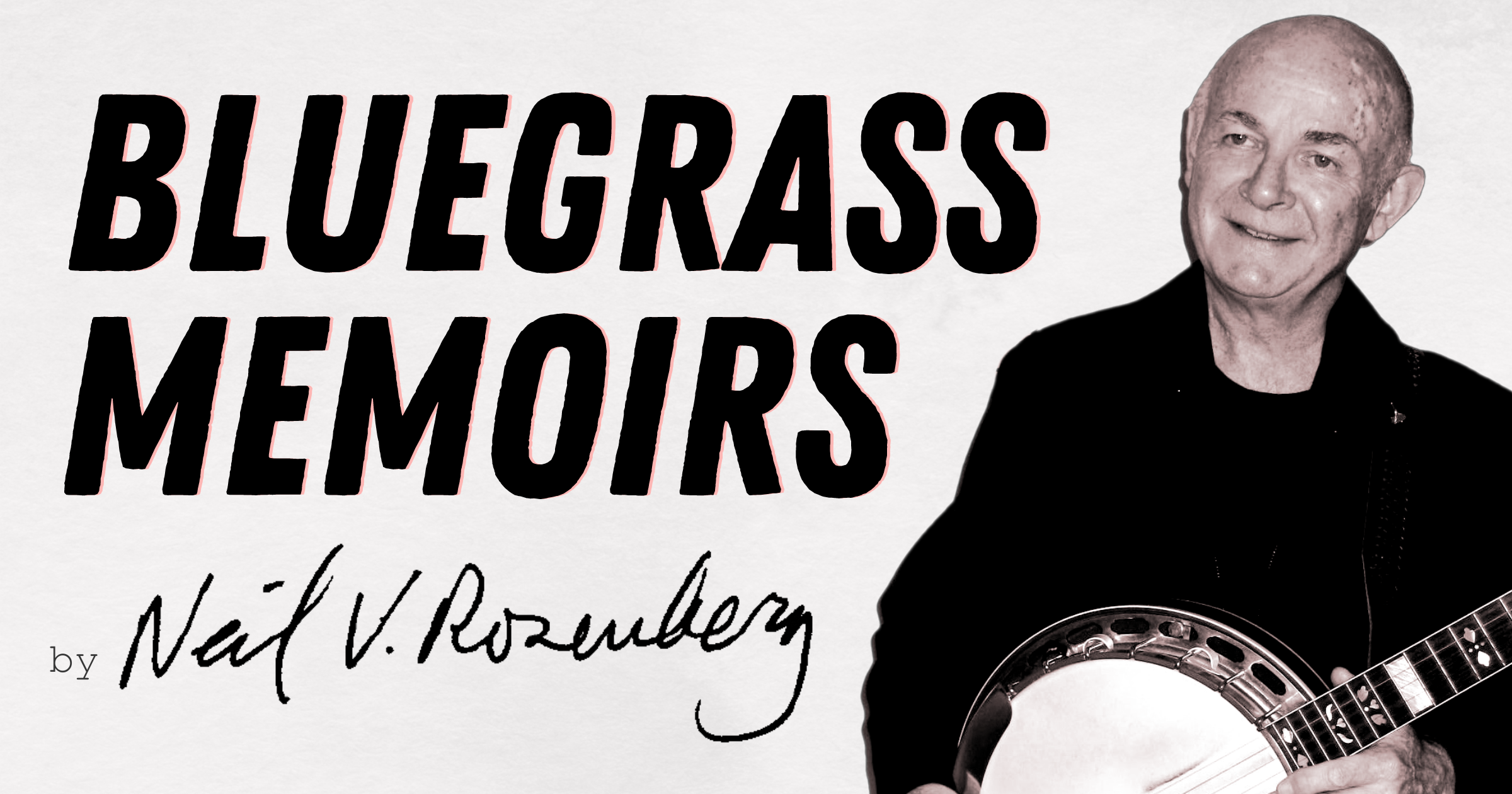
Neil V. Rosenberg is an author, scholar, historian, banjo player, Bluegrass Music Hall of Fame inductee, and co-chair of the IBMA Foundation’s Arnold Shultz Fund.

Photo of Rosenberg by Terri Thomson Rosenberg. 

Edited by Justin Hiltner.

Jontavious Willis Is Traditional and Contemporary At The Same Time

Growing up in rural Georgia, Jontavious Willis discovered blues through a YouTube video of Muddy Waters and immediately immersed himself in the genre. At 14, he began playing acoustic guitar, he started gigging as a college student, and released his first album, Blues Metamorphosis, in 2016. Two years later, he opened on the TajMo tour with Taj Mahal and Keb’ Mo’. They co-produced his GRAMMY-nominated second album, Spectacular Class.

Offered the opportunity to record his new album, West Georgia Blues, in Nashville, Willis’s response was a resounding “No.” Tracking in his home state was non-negotiable, as that DNA was critical to his vision and sound. “Georgia was a big part of the story and I wasn’t going to fold on that,” he says. “I wasn’t going to let up.”

The singer-songwriter-guitarist and his musicians gathered for ten days at Capricorn Studios in Macon. Willis produced while engineer-guitarist John Atkinson mixed (and contributed guitar work on “A Lift Is All I Need”). They tracked some 200 songs, 80 of them usable, says Willis, and pared those down to the 15 that became his third album.

Willis’s fingerpicking style is rich in tradition and, as he’ll tell you, contemporary because it exists – now. With that, being featured alongside bluegrass and country music on a website such as this is a perfect fit, as he explained during his recent interview with BGS.

What were your goals going into this record?

Jontavious Willis: My goal was to show growth and stay away from carbon copies of other songs. I hear it all the time – you take a song and change a few words around, but it’s still B.B. King, it’s still Robert Johnson. I tried to make each song its own and if I did take from other folks, I did it my own way.

We get so wrapped up in saying, “Oh, I can play old music, so let’s stay there,” that we forget to create. I wanted to show my writing ability, my producing ability, and I wanted to show a difference. I’m glad I put space in between the albums to really show growth. Since the album’s complete, I’ve been getting great reception. But beyond that, I made an album I can listen to from beginning to end.

You didn’t feel that way with your other albums?

The first one, I knew I was green, but I had to put something out there. I’m always happy in the beginning. Then, when you listen to it long enough, you’re like, “I should have did this and this.” But I really can listen to this one. Truly, honestly, the first one, I wasn’t as good a player. The second one, I wasn’t playing at my full capacity or with blues players. I was playing with session musicians. This one, I played with people that knew the references to blues.

You’re a blues musician being interviewed by BGS, a bluegrass website, with a country music “sister” website, Good Country. That might seem like a big jump to some people, but the genres have common threads. Music historian that you are, could you address those connections?

Music was the most integrated pastime, prior to the big record labels coming in and separating them. One of the first integrated groups was actually in Georgia, called the Georgia Yellow Hammers. It featured a fiddle player named Andrew Baxter.

When some people think of country, they think of a particular sound. When I think of country, I think of rural. A lot of people say “simplistic,” because it sounds so peaceful and melodic, but it can be some of the hardest music ever. When I think of the intertwining of country music, I think about the early pioneers, like the first star of the Grand Ole Opry, DeFord Bailey, a Black fellow that played harmonica. Hank Williams learned from Tee Tot, [Rufus Payne]. Johnny Cash spent a lot of time with Gus Cannon and Furry Lewis and old blues folks like that. You can go on and on. A lot of the repertoire of blues artists isn’t just blues. Some of it could be classified as country.

Over time, with new talent, genres expand and change and self-proclaimed “purists” get ruffled. As an artist with deep roots in traditional and contemporary music, what are your thoughts?

I’m kind of with them and not with them. The reason I say this is because I feel like it is good to identify things sonically. When I listen to classical music, I think about what makes it classical. When I listen to jazz, I think about what makes it jazz. The same with blues, because what I’m seeing now is that blues have been overtaken by rock, and I don’t like that, because rock is not blues. It’s definitely a sub-genre or even a whole ’nother genre of blues, but it’s not interchangeable. A lot of the audience the rockers had kind of melted over into the blues, and a lot of people didn’t learn the blues from the front. A lot of ’em came through the back door, through these rockers and other big bands.

So I feel like it is good to identify what it is, but also understand that music changes. But call it what it is. If I’m playing blues-rock, I’m not playing natural blues. If I’m playing contemporary gospel, I’m not playing traditional gospel. The guys that made these beautiful songs that sold millions of copies — they didn’t get money for it. They didn’t get their due. It’s time for folks to stand by the genre of music they do and tell folks what it is.

Let’s talk about those sub-genres and what they mean, if anything.

It’s hard to really define the categories. With blues, they chop it in two main categories, at least for the GRAMMYs: contemporary and traditional. Contemporary means you’re keeping with the times. So by me living and writing music, that is being contemporary. Traditional means I’m a part of the tradition. So I can be traditional and contemporary at the same time. It is not one or the other. It’s a safe room for both.

Scholars made these terms up. Black folk wasn’t calling their music Delta blues or Piedmont blues until they heard so many folks saying it. Then they started saying it. But nowadays, those terms don’t mean nothing unless you’re from those places. I’m from Piedmont, so I’m a Piedmont player by default. I even went one step further to say I play West Georgia blues. What is West Georgia blues? I don’t know. I’m from West Georgia and I’m playing the blues in West Georgia. I can say that’s my style. A lot of people say Delta blues. Delta blues is a region, not necessarily a style. I can name three artists from the Delta that don’t sound alike. It varies from musician to musician.

It’s nicer for the listeners to think it’s categories, so you can navigate your way. But it also pigeonholes the artists and doesn’t really showcase the music and what it is. This is freeform music that people created. The record industry had a big hold on all of it, and that’s how they separated bluegrass from blues and country music. So I think you have to be a purist in a sense to maintain. If not, everything could spill over into everything, which is a good idea, but in essence, you want to identify the different sounds and nuances.

How does Georgia – its music, its history, and your history – inform your music?

Every state has salt-and-sugar history. I grew up in a predominantly Black town. Greenville, Georgia, is 70 or 80 percent Black. We’ve got a rich gospel history, and Georgia overall has Buddy Moss, Blind Willie McTell, on and on. So being in Georgia, always loving history, and always being around my family definitely shaped my music, the good and the bad. That’s what life is about, the good and the bad. Most of all, my hometown shaped me, more so than the famous people.

The blues people from Georgia definitely shaped my music. I was always aware of the other folks, like Little Richard, James Brown, Ray Charles, and Otis Redding, but they didn’t shape me. I listened to the old blues players and it was a great awakening for me to realize that Georgia has blues, because if you listen to a lot of folks, you’ll only think that it’s in Illinois and Mississippi. But the first studio in the South was in Atlanta in 1923. Everybody had to come to Georgia to record.

I know the United States has got twisted history, and that’s part of the blues. The blues is free Black people speaking their mind and saying how they feel, not always being political but just being true to themselves. To me, Georgia is family, struggle, prosperity, farming, food, life. It’s everything. I’ve been to a lot of places in the world, in Europe, to 46 of the 50 states, and ain’t no place like home. I’m looking at it now – the contrast of this dark green and light blue and these hills. You can’t beat that, man. Georgia’s everything to me.

What was it about blues that spoke to you as a 12-year-old? What has or hasn’t changed?

When I was a kid, I was singing gospel music about going to heaven and wasn’t I thinking about dying! A lot of those blues guys started out young. They were teenagers. Helen Humes, Buddy Moss, Josh White … Robert Johnson was 27 when he died, so he had to be singing the blues when he was young.

I’ve loved the blues since I was 12 years old, two years before I started playing guitar. I was at the age where I could appreciate it. The blues makes you think. Technically, some of those sounds aren’t supposed to be happening. Some of the stuff don’t make musical sense because lot of these folks aren’t trained musicians. But the stuff they put out – I can listen to it because it’s relatable to me. They talk in the way I understand. They sing in the way I understand, and man, it can just do something good to me. I don’t know what it is, but Jesus, it’s so good!


Photo courtesy of the Jontavious Willis Team.

The Cactus Blossoms’ Modern-Classic Sound Blooms on New Album

With a sound that’s like rain in the desert for fans of early rock and country, the Cactus Blossoms let their modern-classic vibe bloom on their latest album, Every Time I Think About You. But with pair of big shows to help celebrate the launch, this band is living very much in the present tense.

Made up of Minneapolis-based brothers Jack Torrey and Page Burkum, the duo’s new project arrives August 30 and once again captures the full, timeless magic of spacious melodies, tasteful twang, and tightly-wound harmony. That night, they’ll mark the release with a long-overdue debut at the Grand Ole Opry – where they ought to find a few like-minded fans of keeping music’s traditional cool factors alive – and then head home for a milestone gig in St. Paul.

After a trio of well-received albums and more than 10 years of riveting shows, it’s the perfect setup for a duo who seem totally at ease blurring the American roots timeline – and who promise they couldn’t fake it if they weren’t.

“I don’t think we’re very good at striving,” Torrey says, speaking from the verdant midsummer shores of Lake Superior on a much-needed break from the road. “I do think [this record] has a comfort level, especially since we’ve been able to start touring again, and really hit it. It’s been feeling like we’re a unit and we can kind of read each other’s minds a little bit.”

Speaking with BGS ahead of the release of Every Time I Think About You, Torrey and Burkum filled us in on what that telepathic bond helped create, and where it’s coming from.

A lot of Every Time I Think About You features the “modern-classic” sound you have both made a calling card – like it would sound fresh a few decades ago and today as well. But is that dangerous territory for a band? You don’t want to be pigeonholed as a throwback, right? So how do you walk the tightrope?

Jack Torrey: I think there’s an interesting aspect of that from our perspective. I got super into Bob Dylan and Hank Williams and I was singing songs by both of those guys way back, 18 years ago or whatever. Page was into Jimmie Rodgers and those other super old country things. We start singing together and it’s like if you harmonize on a Hank Williams song, it kind of starts to sound like an Everly Brothers song. You’re kind of accidentally falling into that and getting into territory that people went into 60 years ago – but it’s new for us and I think that has kind of kept happening. We’re not recreating or trying to do anything like listening to records and imitating it. It’s almost like we’re carving our own mini canyon, that resembles some of the other ones from the past.

Page Burkum: I was kind of thinking about this as a way of summing up our style and influences: The Band, The Traveling Wilburys. Those are like my four main food groups or something. I love where all those guys are coming from – a little Roy Orbison, a little Bob Dylan. They balance each other nicely. And I was thinking, when that’s your diet, you’re going to make something that comes out [like Every Time I Think About You]. … But we love other totally different kinds of music outside of that realm too, and I hope a little bit of that gets in there, too.

Where is the title track, “Every Time I Think About You,” coming from? It’s got that lovely, warm-and-fuzzy feel of a mid-century romance ballad to it, but maybe something more, too …

JT: That one is kind of a love song to losing a friend – it’s kind of a heartwarming grief, where you’re almost being consoled by the memory of someone. And that’s where that song came from. The way we wrote it, I just had a couple lines, and then Page jumped in and started singing the beginning of the chorus, and then I sang back the next line, “Every time I think about you …”

PB: Sometimes Jack and I have made fun of biopic movie scenes like in Walk the Line, where it’s like Johnny and June or whoever sit down with a guitar and they’re just writing a song in real time. Like, they sing one line and then pause dramatically, and then sing another line and then it cuts to them playing it for a thousand people or something. But in a funny way, that was kind of the closest to that. [Laughs]

JT: I was like, “I didn’t ask you to jump in and work on my song … but that’s pretty good idea. Let’s do it.”

The album kicks off with “Something’s Got a Hold On Me” – which almost has a Southern rock swagger to it. Where does that come from? Is that your Tom Petty influence showing?

PB: When I first had the idea for that one, the very original idea that set it off was actually a weird little piece of a Jimmie Rodgers song. So, I stole that line and that melody, which is about two notes or something, but it kind of inspired the whole song in a weird way. To me there’s some blend of Lead Belly and The Beatles or something in my mind, but then it ends up just sounding like a country-rock two step. That’s just what happens. It’s fun to roll with stuff. … I threw in another Jimmie Rodgers line, that “T for Texas, T for Tennessee,” to kind of keep that tribute going.

Oh that’s right, I should have known. Why did you end up finishing on “Out of My Mind (On Sunday)”? Is there a reason that seemed to wrap things up?

JT: It wasn’t a big dramatic decision, but it seemed like a nice bookend from “Something’s Got a Hold on Me” to end with being a bit of a crazy person. [Laughs]

PB: To me it actually kind of leaves the door wide open. I don’t know if you want to cap things off with the sweetest, most-concise thing you have, you know? There’s something about it that’s a little bit out there to me.

You’ll make your Grand Ole Opry debut the night this album drops. Then you’re having a big hometown party with show at Fitzgerald Theater in St. Paul [on September 13]. What does that mean to you?

PB: We’ve got one of our favorite local bands, Humbird, joining us for that [St. Paul] show, so that’ll be really cool. We’re trying to get some of our collaborators to be involved too, if we can spice it up with an extra ensemble beyond our regular band. So we’re trying to get a piano on stage or something. I mean, it’s a theater show, so it’s a little different. And it’s our first time playing our own show at this theater. It’s a really beautiful building and I never thought I’d play there when I was a kid.

JT: It’s where [A] Prairie Home Companion used to be back in the day. Page and I actually played there when we were first getting started, which was a special time. So it’s cool, and should be fun. Some people can come that don’t like to stand, since we play a lot of clubs. [Laughs]


Photo Credit: Aaron Rice

You Gotta Hear This: New Music From Rhonda Vincent, Joy Clark, and More

Are you enjoying brat summer? We sure are, too, but as Teddy and the Rough Riders declare with their new video dropping today in You Gotta Hear This, “Catfish Summer” is what it’s really all about!

That’s not all our premiere round-up holds this week, either. We’ve got new videos from folks like guitarist-songwriter Joy Clark and Texan-Los Angeleno Silas Nello, and a new track has been unveiled by Americana duo Ocie Elliott, too.

Don’t miss bluegrass offerings from up-and-comers and legends, both. Jaelee Roberts brings a new single, “Between The Two Of Us,” East Nashville mainstays Greenwood Rye premiere “Down to the River,” and the Queen of Bluegrass herself, Rhonda Vincent, pays tribute to her homeland of Missouri with a song co-written by Opry star Jeannie Seely and Music Row stalwart writer Erin Enderlin. Vincent’s new album, Destinations And Fun Places, hits store shelves and digital platforms today.

To round out this edition of our weekly collection of premieres, don’t miss Moira Smiley’s rendition of the classic Jean Ritchie song, “Now Is The Cool Of The Day,” which debuted on the site earlier this week in honor of Farmworker Appreciation Day. It’s all right here on BGS and You Gotta Hear This!

Joy Clark, “Lesson”

Artist: Joy Clark
Hometown: New Orleans, Louisiana
Song: “Lesson”
Album: Tell it to the Wind
Release Date: October 4, 2024
Label: Righteous Babe Records

In Their Words: “My grandma is and was my root and when she passed, I thought about the gems she imparted to me in her 86 years of life. She’d say to me ‘Get your lesson!’ I’d sit at her table and talk to her. I came out to her at that very table. She accepted me. After she died, I sat down with my producer Margaret Becker to write, and the lyrics just rolled out; capturing the way my grandma lived her life. She taught me to treat everyone with kindness and to strive for peace while never backing down from a good fight. It’s a timely ‘Lesson’ for this country as we fight to take our rightful place in the struggle for freedom.” – Joy Clark

Video Credits: Directed and shot by Jared LaReau, Something Human.
AJ Haynes – Creative Assistant 


Ocie Elliott, “Adelina”

Artist: Ocie Elliott
Hometown: Victoria, British Columbia, Canada
Song: Adelina
Release Date: August 9, 2024
Label: Nettwerk Music Group

In Their Words: “‘Adelina’ is about a fictional heroine inspired by a combination of legendary musicians and personal idols –people who hone that extra something inside of them to carve their way through the barriers of the tangible world, prying doors open for others in their wake. In comparison to some of our previous recordings, the final result of ‘Adelina’ reflects the way in which it was put together – with a lot of play, compromise, reinventing, and scrubbing at the built-up grime and loose ideas to make a smooth surface for finer grit to be poured back in. To us, it feels louder, more immediate, and present. It’s a song you play when leaving somewhere – a ‘windows down, future open and ready’ kind of song.” – Sierra Lundy and Jon Middleton, Ocie Elliott


Greenwood Rye, “Down to the River”

Artist: Greenwood Rye
Hometown: Nashville, Tennessee
Song: “Down to the River”
Album: Hideaway
Release Date: August 9, 2024 (single); August 23, 2024 (album)

In Their Words: “‘Down to the River’ was one of the first songs I wrote when I moved to Nashville in 2020 and the first original song we started playing live as we started Greenwood Rye during the pandemic as the house band for Jane’s Hideaway in Nashville. I wanted to write the quintessential song for what we were trying to do as a band. It is a fun, funky groove with a singable chorus, has a jamgrass style instrumental bridge, and plays around lyrically with some bluegrass themes. I was thinking a lot of ‘Old Home Place’ and how the narrator is blaming others for his problems. So, I came up with the idea to have a character who takes responsibility for his actions. He ‘runs off to the vineyards’ rather than the ‘taverns took all his pay.’ But there is also a level of hubris in the narrator, as he feels like he can just go ‘down to the river’ every time he does someone wrong ‘again.’

“The track features Sasha Ostrovsky (Darius Rucker, Bering Strait) on dobro.” – Shawn Spencer, guitar, vocals, songwriter

Track Credits: Written by Shawn Spencer.
Shawn Spencer – Guitar, vocals
Cat McDonald – Fiddle, vocals
David Freeman – Mandolin, vocals
Taylor Shuck – Banjo
Sasha Ostrovsky – Dobro
Larry Cook – Bass

Produced & mixed by Billy Hume.
Mastered by Pete Lyman.
Matt Coles – Additional engineering
Recorded at Compass Records.


Silas Nello, “Holy Ghost Blues”

Artist: Silas Nello
Hometown: Los Angeles, California via Dallas, Texas
Song: “Holy Ghost Blues”
Album: From West Hollywood
Release Date: August 9, 2024 (single); September 13, 2024 (EP)
Label: Blackbird Record Label

In Their Words: “It came to me in a dream – a sort of fantasized crossroads moment of how mankind trades this for that and we don’t realize until the deal is already done. I wrote this song at the wet bar of my then 1980s home just north of Dallas sometime in 2016.” – Silas Nello

“The video was meant as a portrait of Silas Nello. We went around Los Feliz, West Hollywood, and Wild Horizon Sound, documenting his travels like a ‘day in the life.’ We broke the fourth wall with Silas acknowledging the camera and the audience throughout the piece. What this created was an intimate moment where we’re spending time with him but he was also spending time with us.” – Taylor Hungerford, filmmaker, Silverspark Printworks

Track Credits: Written by Silas Nello.
Silas Nello – Lead vocal, background vocal, acoustic guitar, harmonica, tambourine
Produced by Claire Morison & Silas Nello.
Recorded at Wild Horizon Sound.
Recording engineer, mixing engineer, and mastering engineer – Claire Morison

Video Credit: Taylor Hungerford, Silverspark Printworks


Jaelee Roberts, “Between The Two Of Us”

Artist: Jaelee Roberts
Hometown: Nashville, Tennessee
Song: “Between The Two Of Us”
Release Date: August 8, 2024
Label: Mountain Home Music Company

In Their Words: “‘Between The Two Of Us’ was written with my friends Donna Ulisse and Kristen Bearfield. When we got together, we agreed that we’d like to write something up-tempo and happy, and ‘Between The Two Of Us’ is the result of that session. It truly is a happy song about love lasting between two people and what you have to do to achieve that. Getting to hear this song come together in the studio was really amazing, and I am so thrilled with the end result. The musical arrangement provided by Ron Block, Andy Leftwich, Cody Kilby, Byron House, Justin Moses, Stuart Duncan, and John Gardner absolutely made this song even more special than I could have imagined! To top it off, Stephen Mougin and Kelsi Harrigill joined me on harmonies and their voices were the perfect touch to convey the message of the song. I hope y’all enjoy this love song that is filled with words of hope, joy, and encouragement.” – Jaelee Roberts


Teddy and the Rough Riders, “Catfish Summer”

Artist: Teddy and the Rough Riders
Hometown: Nashville, Tennessee
Song: “Catfish Summer”
Album: Down Home
Release Date: October 11, 2024 (album)
Label: Appalachia Record Co.

In Their Words: “This one is about visiting my mom’s side of the family who live in Rockmart, Georgia. I was 12 or so and didn’t really wanna visit my grandma Lou-Lou that summer. But instead, my mom dropped me and my cousin off at my uncle Bubba’s house for a few weeks, and he lived in an amazing hillbilly shack on the side of a catfish pond with about ten dogs, deep in the woods. Greatest summer ever! From childhood bummer to high time.” – Ryan Jennings, Teddy and the Rough Riders


Rhonda Vincent, “I Miss Missouri”

Artist: Rhonda Vincent
Hometown: Greentop, Missouri
Song: “I Miss Missouri”
Album: Destinations And Fun Places
Release Date: August 9, 2024

In Their Words: “My Grand Ole Opry sister Jeannie Seely started writing ‘I Miss Missouri’ for me several years ago. She lost everything, including the lyrics she had written, in the Nashville flood of 2010. Fast forward to February 29, 2020, the night she made my greatest dream come true and invited me to be a member of the Grand Ole Opry. We have since become close friends, and after the Opry invitation she said the lyrics started coming back to her.

“She invited Erin Enderlin and I to join her in writing the song. ‘I Miss Missouri’ was the inspiration for creating a ‘destinations’ project, with all the songs representing a destination.” – Rhonda Vincent

Track Credits: Written by Jeannie Seely, Erin Enderlin, and Rhonda Vincent.
Adam Haynes – Fiddle
Rhonda Vincent – Lead vocal, mandolin
Mickey Harris – Bass
Zack Arnold – Guitar, harmony vocal
Aaron McDaris – Banjo
Jacob Metz – Resophonic guitar


Moira Smiley, “Now Is The Cool Of The Day”

Artist: Moira Smiley
Hometown: New Haven, Vermont
Song: “Now Is The Cool Of The Day”
Album: The Rhizome Project
Release Date: September 6, 2024

In Their Words: “August 6th is Farmworker Appreciation Day, and I didn’t know that until this year. I am writing this as I sit on a hill above the rolling Vermont farmland where I grew up being a young farmworker and musician. In honor of this day, I’m releasing one of my favorite songs of all time – and the best one I know for reminding us to slow down and remember our roles as carers and tenders of this beautiful planet and the people around us. This week, I’m showering appreciation on the people that grow and tend food in my area; buying from small farmers, donating to the Open Door clinic that serves the medical needs of immigrant agricultural laborers. This gentle video hopes to slow your pace, and bring you along with me in acknowledging that farmworkers make our nourishment possible. Let us thank them.” – Moira Smiley

Read more here.


Photo Credit: Joy Clark by Steve Rapport; Rhonda Vincent by Tanner West.

First Woman To Ever Yell “WOOO!” During Concert Honored With Statue

NASHVILLE, TN – The first woman to ever yell “WOOOOOO!” at a bluegrass show over eight decades ago will be honored by the city of Nashville with a statue on Lower Broadway.

Mayor Freddie O’Connell acknowledged Vicki Lynn Bludso (103) in a heartfelt speech during the statue’s unveiling ceremony. “When a 22-year-old Vicki Lynn devised her perfect exclamation during the open bars of ‘Shady Grove,’ she had no idea that ‘WOOOO!’ would change the world,” O’Connell said.

“Heck, I yelled it last night during my daughter’s piano recital,” he grinned.

Despite the praise, the centenarian Bludso appeared unfazed in her remarks. “I’d just gotten out of a bad marriage and was letting off some steam,” she shrugged. “The band kicked in, and it just came out. I didn’t think the whole world would start sayin’ it.”

The last surviving member of The Red Boot Boys, fiddle player Jimmy “Slacks” McCoy (99) was on stage at the time of the incident. “When it happened, I froze. I thought a lady had fallen out of the Ryman balcony.”

As the sound caught on, McCoy said it became nearly inescapable whenever The Red Boot Boys played. “Sometimes they’d yell it before a tune started or right in the middle of a solo. By the time we came off the road, our nerves were fried. I think it broke up the band.” He added, “Either that or the excessive drinking.”

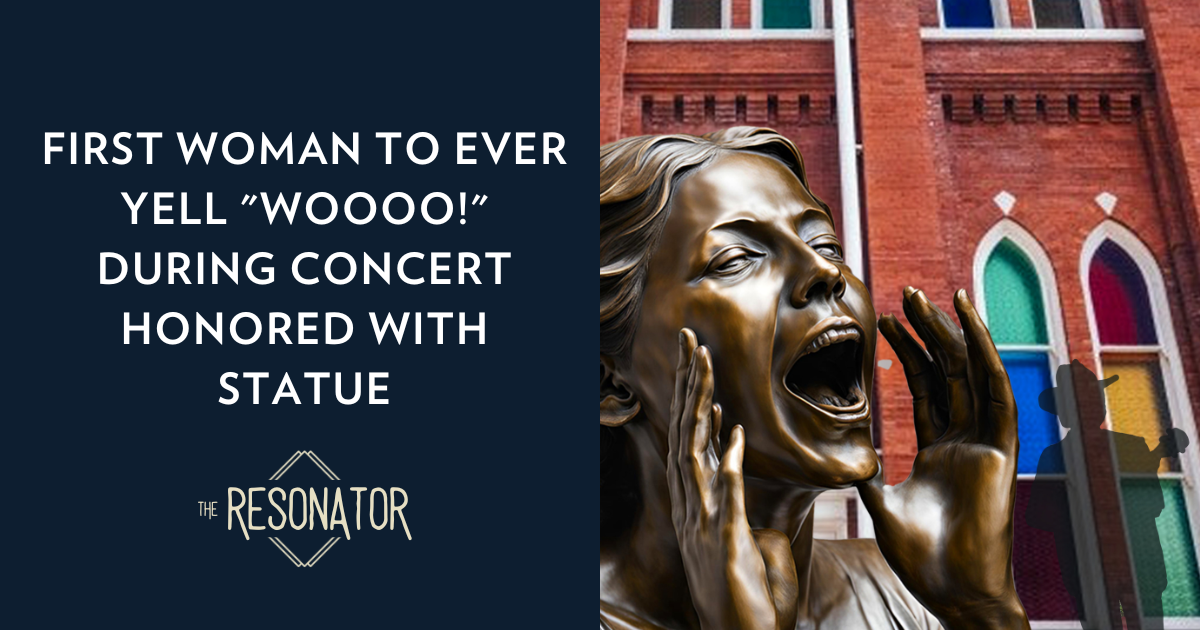
The 14-foot bronze statue depicts a young and wild-eyed Bludso, head tilted back, bellowing with the now-signature “O”-shaped mouth. Little did she know that “WOOOO!” would go on to span the worlds of music, sports, frats, bachelorette parties, transpotainment and extreme temperature change.

“I only said it once. Now I’m stuck with it.” Bludso reminded the crowd.

Bludso’s statue will join the statue of Rick Funt, more famously known as the 1974 creator of yelling “Freebird!” during a show of a band that did not, in fact, know the song.


Laurie Lewis Chooses Tenacity Over Hope on New Album, ‘Trees’

Counting John Prine, Linda Ronstadt, and Wendell Berry among her fans, Laurie Lewis is arguably one of the most diversely influential figures in American roots music culture. She’s a songwriter, fiddler, frontwoman, performer, producer, teacher, and mentor. She’s been nominated for multiple Grammy awards and graced the stage at the Grand Ole Opry. The International Bluegrass Music Association has twice named Lewis Female Vocalist of the Year, and the association’s former executive director, Dan Hays, once called her “one of the preeminent bluegrass and Americana artists of our time and one of the top five female artists of the last 30 years.”

Lewis’s latest release — her 24th full-length record — pairs the artist’s musical mastery with her willingness and courage to face the full spectrum of life’s experiences. From personal grief to environmental despair, Lewis does not shield her eyes from difficult truths. In many ways, the album pays homage to its namesake, trees. When asked why, Lewis notes their tenacity. When something is tenacious, it grips firmly, with determination and persistence. Even in the face of immense challenge and uncertainty, trees abide in their purpose and work — and so does Laurie Lewis.

TREES is a long-play collection of songs that tenderly, earnestly, and sometimes joyfully explore what it means to exist on a vulnerable planet through times of loss and love. Supported by a band of masterful collaborators — Haselden Ciaccio (bass, vocals), Brandon Godman (fiddle, vocals), Patrick Sauber (banjo, vocals), George Guthrie (banjo, vocals, guitar), Tom Rozum (vocals, cover art), Andrew Marlin (mandolin), Sam Reider (accordion), and Nina Gerber (guitar) — Lewis dives into the deep end of sorrow and change with tenderness, authenticity, and Americana storytelling prowess.

In the album’s liner notes, Lewis shares that TREES is the first project she’s made in nearly 30 years without the mandolin accompaniment of her partner Tom Rozum, who recently developed Parkinson’s disease. “This collection represents a difficult transition in my musical life,” Lewis shares. “Think of it as ‘Music Minus One.’”

From bright bluegrass tracks like “Just a Little Ways Down the Road” to the somber invocations of “Enough” and “The Banks Are Covered in Blue,” this album is intricate and complex, much like a healthy forest. The album brings us “Quaking Aspen,” showcasing Lewis’s characteristic lyrical fiddle style, and title track “Trees,” an a cappella bluegrass-gospel ballad that gently yet hauntingly denounces the violence of industrial civilization.

Always looking to the natural world for strength and guidance, TREES is about love — for life, for land, and for people. But love isn’t a purely hopeful or romantic thing; it encompasses both loss and pain, and Lewis gracefully and vulnerably reckons with both on this album.

You just returned from a string of shows playing songs from the new album. Where did you go?

Laurie Lewis: My string of shows was actually mostly a river trip. So I did play every night, but I was mostly spending the days in the canyons… On the Yampa River, which starts in Colorado and goes into Utah and flows into the Green River. It’s a really, really beautiful canyon.

I love that. When you were playing shows, how did it feel to share these new songs with the world?

I’ve been doing a lot of songs from the new album, yeah, and I’m really enjoying that. But also, in any of our sets with my band, we pull out the old ones, too.

Speaking of the older stuff, I listened to your first solo record, Restless Rambling Heart, directly after listening to your newest record from start to finish. The first thing I noticed was that the tempo has downshifted quite a bit from that first release. Does TREES feel more introspective to you than other records you’ve made?

Oh yeah, it definitely does — especially compared to Restless Rambling Heart.

You’ve collaborated with the great poet, writer, and activist Wendell Berry — he asked you to set some of his poems to music. What was that experience like?

It was really fantastic. I’m such a fan of Wendell Berry’s writing. It came about because I was putting out a songbook and the publisher said, “Well, you need to get some blurbs for the back.” I happened to be at a writing workshop and one of the writers there said, “Hey, do you know Wendell Berry?” And I said no, and he said, “Well, he’s a big fan of yours.” [He had been] at a writing conference with Wendell and Wendell asked if he knew me and, you know, small world sort of thing.

So I thought, Well, how do I get in touch with him? Maybe he could write me a blurb, who knows? But [Wendell] famously doesn’t do e-mail or anything like that, so I got his mailing address and wrote him a long-hand letter on one of those yellow legal pads, you know, and I sent it off to him. And lo and behold, he wrote back. He said, “Well, I really don’t know anything about music, and my wife says I can’t carry a tune in a bucket, so hadn’t I better say no to writing a blurb?” And I thought, Well… that’s a question, so it deserves to be answered. So I wrote back and said, “Of course you should say yes, because really, the only prerequisite for saying you like something is that you actually like it. It doesn’t matter that you don’t have a background in music. It’s a personal response.”

And he said, “Well yeah, okay. I’ve been telling people I’m not writing blurbs anymore because too many people ask me, but didn’t I write something in that first letter that you could take out [and use]?” And there was this really nice thing…

So we just ended up having this back-and-forth conversation. He sent me some books. I sent him some CDs. I finally got a chance to meet him, but eventually I just felt like this is a person who is so conscientious, he’s going to respond to whatever I write. And he’s so busy, and he’s got so much stuff to do, I don’t want to bother him anymore. So I kind of dropped the correspondence. I wish I hadn’t, but it felt like the right thing to do. I just didn’t want to be that pestering voice that he felt he had to write back to.

Did he get back in touch with you at some point? Is that how his request came to light?

In the midst of all our back and forth, he sent me a poem in the mail and asked if I wouldn’t mind terribly trying to put it to music. So I did. That was “Burley Coulter’s Song for Kate Helen Branch.” It was quite a puzzle, because it’s not a standard rhyme scheme or anything. I had to make it loop around like a little crooked fiddle tune to make it really work.

Trees aren’t just the theme of this album — they’re growing all over your creative imprint. Your label is called Spruce and Maple Music, for example. What is it about trees specifically that inspires you?

I love the tenacity of trees — the way they just wait ‘til you get out of the way and then come back. … There are too many humans on the earth. We take up way too much space and way too many resources and we’re crowding everybody else out. And by “everybody else” I mean all the animals and plants and everything that also shares our earth. I just feel that, you know, trees are these beneficent beings that just wait and take their time and come back whenever they’re given a chance. They’re responsible for the oxygen we breathe and for taking in the CO2 we release. They’re sort of purifying everything. So it makes me feel very hopeful… If we just get out of the way a little bit, trees can come in and help set the planet right again.

Speaking of trees, the title track on this album is written from such a unique perspective. You literally embody the voice of the trees. How did this idea come about? Had you written from the perspective of the natural world before?

Well actually, “The Maple’s Lament” … I think that was the first time I tried to embody a tree. But I’ve done a few songs like that since. “American Chestnuts,” from my Skippin’ and Flyin’ album is from the voice of the American chestnut trees, which were the main tree along the Appalachian Mountains before the Chinese chestnut blight.

Have you read The Overstory by Richard Powers?

You know, I have, and I thought, Well, this is my song! [Laughs] But I wasn’t inspired by the book.

I personally take comfort in the knowledge that the world will go on spinning without us, despite how powerful we imagine ourselves to be. What sustains you as a sensitive person who feels the weight of what’s happening in and to the world? What carries you through?

Well, that’s that hope – [in] the other beings on the earth, their ability to repair the damage we’re doing. But I don’t hold out a lot of hope for human beings to rein in our excesses. I just don’t. I unfortunately do not see that happening in a timely enough manner to prevent, for instance, desertification of much of the earth’s crust. I’ve never said this stuff in an interview before, but yeah– I do not hold out a lot of hope.

I really appreciate you saying that. I feel like we’re often pressured to feel hopeful, but sometimes it feels more important to just be present with our grief about what’s happening to the world. Where did your deep relationship with and love for the natural world begin?

Oh boy, well, lots and lots of places. From ages three to eight, I lived in Ann Arbor, Michigan, in this new subdivision a block from the country. I loved to ramble in the woods and just see the farms and stuff like that. When my family [moved to] Berkeley, California, it was really a shock for me, and I have to say, Tilden Park probably saved my life. It’s a big regional park that’s up over at the top of the Berkeley Hills. It’s a huge park — you could get lost in it for days. Being able to take the bus to the top of the hill and disappear into Tilden Park when I was a kid was the best thing ever, and it really helped me through a lot. So I would say Tilden was maybe the first place where I really sought refuge in the natural world.

In addition to environmental grief, you’ve spoken about the role personal grief played in the creation of this album, and the presence of these feelings is very tangible throughout. Has some part of you had to practice becoming more vulnerable as an artist over time, or did the process of sharing your pain through your songwriting come naturally?

I have been accused throughout my career of writing songs that are a little bit too easy to figure out, you know, where they’re from. They’re personal songs — people have noted that. [But] maybe they’re putting stuff in them that’s not actually there, and I believe that to be the case on some of the stuff. Writing has always been my best source of communication with the world and I think I’ve always just written from an emotional place. If my songs are deeper now, it’s because events in life are a lot harder when you’re 73 than when you’re 23 or 33 or 43.

One of the more uncommon forms of grief is the grief over the loss of one’s own voice. A few years ago, you lost your singing voice for six months. What was that experience like for you, as someone who’s spent so much of your life using your voice to connect with the world?

It was terrible. It was paresis, [so] the right side of my neck muscles were paralyzed, and I couldn’t move my larynx on the right side. It made singing very, very difficult, until it got to a point where my voice just quit. And I thought, I’m not gonna sing anymore. It took about six months to recover, and it hasn’t completely recovered. My voice is different now.

It was a very difficult time. I went to many doctors, and one said, “Well, you have about a 50/50 chance of getting your voice back.” And I’m going, “Those odds are just not good, you know? It could happen or not — it’s a coin toss.” That freaked me out.

But some amazing things happened in that time. I have an annual gig, the concert I do at the Freight & Salvage here in Berkeley, my hometown, over Thanksgiving weekend. When I had no voice, I didn’t want to give up my night, so I asked my friends to come and sing my songs. I put together a folder of tons of songs and nobody picked the same song. It was amazing. It was the most incredible healing night of music for me. I mean, it was really the best Laurie Lewis show ever and I never opened my mouth except to speak a little bit. It was really lovely. Out of anything, I think that helped me get my voice back.

I’m honestly tearing up a little hearing you talk about that. It really speaks to the power of community. Speaking of community and audiences, who do you write music for? When you’re writing a song or recording an album, do you have a particular listener or audience in mind?

Just myself, really. It’s very selfish. [Laughs] I mean, I just write for myself, what I’m feeling or what I’m observing. … That’s always the starting point. If I think up a story, it’s because I want to tell the story, you know? I want to hear the story. If it’s an emotional thing, it’s because it’s something I’m dealing with or going through. But after the initial thought, I try and use my craft to make the songs better so that somebody can actually understand what I’m singing about and talking about in my music. And that’s really the most gratifying thing, when a listener really responds. It’s just great.

You’ve described your music, particularly on this album, as a way of interpreting the voices of the landscapes you adore. How do you experience or receive the voices of the natural world? How did you learn to listen for these much-needed voices?

I’ve always been a fairly quiet person. I listen more than I speak. I’ve had to actually learn to speak, you know, out loud. But I think I just have an observational approach to the world. I would rather listen and observe people talking to me than jump in and add my own spin or make a lot of noise myself. The same thing is true in my relationship with the natural world. I’m an avid walker and I find that walking and listening and looking in the natural world is my favorite thing to do.

Do you have a favorite song on the album?

I like a lot of them actually. You know, they’re different moods. Speaking of walking, “Just a Little Ways Down the Road” I find to be just so fun to sing and play. And of course, “Enough.” It’s heart-wrenching for me. It’s still hard for me to play that song in public. It requires a really different audience. It’s not a festival song. It’s much quieter, so I hold it back a lot. I just love the sound of the instruments on that cut. But I really like them all, from “Just a Little Ways Down the Road” to “Rock the Pain Away.”

It depends on the mood too. If I talk about John Prine and I sing that song [“Why’d You Have to Break My Heart?”], that really goes over well with audiences. I truly appreciate that people connect with that song.

Do you have a favorite tree?

[Laughs] No. I do not have a favorite tree.

Fair enough. [Laughs]

The California buckeye – I think it’s the prettiest little tree ever. But then I see another, you know? I was just out in Colorado among the junipers. That was the main tree alongside the river, junipers and cottonwoods. Every one of those trees was astoundingly beautiful – and so tenacious.

Is there somewhere special close to home where you’ve been going recently to be with the trees?

Well, yes. I stick around home quite a bit, because I have a lot of caregiving to do with my partner. We had to cut down a tree in our yard a couple of years ago and I was very, very sad about cutting down this great big old blackwood acacia. But we had to do it – it was gonna fall over and wreak havoc. But it cleared the way for me to view these two enormous birch trees that are like four-stories high in the neighbors’ yard. Those two trees are just remarkable, through all the seasons. They’re so graceful, and they change so much. I’ve been enjoying those trees a lot from the kitchen.

And Tilden Park is still my go-to. It’s five minutes up the road, so I can get out and walk amongst the oaks and the laurels and, unfortunately, eucalyptus, which is an invasive fire-hazard tree around here, but they’re still beautiful.

It’s so special that you still get to spend time in the same place that meant so much to you as a kid. There’s really so much we could talk about, but is there anything else you’d like to share about the album?

I did it mostly with a very small group of fantastic musicians – my bandmates Hasee Ciaccio on bass, Brandon Godman on fiddle, Patrick Sauber on banjo, and then George Guthrie also on banjo and some guitar. It’s just been really great working with these wonderful people. What they bring to the songs and how they help shape the music, they really are part of the fabric of what makes this album what it is, and it feels important to me to share that.


Photo Credit: Irene Young

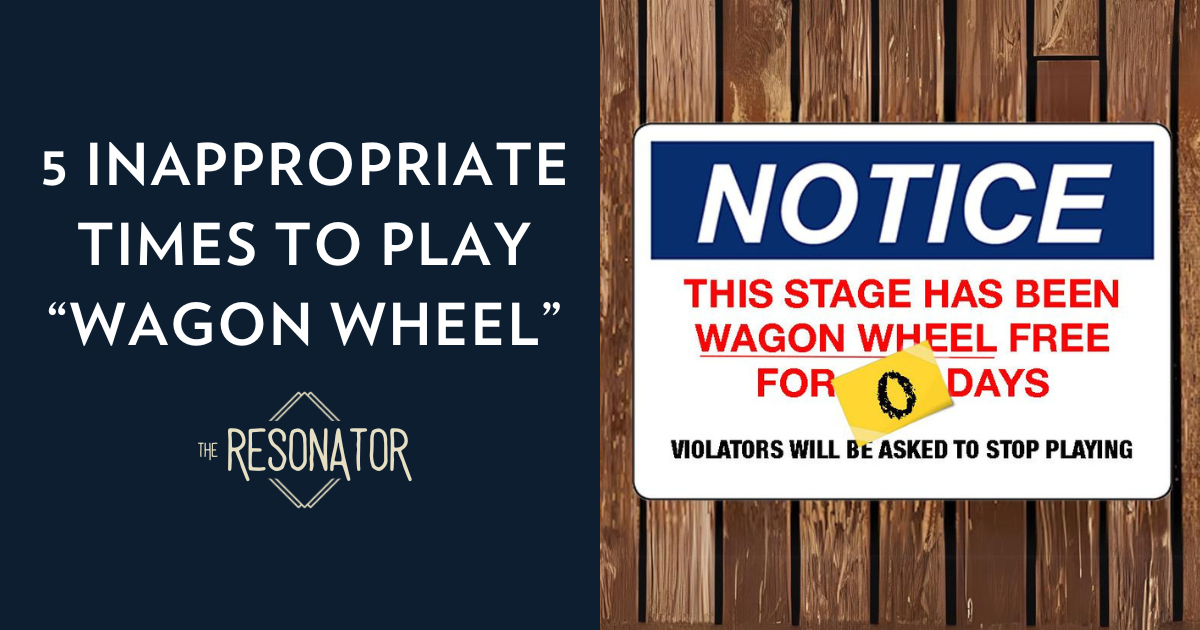
5 Inappropriate Times to Play “Wagon Wheel”

Whether you’re desperately scrambling for a karaoke number or seeking an anthem to unite your politically-opposed family this election season, Old Crow Medicine Show’s 2004 hit “Wagon Wheel” has been a safe bet for nearly two decades.

However, despite its widespread appeal, we’ve curated a list of scenarios where this ubiquitous ditty might do more harm than good. Here are five times you should firmly resist the urge to play it:

At the North American Cartographer’s Convention  

Suggesting a westward journey through the Cumberland Gap will land a trucker in Johnson City, Tennessee is geographic heresy that will incite blind fury from the map-making community. Johnson City lies east, you directionally-challenged jackwagon. Prepare for fisticuffs.


During Daycare Center Staff Training

Regaling childcare workers with tales of rocking children “any way you feel” in “the wind and the rain” is a surefire way to get your facility’s license revoked.


As the Climactic Closing Argument in the Luciano Crime Family’s RICO Trial

Defending your allegedly innocent client by randomly bursting into a tune about boxcar-hopping and ramblin’ is a strategy that will absolutely undermine their chances of avoiding jail time. Your client is already a flight risk — don’t give them any ideas.


Over the Commlink During a Navy SEAL Covert Op

It turns out that the terrorists can win against an elite force’s meticulously-planned stealth mission when this ill-timed, rousing chorus echoes through the halls of whatever compound they are infiltrating.


At a Funeral for Your Stepdad Who Died Getting Crushed by His Own Station Wagon

You never liked your mom’s third husband Keith, but kicking off your eulogy by cheerfully strumming “Headed down South to the land of the pines” might miss the solemnity mark. Especially since it was an actual wagon wheel that took him.


Greg Hess is a comedy writer and performer in Los Angeles. His work has been featured in The American Bystander, The Onion, Shouts & Murmurs, Points in Case, and he cohosts the hit satirical podcast MEGA.

10 of the Best Deep Voices in Country

No matter where you look in the history of country music, you’ll find some common themes – working-class stories, banjos, an appreciation for the simple life. But there’s something else fans of country music then and now all seem to love, and that’s a deep, rich singing voice.

In this roundup, we’ve gathered just 10 of the all-time best deep voices in country music, from smooth baritones to booming basses. Whether you’re a fan of outlaw country, pop country, or something a bit more classic, there’s a voice for you on this list.

Amythyst Kiah

Combining elements of Americana, old-time, folk, and country, Amythyst Kiah has spent the past decade proving she has one of the most powerful deep voices in roots music. Whether she’s sharing an arrangement of a traditional ballad or innovating Americana, Kiah brings her unique, rich, and haunting voice to everything she does. Her song “Black Myself” even earned her a Grammy nomination in 2020 for “Best American Roots Song.”

Accompanied only by banjo, Kiah’s take on the traditional ballad “Darlin’ Cory” highlights the literal and emotional depth of her one-of-a-kind voice.

Waylon Jennings

Known as a pioneer of outlaw country, Waylon Jennings got his start in country music when he was just a 14-year-old kid in Texas. He then spent six decades gracing the world with his soothing baritone voice, earning himself a permanent place in country music history – and the Country Music Hall of Fame. Alongside frequent collaborators Willie Nelson, Kris Kristofferson, and Johnny Cash, Jennings recorded some of the most legendary songs in the modern country canon, including “Highwayman” and “Mammas Don’t Let Your Babies Grow Up to Be Cowboys.” Jennings passed away in 2002, but his deep and powerful voice remains one of the most recognizable sounds in country music.

Scotty McCreery

Newer to the scene, North Carolina-born Scotty McCreery got his industry start in 2011 after winning the 10th season of American Idol. Since then, he’s enjoyed a successful career as a country singer-songwriter – he even became a Grand Ole Opry member earlier this year – thanks largely to his smooth, deep vocals. Fitting in perfectly with the modern Nashville sound, McCreery’s most recent single, “Cab in a Solo,” showcases this young country star’s keen skill as a baritone crooner.

Orville Peck

A mysterious character in the alt-country realm, Orville Peck has one of the most stunning deep voices in country music, genre-wide. Boasting an impressive vocal range (baritone to falsetto), Peck is best known for his resounding lower register. Teaming up with country stars like Midland and Sheryl Crow, Peck has quickly made a name for himself since the release of his debut album, Pony, just five years ago. Inspired by ’60s- and ’70s country (à la Jennings and his collaborator, Willie Nelson), Peck’s brooding, emotive, and theatrical voice is a must-hear for appreciators of high-quality baritone country singers.

Trace Adkins

First rising to fame in the mid-’90s, Trace Adkins continues to reign as a big name in pop country. His gruff-yet-soothing voice sounds like a day on the farm in the hot sun — and that’s exactly why he’s on this list. A songwriter, singer, and dynamic performer, Adkins wields an unmistakable baritone voice that helped shape the sound and direction of Nashville in recent decades. If you’re looking for a chance to relive the glory days of early pop country, Adkins has the voice you’re looking for.

Randy Travis

One of the most popular country singers of all time, Randy Travis is known for his earnest songwriting style and velvet-smooth baritone voice. After getting his start in the 1980s, Travis recorded over 20 albums and charted on the Billboard Hot Country Songs chart over 50 times. In 2013, he experienced a tragic, life-altering stroke, affecting his ability to sing and perform. With the help of AI, producers recently teamed up with Travis to record and release his first new single in over a decade, “Where That Came From.” Using AI to combine past existing recordings of Travis’s vocals with contributions from another singer, James Dupre, the new single captures the singer’s spirit and depth, giving listeners a newfound opportunity to appreciate a living legend.

Johnny Cash

Let’s be real: This list would not be complete without Johnny Cash. Arguably the most famous country music star to ever live, Johnny Cash is known near and far for his deep, rich voice that straddled the border between baritone and bass. Cash had a storyteller’s voice, and he used it proudly to tell the stories others weren’t telling. As time went on, Cash’s voice settled into its lower register, which can be heard on his final non-posthumous album American IV: The Man Comes Around. But there’s no better way to showcase the rumbling voice of Johnny Cash than through his infamous recording of “Folsom Prison Blues,” recorded live at Folsom State Prison in 1968.

Jim Reeves

One of the forefathers of country music, Jim Reeves wielded one of the most beautiful baritone voices in the genre. A true crooner and country & western artist, Jim Reeves’s voice is smooth, deep, and unforgettable. Arguably the most technically accomplished singer on this list, Reeves topped the country charts throughout the ’50s, ’60s, ’70s, and ’80s. A dynamic and masterful baritone with a gentle stage presence, Reeves played a huge role in shaping the sound of Nashville and his influence is still felt today.

Colter Wall

Canadian singer-songwriter Colter Wall released his first single, “The Devil Wears a Suit and Tie,” in 2015 when he was just 20 years old. Showcasing Wall’s impossibly deep and weathered voice, the single swiftly launched the young artist into the limelight, mostly via a live performance video on YouTube. Treading the country and Americana borderlands, Wall has one of those voices that makes you think, “How is that sound coming out of that person?”

Since his debut, Wall has released five full-length albums, including his 2023 release, Little Songs. Throughout his catalogue, Wall never misses a beat or fails to remind us that he has one of the deepest and richest bass voices in country.

 Josh Turner

For Josh Turner, bass singing is old hat. He grew up singing bass parts in church choirs and gospel quartets, then debuting at the Grand Ole Opry when he was just 24. Now in his 40s, Turner has spent over half his life making waves in the industry as one of the only true bass singers in the genre — and a top-notch one at that. In May 2024, Turner released a brand-new single, “Heatin’ Things Up,” proving he still deserves the title of the man with the most satisfying deep voice in country.


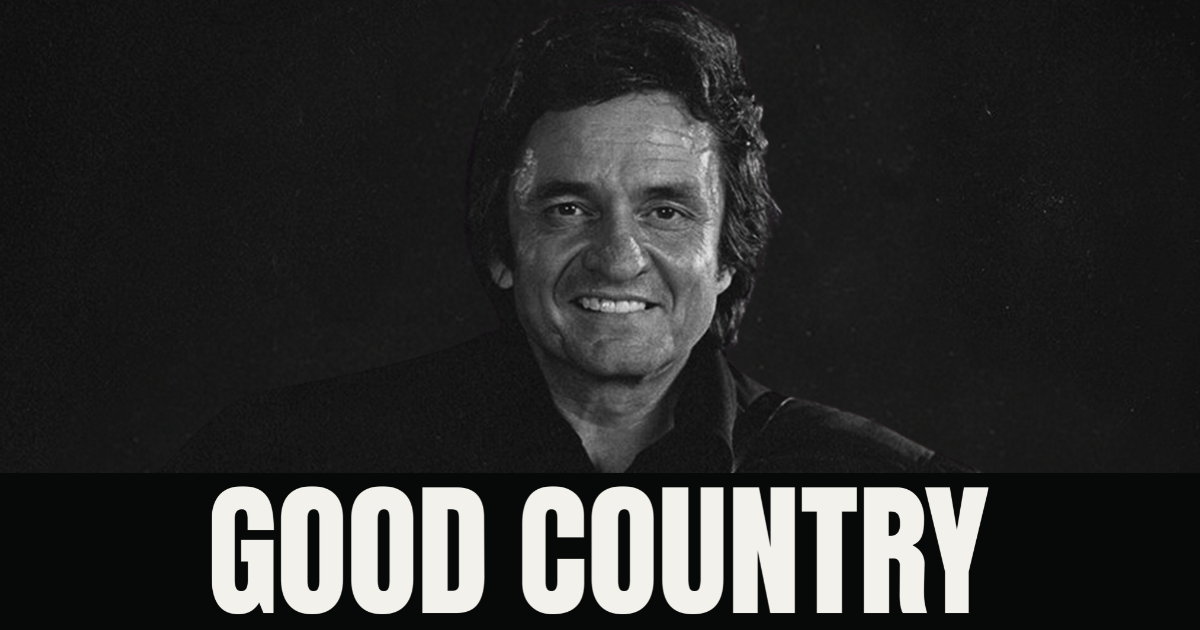
Photo Credit: Johnny Cash courtesy of JohnnyCash.com.

Mental Health, Healing, and Redemption Flow From Becky Buller’s ‘Jubilee’

With her work as a songwriter and as a sidewoman, Becky Buller made a name for herself long before she became a bandleader. In 2015, after becoming a mother, she realized the need to control her own schedule and reluctantly began a touring career under her own name. But for someone more comfortable outside of the spotlight, the pressure and stress of leading her own project took its toll and in 2020 Buller found herself in a mental health crisis.

Her new album, Jubilee (available May 17), chronicles her journey through depression in the form of a song cycle including instrumental interludes. This project was initially commissioned by the FreshGrass Foundation and was recorded almost entirely live with Buller’s band. The music is beautiful and vulnerable – and the group’s chemistry and musicianship shine.

In a BGS interview, Buller opens up about what triggered her mental health breakdown, about the stigma around mental health care, and how she found her way out of the dark through medication, songwriting, therapy, and prayer.

This album was commissioned as a long form composition by the FreshGrass Foundation for debut at their 2023 Bentonville, Arkansas festival. How was your experience as a writer working in a song cycle/conceptual format, versus previous songs and albums that you’ve written?

Becky Buller: I almost always follow the muse where she leads. Having an assignment generally tends to squelch my creativity. I’m so grateful to the FreshGrass Foundation for commissioning me to write this piece, but I’ll admit, after I hung up the phone last fall, I did panic a little bit. But once I settled on the topic for the cycle and decided that the previously unreleased song, “Jubilee” (co-written with Aoife O’Donovan), would be the seed I would plant and water to cultivate the entire project, the rest of the music came to me pretty quickly.

Tell me about your connection with Aoife – how did that come about, and where did it lead the project?

She and I were talking at the 2019 Newport Folk Festival about writing together at some point. She was there touring with I’m With Her, and I was there with the First Ladies of Bluegrass as part of a historic all-female Saturday night headliner set curated by Brandi Carlile, which included folks like Yola, Sheryl Crow, Linda Perry, and Dolly Parton.

Once I got back home, I ended up sending Aoife the first stanza of “Jubilee” and she said the idea of needing a rest resonated with her. We started writing “Jubilee” just before the pandemic shutdown, finishing it in December. Ironic that we were singing about needing a rest… and then we got one! [Laughs]

[Laughs] You manifested it! But the rest for you – it didn’t really help? From your bio it seems like it caused a crumbling of sorts?

No, I don’t know how to rest.

I’m the same. I find that when I have time to think it can be very confronting.

That totally resonates with me, it exposed all the cracks in my foundation.

I was really interested in the line, “She’s been told that she’s absurd,” as a potential crack in the foundation – the idea of the separation between an artist and a human. That one could feel respected as a musician, but not as a person… where is that line coming from for you?

Or not respected as either…

We all have so many voices and opinions whirling around us. Some louder than others. Some speak honey, some poison. Unfortunately, and more often than not, I tend to fall victim to the poison, trying my best to get others to change their opinion of me. Fruitless, I know.

So you’re speaking about personal and professional critics who you feel don’t respect you and your art, that type of chatter, seeing negative feedback or commentary?

I’ve always been more comfortable in the background.

Interesting! So how did you end up leading a band?

I was terrified of leading a band! There were folks that got mad at me, because I wouldn’t start my own band. I didn’t know how I would fund it. I definitely didn’t think I could handle the stress.

What made you decide to do it in the end?

I was a side person for the first half of my professional career. Wrote a lot of songs cut by colleagues and heroes in the bluegrass industry. In 2011, I took a break from the road. In 2012, Jeff and I were expecting [our daughter] Romy. That fall, I joined up with Darin & Brooke Aldridge’s band and toured with them for two seasons… We had our baby girl in March 2013.

I recorded a solo record, my first in 10 tears and my first with Dark Shaddow Recording. It officially came out October of 2014. By that point, Romy had started walking and Jeff and I determined that I needed to be able to create my own schedule. I was under contract to the label to sell a record, so I needed shows…

So I gave my notice to Darin & Brooke, held my nose, and walked out on the water. I’ve had my own band since 2015.

When I started the band, I also started going to a Christian counselor. I knew the stress of running a band would be too much for me… it helps. It helped untie all sorts of knots in my brain. Even after all of these years, I will wind up in situations where I feel myself leaning in a certain negative way and I’m so grateful when I catch myself and say, “No, I don’t have to think that way anymore.” But the counseling wasn’t enough when the world shut down.

I totally understand what you’re saying about the schedule. It’s so interesting how being a mother in some ways necessitates being a band leader rather than a hired gun on tour. It’s something I think about a lot, because you need control. But also, man, that’s a lot to take on at once!

It is. And I’m so grateful for a tight community of touring mamas who get it. My folks are working on moving to Tennessee, but up ‘til now, they’ve been in Minnesota and unable to help us much. I’m so grateful for the beautiful Tennessee family God planted me in. We also have the best neighbors and church family. I couldn’t do what I do without their love and support.

I wanted to thank you for your openness about mental health on this record. I saw in the liner notes that you said medication has been a really helpful part of your healing. I also take medication for mental health and I feel there’s a lot of stigma around it. Often on the road, I’m surrounded by folks self-medicating with drugs and alcohol who are afraid to take prescribed medication for their mental health issues. How has medication helped for you?

The culture I grew up in was very against prescription medication for mental health. More faith and prayer and less self-pity, that was supposed to take care of things. I’m like the fellow in the Gospel of Mark who fell at Jesus’s feet, crying out “I do believe, help my unbelief!”

Like you, I’ve also been around a lot of musicians who are self-medicating with drugs and alcohol. I never want to wake up not knowing where I’ve been, etc. For these reasons, I was afraid to take medication.

But in mid-2020, I literally felt something in my brain pop. I couldn’t make complete sentences. I couldn’t write my own name correctly. I needed the medicine to help me begin climbing out of the hole I was in.

My doctor is also a musician and understood where I was at. He told me to give him a year and we’d get it sorted out. And he was right. In the late summer of 2021, when we found a medicine that I responded to, it felt as if a cinder block was lifted off of my head. I know getting to debut at the Grand Ole Opry on September 3, 2021, was also a huge validation, and part of my healing journey.

Thanks so much for sharing all of this, Becky! You’ve made a beautiful record and one that I think will help a lot of people feel less alone in facing their own mental health journey.


Photo Credit: Shayna Cooley

BGS Bytes: Your Roots Music Social Media Round-Up

Welcome to the second edition of BGS Bytes! From up and coming artists on TikTok to conversations the biggest artists are having online, we’re here to round up any important things happening online in roots music — so you can save your thumbs a few scrolls!

In no particular order, let’s take a look back at a few notable highlights from bluegrass and country social circles in the last few weeks.

Spotify Stopped Paying Out to Small Artists On Its Platform

In early April, More Perfect Union reported that Spotify has stopped paying out for artists whose songs don’t top 1,000 streams. While this change won’t impact musicians who top the charts, it reduces profitability for smaller up-and-comers. Of course, this also impacts all genres, not just roots music, a genre that has already historically struggled with a digital era. We might have posted some satirical news about Spotify recently, but this is all too real.

I’m With Her Celebrates the Eclipse

Could there possibly be new music on the way?? I’m With Her posted a reunion photo with all three members: Sara Watkins, Aoife O’Donovan, and Sarah Jarosz, as the golden trio took in the eclipse through solar viewing glasses!

Black Opry Hit Mainstream News Talking About Beyoncé’s New Album

Tanner Davenport, co-director of The Black Opry, spoke with MSNBC in March about the record-breaking album, ‘Cowboy Carter,’ that’s been setting tongues wagging since its debut.

A Star-Studded Cast Paid Tribute to Jimmy Buffet

@amandapaulak the craziest video youll see today #jimmybuffett #maragaritaville #harrisonford #paulmccartney #juddapatow #woodyharrelson #theeagles #pitbull #brandiecarlile #sherylcrow #bonjovi #joewalsh ♬ original sound – Amanda

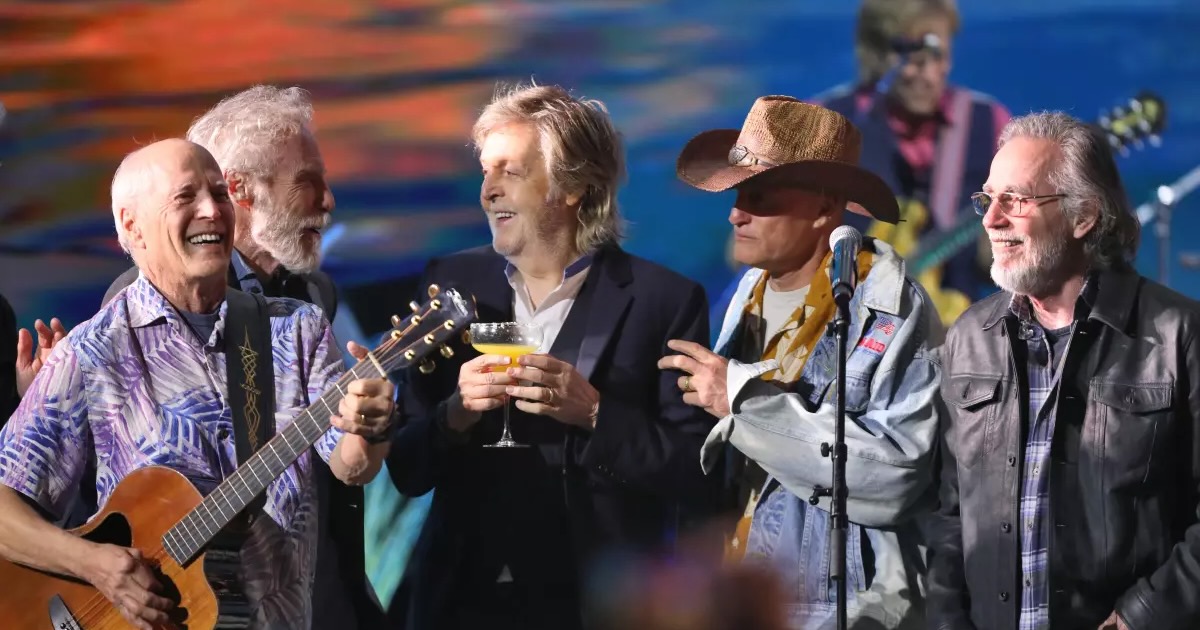
One of the wildest social media videos you’ll see this week features a surprising crew — watch Harrison Ford, Paul McCartney, Will Arnett, Brandi Carlile, Mac McAnally, Jon Bon Jovi, Vince Gill, and Pitbull on stage singing “Margaritvaille” together. That’s not an exhaustive list, of course, so let us know who else you can spot! It’s hard to count all the celebs in this Jimmy Buffet tribute.

Orville Peck Celebrated His New Release With Willie Nelson

If you missed it, Orville Peck recently released a recording and accompanying music video for “Cowboys Are Frequently Secretly Fond of Each Other” with Willie Nelson. The video has already racked up more than half a million views on YouTube! Turns out there must be many a cowboy feeling the vibes Peck and Nelson are putting out.

Viewers Have Been Digging Tyler Childers’ Live Performances on TikTok

@itscristal.g Most amazing concert 💓#tylerchilders #tylerchildersconcert #mulepulltour #country #countrymusic #concerts ♬ original sound – ⚡️Cristal⚡️

A handful of Tyler Childers’ videos have gone viral in the last few weeks, including the above that’s racked up more than 179,000 likes and nearly two million views. Hey, we can’t blame y’all for loving his music, especially when it’s performed live!

Gary the Snail Sang “Fast Car”

@ai.concerts This version should’ve been performed at the Grammys.. Gary the Snail sings Fast Car by Tracy Chapman #fyp #aicover #spongebob #tracychapman #gary ♬ Gary the Snail Fast Car – AI Concerts

With nearly three million views, Gary the Snail’s version of Tracy Chapman’s “Fast Car” has been taking over TikTok. Just a silly little cover, you’re sure to get a good chuckle, even if you’re not a huge SpongeBob fan.

It’s pretty obvious — a lot happened in March and the beginnings of April! We’ll continue rounding up the hottest social media conversations and goings-on for BGS readers every month — let us know on social media and tag us in a post if you think something deserves to make the next list.


Photo Credit: Jackson Browne, Paul McCartney, Woody Harrelson, and more perform on stage at the Jimmy Buffett tribute on April 11, 2024 shot by Randall Michelson / Live Nation – Hewitt Silva.