MIXTAPE: The Barefoot Movement’s Holiday Favorites

To get an idea of how much I love Christmas music, I’ll start with a series of questions. Do I have nearly 700 Christmas songs on my iPod? Why, yes I do! Did I scroll through every one of them in search of ideas for this playlist? I sure did! And did I start with about 75 songs, which I had an incredibly hard time whittling down to a mere 14? Yes, yes I did — I take this playlist business quite seriously. Also, on an unrelated note, do I actually still use an iPod classic? You betcha!

As you can plainly see, I love holiday music. At any other time in the year I might weary of hearing 100 versions of the same song. But at Christmas, anything goes. If a band I love has a holiday album, I’m most definitely buying it. In high school — these were pre-Spotify days mind you — I curated my own “playlists” and grouped them into categories like “Christmas Classics,” “Rockin’ Christmas,” and “R&B/Soul” and burned them onto CDs. Every year I would add more songs ’til eventually, they outgrew the CD format!

So I relished the opportunity to put together this specially curated Mixtape for the Sitch. I tried to stay away from the classic category, even though I love “Jingle Bell Rock” and “Rocking Around the Christmas Tree” as much as the next person. My taste in music is very personal to me, so with every song comes a little story.

I understand that Christmas music is not for everyone. Even some folks who like it in small doses might tire of hearing the same songs year after year. But for me, these annual celebrations — whether Christmas, Halloween, or National Donut Day — give us something to look forward to when the constant toiling of life wears us down. And that is a good and worthy thing, especially in a year when so many joyful things have been canceled. I hope you enjoy this collection and that you’ll get some real enjoyment out of these great songs! Happy listening! — Noah Wall, The Barefoot Movement

Doc Watson, Del McCoury, and Mac Wiseman – “Christmas Time’s A Comin’”

Something about the combination of Doc Watson’s immediately recognizable guitar playing and Del McCoury’s high lonesome tenor, not to mention the great Mac Wiseman (who I just learned was a co-founder of the Country Music Association, who knew?!), transports me directly to a living-room, after-dinner, holiday pickin’ party. This may be the quintessential bluegrass Christmas song and this is my all-time favorite version. I love it so much, it makes me want to learn to flatfoot.

Red Clay Ramblers – “One Rose/Hot Buttered Rum”

The Red Clay Ramblers are a North Carolina-based Americana band who have been making wonderful music since the 1970s. I first heard this song on our local NPR affiliate radio station’s weekend folk show, “Back Porch Music.” I was introduced to many bands on that fabulous little program that is still airing today, from legends like Doc Watson to then-up-and-comers Nickel Creek. It’s been an honor to hear my own music played on there amongst them.

Just once in my life, I’d love to write some lyrics half as good as these, which so beautifully capture the gloom of a wet, cold, melancholy Carolina winter, when even sparkling lights and greenery seem colorless and out of place. Ultimately, it’s a love song, an ode to the ones who keep us warm, no matter the weather. “When dreary Christmas decorations line the streets and filling stations and dime store Santas can’t disguise their empty hands and empty eyes… In the dead of winter, when the tinsel angels come, you’re my sweet maple sugar, honey, hot buttered rum.”

Sufjan Stevens – “That Was the Worst Christmas Ever!”

I am a huge fan of Sufjan Stevens and his wildly imaginative, fearlessly quirky music. I gave his first collection of holiday songs as a Christmas gift to Tommy Norris, our mandolinist and my now-husband, back when we were first dating. It’s since become a staple of our seasonal collection. This song in particular strongly resonated with me, as I can recall moments in my childhood that mirror the lyrics. For many, family relations around the holidays are tense and somewhat less than “holly jolly.” I think that’s okay — holidays can be stressful, and no one is perfect. This Sufjan song offers anyone who has been on the giving OR receiving end of some righteous seasonal stress a lovely cathartic release. Other favorites from this collection are “Only at Christmas Time” and “Hey Guys! It’s Christmas Time!”

Ralph Stanley – “Christmas Is Near”

Ralph wrote this downhome delight himself and originally recorded it with his brother Carter in 1958. This newer version is unabashedly country and I love everything about it. It’s as pure as freshly fallen snow! While some of the songs on my list might highlight the somber side of the season, this one is the exact opposite, with lyrics that round up all the good things that make the holidays special: family, joy, and love. It’s a magical time, if we are lucky enough to be able to focus on these things.

Pearl Jam – “Let Me Sleep (It’s Christmas Time)”

My “Rockin’ Christmas” playlist has all the classic holiday tracks from greats like John Lennon, Eagles, and Queen. It also includes this grunge-era gem. Picture, if you will, 4-year-old Noah, a card-carrying member of the Pearl Jam fan club with a wicked crush on Eddie Vedder. If I remember correctly, this song was on an exclusive vinyl single that was sent to members of said fan club, and I was one of them! It’s such a dreamy tune, and while a look at the lyrics today reveals deeper meaning, 4-year-old me related to the simple joy of taking a cozy nap on a cold day during Christmas vacation. And y’all, I still love naps. Especially Christmas naps. Because I feel like I earn them.

Duke Ellington – “Nutcracker Suite: Peanut Brittle Brigade (March)”

This is a pick from our bassist, Katie Blomarz. She began performing with us in 2015 and brought with her a background in jazz music that was cultivated by her musical family. In her own words, “For me, the Christmas spirit is amplified in jazz/big band arrangements. The Nutcracker Suite interpreted by Duke Ellington and Billy Strayhorn is the perfect harmony of a classical favorite by Tchaikovsky reimagined by a big band for a modern flair. This album has been a special one for my family because my dad, brother and I all grew up playing in big bands, and in non-2020 years, my brother plays this record live every December! It is a swinging change of pace from the pop songs on any Christmas playlist!”

Laurie Lewis & Tom Rozum / Merle Haggard – “If We Make It Through December”

When I was fresh out of high school, I landed a job at a local country music radio station. Though our programming was your typical Top 40 and wasn’t even handled at the local level, we would still get CDs sent to us occasionally, the old school, indie marketing way. This is how I happened upon Laurie Lewis and Tom Rozum’s seasonal album, Winter’s Grace. Believe it or not, this was the first time I had ever heard of Laurie Lewis, and even harder to believe, it was the first time I had ever heard Merle Haggard’s wonderful song (I was only 18, so cut me some slack!) I was an immediate fan of both. The song tells such a relatable story. I am always inspired by the way a song can take a moment in time, no matter how insignificant in the long run, and immortalize it. It’s the perfect healing device that brings comfort and affirmation, even when that moment has long passed. You can’t find Laurie & Tom’s version on streaming services, so we’ll include Merle’s here.

The Jackson 5 – “Give Love on Christmas Day (Group A Cappella Version)”

My R&B Christmas playlists feature tracks by folks like Otis Redding, The Temptations, Stevie Wonder, and of course, the entire Jackson 5 Christmas album. This song is what it’s all about. Whether or not you are religious, the sentiment of spreading love is universal, and that very concept is what lies at the heart of Christmas. I love the original Jackson 5 recording, but this one, a special track from The Jackson 5’s Ultimate Christmas Collection, is stripped down to just the vocals. It goes from being a full-fledged, studio package, to an intimate, almost hymn-like family prayer, sung by an extremely talented group of brothers. The quality of their voices is so palpable and innocent, which lends to the sincerity of the message. “Out of the mouths of babes,” indeed.

Rogue Wave – “Christmas”

I love Rogue Wave so much! And I was today years old when I realized that this Christmas tune of theirs from an awesome collection, put together by their label, Brushfire Records, is a cover of a song by The Who from their rock opera, Tommy. I’ve seen it, but I completely forgot about the song. Rogue Wave’s version sparkles like sun reflecting on a snow covered hillside, peppered with sledders. Seriously, that’s exactly what I picture when I hear it.

The Judds – “Beautiful Star of Bethlehem”

One Christmas Eve, I was attending the annual service held at my great grandmother’s church. One of the performers they had scheduled to sing came down with something, and the other musicians asked me to fill in on this song. It went over so well, it turned into a tradition, and I came back and sang it every Christmas Eve for the next 15 years. Needless to say, it earned a very special place in my heart, especially after we lost my grandmother at age 96 back in 2018. Every time I hear this recording, I remember listening to it in my car in the parking lot, to remind myself which part to sing, and my precious grandmother, beaming with pride in the audience. This is another song that I would file under the label “quintessential bluegrass Christmas listening.” The Judds’ version is perfect, thus I have yet to record a version myself, as I can’t think of one thing I would do differently.

Bob & Doug McKenzie – “The Twelve Days of Christmas”

And now a fun one! One of my holiday playlists highlights things that fall into the humor category. The selections include songs like Porky Pig’s “Blue Christmas,” barking dogs singing “Jingle Bells,” and the parody of Black Sabbath’s Iron Man, “I Am Santa Claus.” I have about five spoofs of “The 12 Days of Christmas” because, well, it just lends itself so well to mockery! This one is my favorite. The characters Bob & Doug Mckenzie are fictional Canadian brothers, created and played by Rick Moranis and Dave Thomas on the sketch comedy show SCTV that aired during the ‘70s and ‘80s. I won’t say too much. You’ve probably heard it, but if you haven’t, you should. My favorite line: “Next year, get me a chainsaw.”

Track Dogs – “How Christmas Was Meant to Be”

We met the band Track Dogs at Folk Alliance International several years ago. I was walking by a hotel room showcase and the sound I heard from within made me turn around and go listen. Their typical instrumentation consists of guitar, trumpet, bass, and percussion, and they are made up of members from England, Ireland, and the US, yet the band came together and now resides in Spain. The fusion of all these elements yields something truly unique. Lead singer Garrett Wall, whom I must be distantly related to (at least I hope so) has one of my favorite voices in modern music. This song is eloquently penned, perfectly arranged, and beautifully recorded. A new Christmas favorite for me, to be sure.

The Seldom Scene – “Silent Night”

No autotune here folks, these guys are the real deal. The Seldom Scene is one of my all-time favorite bluegrass bands. When I was a preteen, and all I listened to was Limp Bizkit and Korn, I went through a phase where music like theirs was “too bluegrassy” for my taste. Then one day, I saw the light, thank God. They have such a signature sound, they were true innovators, with harmonies that stand alone in creativity, even today. This song in particular is the perfect example of why people buy Christmas albums. It’s simply pleasing to hear a band you love sing a familiar song, even one that has been recorded thousands of times and sung for centuries. Oh and by the way, I still love Korn and Limp Bizkit and have absolutely no shame in admitting this. If they had Christmas albums, I’d probably buy them.

Ryan Shupe & the Rubberband – “The Gift”

Ryan Shupe & the Rubberband are described as an American rock/bluegrass band on Wikipedia. The “rock/bluegrass” classification kind of makes me chuckle, but it’s true! Their style marries the two seemingly opposite genres of music. We shared a booking agent with the band for a while and we were able to play a few events with them. Every year when I hear this song, my sincere desire to spend my time on Earth doing good is renewed. It’s so hard to keep this ideal at the center of my attention, when the inevitable storms of life keep me constantly distracted and focused on myself, and my innate introversion pressures me into seclusion. But when I hear this song, it gives me the motivation I need to get back out there and try again, to seek to do better in every way I can, to be a friend, an ally, and a comfort to anyone in need. It’s a lofty aspiration, and I am just a work in progress, but this song gives me hope that I might one day find the strength to live up to it.


Photo credit: Workshop Media Co.
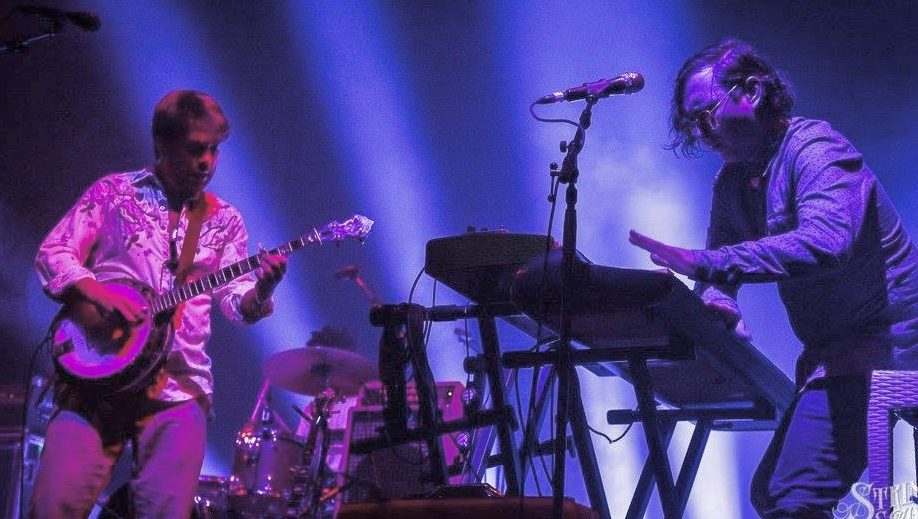
LISTEN: Deutsch & Thorn, “Scorpio Sun”

Artist: Deutsch & Thorn (Erik Deutsch and Andy Thorn)
Hometown: Mexico City, Mexico and Boulder, Colorado
Song: “Scorpio Sun”
Release Date: December 4, 2020
Label: Thornpipe Music

In Their Words: “When I first wrote this tune, I recorded it with the Colorado Playboys (Travis Book, Jon Stickley, and John Frazier), and called it ‘Sicks Ate.’ (We thought we were very clever.) Over a decade later, playing it with pianist Erik Deutsch, it took on a whole new life. As fellow Scorpios, Erik and I retitled it ‘Scorpio Sun.’ We recorded this EP in Erik’s beautiful Mexico City apartment, between playing shows at Zinco Jazz Club in the city’s vibrant Centro neighborhood. I never thought I’d bring my banjo to Mexico City, to mingle with Erik’s jazz influences and the sights and sounds of a dazzling culture. But that’s kind of what it’s like playing with Erik — you never know what might happen next.” — Andy Thorn


Photo credit: Josh Timmermans

BGS 5+5: Lera Lynn

Artist: Lera Lynn
Hometown: Nashville, Tennessee
Latest album: On My Own

What other art forms — literature, film, dance, painting, etc — inform your music?

I think everything we consume ends up informing our art. It’s difficult for me to pinpoint any one art form that influences me, but I did use the act of painting with intention while making my new record, On My Own. Because I was working completely alone on the record, I desperately needed some method for gaining perspective, so I kept my easel set up in the room where I was recording and would bounce back and forth between the two mediums. Where I would reach a roadblock with one, I would move to the other.

What was the first moment that you knew you wanted to be a musician?

Music was always a big part of life for me growing up. If there wasn’t a record or the radio blasting, someone was playing guitar or keyboards and singing. I, however, had always planned on becoming an astronaut until one fateful day as a 10-year-old, when I learned that my eyesight was too poor for me to ever be accepted into the space program. I happened to be watching Star Search minutes after that disappointing realization and distinctly remember thinking, “Oh well, I’ll just do that.” It wasn’t until a couple of years later, playing violin in the school orchestra that I understood, for the first time, the hypnotic power of playing music with and for others and I was hooked.

What’s the toughest time you ever had writing a song?

I once spent 10 months working on a song, because someone I shared the song with suggested that the chorus wasn’t strong enough. I must’ve written six or eight different choruses and ultimately decided that the original chorus was the one. The song is called “Fade Into the Black.”

What rituals do you have, either in the studio or before a show?

My rituals are pretty different for live shows vs. studio work. I have to be pretty straight before getting on stage. I sing the old jazz standard “Lover Man” for its vocal range as a warmup and just before going on stage I get pumped up by yelling like I’m at a drag race. In the studio, a good buzz goes a long way for getting inside the song and tracking vocals.

If you had to write a mission statement for your career, what would it be?

Let art guide the process and decisions, not the prospect of money or success. Maintain autonomy by nurturing meaningful engagement with fans; let them be the guide and support system. And finally, trust your gut!!


Photo credit: Alysse Gafkjen

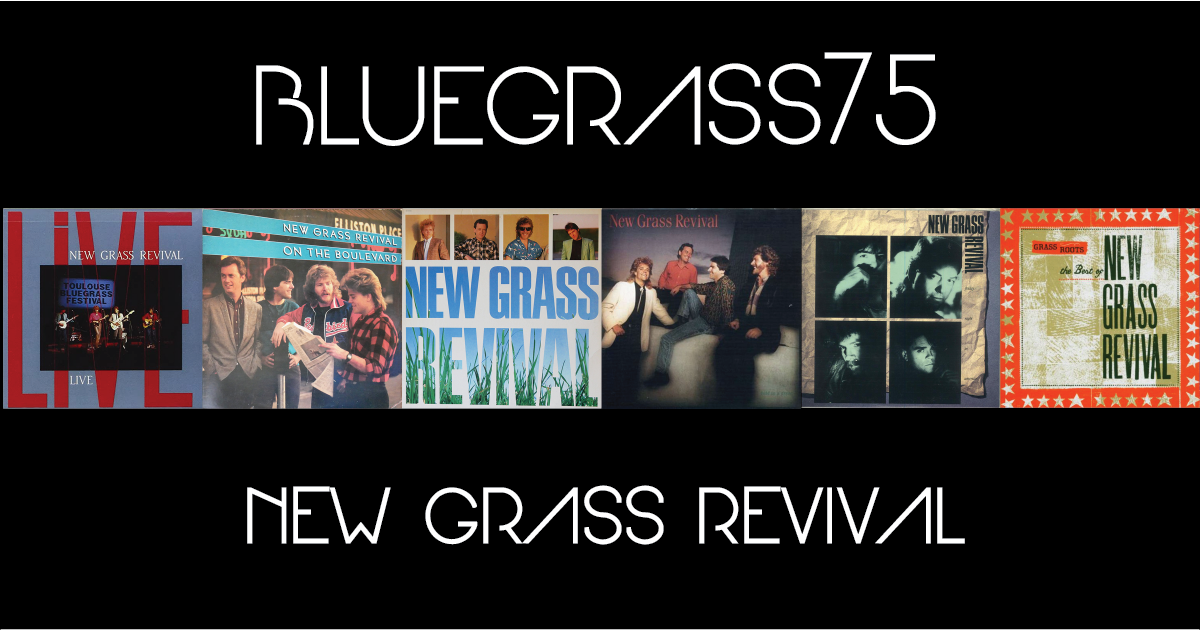
New Grass Revival: Four Members Look Back on Their ’80s Albums (Part 2 of 2)

A beloved band that was perhaps ahead of its time, New Grass Revival will be inducted into the Bluegrass Hall of Fame during the IBMA Bluegrass Music Awards on October 1. In the second half of our oral history with New Grass Revival, we hear from band members Sam Bush, John Cowan, Béla Fleck and Pat Flynn. Read the first half of the interview, which is part of our celebration of the 75th anniversary of bluegrass.

In 1981, founding members Courtney Johnson (who died in 1996) and Curtis Burch left the band after a long tour with rock ‘n’ roll star Leon Russell. As a result, New Grass Revival began its newest incarnation with Béla Fleck and Pat Flynn.

Sam Bush: Courtney and Curtis were older than me and John and they were just burned out. We had worked harder on the road with Leon than we’d ever worked in our lives.

Pat Flynn: New Grass Revival had established a following on the circuit in the late ’70s, but Leon Russell had sucked them into his orbit and taken them away from the bluegrass world. So by the time that band [lineup] broke up, they really had to start over.

SB: I had met Béla in a band he played in called Tasty Licks, and Béla had hired me as the fiddler on his first album, Crossing the Tracks.

PF: Béla was a smart kid. He thought, “If I’m going to come out with a solo album and nobody knows who I am, why don’t I hire high-profile people to play on it?” That’s a smart move!

Béla Fleck: I liked the original band when I heard it, but I admit I was attracted to smoother and jazzier stuff at the time. I have matured a bit since then and now I am a huge fan of the early band, their bravery and iconoclastic spirit, and a poetic expression of their time and place. They were committed to the moment and improvising, and taking the music to a new place that resonated with a lot of folks who loved bluegrass, but it didn’t totally represent them.

SB: Pat and his friend Scott Myers had opened for New Grass Revival on the Colorado tours we did. We loved his guitar playing because it wasn’t like the bluegrass players. He was a rock electric guitar player that could do it on acoustic.

PF: I’d moved from Los Angeles to Aspen, Colorado, and got to know the band at Telluride. Sam had a hand in writing some songs, but they really didn’t have an in-house songwriter. I had always written songs for the bands I was in. And Béla brought a unique and original instrumental vision. So all of a sudden you had two new people that could supply original material.

SB: They were the two musicians who could bring the next step of another sound for us. I called Garth [Fundis, the band’s producer] and said, “You’ve got to come hear these new pickers we’ve got, this is something, this is really good.” I knew it was too hot for me to handle — I didn’t feel I was qualified to produce the four of us. We needed another ear, an outside opinion, because we had so many ideas between the four of us.

PF: On the Boulevard was the first album we released in the US, but we’d done a live album in France almost a full year prior. Technically Live in Toulouse was the first album we made as a new band.

JC: We’re playing like a well-oiled machine; it’s really a good record. It has one of Sam’s instrumentals on there called “Sapporo” that might be 11 minutes long!

SB: The idea of “Sapporo” started when the band went to Japan for the first time. It was my favorite city over there; it was also my favorite beer. A mandolin player over there taught me a five-note Japanese scale and that is a recurring riff you hear us play as we jam.

JC: The first year we were together with Béla and Pat, the energy and the love and everything was way up, confidence was high. And On the Boulevard is one of my favorites. There’s no drums, it’s just the four of us.

PF: It was very fresh. I remember the recording sessions at Jack’s Tracks studio in Nashville. We had a decent budget from Sugar Hill, enough to record comfortably and take our time. I experimented with different guitars and arrangements. We were able to bring the music into the magnifying glass of a studio and really look at it in depth.

JC: The dynamic of the band had changed so much, because Béla was already miles ahead of everybody in terms of his ability to play. He practiced all the time. In the old band, I was in charge of shoveling coal into the engine and Sam was flying around on top painting whatever picture he wanted to paint. Courtney and Curtis, they were kind of like myself, advanced support players. But now you’ve got two other players who can play at the same level of Sam. So we could take this train anywhere. We could get off the tracks.

PF: I had brought some songs with me to the band and I was very happy with “On the Boulevard.” I had written it prior to joining. It was pretty much autobiographical. I’d been living in Thousand Oaks, California, and there’s a boulevard that runs through the middle of the Valley, and as I watched it from the window it was like its own little world, a parade of passing people. It was one of the earliest things we worked out.

SB: My songwriting partner Steve Brines had died a sudden death of a heart ailment he didn’t know he had. So Steve was gone and I was still writing instrumentals, but I lost my enthusiasm for songwriting.

PF: I was especially happy with “One of These Trains,” the way the material came out, and the band took to it so naturally. I was encouraged that I was in the right place with the right people. I loved Sam’s instrumental “Indian Hills,” and John did a great blues number called “Just Is.” We were discovering each other’s powers and personalities as musicians and friends. I remember it very fondly. We were struggling for employment to connect with the old fans and that album was a big help — when it came out, we created a pretty big buzz.

SB: Toni Foglesong told her husband Jim, who was the president of Capitol Records Nashville, “I heard a band that makes a sound like nothing I’ve ever heard before.” So, Jim came to hear us and he said, “I want you guys to record. I don’t know how we’re going to sell you but I want you to be yourselves.”

Two studio albums followed: New Grass Revival in 1986, and Hold to a Dream in 1987.

SB: Every time new people joined, we encouraged them to bring their influences into the music. When Pat joined he was influenced by those Southern Californian songwriters like Jackson Browne, and the country-rock Telecaster picking he knew. One song where I specifically hear Pat’s southern rock influence is “In the Middle of the Night,” on the ’86 album.

PF: I was very involved in the country-rock sound like the Eagles and the Flying Burrito Brothers and the songs I wrote were well-fitted for a bluegrass approach. I didn’t have to make adjustments musically or lyrically, just in the area of arrangements. I had to make sure the songs I wrote had great solo spots for the instrumentalists and I had to fit the songs to whoever was singing, either John or Sam. So I started to instinctively shape my material where there was plenty of room for improvisational playing and also good range of vocals for those two.

BF: This band was full of guys with very different musical influences. If you didn’t want to be challenged, it was the wrong place for you. Some folks surround themselves with people that love all the same stuff they do, and that can work too. But in New Grass Revival, we were all into different stuff, which we brought to the band to see if we could get our favorite stuff included.

SB: Béla is a jazz player and when he came in his favorite musician was Chick Corea. I had his records, but they didn’t make so much sense to me until then.

BF: I think my interest in jazz gave me some cool tools to work with in a bluegrass context. I wrote a tune called “Metric Lips” [on Hold to a Dream], which was partly in jig time. I feel like that main melody had some Chick Corea influence. Sam was highly influenced by John McLaughlin and his great bands. One of them was Shakti, a collaboration with Indian musicians. This seemed to encourage his interest and ability in odd meters, which I also was quite fond of exploring. So if you look at “Metric Lips,” you have Irish music, Indian music, and fusion jazz represented, along with some raging bluegrass. It’s puzzling that it actually works, but in my opinion, it does.

PF: When you’re in a bluegrass band, it’s blend or die! You’re cramped inside a van together and you’re sleeping feet to nose. You’re in a very confined space together more than you are with your significant others back at home.

JC: We called our bus The Bread Truck. We’d bought it from a dry cleaning business. It wasn’t like the 36-footers I had in the Doobie Brothers; it was less than half of that, closer to a van.

PF: John slept half the time, I would be reading a book or writing a song, Sam would be listening to reggae or some weird eclectic thing, Béla was always fiddling with a new tune.

BF: For me it’s the intention and commitment to the ideas that make them work in this band. The same ideas might not work for a band that didn’t play so confidently. Of course we loved bluegrass and that was the common denominator. Each guy also played with a savage fervor or intensity, and perhaps that was another denominator.

PF: We could really charge each other up with the solos. We admired each other, and when somebody threw a flaming ball out there it would be a challenge. And in that exchange, gosh, we became so much better players. I remember listening back to tapes and thinking I lifted myself up and above myself. We all did.

BF: The new band with me and Pat was a somewhat cleaned-up version of the band. We still improvised and pushed hard, but we also were going for a supercharged, seamless tightness.

PF: The thing I remember that we developed between the first two albums was a hardcore consistency. We could turn it on and it would just come on full-bore despite whether or not there was a good sound system or the weather was bad or the crowd was sluggish. We could always count on each other to present a united front. There were no weak links. We just locked into that energy and never lost it.

BF: And we made singles for country radio, which is hard to imagine the early group doing.

SB: We knew we were going into a country market, but I think there’s a misconception that Capitol Records changed us, when in fact the change came from us. We were the ones that said, “We’ll try this song,” and maybe we wouldn’t have tried it in the past.

BF: We were still too out there for it to work, but we were trying to take the music closer into the mainstream, and that was bringing a lot of new people into the scene and showing them what bluegrass could produce.

PF: We would laugh about that in a sad way. The jocks would come to us and say, “I love your stuff, I listen to it at home,” and we’d say, “What about playing it on air?!” They’d say “Yeah, but it’s bluegrass….” We finally got “Callin’ Baton Rouge” into the top 40 which opened up a lot of shows and airplay for us. But we ended up disbanding before we could really bring that home.

SB: For our last album, Friday Night in America, Wendy Waldman became our producer and we really tried all kind of things on that. It’s hard for an athlete to know when to stop, but I really think our last record might be our best one.

PF: I saw a deepening musically. John’s vocals had got better and better, but he also doesn’t get the props for his bass playing. He was a terrific player — listen to his work on Friday Night in America, see how he connected the melodies, the tone he got and the way he tied together the four instruments. They would get noticed, but the glue was John.

SB: John and I had been together 15 years and we were burned out. We lived on the road and I was suffering responsibility overload. And we couldn’t possibly accommodate all that Béla was writing, the type of tunes he was writing. I physically couldn’t play them and neither could the rest of us! We all loved each other, but it was time for him to go on, he needed to express himself. Because at that point it’s not about making money, it’s about musical happiness and your satisfaction.

PF: We’d got together in 1981, and we played our last job as a band on New Year’s Eve, the last day of 1989. We were opening for the Grateful Dead at the Oakland Coliseum, 10,000 people inside and 5,000 outside. That night was particularly memorable — on the right side of the stage sitting nearest Béla was Bonnie Raitt, on the left side, near to me, was Jane Fonda — and I’d always thought what a shame we didn’t release that. Years later someone walked up to me and said, “Remember when you guys opened for the Dead?” I said yes. He said, “Have you got a copy of that set?” I said no. He said, “Do you want one?” A tape of our concert had leaked out among the Dead fans. I contacted a friend at Capitol Records and then that set was remastered and released on a two-CD set called Grass Roots, which has stuff you wouldn’t find on our records. It had its rough spots as a live tape, but you’ll hear that energy and visceral connection we had with each other on stage, you sure will.

(Editor’s note: Read part one of our New Grass Revival Bluegrass 75 feature.)


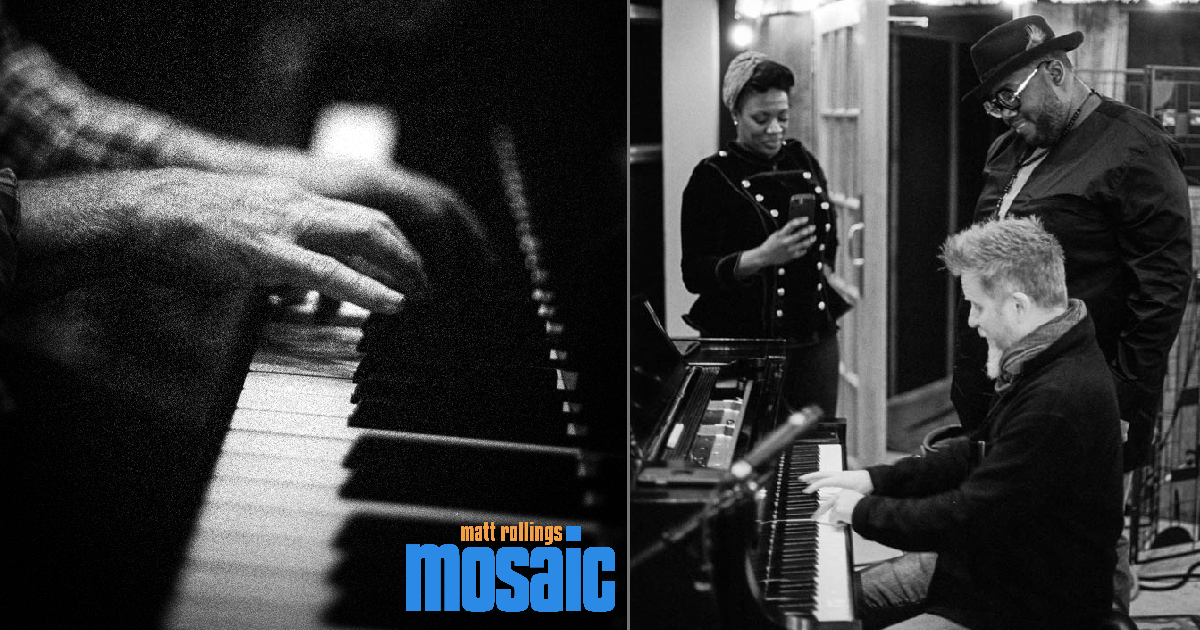
WATCH: Matt Rollings, “Wade in the Water” (Featuring The War and Treaty & The Blind Boys of Alabama)

Artist: Matt Rollings
Hometown: Nashville, Tennessee
Song: “Wade in the Water” (Featuring The War and Treaty and The Blind Boys of Alabama)
Album: Matt Rollings Mosaic
Release Date: August 14, 2020
Label: Dualtone Records

In Their Words: “Michael and Tanya [of The War and Treaty] and I had decided to record ‘Take Me to the Mardi Gras,’ the Paul Simon classic, for the record. We spent a few hours — Michael, Tanya, Jay Bellerose and I — and wound up with an amazing take of the song and I was thrilled. After listening to the playback of ‘Take Me to the Mardi Gras,’ I spontaneously asked if they’d be willing to try something else. I had been nursing an idea about the old spiritual, ‘Wade in the Water.’ My first real jazz piano influence, Ramsey Lewis, recorded it on his 1966 album of the same name, and I’ve always loved it. After hearing what Michael and Tanya had done with the Paul Simon song, I was dying to hear them sing it.

“I printed the lyrics out and we went for it. This is the first and only take we did of the song. It was so good that we didn’t even try it a second time. After adding acoustic bass, it still didn’t feel quite complete… some background vocals were needed. I thought, ‘Who would the ultimate singer(s) be for this?’ It occurred to me that a real-deal gospel quartet would be perfect and The Blind Boys of Alabama would be the ideal candidate. Somehow I was able to catch them while they were in Muscle Shoals, recording on another project. So I drove down there from Nashville on the appointed day and recorded them on the track. They brought just the magic that was needed. The way they blended with Michael and Tanya is amazing… like they were in the same room singing together. After that, the song was done.” — Matt Rollings


Photo credit: Michael Wilson

Bluegrass Memoirs: Scruggs Pegs & Earl’s Hooks

Let’s begin with a 45 RPM record I played banjo on. 

In July 1964, I was hired by the Rick Sutherlin Orchestra to play banjo for one night at the Monroe County Fair in Bloomington, Indiana. They needed a banjo player, because they were going to back up the fair’s featured music that night, the famous barbershop quartet, The Buffalo Bills

The Rick Sutherlin Orchestra was a big band based in Bloomington. Its leader Sutherlin, from a local family, was not a great musician. I remember him at the fair waving his baton at the front of the stage while one of the sidemen did the countdowns before each tune. I’m pretty certain I got the gig because Tom Hensley, who’d played bass in our bluegrass band, the Pigeon Hill Boys, played piano for the orchestra. They needed a banjo; he suggested my name. Hensley, like most of the other members of the big band, was at the Indiana University School of Music. He recently retired after over 40 years as Neil Diamond’s pianist.

A banjo solo was needed for the show, so one of the other orchestra members, trombonist Gary Potter, came to consult with me. Potter and I had been classmates at Oberlin College, playing in Dick Sudhalter’s jazz band in 1960. The following year we had roomed in the same boarding house, and he’d played bass with our campus bluegrass band, The Plum Creek Boys. Now he was at the start of a long career teaching music, principally at IU’s Jacobs School of Music. 

We decided on Bob Dylan’s “Don’t Think Twice,” a contemporary folk hit. I’d been playing it with David Satterfield in our Bloomington bluegrass band. Dave, an IU Grad student from Columbus, Indiana, had lived in Greenwich Village a few years before and done some singing with Dylan at that time. This song was in his repertoire.

I loaned Gary a copy of Sing Out! that had Dylan’s words and music so he could work on the arrangement. At this point he suggested inserting the sound of the Scruggs pegs, the musical hook in Flatt & Scruggs’ “Flint Hill Special.” Scruggs had added two additional tuning pegs to his banjo. They had cams which pushed on the second and third strings, enabling him to raise and lower the pitch of each string while it was being plucked. That created a slurred note sound resembling that of a slide guitar or a pedal steel.

Gary had heard that sound when we were at Oberlin and thought its riff with the strings being tuned down and back up would make a nice introduction for my banjo part. He enjoyed the challenge of arranging the sound of the pegs for the orchestra.

The performance at the fair went over well, and soon after that someone — maybe Sutherlin? — suggested we try doing a banjo + big band LP. Thus the Delmarti 45, intended as a demo, was born. The recording was made, as the label indicates, by Don Sheets. Sheets had a recording studio in Brown County on Highway 135 halfway between Bean Blossom and Nashville. He did custom recording work — high school bands, choirs, that sort of stuff — and specialized in jingles. I worked for him there occasionally. A gold record for one of his jingles hung on the studio wall.

The recording was made on the IU Bloomington campus in August 1964, at the Indiana Memorial Union building’s Alumni Hall. The band was on the hall’s stage. Sheets set up his recording equipment on the floor in front of the stage. What I recall most vividly about the recording session is how solid the rhythm section was. “The Marti Mae Singers” was Don’s wife Marti, who overdubbed the harmony voices in his studio afterward.

The record was published in the fall of 1964. Our banjo + big band idea didn’t find any takers at record companies. At the time, bluegrass banjo crossover projects like this one were already up and running, and the heyday for Scruggs pegs had passed.

Earl Scruggs invented his pegs in 1952 after recording “Earl’s Breakdown,” an instrumental that incorporated as its hook a musical trick he’d been playing since boyhood — making a slur by plucking the second string (a B note), tuning it down while still ringing to an A, and then quickly back up to B, right in the middle of an instrumental break. A quick twist! He and Lester recorded it in October 1951. 

It was released at the end of the year on a Columbia single, the B side of “‘Tis Sweet To Be Remembered,” the first Flatt & Scruggs title to make the Billboard charts. All winter long, Columbia advertised the single as a best-seller. The band, then based in Raleigh, was playing it on the radio and the road daily. 

The tedium of having to retune the string by ear every time he played it prompted Earl to invent a labor-saving device. He installed a tuning peg with an adjustable cam on it in the banjo’s peghead between the first and the second string. Turning the peg up made the cam stretch the second string up to B. Turning it down loosened it to A. That enabled him to play these peg hooks accurately every time.

At the same time as he installed the new tuning peg he placed an identical one between the third and the fourth string so that the third string could be moved down from a G to F# and back.

Earl did this because moving the second and third strings down is a natural part of tuning the banjo from an open G chord (the default, for Scruggs-style) to a D chord. This boyhood musical trick came from something he did whenever he played at a dance — change tunings. Certain dance pieces were in G, the most frequently used tuning. Others were in C or D, each with its own tuning. Scruggs used all three throughout his musical life.

In the spring of 1952 Earl could use his new tuners not only for “Earl’s Breakdown,” but also to move quickly from G to D in order to play “Reuben,” the old-time tune that had launched him as a three-finger picker, which he often picked with the band. 

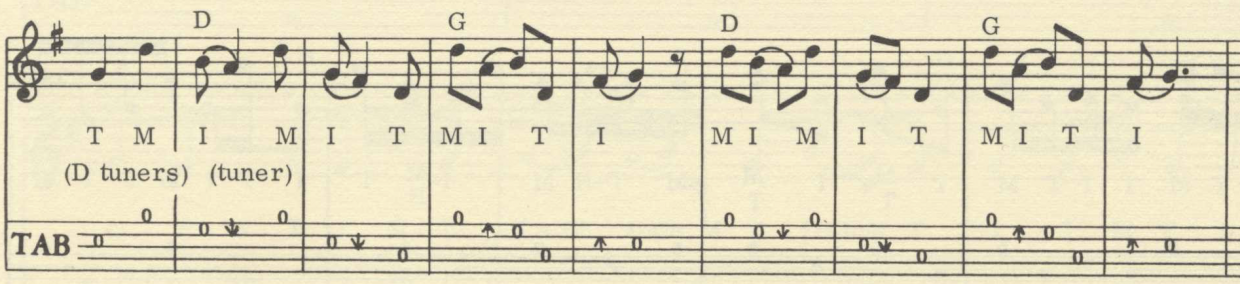
Tablature for “Flint Hill Special” from Earl Scruggs and the 5-String Banjo, p. 103

That fall, just after moving to Knoxville, they recorded “Flint Hill Special,” Earl’s newest composition. It used his new pegs for the tune’s hook.  This riff came at the start of the recording and was repeated at the end of each banjo chorus. That’s what Gary Potter incorporated into his charts for our version of “Don’t Think Twice.”

Released within weeks as the B side of “Dim Lights, Thick Smoke,” “Flint Hill Special” was advertised by Columbia as a best-seller all spring of 1953. It got a lot of radio play. 

At the end of August, not long after Lester and Earl started broadcasting for Martha White Flour in Nashville, they recorded another new peg hook instrumental, “Foggy Mountain Chimes.” In the second half of each chorus Earl tuned both strings down, changing the banjo’s open chord to a D, then played harmonics — “chimes” — in that key before tuning back up to G. 

“Foggy Mountain Chimes” was released in November 1953. The following month Decca released a single recorded in Nashville by the Shenandoah Valley Boys. On one side was “Plunkin’ Rag,” a new banjo instrumental with yet another Scruggs peg hook. 

With the pegs as with every other aspect of his music, Earl Scruggs was being listened to in Nashville and copied by young banjo players everywhere. “Plunkin’ Rag” was just the start. More about that next time!


Neil V. Rosenberg is an author, scholar, historian, banjo player, and Bluegrass Music Hall of Fame inductee.

Photo of Neil V. Rosenberg: Terri Thomson Rosenberg

From Goat Rodeo to Songs of Comfort, Yo-Yo Ma Believes Music Builds Bridges

The world’s most famous cellist Yo-Yo Ma is spending the pandemic at home in Cambridge, Massachusetts, with his family. It has been a situation that he describes, rather humorously, as being an adjustment for everyone. “Two-thirds of my marriage has been on the road. Forty-two years and suddenly my wife sees me home every night, and every day and every morning.”

Yet he says the experience has been a real blessing, too. “All the tensions of being home and preparing to leave, or coming back home to recuperate and then leave again, are all gone,” he explains by phone, before adding “replaced by, of course, the incredible fractures and ruptures in our society.”

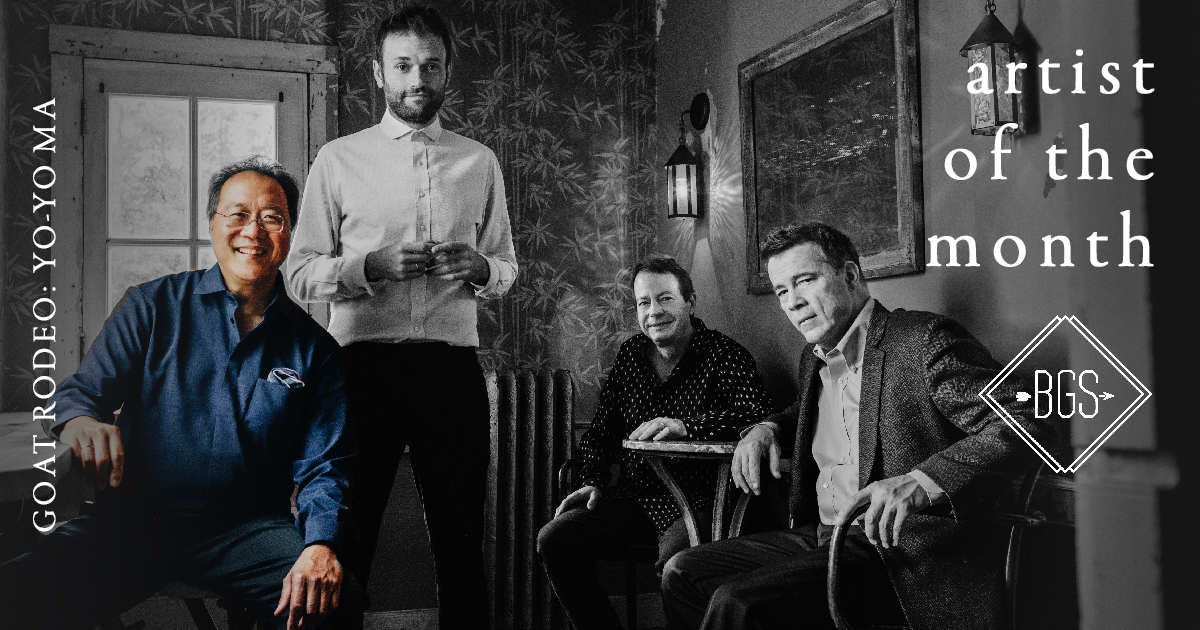
Besides pondering a “tsunami of crises,” Ma talks about the joys of getting the band back together — a lineup informally known as Goat Rodeo, which also encompasses Stuart Duncan, Edgar Meyer, Chris Thile, and special guest Aoife O’Donovan. This Artist of the Month interview is the fourth of four installments as BGS salutes the incredible and iconic musicians behind the ensemble’s second project, Not Our First Goat Rodeo.

BGS: Like the first album, Not Our First Goat Rodeo was recorded at James Taylor’s studio in the Berkshires. Was there a comfort level about returning there?

Totally. The studio is aesthetically beautiful. It is right there in the middle of the Berkshires, the middle of the woods, and it’s a barn that has been built for that reason. We work hard. We play hard. And going back to it is fabulous because everybody in the band is so busy. So, just to get the time from their busy lives to get together is a feat, but when we get together, it feels like we never left. So, add to the great acoustics and the set-up of the barn, another added feeling of “the band is getting back together again.”

Since it was in August, was there a summer vacation vibe?

It was like camp except we weren’t 12 years old. [Laughs] Adult camp! We spend all day together. We have meals together. But it was also work. I have to say that Edgar, Chris, and Stuart worked like dogs, way into the night. Working on scores, working on correcting things. They worked really, really, really hard, but we also had a really good time.

Although the four of you don’t play together often, it seems that a high level of trust exists within the group and with the audience.

That’s such a good question, because you are talking about both the external and internal relationship of building trust. It starts with the trust we have in one another, interpersonally. Between Chris and Edgar. Between Chris and Stuart. Stuart and Edgar. Edgar and me. If you were to draw a networking line between all of us, and Aoife included, it’s trust on every level. Trust and respect. I think the two go together. In that, if someone has a deep opinion about something, there’s going to be deep respect for that. We might try it and it might evolve into something else. There’s never an argument…

The trust also comes from the philosophy: it’s not “It’s my way, your way or the highway.” It’s more like “I know certain things and you know certain things and I love what you know and you like what I know and respect what I know.” So we are just working it out all of the time.

So that allows for the freedom of creativity, to follow a musical idea and see where it takes you?

You know, that other thing about that is where you place your ego. We live in a world where some people think their ego walks in front of them. And [with Goat Rodeo], every one of us has a pretty strong ego because otherwise we can’t go and perform. But the egos never lead. We actually make fun of our own egos or each other’s.

Another thing is, we all have strengths and vulnerabilities, [but] we never, ever pounce on anybody’s vulnerability. I’m the oldest guy there. I’m full of warts. You can probably make fun of me until the cows come home but I think they treat me nice. There’s respect but they never step on someone’s vulnerability. It’s like a great relationship — a great domestic relationship. We didn’t get into pushing buttons. We’re so clear about the work that needs to be done. That’s how you build trust. You accept the whole person, and you treasure the parts that they excel in. You don’t tramp on weaknesses. But while we have a lot of fun!

What is one recording that ranks as a G.O.A.T. (greatest of all time) for you?

When you ask a question like that, I can’t help but think about different time periods. If the well-lived life is the life that has been explored, then obviously at all times in your life you will have had different influences that have sparked new interests.

I will give you a musical example of recent vintage. There’s this 23-year-old musician named Jacob Collier from England. He’s almost self-taught. He sings. He plays dozens of instruments. He goes and creates. I find more and more as I get older and older, I am just stupefied by young talent in a way I never was. So someone like Jacob Collier comes along and he does harmonies in ways that are so astounding. I think he studied with Herbie Hancock and his level of inventiveness is so astounding. I feel like Salieri hearing Mozart for the first time. This guy just appears and he can spin and juggle 36 balls in the air while he’s talking to you. I just can’t take this! It’s just so amazing!

Chris is someone like that. Chris has that kind of mind. And I think working with Edgar gives me that sense of him. Because here’s this mind who is a perfectionist mind, in that he works things out in the perfectionist mentality where the abstract is really close to the reality. Usually I have an image of something and I’m going to translate that into a feeling, into a sound, and here it is. Edgar likes manipulating things in the abstract. That’s hard to do, because most of us like to work in the visible world, [which is a] tiny part of the spectrum in the universe.

So the invisible world, whether it is the larger universe or the micro universe, is something that most of us can’t experience… To go to trusting the abstract world, which we can’t see, and say that it’s real is very difficult. And so the question is, What is our faith in the invisible? That’s a big question. For me it is not a political question. It is a human question. As in, who do you trust and on what subjects? That’s very difficult because the world has become so complex.

And the world is so immediate and immense, and you are inundated from so many sides.

So, I grew up in three cultures, and each culture said, “We are the best!” I grew up as a 7-year-old — that is when I came to the States — saying, “Are you all crazy? You can’t all be right because you are claiming you’re the most right and that’s not logical!” So I had to figure out what that means. Just like, is bluegrass music the best? Is classical music the best? Is jazz the best? Is R&B the best? Is hip-hop the best?

I decline to think that way because that just gets me in trouble. Just because it doesn’t make sense. It doesn’t make sense logically. It doesn’t make sense to me sociologically. It doesn’t make sense to me as an American citizen because I take pride in all of the inventions we have made to the expressive world. And every new invention we have is a combination of a number of worlds.

You posted some music performances to your pandemic-inspired project, Songs of Comfort, to bring a little solace to people. How gratifying is it that it’s taken on a life of its own, with people around the world uploading videos?

One of the things that I have found out in this first trimester of the pandemic is how deeply people need one another. How deeply they need community. After lockdown, we see the beaches fill up, the bars fill up, and some people say that the economy must move. It’s totally understandable that we have that drive to be together. My way of thinking about it is to say, let’s be a community given the means we have.

In music, in service, it is always asking the question, “How can we help?” So it came from that impulse. That is a very natural impulse, which so many people have added to, or responded to, because we are all going through different versions of the same thing. We’re losing people. We’re stressed. We can’t find food. We can’t earn our living. We can’t plan. We can’t move around. We can’t be with one another.

But guess what? Music travels lightly. This is where the ephemeral is an advantage. It’s not something that needs to be moved by FedEx or a delivery person, but something we can transfer anywhere we want. It goes through walls. That’s why I say, in culture, music builds bridges because the bridges are not physical. Music doesn’t build walls; it builds bridges, because I can send you a link and there you have it.

I relished not only doing Songs of Comfort, but being able to Zoom into hospitals or getting to play for one patient. To send some music to one specific person to say, “I hear this is what you are going through. I’m so sympathetic. I’d like to send you this piece of music. Here it is. I recorded it on my phone.” And then send it to someone. That’s pretty personal. That to me is the essence of the aesthetic experience.

(Editor’s note: Read the remaining installments of our Artist of the Month interview series here.)


Photo credit: Josh Goleman

Ross Holmes, “Overture”

An instrument as agèd, storied, and established as the violin — henceforth in this piece obstinately referred to as “fiddle” — carries with it vestiges and artifacts of its own history into any/all of its new musical forays. It’s one of the most charming qualities of the instrument, that whether a rosin-laden bow grinds and saws against the strings or whether it floats, gently ringing an intransigent harmonic, a fiddle is still a fiddle. It is the sum of its disparate parts. 

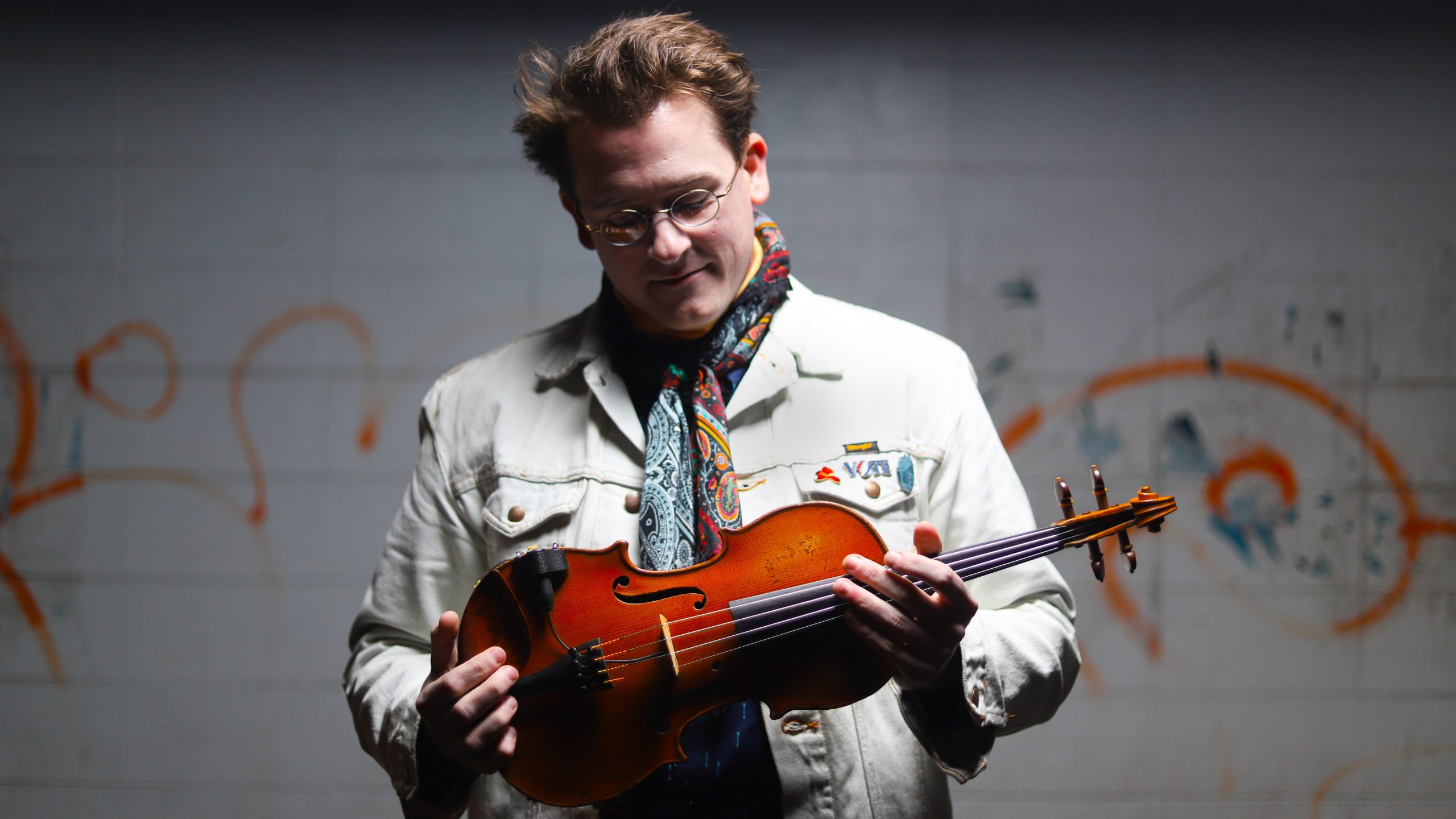
Many virtuosos, hobbyists, and career musicians have staked their entire artistic worldviews on the paradoxes contained within the instrument. We in roots music quite often enjoy the musical aftereffects, songs and compositions that gleefully train magnifying glasses on paradigms such as classical versus jazz, old-time tunes versus minuets and cadenzas, or perhaps a chamber orchestra versus a square dance band. Ross Holmes, a session player, composer, and fiddler (Nitty Gritty Dirt Band, Mumford & Sons), counts himself among the violinist vanguard tinkering with the existential building blocks of the violin fiddle – a tradition and subculture he grew up with. “Overture,” an original, grandiloquent composition from Holmes, is something of a manifesto on the concept. (Listen below.)

The nearly fifteen-minute-long piece is performed entirely solo, beginning with a meditative, droning theme that Holmes describes as a “secular prayer.” As he carefully, intricately unspools each melodic turn, infusions from across the map — geographical and genre — are delivered directly from Holmes’ brain-as-musical-sponge to the listener’s ear. Each fluttering bow stroke, aggressive shuffle, and stunning double-stop speaks to the contributions of the fiddle in nearly every culture on earth. Throughout “Overture,” these global influences reflect the United States’ “melting pot” status — the greater piece for which this is the overture, after all, is titled: American Fiddle Suite. (Its remaining movements are a work-in-progress.)

Fiddling, by its nature, will be an outgrowth of all of the history, culture, and art that has flowed through it over the course of its centuries-long existence. What distinguishes Holmes and “Overture,” however, is the intention with which he connects all of these widespread dots. It makes sense, it’s tangible, and at its essence, it’s beautiful. It’s all the more impressive then, that though “Overture” is an entirely composed, ostensibly “classical” piece, not a note is yet written down. Holmes plays it all by memory — his memory, and the fiddle’s, too.


Photo credit: Micah Mathewson

Best of: Live From Here

This month brought the unfortunate news that Live From Here, hosted by Chris Thile, has been cancelled.

The American Public Media-produced radio show, previously known as A Prairie Home Companion, has been beloved by listeners since its inception in 1974, and continued in 2016 when the series was rebranded as Live From Here, with Thile leading the way.

The show was cut from production as a result of COVID-19’s widespread impact on the music and entertainment industries. On his socials, Thile graciously acknowledged the decision, stating the purpose of Live From Here as “a celebration of live, collaborative audible art.”

So, without further hesitation, let’s look at 11 of our favorite Live From Here moments.

“Dean Town” – Vulfpeck & Chris Thile

Perhaps one of the most loved Live From Here moments was Thile’s guest performance with Vulfpeck on their classic, “Dean Town.” One has every reason to assume that eye contact between Thile and Joe Dart is still going strong at this very moment.


“Fiddle Sticks” — Billy Contreras

It may be one of the lesser-viewed bits from the show, but this “Fast-AF” fiddle tune feature by Billy Contreras is certainly not short on notes. Two and a half minutes of pure double stops and bass walks.


“Lovesick Blues” — Brandi Carlile, Ben Folds, Chris Thile, & Sarah Jarosz

Ever wondered if Brandi Carlile could yodel on par with Jimmie Rodgers — or everyone’s favorite Walmart yodeling kid, Mason Ramsey? Well, look no further than this early Live From Here collaboration with Carlile, Thile, Ben Folds, and Sarah Jarosz.


“Change” – Mavis Staples

“Say it loud, say it clear!” We’ve shared this powerful performance from the legendary Mavis Staples before, but it is even more relevant now. Things are starting to change around here!


“Toy Heart / Marry Me / Jerusalem” – I’m With Her

Almost 10 minutes of mind blowing harmony and togetherness from I’m With Her, all beloved guests throughout the show’s course. As Thile so happily declares at the end, “There’s not a better band — in the world — than I’m With Her.”


“In Da Club” / Musician Birthdays – Julian Lage, O’Donovan, Thile, and More

What could be better than the composer of 50 Cent’s “In Da Club” jamming with Chris Thile, or Julian Lage playing Django Reinhardt? Oh that’s right: it’s Aoife O’Donovan singing Dolly Parton’s “9 to 5.”


“Blue Skies” – Andrew Bird & Chris Thile

Not only does this pair look quite the same, but their playing together is divine, and one of the last Live From Here moments we were graced with before shutdown.


“Kodachrome” – Paul Simon

This one’ll make you think all the world is a sunny day. Just look at Thile’s face!


“Can’t Find My Way Home (Blind Faith)” – Rachael Price

The tonal map of this moment is pure magic. Lake Street Dive’s Rachael Price supported by Thile’s harmony, Mike Elizondo’s bass lines, Brittany Haas’s fiddle playing — need we say more?


“Winter Boy” – Amanda Brown

Since Thile’s takeover as host, Live From Here has always had a strong female vocalist on stage. From Aoife O’Donovan to Sarah Jarosz to Gaby Moreno to more recent guest Amanda Brown — these women have been an integral part of the show’s cast and performance. Enjoy Brown’s beautiful take on this Buffy Sainte-Marie classic. 


“Hard Times” – Chris Thile

It only seems right to acknowledge the many efforts of the Live From Here cast and crew to bring listeners the show, recast as “Live From Home,” in the wake of the COVID-19 pandemic and global shutdown. For the last three months, those at the show worked tirelessly to bring us the weekly program, with the help of dozens of musicians, show regulars, and the #LiveFromHome social media campaign.

All we have left to say is — thank you to Chris Thile, all of the musicians, crew, and those who made Live From Here possible. And we hope these “Hard Times” we’re all living in together come again no more.


Photo credit: Nate Ryan

MIXTAPE: Songs That Changed Jon Stickley’s Life and Still Blow His Mind

When I was a senior in high school, my lacrosse teammate Andy Thorn loaned me a couple CDs and a mandolin. The two CDs were the original David Grisman Quintet album and Sam Bush’s Glamour and Grits. I was an angsty teen drummer in a punk band, and when I popped the Grisman album in my Sony Discman and pushed play, my life changed forever.

We started a little band and I started learning mandolin and making weekly trips to the local record store to buy every “newgrass” album I could. I didn’t know anything, so searching through the bluegrass/country section was an adventure of discovery. I learned to recognize the font that Rounder Records used and started using liner notes to find other musicians to listen to.

A lot of the tracks on this list are track #1 on the album, and I think that’s because when I heard them for the first time, they magically seared themselves into my brain. When I hear them today they inspire the same excitement as they did when I first heard them, and they have had an enormous impact on the music that I create for the Jon Stickley Trio. — Jon Stickley

David Grisman – “E.M.D.”

The first track I ever heard in the vein of bluegrass/newgrass. I heard David Count “1,2,3,4…” just like the Ramones! Then they launch into the most indescribable, unbelievable, clean, rockin’ jam I’ve ever heard. Also my first introduction to my guitar hero, Tony Rice. Nothing compares to this track!

Sam Bush – “Whayasay”

Another leading cut. This was my introduction to the one and only Sam Bush. His kickoff tells you everything you need to know about Sam’s music. It’s masterful, tasteful, and it freakin’ ROCKS. Then he goes totally Mark Knopfler at the end. Blew my young mind!

Jerry Douglas, Russ Barenburg & Edgar Meyer – “Big Sciota”

I picked this record up at the store because, on the back cover, they are dressed in gorilla suits. I thought, these dudes MUST be cool. Something about the tone of this record is unparalleled. It’s just the nicest-sounding acoustic record I’ve ever heard. Still cook dinner to it almost every night and my wife walked down the aisle to another track from the album called “The Years Between.”

Ricky Skaggs & Kentucky Thunder – “Pig In A Pen”

Holy crap. This is another album I bought blind at the record shop knowing absolute nothing about the music. To this day I have never heard anything rock this hard! Also, my first intro to a big guitar hero, Bryan Sutton.

Bryan Sutton – “Decision At Glady Fork”

Senior year of high school my uncle Pat took me to the Béla Fleck Bluegrass Sessions concert. I knew who Sam Bush and Béla were, but it was my first time hearing Jerry Douglas, Stuart Duncan, and the young Bryan Sutton. They played this song and the audience pooped their pants!

Béla Fleck – “Blue Mountain Hop”

The ultimate supergroup in my opinion. This song got me thinking about composition and arrangement in a new way. It seems like each new part of the song was written with each individual soloist in mind. Also the giggles and growls in the intro remind you that they’re having a ball.

Béla Fleck & the Flecktones – “Sinister Minister”

Two words. Victor Wooten. Blew. My. Young. Mind! I’ve listened to this version of this song more times than I can count, and it’s one of the covers that we do in the trio. The Flecktones probably had more of an impact on our trio than anyone else out there.

The Bluegrass Album Band – “Blue Ridge Cabin Home”

This is another album where I had no idea what I was buying. It wasn’t until I looked at the back of the CD that I realized that Tony Rice was on it. It was my introduction to J.D. Crowe, Doyle Lawson, Bobby Hicks, and Todd Phillips. I fell in love with bluegrass banjo by listening to this song, and I was thrilled to find out there were five more volumes!!!

The Nashville Bluegrass Band – “Dog Remembers Bacon”

Another record store score that I grabbed just because “bluegrass” was in the title. LOL. These guys became my favorite group for years and this was always one of my favorite tracks. I learned about Gillian Welch from this album. Stuart Duncan is the best fiddler in the world!

Acoustic Syndicate – “No Time”

Man, I love these dudes SO much. My Uncle Pat gave this album to my dad around ‘98, and I promptly stole it. The chill energy of this album really spoke to me and I feel like it really embodies the spirit of the North Carolina festival scene. Super sentimental band for me!

Tracks from our new album “Scripting the Flip” that draw heavy on these influences:

Jon Stickley Trio – “Scripting the Flip”

This song is pretty much a bluegrass fiddle tune turned on its head. It reminds me of some of my favorite newgrass instrumentals that take the music somewhere new.

Jon Stickley Trio – “Driver”

Well, given that my buddy Andy Thorn got me into this music waaaaay back in the day, I had to bring it full circle and write a tune for him to come in and play on. This piece definitely draws on the music of the Flecktones and some of the tunes they play in odd meters.

Jon Stickley Trio – “Bluegrass in the Backwoods”

Kenny Baker, Bill Monroe’s longtime fiddler, was surprisingly one of the most innovative of the classic bluegrass pickers! He is thought of as a traditional fiddler, but his music is really anything but. I think this tune was way ahead of its time and we love the elements of gypsy jazz and Latin music in the melody. We HAD to cover this on at some point and it was so much fun!


Photo credit: Sandlin Gaither