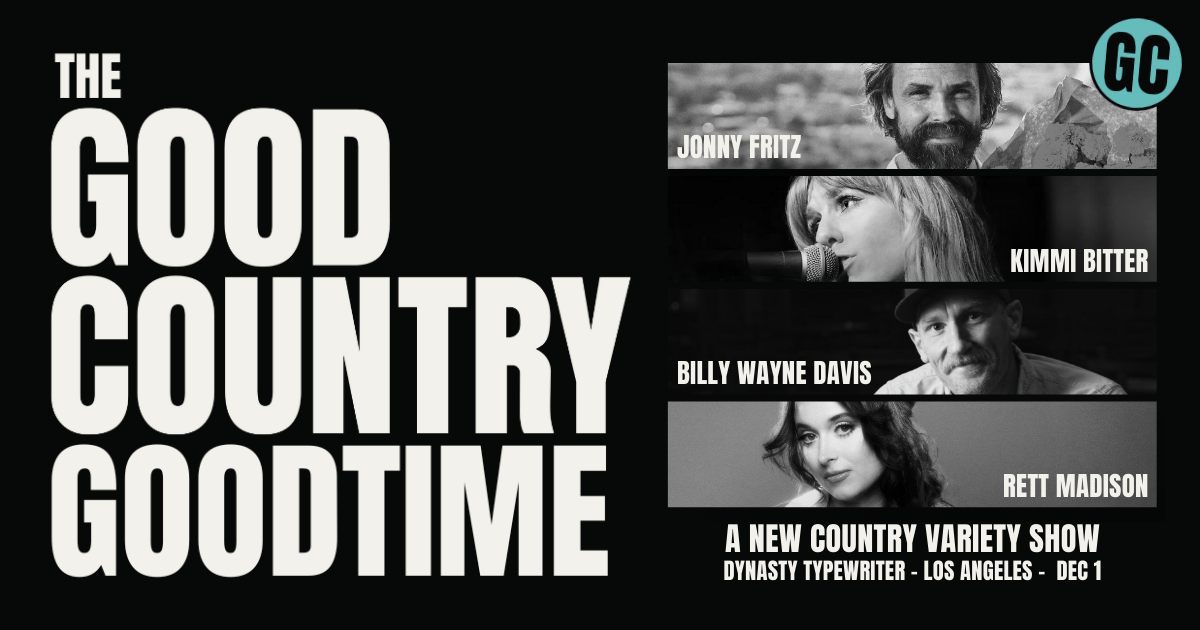
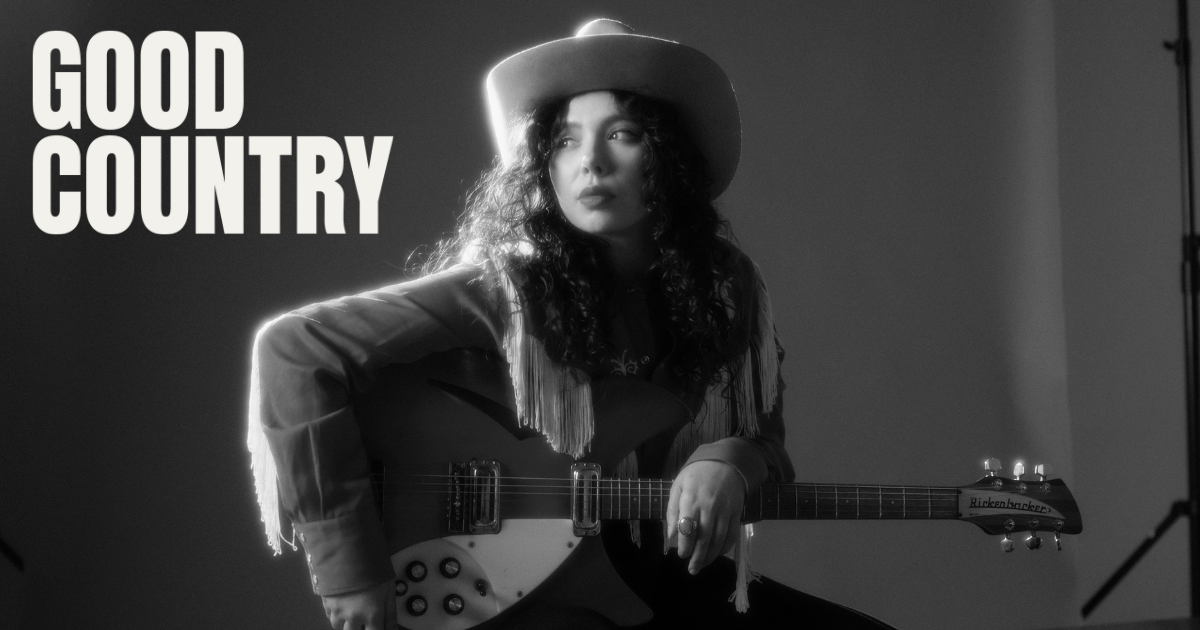
BGS and Good Country are so excited to continue our one-of-a-kind, brand new variety show, The Good Country Goodtime, at premier Los Angeles venue Dynasty Typewriter on December 1 at 7:30pm! The second edition of the event – which features the best in country, Americana, and roots music, a first-rate house band, delightful comedy, and more – will be a whimsical walk through a western winter wonderland. In-person and livestream tickets are on sale now.
Confirmed guests for the December 1 show include Jonny Fritz, purveyor and proprietor of “dad country;” the delightful Old School countrypolitan sounds of California native Kimmi Bitter; plus indie/country singer-songwriter Rett Madison, who just released her latest album, One More for Jackie; and, attendees will enjoy stories, laughs, and more from comedian and Tennessee’s own Billy Wayne Davis – who will serve as the evening’s host. The Coral Reefers’ Mick Utley will return to direct the Goodtime’s all-star house band. And, you never know which Hollywood writers, actors, and improvisers and special guests may just show up to join in the fun.
Not able to attend in person? Grab a livestream ticket, or, just hold on – our Good Country Goodtime shows are recorded by Dynasty Typewriter’s multi-camera, multi-media content capture team and we will be sharing performances, sketches, and songs from the Goodtime right here, on BGS and Good Country, in the near future. Stay tuned!
We hope you’ll join us for the December 1 edition of the Good Country Goodtime, the show’s last hurrah of 2024 – before we continue with regular monthly shows in 2025! Attendees will enjoy songs, stories, sketches, and so many surprises in store. Pull on your boots and get ready for our western winter wonderland.
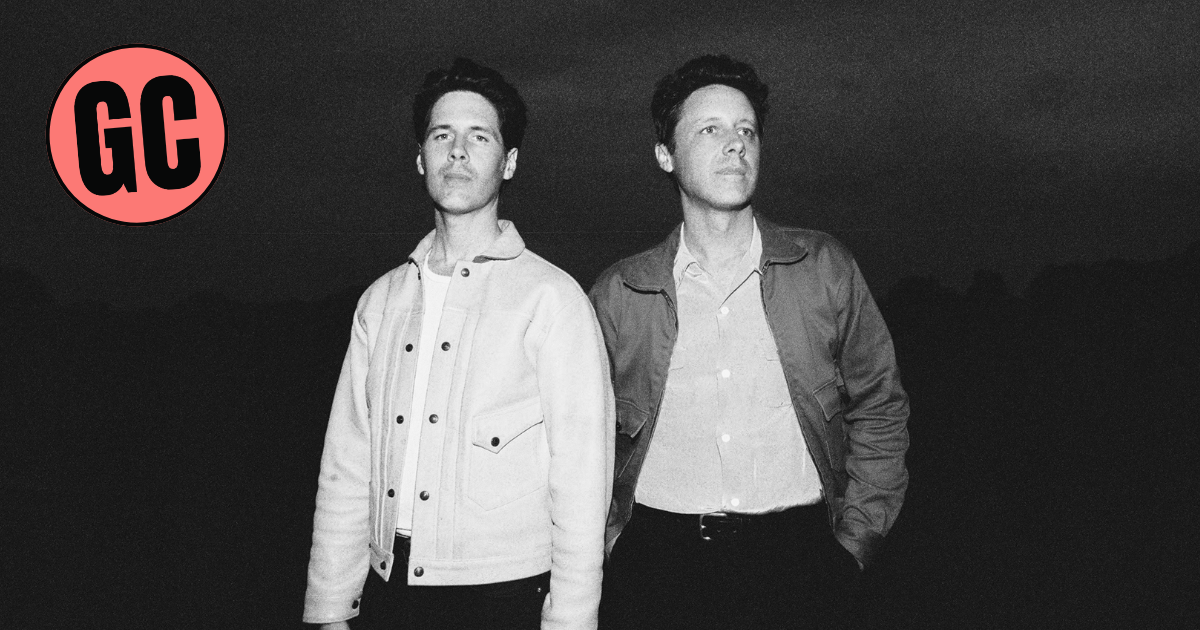
With a sound that’s like rain in the desert for fans of early rock and country, the Cactus Blossoms let their modern-classic vibe bloom on their latest album, Every Time I Think About You. But with pair of big shows to help celebrate the launch, this band is living very much in the present tense.
Made up of Minneapolis-based brothers Jack Torrey and Page Burkum, the duo’s new project arrives August 30 and once again captures the full, timeless magic of spacious melodies, tasteful twang, and tightly-wound harmony. That night, they’ll mark the release with a long-overdue debut at the Grand Ole Opry – where they ought to find a few like-minded fans of keeping music’s traditional cool factors alive – and then head home for a milestone gig in St. Paul.
After a trio of well-received albums and more than 10 years of riveting shows, it’s the perfect setup for a duo who seem totally at ease blurring the American roots timeline – and who promise they couldn’t fake it if they weren’t.
“I don’t think we’re very good at striving,” Torrey says, speaking from the verdant midsummer shores of Lake Superior on a much-needed break from the road. “I do think [this record] has a comfort level, especially since we’ve been able to start touring again, and really hit it. It’s been feeling like we’re a unit and we can kind of read each other’s minds a little bit.”
Speaking with BGS ahead of the release of Every Time I Think About You, Torrey and Burkum filled us in on what that telepathic bond helped create, and where it’s coming from.
A lot of Every Time I Think About You features the “modern-classic” sound you have both made a calling card – like it would sound fresh a few decades ago and today as well. But is that dangerous territory for a band? You don’t want to be pigeonholed as a throwback, right? So how do you walk the tightrope?
Jack Torrey: I think there’s an interesting aspect of that from our perspective. I got super into Bob Dylan and Hank Williams and I was singing songs by both of those guys way back, 18 years ago or whatever. Page was into Jimmie Rodgers and those other super old country things. We start singing together and it’s like if you harmonize on a Hank Williams song, it kind of starts to sound like an Everly Brothers song. You’re kind of accidentally falling into that and getting into territory that people went into 60 years ago – but it’s new for us and I think that has kind of kept happening. We’re not recreating or trying to do anything like listening to records and imitating it. It’s almost like we’re carving our own mini canyon, that resembles some of the other ones from the past.
Page Burkum: I was kind of thinking about this as a way of summing up our style and influences: The Band, The Traveling Wilburys. Those are like my four main food groups or something. I love where all those guys are coming from – a little Roy Orbison, a little Bob Dylan. They balance each other nicely. And I was thinking, when that’s your diet, you’re going to make something that comes out [like Every Time I Think About You]. … But we love other totally different kinds of music outside of that realm too, and I hope a little bit of that gets in there, too.
Where is the title track, “Every Time I Think About You,” coming from? It’s got that lovely, warm-and-fuzzy feel of a mid-century romance ballad to it, but maybe something more, too …
JT: That one is kind of a love song to losing a friend – it’s kind of a heartwarming grief, where you’re almost being consoled by the memory of someone. And that’s where that song came from. The way we wrote it, I just had a couple lines, and then Page jumped in and started singing the beginning of the chorus, and then I sang back the next line, “Every time I think about you …”
PB: Sometimes Jack and I have made fun of biopic movie scenes like in Walk the Line, where it’s like Johnny and June or whoever sit down with a guitar and they’re just writing a song in real time. Like, they sing one line and then pause dramatically, and then sing another line and then it cuts to them playing it for a thousand people or something. But in a funny way, that was kind of the closest to that. [Laughs]
JT: I was like, “I didn’t ask you to jump in and work on my song … but that’s pretty good idea. Let’s do it.”
The album kicks off with “Something’s Got a Hold On Me” – which almost has a Southern rock swagger to it. Where does that come from? Is that your Tom Petty influence showing?
PB: When I first had the idea for that one, the very original idea that set it off was actually a weird little piece of a Jimmie Rodgers song. So, I stole that line and that melody, which is about two notes or something, but it kind of inspired the whole song in a weird way. To me there’s some blend of Lead Belly and The Beatles or something in my mind, but then it ends up just sounding like a country-rock two step. That’s just what happens. It’s fun to roll with stuff. … I threw in another Jimmie Rodgers line, that “T for Texas, T for Tennessee,” to kind of keep that tribute going.
Oh that’s right, I should have known. Why did you end up finishing on “Out of My Mind (On Sunday)”? Is there a reason that seemed to wrap things up?
JT: It wasn’t a big dramatic decision, but it seemed like a nice bookend from “Something’s Got a Hold on Me” to end with being a bit of a crazy person. [Laughs]
PB: To me it actually kind of leaves the door wide open. I don’t know if you want to cap things off with the sweetest, most-concise thing you have, you know? There’s something about it that’s a little bit out there to me.
You’ll make your Grand Ole Opry debut the night this album drops. Then you’re having a big hometown party with show at Fitzgerald Theater in St. Paul [on September 13]. What does that mean to you?
PB: We’ve got one of our favorite local bands, Humbird, joining us for that [St. Paul] show, so that’ll be really cool. We’re trying to get some of our collaborators to be involved too, if we can spice it up with an extra ensemble beyond our regular band. So we’re trying to get a piano on stage or something. I mean, it’s a theater show, so it’s a little different. And it’s our first time playing our own show at this theater. It’s a really beautiful building and I never thought I’d play there when I was a kid.
JT: It’s where [A] Prairie Home Companion used to be back in the day. Page and I actually played there when we were first getting started, which was a special time. So it’s cool, and should be fun. Some people can come that don’t like to stand, since we play a lot of clubs. [Laughs]
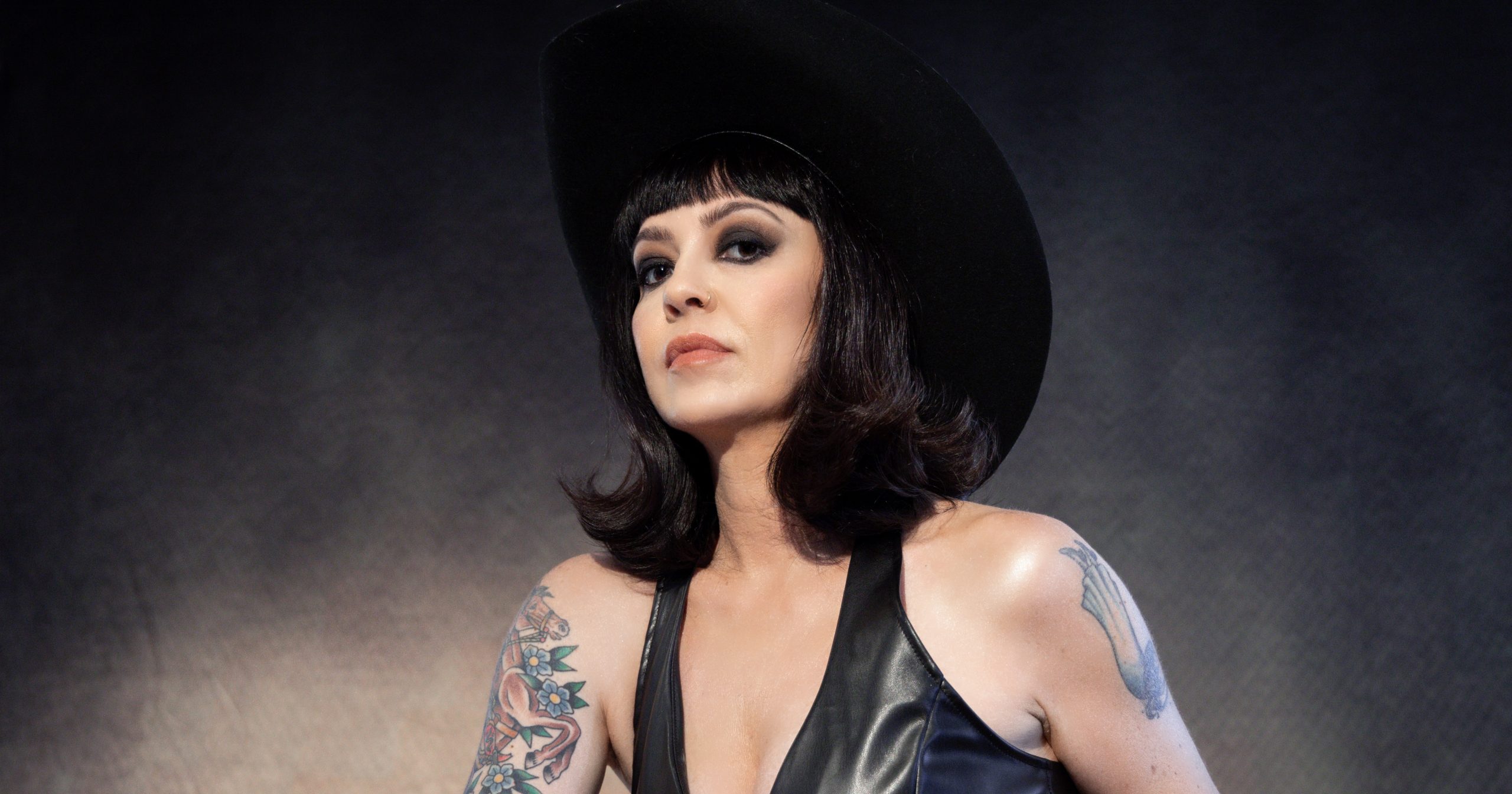
When life hands you lemons, sometimes it’s better to just burn them and start anew rather than make lemonade. That’s exactly what India Ramey does on Baptized By The Blaze, the singer’s empowering fifth album that sees her shedding the trauma that had haunted her since seeing her father abuse her mother as a child.
For years Ramey tried coping by working as a domestic violence prosecutor, but turned to music when that career fell apart in 2009 with her first album, Junkyard Angel, already in hand. Despite all the pain her father inflicted, she says her first musical memories were with him.
“He’d play Waylon Jennings and Willie Nelson’s Wanted! The Outlaws on repeat,” Ramey tells BGS. “Through that I became obsessed with Jessi Colter. I’d get my mom’s curling iron and sing her songs while standing on our living room ottoman. I always say that my dad was such a bad guy. He never gave me anything except for my love of country music.”
But as Ramey’s own career in music materialized, a 12-year dependence on the daily tranquilizer Klonopin began to rear its head. Taken to quell the panic disorder that’s lingered since first witnessing her abusive father’s actions, Ramey sought to gradually come off the drug during the pandemic before its severe withdrawal symptoms landed her in rehab. There, through stubbornness and self-determination, she was able to reclaim the power over her dependence and the trauma that caused it, vowing to never go back. Baptized By The Blaze is her journey to become a better version of herself.
“I went through a lot of stuff — a metamorphosis if you will,” says Ramey. “It was really hard and really scary, but I got so much personal empowerment out of it. Since then, I’ve been motivated to pass that on to bring folks strength and remind them that the tragedies they’ve faced give you superpowers to handle anything else life throws at you.”
Helping Ramey realize those superpowers was her therapist, a conversation with whom inspired the song “The Mountain.” According to Ramey, it occurred about a year into their sessions after something had left her in a puddle of shame and defeat. She explained how our anxiety attacks are similar to avalanches in that we don’t know the tools needed to combat them until going through it. But every time there is an avalanche you’ll have more tools and awareness to recover because you are the source, you are the mountain.
“It was the most empowering thing anyone had ever said to me in a moment where I was so vulnerable,” admits Ramey. “It left me feeling so powerful and wanted. This song is my way of spreading that beautiful message she gave to me.”
Another metaphor central to the album comes on its title track, on which Ramey compares her journey of redemption to a phoenix rising from the ashes. It was written while she “was thinking about that moment where I decided to burn it all down, to burn all of those defense mechanisms that I’d put in place to avoid confronting my trauma.” Despite its personal and well-meaning message, the song didn’t always resonate with everyone on her team though, with one person even calling the song over-dramatized. This led Ramey to shelve it for a couple years until producer Luke Wooten chose to include it on the new record.
“As artists, we’re always second guessing ourselves, so to have somebody on my own team tell me I should leave the idea behind really hurt,” Ramey confides. “Because of that, I struggled with self doubt for a long time about going all in on it, but in the end I went with my gut and I’m glad I did.”
Another example of being misunderstood and defying the expectations of others comes on “Piece Of My Mind,” a soft but stern ballad about an industry type who found out about her past working in law and said if he’d known he would just assume all her albums were vanity projects. On it, Ramey’s signature sass shines through as she urges the person to tell them their story: “Just a snapshot is all you see, you don’t know shit about me.” Before going on to describe how “I’ve fought wars and still they haunt me” and likening each day to being Halloween.
“It pissed me off, because that judgment he had was denying me my authentic story,” exclaims Ramey. “He was denying me the suffering that my family and I had gone through because of a job, so this song is me telling people exactly who I am, which is a lot more than any article or bio can capture.”
While most of the album is derived directly from Ramey’s own personal experiences, two songs that veer from that path are “Silverado” and “Down For The Count.” Both are stories about badass women living life on their own terms unburdened by the judgment and shame often delivered through patriarchal transgressions. “Silverado” details a one night stand at the motel El Dorado and “Down For The Count” highlights a streak of promiscuity to get over a past lover (“I put ten men between you and me”).
“The women I wrote about in these songs are people I think any woman will resonate with, because they’re about women doing whatever the hell they want,” she asserts. “It’s about doing things that dudes do all the time without the same level of judgment and are unapologetic about it. They’re my way of giving the middle finger to the patriarchy.”
No matter the delivery, Baptized By The Blaze charts out a journey of empowerment and recovery that is sure to provide strength and an upbeat honky-tonk soundtrack to anyone with a listening ear. It’s also proof that Ramey’s best work isn’t behind her and that her renewed focus has her poised for a bright future, despite the scars that once plagued her past.
“The process of making this record has taught me just how strong and powerful that I am, which are both things I was never convinced of beforehand,” Ramey reflects. “My hope is that it does the same for listeners and helps guide them on their own journeys.”
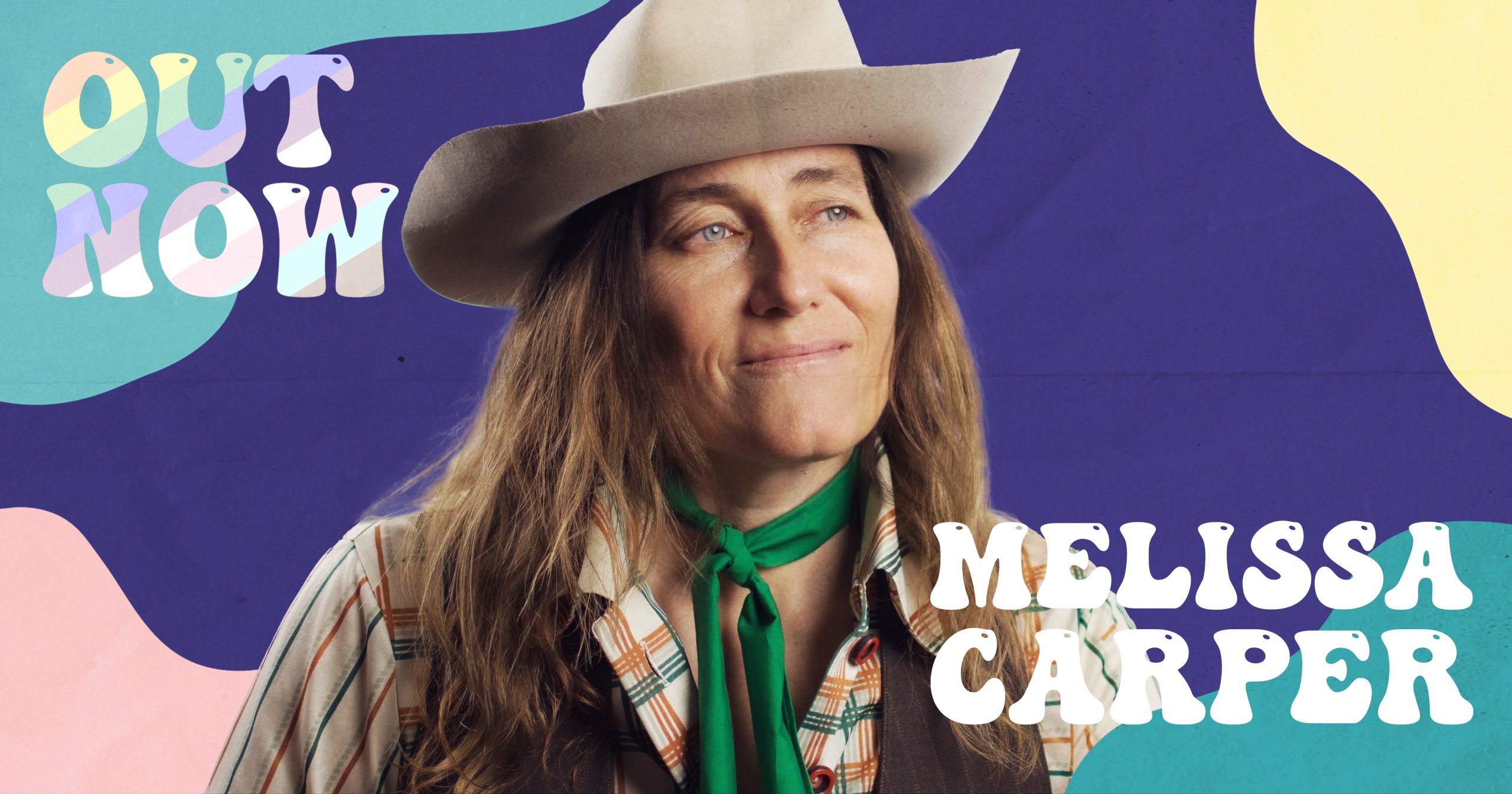
Melissa Carper’s new album, Borned In Ya, was released today. The album travels through stories and experiences that explore journeys of self-actualization. The songs gather many proficient and accomplished musicians – Dennis Crouch, Chris Scruggs, Jeff Taylor, Billy Contreras, Rory Hoffman, Sierra Ferrell, and more – to create a collection of sounds that are carefully shaped into a captivating work of art.
Carper stitches innovation with tradition, creating something that is new and exciting while also feeling familiar and warm. Her storytelling and authentic style shine, making her music both personal and relatable. In this interview, we dive into her new album, why she creates music, and her release and touring plans for the next year. We’re so excited to highlight this incredible artist and her new album, Borned In Ya.
What excites you most about this new album?
Melissa Carper: This is my favorite album I have made so far; the material is fresh and demonstrates an evolution in my writing and singing. I feel more confident and relaxed and many of these songs allow me to “croon.” I am excited for people to hear it and to see how they respond and how they like it. I can’t wait to take these new songs out on the road and play them for people.
How do you cultivate a balance between traditional and innovative sounds?
The traditional is easy for me, because I’ve mostly listened to older music, so those are my influences. I don’t “try” to be innovative, but I feel like having a really good grasp on roots music these days is almost innovative, in a sense. A lot of people have lost touch with that music. My goal is to bring the roots back, but perhaps with some new lyrical ideas, a unique and personal expression of pain and growth (that I hope is relatable), and combining styles that I love together. Together with the producers and musicians that I have been working with on my albums, I think we’ve taken innovative approaches to the songs as well as maintained traditional feels and sounds.
What was your experience collaborating with such an incredible team of highly skilled and accomplished musicians?
I feel so lucky to get to work with everyone you mentioned. They bring my songs to life in a way I could have never imagined. Chris [Scruggs] plays straight or console steel, rather than pedal. The straight steel is the older instrument and is perfect for most of the songs I write. Chris also played guitar, rhythm and lead, on my albums. Rory Hoffman played guitar on about half of the songs on Borned In Ya. They both did such an incredible job. I’m really in awe of all of these musicians.
Dennis Crouch is the best I’ve heard on upright bass and as an upright player, I listen to his bass parts and try to learn them. In the process of doing that I realize what a genius he is. Jeff Taylor, on piano, often sets the tone of a song and always has brilliant ideas. Billy Contreras blows my mind (and everyone else’s) with the fiddle parts and layers he comes up with. On “Lucky Five,” he really outdid himself on the fiddle solo section. Also, I had Doug Corcoran on horns for this album. He played trumpet and saxophone on five songs. Having horns on my songs is new for me, and I think that sets this album apart from the previous ones.
Rebecca Patek wrote an absolutely gorgeous string arrangement for my song, “There’ll Be Another One.” It is my favorite part of the album, when the strings come in on this song. Jenn Miori Hodges, an old bandmate of mine from The Carper Family, sings stellar harmony on several songs. It felt great to have her on this album, we have such a long history of playing together and she plays with me now quite a bit, whenever she is available. And Sierra Ferrell sings an amazing harmony on my cover of a jazz tune from the ’30s called “That’s My Desire.” Sierra actually recorded that harmony back when we were recording the Ramblin’ Soul album. I had too many songs to fit on that album, so I saved it for Borned In Ya. It is really a dream to work with all these folks and I hope I get to continue to do so. I feel like I lucked into a good thing, a formula that really works for me.
The title track, “Borned in Ya,” focuses on being shaped by life experiences. What are your thoughts on how nature (genes) versus nurture (environment) shape musical ability?
I believe, in most cases, it’s probably a lot of hard work and obsession with something you love that makes someone good at something. I definitely have musical genes in my family, but I had the advantage of my parents having me sing and play from an early age. I had a great bass teacher in junior high and high school and got to study music in college with great teachers, then I kept on learning from each band I was in. I was obsessed with old-time music – country, blues, jazz. I listened in an obsessive way until it became a part of me. I feel my learning process has been a steady, slow one, but the great thing is, I continue to grow.
This album is a compilation of stories and experiences written in song. What was it like to craft one collective album that travels through desire, love, heartbreak, life on the road, and growth?
I had a lot of fun writing the songs on this album. Three of them are co-writes with Brennen Leigh, and we always have a good time writing together. I think I’m having more fun than ever with writing and I hope people can feel that in the songs. I love having a combination of heartbreak and also some fresh romance in this album. Not everything is autobiographical of course, and I’m getting better with that – writing from imagination, pulling from some old experiences and emotions to make it real, or imagining someone else’s situation.
I would call a couple of these songs “spirituals” that go a little deeper with life philosophy. It feels good to write about something besides romantic love and to speak of spiritual growth. Hopefully people who listen find the album inspiring. I feel like Borned In Ya is an expression of some of my past and some of the present, but with a wiser and more experienced soul – more has been “borned in me.”
What’s your ideal vision for your future?
I’d love to have a great balance between performing/touring and getting to spend time at home and in nature. To me, that would be the ultimate, to feel like I’m successful enough financially so that touring doesn’t turn into a grind. I don’t mind touring, but when I’m away from home too much it makes me feel disconnected from life in general, being exhausted, not getting enough alone time to be still and to be in nature. I am in a phase currently where I need to take the opportunities offered to me, even if at times it feels like I have too much on my plate. I’d also love more time to focus on creating a nonprofit to help those who are experiencing homelessness and struggling with mental illness. I dream of creating a center with a working organic farm, providing homes and a healing atmosphere.
Why do you create music?
I get melodic and lyrical ideas in my head and they just start developing, it’s one of the most fun and rewarding things that I do in my life. Once I know I’m onto something good, I’m quite obsessive about finishing it – usually within the day if the flow is there. If it is a song that I am forcing a little, or maybe the song has something good and promising in it but isn’t ready to be fully realized yet, I’m pretty good at coming back to it, sometimes even a few years later, and finishing it when the time is right. The process is the most fun, but I also love getting to present the song to an audience. It’s rewarding in a completely different way. Being able to record the song with great musicians and producers to see what it can sound like in its ultimate form, is an especially rewarding part of the process.
What is your greatest fear?
Even the idea of holding onto fear is fearful; my goal is to keep growing and confronting any fears I have that keep me from being the best possible version of myself. I guess that would be my biggest fear, that I allow myself to be too distracted to actually work on myself and confront any fears that I have.
Why do you think LGBTQ+ representation and community are important – in roots music and beyond?
When I came out, there were very few ‘out’ people in our culture. Seeing k.d. lang and Ellen DeGeneres coming out for me was just an affirmation that there were lesbians that existed in the world besides myself. It was really helpful for me to move to a community where it was normal and acceptable, which was the small and diverse town of Eureka Springs, Arkansas. If you are feeling uncomfortable with yourself, being in a community of folks that are accepting of who you are is a great thing. What I loved about Eureka Springs is that there were a couple of gay bars, but the gay people just hung out in all the bars and it didn’t feel like an isolated thing. It just felt normal and accepted to be part of the LGBTQ+ community there for the most part – except for maybe at the Walmart. [Laughs]
What are your release and touring plans for the next year?
Borned In Ya is out July 19th, 2024! I am doing a whole lot of touring around it – Montana, Colorado, Wyoming, Oregon, Washington, then venturing into Missouri, Arkansas, Illinois, Minnesota, Michigan, Wisconsin, Kentucky, and lots of Texas before making my way to Nashville for AmericanaFest. And, I just got back from performing in Europe! It’s a busy year, birthing Borned In Ya!
Artist:Kiely Connell Hometown: Hammond, Indiana Song: “Damn Hands” Album:My Own Company Release Date: July 19, 2024 Label: Thirty Tigers
In Their Words: “It amazes me that we’re still having this conversation about consent. Just because somebody is nice to someone it does not mean they’re entitled to put their hands on you. Let’s let that die here and now. Keep your damn hands to yourself.” – Kiely Connell
Track Credits: Drums and percussion – Andrew Borger Bass – Nate Query Electric guitars, piano and organ – Drew Kohl Acoustic guitar and vocals – Kiely Connell
March is Women’s History Month, and BGS, Good Country, and Real Roots Radio have partnered to highlight a variety of our favorite women in country, bluegrass, and roots music with our Women’s History Spotlight.
Each weekday in March at 11AM Eastern (8AM Pacific) on Real Roots Radio, host Daniel Mullins will be celebrating a powerful woman in roots music during the Women’s History Spotlight segment of The Daniel Mullins Midday Music Spectacular. You can listen to Real Roots Radio online 24/7 or via their FREE app for smartphones or tablets.
Then, we will have a Friday recap here on BGS featuring the artists highlighted throughout the previous week. No list is comprehensive, but we hope to feature some familiar favorites as well as some trailblazers whose music and impact might not be as familiar to you.
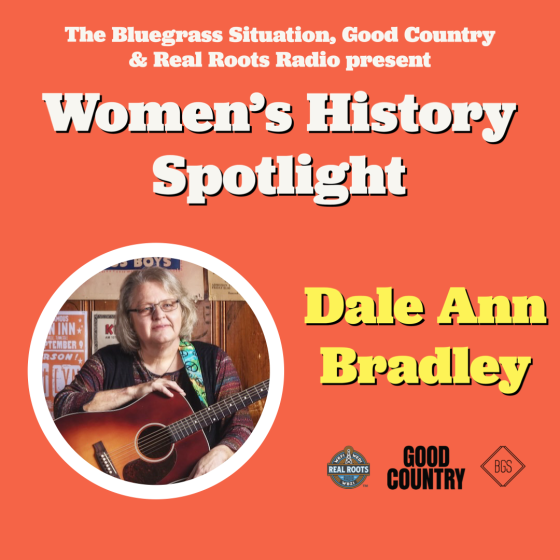
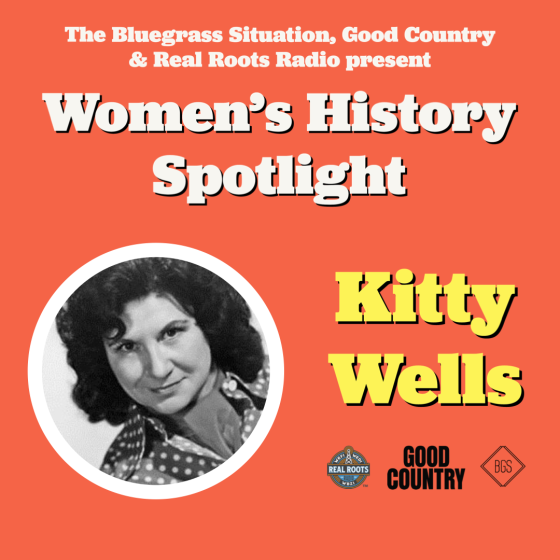
This week’s edition of our Women’s History Spotlight features musicians and artists like IBMA Award winner Dale Ann Bradley, the legendary Dolly Parton, Bluegrass Music Hall of Fame inductees Hazel Dickens & Alice Gerrard, early country hitmaker Kitty Wells, and Kentuckian-West Virginian Molly O’Day. Tune in next week for the final installment of our Women’s History Spotlight!
Dolly Parton
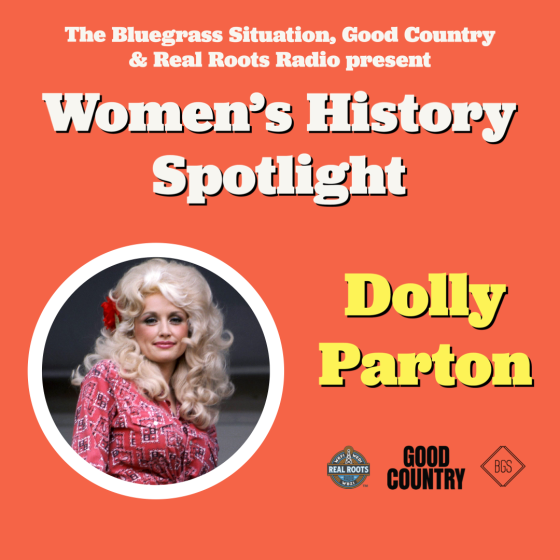
You knew it was coming. You can’t tell the story of country music (or American pop culture) without Dolly Parton. Growing up in Sevier County, Tennessee, she is not just the Queen of the Smoky Mountains, but quite possible the Queen of the Universe (if there was such a ridiculous title). Her rags-to-riches story will continue to be told and re-told for generations. Aside from her beautiful voice and philanthropic work (the millions of books that she gives to children through Dolly Parton’s Imagination Library is her proudest achievement), there are numerous other aspects about Dolly Parton that are remarkable.
Her business acumen is frequently praised, but it still bears repeating. Aside from her numerous endeavors (including Dollywood), it’s often worth remembering that she fought to regain control of her own career and decision-making from Porter Wagoner after her star began shining brighter than his scope of influence. (Remember, it was the ending of this business relationship that was the impetus behind Dolly writing one of her most famous songs, “I Will Always Love You.”) Call it a business decision or just genius, but Dolly’s ability to juggle embracing her role as an undeniable sex symbol and avoiding being labeled as “unwholesome” by conservative crowds has to be one of the most difficult tightrope walks in American entertainment.
Vanity Fair’s 1991 article “Good Golly, Miss Dolly“ did a deep dive into the dichotomy of Dolly’s role as a sort of clean sex symbol: “Dolly, in her openness, demystifies sex. ‘One of the things that makes the image work is that people understand that I look one way, but am another, that there’s a very real person underneath this artificial look,’ she theorizes. ‘It’s not like I am a joke. People can laugh at me, but they don’t make fun.’ … Indeed, Dolly Parton has become the billboard for sex without being the product itself.”
It is the way that she ensures that the “very real person” that is Dolly Rebecca Parton doesn’t get lost in the glitz, glamor, and boob jokes that is part of the reason why she is so endearing and universally beloved by folks from all walks of life; in a world where polarization is en vogue, Dolly is one of the few topics on which everyone agrees! She epitomizes the best of us.
Hazel Dickens & Alice Gerrard
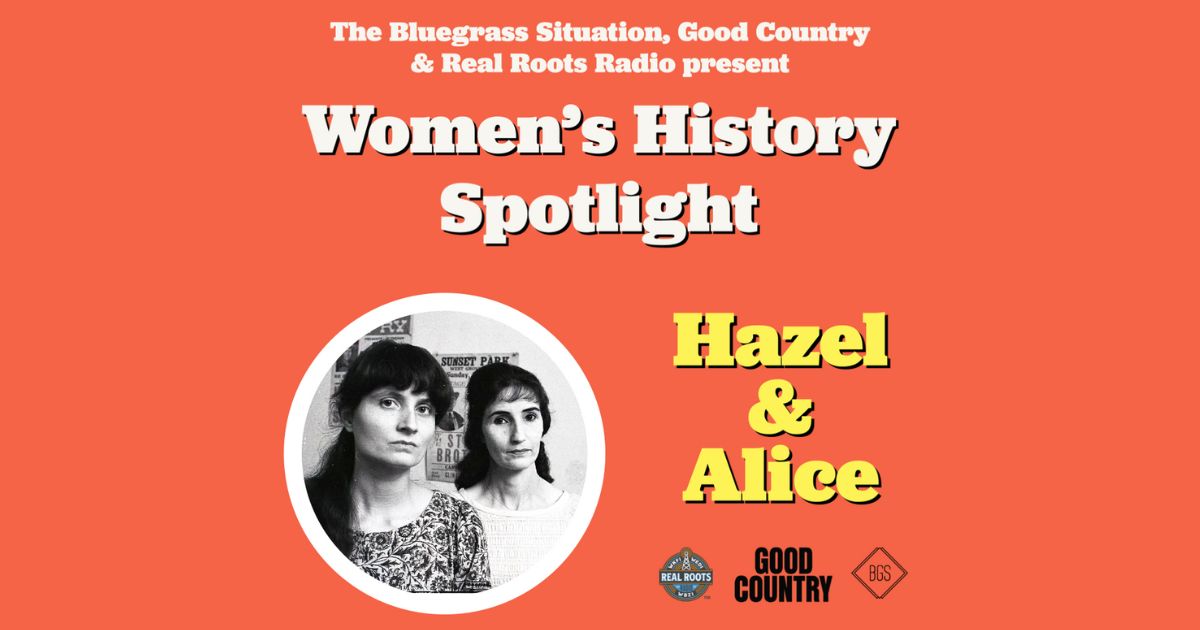
Members of the Bluegrass Music Hall of Fame, Hazel Dickens & Alice Gerrard were an unlikely pair who blasted down doors for women in bluegrass. Hazel hailed from the mountains of West Virginia, while Alice was from across the country in Seattle, Washington. Alice attended Antioch College in Yellow Springs, Ohio, where she was exposed to folk and bluegrass music. While a student there, she helped coordinate bringing The Osborne Brothers to the Antioch campus, making history as the first major bluegrass concert held on a college campus! After college, she wound up in the D.C. area, becoming active in their flourishing bluegrass scene, where she became friends and musical partners with Hazel Dickens – who had moved to the region with her family to find factory work years earlier.
Hazel & Alice became some of the first female bluegrass bandleaders and recorded some classic albums for Smithsonian Folkways and Rounder Records before embarking on successful solo careers by the mid-’70s. With Hazel’s mountain sound and Alice’s more folk-oriented sensibilities, their music appealed to both traditional bluegrass fans and those who were being introduced to the genre via the Folk Revival. Their original material which highlighted a woman’s perspective were critical in bringing a voice to women in the bluegrass canon. Decades later, their music and legacy is still rippling across American roots music, with artists as diverse as Rhiannon Giddens and Dudley Connell still celebrating their influence and impact.
Molly O’Day
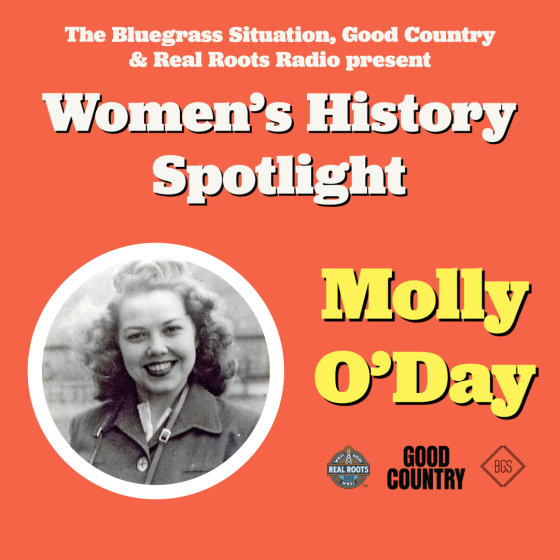
Born Lois LaVerne Williamson, country pioneer Molly O’Day was born in Pike County, Kentucky. She would become a popular radio star in West Virginia by the early 1940s, eventually leading Molly O’Day & The Cumberland Mountain Folks. Her band crossed paths with Hank Williams on the radio circuit and Molly even sang quite a few of his songs on radio and later in the recording studio. Molly learned “Tramp On The Street” from Hank Williams and it would land her a recording contract with Columbia Records. (Fun Fact: Her band at the time of her first Columbia recording session featured a young Mac Wiseman on bass!)
In an era when the term “hillbilly music” was still commonly used, Molly’s music, retroactively, could have country and bluegrass labels applied to it. Her powerful voice felt just as at home on an ancient balled like “Poor Ellen Smith” as it did on soul-stirring gospel songs like “Matthew 24.” By the early 1950s, Molly and her husband grew weary of life in the limelight and essentially retired from the music business, both dedicating their life to ministry. She would record a few gospel albums for some small record labels in the ensuing years, but her final album was released in 1960. She would pass away in the late 1980s, but she left a mark on country music and earned the respect of her peers at a time when the list of female country pioneers was relatively short.
Dale Ann Bradley
Revered as one of the most heartfelt bluegrass singers of her generation, this Kentucky songbird’s career started in earnest as a member of the Renfro Valley cast in her home state of Kentucky. The Renfro Valley Barn Dance was an extremely popular barn-dance style radio program in the 1930s and it spurred the creation of Renfro Valley as a country music entertainment destination in Kentucky. This helped kickstart the careers of folks like Steve Gulley, Jeff Parker, Dale Ann Bradley, and more by the 1990s.
While at Renfro Valley, Bradley would eventually join The New Coon Creek Girls, one of bluegrass’s only “all-girl” bands at the time, and aptly named after The Coon Creek Girls, a pioneering female string band of the 1930s who also started on The Renfro Valley Barn Dance.
Dale Ann’s soulful voice, largely influence by the Primitive Baptist tradition which she grew up around, quickly gripped the bluegrass world, leading to a successful solo career for the last three decades. In addition to recording songs that hearken to those familiar with mountain people and mountain ways, the appeal of Dale Ann’s voice has led her to adapt songs from outside of the genre to her style of bluegrass, tackling tunes from Tom Petty, Bobbie Gentry, The Grateful Dead, Jim Croce, and everyone in-between! Her diverse material has led me (and many others) to the conclusion that no matter the material, if Dale Ann is singing it, I already know I’m going to like it!
Kitty Wells
Hailed as the original Queen of Country Music, Kitty Wells hit a massive reset button on the role of women in country music after the massive success of her breakthrough hit, “It Wasn’t God Who Made Honky Tonk Angels.” Written by J.D. Miller, it was penned as the antithesis of Hank Thompson’s hit, “The Wild Side of Life.” After writing the song, the search began for a woman to sing it. Kitty Wells had pursued a country career, to little avail, and had essentially consented that maybe it wasn’t in the cards for her, when she was contacted to record the song. “It Wasn’t God Who Made Honky Tonk Angels” would become the first Number One hit by solo female in country music history, and its status as one of the most iconic country songs of all time only grows.
This explosion of success led to many other hit records by Kitty Wells, and opened the doors for those who would follow in her wake like Jean Shepard, Loretta Lynn, Dolly Parton and more! You can’t celebrate Women’s History Month without honoring the gal who famously sang the line, “It’s a shame that all the blame is on us women!” (Still kind of bummed that Margot Robbie didn’t sing that line in Barbie. Seems like a missed opportunity to me!)
As an added bonus, here’s another cool version from 1993, where Dolly Parton, Loretta Lynn, and Tammy Wynette recruited Kitty Wells to join them on a new version of this country classic on their collaborative album, appropriately entitled Honky Tonk Angels.
In country and roots music, authenticity is treated like the most valuable currency of all. Maybe that’s because the genre has always been caught between the fiction that this music is frozen in amber and the reality that it has always borrowed liberally from current musical trends in order to have commercial value. The earliest popular country music was an amalgamation of regional music from rural white artists, music stolen wholesale from Black and Indigenous artists, and plenty of nods to prevailing pop (i.e., urban or non-rural) trends – looking back at the places young laborers and listeners that had been drawn to cities came from, and the exciting present and future they found themselves in once they arrived.
Can anyone or anything truly be considered “authentic” in America, a country whose identity is built on masking fundamental historical truths?
While artists like Zach Bryan are hailed for their “authenticity,” the vast majority of the current class of mainstream country and Americana artists grew up in suburbs, in postmodern America, in the internet age, and are graduates of major colleges – like Nashville’s Belmont University or Boston’s Berklee College of Music. Their experiences are also authentic, of course, to each individual artist – just as Bryan’s initial motel room demos are electrifying for the soul he brought to them. But these origins bring up questions around how country and Americana construct “authentic” narratives, especially to market roots music.
Still, it’s noticeable that certain types of creators are automatically considered “authentic” country artists – and they often match the complexion of the first generations of country singers, when “race records” and “hillbilly music” were originally split and whose most famous individuals wore cowboy cosplay on stage.
We want to tip you off to some real Good Country music: Music that portrays life in its complexity and a deep appreciation for one’s roots, whether they lie in the Bronx, rural Arkansas, or anywhere else on this rich blue marble we live on. Because authenticity in country doesn’t necessarily equate to rurality, to back roads and red dirt and farm trucks; real country music is real not because it’s built to be “authentic,” but because it’s honest.
Hurray For the Riff Raff
Hurray For the Riff Raff’s Alynda Segarra is from a little bit of everywhere, but the Bronx is where they grew up and the punk houses of the Lower East Side raised them. Between their jazz artist father and picking up a guitar as they rode the rails, Segarra’s approach to folk music began with a traditional bent and has since exhaled into an expansive approach, as with their astonishing 2022 album Life on Earth. Their upcoming album The Past Is Still Alive finds Segarra focusing more on twang, but their philosophical core has always remained the same: breathing life into unspoken pain and empowering people that society would like us to forget.
Amythyst Kiah
Amythyst Kiah’s music is a powerful force. Inspired by the blues and old time music, Kiah uses her art to prop the furnace doors open to make way for blasts of grief and abandonment. Kiah grew up in Chattanooga, Tennessee and picked up the guitar while attending an arts magnet school. She fell in love with old time music at East Tennessee State University and never looked back.
I first saw Kiah in 2016 at Karen Pittelman’s Queer Country Quarterly, her first show in NYC. Karen introduced her by remarking, “trust me, she’s going to be famous.” When Kiah belted her powerful alto, we all knew we were in the midst of greatness. Kiah’s most recent work on Wary + Strange (2021) takes us in a more experimental direction, but her exploration of alienation – like a toy in her hands – informs her music no matter what she’s plugging into her pedalboard. Kiah’s “Black Myself,” originally recorded with supergroup Our Native Daughters, fiercely proclaims her love for herself and her ancestors.
Willi Carlisle
Willi Carlisle has seen a thing or two in his travels across the lower 48. Carlisle cut his teeth musically in DIY and punk rock, but his search for queer role models and love for poetry drew him to New York City. With disgust for the elitism of the poetry scene there – and their mockery of his roots in the Midwest – Carlisle went searching for a life of words in folk music.
Carlisle has a knack for painting complex portraits of down-and-out characters, refusing to be drawn into simple narratives of left and right, red and blue. His stunning “When the Pills Wear Off” from the upcoming Critterland demonstrates Carlisle’s ability to turn the personal into the political – and back into the personal again. This is not the blind invective of JD Vance, but the realization that only empathy can build bridges between people who think they have nothing in common.
ISMAY (née Avery Hellman) has spent their whole life around folk and bluegrass music – their grandfather is one of the founders of the Hardly Strictly Bluegrass festival. As a contestant on Apple TV+’s short-lived My Kind of Country competition series, ISMAY is very much a representative of roots music’s vanguard. With their sparse arrangements and winsome vocals, ISMAY’s music feels like deconstructed folk music. They understand the core elements of the sound thanks to a lifetime immersed in it, and they create something wholly unique from its constituent parts, as we hear on “Point Reyes.” There, ISMAY’s contemplative vocals are orbited by a gauzy cloud of pedal steel and gentle finger-picking. ISMAY’s upcoming album Desert Pavement speaks to their sense of place: all of their music is enamored by nature. “Golden Palomino” illustrates ISMAY’s love for their rural California upbringing, guiding us to realize how much our natural and inner worlds inform each other.
Buffalo Nichols
You’d be hard-pressed to find a more devastating songwriter or guitar player than Buffalo Nichols. Nichols, like many teenagers before him, picked up a guitar and played his way through the hip-hop and hardcore scenes in his Milwaukee hometown. He found himself drawn to blues music as he began to dig into his mother’s collection and connect with Cream City’s West African community. Nichols and musical partner Joanna Rose made a mark on the Americana scene with their duo Nickel and Rose, shining a harsh light on the ignorance on full display in the community’s supposedly liberal refuge on the song “Americana.”
With his most recent solo album The Fatalist, Nichols brings all of his experience to bear on a remarkable collection of songs that combine elements of all of his musical loves. On his rendition of the classic “You’re Gonna Need Somebody On Your Bond,” Nichols’ guitar becomes an extension of his own body with lightning-fast licks. Buttressed by electronic drum samples and a haze of synths, Nichols shows that music is at its most vital when it is rooted in the past and embraces the future.
Ally Free
Ally Free is one to keep your eye on in 2024. They write in their bio that they see music as the universal language that can bring people together, and that’s clear on their versatile 2019 album Rise. From the nu metal-inspired chugging of “Fool’s Gold” to the craftsman’s approach to “Fast Train,” Free isn’t embarrassed to draw from any inspiration to make a damn good song. Free’s rich alto gives their music depth: from their performances, it’s clear that this is someone who has lived a lot of life. Free is one of the newest members of the Black Opry and has taken a few steps out of their Huntsville, AL hometown to playing more shows around Nashville. Here’s hoping that means the rest of us get to hear more from this remarkable performer soon.
William Prince
William Prince’s voice carries a warm, earthy timbre that is wholly unique. Prince grew up on Peguis First Nation (in what is now Canada) and is well-versed in the travails of people living under oppression. But that experience is translated into patience and warmth, a gentle perseverance that can only come from a keen observer. Prince’s stark breakout album Reliever (2020) has given way to the warm Stand in the Joy (2023), which details the travails and victories we most often find in daily life. “Tanqueray” is a gorgeous example of Prince’s dynamic, a story of two improbable lovers finally coming together to make it work.
Sabine McCalla
Sabine McCalla is readying for a breakout 2024. McCalla’s music is steeped in the sounds of New Orleans, which she has made her home. McCalla has performed with others, but her performance on Offbeat Magazine’s OnBeat Session from September 2023 shows us she’s ready to step out on her own. For now, we have her 2018 EP Folk, which sports arresting songs that feel timeless. Maybe it’s the gentle groove in her music that feels like the stately flow of the Mississippi River – discordant with the immediacy of her lyrics that protest violence and oppression, as demonstrated by “I Went to the Levee.”
Margo Cilker
Look – Margo Cilker is literally a cowboy, okay?? Isn’t that what you imagine when someone mentions “country music” and “authenticity” in the same breath? But Cilker’s music glorifies a life of searching, not a mythologized America of white picket fences, so you can also picture the quintessential Nashville executive saying, “We like cowboys, but no, not like that.”
Cilker’s latest album, critical darling Valley of Heart’s Delight, is nostalgic for her family orchard in California’s Santa Clara Valley – but not without a heavy dose of reality. “Mother Told Her Mother Told Me” caution the listener not to become too attached to any one place – and the cost of leaving it behind. Cilker’s impassioned “With The Middle” cuts to the core of her work – a weighing of the contrasts between pleasure and pain and yearning to find common ground between the two.
Brittany Howard
Brittany Howard transcends pretty much everything – except the act of exploration with wild abandon. Having gained notoriety as the lead singer of the retro soul band the Alabama Shakes, Howard seemingly will not rest until she’s drawn with every musical crayon in the box. In her recent interview with NPR’s Jewly Hight, Howard cracks that she grew up in a trailer and would still be perfectly content to be working the land somewhere. But her music has led her elsewhere, perhaps everywhere. Howard has teased a few songs off her upcoming album, What Now, with the title track featuring hooky grooves and propulsive energy, but it’s “Red Flags” that astounds with its jarring drum loop, woozy vocals, and disorienting production that demonstrates how much mastery Howard has gained in her craft as an artist and storyteller.
Samantha Crain
Few artists in the last decade have shown the same growth and versatility as Samantha Crain. A part of the rich Tulsa music scene that has given us John Moreland, John Calvin Abney, and M Lockwood Porter, Crain follows a road all her own. Under Branch & Thorn & Tree (2015) found Crain exploring the pride and trauma of her Choctaw heritage through folk-inspired music. In 2017, Crain broke her own mold with the quirky indie-pop album You Had Me at Goodbye (2017.) Since her 2020 album, A Small Death, Crain has been playing in the spaces in between, utilizing woodwinds, pedal steel, pianos, and guitar to create a woozy soundscape as her spacious, gravelly voice helps us stay anchored in the real.
Nick Shoulders
Nick Shoulders rounds up the list with his commanding All Bad. While Shoulders’ music leans traditional sonically, it’s anything but. The Fayetteville, Arkansas singer begins his album with phaser blasts and a menacing invitation to a “conversation,” and that conversation is explicitly about all the “country” stylings that deserve to be thrown in the trash heap – and the many, many qualities we need to hold on to and claim for ourselves: grit, honesty, love, and togetherness. “Won’t Fence Us In” and “Appreciate’cha” speak to this theme most clearly, but the way Shoulders approaches the classic country canon with loving irreverence reminds us that we never have to be weighed down by tradition.
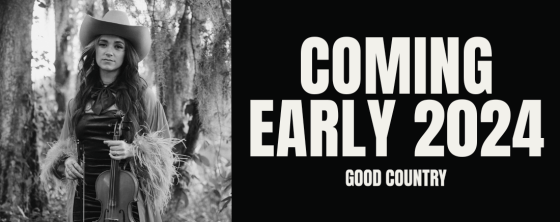
BGS is proud to announce the launch of a new brand in 2024: GOOD COUNTRY. By this point, you may have seen or heard mentions of Good Country on our site, at our events, and on our socials feeds as we prepare this exciting new expansion for our readers and fans.
Launching in mid-January 2024, Good Country is a curated, bespoke email newsletter that will highlight all good country from across the roots music landscape. Every other week, GC will deliver high-end country music reporting, long reads, playlists, videos, and exclusive content from your favorite country artists direct to your email inbox. As you scroll, you’ll dive into the deep and broad world of Good Country, from gritty and raw Americana to glitzy and glamorous radio hits, from bluegrass supergroups to southern rock ensembles and swampy string bands. Sign up for Good Country now.
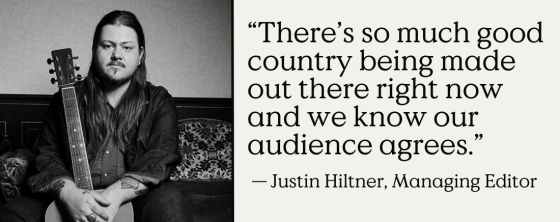
“Good Country is a brand new horizon for BGS,” says managing editor Justin Hiltner. “But, at the same time, it’s nothing more than a reinforcement of our values as a media company and roots music community. Country – like its family members bluegrass, folk, and Americana – is more than just music, it’s a lifestyle, an identity, a way of being. There’s so much good country being made out there right now and we know our audience agrees. Whatever ‘good country’ means, you’ll know it when you hear it. And you’ll hear plenty of it in this newsletter!”
Each issue of Good Country will center features, think pieces, and interviews penned by the best writers and thinkers in country music highlighting not just the biggest names in the genre, but new and upstart artists as well. Exclusive newsletter content will live alongside deep dive playlists, sonic explorations, and thoughtful examinations of what country is, who makes it, and to whom it can belong – everyone.
BGS co-founder, actor, activist, and musician Ed Helms, will be featured in each issue as well with “Ed’s Picks,” artists and bands selected by Helms himself, direct from his own listening.
“From the very beginning, BGS was forged on a foundation of celebrating the full spectrum of roots music fans and artists,” explains BGS co-founder Amy Reitnouer Jacobs. “This community has never been one thing, nor has it been static. It’s a diverse, expansive, and ever-changing art form. The same can and should be said for country music. And that’s why now is the perfect time to create a more representative media landscape. It’s time for Good Country.”
Good Country’s first issues will feature music, art, and content featuring Zach Bryan, Sierra Ferrell, Amanda Fields, Veronique Medrano, Shania Twain, Chris Stapleton, Vincent Neil Emerson, Brittney Spencer, and so many more. No matter your entry point to this music, with our new brand and newsletter you will find endless Good Country to enjoy. Interact with content in your email inbox, on our website, and on our social media – wherever you are, Good Country will meet you there.
Good Country isn’t about deciding what is or isn’t good country music. Good Country is a place. It’s a way of looking at the world, a way of enjoying music. If you think it’s good and you think it’s country, then you’ve found Good Country.
What is Good Country? A great question, to be sure. It’s a new brand coming from BGS in 2024 that will feature all good country. A bi-weekly email newsletter that’s curated and one-of-a-kind, Good Country will feature long reads, playlists, videos, interviews, and more all highlighting the best of country music from across the roots music landscape.
But what is good country? A much more nebulous question! As one wise social media commenter put it, “You’ll believe it when you hear it.” We posed the “What is good country?” question to our BGS contributors and the year-end list they’ve put together is striking in its depth, breadth, inclusion – and it’s full of good country, certainly. From Tanner Adell’s boundary-pushing, pop-inflected country trap to Dean Johnson’s retro, genuine sounds; from Jelly Roll to Kara Jackson, “Fast Car” to “Lavender Country,” good country has been all around us all year.
Whatever good country is to you, we hope you’ll find plenty of it below, within our list of country favorites from across 2023. And, we hope these albums, songs, and performances whet your appetite for plenty more Good Country, coming from BGS in early 2024. Sign up now to be one of the first to enjoy our upcoming newsletter, direct to your email inbox.
Tanner Adell, Buckle Bunny Before we forget, “Old Town Road” was not only a novelty, but a masterpiece of a country song, and a reminder that the South has always been a vulgar mix – the more vulgar, the more forward-thinking, and the more complexly, political. In a rejoinder to stupid, butch truck songs – and a specific “fuck you” to people like Aldean – Adell’s Buckle Bunny is filled with all kinds of specific geographic detail (see the chorus to “Bake It,” which goes: “Brown sugar caramel/ Ding ding Patti LaBelle/ Sweet potato pussy pie/…”) in service of sexual and political liberation.
On the highlight of the album, “FU 150,” she owns the truck, the means of production, and any man who trifles with either her or her truck. This has been a year of ambivalent women pushing against dumb men (See Pillbox Patti, Elle King, Tigirlily Gold, Kelsea Ballerini, Hannah Dasher, etc.), but this might be the best time I had listening to music this year, and considering how much we had to endure, can’t we have a little bit of fun? – Steacy Easton
“Fast Car” – Luke Combs, via Tracy Chapman It’s painfully obvious how long overdue it is for Tracy Chapman to be recognized, in this way, as a pivotal American songwriter – plus, the absurdity of her being the first Black person ever to win CMA’s Song of the Year. Still, it’s worth celebrating just how great it is to hear “Fast Car” on the radio again, and for a whole new legion of fans to discover it. – Amy Reitnouer Jacobs
Sierra Ferrell, “Fox Hunt” and “The Garden” We would be remiss if we failed to include the astoundingly radiant Sierra Ferrell from our inaugural year-end round-up for Good Country. From her baffling multi-instrumentalism to her gilded attire to the floral ornamentation of her microphone, Ferrell has captivated the hearts of troves of roots music fans across the globe. Most recently, she graced us with her single, “Fox Hunt,” and “The Garden,” an original song recorded for the soundtrack of The Hunger Games: The Ballad Of Songbirds & Snakes.
Each release is enchanting in its own right; “Fox Hunt” corrals listeners to the dance floor with its sturdy backbeat and fiery fiddles, while “The Garden” delivers a gorgeous, melancholic waltz full of gentle mourning and fertile metaphor. Ferrell’s capacity to encapsulate such a wide range of emotions through the many textures and tonalities of her talent casts her as a superlative country artist of this day and age. We anticipate, with great impatience, the release of her next album, due to arrive sometime in early 2024. – Oriana Mack
Amanda Fields, What, When and Without Whether singing with a hard-driving bluegrass band (like 2019’s “Brandywine”), or atop a pedal steel and gut-strung upright bass, Amanda Fields’ voice cuts right through the mix to deliver thoughtful and resonating lyrics. This is the case on What, When and Without, Fields’ first full-length album, and her first project in the country music realm. Produced by Megan McCormick, the album is a master class in taste, musical restraint, and great singing and songwriting. Fields’ Appalachian-inflected vocal, rested on this sonic foundation, says good country about as clearly as it can. You’re going to want to put on headphones for this one! – Thomas Cassell
Paisley Fields at The Knitting Factory, October 15 What is obvious is that Paisley Fields is an important songwriter and a frontperson of immense talent. What only became clear to me at the Knitting Factory’s new Baker Falls, New York City location on October 15th is that Paisley is also an angel. It might have been the reflection of stage lights on sequin, or the fiery righteousness of blues-rocker “Burn This Statehouse Down” (a Mya Byrne co-write), but I left the show convinced of their divine purpose as a prophet of cosmic country. During the encore, I joined the band on stage for an impromptu tribute to our dear departed auntie Patrick Haggerty and forgot all the words to “Lavender Country,” but the whole room sang, “Y’all come out, come out” until I remembered. – Lizzie No
Kara Jackson, Why Does the Earth Give Us People to Love? You might find Kara Jackson’s manner frank and plain-spoken. That’s a trap. Yes, the young Chicago-raised singer, songwriter, and poet (she was the US Youth Poet Laureate for 2019-20) puts much on the surface, but it’s slippery, shifting ground. It’s right there in the title of her first full album, Why Does the Earth Give Us People to Love?, a question with no answer. She contemplates such things as if on a walk in the park – wandering, meandering. The genre-defiant music, crafted with collaborators Kaina Castillo, Sen Orimoto, and Nnamdi Ogbonnaya, meanders with her, ducking down shadowy side paths, hiding behind trees, dancing in light shimmering through leaves – a short banjo coda here, a swelling choir there. And still questions with no answers, this love and life stuff. In the title song and spiritual center, she laments a friend’s death: “Why does the earth give us people to love, then give them a sickness that kills?” It’s a trap, but it’s going to be fascinating to watch this exceptional artist try to sort it out. – Steve Hochman
Jelly Roll, CMA’s New Artist of the Year My favorite country artist of the year was Jason DeFord, better known as Jelly Roll. He enjoyed a monster year both commercially and industry wide, winning 2023 CMA New Artist of the Year honors and topping all male country vocalists overall with five nominations. He also earned three CMT Music Awards, with his powerhouse anthem “Son Of A Sinner” – in my view a more explosive and dynamic tune than “Need A Favor.” His performance of the latter with Wynonna Judd and “Love Can Build A Bridge” with K. Michelle during the CMA Awards broadcast were among the program’s highlights, as well as being emblematic of his performing charisma and adaptability. But the documentary, Jelly Roll: Save Me (available on Hulu), documented his troubled teen past and redemption from incarceration and addiction, as well as the many current philanthropic activities that’s seen him use his stardom to aid and inspire others. It represents Jelly Roll’s larger societal impact beyond the music world. He’s also combined a love for classic country, as well as folk and even hip-hop, into a distinctive, identifiable and magnetic sound that made his 44+ city Backroad Baptism Tour one of the year’s best. – Ron Wynn
Dean Johnson, Nothing for Me, Please Some of us release music relentlessly from a young age and have to get comfortable with the public watching us learn and grow on the job. Others, such as Seattle’s Dean Johnson, wait until they are fifty to release a debut album and then absolutely knock it out of the park from song one. When a friend sent me “Shouldn’t Say Mine,” I assumed it was from a ‘60s era country artist that everyone else knew about but that I had somehow missed. Wouldn’t you know, it’s from Dean Johnson’s Nothing for Me, Please, released this very year on Mama Bird Records. Mama Bird releases some of the best West Coast roots music, including other favorites of mine, like Anna Tivel and Courtney Marie Andrews, and this new release by Johnson will be making waves for years to come. – Rachel Baiman
Brennen Leigh, Ain’t Through Honky Tonkin’ Yet You know what? Thank goodness Brennen Leigh ain’t through honky tonkin’ yet, someone needs to keep the neon lights burning and the juke box bumpin’ – and we’re glad that someone is Leigh. An album for the lonesome boot scooters, for the belt buckles longing for another to rub up against, Leigh’s prowess as a country alchemist is on fully display, combining sounds from the Midwestern plains, east and central Texas, and Nashville’s lower Broadway refracted through East Nashville and Madison. It’s old country, “real” country, alt country, outlaw country, and more, but most importantly it’s honest, true – and it’s danceable. What’s more traditional than country music that’ll draw tears and flat-footing? The cherry on top of all of it is the picking – you can hear the influence of Leigh’s bluegrass upbringing in every track, like Skaggs in his radio hits heyday or Vince Gill’s bluegrass tinged albums. – Justin Hiltner
Ruby Leighon The Voice 16-year-old Foley, Missouri native Ruby Leigh moved both Reba McEntire and Gwen Stefani to tears on her first live show appearance on The Voice, when she performed a version of McEntire’s own “You Lie,” from the Voice coach’s 1990 album Rumor Has It. Leigh’s vocals are strong and beautiful, and slightly more developed since her September audition for the show. Then, she performed Patsy Montana’s Country & Western classic, “I Want Be a Cowboy’s Sweetheart,” and got all four judges to turn their chairs – The Voice’s equivalent of a unanimous vote.
The crowds seem to love Leigh as much as the celebrity coaches do. In that clip, with Leigh decked out in red and black Western wear, audience members held up red hair signs to indicate that Leigh should pick McEntire as her coach, which she astutely did. Since her television debut, Leigh has racked up thousands of followers and hundreds of supportive comments on Facebook and other social media platforms — all while performing a super classic repertoire and sound. She even yodels! It’s hard not to love Leigh’s moxy, and it’s just as exciting to see people getting thrilled about country music again. Here’s hoping Leigh continues a winning streak on The Voice, and helps folks see what made this genre so good in the first place. – Lonnie Lee Hood
Mipso, Book of Fools Mipso has never been entirely bluegrass so much as bluegrass-adjacent, and the North Carolina quartet’s sixth album finds them farther from conventional roots music than ever. But it’s in service to an artistic identity all their own, with lush pop tones and minor-key vibes predominating. As always, Mipso’s most recognizable sonic signature is the dual lead-vocal approach between Libby Rodenbough’s atmospheric dreaminess and Joseph Terrell’s plainspoken drawl. When they come together to harmonize on “Carolina Rolling By,” it’s truly heavenly. The true leap forward on Book of Fools, however, is Terrell’s guitar, which is every bit up to the standards of the singing. It’s jittery and angular on “Radio Hell,” moody on “I Wait For Your Call,” and jagged enough on “Broken Heart/Open Heart” to live up to a title like that. – David Menconi
Lizzie No, “The Heartbreak Store” Lizzie No’s “The Heartbreak Store” isn’t just a catchy country tune, it’s a lifeline for the heartbroken. Inspired by a transformative tour with queer country trailblazer Patrick Haggerty, the video embodies a message of belonging and acceptance through line dancing. Country music often overlooks queer voices, however Lizzie’s anthem becomes a resonant declaration, echoing the ethos of unity and visibility. With every note, it stitches a musical tapestry of compassion, offering solace and celebration for those who’ve felt the pain of heartbreak, yet hope of community. In under three minutes, it becomes a powerful testament to resilience and love. – Cindy Howes
Jobi Riccio, Whiplash We’re at last reaching a point where queer creators in roots music are being enabled to offer their identities not as the sole complication or subversion of country norms in their music, but as just one of many inputs that wrinkle and challenge ideas of what country is and to whom it can belong. Singer-songwriter Jobi Riccio has had a breakneck year, with seemingly endless momentum piling up behind her stellar debut, Whiplash. Where the first press releases and official narratives around the album centered a “rainbow cowgirl” story, as critical mass continued to grow behind this set of songs, one could sense Riccio intentionally carving out space for their agency among that momentum. Carefully and deliberately, Riccio has re-centered focus away from reductive “rainbow cowgirl” constructions and toward what matters most: The music.
The music is certainly what deserves the focus, with queerness infused throughout, as if just one of Riccio’s own claims to the “outlaw” movement or as a purposeful snare for normative country expectations. Because these songs are straight-ahead good country – there’s a touch of kd lang’s approach, or the Chicks’, or Indigo Girls’ – Riccio’s identity is still indelible, it shines on every single track. It needs no artificial spotlight, or to be considered monolithic. As they discuss class, image, consumption, heartbreak, restlessness, and so much more, queerness is just one of the many entrancing, complicated threads begging to be pulled as you canter along with Whiplash. – Justin Hiltner
Jordyn Shellhart, Primrose Those who enjoy the confessional aspects of country music – but crave an unexpected sound and some humanistic insight – should check out Jordyn Shellhart. An emerging singer-songwriter who released Primrose, her album debut in 2023, she stands boldly apart for a singular voice and crystalline roots-pop style, with equally-exceptional lyrics. Whether breezily defying a cultural convention, delivering a mic-drop romantic kiss-off, rhetorically destroying the clueless cruelty of a teenage boy or dissecting her own mental wellness (or lack thereof), her songs are filled with nuance and sharp, straight-to-the-bone hooks, twisting and contorting along the often irregular path of real life. With the power to make a crowd of jaded journos cry, but very little exposure, she’s almost criminally under-appreciated – although we could fix that. – Chris Parton
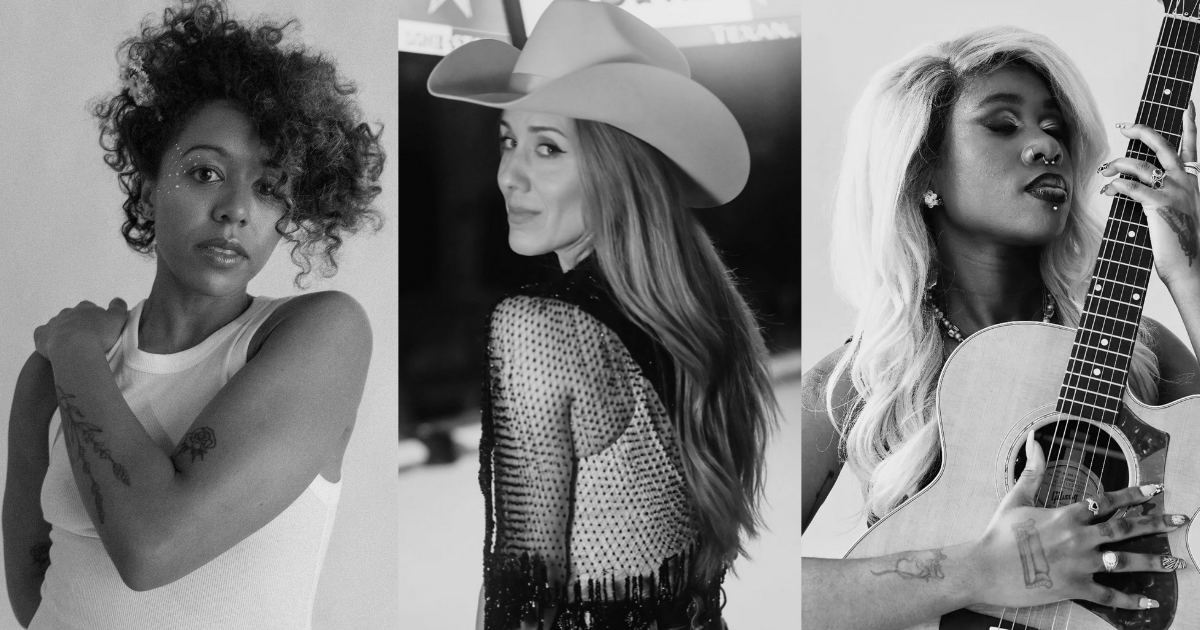
Photo Credit: Lizzie No by Cole Nielsen; Brennen Leigh by Brooke Cooper; Kara Jackson by Lawrence Agyei.
I was born into a music-centered family in small town Arkansas near “where the Delta meets the Ozarks.” My grandparents started a music store on the court square in the 1960s and they sold instruments and equipment, et al. – and also carried the top records of the day. So, music and musicians were infused into my life from birth and my family was at the center of a vibrant musical community.
At every holiday or birthday or community event, we played music together and sang with a cast of characters ranging from the local church organist to Sun Records session players. I thought every family was like that, but as I’ve grown older and a lot of those characters have passed on, I’ve realized how rare my upbringing was and I cherish it with all my heart.
I remember the voices and the sounds of the jams like it was yesterday, and I’m honored to make a playlist of some of the favorites we played and sang together. I didn’t discover a lot of the recordings of these songs until much later in my life because we played them by rote – or sheet music – at those beautiful, heavenly hoe-downs. These songs are the soundtrack of my early life. I’m honored to share them. – Bonnie Montgomery
(Editor’s Note: Scroll to find the full Mixtape playlist below, to enjoy while you read.)
“Precious Memories” – Merle Haggard & The Strangers featuring the Carter Family
I chose Merle Haggard and the Carter Family’s version of this hymn, because it’s the closest version to what I remember our hoe-down version sounding like. My grandfather Ivan would always request this song and all the old-timers would sing with such passion, and even tears. I remember the far away look in their tear-filled eyes when they sang it, and although I never felt it like they did back then, I loved the song. We always thought it was a funny selection too, because they would always sing it “pray – shush mam -ries” over and over, which made us laugh. But now that those faces are all passed and gone across the great divide, I feel it like my grandfather used to. Now, just like them, all I have is the memories. Sacred, precious, treasured memories gathered around the piano in my grandparent’s music room – in what feels like a lifetime ago.
“Your Cheatin’ Heart” – Hank Williams Sr.
I didn’t hear the recorded Hank Williams version of this until my late teen years, but we sang it as the grand finale of the Christmas Eve hoe-down every year. After hours of singing the entire catalogue of Christmas carols and standards, my grandfather would sing this one with the most volume and gusto of them all. My mother, or our dear family friend Teddy Reidel, would play a romping walking bass line on the piano with it. So when I went Christmas caroling with friends at age 11, I was ready for the big grand finale and started in on “Your Cheatin’ Heart,” but none of my friends knew it! It was then that I realized “Your Cheatin’ Heart” in fact wasn’t a Christmas carol!
“Born to Lose” – Ted Daffin
My grandfather always requested this song when I was playing piano, whether at the jam sessions or after school, when I would be practicing piano at their house. I never understood it, because the lyrics were so depressing and I wondered why anyone in their right mind would want to profess to being such a huge loser, ha! I remember practicing my classical pieces (I rebelled in the ultimate way by falling in love with classical music at a young age) and Papaw would holler “quit playing that long hair music and play ‘Born to Lose.'” By “long hair,” he meant classical, as in Handel or Beethoven’s long hair. I still laugh about that – instead of long haired hippies, he was talking about the wild artists from centuries ago.
“Sentimental Journey” – Doris Day, Les Brown & His Orchestra
This was my grandparents’ song. They would request this one and dance together every time we played it. During the Great Depression, my grandfather left Arkansas and went to California to look for work. Once he was there, he sent for my grandmother Frances and when she was out there, they got married. They both missed home terribly, so around 1943, when they finally arranged to go back, they had to go separately because of money. My grandmother was expecting their first child by then and had to ride all the way home from California to Arkansas in the back of pickup truck. She always called it her sentimental journey and you could just see the love between them every time we played this one.
“Tennessee Waltz” – Connie Francis
This was another favorite at the hoe-downs. I must have played it a million times while everybody danced and sang. And other times, when we were just hanging out at home, my grandmother would sit in a chair near the piano and ask me to play this one. She would have such a huge smile on her face and she just seemed to melt into the song. I’m so grateful for her encouragement with my musical endeavors.
“Sweet Dreams” – Patsy Cline
This was another of my grandmother Frances’ favorites. She was a fashion-forward, tall, beautiful red-head, full of life and fire. For small town Arkansas she was way ahead of her time. She started her own businesses (the music store was her main project) and ran for mayor in the ’60s too. She adored Patsy Cline and always thought she was so classy compared to the other female country singers of her time. We didn’t jam on this song, but we listened to the recording at full volume. The string arrangements from those Patsy songs have a huge influence on my string arrangements (arranged and played by maestro Geoffrey Robson) in the studio.
“Goin Down the Road Feelin’ Bad” – Woody Guthrie
My grandfather used to take us to his farm in Garner, Arkansas almost every morning in the summer. It was pure heaven for us as children – we could run wild and do whatever we wanted, ride horses, swing on the barn swing, go fishing, drive old cars and tractors around the farm, eat turnips straight out of the ground when we got hungry, crawl around with the pigs in the pig pen, and much more. We would sing in the truck with him all the way to the farm and he loved to sing this song and make up new verses such as, “I’m goin’ where the boys don’t blow their nose…”
That farm lives in my memory every single day – and incidentally, the highway it’s on (old highway 367), got named the “Rock and Roll Highway,” because it’s the road all the Sun Records artists would drive from Memphis to Helena back in the day. I didn’t know that when I was young, but it makes sense that Johnny Cash, June Carter, Elvis, Roy Orbison, Carl Perkins, etc. knew that road well.
“The Strawberry Roan” – Sons of the Pioneers
My grandfather on my father’s side, a wild cattle auctioneer named Leon Montgomery, used to drink his whiskey and burst in the door with his cowboy hat and a grin and croon out “Oh, That Strawberry Roan” as a greeting.
“Gonna Burn Some Bridges” – Ray Price
Ray Price was another familiar voice in the musical landscape of my childhood and is pretty much the ultimate crooner in my opinion. I’m including this tune because it’s direct inspiration for a song on our new album.
“I Was Fine” – Bonnie Montgomery
I’m including one of the songs off my new album, because it was inspired by the music of my childhood and, in particular, the music of Ray Price. My bandmate and engineer, Kevin, came up with a steel guitar riff that’s a direct nod to the steel guitar riff on Price’s “Gonna Burn Some Bridges.” We recorded this one with vibraphone and full string orchestra and I sang my heart out for Ray.
Photo Credit: Jamie Lacombe
This website uses cookies to improve your experience. We'll assume you're ok with this, but you can opt-out if you wish.AcceptRejectRead More
Privacy & Cookies Policy
Privacy Overview
This website uses cookies to improve your experience while you navigate through the website. Out of these, the cookies that are categorized as necessary are stored on your browser as they are essential for the working of basic functionalities of the website. We also use third-party cookies that help us analyze and understand how you use this website. These cookies will be stored in your browser only with your consent. You also have the option to opt-out of these cookies. But opting out of some of these cookies may affect your browsing experience.
Necessary cookies are absolutely essential for the website to function properly. This category only includes cookies that ensures basic functionalities and security features of the website. These cookies do not store any personal information.
Any cookies that may not be particularly necessary for the website to function and is used specifically to collect user personal data via analytics, ads, other embedded contents are termed as non-necessary cookies. It is mandatory to procure user consent prior to running these cookies on your website.