Crying in Music: Darrell Scott’s Honest Artistry

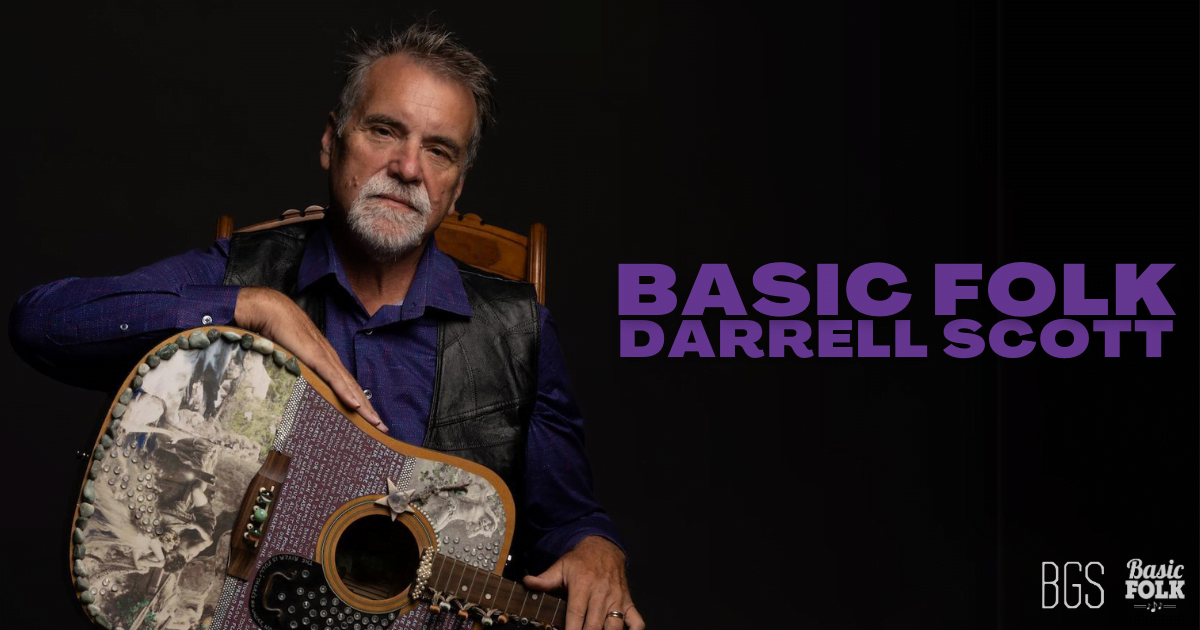
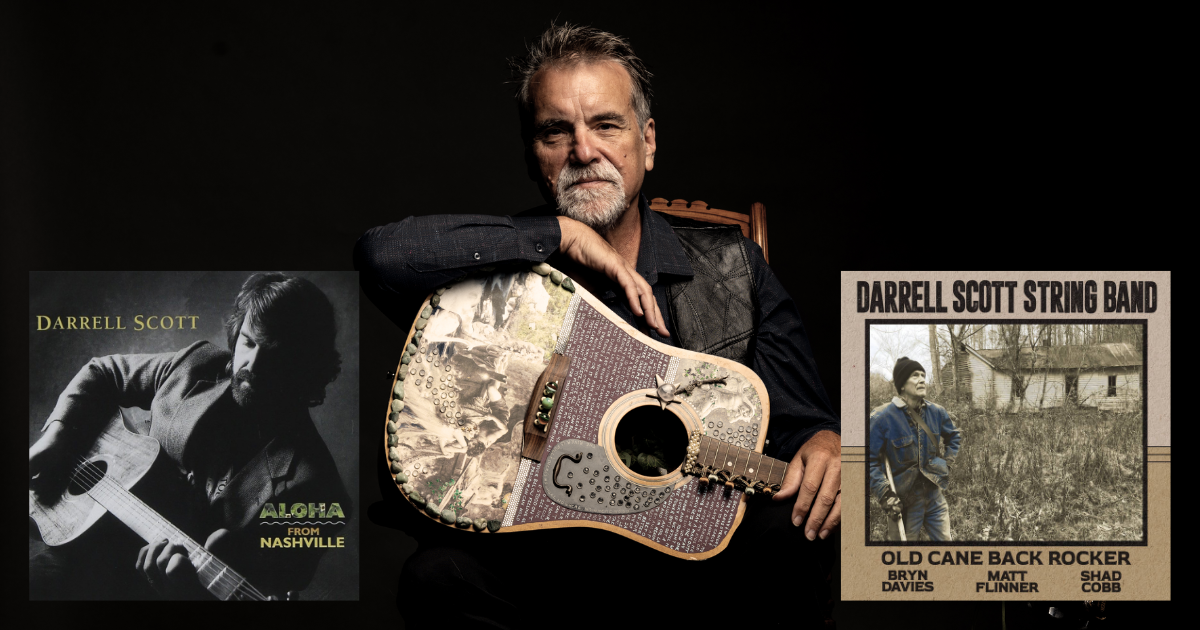
The cover of Darrell Scott’s latest album, Old Cane Back Rocker, immediately sets the tone for your listening experience. The inclusion of the names of the Darrell Scott String Band (Bryn Davies, Matt Flinner, and Shad Cobb) lets you know right off the bat that this recording is a band effort. The photo on the album cover gives a visual of Scott’s family roots in rural Kentucky. His cousin Dwight Messer is standing in front of his former childhood home, now abandoned on the family land. The music reflects his family’s story: some, like Dwight, stayed behind and some, like Darrell’s father, Wayne Scott, moved up North to find work. Despite being raised in the North, Darrell’s home has always felt like Kentucky and the traditional music learned from there. These songs showcase those roots.

LISTEN: APPLE • SPOTIFY • STITCHERAMAZON • MP3

In our conversation, Darrell digs into the darkness that can be heard in his music, even if it’s not a sad song. He talks about his friend and frequent collaborator, Tim O’Brien, and how his performance and writing has allowed Scott to level up. Darrell also speaks to leaning into emotional songwriting and trusting his tears during the creative process. He shares the emotional account of rerecording his father’s song “This Weary Way” and how he used to think Hank Williams had actually written it.

Immediately after we finished our interview, Lizzie texted me, “What a cool eccentric intellectual dude.” Couldn’t have said it better myself. This episode honestly discovers the true essence of Darrell Scott — an artist whose music resonates with the soul, rooted in the traditions of Kentucky.


Photo Credit: Michael Weintrob

Acoustic America: Musical Instrument Museum’s Exhibit Gathers Iconic Instruments

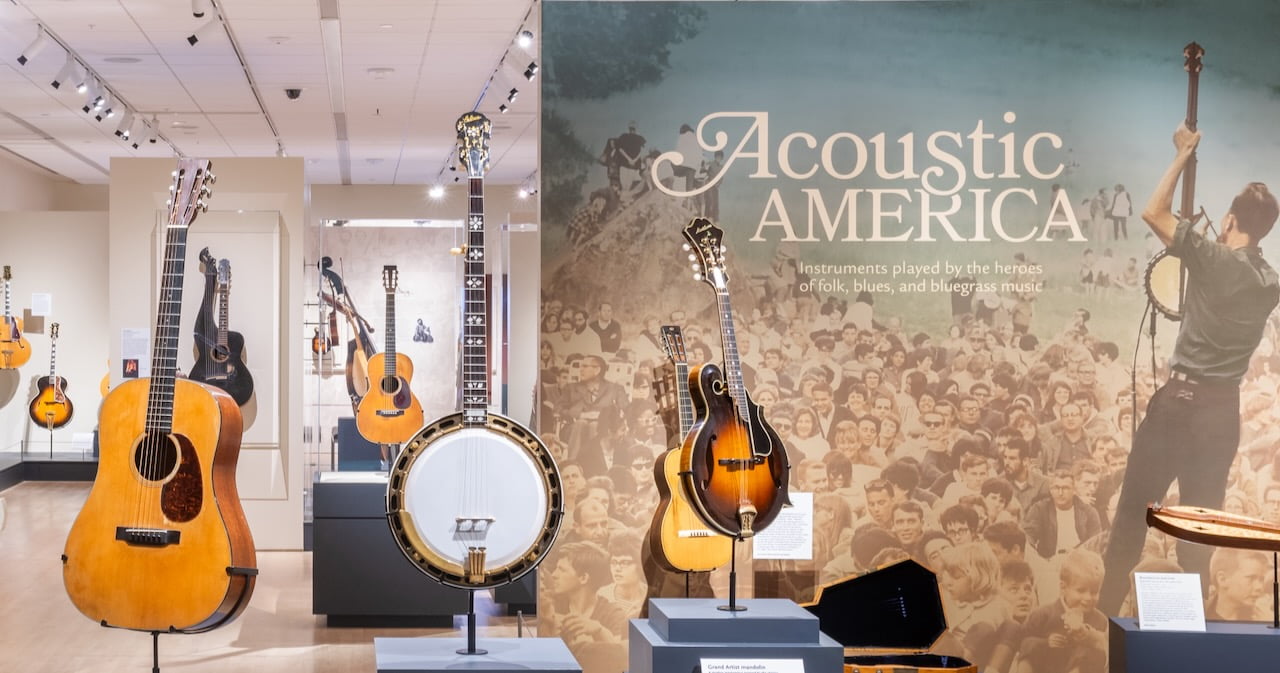
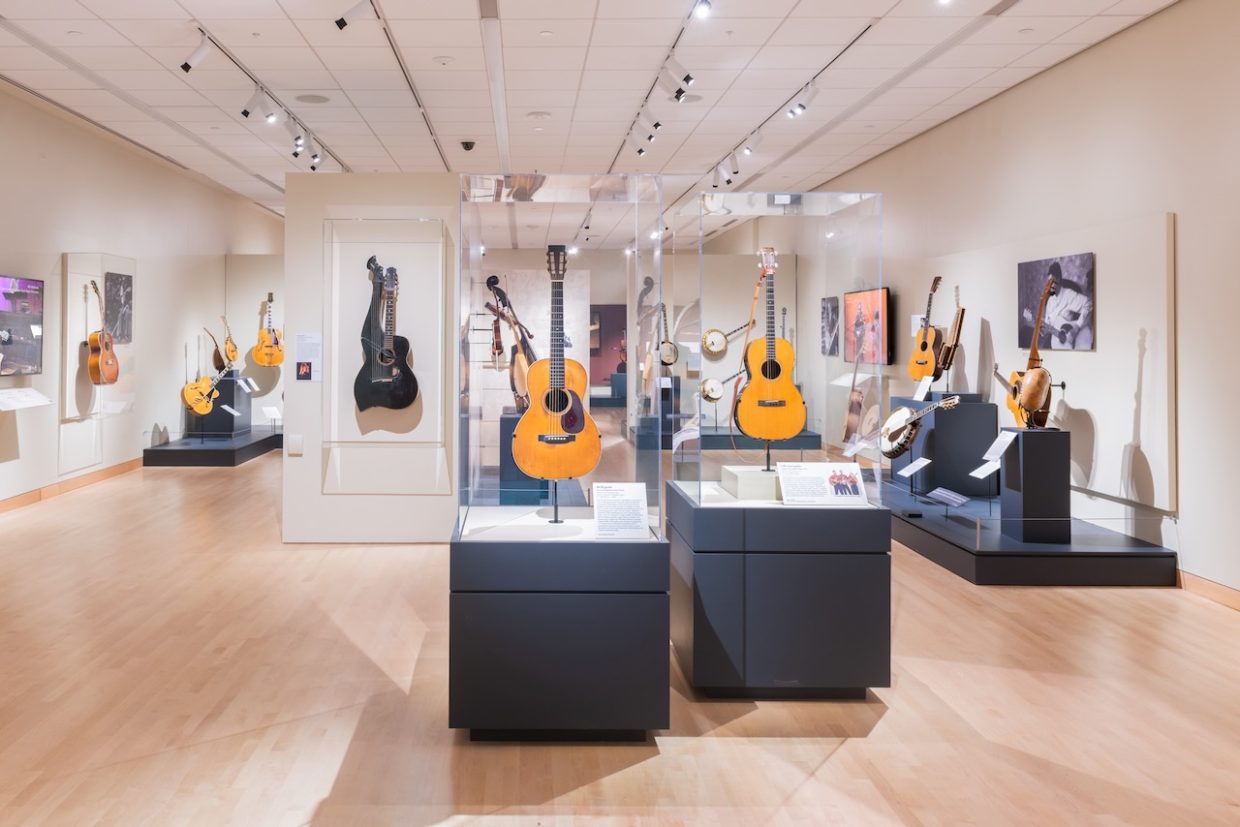
In early November, the Musical Instrument Museum in Phoenix, Arizona unveiled a brand new exhibition, Acoustic America, which celebrates iconic instruments of many heroes of folk, blues, bluegrass, and more. The exhibit is presented in partnership with our Dawg in December Artist of the Month, David Grisman and his record label Acoustic Disc, and showcases a remarkable collection of instruments that the museum states, “Have redefined music not only in the United States, but around the world.” This includes more than thirty instruments on loan from the Dawg himself.

“MIM is honored for this opportunity to collaborate with David Grisman and feature so many prized instruments from his collection,” says MIM senior curator Rich Walter, via email. “And after many years of loving his music, it has been a joy on a personal level for me, too. His influence as a mandolinist, composer, and bandleader is huge, and he absolutely changed the course of acoustic music as we know it today.”

The Acoustic America Gallery at the Musical Instrument Museum in Phoenix, AZ.

Guests of the museum will be able to view storied and legendary instruments formerly owned and played by such luminaries as Earl Scruggs, Elizabeth Cotten, Mississippi John Hurt, John Hartford, Lloyd Loar, and many more. “Beyond the legacies of the individual artists and the beauty of these historic instruments,” Walter continues, “Seeing this collection together in one space is really striking because it reflects a broader American narrative. Exceptional individuals from diverse backgrounds crossed paths and connected their talents in ways that gave us distinctive new traditions that continue to inspire people around the world.”

To celebrate the new exhibition and Dawg in December, we’ve partnered with MIM to bring you these photos of select instruments from Acoustic America. Make plans to visit the Musical Instrument Museum in Arizona now! Tickets are available at MIM.org.

(Editor’s Note: Instrument information provided from the Acoustic America catalog.)

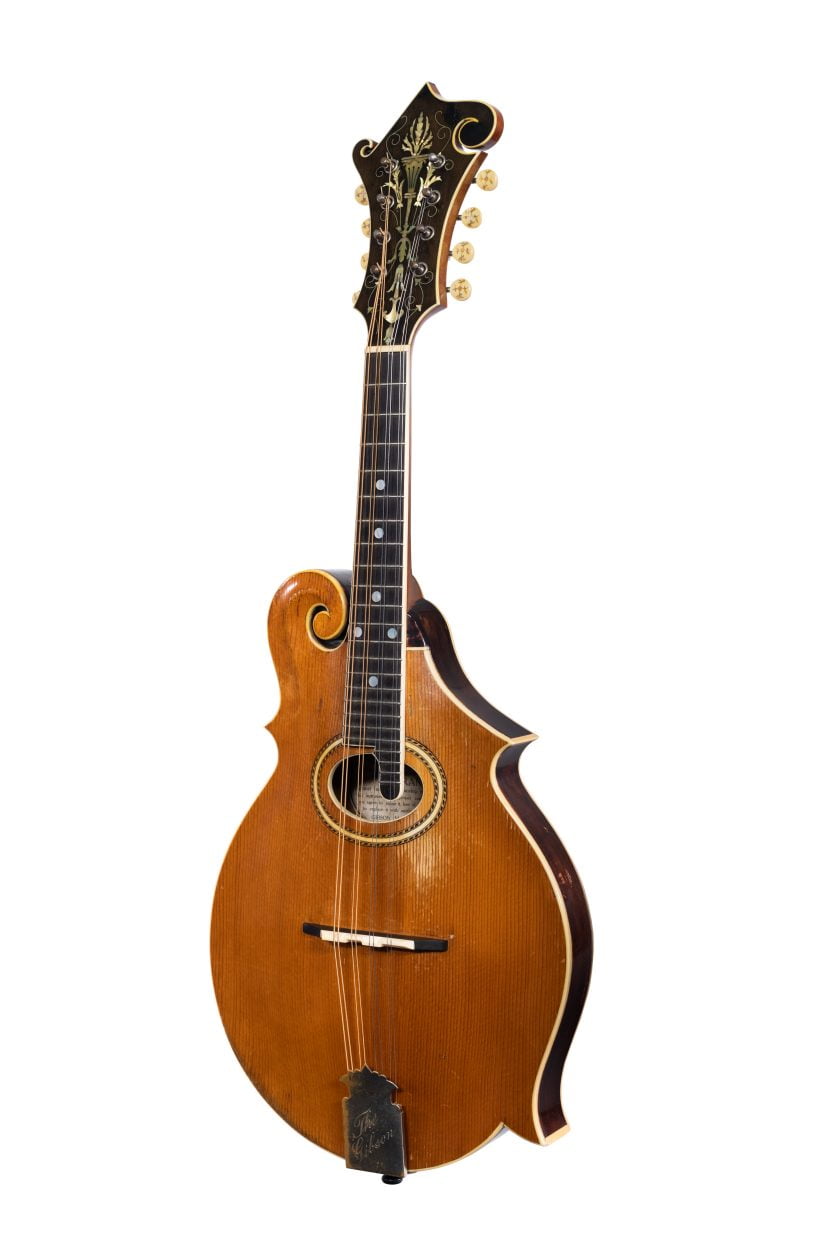
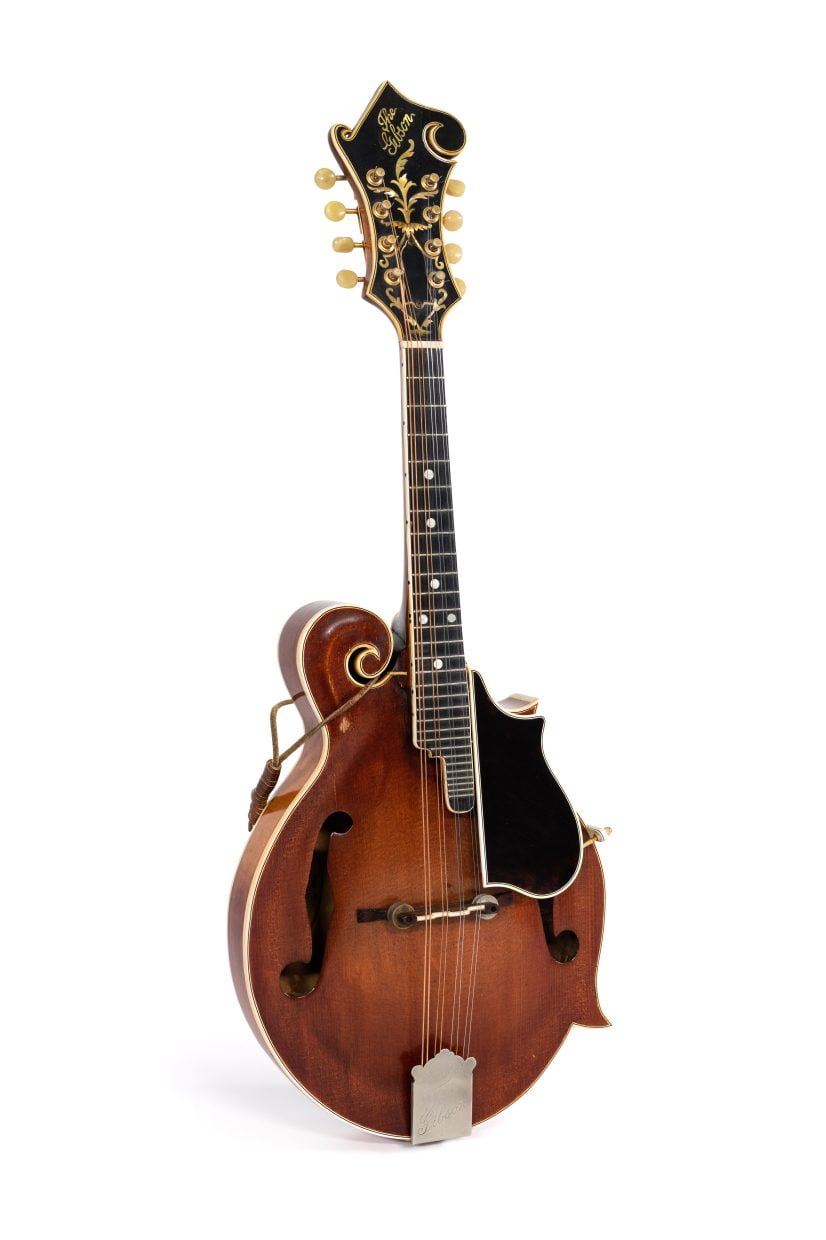
1910 Gibson F-4 Mandolin: Owned and played by David Grisman. Loan courtesy of David Grisman.

The F-4 model was Gibson’s premier mandolin until late 1922, when the F-5 was introduced. In addition to the characteristic oval sound hole and carved scroll, this early example features a three-point body style (note the points protruding from the body), elaborate torch and wire peghead inlay pattern, and special Handel tuning buttons with colorful inlays. David Grisman featured this mandolin on the cover of his first solo album, The David Grisman Rounder Album, and has recorded with it on other projects, including Tone Poems with Tony Rice and Not for Kids Only with Jerry Garcia.

1954 Gibson F-5 Mandolin: Owned and played by Ralph Rinzler. Loan courtesy of David Grisman.

Manager, talented musician, and legendary folklorist Ralph Rinzler (1934–1994) was one of David Grisman’s earliest and most influential mentors. Sharing a hometown of Passaic, New Jersey, Rinzler introduced Grisman to important recordings of folk music and inspired him to play the mandolin. Rinzler played this F-5 mandolin with the Greenbriar Boys, who were the first non-Southern bluegrass band to win at the Union Grove Old Time Fiddler’s Convention in North Carolina. He also managed the careers of Doc Watson and Bill Monroe and was instrumental in creating the first dedicated bluegrass festival in Fincastle, Virginia, in 1965. Two years later, Rinzler founded the Smithsonian Folklife Festival to celebrate and support living cultural heritage from around the world.

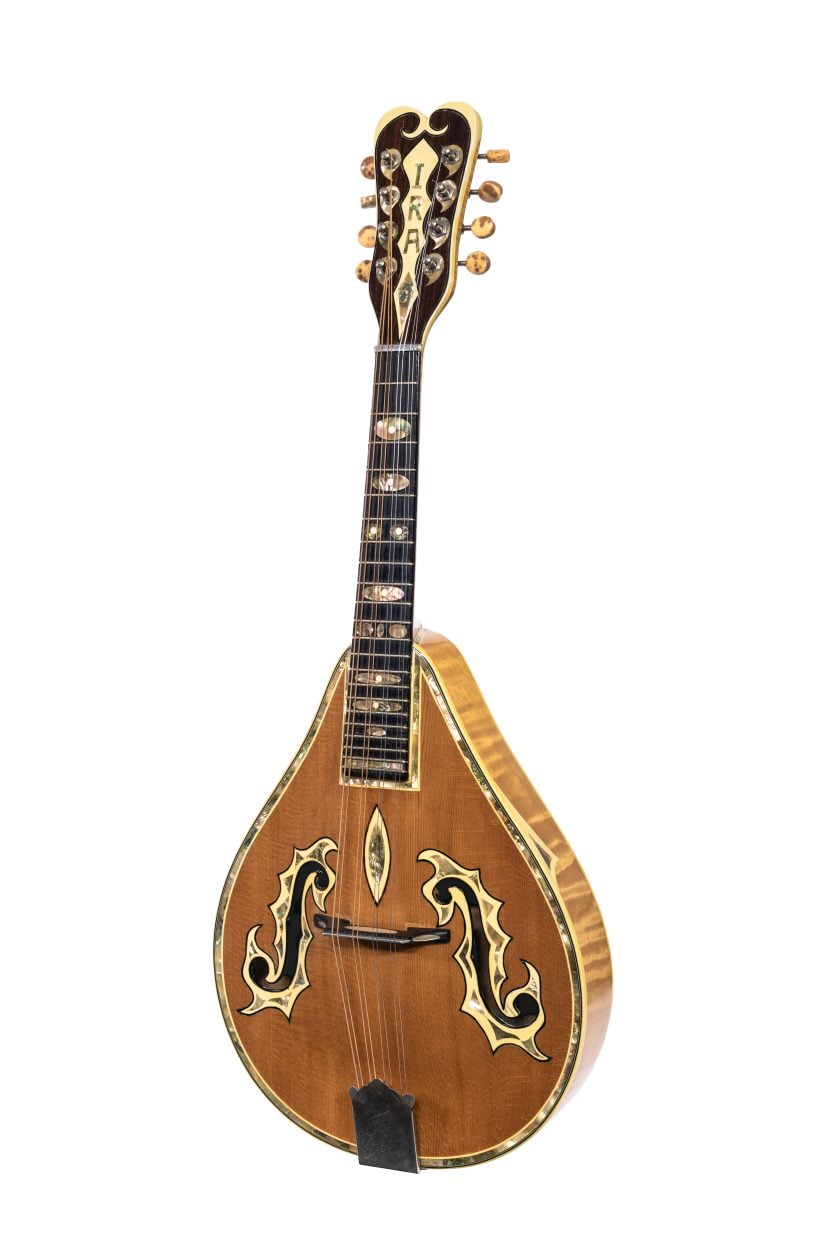
1947 Martin 2-15 Mandolin: Owned and played by Ira Louvin. MIM Collection.

Few brother duet acts in country music were as influential as the Louvin Brothers. Ira and Charlie Louvin were born in Alabama in the 1920s, and their high harmony singing and Ira’s tasteful mandolin playing helped them define a sound popularized through radio broadcasts, commercial recordings, and appearances on the Grand Ole Opry – where they debuted in 1955. Ira customized this one-of-a-kind mandolin in the flashy style of professional country artists and played it extensively, including on the Grand Ole Opry stage. This special piece of mandolin history was also owned by David Grisman for many years.

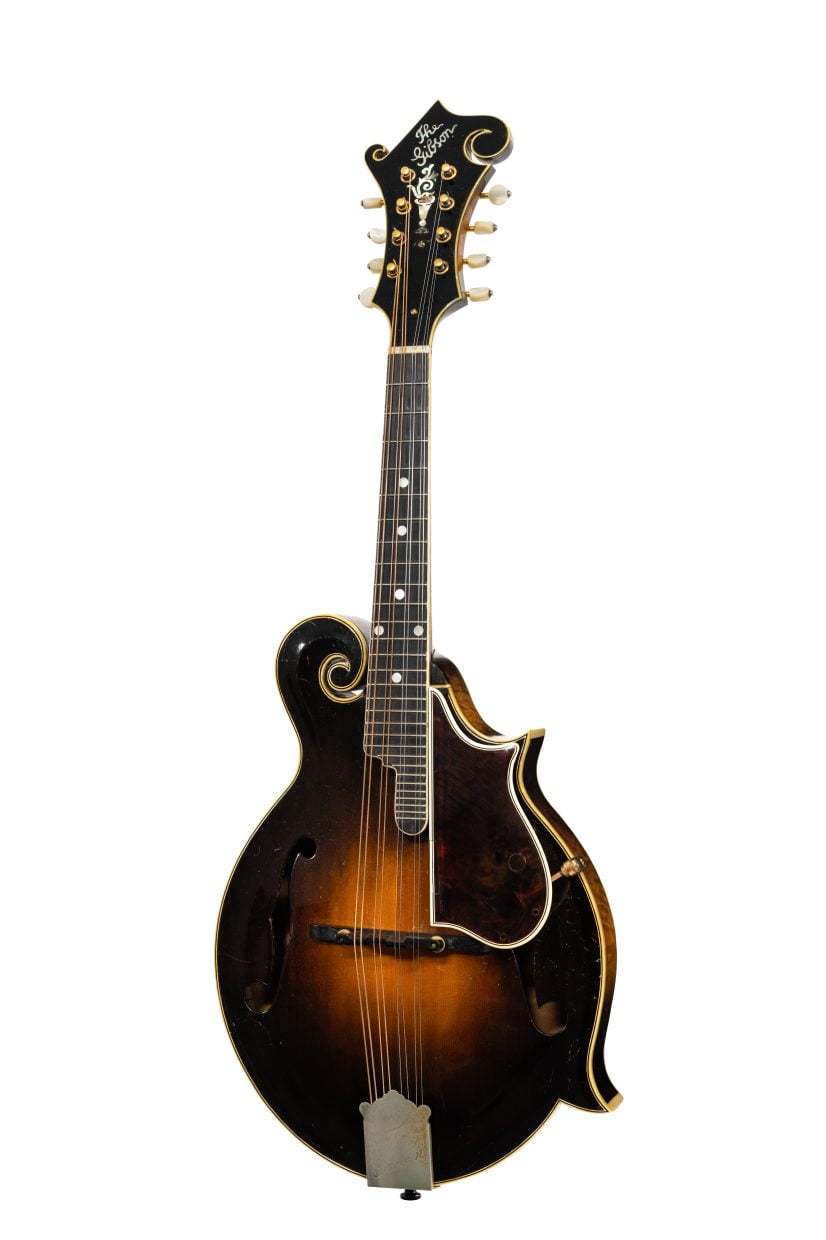
1924 Gibson F-5 Mandolin: Lloyd Loar’s personal F-5 mandolin. MIM collection.

This mandolin — serial number 75315; label dated February 18, 1924 — was the personal instrument of famed Gibson acoustic engineer Lloyd Loar. Loar was impressively inventive and patented designs for keyboard actions and electric instruments, among many others, but the F-5 Master Model mandolin is arguably his most iconic and enduring success. The interior of this mandolin is fitted with an original Virzi Tone Producer. F-5 mandolins with Loar’s signature on the label are the most valuable and sought-after in the world, and Loar F-5s from the batch signed on this date are known to be among the best-sounding. Perhaps it is not surprising that Loar kept this remarkable mandolin for himself!

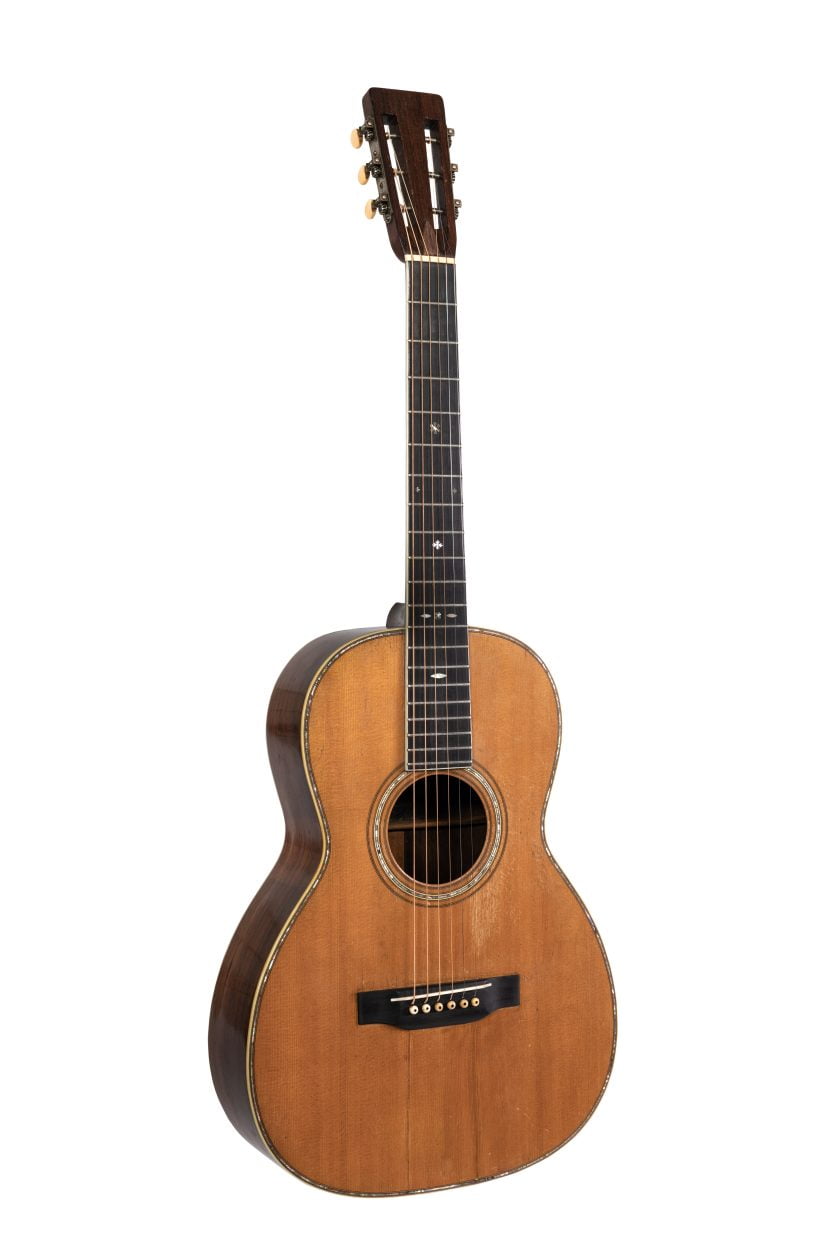
1928 Martin 00-40H Guitar: Played by the New Lost City Ramblers. Loan courtesy of Darrell Scott.

This guitar was played extensively by the New Lost City Ramblers, who were pivotal to the national revival of Southern folk music in the 1950s and 1960s. Founding members John Cohen, Tom Paley, and Mike Seeger were dedicated to authentically reproducing folk traditions for new audiences. The group recorded several albums for Smithsonian Folkways and helped discover, document, and showcase talented artists such as Elizabeth Cotten, Dock Boggs, and Snuffy Jenkins. Prewar pearl-trimmed Martin guitars are among the most desirable acoustic instruments in the world.

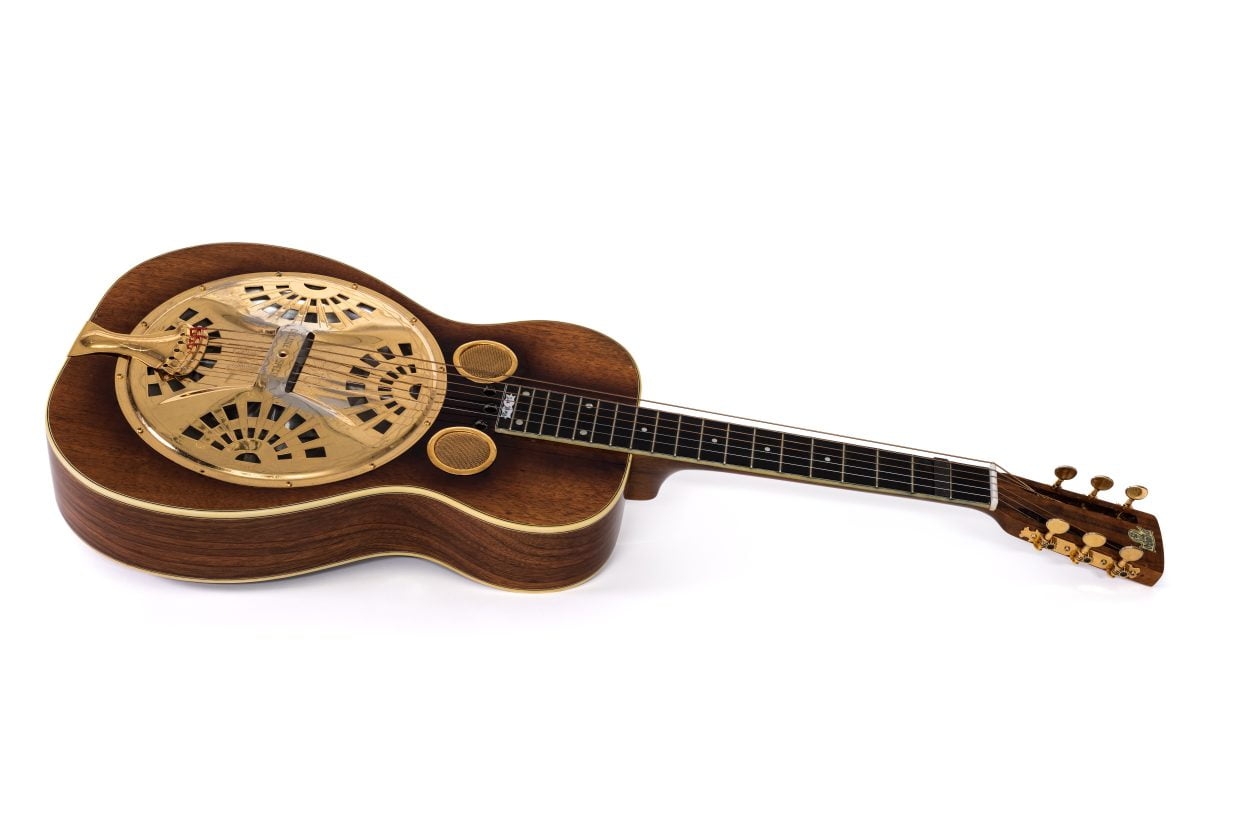
1929 Dobro Model 125 Resophonic Guitar: Owned and played by LeRoy Mack. Loan courtesy of LeRoy McNees.

In 1961, the Kentucky Colonels, led by brothers Clarence and Roland White, performed on The Andy Griffith Show, under the alias “the Country Boys.” The Kentucky Colonels were one of the most exciting and influential bluegrass bands of their era, and their national television appearance would have been much of the United States’ first memorable exposure to bluegrass. Dobro player LeRoy McNees (AKA LeRoy Mack) played this Model 125 resophonic guitar during the show and for many years afterward. After the guitar was damaged at an airport, McNees restored and outfitted it with gold-plated metal hardware.

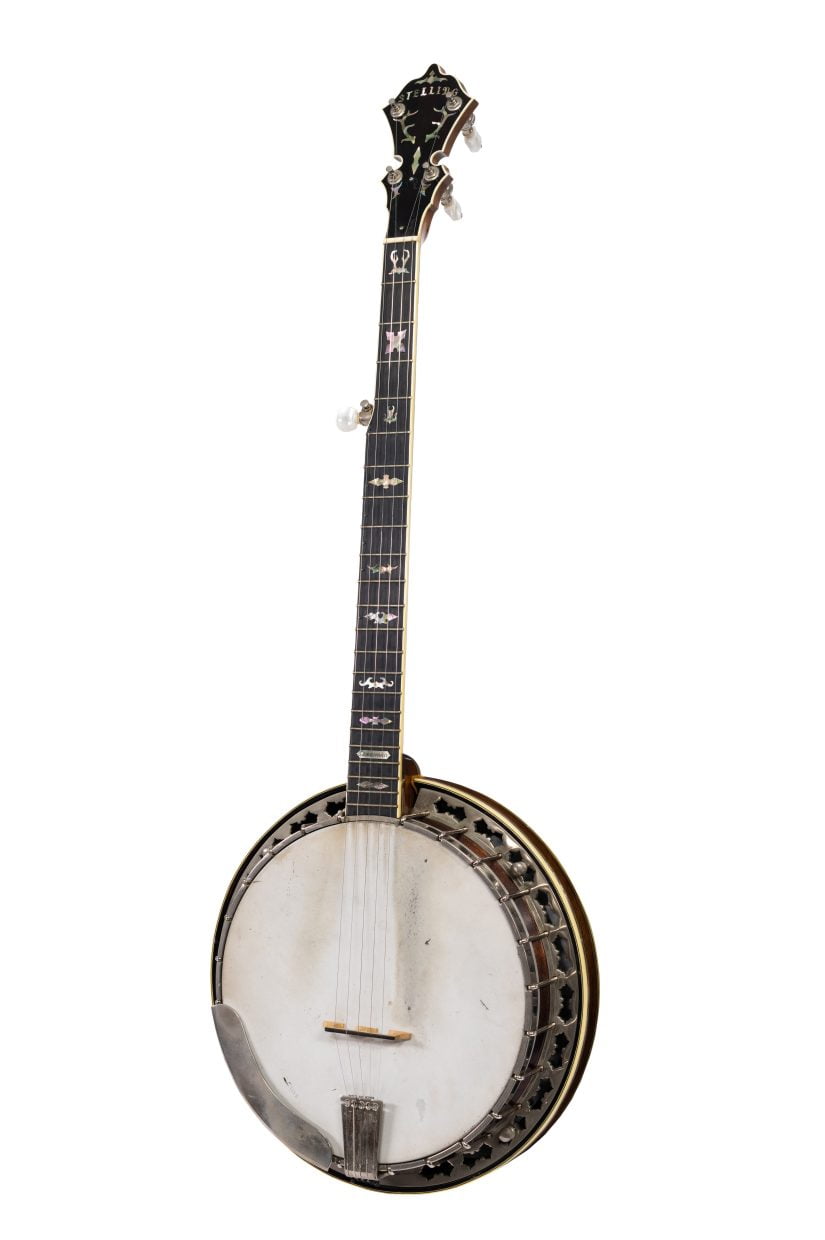
1975 Stelling Staghorn Banjo: Owned and played by Alison Brown. Loan courtesy of Alison Brown.

A young Alison Brown spent her entire savings on this then-new banjo built by Geoff Stelling, hoping to emulate the crisp, solid tone of Alan Munde, an influential older banjoist who played a similar Staghorn model. Brown played this banjo on her first album, 1981’s Pre-Sequel, and she later played it with Alison Krauss’s successful band Union Station. One of the most gifted banjoists in the world, Brown was the first woman voted Banjo Player of the Year by the International Bluegrass Music Association (in 1991). She has also won multiple Grammy awards, founded her own record label, Compass Records, and was inducted into the Banjo Hall of Fame in 2019.

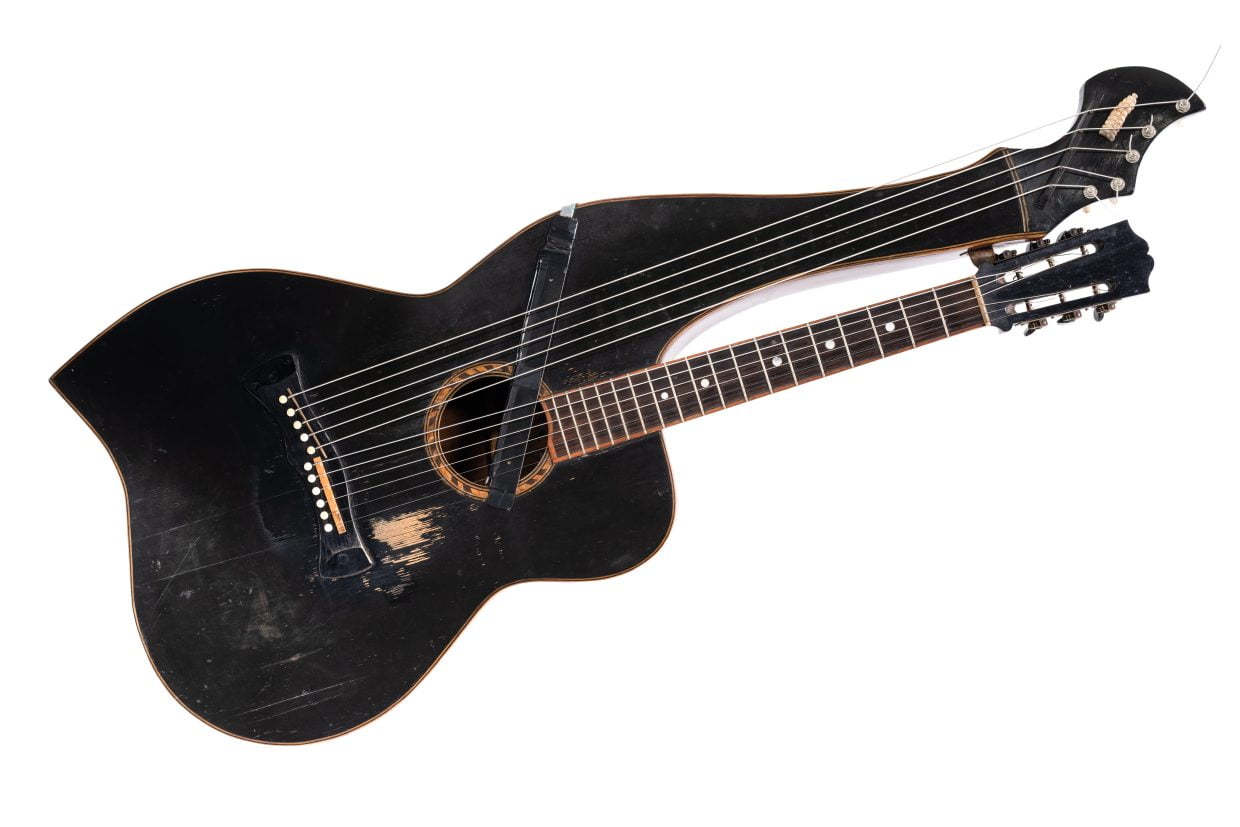
1913 Knutsen harp guitar: Owned and played by Michael Hedges. Loan courtesy of Taproot, LLC.

Guitarist and composer Michael Hedges (1953–1997) used a range of innovative and unconventional playing techniques — such as alternate tunings and percussive tapping on the strings and soundboard — to expand the possibilities of what a solo artist could do. In rediscovering the sound of vintage harp guitars with dedicated sub-bass strings, Hedges reimagined the guitar as a full-spectrum compositional tool. His 1984 album Aerial Boundaries illustrated his astonishing talent and helped define the contemporary new age acoustic music of Windham Hill Records. Hedges nicknamed this favored harp guitar “Darth Vader,” and his use of harp guitars revived interest in these long-obscure instruments.


All photos courtesy of the Musical Instrument Museum, Phoenix, Arizona.

The Latest Album From Steep Canyon Rangers Showcases Fresh Sounds, New Lineup

It’s a rather warm evening in the mountains of Western North Carolina. With a sweltering sun slowly fading behind the ancient Blue Ridge peaks, Graham Sharp takes a seat at a picnic table underneath the welcoming shade of an old tree.

He takes a sip of a craft ale and gazes out upon the festive meadows of live music and fellowship behind Highland Brewing on the outskirts of Asheville. For Sharp, it’s a rarity these days for him to be able to sit back and enjoy the city he’s called home for the last 22 years.

Co-founder and de facto leader of the Steep Canyon Rangers, Sharp is at the center of one of the most enduring and cherished acts in the realms of Americana, bluegrass, and indie-folk — whether on its own merit or backing Steve Martin and Martin Short.

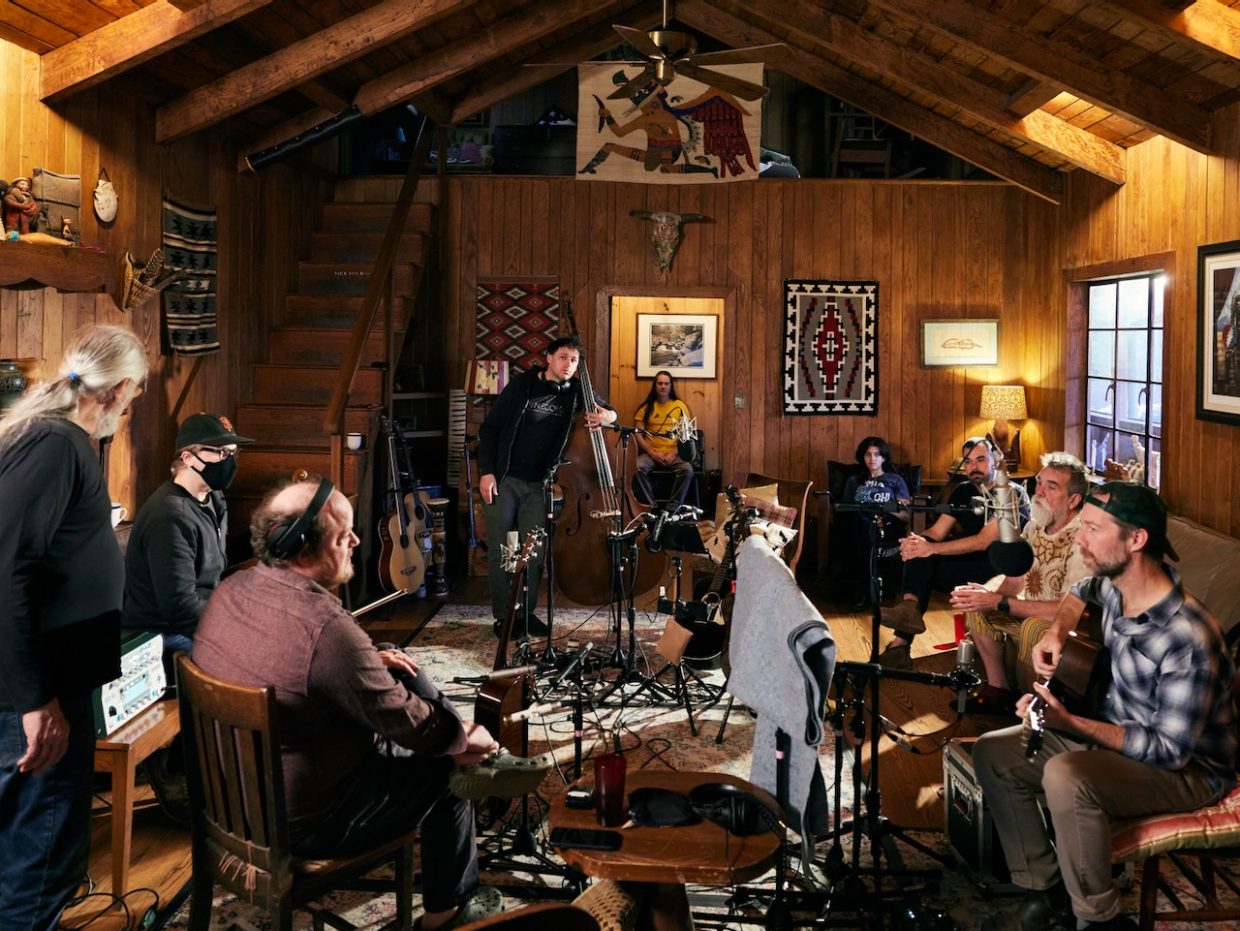
The Steep Canyon Rangers at the Western North Carolina retreat where they recorded ‘Morning Shift’ with Darrell Scott producing. Photo by Joey Seawell

At 46, Sharp has spent the majority of his adult life either on the road, onstage, or in the studio. And yet, like any endlessly restless and creatively curious musician worth one’s salt, Sharp feels like he’s just getting started.

“I’m the luckiest man on earth to be able to wake up in the morning and think, ‘I want to play banjo and write songs today,’” Sharp says. “Or am I going to get on a bus and go play some shows? That’s a good feeling to be excited about what you do — 25 years from now, I’ll probably be feeling the same way.”

What started as a rag-tag bunch of green horns jamming traditional bluegrass numbers in the dorms at the University of North Carolina at Chapel Hill, has evolved into a bonafide group selling out venues coast-to-coast.

Throughout the Rangers’ history there’ve been awards and accolades, including three Grammy nominations and one win. There’s also been big stages (Red Rocks Amphitheatre, the Ryman Auditorium, Hollywood Bowl) and even bigger crowds (Bonnaroo, MerleFest, Hardly Strictly Bluegrass).

But, the core of the group resides in its unrelenting quest to dig deeper within itself to uncover another layer of sound and sonic possibility. Most recently, the band has gone through its biggest test to date, with the departure last year of founding member and arguably the gravitational center of the act, singer/guitarist Woody Platt, who decided to take a step back from the spotlight and focus on family.

“There’s a lot of things you can’t control and Woody leaving is a pretty good lesson in that fact that there’s only so much that you have influence over,” Sharp says. “And I’ve seen that with everybody [in the Rangers]. Everybody had worked hard, stepped up and defined their roles better in the band — just buckle down and push ahead.”

Fellow Western North Carolina singer-songwriter Aaron Burdett stepped into the fold to not necessarily replace Platt, but give the Rangers a new avenue to stride down, in terms of songwriting approaches and musical interpretations.

“We really tried to bring Aaron in to have another voice in there. I love having him as another writer,” Sharp says. “We both generate our own stuff and bounce ideas off of each other, where some of it feels like going back to the beginning [of the band] in the feeling.”

And with the Rangers’ latest album, Morning Shift, the sextet now finds itself at the dawn of a new, unwritten chapter of its continued trajectory as a group as sonically elusive as it is bountiful in its melodic pursuits.

“I don’t think you’d call it a chip on the shoulder,” Sharp says. “But, it feels like there’s just a drive we all have to just get better, to have more people hear what we’re doing — and we know what it takes to get there at this point.”

Hunkering down for a week in the off-the-beaten-path, unincorporated community of Bat Cave, North Carolina, the Rangers transformed a small mountain getaway into a makeshift studio. They also enlisted the help of Darrell Scott, the musical legend being tapped to produce the record.

“Darrell isn’t going to mince words — he’s pretty decisive,” Sharp says. “And Darrell spans all these [musical] worlds. He’s a monster picker and singer, and a great writer. We felt like he also comes from that bluegrass [scene], but also is outside of it, [like we are].”


What resulted is an album of genuine depth and stoic intent, renewal amid a reinvigorated sense of self. It’s a full-circle kind of thing, with the Steep Canyon Rangers not only reflecting on the past, but, more importantly, still chasing after that unknown horizon of artistic discovery. Our BGS interview with Sharp at Highland Brewing in Asheville continued with a conversation about the group’s changing lineup and dynamic.

It’s been a big year for you guys in a lot of ways — physically, sonically. What’s the dynamic right now? What’s kind of changed?

Graham Sharp: Well, what I’ve noticed is my default method [is] when things go weird, to just work harder.

There’s more of a round-robin feel in the band than before.

GS: Yeah. I get that. That’s what people say, that the dynamic reminds them of The Band, where there’s three or four different singers. And that was part of the deal, part of the thought process of, “Let’s take this role that’s the prototypical lead singer/guitar role and de-emphasize that.” Not totally strip it of everything, but the guitar player’s going to sing 40 or 50 percent of the songs. He’s not going to sing 80 percent of the songs. And part of that plays like a little bit of a safeguard, where if something happens with Aaron two years from now, we don’t want to be back in the same boat, where it’s like we’re losing a big hole out of the middle of the band.

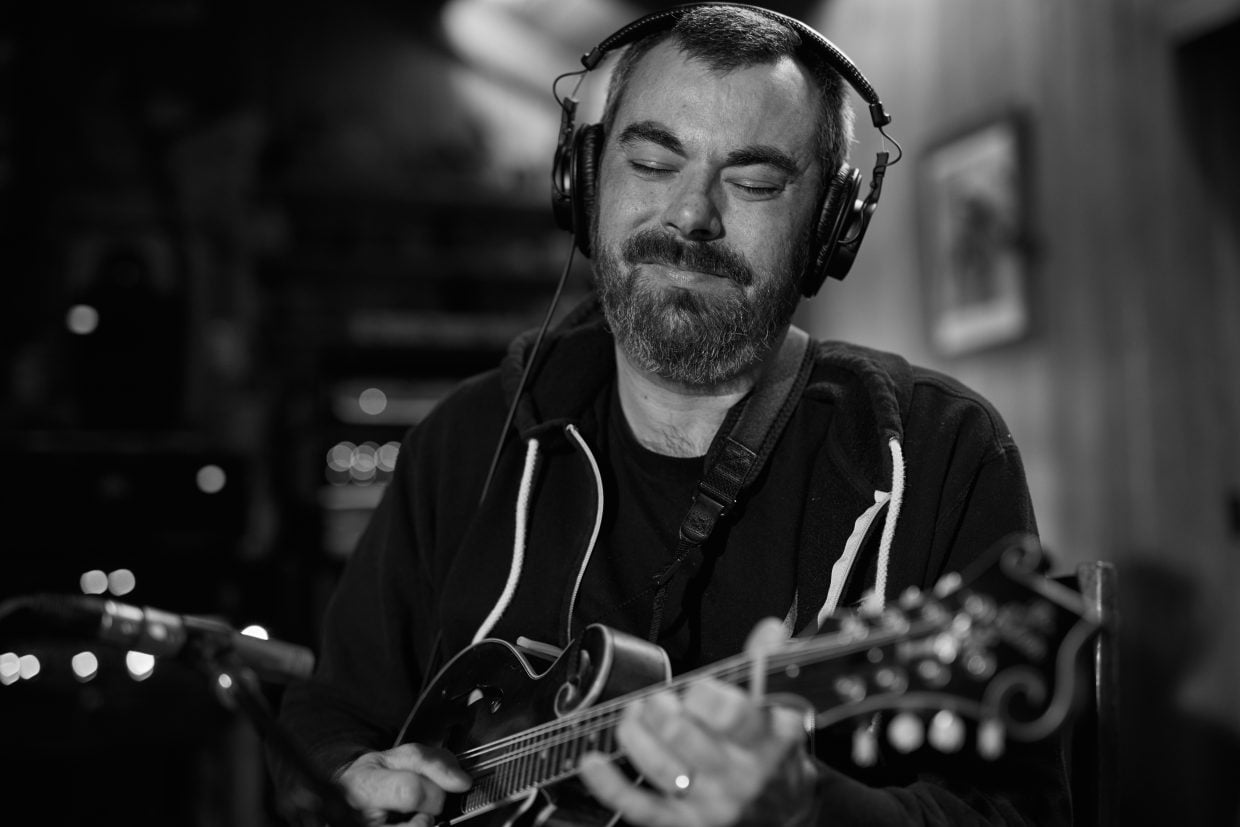
Mandolinist Mike Guggino, in the studio recording the Steep Canyon Rangers’ ‘Morning Shift.’ Shot by Joey Seawell.

Like equally distributed weight now.

GS: Yeah. That’s kind of how we want it. And I think that’s what it needs to be. There’s a lot of talent in [the band] and maybe this is a chance to uncover some of it.

Not to take anything away from Woody and his contributions, but it feels more of a cohesive unit than I’ve ever seen it before.

GS: Isn’t that crazy? And that’s what people have been saying. I don’t know what that is except to say everybody’s stepping up and also making sure everybody else shines a little bit more.

I also wonder if that plays into more camaraderie in the band.

GS: Maybe. I mean, the band is a brotherhood. You couldn’t have more camaraderie than we have. But, that said, if people are feeling like their talents aren’t being put into full use – there’s one thing about being great friends and being brothers, but also on some kind of subconscious level, if you feel like there’s stuff that’s not being utilized, then maybe there’s something else you should be doing, you know?

And there’s maybe a reaffirming of gratitude for how far you guys have come.

GS: No doubt, man. That’s definitely one of the overwhelming things that has come out of this [latest chapter], is just gratitude to still be doing it — just keep going and keep doing it. [With Morning Shift], this record feels like a jumping off point.

The album also reinforces that elusive nature that’s always resided in the Rangers, where the last thing you ever want to be is pigeonholed, musically.

GS: Yeah. But, I love to play the banjo, so I don’t want to grow away from that. And [sometimes] I feel like my writing doesn’t always lend itself to the banjo. So, a lot of my stuff on the banjo ends up being able to figure out how you play to this weird song that doesn’t really call for banjo like a bluegrass song would — that’s part of the fun of [songwriting].

Aaron has now been in the band for a year. What’s surprised you the most about what he’s brought to the Rangers?

GS: We knew he was a great singer when we hired him, so that didn’t come as a surprise. When he sent us his demos, we knew this was our guy. But, the biggest surprise has been just how far apart our musical worlds are. He’s a very different musician than anybody we’ve had in the band. There’s things that he does in his own rhythm. He just has a different touch on the rhythm guitar.

Graham Sharp of the Steep Canyon Rangers recording ‘Morning Shift’ in studio. Photo by Joey Seawell.

There’s definitely a feeling of reinvigoration within the band. Almost 25 years into the Rangers, the band is still at the top of its game. But, playing devil’s advocate, I think there’s now other mountains you can see that you may want to climb?

GS: I think you’re right. I mean, as a band, you only have one introduction to the world. Maybe we were lucky because we got two, the other with Steve Martin. But, right now, it feels more like a collective up onstage. And I think that’s invaluable. Everybody is putting in the work. For example, I’ve always played banjo for a couple hours a day. But, maybe now, I play it for three hours a day. You’re just stepping things up, bringing things up a notch.

What really sticks out when you look back at the early years of the band, this handful of college kids learning to play bluegrass music?

GS: It was 1999. Somewhere in my junior or senior in college. It was myself, [former bassist] Charles [Humphrey] and Woody. Then, [mandolinist] Mike [Guggino] showed up later because he was Woody’s friend from Brevard, [North Carolina]. There was no ambition at the time. The ambition was really, “Let’s learn to play [bluegrass] so it sounds like it does on these records.”

New Grass Revival. [Russell Moore and] IIIrd Tyme Out. We never got to where we sounded like any of those bands. We could never sound like Lonesome River Band. But, take a little bit of this, take a little bit of that and go play onstage at bluegrass festivals. Go to Sears and get some clothes that match. And [a lot of the bluegrass] legends were still around and playing those festivals. Earl [Scruggs] was still around. John Hartford. Jimmy Martin. You know, when you’re young and rising, you’ve got all the momentum, all the buzz. And when you’re established and older, it’s different. Right now, we’re in this in-between period where it’s not newer and it’s not legacy. But, we’re not Billy Strings or Molly Tuttle, either. I still just love going out [there onstage] and proving it every single time — that feeling of doing what it takes to be our best each night.


All photos: Joey Seawell

Watch the Zany Music Video for Willi Carlisle’s Just-Announced Album, ‘Critterland’

Arkansas-based country and old-time troubadour Willi Carlisle has announced his upcoming, Darrell Scott-produced album, Critterland, with a delightful stop-motion music video. (Watch above.) Set for release January 26, 2024 on Signature Sounds, the collection once again draws on Carlisle’s apt self-positioning as a sort of rural, countercultural, folklorist guru, crafting poetic yet down-to-earth songs that feel all at once fantastic, resplendent, whimsical, and– well, trashy. It’s a dichotomy not unknown to American roots musics, but rarely is this paradoxical construct inhabited so intentionally and subverted so artfully. It’s a language Carlisle isn’t just fluent in, it oozes from his spirit and lives in his bones.

On “Critterland,” Carlisle positions himself not as an omniscient narrator, but well within his own communities – musical and otherwise – as he examines how the “big tent” of his prior album, Peculiar, Missouri, could be put into action. And, in doing so, he demonstrates how varied, broad, deep – and sometimes ugly – open arm, open heart policies can be. But in that mundane, in that bittersweet, there is endless beauty.

With that thought in mind, Darrell Scott as producer and collaborator here isn’t merely a solid choice, but a nearly perfect one. You hear his touches in the confidence Carlisle has stepped into – with hundreds and hundreds of shows under his belt – with his soaring, passionate vocal on “Critterland,” raising its possums and raccoons and armadillos to saint-like status. Because, after all, aren’t all living beings divine? Don’t we all have something to contribute to our own, particular critterlands? Carlisle says so, and makes a compelling case.

This 2024 album will be a must-listen.


Photo Credit: Madison Hurley

First & Latest: For Darrell Scott, It’s Almost Always “A Great Day to Be Alive”

For a musician that could easily play every instrument in a standard bluegrass lineup – plus dozens more – it’s remarkable that Darrell Scott put out a post-pandemic record, Old Cane Back Rocker, that decidedly features a band. A picker’s picker and a songwriter’s songwriter, Scott has in the past recorded and released albums that feature other players only sparsely, fleshed out nearly entirely by his own playing. But this time, he wanted to feature his string band.

This wasn’t a post-pandemic realization either or a discovery brought on by the existential crises of the early pandemic, when communal music seemed like a far distant memory. No, Old Cane Back Rocker was actually tracked in 2019. COVID-19 was not the impetus for this collectively-created record, but rather the pickers themselves: Bryn Davies on bass, Matt Flinner on mandolin and banjo, and Shad Cobb on fiddle each inspired this new release, its track list, and its “out of many, one” approach.

For avid fans of this hit songwriter and country music renaissance man, Old Cane Back Rocker will feel like a return of sorts, a homecoming that reminds of many shows at the Station Inn and performances at bluegrass camps and festivals around the country. But, the album is even more fascinating and engaging when contrasted with Scott’s entire catalog, which showcases a diverse and circuitous lineup of production styles, genres and musical aesthetics.

For a new edition of First & Latest, we put Scott’s latest, Old Cane Back Rocker, up against his first release, Aloha From Nashville. As it happens, there’s a recording of Scott’s Travis Tritt-recorded hit, “It’s a Great Day to Be Alive” on each album, making for the perfect starting point for our phone conversation.

When you first recorded “It’s a Great Day to Be Alive” in the ‘90s, did you expect it would have this longevity? Did you have a feeling you’d still be recording it and performing it or did you think it would be the hit that it’s been?

Darrell Scott: No, hits are hard to distinguish, when you just hear the song – at least for me.

I think a hit has a lot more to do with the business, to make a hit, and it’s not the songwriter. It’s everything that follows after the songwriter. It’s the label. It’s the management. It’s the business connectivity, the promotion, the radio – all that has nothing to do with the songwriter. Zero. I remember saying one time, “A hit is that thing you hear a thousand times.” Repetition has a lot to do with a hit. It’s almost obvious.

Here’s one of the ironies. That song had been recorded three other times on major labels, but was never released before Travis Tritt got it. So tell me this, since it was a hit, why would three acts lose their deal [and not make it to release] with a hit? You see what I’m talking about? What made it a hit was the business machine that makes hits. A song is written by a songwriter. But a hit is made by the powers that be, after the fact.

In my case with that song, I had hurt my back, so I had to be on my back for a week. I couldn’t move, I couldn’t drive, I couldn’t go to sessions. I had to cancel my entire week so that I could lie on the floor, because I couldn’t do nothing else. Honestly, I couldn’t even sit up. After 6 or 7 days when I could [finally] sit up, I was literally just heating rice in a microwave – and considering making soup. Just sitting at the table, which I hadn’t done all week. It was the most blessed thing to do such simple things. And that’s where the song came from.

I wonder what made you want to do another version of that song this time around, with a string band? Because this is a song you’ve recorded and put out in quite a few manifestations.

DS: There’s one really simple answer for that. We recorded this album in August of 2019. In September of 2019, I’d heard two or three months in advance that a cornfield, a corn maze – like those pumpkin farms and apple pickings and that style of thing. There’s one north of Nashville that I heard was going to put my image in their corn maze. They cut my image and then the words, “It’s a great day to be alive” in their corn maze.

I thought, you know what? That, I can’t pass that one up. We’re going to have to make a video of that, and of us doing that song, rather than just lip-syncing to the one from ‘95 – which is actually when I recorded it. Wait, maybe even ‘94, but somewhere way back there. Instead of using that track, it was like, “Hey, I’m recording a string band album. I’m just going to put this in the string band’s hands and we’ll throw it down.”

I think we premiered that video back in the day! Well, the song certainly does beg the question: Does “a great day to be alive” look the same to you now as it did back then? Or, what does “a great day to be alive” look like to you now?

DS: Man, anything that makes you grateful, is a great day to be alive.

If you look at that song, there’s two things I notice in that song. First of all, the things that this person is grateful for are simple things like rice in a microwave, making some soup. They’re pondering, “Hey, I know it’s hard out there in the world, but today’s a good day, and tomorrow may not be.”

It’s just taking that moment, when you realize, “Hey, it is a great day to be alive. I am glad to be alive.” There’s no shame in saying such a thing. And that’s still the case. You know, that wasn’t just in 1994 or ‘95 or ‘97. Any day that you can feel that way is a great day.

You have this uncanny ability to take your listeners into a small, tiny moment like that, a split second moment of gratitude or of grief or of just big feelings and turn it into this whole big song. And what I’m thinking of now is “Inauguration Day” / “The World Is Too Much With Me.” And I’m so glad that ended up on the new record, because I went back to that Facebook video of that song, dozens of times after I first saw it.

DS: I’ve alluded to it so far in our talk, but songs have a life of their own, and they have a timing of their own, and they don’t have a shelf life or preservatives. You know, almost anything’ll start showing mold in about three to four days here in Tennessee. And songs don’t have that kind of shortness.

I try to gravitate towards songs. On a good day or night, to have a song that’s timeless is the goal for me. One that doesn’t just burn out in the second listening or in three months or something like that. That’s what I try to go for. I’m trying to see a bigger picture than, “So-and-so will like this song” while I’m writing it. “Oh, my publisher will like this” or, “I’m going to pitch this to so-and-so.” If you’re thinking that while writing a song, you just sold the song down the river. You don’t have that song any longer, you have a commodity.

I’m not a commodities writer, I’m a songwriter. From an experiential point of view. So, “Inauguration Day” is simply how I felt on inauguration day.

Well, and I felt myself returning to that song over and over. Even though it’s a very specific and very topical song, the repeated line, “The world is too much with me, too much today,” it just feels like such a mantra.

DS: Right? Because some could feel the same way about– uh-oh, I’m blanking on the current president… Biden! But see, some people could feel that about any inauguration day, the day that Biden got in or the day any other president got in and that’s fine.
But I absolutely wrote it on Trump’s inauguration day. I couldn’t do anything else, to tell you the truth. The world was too much with me that day. All I could do was I escaped over to my dad’s cabin. I have my dad’s Kentucky cabin here on my Tennessee property, and that’s where I went. I just crawled into a hole, pretty much, but inside the cabin was a five-string guitar that’s supposed to have six. I just played it with a bar, like a Dobro thing.

I came back to the house where there was a signal [to record the video] and there was wind in the microphone and all sorts of unprofessional things. But I then recorded that song within five minutes of being back at the house, having just written the song. That’s what I do. I follow my inclination. There again, I’m not writing a hit. I’m writing from a reaction in that case, just like “It’s a Great Day to Be Alive” was a reaction to seven days of lying on a concrete floor.

It’s not my only skillset, but it shows up [in songs] like that. I’m just writing out of a need to write. I need to write. On inauguration day, I had to. I couldn’t do anything else, so I did that and that’s how it felt. It felt like the world was too much with me.

So the other two First & Latest tracks we’re here to talk about are “Title of the Song” from Aloha From Nashville and “Fried Taters” from Old Cane Back Rocker. I feel like the through line here is pretty obvious, the sense of humor that you have in your songwriting and in your music making.

DS: Right, because that’s another part [of my writing,] I do have a humorous side. I have a sarcastic side. I have a pointed, jabby way of observation, because – here’s what’s at the top of the page, above “songwriter” or “musician” and “singer” is observer. I’m first and foremost an observer. Part of that observation is being comedic or pathetic.

That whole first album of mine, Aloha From Nashville, “aloha” means hello and it means goodbye. I wasn’t sure which it was going to be, it being my first record I put out in Nashville. I took a lot of pot-shots at Nashville and the music industry within that album, and that’s why I called it Aloha From Nashville.

“Title of the Song,” it’s just a comedic song that’s so true that it’s almost doesn’t need to be said, except I went ahead and said it, you know? Writing a song about writing a title for a song, we all know the formula. It’s poking fun at that situation. The comedy is there, in both the writing and the production.

The reason I put comedy on this last record with “Fried Taters,” is it’s the same humor, it’s the same comedy. This one’s an instrumental, but I have a voiceover thing going on that’s making the snide commentary, that is kinda the same commentary as 1994 or ‘95, with “Title of the Song.” On “Fried Taters” it’s literally the words of a famous musician in jazz who really put down country music, audibly and frequently. Those are literal quotes from that person. I littered them throughout our little instrumental, to have that attitude.

Was that a tune by you? Did the melody come from you? Was that a band tune?

DS: I had the progression, that I wrote. Matt Flinner is such a great composer, who plays the mandolin and banjo in this group, he has so many records and compositions. He’s an educator, he teaches. He’s just a marvel as a composer. I knew that I could just flip [the chord progression] over to Matt. It had an A section and a B section, but that was about it. So he’s the one who put the melody to it. It’s a co write, but we never sat together with it. I did the chords and sent it off to him and he sent me back the melody and we were ready to record it.

I definitely appreciate you, more than almost anybody else, getting Matt Flinner to play banjo. He is so good on banjo.

DS: Yeah, he’s such a great banjo player and I’m so pleased that he plays it for me. I think probably, the only other time that he played banjo was in Leftover Salmon. Matt Flinner is such a great banjo player and many of us know this about him. I’m so lucky I get him to play banjo on every single gig, I mean, he may be on banjo more than he is on mandolin on our gigs. He’s a fabulous banjo player. I play banjo, too, but I know what a really great banjo player is. Matt’s got the composer ability. He’s got the band leader ability. He’s got the sideman ability, obviously the mandolin and the educator ability, but then he gets in there and and plays banjo that well.

What a lot of people think of first when they think of you is like, a one man band or that you’re a multi-instrumentalist or utility player, but clearly it was so important for you to have a band with you on this album. Why did you intentionally want to make this a collective work, rather than just hiring a band to back you up or playing it all yourself?

DS: Yeah, well, because I wanted this to be a band. I’ve played with these guys now for eight or 10 years. I don’t even know. Anytime a festival wanted me to have, in essence, a bluegrass band or bluegrass instrumentation, these are the very people I’d take. Every single one of them. We did a Live at Station Inn album and it’s the same people. If RockyGrass hired me, or Grand Targhee, or MerleFest, or something like that, this is who I would bring. But we’d never made a studio album. So I knew I had to do that.

Then the other part of it, I wanted it to be a band, but not just in the instrumentation. I want Matt to bring in a tune. I want Shad [Cobb] to bring in a tune. I want participation. I want everybody to sing harmonies, every chance we get. I very mindfully made this a band record – sound, input of songs, and stuff – because I know how to put together a solo album and all that. I’ve done it. I wanted this to be this band, because I know their abilities beyond just being sidemen.

I think bluegrass fans know that you’re a picker’s picker. But sometimes your albums, they’re so song-centered that that fact can fall to the wayside, despite the fact that you’re always improvising and using that vocabulary. So with this album and having the band right in the title, it felt like a return in some ways.

DS: Well, that’s what I wanted and why I wanted to do it with these people, it has everything to do with these exact people.

Here’s one of those ironies of our town or this music. So you what’s supposedly called a “sideman” like Shad Cobb, but Shad can lead his own band. He’s got boxes and boxes of songs and tunes. Matt Flinner has cases of songs and tunes. He used to tour with his trio and they would write a song per day, each of them. And that night they’d perform it!

This is what I’m talking about. These people, they do stuff like that. Where’s the hit making in that, you see what I mean? Just going back to that silly idea that the hit is everything. No, driving 300 miles and having a new tune that night times three people in the band, that’s news to me! Not what’s number one this week.


Photo Credit: Michael Weintrob

33 Must-See Roots Artists at This Year’s Bourbon & Beyond

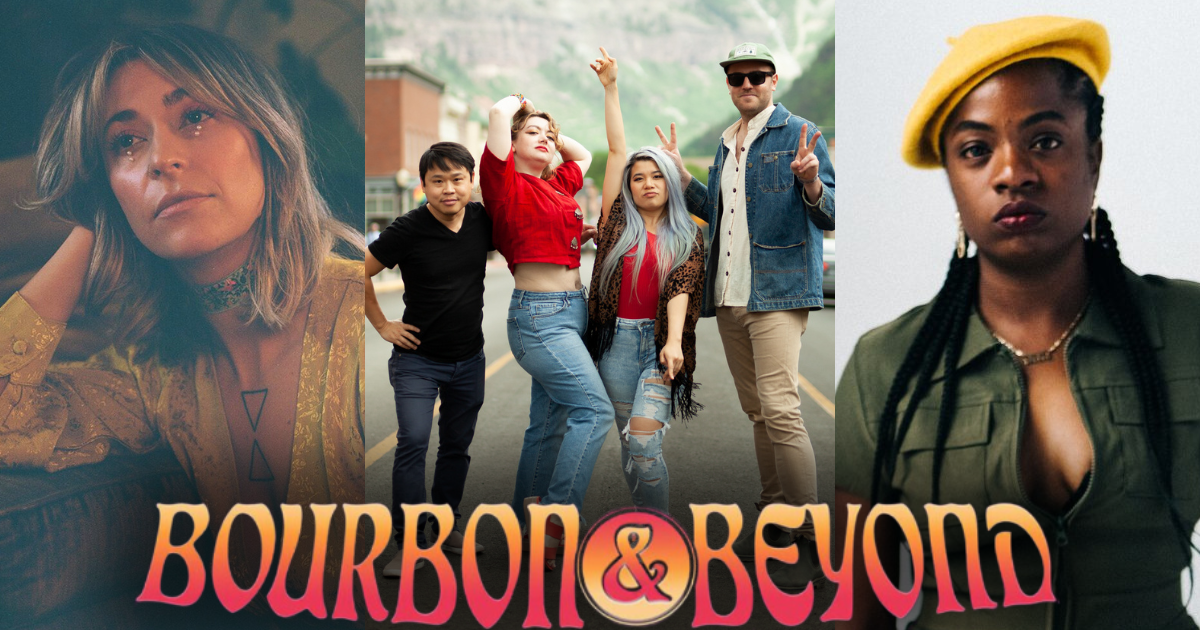
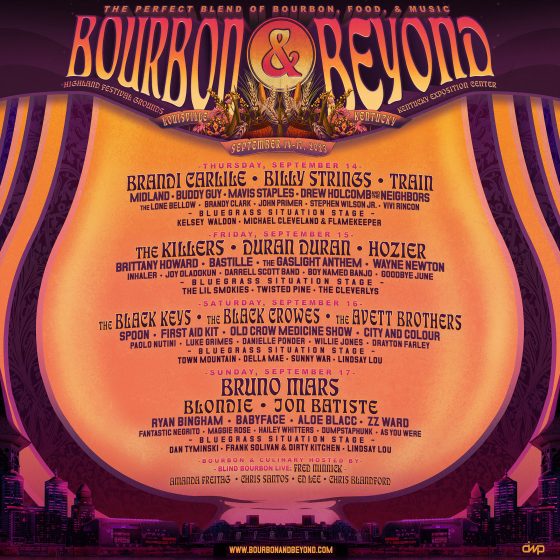
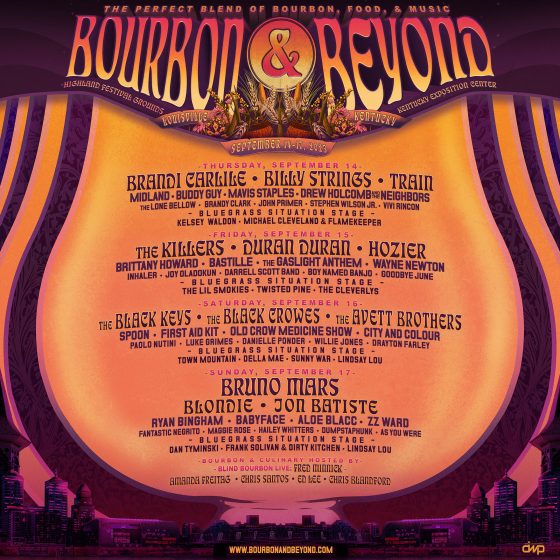
Since 2017, Bourbon & Beyond has become one of the BGS Team’s favorite annual events. The music, spirits and food festival held at the Kentucky Expo Center in Louisville, Kentucky, always boasts a roots-forward lineup – on and off the BGS Stage.

In anticipation of Bourbon & Beyond kicking off Thursday, September 14, and running through Sunday, September 17, let’s preview all of the artists gracing our stage throughout the weekend – and we’ll throw in a few we’re excited to catch on the main stages as well. 

Limited tickets are still available! Join us this weekend at Bourbon & Beyond in Kentucky. Scroll to see the full schedule for the BGS Stage. 

The Arcadian Wild – BGS Stage

We’ve been a fan of this bluegrass-infused Nashville string/Americana band for more than a few years now. In 2021 we invited the Arcadian Wild to perform a Yamaha Artist Session, for which they performed two songs, “Hey Runner” and “Finch In the Pantry.” They hit the BGS Stage at B&B on Sunday.

Armchair Boogie – BGS Stage

We recently caught this jammy Wisconsin outfit, Armchair Boogie, at Earl Scruggs Music Festival, where they burnt down their late-night set. You have two opportunities to see them on the BGS Stage, as they’ll kick us off both Friday and Saturday.

The Avett Brothers – Main Stage

These Saturday headliners need no introduction to our BGS readers and followers, as the Avett Brothers have been a staple of our community for nearly our entire lifespan. Looking at the Bourbon & Beyond lineup poster, it’s hard to believe we didn’t book this entire event! 

Jon Batiste – Main Stage

Fresh off the release of a brand new album, World Music Radio, in August, don’t miss Americana renaissance man Jon Batiste when he hits the B&B main stage on Sunday. We can certainly appreciate this Louisianan’s love for blurring genre lines – a perfect fit for Bourbon & Beyond.

Brandi Carlile – Main Stage

Let’s return to MerleFest 2019, the last time we had a stage at a festival Brandi Carlile headlined – and she brought her pals the Avetts out to sing “Murder In the City.” A BGS classic! We’ll be running from the BGS Stage to see Brandi on Thursday evening for sure.

Brandy Clark – Main Stage

Appropriate that Brandi and Brandy would end up as list neighbors and both on the Bourbon & Beyond main stage lineup, as the former produced the latter’s stunning new self-titled album. Clark has been a Music Row mainstay as an artist and songwriter for decades, but with her new record and her hit Broadway show, Shucked (penned with Shane McAnally), she’s finally getting her well-deserved flowers. 

Clay Street Unit – BGS Stage

We crossed paths with Denver, Colorado, country-folk-grass group Clay Street Unit earlier this year at WinterWonderGrass, so we’re more than pleased to have them on the BGS Stage on Thursday afternoon. 

Michael Cleveland & Flamekeeper – BGS Stage

Fiddlin’ phenom Michael Cleveland has performed for BGS at Bourbon & Beyond before, but with his new critically-acclaimed album, Lovin’ of the Game, and his recent selection as our March 2023 Artist of the Month, it’s the perfect time to get him back to Louisville. It’s basically home turf for Cleveland, and his set Thursday evening is not to be missed.

The Cleverlys – BGS Stage

Bluegrass’s preeminent song-interpreters – or song skewer-ers, depending on how you look at it – are a humorous hoot, bolstered by fantastic picking and on-stage personas pulled straight out of a caricature book. If you’ve never seen the Cleverlys live and in person, now’s your chance to catch covers like this waltz version of Radiohead’s “Creep” like you’ve never heard them before. 

Della Mae – BGS Stage

Our old pals Della Mae brought an outsized energy and charisma with them to their sets at Earl Scruggs Music Festival a couple of weeks ago, wowing the crowds in North Carolina. Now the groundbreaking bluegrass foursome set their sites on the BGS Stage at Bourbon & Beyond. There’s a reason why this group of all women remains a stalwart in bluegrass, old-time and Americana.

Myron Elkins – BGS Stage

If you’re not familiar with guitarist and Americana alt-rocker Myron Elkins, you’re about to be! His debut album, Factories, Farms & Amphetamines, was produced by superstar musician-engineer-producer Dave Cobb and released on Elektra. Catch him as he ascends on the BGS Stage on Thursday, kicking off the entire weekend for us at 12:30 p.m.

Fantastic Negrito – Main Stage

Fantastic Negrito is a one-of-a-kind performer. An expert in blues – and a purveyor of post-blues, neo-blues, and the tastiest of fringe Americana – Fantastic Negrito occupies a stage like no other. He’s a Bourbon & Beyond veteran as well, and his past performances are seared into our memories of this amazing event. Do not miss!

First Aid Kit – Main Stage

Indie folk duo First Aid Kit, made up of Swedish sisters Klara and Johanna Söderberg, are a favorite of BGS readers – the kind of readers who equally love Bill Monroe, Nickel Creek and boygenius. Get a taste at their Saturday main stage set or check out our 2018 feature on the group.

Drew Holcomb & the Neighbors – Main Stage

Don’t you just wish Drew and Ellie Holcomb and the Neighbors were your neighbors? (Sigh…) It just seems like it would be lovely. At any rate, you can catch up with these fine folks from next door on the main stage at B&B on Thursday. 

Brittany Howard – Main Stage

A god of rock and roll incarnate, Brittany Howard’s particular brand of roots rock is enormous and will fill the Bourbon & Beyond main stage and then some. If you haven’t caught the Alabama Shakes front person recently, now is your chance. Howard hits the main stage on Friday.

The Lil’ Smokies – BGS Stage

Formed in Montana, the Lil’ Smokies combine so many contemporary bluegrass influences into a Western-influenced, jam-forward sound. We enjoy every chance we have to cross paths with this group – if you miss their set at Bourbon & Beyond, catch the Lil’ Smokies at AmericanaFest in Nashville very soon.

Lindsay Lou – BGS Stage

Roots singer-songwriter Lindsay Lou is entering yet another new era of her career, with her signing to Kill Rock Stars and upcoming album, Queen of Time, due out later this month. At Bourbon & Beyond you’ll have two chances to hear current and past sounds from Lindsay Lou – on both Saturday and Sunday on the BGS Stage.

The Lone Bellow – Main Stage

One of our all-time favorite rootsy, folky, string band trios. It’s been too long since we’ve reconnected with our friends The Lone Bellow and we’re grateful B&B will give us that opportunity when they play the main stage on Thursday.

Lola Kirke – BGS Stage

Lola Kirke, who you can see on Friday on the BGS Stage at B&B, is an accomplished actress whose dream is to be a country singer – dream, achieved! She makes joyous, lyrical, story-rich music that pulls as much from country’s grit as its glitz. (And an appearance from lineup-mates First Aid Kit on “All My Exes Live in L.A.” is the cherry on top.)

Joy Oladokun – Main Stage

Intricate and involved indie folk is Joy Oladokun’s medium, her songs dripping with pop sensibilities and led by an agnostic approach to genre that builds on work by predecessors like Aimee Mann, Ani DiFranco, Tracy Chapman, k.d. lang, and many more. Oladokun continues to rise through the music-industry ranks, her latest album Proof of Life building more momentum off the ex-evangelical’s heart-forward, earnest, stoner indie pop.

Old Crow Medicine Show – Main Stage

Old Crow Medicine Show bring the Jubilee to Bourbon & Beyond! Don’t miss the party as the world’s most renowned and rollicking string band celebrates their just-released album on the B&B main stage on Saturday. And keep an eye out for a BGS feature on the new record coming soon to the site.

Pixie & The Partygrass Boys – BGS Stage

Another of our WinterWonderGrass pals headed to Bourbon & Beyond! Catch Pixie & the Partygrass Boys on the BGS Stage kicking off our final day of music on Sunday. You’ll certainly enjoy the party – unless you’re a fascist, in which case, avoid our stage altogether or you might get eaten by some chickens.

Darrell Scott Band – Main Stage

Darrell Scott is a musical shapeshifter, effortlessly moving from Music Row country to dyed-in-the-wool bluegrass to rocking and rolling. At his Bourbon & Beyond main stage set on Friday, you’re sure to hear new tracks from his recent album, Old Cane Back Rocker, made with the Darrell Scott String Band, as well as original hits like “It’s a Great Day to Be Alive” and some tasty covers, too. We never get enough of Darrell Scott! (Watch for an interview with Scott coming to BGS soon.)

Frank Solivan & Dirty Kitchen – BGS Stage

If this is the kitchen dirty, let’s never clean it up! Frank Solivan & Dirty Kitchen are a shredding bluegrass jam band certainly worth sticking around for on Sunday evening. You’ll hear music from their most recent Compass Records album, Hold On, which recently turned one year old, and plenty of mind-(and string-)bending solos.

Mavis Staples – Main Stage

Put the legendary Mavis Staples’ main stage set (Friday, 3:50 p.m., Oak Stage) on your calendar and circle it. And underline it. And set a push notification. We are grateful every single time we get to occupy the same space and air as Mavis, and this time will be no different. It’s a privilege to walk the earth at the same time as this civil rights leader and musical oracle! 

Billy Strings – Main Stage

Not so long ago our old friend Billy Strings would have been playing our BGS Stage, but not anymore, this flatpickin’ global sensation has decidedly hit the big time! We’ve so enjoyed watching Billy move up and up and up in the world and we can’t wait to see his main stage set at Bourbon & Beyond Thursday night. With such a stacked lineup, the special guest opportunities are exciting and limitless. 

Town Mountain – BGS Stage 

Western North Carolina string band Town Mountain have built up their sound over the past few years to where they feel and sound something like Ricky Skaggs in his country days — bluegrass bones, but fleshed out country. Their songs still go by you like a rousing honky tonk dance band, bluegrass or no, but with spit and polish and thousands of miles under their belts. Worth an add to your B&B to-do list!

Twisted Pine – BGS Stage

Another group that blew us away at Earl Scruggs Music Festival, Twisted Pine turns the jamgrass model on its ear, building their vibey, virtuosic songs and tunes with as much jazz interwoven as bluegrass, old-time, and country. They’re like Lake Street Dive and Crooked Still, mashed up together and lingering a bit longer in string band traditions – from across the Americana continuum – before taking off. Plus, bluegrass just needs more flute, right? See them Friday on the BGS Stage.

Two Runner – BGS Stage

We’re glad to be bringing some California sounds to Kentucky with Two Runner, old-time and Americana duo of Paige Anderson and Emilie Rose coming to B&B. They bring to mind duos like Hazel & Alice and Anna & Elizabeth, combining country harmonies and old-time instrumentation – all dragged through the coastal evergreen woods of Northern California. Hear them Thursday on the BGS Stage.

Dan Tyminski – BGS Stage

Dan Tyminski headlining a BGS Stage is simply a dream come true! This multi-hyphenate, lifelong bluegrasser has been a member of so many seminal and groundbreaking bluegrass groups and projects. He’s had a full career within and outside of bluegrass, but lately has returned to the genre that made him with a new band, a new album, God Fearing Heathen, excellent songs, and that voice – fit for George Clooney. 

Kelsey Waldon – BGS Stage

Kelsey Waldon on her home turf! Though she hails from West Kentucky, the entire state is certainly this country singer-songwriter’s domain. We’ve collaborated quite a bit with Waldon across her career, and are looking forward to her headline set closing out our first day of Bourbon & Beyond on the BGS Stage. She may be country, but her bluegrass roots run deep – and will be on full display at B&B for sure. 

Sunny War – BGS Stage

 One of our favorite guitarists of the last several years has released one of our favorite albums of 2023, Anarchist Gospel. If you’re unfamiliar with her work, you won’t want to miss Sunny War perform on the BGS Stage on Saturday. Her right hand is confounding and inspiring, an often textural and tone-setting device in her bigger sounding recent songs that combine punk, blues, indie and more. Not to be missed! 

Hailey Whitters – Main Stage

It’s no secret BGS loves some good country. Hailey Whitters is certainly some of the best to come out of Music Row in recent memory, releasing radio-ready bops that are fun and exuberant, yes, but also have a rich and subversive well of influences, content and production styles. That Whitters is connected with all the best pickers and singers in Nashville and has a penchant for bluegrass are nice little details to remember about this TikTok phenom. Worth a mosey to the main stage on Sunday, certainly!


The Bluegrass Situation Stage – Daily Schedule

Thursday, September 14

5:45 p.m. – Kelsey Waldon
4:15 p.m. – Michael Cleveland & Flamekeeper
3 p.m. – Two Runner
1:45 p.m. – Clay Street Unit
12:30 p.m. – Myron Elkins

Friday, September 15

5:45 p.m. – The Lil’ Smokies
4:15 p.m. – The Cleverlys
3 p.m. – Twisted Pine
1:45 p.m. – Lola Kirke
12:30 p.m. – Armchair Boogie

Saturday, September 16

5:45 p.m. – Town Mountain
4:15 p.m. – Della Mae
3 p.m. – Lindsay Lou
1:45 p.m. – Sunny War
12:30 p.m. – Armchair Boogie

Sunday, September 17

5:45 p.m. – Dan Tyminski
4:15 p.m. – Frank Solivan & Dirty Kitchen
3 p.m. – The Arcadian Wild
1:45 p.m.- Lindsay Lou
12:30 p.m. – Pixie & The Partygrass Boys

Purchase your Bourbon & Beyond tickets here.


BGS Returns to Louisville for Sixth Consecutive Bourbon & Beyond

BGS is excited to announce the full lineup and schedule for our Bluegrass Situation Stage at Louisville, Kentucky’s Bourbon & Beyond – for our sixth year in a row! Since 2017, BGS has curated a bluegrass-forward roster for the premier bourbon, food, and music festival’s only music stage outside of their main stages, Oak and Barrel. The 2023 edition of Bourbon & Beyond will be held September 14 through 17 at the Highland Festival Grounds at the Kentucky Expo Center. Tickets are still available.

Each evening of the event, the BGS Stage will culminate with performances by Kelsey Waldon (Thursday), The Lil’ Smokies (Friday), Town Mountain (Saturday) and Dan Tyminski (Sunday). The full schedule includes performances by Michael Cleveland & Flamekeeper, Lindsay Lou, The Arcadian Wild, Della Mae, Sunny War, Twisted Pine and more. See daily BGS Stage schedules below.

This year, as in the past, there are acts and bands all across the Bourbon & Beyond schedule that feel like they were pulled directly from the pages and stories of BGS. On the Oak and Barrel stage roots music fans can hear artists like Jon Batiste, Billy Strings, Midland, Brandi Carlile, Brittany Howard, Joy Oladokun, Darrell Scott Band, Fantastic Negrito, Hailey Whitters, Brandy Clark, Mavis Staples, the Avett Brothers, Old Crow Medicine Show, and so many more.

But that’s not all! For the foodies and bourbon hounds alike, there will be wall-to-wall culinary demonstrations, bourbon experiences, and more featuring celebrity chefs such as Edward Lee, Amanda Freitag, Chris Santos, Sara Bradley, bourbon expert Fred Minnick, and many others. If you’re curious which Kentucky straight bourbon whiskeys will be available for sipping and guzzling at the Big Bourbon Bar, it’s pretty much every distiller you could ever crave: Angel’s Envy, Bardstown, Brother’s Bond, Bulleit, Doc Swinson’s Whiskey Collection, Elijah Craig, Four Roses, George Dickel, Green River, Heaven’s Door, Jack Daniel’s, Jefferson’s, Kentucky Peerless, Larceny, Legent, Maker’s 46, Michter’s, Middle West Spirits, Monk’s Road, Old Forester, Rabbit Hole, Resilient Bottled in Bond, Starlight Distillery, Wilderness Trail and Willett Distillery.

Bourbon and bluegrass and beyond – what more do you need? We hope you will make plans to join us in Louisville for the 2023 edition of Bourbon & Beyond!


The Bluegrass Situation Stage – Daily Schedule

Thursday, September 14

5:45 p.m. – Kelsey Waldon
4:15 p.m. – Michael Cleveland & Flamekeeper
3 p.m. – Two Runner
1:45 p.m. – Clay Street Unit
12:30 p.m. – Myron Elkins

Friday, September 15

5:45 p.m. – The Lil’ Smokies
4:15 p.m. – The Cleverlys
3 p.m. – Twisted Pine
1:45 p.m. – Lola Kirke
12:30 p.m. – Armchair Boogie

Saturday, September 16

5:45 p.m. – Town Mountain
4:15 p.m. – Della Mae
3 p.m. – Lindsay Lou
1:45 p.m. – Sunny War
12:30 p.m. – Armchair Boogie

Sunday, September 17

5:45 p.m. – Dan Tyminski
4:15 p.m. – Frank Solivan & Dirty Kitchen
3 p.m. – The Arcadian Wild
1:45 p.m.- Lindsay Lou
12:30 p.m. – Pixie & The Partygrass Boys


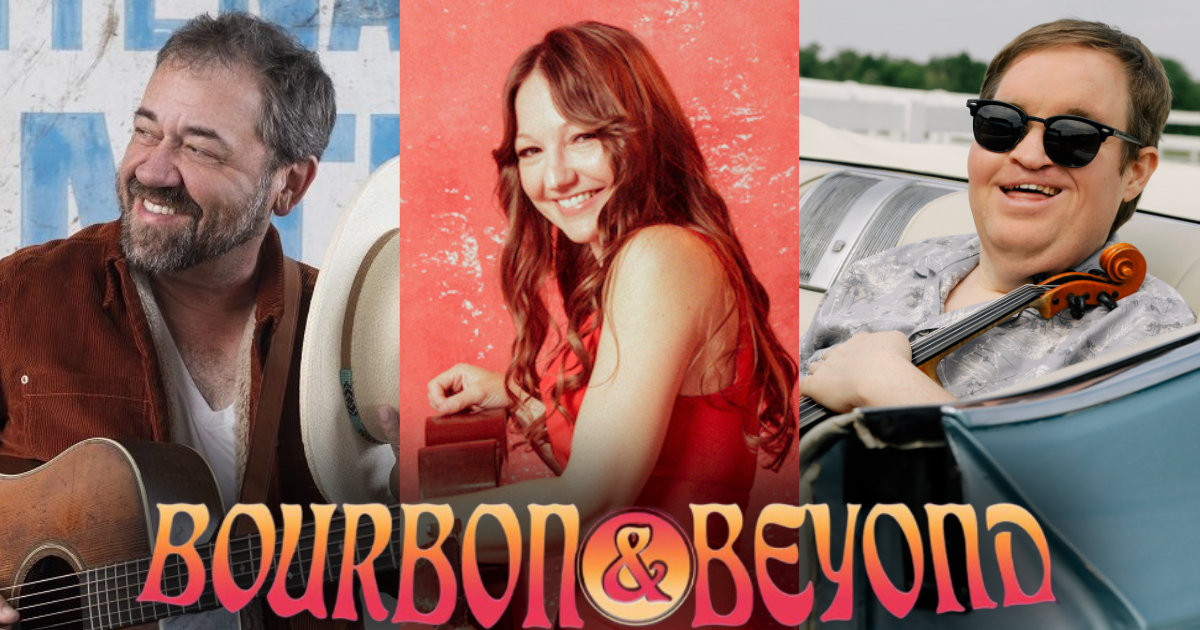
Photos L-R: Dan Tyminski by Scott Simontacchi; Kelsey Waldon courtesy of the artist; Michael Cleveland by Amy Richmond

WATCH: Patty Loveless, Chris Stapleton Sing “You’ll Never Leave Harlan Alive”

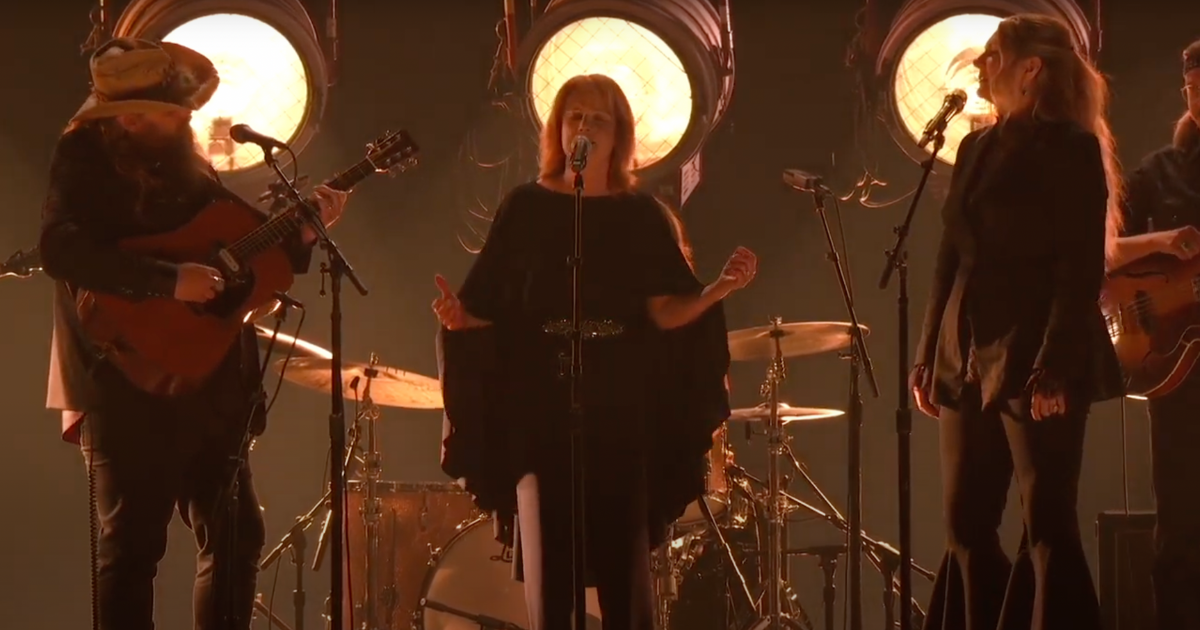
Patty Loveless reminded us why she’s still a hero to traditional country and bluegrass fans during a rare performance with Chris Stapleton at the CMA Awards on Wednesday night. Loveless included the poignant composition on her landmark 2001 album, Mountain Soul, an acclaimed record that still holds up. Look closer and you’ll see that Darrell Scott, who wrote the song, is playing Dobro on this performance, along with Deanie Richardson on fiddle and Morgane Stapleton on harmony.

Released at the height of the O Brother, Where Art Thou? soundtrack’s popularity, Loveless pressed pause on her commercial country career for a set of songs featuring Jon Randall, Travis Tritt, and an exceptional group of studio musicians. (Seriously, look at this personnel list.) The emotional centerpiece of the project may be “You’ll Never Leave Harlan Alive,” which feels almost like it was written for Loveless, whose late father worked in the coal mines.

Stapleton deservedly won the CMA Award for Male Vocalist during the show, but his greatest accomplishment of the night may be been placing a six-minute Appalachian ballad in the middle of a mainstream country show, not to mention inviting Loveless back into the spotlight. She’s no stranger to the CMA Awards, of course, having won back-to-back Female Vocalist trophies in 1995 and 1996, in addition to Album of the Year honors for 1994’s When Fallen Angels Fly. She later collected another one for 1997’s “You Don’t Seem to Miss Me,” which she recorded with one of her own heroes, George Jones. It’s a touching moment to now see Stapleton paying homage to an artist who has made her own mark on country music throughout the decades. And it goes without saying that any time that Patty Loveless wants to make another album, we’re here for it.

Stapleton and Loveless first sang the song together at the Kentucky Rising benefit concert in Lexington on October 11, raising funds for relief and recovery following the devastating floods in Eastern Kentucky this past summer. The one-night-only event also featured performances from Kentuckians Tyler Childers, Dwight Yoakam, Ricky Skaggs, and S.G. Goodman. You can still donate to the Kentucky Rising Fund here.

Take a look at Patty Loveless and Chris Stapleton singing “You’ll Never Leave Harlan Alive” below.

MIXTAPE: The Wilder Blue’s Smooth Harmony Jams

Something special happens when multiple human voices intertwine. Maybe it stirs something in our DNA, some echo of countless lost generations and the songs they sang together on countless fire-lit nights. All I know is that people love it. It’s the part of our show people remark upon the most afterward, often adding something along the lines of “You just don’t hear harmonies like that much anymore.” While it does seem to be true that solo artists tend to dominate the charts these days, there are still a lot of groups out there keeping harmonies alive. Here are some of our favorites from both past and present. — The Wilder Blue


From Paul Eason, lead guitar

Alison Krauss & Union Station – “Maybe” (from Live From The Louisville Palace, Kentucky)

These harmonies (which are performed live!) are just super interesting and not predictable. I love how the first chorus is just a single harmony and the second adds the third part.

Punch Brothers – “My Oh My”

These guys are just some of the best musicians alive, and their harmonies match their virtuosic instrumentalism. I have seen them do it live, and it seems they are incapable of singing even slightly off pitch.

Darrell Scott – “No Love in Arkansas”

I don’t know if I love the harmonies as much as I just love this song. It has the feel of a live recording — but a real, real good live recording. I get the impression that Darrell surrounded himself with players as effortlessly musical as he is, and the song just came out the way it was supposed to be.


from Andy Rogers, multi-instrumentalist

Bluegrass Album Band – “So Happy I’ll Be”

I grew up singing bluegrass gospel music with my family and this tune always stuck out to me. I love the call-and-response singing and of course that sweet guitar pickin’.

I’m With Her – “See You Around”

I can’t say enough good things about these three artists’ solo work, but putting them together and hearing those beautiful three-part female harmonies is just magical to me. They sort of remind of a more modern sounding Trio.

The Brother Brothers – “On the Road Again”

I found this group through a friend’s suggestion and just instantly loved it. I mean, does it get much better than sibling harmony? They are incredible songwriters as well. I often send this tune out to the guys in the band when we’ve been off the road for a little too long, at least in my opinion, lol.


from Sean Rodriguez, bassist

The Band – “Time to Kill”

I think it’s pretty undeniable the effect The Band had on harmony-driven bands in America, despite everyone but Levon Helm being Canadian. This great Richard Manuel-led song I think is underrated in their catalog and has great harmony parts throughout.

Billy Preston – “Let the Music Play”

After watching The Beatles doc Get Back, I couldn’t resist the urge to dive further into Billy Preston’s catalog. The vocal arrangements here bit me hard and haven’t let go.

The Staples Singers – “Respect Yourself”

There’s just something special about a family that sings harmony together. The blend of the voices can’t be beat, not to mention the message here. Respect yourself, baby!


from Zach Williams, frontman

Brandi Carlile – “The Eye”

This was the song that got me hooked on Brandi. I was instantly roped in by the beautiful stripped-down harmonies and The Firewatcher’s Daughter is still my favorite album of hers.

Alabama – “I’m in a Hurry (And Don’t Know Why)”

There were a lot of great harmony-based country groups in the ’90s. I could’ve picked Diamond Rio, Blackhawk, Little Texas, or any number of others. But this is the one that came to mind, and I remember jamming along with it back in my college days.

Acappella – “I Feel Good”

Speaking of my college days, I was raised in the church of Christ and went to Abilene Christian University. Churches of Christ traditionally don’t use instruments in worship and the whole congregation sings together in four-part harmony. My first paying gig as a musician was singing bass and beat-boxing in an all-vocal group at ACU, and I only wished I could sing bass like the guy in this premier C of C singing outfit… Acappella


from Lyndon Hughes, drummer

Eagles – “Witchy Woman”

This is one of my favorite Eagles tunes. The way they break it down on the bridge to just vocals, drums and bass is absolutely brilliant. #BandGoals

Dan Fogelberg – “Leader of the Band”

Oh the smooth harmonies of Dan Fogelberg. Nothing too complicated… just crystal clear vocals and guitars (and a bonus horn solo).

The Beatles – “Because”

Here is a beautiful and eerie song by a little known band called The Beatles. Over 50 years later… the harmonies never get old.


Photo Credit: Cal and Aly

LISTEN: Darrell Scott, “10 Degrees and Getting Colder” (From ‘Barry Waldrep & Friends Celebrate Tony Rice’)

Artist: Barry Waldrep & Friends – Featuring Darrell Scott
Hometown: Nashville, Tennessee
Song: “10 Degrees and Getting Colder”
Album: Barry Waldrep & Friends Celebrate Tony Rice
Release Date: December 24, 2021

In Their Words: “Darrell Scott is an extraordinary artist and someone that I definitely wanted on this project. When we asked, he was eager to get on board. I know his love for Tony as an artist, and his passion really shines through on this track. Working with him in the studio was a pleasure, and the music created was from a very original perspective but honors Tony as well. I feel Tony would be pleased.” — Barry Waldrep, producer

Editor’s Note: Tony Rice sang this Gordon Lightfoot classic on the landmark 1975 album, J.D. Crowe & the New South, titled as “Ten Degrees (Getting Colder).” It also appears on the 1996 compilation, Tony Rice Sings Gordon Lightfoot.

Barry Waldrep & Friends · 10 Degrees and Getting Colder – Featuring Darrell Scott

Photo Credit: Gabriel Scott