Brat summer has come to bluegrass music – like seemingly every other corner of our culture. This viral social media sensation continues to mystify internet scrollers, news anchors, journalists, and analysts of certain generations, but the trend – based on the wildly popular hyperpop/dance album, brat, released by DJ and pop star Charli XCX in June – has found a sure footing in one perhaps unlikely corner of the music industry: bluegrass.
This fact was no more evident to the editorial staff at BGS than at our A Bluegrass Situation after show at Newport Folk Festival last month, where recent BGS Artist of the Month and banjo magnate Tony Trischka posed an earth-shattering question to the cavalcade of bluegrass and roots music stars waiting backstage: “Who here is brat?”
Reactions were mixed. Trischka and his cohort attempted to explain “brat” to the gathered artists and comedians; those with knowledge of the conversation hesitated to identify who among the star-studded lineup identified as “brat” to Trischka and who did not, out of respect for those present.
While our Newport Folk Festival lineup may have been an organic blend of brat and non-brat, elsewhere in the roots scene critically-acclaimed and award winning artists, pickers, and bands have gleefully brought brat to the forefront of a busy bluegrass festival and music camp season with many videos and posts celebrating brat summer. Impeccable instrumentalists, GRAMMY and IBMA Award nominees and winners, and industry leaders have all been seen making posts, referencing brat, and doing viral accompanying dance moves for XCX’s “Apple.” Meanwhile, new acoustic string band supergroup Hawktail have declared it’s a “Britt summer,” instead, celebrating their bandmate, fiddler Brittany Haas.
Do you or someone you know identify as brat? Are you, too, enjoying a bratgrass summer? You aren’t alone. These bluegrass artists and bands are certainly brat. And, with a few more weeks left before we usher in fall, there’s still plenty of time for bratgrass to continue to entrance and enlighten the bluegrass community.
Look, we already knew Sister Sadie are brat, because No Fear = brat. The transitive property applies. Brat brat brat. Whatever this legendary lineup tackles, from exciting covers to TikTok dance trends, we’re here for it. Bratgrass epitomized. No notes, very demure. Very cutesy.
Mandolinist, instructor, multi-instrumentalist, and coffee expert Maddie Witler was one of the very first bluegrass adopters of brat – some would argue, even well before the eponymous album. Witler has toured and performed with so many of bluegrass’s greats from all across the genre map, and now has crafted a vibrant online presence and business through TikTok, Patreon, and, of course, bringing the “Apple” dance and brat chartreuse to bluegrass.
Missy Raines is one of the winningest musicians in the history of the IBMA. Clearly, Raines is also brat. Here, she and members of her band, Allegheny (Ellie Hakanson and Tristan Scroggins), are joined by the Onlies (Sami Braman, Vivian Leva, Riley Calcagno, Leo Shannon) as well as several other instructors and musicians at Targhee Music Camp in Alta, Wyoming in the Grand Tetons. Sounds plenty brat to us!
In-demand guitarist and multi-instrumentalist Seth Taylor currently tours with Sarah Jarosz, bringing brat with them everywhere they go. Or, should we say, “brat paisley summer.” Which, naturally, we’ve gone ahead and agreed is 100% a thing. Taylor is a bluegrass shredder who’s performed and recorded with countless artists and bands in country, Americana, folk, and beyond. Plus, his tasty acoustic guitar cover of Sabrina Carpenter’s “Please Please Please” feels pretty brat to us, too.
While we wish we could report a Pickin’ on Brat album is currently in the works or that Charli XCX will launch surprise bluegrass remixes with a Sierra Ferrell feature verse coming soon, rest assured the BGS team will continue to monitor, address, and report on the very important issue of bratgrass to our audience and readers – brat or not.
As more and more TikTok trends and hits from the current pop and Top 40 charts filter into string band music – like Taylor Ashton or Sister Sadie covering Chappell Roan, Seth Taylor’s “Please Please Please” rendition, Molly Tuttle singing Beyoncé, and many more examples crossing our feeds daily – it’s clear this bratgrass summer is first and foremost for the demure and mindful rootsy girls, gays, theys, and every brat in between.
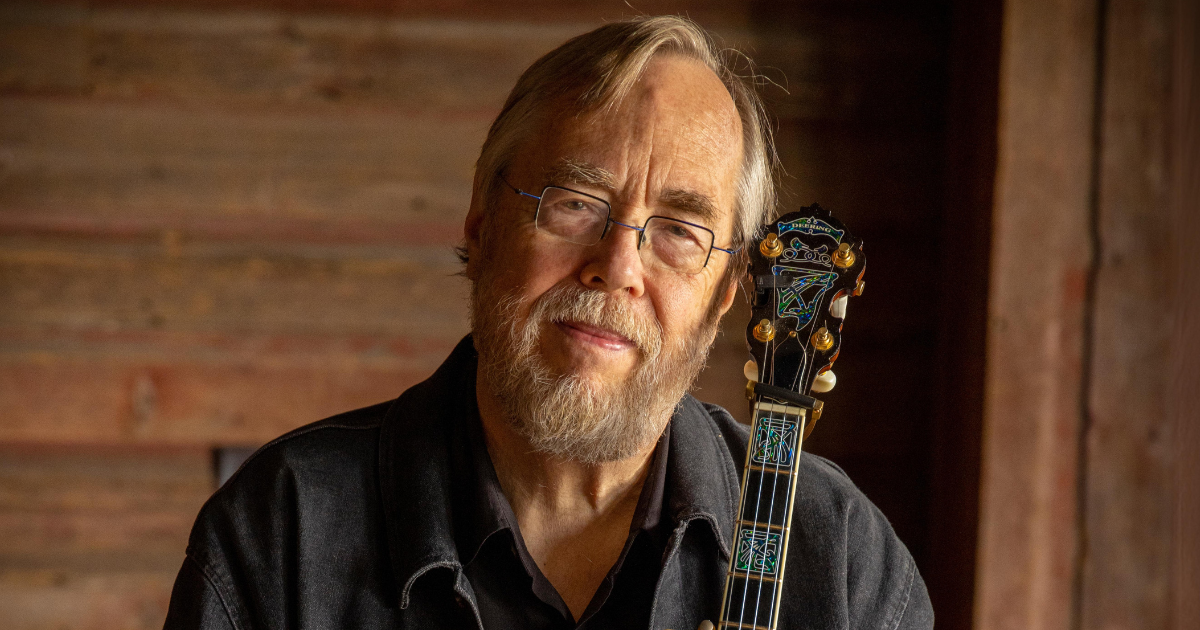
Banjoist Tony Trischka is a brilliant creator, an entertainer, and educator who makes his own time. He’s always on the run, trying new things and yet also always ready to stop and have a friendly chat and a catch up. His musical life includes teaching, performing, and recording as well as studying music history. And, at a very young 75, he’s always up for an impromptu jam.
In 1976, when he was 28, Oak Publications published his Melodic Banjo, an instruction book featuring his transcription tablatures of pieces by and introductions to the top players of this new style of bluegrass banjo in which he was already recognized as a virtuoso. The book became a modern bluegrass banjo classic and was later published in new editions by Hal Leonard.
When Rounder reissued Tony’s first two albums as Tony Trischka the Early Years, Berklee’s Matt Glaser wrote:
Rarely, perhaps three or four times a century, some music will be created that is a pure explosive expression of life energy and uncontaminated joy. The music on this CD is, in my humble opinion, exactly that. … I put Tony’s early music in the same category as the best of Charles Mingus, Cecil Taylor, Scotty Stoneman, and Wagner, mad and magnificent. … It’s some of the most unjustly neglected of all popular music masterpieces.
Tony’s passion about bluegrass banjo history came to the fore in 1988 when he co-edited “the most comprehensive banjo book ever written,” Masters of the 5-String Banjo, with Pete Wernick, his partner in the early ‘70s band Country Cooking.
There’s not enough room here to write about Tony’s full career, but it’s important to know that in addition to performing on the banjo doing everything from straight-ahead bluegrass to rock, avant garde, and theater, he’s also a band leader, producer, teacher and historian. A Grammy nominee and winner of the IBMA’s 2007 Banjo Player of the Year award, he now teaches an online banjo course for ArtistWorks, and continues to appreciate the pleasures and challenges of jamming – the subject of his latest album, Earl Jam, which was released June 7 on Down The Road Records.
I met Tony in 1986 in New York where I was giving a lecture to promote my new book, Bluegrass: A History. We got together afterward to explore our shared interest in bluegrass banjo. Since then, we’ve worked together on several projects, the latest being Earl Jam.
In November 1990, we reconnected at the Tennessee Banjo Institute. He took me to hear Institute faculty member Carroll Best, a North Carolinian who’d been playing melodic banjo since the ’50s. We ended up together at Best’s campsite. In 1992, Banjo Newsletter published our interview of him along with Tony’s transcription of his work.
Trischka’s 1993 album, World Turning, reflected his eclectic experiences in taking the banjo to the world. Bob Carlin called it “his bid to move the instrument back into the mainstream.” Beginning with an African tune, he explored the banjo in a variety of genres – minstrel, classical, old-time, ragtime, new acoustic, and rock, along with his own brand of bluegrass.
In 2001, Tony and I reconnected at Banjo Camp North in Massachusetts. In addition to its concerts and workshops featuring big-name instructors like Tony, Bill Keith, Pete Wernick, Tony Ellis, and Bill Evans, there was free time for informal music-making. Tony and I spent a pleasant evening jamming together.
For his 2007 album, Double Banjo Bluegrass Spectacular, Trischka recorded duets with 10 banjo pickers, with backing by top-flight bluegrass instrumentalists. These recordings have taken on new meaning now that some of his musical partners on this award-winning production – Earl Scruggs, Kenny Ingram, Bill Emerson, and Tony Rice – are no longer with us. The album introduced a generation of young musicians, showing the remarkable depth of Tony’s musical connections.
Tony’s brand new Down The Road album, Earl Jam: A Tribute to Earl Scruggs, reflects his longstanding interest in bluegrass banjo’s late founder. The album began during the pandemic, when Banjo Newsletter columnist, Bob Piekiel, author of “Earl’s Way” and a Scruggs family friend, sent Tony a thumb drive containing two hundred songs and tunes recorded at jams with Earl Scruggs and John Hartford during the ’80s and ’90s.
Tony and Piekiel had been working on the “tabs” – tablatures – for a new Scruggs banjo book. Since the early 1970s, bluegrass banjo tabs have been key musical manuscripts. None are more important than those of Scruggs, whose iconic statements – the ones he recorded – were published by Scruggs himself in tabular form in 1968. Many banjo pickers learned “Foggy Mountain Breakdown” and other familiar favorites from Scruggs’ tabs.
Like any written music, tablatures are scores meant to describe how music is created on an instrument, while simultaneously prescribing how it is to be reproduced. Tony made tabs of Earl’s jam breaks so that he could recreate them. Jamming with Hartford, Scruggs played familiar pieces he’d never before recorded or performed in public. On that thumb drive, Tony found Scruggs’ impromptu banjo statements as interesting and entertaining as the old familiar recorded and transcribed ones from his commercial appearances.
Change and innovation are part of the ambiance at jam sessions. Playing an old tune or song in a new way is a sure route to pleasant interaction in these friendly musical conversations. Here, ideas are expressed, tested, embraced. Participants play for their own delectation and to pique the interests of the other jammers.
It’s not easy for those of us who enjoy hearing commercially produced Nashville music to know what goes on informally and privately in that town’s local music scenes. Beyond the bars, stages, and studios, away from the producers, who jams with whom? In 1998 when Tony interviewed the late Bobby Thompson, melodic banjo pioneer and Nashville studio A-lister, he got Bobby’s answer to that question:
Scruggs, he’s real nice. Me and him would get together and play a lot. Lately I do him and John Hartford and bunch of them come over here a lot.
In his notes to Earl’s 1972 album, I Saw the Light with Some Help from My Friends (Columbia KC 31354), Bill Williams wrote about star-packed jams at the Scruggs home, calling it “a gathering place, a watershed of talent, a place to be oneself,” adding that “while the industry has known many outstanding jam sessions, there are none quite like these.” By that time, jams had been going on at the Scruggs house for a long time.
A number of the old Flatt & Scruggs songbooks published snapshots from ’60s jam sessions at the Scruggs home. And just as some people took snapshots at such sessions, others made recordings. John Hartford had recorded his jams with Earl and given Piekiel a copy because he worried that if his house burned down all those jam recordings would be lost.
Nashville pros like Thompson and Hartford – whose success as a singer-songwriter (“Gentle On my Mind”) underwrote a unique career – would, as Thompson said, “get together and play a lot” with Scruggs. Hartford, a Scruggs fan from an early age, played the fiddle while listening with pleasure to Scruggs’ banjo statements, and began bringing a tape recorder along.
Earl and John had played what they knew, taking pleasure in attacking old favorites in new ways. After learning and transcribing Earl’s banjo jam breaks, Tony put together a band to showcase them in a show at in the New York club Joe’s Pub. What people heard was first-class bluegrass musicians along with Tony’s musical recreation of Scruggs performing an eclectic repertoire – pre-war and post-war country classics, traditional tunes, rock, bluegrass, folk and more.
On Earl Jam, which grew out of Tony’s showcase band, we hear leading contemporary artists, including Sam Bush, Michael Cleveland, Dudley Connell, Michael Daves, Jerry Douglas, Sierra Ferrell, Béla Fleck, The Gibson Brothers, Vince Gill, Brittany Haas, Del McCoury, Bruce Molsky, Billy Strings, and Molly Tuttle, in new musical conversations with Tony Trischka providing the “banjer” voice of Earl Scruggs.
Here, today’s artists each perform with their own contemporary voice while Tony, consummate and experienced stage actor that he is, takes center stage in the role of Scruggs-at-a-jam. He’s a musical equivalent of actor Hal Holbrook, who brought the voice of a famous American author to millions in his one-man show “Mark Twain Tonight.”
A good example of the music on Earl Jam is “Brown’s Ferry Blues,” the album’s first single. It opens with a solo guitar break by Billy Strings during which rhythm instruments: mandolin (Sam Bush) and bass (Mark Schatz) come up behind. Then Trischka introduces one of Earl’s jam breaks, after which Strings sings the first of six verses.
After each verse, we hear an instrumental solo. First comes Michael Cleveland, who throws in some licks associated with Foggy Mountain Boys fiddler Benny Martin. Next is Bush playing his usual great, hot stuff.
After verse 3, Tony plays not one but two more Scruggs jam breaks, each quite different from the other. After verse 4, producer and banjoist Béla Fleck contributes a statement in his unique style. Following the next verse there’s a blazing guitar break from Strings, who then sings a newly composed verse that names everyone at this live session, after which the track closes with all five instruments going full-bore as if at a jam – instruments like voices at a cocktail party.
Tony’s newfound conversations demonstrate Earl’s economy and genius, and his ability to inject feeling – humor, soul, hot, cool – in unexpected places. Scruggs’ musical vision is an education and a pleasure. We’re grateful to Tony for capturing it, preserving and showcasing it.
This truly is a unique album. Each track combines the contexts of bluegrass and theater. We hear bluegrass and old-time music’s standard verses and instrumental breaks. They are mixed so that we can visualize each musician stepping up to the mic to sing or pick. And then the curtains open and Trischka appears spotlighted in a cameo closeup delivering lines – breaks – that Earl spoke at the end of the century, when he was in his 70s.
It’s ironic that tabs have crystallized an aural model of Earl Scruggs’s banjo playing based largely on his ’40s and ’50s work with Monroe and Flatt. That music became the model for classic bluegrass. It still sounds great today. But by the ’60s, Earl had moved on. As Tommy Goldsmith (Earl Scruggs, p. 120-123) points out, an informal backstage jam in New York with saxophone virtuoso King Curtis convinced him that he could take his banjo into other genres like rock.
As soon as he and Flatt parted ways in 1969, Earl joined his sons to form the Earl Scruggs Revue. In the following decades he played with them as well as a variety of folk, rock, and pop acts, fitting his banjo into many new contexts. By the times of his jams with Hartford, foremost in Scruggs’ mind were the then-recent years of touring with the Revue and trying new stuff.
In 1983, L.A. producer (Byrds, Flying Burrito Bros.) Jim Dickson told me why he came to like bluegrass: “It was part formal and part improvisational breaks, the same kind of structure jazz had.” (Bluegrass: A History, p. 190) Tony’s cameos highlight the improvisational genius that kept Earl’s music fresh and inspired a generation.
On Earl Jam, Trischka explores Scruggs’s genius in various ways. Several individual song arrangements have modulations (as in “Dooley” and “Casey Jones”) that show how Earl was able to recast his melodic ideas in different keys and tunings. Tracks like “Liza Jane,” “Lady Madonna,” and “Brown’s Ferry Blues” close by moving beyond solo breaks into riff trade-offs to portray the playful conversation that is the essence of jamming.
Tony’s sense of history is reflected in his repertoire choices – reflecting rich heritage and continuing experimentation. Like a painter he has blended, collaged, borrowed, and adapted widely from past art. The result is a series of vignettes building on the shared creativity of today’s most gifted singers and players while also embracing Earl’s many paths.
I visualize these tracks as tangible works of art like we might see in a museum or gallery – from antique quilts to abstract modernist paintings. BGS’s Artist of the Month, Tony Trischka, has created a veritable aural exhibition.
At 26, the prodigy phase of AJ Lee’s music career has passed. It might take a little more time for the tendency to confuse her with a professional wrestler using the same name to fade away.
“I think I could take her!” Lee — the singing one — gamely pronounces at the conclusion of an interview on the third album by AJ Lee & Blue Summit, City of Glass (out July 19 on Signature Sounds), prompting laughter from the band’s Scott Gates, who asserts himself on the new album writing three songs on which he sings lead.
Rounding out Santa Cruz, California-based Blue Summit are fiddler Jan Purat and guitarist Sullivan Tuttle, one of the children of educator-musician Jack Tuttle and brother of breakout star Molly Tuttle. Lee also got her start with “The Tuttles with AJ Lee.”
A keen sense of humor dots City of Glass, which was produced by Lech Wierzynski of “retro-soul” band The California Honeydrops. It was Wierzynski who suggested Harlan Howard’s “He Called Me Baby,” on which Lee delivers a notably sultry lead vocal. The reference point for her version of “He Called Me Baby” is soul singer Candi Stanton, rather than Patsy Cline or Charlie Rich.
“I was raised to sing pretty straightforward. I wanted to remove as much ego as I could, because I just wanted to sing and have fun,” Lee said. “I’ve learned to put a little bit more of my personality into it and that, I think, is making me a better singer overall, which is why we wanted to work with Lech in the first place, because he’s such a powerful singer.
“That really resonated with me and I’m trying to move more in that direction.”
Gates pipes up at this point: “AJ’s not going to say this, but Lech brought ‘He Called Me Baby’ to the table because he had the foresight, coming from that soul world, he recognizes in AJ’s voice the ability to do this kind of thing.
“The cross-pollination of these American roots, is a smart move from Lech, I think,” he said.
BGS caught up with Lee and Gates as they rehearsed in Nashville, Tennessee, and prepared to do some lip synching for a video. As a seasoned bandleader, Lee takes pains to spread the credit for her success around and steers some questions toward Gates to try and ensure she doesn’t dominate the conversation.
City of Glass is AJ Lee & Blue Summit’s third album. How do you view the progression that got you to this point?
AJ Lee: The first album, [Like I Used To], we were looking for what kind of sound we wanted as a band. Because at that time, it was only four members without a fiddle player. So on that one, we had some more electric instruments and more drums. The second album, [I’ll Come Back], we went more acoustic roots, because we just wanted to play more bluegrass, because that’s what we grew up on and that’s what we do best. For this third album, we’re confident doing bluegrass, roots, and country, sticking with more stringed instruments, but also branching out. With Lech’s involvement, we’re leaning a little bit towards soul, R&B, and keeping it interesting, but still showcasing ourselves and what we like to play and what we like to do.
Several songs on City of Glass are funny. There’s one, “Toys,” making fun of a men who act like boys, another about getting “Sick on a Plane” and a humorous take on busking, “Solicitor Man.” Why so lighthearted this time around?
Scott Gates: I grew up playing bluegrass with a lot of silly guys. There’s a bouncy kind of lighthearted feel in a lot of traditional stuff. … I noticed that a lot of songs that I had written were kind of getting down into my feelings and whatnot, and I wanted to write one that I knew would be fun for my friends to play.
Are there models in bluegrass you’re following with the humor?
SG: There is a history of fun stuff like The Louvin Brothers. I’m also influenced by Jimmy Martin. Jimmy Martin is one of the pillars of bluegrass music, and he’s hilarious.
“Toys” is about a young guy or maybe an immature man. Is it about yourself, Scott?
SG: A little bit, yeah, probably as a teenager noticing the involuntary methods by which young, dumb boys go about thinking of themselves. It was mostly born out of that phrase, “The man who dies with the most toys wins.”
The title cut, “City of Glass,” is about leaving an artistic legacy. Aren’t you guys a little young to be concerned about that?
AJ: Yeah, I’m pretty young. I’m 26 now, but I have been doing music since I was really young. Collectively, we figured out that the band has about 90 years worth of experience. I’ve been playing on stage since I was about four or five years old. So I’m young, but I have been doing it for a long time. Legacy is having something that you’ve made be around even when you’re not doing it anymore. That’s a big theme of “City of Glass.”
As you say, you got started very young as musicians and Jack Tuttle was a common mentor. How did that develop?
SG: I met AJ when she was four. I knew her older sister Molly, ‘cause she’s my age. So I knew her more. But [Sullivan Tuttle] was around, and Sully and AJ had known each other since back then. I was probably about seven or eight when I first started going to the Father’s Day Festival and the music camp. So I got an opportunity to learn and play from people like John Reischman and Mike Compton and see musicians like The Osborne Brothers and Earl Scruggs. The picking scene is incredibly high quality.
AJ, you were the only non-Tuttle in the Tuttle family band when you were very young. What was that like?
AJ: I loved it. As a young kid, it’s kind of hard to be in the moment and really appreciate what you’re doing. As a seven-year-old to fifteen-year-old, I went about it as like, “OK, we’re playing a gig, I’m going to practice here and I’m going to sing my song. I’m hanging out with my friends, and that’s it.” But being in that band was definitely instrumental in my progress as a bluegrass musician, because I got to work directly with Jack Tuttle. Everyone loves Jack because he’s such a renowned teacher in the community and obviously all of his kids are talented beyond measure. So I was able to play with people who were better than me and also equal to me. My mom, growing up, she always said, “You always want to play with people who are better than you, because that’s how you’re going to get better.” And so I got to have that opportunity for many years.
Is there any competition now between yourself, Molly Tuttle and Bronwyn Keith-Hynes now that you all are competing musicians in the marketplace?
SG: Absolutely! [Laughs]
AJ: No, no, no, definitely not. For me and Molly, we’re branching off and doing our own thing. We were in a band for however many years, and now we’re off doing our own projects. And Bronwyn is branching off and doing her own projects in a similar way.
So, it’s the same in any community or genre of music, you played together and now you’re doing your own thing. Molly’s singing on our album as well, on a song [“I Can’t Find You at All”] that her dad wrote.
AJ, you could pursue a solo career, why do you prefer a band situation?
AJ: It makes me happy. I like playing with other people. I don’t really like performing by myself. I feel like I have a lot to offer, but I also like playing with people who also have a lot to offer and are amazing talents. And, you know, people compliment our band on how many singers there are. I always think that the more singers the better, the more talent you can showcase the better.
Pretty much anyone in the band could peel off and do a solo career. But I think what makes us really unique and strong as a band is that we all can be individual musicians, but we choose to play together, because it just makes the creative juices flow more and it makes us want to even continue on more than I would as a solo musician.
SG: At some point, I’ll probably do my own project. But right now, all I care about is playing music with AJ and the boys and see where this goes. I try not to plan too much. I don’t really scheme. I probably should scheme a little bit more, but I just don’t.
How does the California bluegrass scene differ from the South?
SG: A lot of people think of California as the jammy stuff, the Deadhead stuff that comes out of there. But even to this day, the California Bluegrass Association is very traditional. It’s one of the most traditional associations out there and there’s also a huge focus on singing. The singers that come out of a place like Tennessee are extremely good at blending. There’s a school of singing, and a lot of them sound very similar. Their harmonies are incredibly perfect. But California tends to reward individuality and uniqueness. The unique voices are kind of put on a pedestal.
AJ, your singing style is more subtle than showy. Why?
AJ: I agree with you. I’ve always really appreciated the subtlety of singing to where it’s not, “Look at me. Look at how well I can sing.”
“Hillside” uses the metaphor of a hill that aspires to be a mountain. What does the metaphor represent?
AJ: “Hillside” is about women empowerment. The metaphor is that you are this hill that is bombarded by all these outside elements trying to knock you down. But your foundation has become so strong and nothing’s really going to topple you over.
Have you experienced a lot of sexism in your career?
AJ: I’ve experienced some, of course. Especially after shows, you know a lot of older gentleman say things to me that obviously they mean well, but it just turns out to be very sexist. I get a lot of the, “If I was 20-years, 30-years younger” sort of statements, and it’s just like, “Ooh, gosh.”
How about general discrimination?
AJ: Yeah, especially jamming in the bluegrass community, as a woman sometimes you’ll just get into those circles that have that male energy so present and it’s really hard for women to join a jam sometimes. But I’ve learned to try to just get myself in there over the years with support from my mom and other strong women who are also in the community.
Are you on the record on where the “Blue Summit” band name originates?
AJ: Our first festival we played was a Kate Wolf festival. We actually didn’t really have a band name yet that we were happy with. The original name we hated. Our original bass player at the time, Isaac Cornelius, came up with The Highway 17 Savages, which doesn’t really resonate with our band at all. We totally needed to change this name. So we made these recordings to send in to Kate Wolf at Isaac’s house, which he grew up on the summit in Santa Cruz. So we were like bluegrass on the summit. So we became Blue Summit.
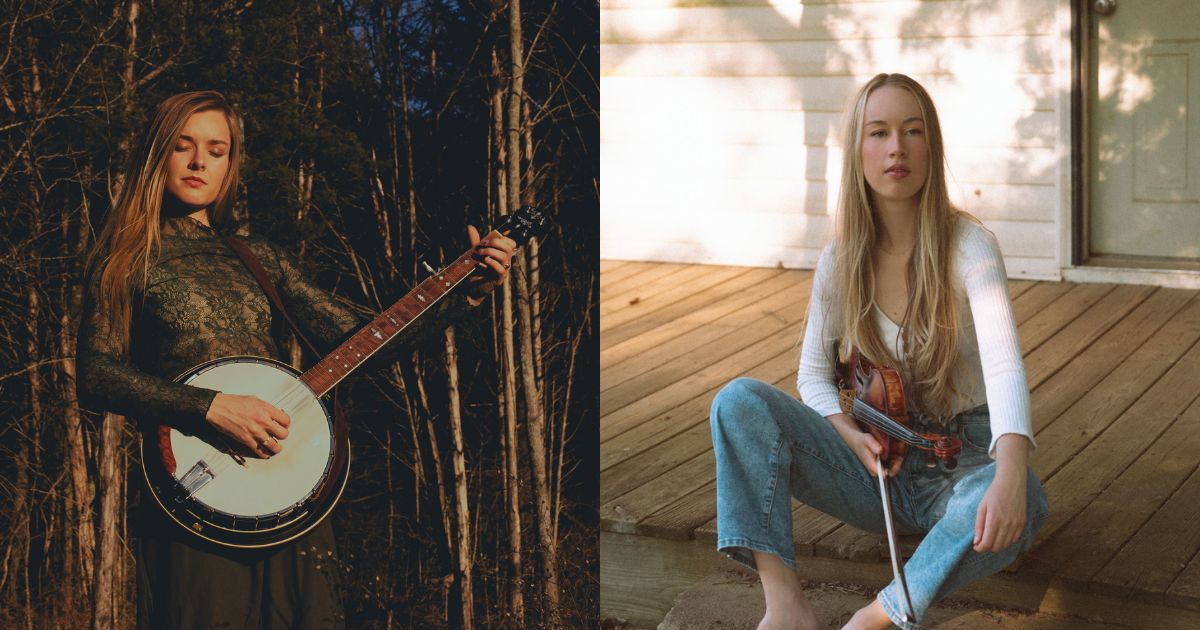
At whatever level you may be plugged into the online bluegrass scene, you have surely heard, seen, or scrolled into content by Bronwyn Keith-Hynes and Brenna MacMillan. These two young, talented pickers are part of a vibrant and blossoming community of traditional musicians and folk artists that includes folks like Cristina Vane, Victor Furtado, Hilary Klug, Wyatt Ellis, and many more.
What makes these creators stand apart, especially Keith-Hynes and MacMillan, is that they aren’t just shoehorning social media into their art-making and creative processes to move up Music City ladders and check abstract music industry boxes. Instead, they’ve intentionally demonstrated how powerful, engaging, and charming content can be when it’s made with art, creativity, tradition, and joyful, cooperative generation as its focal points. Instead of bending over backward to construct virality and lean into transient socials trends, they let their talent, their songs, and their communities do all the talking.
In May, Keith-Hynes released her second solo album, I Built a World, her first project to center songs and her recently-developed, impressive vocals. Drawing on musicians and pickers from her immediate circle and her main gig – Molly Tuttle & Golden Highway – as well as tapping notable country stars and bluegrass legends, the project finds Keith-Hynes at her most confident and unbothered. This is a fiddler-singer-front woman who has found her voice – literally, through work, practice, and vocal lessons as well as figuratively, not satisfied to craft a career on bowing the fiddle alone.
Later this year, MacMillan will release her debut solo album. Its lead single, “What’s to Come,” features Ronnie McCoury and is indeed a harbinger for the superb album to follow. This project, which highlights MacMillan’s prolific songwriting and features her musical community fleshing out the band, is built directly upon the successes she, Keith-Hynes, and others have found on the internet. Eschewing labels, management, or traditional roll outs, MacMillan will release the project herself, with funds raised on GoFundMe, bringing the music directly to her consumers on her own website and socials channels without “middle men.”
So, not only are MacMillan and Keith-Hynes innovating on ideas around what it means to be a side person, a career picker, and multi-hyphenate, professional traditional musicians, they’re taking all of their expertise as online brands and businesswomen to find success for themselves, on their own terms. They’re focusing on what matters, centering their communities, and making incredible, superlative music at the same time.
BGS connected with MacMillan and Keith-Hynes together via video chat to talk about their unique approaches to making albums, content, and music, while highlighting the deep and tight-knit “bluegrass influencer” circle they’ve each helped create since moving to Nashville and putting their all into bluegrass.
I wanted to start by talking about community and musical community – one of the reasons why I wanted to have you both in conversation with each other is how you each rely on, draw from, and center your musical communities in what you create. It may look like these are solo projects that you’re making, but they’re clearly not solitary projects – and they don’t really feel like vanity projects, either. from the outside looking in either. It really feels you’re making music with other people so you can make music with other people. Could you talk about your work, your solo albums, and working in your communities?
Bronwyn Keith-Hynes: Yeah, I think first and foremost, me and Brenna are good friends and we just ended up being drawn together. We both moved to Nashville around the same time and ended up doing a lot of things together and had a lot of similar interests. That’s cool to find. I haven’t found that many women who have my same interests until I moved to Nashville and then all of a sudden I felt like there was a whole bunch. It’s been really awesome to find that.
First of all, I’m just such a fan of so many people, and I wouldn’t want to make music any other way. My project was based around songs from my community, which was really special to me. It was like a little nerve wracking reaching out to friends and people I respected to be like, “Do you have a song that you’re not going to record that I could record?” But, thankfully, a lot of people did – including Brenna – and I ended up recording one of her songs. And, she sang on it and it was awesome!
I feel like I couldn’t do it alone. I know my strengths and then I know other people’s strengths and I want to make sure we’re all [drawing on our strenghts]. I don’t know if singing is my strength, but it’s something I feel passionate about and feel driven to do for whatever reason. I know the things that I want to put out in the world; I want to make sure the music I’m making has the best parts of myself, but then the best parts of everyone else who’s playing on it.
I think that folks who aren’t just straight white men in this industry, we realize from the get-go that we have to have others with us. We have to do it together. Otherwise we’re not going to go the distance. I feel that in both of your music, as well. But Brenna, I wonder what that question brings up for you, as you’re thinking about and positioning your album to release as well?
Brenna MacMillan: It’s funny, because when Bronwyn asked about songs that I had, I had like a bunch and at that time I wasn’t even thinking about [making] an album at all. I think it was maybe like a couple months later that I decided, based on my friends that kept being like, “You should record some of these songs!” And I was like, “I guess…” I wasn’t thinking about it at all whatsoever.
Then that’s another way like to get my songwriting out there, too. And why wait for someone to come to me for songs if they don’t even know that there are songs? Besides my friends, which is who I first would want to do my songs anyway. It’s funny, because obviously it’s really cool putting out your own music, but I still get more excited when “Riddle” comes on than when “What’s to Come” comes on. [Laughs] That is so cool!
Someone else’s vision for your song, it’s like the coolest thing ever to me. Because, I know what my brain comes up with so it’s not shocking, but someone else’s ideas around something that you wrote – it’s like the coolest thing ever, and I guess that’s why I love the community. I feel like community is like the word that I say way too much, but I do I love it. For Bronwyn, Cristina [Vane], Hilary [Klug], Emily, and Mallory, to some extent back in 2018, we all were moving to town around that time and then 2020 hit and I think that’s when we all got a little closer, because we were all bored and wandering around. I took a lot of walks with my friends, individually, we tried to stay across the path from each other, but I think those bonding moments brought us closer. We were like, “Let’s get coffee” or “let’s get dinner,” and then we ended up making a video or something and it all evolved into great friendship, plus people online being like, “Oh, we like to hear you guys play together!”
One of the things I love most about that whole community of content creators – you’re talking about Cristina Vane and a lot of these other folks you create with here in Nashville – it never feels like you’re trying to shoehorn bluegrass into contemporary content creation. It really seems that making bluegrass music and making roots music with your friends is the impetus, and then you made it fit into social media – instead of vice versa. Like, it’s happened organically and from a community standpoint first, and not just from “I have a social strategy. I have a five year plan.” Do you agree or disagree?
BM: Oh yeah, I agree. There’s not much strategy that’s happened in here. There’s not a lot of that going on. [Laughs]
And yet, I can tell you objectively from the outside looking in, y’all are still operating with 110% more strategy in mind than most of bluegrass. [Laughs]
BKH: I feel like Brenna and I have both talked about – correct me if I’m not saying this right, Brenna – wanting social media to serve us, rather than for us to serve social media. The end goal, for at least for both of us, is not like to become a social media star, it’s to have it serve us, to get our names and our music out to more people.
BM: Yeah! And it felt like it was very random that social media took off for me. I was just like, “Where are you guys coming from? Why do you want to hear me kick off a J.D. Crowe song like every day?” But at the same time, it has its own frustrations and that’s when me – and I think a bunch of the other girls that do this side by side with their music careers – we’re like, “We’re going to have this, but only if it makes sense for helping promote our live gigs and any projects we’re doing.” But as soon as I get nasty comments, or this, or that I’m like, “Oh, I will literally just get off of this app if it’s going to go this direction.” I just block people and then keep going.
I want an audience who will appreciate the things that I want them to appreciate. I think that I’ve trained my audience, too. Basically I shoved it in there, “You are going to listen to this slow song and try to enjoy that. And if you don’t, then I’m going to take you [out of my following]…” Because there have been some people who think that I am a content creator on there, and I’m like, “No, I play music and I took an hour out of my day and posted this video and we’re lucky that happened. Now I’m on my way to a gig and I don’t need some [negative] comment.” But you could come to a live gig and request a song!
Brenna, one of the things I love about your upcoming album and the messaging around it is that you’re really doing a direct-to-consumer business model and roll out. You’re being like, “Y’all can come to me. You already know how to find me, so this is where you can find the music, too.” I think it’s amazing and again, it’s the cutting edge of what the future of bluegrass will be while it’s also so fucking trad. It’s like back in the day, when bluegrass music required taking the car battery out of the car to play a show in the high school auditorium and then putting the battery back in to drive to the next high school auditorium.
It’s like you’re doing that in the 21st century. You’re being a DIY bluegrass musician, but in 2024. Can you talk a little bit about the direct to consumer model you’re using with your album roll out?
BM: I was like, I need to build a website so that there’s everything in one place – I remember why I did it, too, because there are a bunch of fake accounts. I knew I needed something out there to be authentic and to have all of my official links. That was literally my number one goal with the website. So now, here’s the link to my website, you can find my YouTube channel, my Facebook, my Instagram, my TikTok from there. And you’re going to know you’re in the right place. I’ve basically just started to try to push everything to my website and go from there to everything else, even if it’s taking you back to Instagram. Because [the website is] where everything’s going to happen, so that you know that it’s me instead of some person scamming you. I guess with that in mind, I started trying to link everything, like in my stories, when I’m talking about anything coming up, I just say, “Go to my website!”
Bronwyn, I wanted to ask you again about community and about bringing your circle, your scene into your album. I love all of the features on your album and I also love that it doesn’t just feel like you’re reaching for a Collaborative Recording of the Year nomination.
[All laugh]
But I wanted to know how it felt to you, as you were thinking about who you wanted to have on the record and why you wanted to have them on the record?
BKH: I’m glad to hear you say that it feels like it’s in service of the music, because that was definitely my intent. It was the funnest part of [recording the album], for me. I did kind of make those decisions after the tracks were done and I’d done my vocals. I just didn’t know how it was going to turn out until I heard it. Then I would brainstorm with Brent [Truitt], and Jason [Carter], and whoever about who to get on it. Dudley Connell was somebody I was really excited about and I’d never met him. I didn’t know him. Someone just gave me his number, I called him up and left him a nervous voicemail. But yeah, he turned out to be the sweetest guy ever – and he’s a bluegrass hero, I love all those Johnson Mountain Boys records.
It’s crazy especially being a new singer, I haven’t heard my voice recorded much ever. Then to hear my voice with all these other voices that I know and I’ve heard a lot – to hear like that combination for the first time – it was like very surreal!
What was it like working with Dierks [Bentley]? We all know his bluegrass pedigree and his connections to the Station Inn and to the McCourys and that he’s always had one foot so solidly in bluegrass, but y’all would have gotten to know him and got to spend some time with him on the road with Molly Tuttle & Golden Highway, too. I wondered how how that conversation happened and also what it felt like to you to have someone who has gold records and platinum records collaborating with you on your record?
BKH: I grew with his Up On The Ridge album, it was literally one of the first bluegrass albums I heard around my college years. I was obsessed with it and I thought it was so cool. It got me into listening to the more trad stuff, but I’d always loved his music and then being Jason [Carter’s] partner, and Jason and he were friends even before he was famous. So they’ve been friends from the get go.
I’d met him a few times through Jason and then again when we were on tour [opening for him], that was cool. ‘Cause I felt like we could meet [more as peers], not just because I’m somebody’s partner. But now, this is my gig and this is your gig. And you’re asking us to sit in every night. I felt a little bit more comfortable to make that ask. He just came into Brent’s studio one day and tracked it in under an hour. He’s great! Very quick.
Brenna, talk to me a little bit and if you have features on your upcoming album – and if you can’t talk about them yet, that’s totally fine.
BM: I know, I was trying to think of what I should say – I don’t know, I’m the one in charge! But let me check, I don’t know if Brenna wants to tell all that yet. [Laughs]
At the very least, we can talk about Ronnie [McCoury] and “What’s to Come.” Ronnie’s one of my favorites. Talk a bit about, again, bringing in community and bringing in the scene that already surrounds you.
BM: The core band in the studio was [Mike] Bub on bass and Jake Stargel on guitar. Me, I played banjo on four or five of the tracks, but I have been writing a lot on clawhammer lately and I know that I’m not good at it, so I had Frank Evans come in for those and then I had Cory [Walker] play on a couple very last minute. I was thinking, it’s just going to be better if he does it.
When the special guests ideas popped in my brain, I was thinking, “Do I want special guests to be like my friends, my age, or like people that I really are like heroes of mine? Is this the time to ask them? I don’t know.” Nobody knows who I am, but that’s okay. I had met Ronnie a handful of times in kind of settings where it was like, “I’m here with so and so” and I’m just a little curmudgeon. [Laughs]
“What’s to Come,” it’s like a reflective life song. I know that I sound like a small baby when I sing, and I was thinking of someone with an older sounding voice. Like wanting ancient, lonesome vibes so that there could be old and young together, pondering about life. If you’re young or if you’re old, you still ask all the same questions about life.
Also, [Ronnie’s] gritty mandolin playing. I love it so much. Jarrod Walker played on most of the core mandolin stuff, but he happened to be out of the country that session. I was like, this is perfect! But it’s funny, because I didn’t even know if Ronnie was going to bring his mandolin! [Laughs]
To wrap up, here’s a question I had for both of you, because you’re both musical shape shifters. You move in and out of musical contexts so easily; you’re both side people, you’re both front people, you’re both social media brands. How do you maintain your senses of self?
BKH: I feel like I can’t get away from myself! I don’t feel like I ever even think about that. The only way I’ve struggled with that a little bit, or thought about that more, is doing the solo projects. That’s where I’m like, “Wow. OK. What would Bronwyn do next?” But I think I know what I like and I know what I want to do. I’m just like, “How am I going to do that? I need to figure that out.
BM: I think similarly, I don’t really think about it that much. I think I know what I like, too. And I know what I don’t like. From the get go, I’ve very much just been myself online. I come home from the lab job and do a video with dark circles [under my eyes] and grunge and smelling like hemp trash. That’s what I established from the beginning. So now, I feel comfortable being myself.
Pretty much everything has been my own ideas and, it’s funny, because ten of my eleven songs are originals on the album, three of which are co writes, but hearing it come to life in the studio with other people, it still ended up being what I thought it should be. Which is weird, because there’s no way that I could bring some of these musicians into the studio who are eons beyond what I could imagine, but they knew exactly what the track needed. It does sound like me still and what my vision would have been if I had expressed it [all myself].
BKH: I feel like I’m like more myself these days than I’ve ever been. I feel like for a while, starting out in bluegrass, I had a lot of ideas of what a woman in bluegrass needed to look like, or be, or act like. In the last couple years, maybe inspired by being with Molly in Golden Highway, I feel like I’ve been able to let a lot of that stuff go – about how I should dress and whatever. Now, I embrace the things I actually like.
Photo Credit: Brenna MacMillan by Sophie Clark; Bronwyn Keith-Hynes by Alexa King Stone.
Welcome back to BGS Bytes, our monthly column designed to spare you the scroll and key you into the most notable roots-related social media posts! From birthdays to tributes to the dawning of festie season, we’ve got something for everyone. Check out these buzzworthy and viral internet moments from Randy Travis, Molly Tuttle, Chris Eldridge, the Brothers Osborne, and more.
AI Gives Randy Travis’ Voice A Second Chance
@randy.travis Randy’s fans and their desire to hear his voice again inspired Randy to make “Where That Came From” a reality with the help of his team. We are blessed to share this moment with you. Your love inspires Randy to keep on going! Thank you for singing along, always. – Team RT #CountryMusic#NewMusic♬ Where That Came From – Randy Travis
In 2013, Randy Travis suffered a major stroke following his hospitalization for cardiovascular issues, resulting in aphasia that severely diminished his capacity to speak and sing. Devastated, the world thought Travis might never sing again — until just a couple of weeks ago.
Working alongside Cris Lacy, a co-producer from Warner Music Nashville who previously produced Travis’ music, and Travis’ longtime producer Kyle Lehning, a small team of songwriters, musicians, and computer programers put together a new song for Travis, “Where That Came From.”
The track uses scratch vocals laid down by singer James Dupre, which were then filtered through an AI system informed by dozens of sound bytes from Travis’ catalog. Through trial and error, Lehning and engineers worked to ensure that the song seamlessly evoked Travis’ essence. Travis and his wife, Mary, are absolutely elated by the results, calling the experience “magical,” “beautiful,” and “overwhelming.”
Stevie Wonder Celebrates His 74th Birthday by Becoming a Citizen of Ghana
On May 13th, the legendary Stevie Wonder celebrated his 74th birthday while attending a ceremony that granted him Ghanaian citizenship. The first African country to become independent in 1954, Ghana has historically been an epicenter for many African Americans disenchanted with rampant anti-Blackness in the states. In 1975, Wonder began to dream about moving to Ghana to reconnect with his ancestral roots. Though he reconsidered, remaining in the U.S. to record his lauded Songs in the Key of Life, his 50-year dream came full circle this month.
He spoke on the monumental nature of this moment in his speech at the ceremony, stating, “Now, as a Ghanaian citizen, I am committed to fulfilling the dream we’ve cherished for so long — uniting people of African descent and the diaspora.”
Chris Eldridge Pays Homage To His Father, Ben Eldridge
Throughout its history, bluegrass has been well known as an intergenerational genre, passed down through familial, social, and geographical lineages. One glowing example is Chris “Critter” Eldridge (widely known for his role as a vocalist and guitarist with Punch Brothers) and his father, Ben Eldridge, who sadly passed away on April 14th of this year.
In a beautifully written tribute, Chris speaks about Ben’s incandescent banjo playing, the cultural significance of his band the Seldom Scene within the bluegrass and folk landscapes, Ben’s uncanny knack for mathematics, and his beautiful heart. A legend of his time, Ben will be missed greatly and forever revered.
Memorial Day weekend was a legendary one at the 16th annual DelFest, a four-day bluegrass festival taking place alongside the verdant mountains and flowing Potomac river of Cumberland, Maryland.
Listeners were in for a treat when the ethereal Sierra Ferrell came out to join Lukas Nelson’s set with the Travelin’ McCourys for a few songs. Among them was a cover of Adele’s hit, “Someone Like You,” infused with all the melancholy that a little country twang can offer. During a backstage pre-festival rehearsal, Lucas posted a Reel to warn Adele, “You’re going country whether you like it or not!”
In this sweet and heartwrenching post, Molly Tuttle, queen of flatpicking, tells the sweet story of her first Martin guitar. Penny by penny, she saved up enough at the ripe age of 12 to purchase her very own Martin. It is now on display at the Musical Instrument Museum in Phoenix, Arizona, alongside instruments from musical giants like John Hartford, Elizabeth Cotten, Earl Scruggs, Mississippi John Hurt, and more.
AJ Lee & Blue Summit Release New Single, “He Called Me Baby”
A song that has lived many lives, AJ Lee & Blue Summit put their own spin on the classic, “He Called Me Baby.” Written by Harlan Howard, the song was most commonly sung as “She Called Me Baby” until Patsy Cline covered it in 1963. Throughout its history, it’s shifted through many genres and forms, perhaps most notably becoming a Top Ten R&B hit in 1971 with Candi Stanton’s recording.
The Brothers Osborne Guest Judge on RuPaul’s Drag Race
And, being that we’re a few days into June, we simply must include a quick Pride Month teaser! This past week, brothers TJ and John Osborne, most commonly known for their country duo The Brothers Osborne, were featured as guest panelists in Season 9 of RuPaul’s Drag Race All Stars. This iconic crossover is the perfect kickoff to a month sure to be filled with reminders of the inextricable weavings of queer culture and roots music.
Photo Credit: Randy Travis by Marisa Taylor; RuPaul’s Drag Race All Stars productionstill courtesy of QPrime.
Born out of humble beginnings in 1983, Mountain Stage has blossomed to become not just one of Appalachia’s most sought after musical platforms, but one of all of Americana and roots music’s most cherished stages. Broadcasting bi-monthly to nearly 300 NPR stations nationwide, the program has welcomed everyone from John Prine to Wilco, Wynonna Judd, and even Widespread Panic during its historic 40-year run. To celebrate the achievement, Mountain Stage and Oh Boy Records have partnered to release the 21-song Live On Mountain Stage: Outlaws and Outliers (released April 19).
According to Larry Groce — Mountain Stage host from 1983 to 2021 and one of the compilation’s curators — distilling 40 years of music into one album was quite the task. Deliberations began with a list of over 150 songs before landing on the 21 that made the album.
“At first we just looked at the artist named and began to narrow it down from there,” Groce describes the process to BGS. “After several narrowings we began listening to some of them, getting the list down to about 30 before cutting it further down to the 21 that made the album.”
Sticking close to the country, folk, and bluegrass sounds of the show’s West Virginia home, the album includes performances from Appalachia’s own – like current Mountain Stage host Kathy Mattea, Tyler Childers, Sierra Ferrell, and Tim O’Brien alongside A-listers like Prine, Eric Church, Alison Krauss, and Jason Isbell. Helping to attract and keep such a diverse array of talent returning has been the program’s artist-first approach, which caters to the performers and platforms great songs over all else.
“We’re not trying to be trendsetters and we aren’t trying to be hip,” asserts Groce, who broke onto the scene as a singer-songwriter with his song “Junk Food Junkie” in 1976. “We try to look at things in the long run by booking talent we think will last. Our goal has always been to put the artist at the center of the show rather than myself, the program, or anyone else. There’s people that would argue that we should always be pushing the brand, but that’s not the way we — or anyone else — operates in West Virginia.”
One of the many artists appreciative of that approach is Molly Tuttle, who last appeared on Mountain Stage in 2023 to support her album City Of Gold, which has since earned her a second Grammy win for Best Bluegrass Album. Born in California, Tuttle didn’t become aware of the show until moving to Nashville in 2015. She’s gone on to play the show three times, the first being a visit in 2018 that provided the performance of “You Didn’t Call My Name” that made the compilation.
Of the show, Tuttle says what she’s cherished most about her time on it is the chance to collaborate and catch up with her colleagues.
“It’s one of the few places where you get to meet, converse and collaborate with other musicians, which typically only happens for us on the road at music festivals,” explains Tuttle. “That really speaks to the trust Larry Groce and the entire Mountain Stage team have in giving the artists freedom to do what they want. What results is a well curated show that’s become one of the most important showcases around for this kind of music.”
In agreement with Tuttle is Tim O’Brien, a native West Virginian who made his Mountain Stage debut in the late ’80s with Hot Rize, an occasion he credits to his mother that has sparked too many follow-up visits to count.
“She called my sister and I — who were living in Colorado at the time — to tell us about it after hearing about it on the local radio back home,” recalls O’Brien, whose song “Cup Of Sugar” from a 2021 appearance is featured on the record. “She immediately thought we’d be a good fit for it, so she wrote them a postcard one day asking when they were going to get Hot Rize on. It was a good fit the first time, and always has been.”
“I remember writing her back saying ‘Your son’s band is much more famous than we are,” Groce jokes as he looks back on the moment. “The question is, does he want to go on the show, not whether we’ll have him or not. And sure enough, we booked Hot Rize shortly thereafter.”
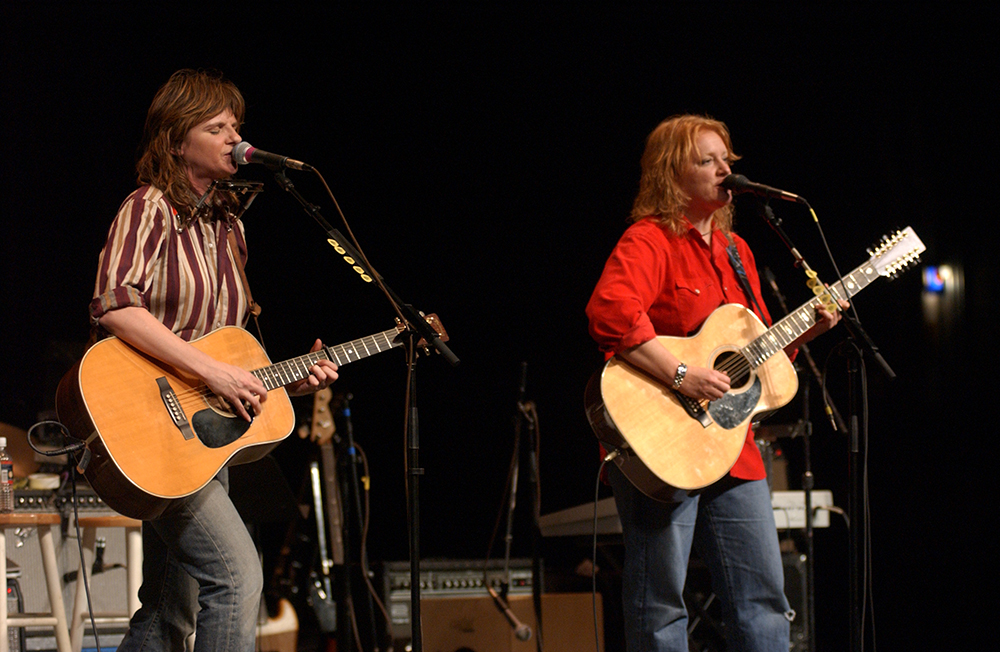
The Indigo Girls perform on Mountain Stage. Photo by Brian Blauser.
It’s that attitude of never feeling above anyone or anything that has helped Mountain Stage to excel and have the lasting legacy that it does. It captures its home region of West Virginia and Appalachia better than most any other music-related program does, both in sound and in sentiment. It’s the latter that’s arguably been the biggest asset in attracting bigger names as the show taps into the majestic mountains around them.
“There’s many different kinds of people that live in Appalachia, but one thing that’s really bedrock is supporting one another, and that shows with Mountain Stage and how they put the program on,” reflects O’Brien. “It’s intimate and friendly, just like the state.”
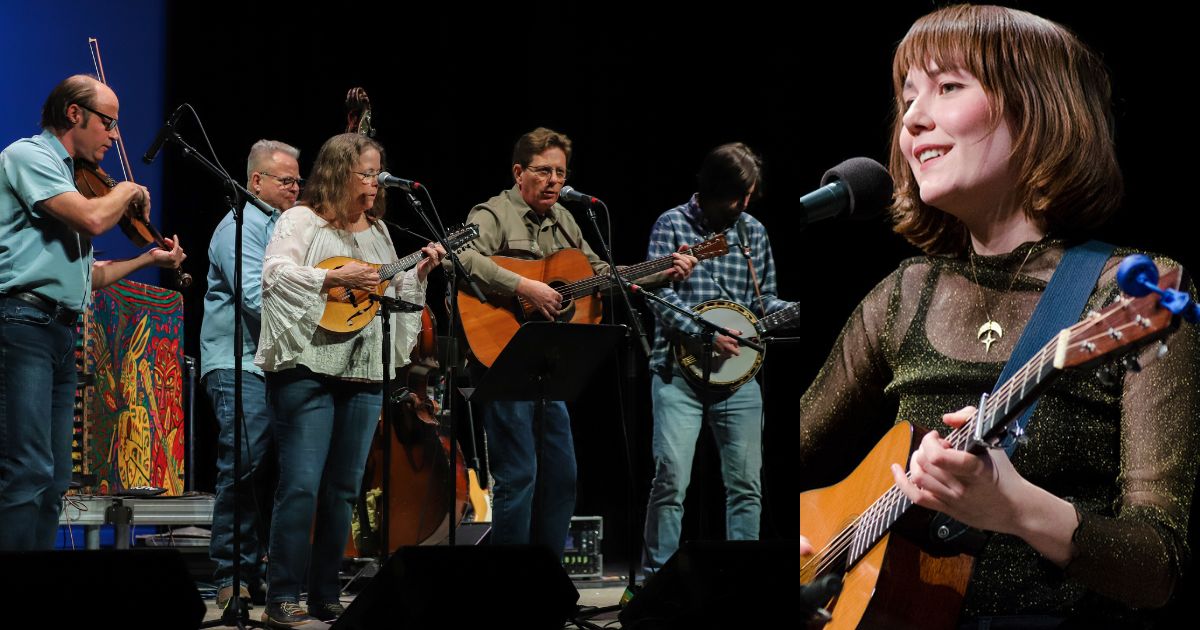
Photo Credit: Tim O’Brien Band performing on Mountain Stage by Chris Morris; Molly Tuttle performs on Mountain Stage by Josh Saul.
One of the most talented and sought after banjo players in bluegrass, Kyle Tuttle’s life has been full of the highest of highs and lowest of lows in recent years, from a marriage and divorce to the surprise death of close friend and bandmate Jeff Austin to the loss of his job due to COVID and finally hitting the road as a member of Molly Tuttle & Golden Highway.
All of that and more are documented on Labor of Lust (out February 16), an 11-song expedition taking listeners on a deeply personal and sonically diverse journey of tragedy and triumph. Recorded across three separate sessions in Nashville dating back to 2018, the record also documents a significant chunk of Tuttle’s life that, despite the length of time and changes that come with it, aren’t lacking a central theme. This led him to describing the project as “a long work-in-progress,” due to how its focus shifted throughout the more than five years of bringing it to life.
“By the time it was all said and done, this was a pretty eclectic group of songs,” Tuttle tells BGS. “There’s some stuff with an electric band that includes drums and me on electric banjo, others with traditional string band arrangements and some that meet in the middle for a more jamgrass sound.”
One of the songs that bridge the gap between these two worlds of bluegrass is “Hard to Say,” a song that sees Tuttle grieving the loss of Austin, his marriage, and his job all at the same time. It’s anchored by his blistering banjo backbone with introspective lyrics like, “Knowing that it’s gone and gone for good, makes you wonder what the hell you’re waiting on?” that serve as a message to himself and anybody listening to ask the questions you need to ask, then play another one.
“Even though the music and lyrics were written over a handful of years, loss and learning to deal with it on a personal level is central to this record,” indicates Tuttle. “That being said, there’s a lot of joy within these songs too. I don’t want to make it seem like I wrote music for five years and all I experienced was misery. Loss is something we all have to deal with at one time or another, and my way of dealing with it was to write some of this music.”
Speaking by phone from his snowed-in Nashville home following a mid-January winter storm, Tuttle opened up about how he approaches being a bandleader compared to his current gig with Golden Highway, being stuck in a Bob Ross painting, choosing to work doing something you love, and more.
You’re notorious for staying extremely busy in your musical endeavors, from sitting in with folks on stage and in the studio toyour stints with the Jeff Austin band, (your current gig with) Molly Tuttle, and your own compositions and projects, like Labor of Lust. With that in mind, how do you approach your own music versus being a member of someone else’s band?
Kyle Tuttle: It’s a bit different, because with my own show I’m the bandleader, along with other variables. With my shows, I play with lots of different members, I don’t have one set group of people that know my body of material super well, but rather lots of friends I can call on who all have different strengths. For that reason, when fronting my own band I’m more in the headspace of trying to wrangle all these people and variables together for a cohesive show, whereas with Molly we all have our roles that are specifically defined. One role isn’t more comfortable to me than the other, they just both require different things from me.
Is that comfort what had you leaning on friends like Travis Book, Dominick Leslie, and Lindsay Lou in the studio instead of session players?
It speaks very similarly to what we were just talking about with putting together a version of the Kyle Tuttle Band for shows. I wouldn’t use the term session player though, because even though all of these people are my friends they can also be called “session players” for their work on other’s records, because they’re all so good at what they do. I pick them very specifically based on their strengths and what they’ll bring to the music. I’ve been lucky through my years in the business to build personal connections with an awesome group of people that I can call when I’m looking to create something.
Although not an original, I really enjoy your cover of Harry Nilsson’s “Turn On The Radio” that closes the album. What drew you to that song of his in particular instead of “Coconut” or another of Nilsson’s gems?
I’m gonna have to work on a “Coconut” cover next, because that song is awesome! In all seriousness, [“Turn On The Radio”] felt like a thematically appropriate way to close this album. At the end of the day, I’m just a jamgrass stoner that plays banjo wanting to make a record that people can enjoy and have fun with. This record has some heavy undertones, so I felt like it deserved a nice ribbon on top to end it. It speaks to me big time, [about] remembering those near and dear who you’ve lost, especially if they’re an artist doing something you can hear. That sentiment of “turn on your record player, listen to my song, turn on your night light baby, I’m gone” felt like the right words to capture that feeling even though I didn’t say them, Harry did! I’ve loved the song for a while, so when I began putting this record together it immediately made sense to close it with this.
In terms of your own songs, I understand that “Trailer In Boulder Canyon” came together at two different times, similar to the recording process for all of Labor of Lust?
That’s a funny one, because as I said previously, I’m just a jamgrass stoner banjo player. First and foremost it’s a fun, feel good song about a magical place — a shitty little trailer on the side of a mountain up in Nederland, Colorado, where you don’t have to worry about any of your troubles or cares and just get to play fiddles and banjos and have fun all day. There’s a great jamgrass scene up there due to Vince Herman and Drew Emmitt basically starting Leftover Salmon up there. Years later some of The String Cheese Incident guys moved there followed by Jeff Austin, leading to the eventual forming of Yonder Mountain String Band there as well. There’s such a rich history of the music I love so much in that goofy little mountain town.
I initially wrote the chorus and first verse for the song as a goofy little ditty after it bounced around in my head for a while. I went up there when Vince put together a memorial concert for Jeff to help raise money for his family and so people could grieve together and ended up writing the second half of the song driving up the canyon road to get there. So like a lot of things on this record, part of it came to me at one point before finishing it off much later.
You’ve got three instrumentals on this record and another mostly instrumental tune in “Two Big Hearts.” What variations do songs like those have compared to ones with lyrics in the creation process?
The process is relatively the same, because no matter if I write with lyrics or melody I’m starting with some short idea and building around that nugget of information piece by piece. If it’s a melody, it’ll probably come out as an instrumental, but if it’s with lyrics it’s probably going to come out as a song with vocals. Even though it’s one track, “Two Big Hearts” is really two songs. The lyrics in it don’t come in until the second song, nearly four minutes in, but I felt that both were similar enough that they should be together and presented as one idea. I don’t think I’ll ever play one part of it without playing the other.
On “Not Quite Spring,” you’re singing about being stuck inside a Bob Ross painting. How’d that idea come about?
That’s a COVID song. I was sitting around on the couch watching a lot of Bob Ross’s The Joy Of Painting, just killing time like we all were back then. All of his paintings were titled and each episode of his show is titled after the painting he does in it. [“Not Quite Spring” is season 25, episode 3]. It’s of this spooky, huge mountain that’s covered in snow and frozen. A lot of his paintings are happy sunsets and warm things like a pond reflecting the trees around it, a stark contrast to this one that’s cold, dark and lonely, which is exactly how I felt at the time trapped inside my house.
In the album’s liner notes you allude to a life in music often being painted in glamor, when in reality it’s a consistent grind where persistence pays off. Is that message of sticking to it what you’re singing about on “Saddle Up?”
“Saddle Up” is the term I have for getting up every day and doing it again. It’s the idea that you may not have succeeded today or done everything you wanted to do the way you wanted to do it, which is what I’m touching on with the lyric, “The past can’t be where my best is.”
I feel like persistence defines my own life and career. Anyone who works in pursuit of a skill or art is always striving to get better. Even outside of that, we’re all working on our personal relationships and doing better by the people around us. Hopefully our best work, whether it be art or personal growth, is ahead of us and it’s not all downhill from here. It’s also a message I wish to impart on any listener or friend going through a rough patch to remind them that brighter days are on the horizon.
With Labor of Lust’s themes of personal growth in mind, what’s one resolution you have for yourself, music or otherwise, in 2024?
I’m actually trying to play the banjo even more, not from the standpoint of traveling and playing more shows, but just tinkering with it more in my downtime. It’s an interesting duality, tying your work to something you love. It’s a tricky thing to do because the lines between work and play are instantly blurred and made one. If it’s all work and no play it makes Jack a dull boy, so my resolution is to just keep the banjo in my hands for fun and to work smarter, not harder, which comes back to the idea that the past is not where my best work is.
With citrusy melodies full of zest and spark, AJ Lee & Blue Summit demonstrate that California bluegrass is alive and well. Based in the Bay Area, they first took to the stage in 2015. Though the group has morphed in shape and size over time, they have delivered musical excellence for nearly a decade.
Currently, the band is composed of four tremendous musicians – AJ Lee (vocals and mandolin), Scott Gates (guitar and vocals), Sullivan Tuttle (guitar and vocals), and Jan Purat (fiddle) with a couple of rotating bassists. AJ’s velvety vocals blend seamlessly atop the many textures and tones this uncommon instrumental lineup can accomplish.
With their third studio album set to be released sometime this year, AJ Lee & Blue Summit set sail for their tour across North America earlier this month. Their emotive, erudite songwriting is brought to life by the band’s natural compatibility.
What is the nature of your musical chemistry? How would you describe it?
Scott Gates: Well, we all grew up going to California bluegrass festivals, and that gives us kind of a through-line. We all grew up with similar mentors and similar principles, so we all have similar ideas of what bluegrass is and what it isn’t, and how to bend those boundaries.
What do you think makes the bluegrass scene in the Bay Area distinct from other bluegrass scenes?
SG: Yeah, I think that there’s more homogeneity in a lot of other bluegrass associations across the country. You know, Tennessee is known for its singers. North Carolina is known for its banjo players, and they turn out some serious musicians. But something I’ve noticed with a lot of Tennessee singers is that many of them sound the same. And it allows for incredible blend and unity in sound, but California tends to reward individual individuality. When somebody has a really unique voice, they’re exalted.
Jan Purat: In the Bay Area scene, there’s a surprisingly large interest in bluegrass that dates back a long time. There’s this really thriving jam scene with lots going on. People in California as a whole tend to really nerd out on bluegrass from from the mid ’40s to the ’60s, that era of the Stanley Brothers, Bill Monroe, Flatt & Scruggs, and such. A lot of reverence for traditional sound and energy, I think, is a big part of why people really gravitate towards it. And in California, trying to channel that kind of fiery energy that you find in the more traditional stuff is definitely part of the sound, as opposed to more of the second gen and third gen newgrass circuit.
A pretty cool aspect of the California scene has been discovering that amazing lexicon of music, especially as the one band member that got into bluegrass a little bit later. I came into it during my college years, but the rest of these guys all grew up together. I met Scott busking when he was like 19, and I met AJ and Sully shortly after I first started going up to Grass Valley, around when I was 22. I started out with second-generation exposure to bluegrass, like John Hartford and similar acts, but going to the festivals and getting turned onto all this amazing music from earlier definitely feels like a big part of why I fell in love with the California bluegrass scene.
So you all share similar roots – on the flip side, what would you say the biggest difference in your respective musicianship is?
AJ Lee: Well, we all like to listen to different things, even though we’re in the same band and we unify on bluegrass. I listen to a lot of indie punk on Spotify, and I know Sully listens to some dark metal. Jan is a little bit more cultured, and Scott likes hip hop. So, there are a lot of bases covered, but we also can all appreciate what the others listen to, which is also unifying in a way.
JP: Yeah, although we love bluegrass, after a certain point we play it so much, but we don’t always listen to it that much.
AJ: I don’t think I’ve actually had a listening session of bluegrass for maybe five years.
Fair enough! What is your collaboration process like with songwriting and figuring out arrangements?
AJ: Since the early days, I’ve been the primary songwriter. I do a lot of my own original material, but since Scott’s joined, he’s brought a lot of his original material to the table as well. And I think nowadays, the songwriting process is more like a collective band arrangement. I’ll bring an unfinished song to the band and someone will say something like, “There’s a part here that I’m not really too sure about. I think it needs this,” and then together we’ll come up with something. Unlike before, when we would mostly just play all of my finished songs, now it’s more of a collective Blue Summit songwriting style.
SG: And we’ve got to give credit to the original guitar player, Jesse Fichman, who definitely helped arrange and put together some serious parts for AJ’s earlier originals.
AJ: Yeah, for a while Jesse was really the only one that I would ever write with. So he had a lot of hand in the first album.
So the first two albums are pretty different in style and tone. Can you talk about what we should expect for your third?
Sullivan Tuttle: Well, the first one had a lot of electric and a lot of drums, basically on half of the songs. And then the second one was all acoustic, all the way through. This one’s maybe somewhere in between. It’s mostly acoustic, but with a little pinch of other things.
JP: Yeah, Lech Wierzynski from the California Honeydrops produced it, so there’s definitely some of his influence. He brought in a cover for AJ to sing and it ended up being really successful and a really good choice. It’s a bluegrass instrumentation take on an old school soul song – some new territory that I haven’t really heard too many bands do. So it’s pretty exciting. And it’s just super nice working with a producer for the first time. He’s also an amazing hang, and one of the funniest people and a great buddy. It was awesome to work with him.
SG: I would say that variety is the main name of the game. When we craft a set list for a show, our goal is to bring as much to the table as possible, so that we don’t have songs that sound similar or the same over and over and we’re not fighting ear fatigue at all times. So we try to bring as many different sounds and approaches and genres together as possible. And I think this album reflects that, more so than any of the others.
Okay, here’s a silly question for you. If we were in an alternate universe, and you guys were all still a group of some sort, but it wasn’t a musical group – you’re connected by some other thing, premise interest, etc. – what would it be?
ST: Could see like a Scooby-Doo type of scenario where we all investigate things together. [AJ, Jan, and Scott emphatically agree.]
JT: We’ve got our next Halloween costume now! I know I have to be Shaggy, it’s fine.
[Laughs] I can definitely see it. I’ve heard that you have famously had to navigate some tricky traveling situations. What’s your favorite one to tell people about?
JT: Rockygrass is a good one to talk about, because it was the second time that we had to do an all-night drive from somewhere like New York City or Boston to an entirely different city like six hours away. Our Boston flight kept getting delayed, so we drove all the way to Philly overnight and got the last flight out. It was brutal. We did not sleep a wink and barely got to Rockygrass in time to play our set on the main stage. And it was our first time playing the main stage there. We were just so haggard, but apparently it was good! I had no perspective because I was so sleepy, but people liked it!
ST: I think that was my favorite, because we actually made it. Other ones didn’t have a happy ending.
Wow. You all must be really great traveling companions.
AJ: Well, we have the perfect travel attire that a lot of people tend to notice.
What is it??
AJ: I think Scott is gonna take the lead on this one. [Scott dons an incomprehensibly fashionable and utilitarian navy blue robe.]
SG: It’s a towel. It’s a blanket. It’s a robe. It’s a pillow. It’s everything that you might possibly need on the road. It keeps you warm. It keeps you dry. You can sleep at noon facing the sun.
AJ: We all have one. And everyone is always asking, hey did you guys come from a pajama party?
Okay, I feel like the Scooby-Doo thing is making more and more sense. You’re coordinating and you’re tackling obstacles!
So the two guitars situation – how did that come to be? And how do you go about arranging with two guitars?
ST: We just formed the band with two guitars – me and Jesse Fichman. When we started, I was already used to playing with two guitars because I played in the family band with my sister, [Molly Tuttle], and we usually had two guitars for that, other than when she played banjo. So it felt pretty natural, to me at least. And then when Jesse left, Scott joined, and we already had all the parts arranged for two guitars. We wanted to keep him on guitar even though he also plays mandolin. When one guitar solos you still have the rhythm guitar behind it. And as long as we’re not both just slamming away on rhythm the whole time, it works out.
It does! No complaints here. So do you guys hate banjos?
AJ: No, we actually really like banjo! Just not in our band.
SG: It’s kind of nice having it this way, because it means that when we’re at a festival, and we have a buddy that plays banjo, then we can just invite them up to play with us. There’s definitely a banjo slot for certain songs, and we can interchange that whenever we want.
AJ: I would also say that when seeing other bluegrass bands without banjo, it feels kind of refreshing to not have that sonic space filled. It gives the music opportunities to go other directions if you wanted to. And the banjo can scratch an itch, for sure, but you can’t scratch for too long or it’s going to make a rash!
So you’re our One to Watch, but who are you watching? Are there any artists, creatives, musicians, etc. that you’re appreciating especially right now?
AJ: Crying Uncle!
SG: Yeah, best band at IBMA. Hands down!
AJ: Yes, definitely the best thing I saw at IBMA. Also, another young band that’s great is Broken Compass Bluegrass. They’re up and coming as well.
JT: I like Viv & Riley – really great music. And their old time band, The Onlies, is great as well. I hope that project continues.
On Sunday night, the music industry gathered in Los Angeles at the Crypto.com Arena for the 66th Grammy Awards. While Miley Cyrus and Taylor Swift took home the evening’s biggest honors, the primetime broadcast and pre-awards telecast saw many roots musicians honored for their musical achievements.
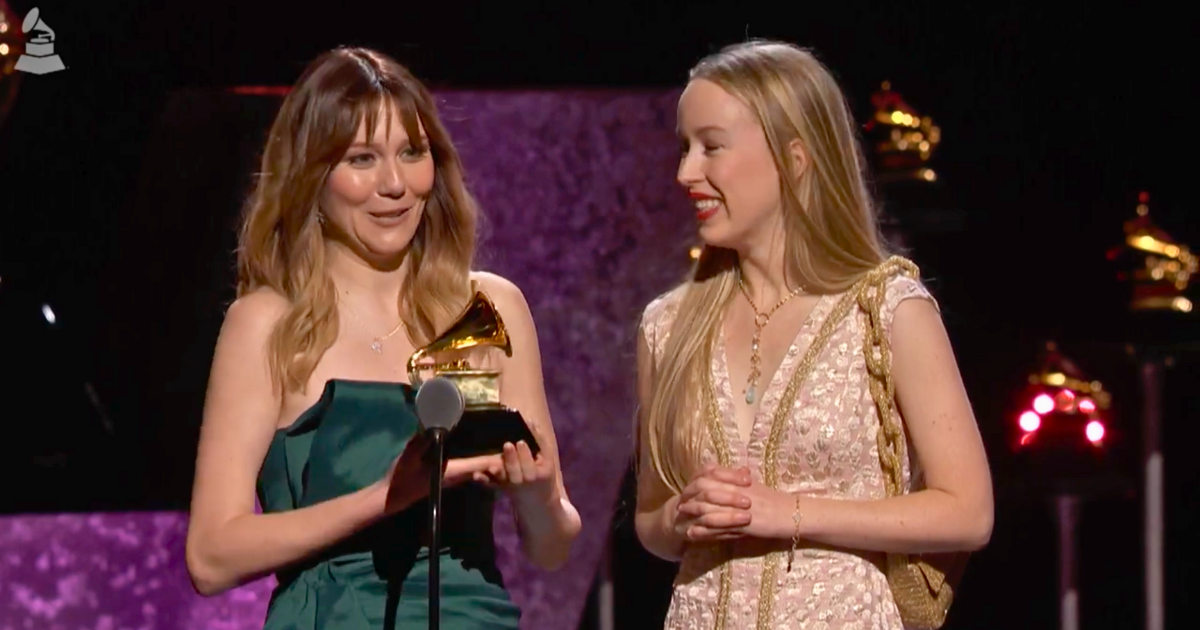
This year’s Best Bluegrass Album nominees were a stout collection of records including Radio John: Songs of John Hartford by Sam Bush, Lovin’ Of The Game by Michael Cleveland, Mighty Poplar by Mighty Poplar, Bluegrass by Willie Nelson, Me/And/Dad by Billy Strings, and City Of Gold by Molly Tuttle & Golden Highway, who took home the trophy for the second year in a row.
In other categories, Allison Russell took home her first Grammy Award after eight nominations – for Best American Roots Performance for “Eve Was Black.” Lainey Wilson won Best Country Album for Bell Bottom Country, Bobby Rush took home the trophy for Best Traditional Blues Album (his third Grammy), and Joni Mitchell won her tenth Grammy for Best Folk Album. Meanwhile, the number one country song for now more than 17 weeks, “I Remember Everything” by Zach Bryan and featuring Kacey Musgraves, was awarded Best Country Duo/Group Performance.
Below, find a full list of this year’s Grammy Award nominees and winners in the Country & American Roots Music fields, as well as selected categories from the greater nominations list featuring roots musicians within and adjacent to our BGS family.
Record Of The Year
“Worship” Jon Batiste
“Not Strong Enough” boygenius
“Flowers” Miley Cyrus
“What Was I Made For?” [from the motion picture Barbie] Billie Eilish
“On My Mama” Victoria Monét
“Vampire” Olivia Rodrigo
“Anti-Hero” Taylor Swift
“Kill Bill” SZA
Album of the Year
World Music Radio Jon Batiste
the record boygenius
Endless Summer Vacation Miley Cyrus
Did You Know That There’s A Tunnel Under Ocean Blvd Lana Del Rey
The Age Of Pleasure Janelle Monáe
GUTS Olivia Rodrigo
Midnights Taylor Swift
SOS SZA
Best New Artist
Gracie Abrams Fred again.. Ice Spice Jelly Roll Coco Jones Noah Kahan Victoria Monét The War & Treaty
Best Rock Performance
“Sculptures Of Anything Goes” Arctic Monkeys
“More Than A Love Song” Black Pumas
“Not Strong Enough” boygenius
“Rescued” Foo Fighters
“Lux Æterna” Metallica
Best Country Solo Performance
“In Your Love” Tyler Childers
“Buried” Brandy Clark
“Fast Car” Luke Combs
“The Last Thing On My Mind” Dolly Parton
“White Horse” Chris Stapleton
Best Country Duo/Group Performance
“High Note” Dierks Bentley featuring Billy Strings
“Abundance In Millets” Falu & Gaurav Shah (featuring PM Narendra Modi)
“Pashto” Béla Fleck, Edgar Meyer & Zakir Hussain Featuring Rakesh Chaurasia
“Todo Colores” Ibrahim Maalouf Featuring Cimafunk & Tank And The Bangas
Best Music Video
“I’m Only Sleeping” (The Beatles)
“In Your Love” Tyler Childers
“What Was I Made For” Billie Eilish
“Count Me Out” Kendrick Lamar
“Rush” Troye Sivan
Best Instrumental Composition
“Amerikkan Skin” Lakecia Benjamin, composer (Lakecia Benjamin featuring Angela Davis)
“Can You Hear The Music” Ludwig Göransson, composer (Ludwig Göransson)
“Cutey And The Dragon” Gordon Goodwin & Raymond Scott, composers (Quartet San Francisco featuring Gordon Goodwin’s Big Phat Band)
“Helena’s Theme” John Williams, composer (John Williams)
“Motion” Edgar Meyer, composer (Béla Fleck, Edgar Meyer & Zakir Hussain featuring Rakesh Chaurasia)
Best Arrangement, Instrumental or A Cappella
“Angels We Have Heard On High” Nkosilathi Emmanuel Sibanda, arranger (Just 6)
“Can You Hear The Music” Ludwig Göransson, arranger (Ludwig Göransson)
“Folsom Prison Blues” John Carter Cash, Tommy Emmanuel, Markus Illko, Janet Robin & Roberto Luis Rodriguez, arrangers (The String Revolution featuring Tommy Emmanuel)
“I Remember Mingus” Hilario Duran, arranger (Hilario Duran And His Latin Jazz Big Band featuring Paquito D’Rivera)
“Paint It Black” Esin Aydingoz, Chris Bacon & Alana Da Fonseca, arrangers (Wednesday Addams)
Photo: Molly Tuttle & Bronwyn Keith-Hynes via the Recording Academy
(Editor’s Note: Welcome to the debut of our new humor column, The Resonator – from the pen of satirist and performer Greg Hess.)
RALEIGH, N.C. — Gary Plapinger (48), a local Guitar Center salesman, expressed surprise upon realizing that the person he had been explaining chords to was none other than acclaimed guitarist Molly Tuttle.
“I feel tricked,” remarked Plapinger in retrospect. “I dedicated a considerable amount of time to that gal’s musical education.”
According to witness Ashlyn Lockerbie (32), the entire interaction could have been avoided. “Molly [Tuttle] politely explained to him multiple times that she had been playing for years,” Lockerbie stated. “She wasn’t even looking to buy a guitar.”
Plapinger, however, held a different perspective. “I was suggesting she get a ukulele; thought her kids could enjoy it too,” he explained, despite Tuttle not currently having children.
Observing the cringe-worthy spectacle from her hiding place behind a bass amplifier, Lockerbie later managed to escape through the loading dock to avoid Plapinger. “I’m not proud of running,” she said with a haunted look. “But I had to save myself.”
In a statement released on Friday, Grammy award-winning Tuttle revealed that she had entered the store seeking directions after leaving her cellphone in an Uber. To her dismay, this led to an hour and twenty-minute encounter with Plapinger, including a lecture on the greatest guitar solos of all time, a photo presentation of his 1999 canary yellow Camaro, and an impromptu performance of “Stairway to Heaven,” all without Tuttle’s consent.
According to Facebook, Plapinger has been a part-time sales associate at Guitar Center since 2016, following his divorce. He also serves as an alternate lead guitarist for the local Led Zeppelin cover band, Boogie With Stu.
“I even added her to the guest list for my show at Foamie’s that night. Surprise, surprise, she didn’t show up!” he exclaimed, before turning his attention to a woman perusing pedal boards. “Her loss. She could have learned how to rock,” he added with a shrug.
Tuttle is currently touring the United Kingdom with Tommy Emmanuel and said that the incident has motivated her to aid other women facing similar situations.
“I never pass a music retailer without checking on the women inside and ensuring they want to be there,” said Tuttle, whose Run Don’t Strum Foundation has rescued numerous musicians to date. “After what I’ve been through, it’s the least I can do.”
Greg Hess is a comedy writer and performer in Los Angeles. His work has been featured in The American Bystander, The Onion, Shouts & Murmurs, Points in Case, and he cohosts the hit satirical podcast MEGA.
This website uses cookies to improve your experience. We'll assume you're ok with this, but you can opt-out if you wish.AcceptRejectRead More
Privacy & Cookies Policy
Privacy Overview
This website uses cookies to improve your experience while you navigate through the website. Out of these, the cookies that are categorized as necessary are stored on your browser as they are essential for the working of basic functionalities of the website. We also use third-party cookies that help us analyze and understand how you use this website. These cookies will be stored in your browser only with your consent. You also have the option to opt-out of these cookies. But opting out of some of these cookies may affect your browsing experience.
Necessary cookies are absolutely essential for the website to function properly. This category only includes cookies that ensures basic functionalities and security features of the website. These cookies do not store any personal information.
Any cookies that may not be particularly necessary for the website to function and is used specifically to collect user personal data via analytics, ads, other embedded contents are termed as non-necessary cookies. It is mandatory to procure user consent prior to running these cookies on your website.