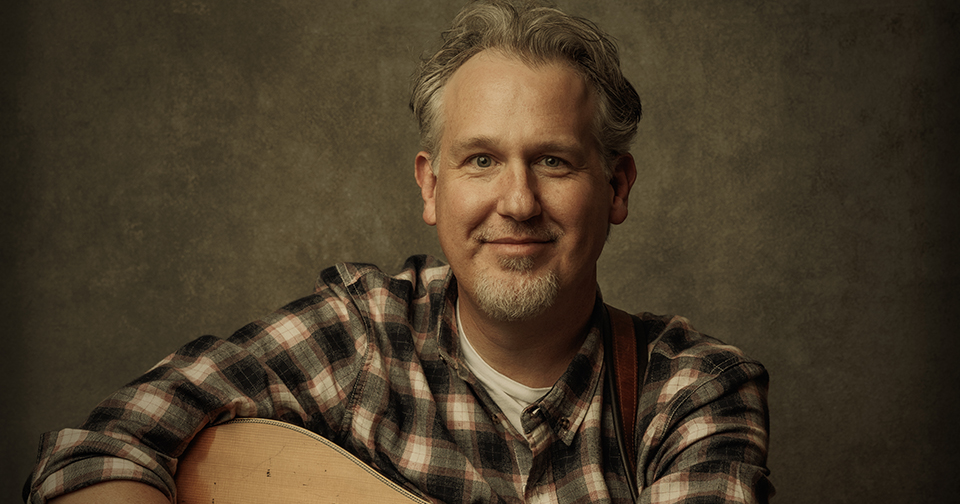
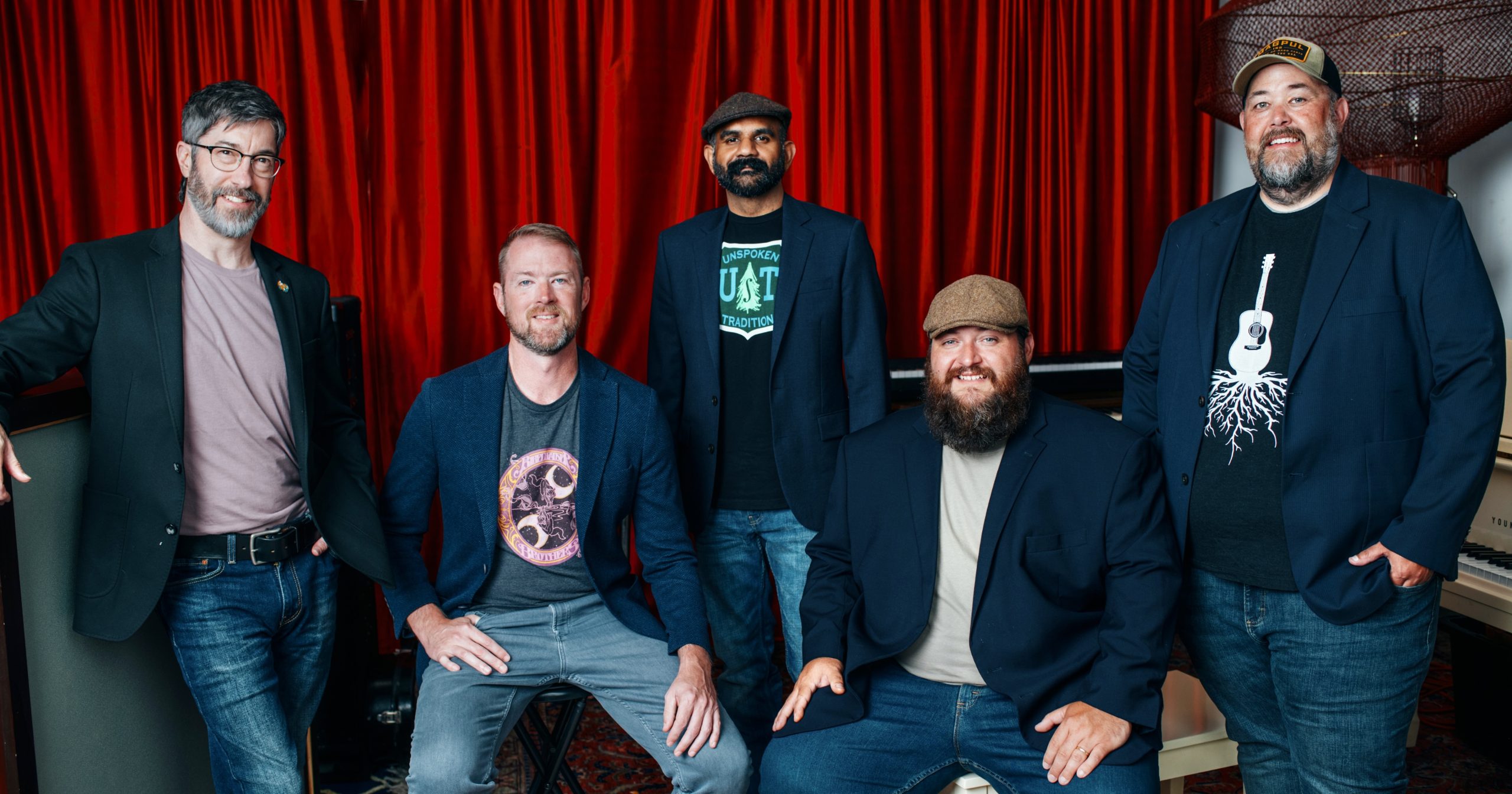
Artist:Bryan Sutton with Billy Strings Hometown: Nashville, Tennessee Song: “The Devil Went Down to Deep Gap” Album:From Roots to Branches Release Date: January 9, 2026 (single/video) Label: Mountain Home Music Company
In Their Words: How do you see Doc’s playing influencing both yours and Billy’s?
“I think beyond the specific influence of Doc’s guitar playing that informs most every note Billy or I may play, I know that we both are students of Doc’s complete artistry. To say Doc is just the most influential flatpicker ever is limiting. He brought so much to the table in his honest and emotional singing, his song choices and writing, banjo and harmonica playing, and Travis-style fingerpicking. He was not comfortable being labeled or limited within a specific genre. His onstage persona was true to him. Without being a ‘showman,’ he was informational when the song needed it and willing to share whatever emotion he might be experiencing. It’s also important to note that Doc and Merle’s duo playing has been a huge part of the overall focus for things Billy and I have done together. I know for both Billy and I, Doc provides a lifetime of inspiration, influence, and learning.”
How do you pay tribute to that in this song and video?
“First and foremost, this is kind of a silly or fun thing, along with being a somewhat serious tribute to Doc Watson. I wanted to use the song to have fun with the guitar shredding and good versus evil battle, but also imagine an origin story of how Arthel Watson could have become the ‘Doc’ we all have loved. Maybe it’s a gospel song in the way that Doc, even and especially in his blindness, can ‘see’ through the Devil’s lies. Ultimately, Doc carries his triumphant message to the world, and influences us all with wonderful and heartfelt music.”
It sounds like you had this concept before talking with Billy about it. How did the concept and song come to be, from start to finish?
“It was listening to Charlie Daniels’ original ‘The Devil Went Down to Georgia’ with my youngest daughter, Lily. She has very eclectic and broad musical tastes. I’ve loved sharing music with her and checking out what she has discovered. We found some other covers of the original and one that stuck with me was Jerry Reed’s interpretation, where he makes Johnny a guitarist instead of a fiddler. I have been working on a duets record for some time, collecting recordings here and there with my pals, and knew I wanted to do something different with Billy, as he and I have a whole record of duet playing.
“Billy and I also share a love for heavy metal. I was trying to think of a way he and I could do something connected to this duets project that would allow us to play acoustic and electric. It all kind of came together when I realized this song would allow for that. The Doc origin story came about thinking how to make this not just a cover, but more personal and fun. It’s also another subtle tribute to Doc, who would oftentimes change or add lyrics to a song in order to make it fit for him. I fashioned the story, made a little demo, and sent it to Billy. He was into it and we were off.
“I feel fortunate that Del was into playing the Devil. I also am so happy to have T. Michael Coleman and Sam Bush on the track, who played many years on the road and studio with Doc. My pal Jerry Roe, who is Jerry Reed’s grandson, plays the drums, connecting to the Reed version that inspired me. Once I had the concept and demo for the song, I knew it had to be an animated video and discovered Pat Bradley of Springshoe Animation. It was wonderful working with him to take what had been in my head and be able to visualize it. Ultimately, all this came about a little piece at a time, and I’m so happy to share it with the world.” – Bryan Sutton
Track Credits: Bryan Sutton – Acoustic guitar, electric guitar, vocal Billy Strings – Acoustic guitar, electric guitar, vocal Del McCoury – Vocal T. Michael Coleman – Electric bass, harmony vocal Sam Bush – Mandolin Jerry Roe – Drums
Video Credits: Animation by Pat Bradley, Springshoe Animation.
It’s no secret that Earl Scruggs and Doc Watson were great friends, collaborators, and mutual admirers. Both of the bluegrass, old-time, and mountain-music stylists took inspiration and borrowed heavily from the other across their careers, whether they were making music together or separately in any of their many endeavors. The moments they came together, though – from The Three Pickers album and concert film, to David Hoffman’s iconic backyard jam session film of the Scruggs and Watson clans picking together, to many more appearances and recordings – were always magical. Two legendary stylists bouncing musical ideas off of each other as only these two could.
In honor of our Doc in December series for Artist of the Month, we’ve partnered with our friends at the Earl Scruggs Center in Shelby, North Carolina, to bring you an exclusive look inside their collection and archives at photos of Scruggs and Watson together. The Center’s executive director, Mary Beth Martin, pulled a selection of historic photos from the collection as well as a handwritten quote directly from Scruggs’ notes about Watson and his influence:
“There are two people’s sound no man can, in my estimation, duplicate,” Earl states in a notebook. “Of course I’m referring to Mama Maybelle and Doc Watson. I’ve had the pleasure to work [with] and visit these people. I will never cease to admire the courage of these people.”
You can certainly hear the impact and influence of Watson and Maybelle Carter on Scruggs’ playing, especially his approach to acoustic guitar, when he would most often fingerpick the six-string.
“Earl had enormous respect for Doc and admired him deeply,” says Martin of the Earl Scruggs Center via email. “Both grew up in humble North Carolina homes surrounded by rich musical traditions and went on to leave an incredible mark on music. Having Earl’s personal memories and photos of Doc in our collection makes their connection feel especially meaningful.”
Over the course of their careers in roots music, Scruggs and Watson performed, collaborated, and recorded together dozens and dozens of times. We’re very proud to be able to share these photographs from the Earl Scruggs Center Collection to celebrate the cross-pollination of these two Bluegrass Hall of Famers and Doc in December.
The Earl Scruggs Center is located in downtown Shelby, North Carolina, and celebrates the life, legacy, and groundbreaking sound of Earl Scruggs. Their collection includes many treasured Scruggs family objects and remarkable pieces from Earl’s career – including more than 2,000 photographs. In January, they’ll install new interactive exhibits that dig deep into the roots of the region’s music and the history of bluegrass. The entire ESC team is excited to welcome everyone back to the museum when they reopen on February 3, 2026, after renovations and completion of the new exhibits.
Beyond the museum, the Earl Scruggs Center team are also restoring the Earl Scruggs Homeplace in the Flint Hill community of Cleveland County, bringing Earl’s childhood home back to the formative era that shaped him as a musician.
To stay in the loop and to catch upcoming Earl Scruggs Center events like the Earl Experience Banjo Camp, visit their website and connect with them on socials. We hope you enjoy our special photo story with our friends at the Earl Scruggs Center celebrating Earl Scruggs, Doc Watson, and Doc in December.
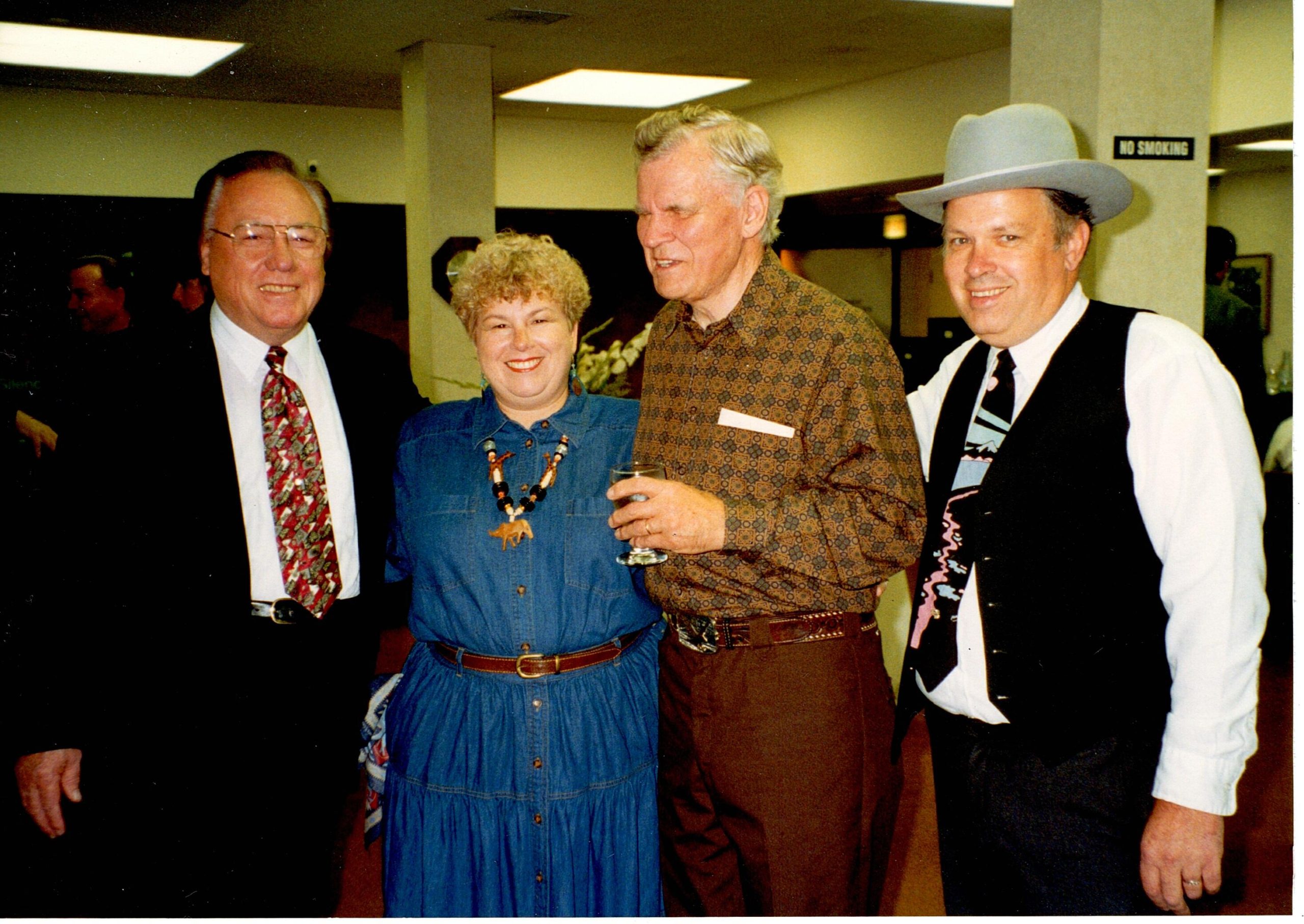
(L to R:) Earl Scruggs, Kitsy Kuykendall, Doc Watson, and Pete Kuykendall.
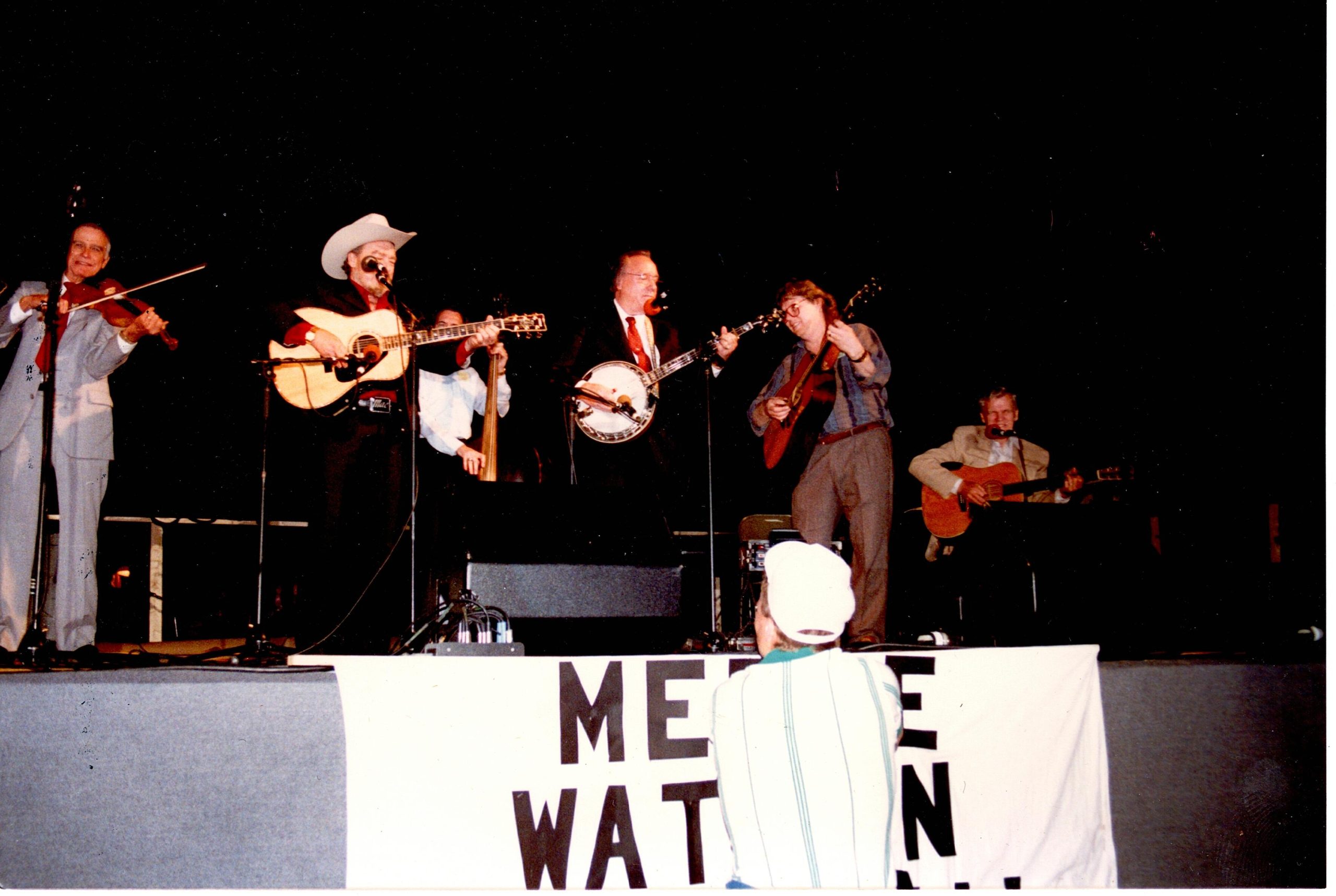
(L to R:) Jim Shumate (fiddle), Mac Wiseman, unknown bassist, Earl Scruggs, Jack Lawrence, and Doc Watson on stage at the Merle Watson Memorial Festival – what would become MerleFest.
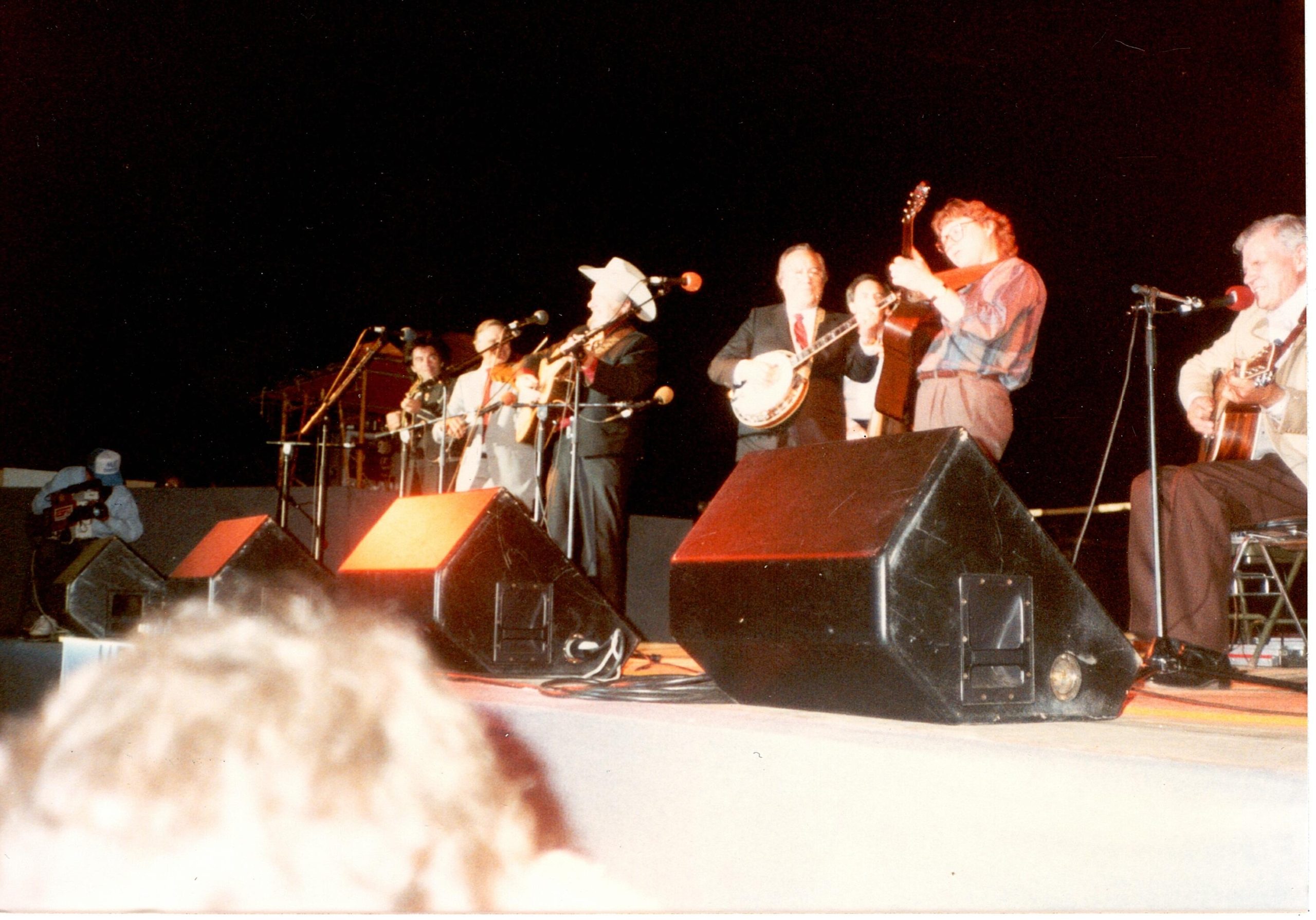
Earl Scruggs and Doc Watson perform at the first MerleFest in 1988, then called the "Merle Watson Memorial Festival." (L to R:) Marty Stuart, Jim Shumate, Mac Wiseman, Earl Scruggs, unknown bassist, Jack Lawrence, Doc Watson.
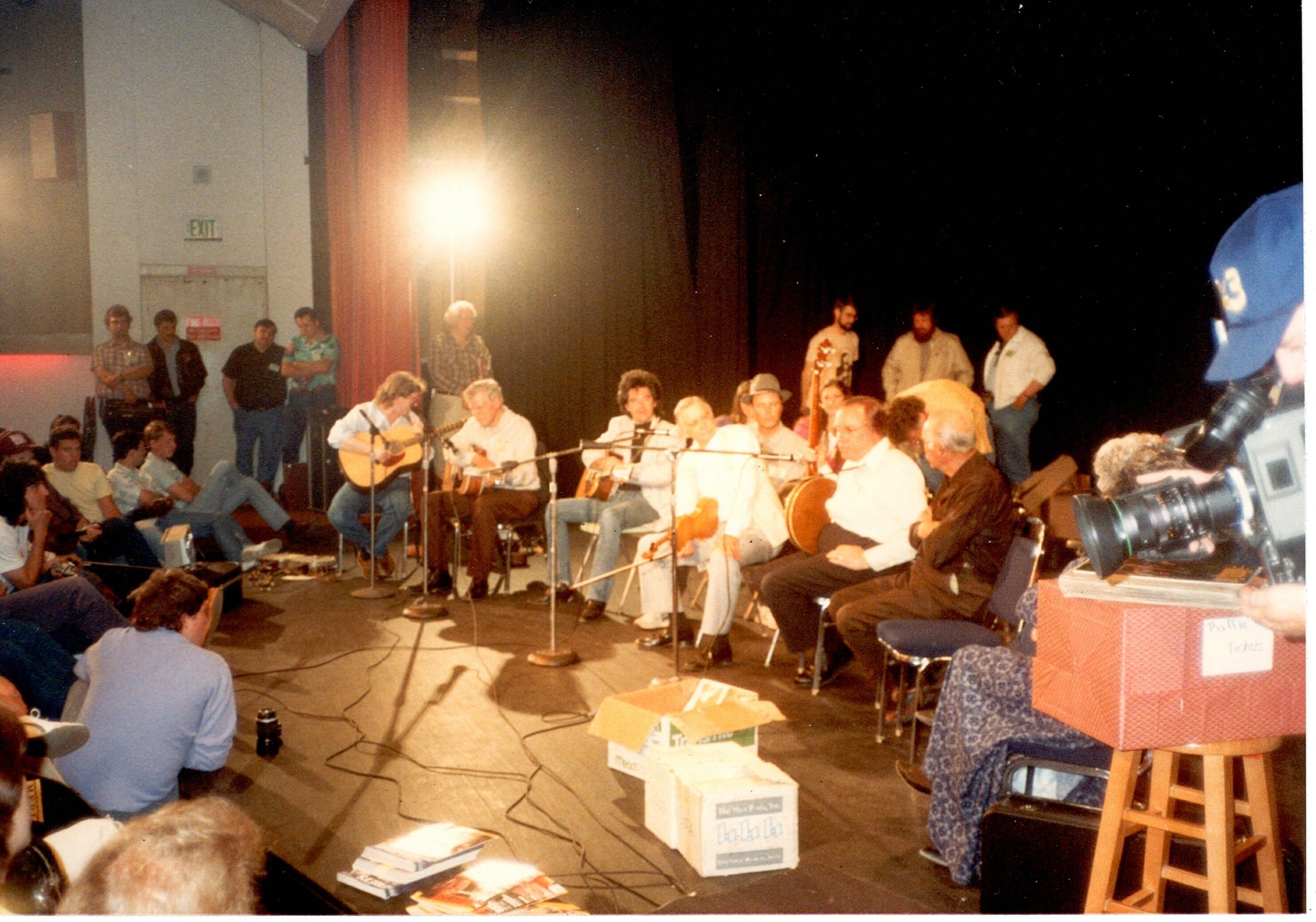
A workshop held at the first MerleFest in 1988. (L-R:) Jack Lawrence, Doc Watson, Marty Stuart, Jim Shumate, Earl Scruggs, Grandpa Jones. David Holt behind the first row of musicians, Ramona Jones on the far right, partially obscured by camera.
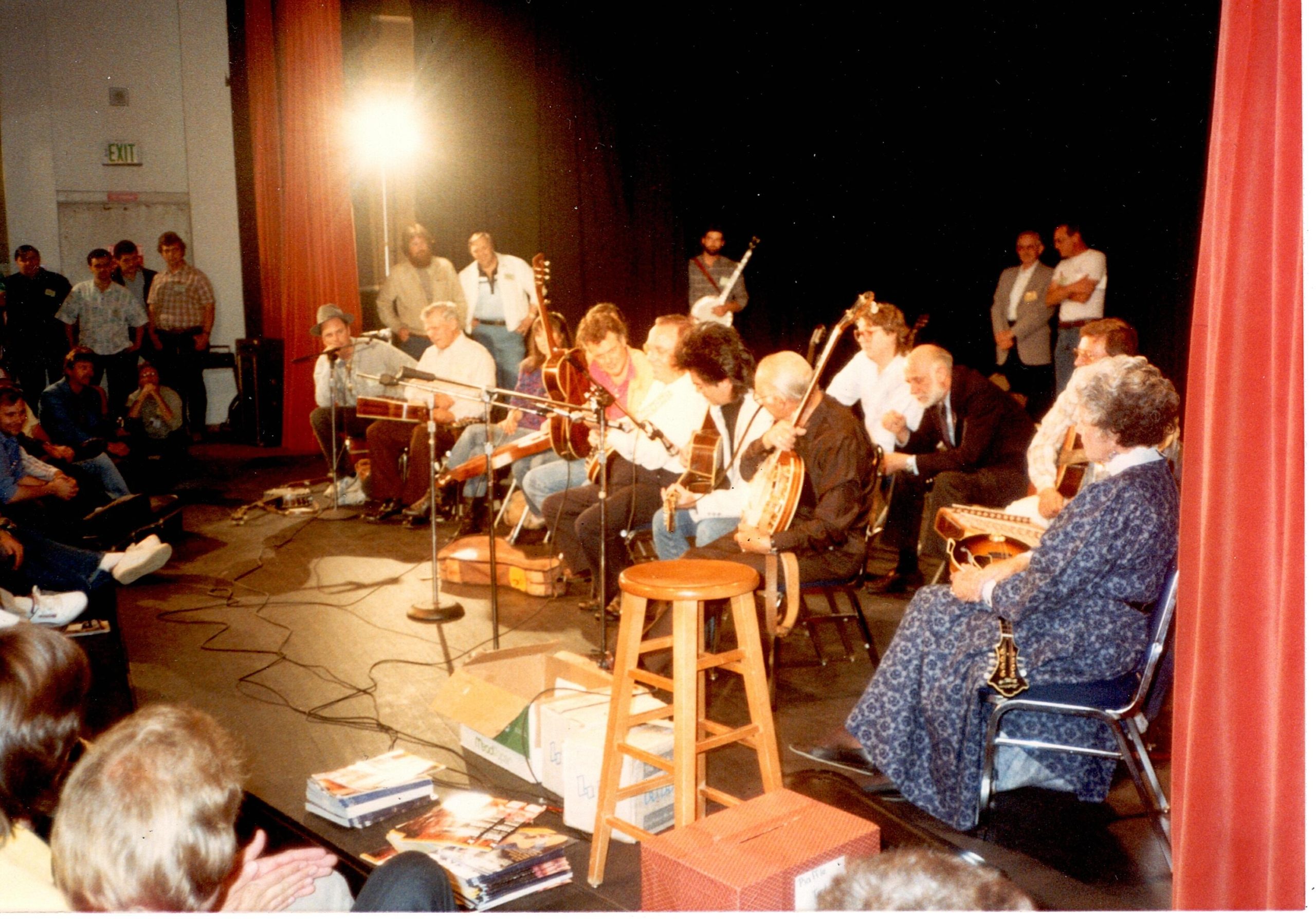
Another scene from a workshop at the very first MerleFest.
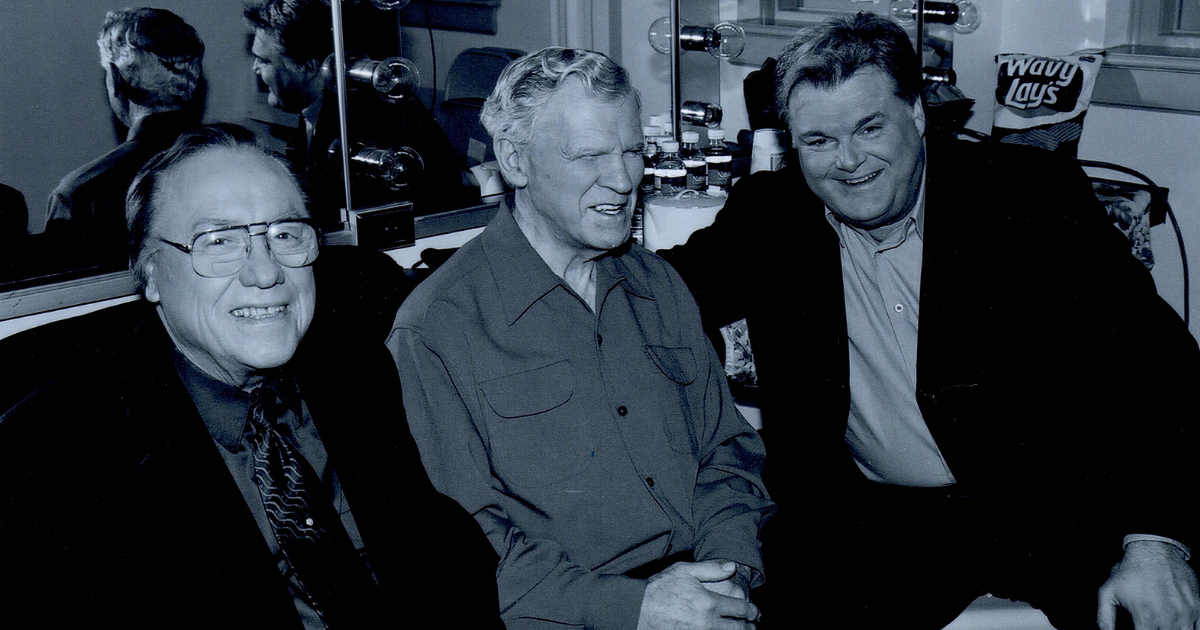
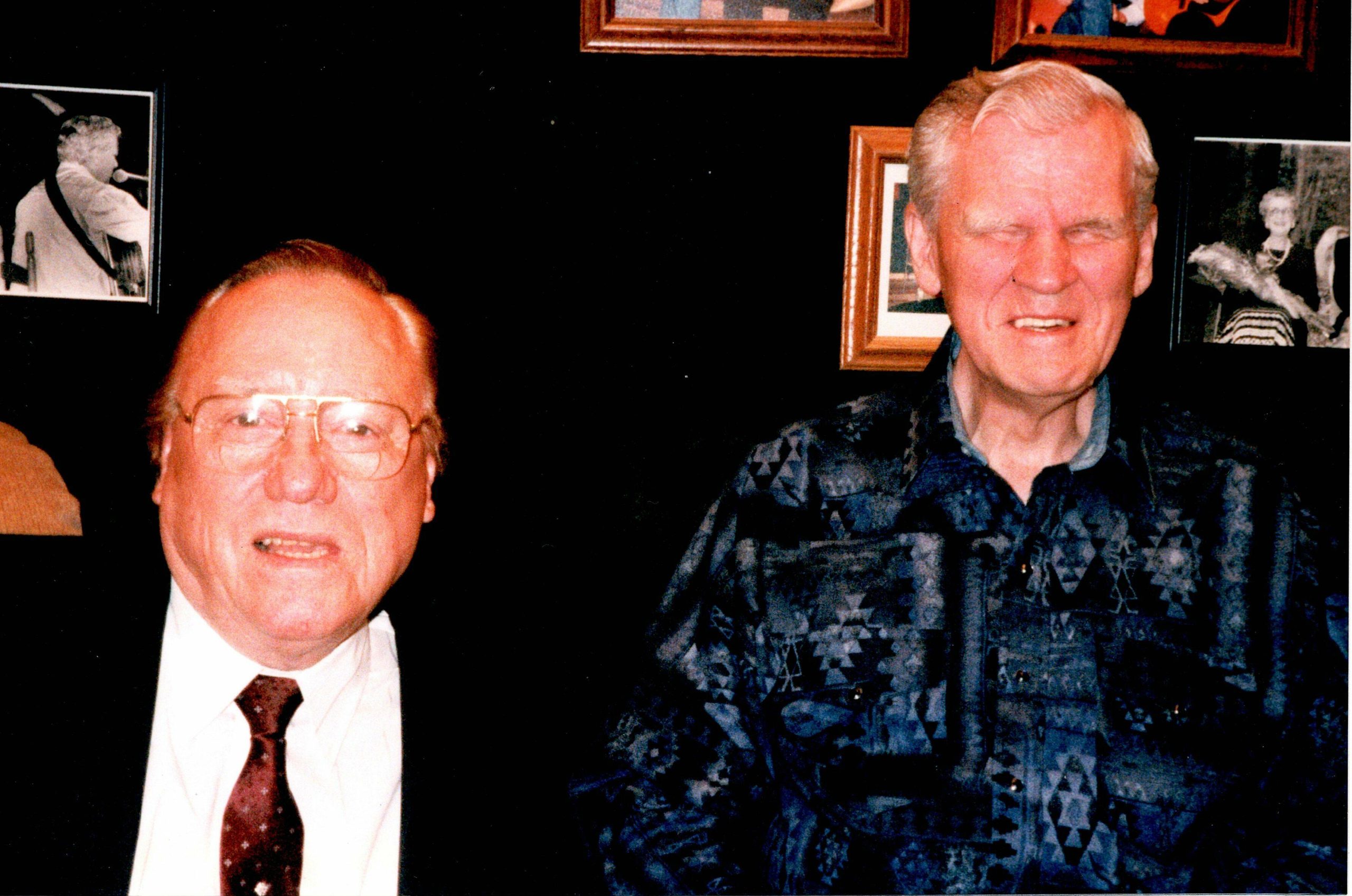
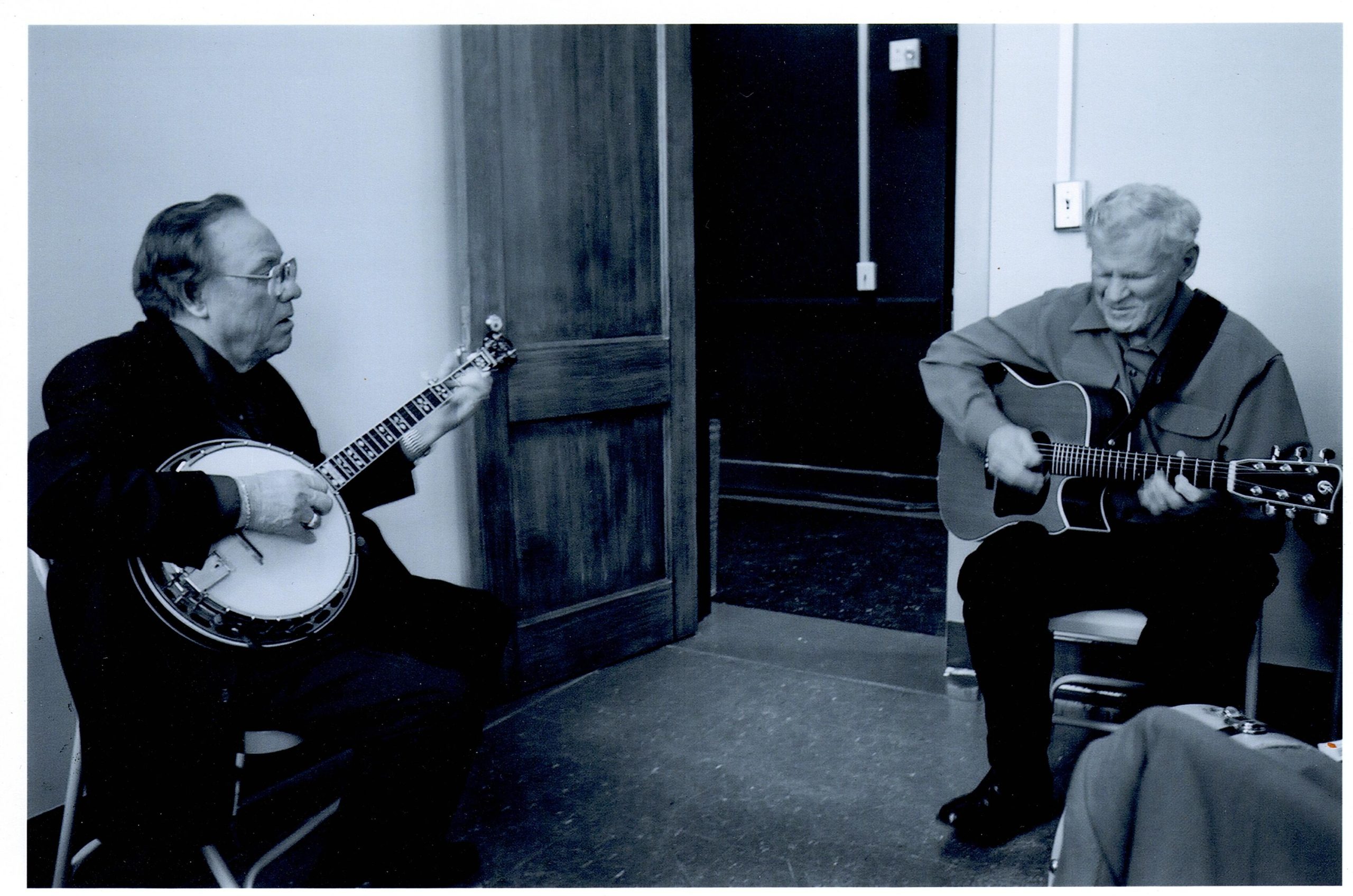
Earl Scruggs and Doc Watson backstage at MerleFest.
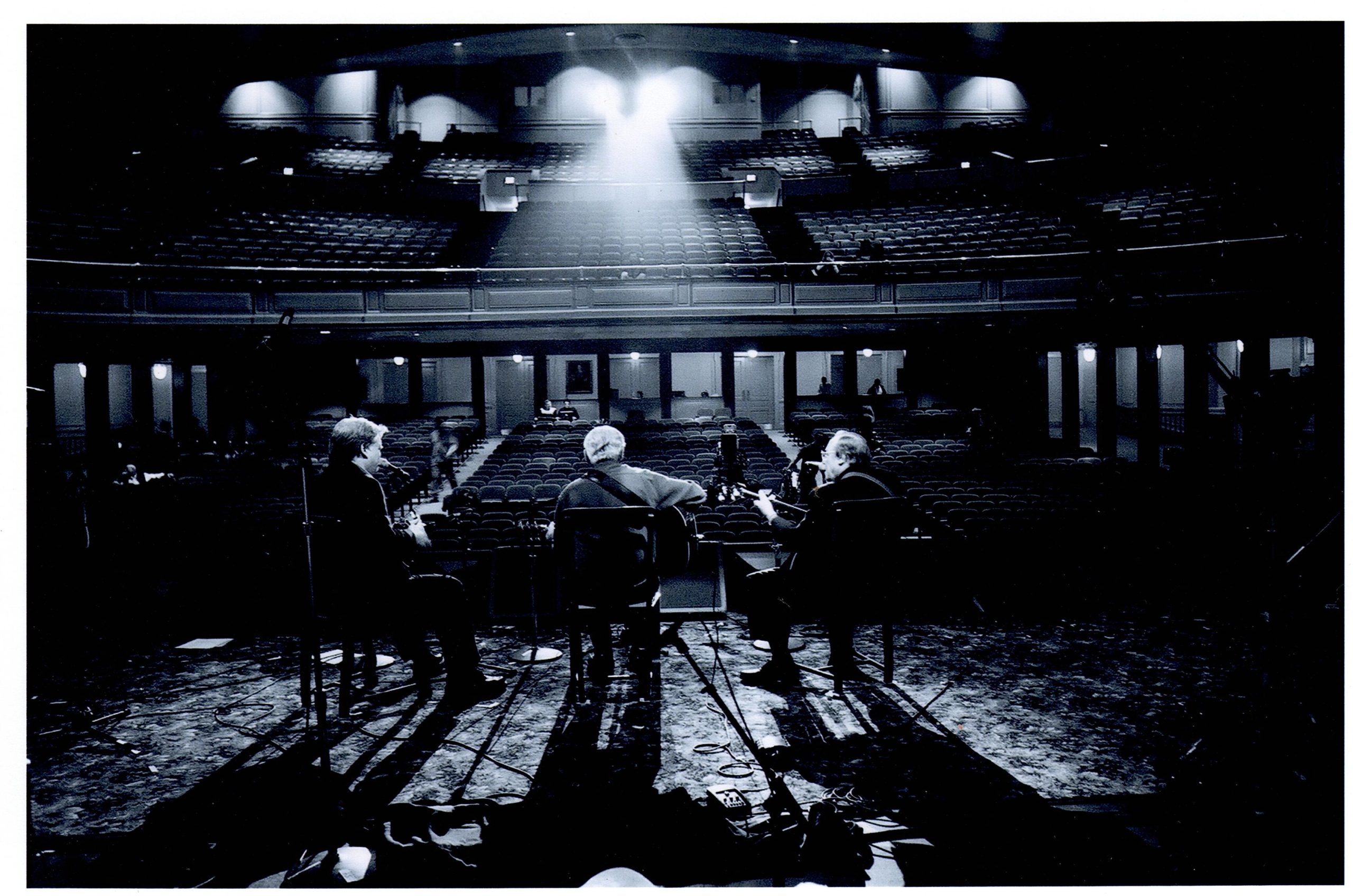
A behind-the-scenes shot of Ricky Skaggs, Doc Watson, and Earl Scruggs preparing for 'The Three Pickers.'
Earl Scruggs and Doc Watson backstage during filming of 'The Three Pickers.'
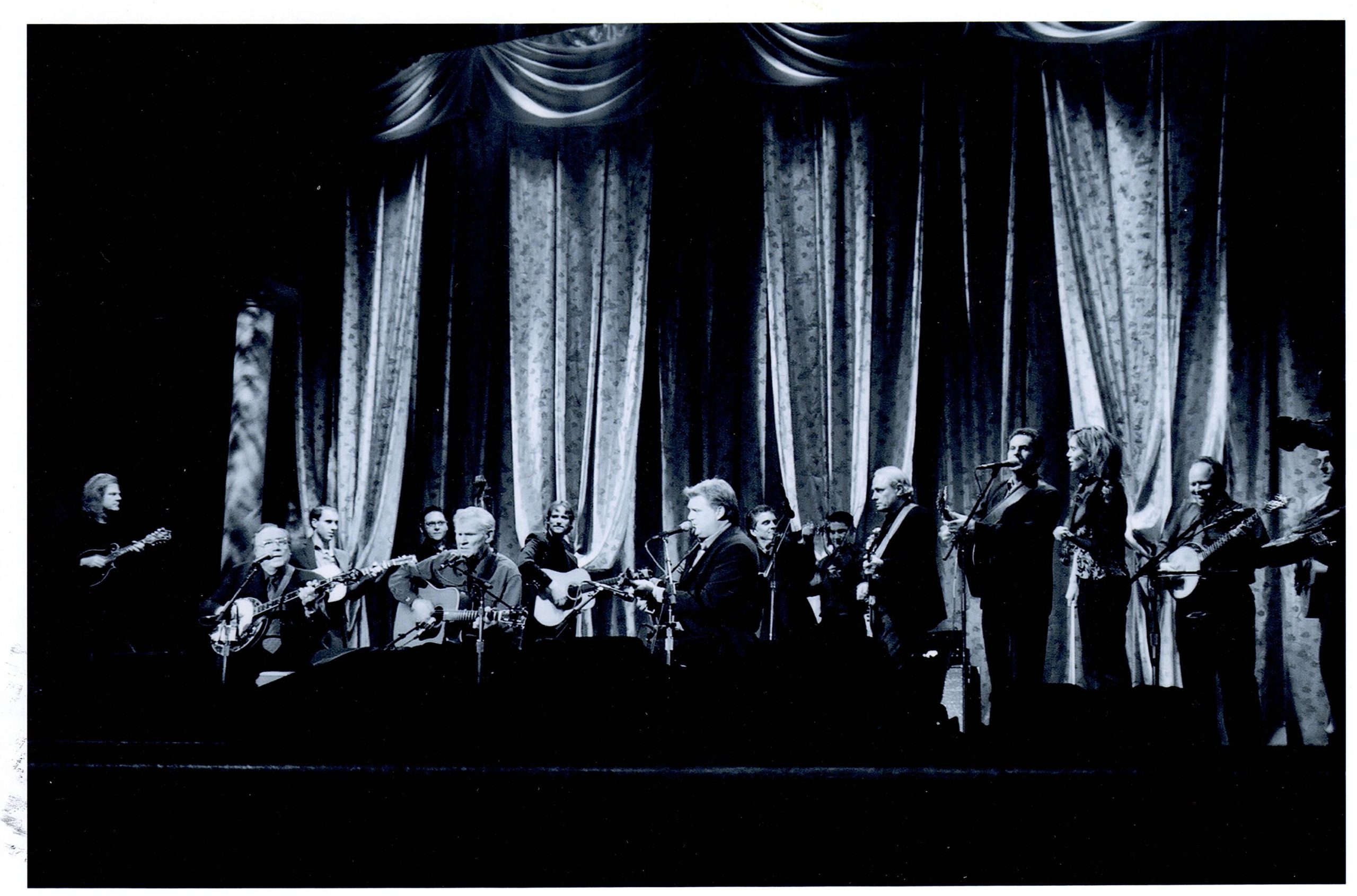
Earl Scruggs, Doc Watson, Ricky Skaggs, and many more musicians (including John Jorgenson, Cody Kilby, Mark Fain, Andy Leftwich, Alison Krauss, Jim Mills, and more) onstage filming 'The Three Pickers.'
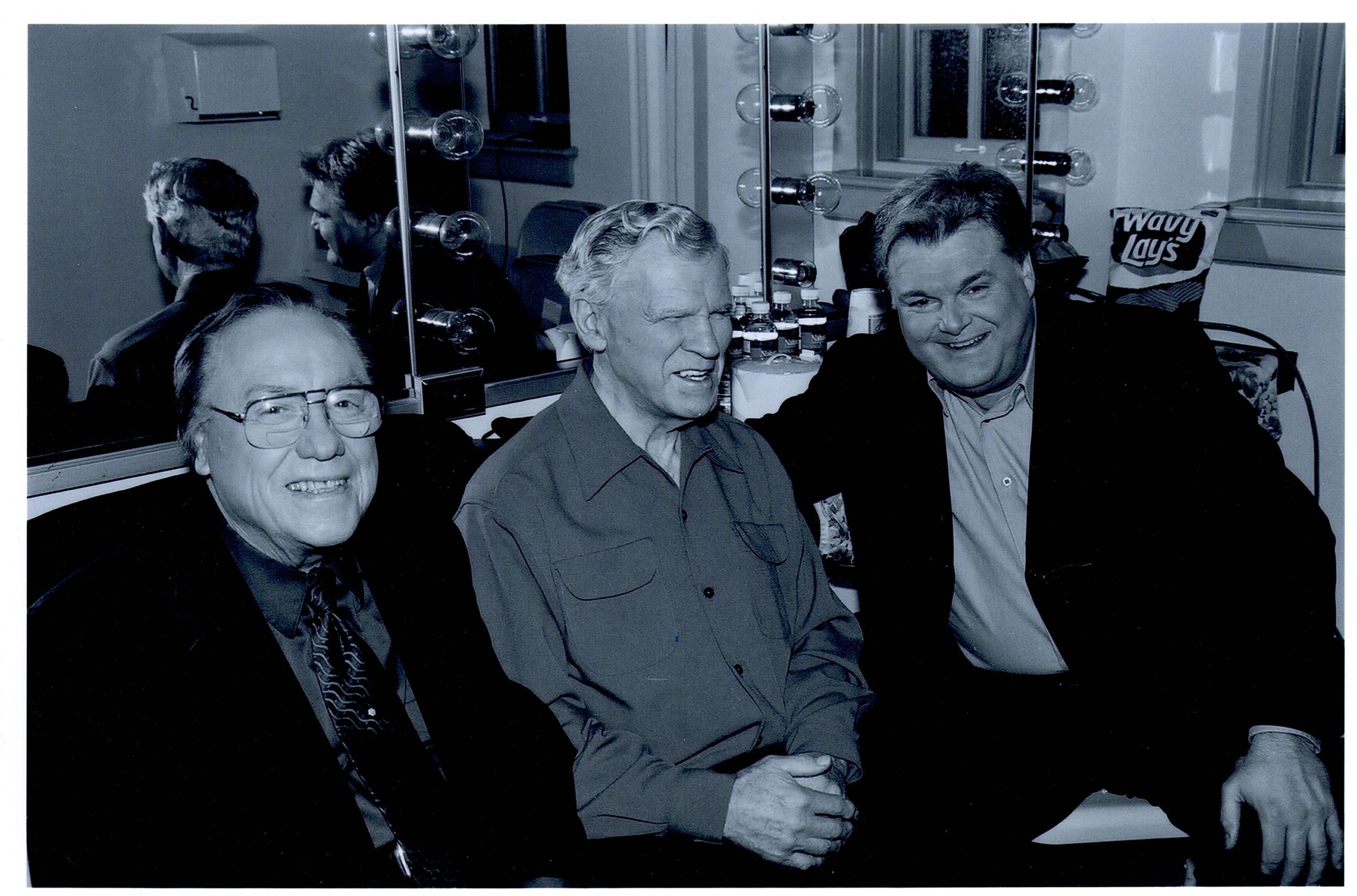
The stars of 'The Three Pickers' pose backstage during the taping.
All photos courtesy of the Earl Scruggs Center Collection. Lead image: Earl Scruggs, Doc Watson, and Ricky Skaggs backstage at the taping for The Three Pickers.
Lots of people would like to think their lives have made a difference – whether through their family life, or work, or some sort of creative endeavor.
However, even to approach the enduring heritage of the great musician Arthel “Doc” Watson, a person would have to achieve lifetime landmarks as imposing as the North Carolina Appalachian mountains that were his home. During a lifespan from his birth in 1923 until his death in 2012, Watson created a legacy of music, folklore, and goodwill that no one has entirely equaled.
First a little background: Arthel Lane Watson was born March 3, 1923, near Deep Gap – he is not from Asheville – in Western North Carolina. An audience member suggested the nickname “Doc” when his given name was found less than compelling for an entertainer.
His life story before and after becoming an admired folk musician has been often told, notably in Doc Watson: A Life in Music, a 2025 biography by Eddie Huffman published by the University of North Carolina Press.
Blind since infancy, Watson started to develop life skills and musical ability from an early age. He learned both formal and popular styles when sent to the state’s school for the blind in Raleigh at about age 10.
The boy was consumed by music and persistent in getting better at it. Watson had learned both the rudiments of harmonica and a few banjo tunes from his father, General Watson, before he went off to Raleigh. While living within the strict environment of the school for the blind, Watson learned braille and grew familiar with classical and church styles of music taught there. Perhaps as strong an influence as that education was fellow student Paul Montgomery, the talented friend from whom he learned guitar chords. Young Watson and Montgomery, later a well-known Raleigh pianist and children’s show host, shared enthusiasm for the popular music of the day, including jazz and big-band sounds.
His parents, Annie and General Watson, taught the boy skills of growing crops and basic carpentry, and he contributed to the family despite his blindness.
After years of mostly local performances back in Western North Carolina, it wasn’t until the early 1960s, when East Coast musician and historian Ralph Rinzler tuned into and promoted his far-reaching ability as a singer and picker, that Watson’s name gained national, then international attention.
According to an account at the Blue Ridge Heritage Area website Watson recorded over 50 albums and was honored with “the National Medal of Arts, a National Heritage Fellowship, the North Carolina Folk Heritage Award, seven GRAMMY Awards, and a GRAMMY Lifetime Achievement Award.”
As fans know, Doc Watson contained multitudes of skills, a breadth of ability that inspired this list of the five pillars of his musical and artistic legacy.
The King Flatpicker
Watson largely created the challenging fiddle-inspired guitar style that led many followers along a flatpicking trail.
It was during the 1950s, when playing an electric Gibson Les Paul in the local Jack Williams Band, that Watson developed a style that would transform the way the guitar was played in folk and bluegrass music.
Generally, earlier acoustic guitarists in roots-derived styles used a flatpick to create basic “boom-chuck” back up, perhaps throwing in some fills and Jimmie-Rodgers-style bass runs.
But when dancers at Williams’s gigs wanted music for square-dancing, Watson worked up single-note versions of fast fiddle tunes such as “June Apple” and “Bill Cheatham” on his Les Paul. This approach enables lead guitar pickers to achieve the same flowing, rapid attack that fiddlers used for tunes, many of which had come over from the British Isles in past generations.
It’s not possible to say that Doc Watson was the first guitarist to flatpick fiddle tunes. After all, it wasn’t until Watson emerged as a folk artist in the 1960s that the broader music scene caught on to his musicianship. And high achievers such as Arthur Smith on “Guitar Boogie,” Don Reno on “Country Boy Rock ‘n’ Roll,” and Bill Napier on the Stanley Brothers’ “Mountain Dew” – along with some jazz and blues players – all recorded hot-licks acoustic soloing before Watson did. Joe Maphis was also cranking out ultra-fast flatpicking numbers in the 1950s.
But it was Watson’s 1960s performances that created a precedent for a wave of guitarists who had to muscle up to the speed and dexterity he displayed.
A long line of guitarists at the top of the field – from Clarence White to Tony Rice, from Bryan Sutton to Billy Strings – all show Watson’s clear influence not just in recreating fiddle tunes, but also in rapid-fire picking and clean sound on a broad range of material.
Player and educator Alan Barnosky wrote in “An Exploration of Doc Watson’s Innovative and Joyful Guitar Stylings” for Acoustic Guitar in 2023 about the spread of this kind of playing.
“Watson amazed folk fans in the early 1960s by taking tunes typically reserved for the fiddle and reworking them for the acoustic with speed, clarity, and flash,” he wrote. “He never claimed to be the first to play fiddle tunes on a guitar, but for the majority of listeners at the time it was an entirely novel and groundbreaking approach.”
Another world-class, tradition-based player, Earl Scruggs, praised Watson’s adaptation of fiddle tunes as the two were joined by Ricky Skaggs for the 2003 The Three Pickers performance and album.
“He was the first man I ever heard on the guitar that was fooling with tunes like that,” Scruggs said in a Three Pickers introduction. “You had all these good G-C-D pickers – that’s chord positions – but I had never heard anybody that actually took over a lead like a banjo or a fiddle or a mandolin and do those tunes. He could do it.
“And what amazed me about Doc Watson’s picking, and still does, is he’s got that – I call it ‘mountain sound’ to his picking, and he’s one of the best to keep it in that mode of sound.”
New generations of players have immersed themselves in Watson’s style. When I interviewed him for a Bluegrass Unlimited article, leading guitar picker and multi-instrumentalist Bryan Sutton talked about being captivated by Watson’s playing during Sutton’s youth on Western North Carolina.
“Doc and Dan Crary were the first great influences on me,” he said. “Doc Watson was one of the first professional musicians/guitar players that I ever saw. He doesn’t live too far from Asheville, so I saw him play some different festivals and at Maggie Valley. So, he was the first one to really catch my ear as far as what you could do with the flatpick.
“My right hand – it may not as much anymore – but I remember at one time it was kind of like Doc’s. It’s kind of like the way Sam Bush plays, using the whole forearm and wrist involved in the playing, whereas with jazz players or Tony Rice it’s more of a wrist thing. I think I’ve got a little bit of both now.”
Billy Strings, the artist who’s likely doing the most to promote Watson’s legacy in the 21st century, sounded almost evangelical during a September 2025 interview for NPR’s Fresh Air.
“He’s like the ground upon which I stand, you know?” Strings said. “My dad played his music all around the house growing up. And by the time I could play guitar, you know, 5, 6 years old, I was learning those tunes, too. I might’ve been able to play some of them before I knew how to tie my shoes or something, you know?
“It was like, I was learning how to speak and talk and walk, and I was learning all these Doc Watson tunes at the same time. And it was just, like, a religion in my house, you know? His music is just – it’s the best.”
To see some of the top pickers in the field paying tribute, check out this video shot at the Merle Watson Memorial Festival – what would become MerleFest – in Wilkesboro, North Carolina, in 1992.
A Model Fingerpicker
From his first albums on, Watson regularly also played guitar with a thumbpick and index finger. As he noted with his customary self-deprecating humor in the DVD “Doc’s Guitar: Fingerpicking & Flatpicking,” “See, I just play with one finger and a thumb. I don’t use the sensible three-finger method that you should use on finger-style guitar.” (Watch below.)
Watson sounded great with that approach, making finger-picked tunes such as “Deep River Blues,” “Nashville Blues,” “Omie Wise,” and “Doc’s Guitar” fan favorites and objects of long study. For every striving guitarist who practiced hard on his fiddle-tune adaptations, plenty of pickers also worked on showcases such as “Windy and Warm,” with its alternating bass, pull-offs, note bending, and a jazzy minor sixth chord at its conclusion.
Watson’s fingerpicking often showed off his acquaintance with diverse approaches, as in “Deep River Blues,” with an E diminished as its second chord. It also illustrates the way he put his touch on existing pieces such as 1933’s “Big River Blues” by the Delmore Brothers, who played with flatpicks.
“There were two guitars, a tenor – a little four-string, and the regular flattop, and I never could get my guitar to sound like both of theirs did,” Watson said. “Then I began to hear brother Merle Travis, the late Merle Travis, on the radio. And I thought, Now, wait a minute. If I can steal me a lick off brother Travis, maybe I can learn ‘Deep River Blues.’”
Multi-talented Kentuckian Merle Travis (1917-1983) popularized a style in which the thumb plays an alternating bass on the guitar’s lower strings while picking the melody on treble strings. Watson also studied the work of the great guitarist Chet Atkins. The picking buddies released the album Reflections in 1980.
The centuries-old, transatlantic ballad “Georgie” would have once been sung unaccompanied, leaving Watson and others free to craft a brand new style of guitar back up. With no clear precedent on guitar, he might employ the flowing, almost classical patterns that became popular among folk revivalists.
And fingerpicking became the tool Watson used to play the blues that he loved and drew on so deeply, music he followed from the time he heard Mississippi John Hurt on the family’s disc player in childhood.
In the end, there’s no easy way to pin down the many elements Watson brought to his picking, musical points of view that enriched his listeners along the way.
A Standout Singer
Doc Watson’s vocal abilities don’t generally get as much attention as his top-drawer chops as an instrumentalist. However, he was also a tuneful singer with a natural, angelic mountain baritone.
Watson came along during an era when rougher-voiced vocalists such as Hobart Smith, Dock Boggs, and his picking buddy Clarence Ashley represented mountain singing to a growing audience. And Watson’s less mannered style likely contributed to acceptance among listeners less familiar with the high lonesome sound. His direct vocal approach was often heard in performances with no instrumental backing.
It’s useful to remember that Watson also enjoyed the smooth country vocalist Eddy Arnold so much that his son Merle Eddy Arnold was named not just after fingerpicker Merle Travis, but also for Arnold.
Tunes from the Tennessee Plowboy’s repertoire such as “Tennessee Stud,” “I Couldn’t Believe It Was True,” and “Anytime” also showed up in Watson’s repertoire. These were only a few examples of the eclectic side of Watson’s vocal approach, with emphasis on great material over genre labels.
Given his broad taste, Watson at times put some extra grit into his singing on a number such as “Blue Suede Shoes” from his Jack Williams days of the 1950s, later a concert favorite. But more often he sang songs straight, even on one like “Nights in White Satin,” a 1967 pop hit by British rockers the Moody Blues. With waltz-time guitar and plain singing, Watson makes the song come across as relevant to himself and listeners as songs by the Delmore Brothers and Jimmie Rodgers.
Watson’s first memories of vocal music came in church, and he prized the straightforward, no-vibrato sounds that carved such songs in his memory.
“If you love music, you have to listen from the time you’re big enough to notice music,” he told me when recording his 1991 GRAMMY-winning CD On Praying Ground.
“If you’re looking for old-time material in songs, those old songs that you heard when you were young were the easiest to put down.”
From his first commercial recordings on, Watson featured gospel numbers such as the a cappella version of “Talk About Suffering” from 1964 and “Down in the Valley to Pray” from 1966. Both radiate belief and unornamented clarity.
More recent listeners may know the latter song as “Down in the River to Pray,” as it was opportunistically relabeled to match a scene in the 2000 hit film, O Brother, Where Art Thou?.
Always A Song Man
Doc Watson had an impressively broad range of musical interests, perhaps markedly so, given the period in which he came along.
Country or folk music didn’t start appearing on commercial records until Watson was about two years old. In childhood he listened to down-home picking as well as church and gospel songs. It wasn’t until the 1930s that the family owned a radio that let them hear music beyond their 78-rpm record collection.
Virtually every great musician is a song collector at heart. And like Bob Dylan, Watson took on songs from tradition and added new elements. Take the mournful ballad “Omie Wise,” based on a North Carolina murder from the early 19th century.
In the 1920s notable old-time artists G.B. Grayson and Clarence Ashley recorded it with modal accompaniment that was neither truly major nor minor. When Watson recorded in the 1960s, he ventured into folky, arpeggiated picking that put it squarely into minor-chord territory, opening up the song to young folkies who couldn’t play fiddle like Grayson or banjo like Ashley.
In fact, Watson’s playing on “Omie Wise” occupied the same guitar realm as folk star Joan Baez’s playing on “East Virginia” and other traditional songs.
He also tuned into compositions by folk musicians Bob Dylan (“Don’t Think Twice It’s All Right), Tom Paxton (“The Last Thing on My Mind,” “Leavin’ London,” and “Bottle of Wine”), and Townes Van Zandt (“If I Needed You”).
Watson isn’t chiefly known as a songwriter, but he enjoyed notable success with “Your Lone Journey,” which he wrote with wife Rosa Lee. The starry duo of Led Zeppelin frontman Robert Plant and bluegrass’s own Alison Krauss released it as “Your Long Journey,” leading to what biographer Huffman called significant royalties for the family.
Watson’s greatest legacy in songs may have come with the wealth of lasting favorites – just a few are “Deep River Blues,” “I Am a Pilgrim,” “Banks of the Ohio,” “House Carpenter,” and “Shady Grove” – that made their way into the folk, old-time and bluegrass repertoire and could otherwise have been forgotten.
Ambassador for the Old-Time Way
This role for Watson may be the hardest to pin down, as it overlaps with almost all the others. By cleaving to his Appalachian heritage while also making the most of decades of change, Doc Watson was able to introduce countless fans to a rich, living culture.
“I don’t live in the past,” Watson told me in 1991. “I still burn wood in a furnace at the house, but I have heat ducts and a blower on it just like an oil furnace.
“I love to burn wood and I love to split wood. There’s a few of the old-timey things I love to do. I like good dried-apple pie and I like ‘leather britches’ beans.
“And I like to be at home, dadburn it. I hate the road.”
Watson’s long career of traveling to take his music to listeners, often in the company of his beloved son, Merle, nourished their taste for music that he built upon sold timbers of musical tradition.
Wade Smith, a legendary Tar Heel lawyer, told me once about his first experience of hearing Watson, at a small coffeehouse in downtown Raleigh in 1965.
“What word would I choose to describe how I felt?” Smith said for a later Raleigh News & Observer story. “Electrified, stunned at the speed of his fingers and the way he played single strings, and the clarity of the sound. Each note was like a piece of gold, so amazing.
“We stayed to the last note. When we left, I remember thinking that I had never heard anything like it and that in some way I had been changed by it, that I was in an altered state of existence.”
Watson’s national and international impact becomes more impressive given that he wasn’t heard outside his North Carolina stomping grounds until his late 30s. That’s when he honed his broad range of expertise into a mountain-based style that captivated and often amazed listeners at first hearing.
When the Society for American Music, a distinguished non-profit scholarly and educational organization, made Watson an honorary member in 2012, musicologist and musician Greg Reish paid tribute to Watson’s broad impact.
“As I discovered more of America’s traditional musical styles through my teenage years, Doc Watson always seemed to be at the core, an entrée into both older and newer styles,” Reish wrote. “Through Doc’s music I found my way to the pre-war music of the Carter Family, Jimmie Rodgers, and the Skillet Lickers; to the first-generation bluegrass of Bill Monroe and Flatt & Scruggs; to the classic country of Merle Travis, Chet Atkins, and Eddy Arnold; to the country blues of John Hurt and Frank Hutchison; and to the contemporary and progressive flatpicking of Clarence White, Norman Blake, and Tony Rice.”
Huffman’s book quotes the great bluegrass musician Roland White as he talked about the way his guitarist brother Clarence was caught up in Watson’s flatpicking after hearing him at California’s Ash Grove club.
“After seeing Doc, his picking became an obsession, an everyday part of everyday life. To play music and practice every day. Whether we played gigs or not, he was always playing music.”
Sixty years after White’s epiphany, Doc Watson’s music continues to gain and inspire new followers, whether through the picking and testimony of contemporary players such as Sutton and Springs, or through his own dozens of albums and videos. His legacy of tradition and innovation still flows like one of the ancient streams that nourish his cherished mountainsides.
Thomas Goldsmith is an award-winning journalist based in Tennessee and North Carolina. In addition to producing many hundreds of articles for newspapers and magazines, he edited The Bluegrass Reader and authored Earl Scruggs and Foggy Mountain Breakdown: The Making of an American Classic, both for the University of Illinois Press.
Few musicians have ever moved as fluidly between eras, genres, and generations as Doc Watson. From front-porch duets to grand-stage bluegrass revivals, Watson’s collaborations have a way of dissolving categories entirely.
His flatpicking precision, rhythmic calm, and vocal warmth made him the kind of performer who elevated everyone within earshot – young prodigies, genre pioneers, folk-tradition torch bearers, and musical iconoclasts alike. His reputation as a consummate accompanist was built not on showmanship or flamboyance, but on musical generosity and an intuitive sense of timing, phrasing, and expression that allowed others to shine while retaining his unmistakable voice.
Part of Watson’s power lies in the consistency of his musical identity. He never strained to fit into a new format or trend; instead, others bent gratefully toward his center of gravity. Whether playing an old-time fiddle tune, trading licks with a jazz-influenced mandolinist, or harmonizing with a younger bluegrass singer, he brought a sense of ease and groundedness that anchored every ensemble. That stability gave his collaborators the freedom to explore, improvise, and innovate – knowing Doc would be right there, steady and sure.
This sense of balance between precision and freedom made him a model collaborator for musicians across generations, and his impact can be traced through countless recordings, festival lineups, and mentorships of younger players.
Watson’s influence was not just technical but communal. He could guide a performance without overwhelming it, offering the ideal blend of authority and humility. In his guitar, listeners hear the voice of the North Carolina mountains, the pulse of Appalachian tradition, and the adaptability of a musician able to engage any genre without losing authenticity.
Today, YouTube’s patchwork archive of footage allows us to witness these collaborations anew: small moments of musical connection, sometimes real-time, sometimes reconstructed from archival sources. Below is a curated set of eight standout filmed or recorded collaborations that illustrate Watson’s reach. From storied duets with Chet Atkins or Earl Scruggs to meetings with newer-generation players.
“Roll in My Sweet Baby’s Arms” – Doc Watson, Earl Scruggs & Ricky Skaggs (The Three Pickers)
This relaxed but virtuosic performance features Watson, Scruggs, and Skaggs playing with the ease of a porch jam made public. Watson’s crisp flatpicking forms a warm foundation, while Scruggs’ banjo drives with characteristic agility and Skaggs adds mandolin flourish and bounce.
The trio exhibits mutual respect and joy, and their lines interweave with natural conversation. The recorded performance comes from the 2003 album The Three Pickers. The energy and clarity of the musicianship exemplify Watson’s ability to anchor an ensemble while remaining entirely supportive, a model of intergenerational teamwork. It is a performance that displays the combination of technical mastery and intuitive musical empathy that defined Watson’s career.
“Tennessee Stud” – Doc Watson & Nitty Gritty Dirt Band (Will the Circle Be Unbroken)
Watson’s performance of “Tennessee Stud” on the Will the Circle Be Unbroken project exemplifies his ability to blend seamlessly with both established musicians and a younger ensemble eager to learn from him. His deep, resonant vocals float over understated but fluid flatpicking, supporting the Nitty Gritty Dirt Band’s harmony vocals and rhythmic drive.
Watson’s musical sensitivity allowed for a dialogue that bridged generations, bringing traditional songs into a contemporary context while retaining their original heart and vibrancy. This track also highlights Watson’s ability to adapt to the studio environment, shaping a sound that was both authentic and polished. The 1972 studio album is well-documented, though various YouTube versions may mix studio, rehearsal, or live takes.
In this medley, Watson and Chet Atkins engage in a playful, masterful guitar dialogue. Watson’s flatpicking exhibits crisp, percussive articulation, while Atkins’ thumb picking introduces a smooth, jazz-inflected counterpoint. Both artists navigate tempo and dynamics with precision, creating a performance that is both technically dazzling and deeply musical.
The track appears on the Reflections album and while some online performances derive from live shows or reissued audio, the studio recording itself exalts the collaborative interplay. This duet demonstrates Watson’s ability to move effortlessly between folk and jazz guitar traditions, honoring both while creating something uniquely their own. The performance underscores his adaptability, an essential quality in a musician sought after by so many genres and generations.
“Black Mountain Rag” – Doc Watson & Merle Watson
The father-son dynamic between Doc and Merle Watson is in full display in this live rendition of “Black Mountain Rag.” Merle’s nimble, rhythmic energy dances atop Doc’s grounded guitar tempo, producing an interplay that is conversational, playful, and intricate. Their shared history and years of touring allow for spontaneous embellishments and musical commentary woven into the tune.
This performance captures the essence of the Watson family legacy, showing how Doc nurtured both musical skill and expressive interpretation in the next generation. The piece also serves as a lesson in ensemble sensitivity, as Doc balances his playing to give Merle ample space while maintaining rhythmic and harmonic cohesion.
“What Would You Give in Exchange for Your Soul?” – Doc Watson & Bill Monroe
Watson and Monroe’s pairing on this traditional tune combines the latter’s piercing, high-lonesome tenor with the former’s warm baritone, creating a striking emotional contrast. Watson’s guitar provides steady, unobtrusive accompaniment, allowing the vocal interplay to take center stage.
This recording exemplifies Watson’s ability to adapt to any partner, responding in real time to vocal phrasing and tempo shifts. The performance demonstrates his interpretive sensitivity, highlighting how he could honor a song’s emotional core while integrating his own stylistic voice.
“Shady Grove / Summertime” – Doc Watson & David Grisman
Watson’s collaboration with David Grisman blends Appalachian folk with progressive acoustic styling. In this rendition of “Shady Grove,” Watson’s rhythmic guitar backgrounds Grisman’s mandolin flourishes, resulting in a lively, conversational back-and-forth. Improvisation is key, as both musicians respond to each other’s phrasing, demonstrating mutual respect and spontaneity.
This collaboration underscores Watson’s versatility, showing he could navigate between traditional melodies and innovative interpretations, elevating both in the process. It is a reminder of his role in bridging traditional and progressive acoustic music for audiences and colleagues alike.
“Amazing Grace” – Doc Watson & Jean Ritchie
Watson and Jean Ritchie’s collaborations were well-established, including performances at venues like Folk City in the early 1960s. However, the specific attribution of some YouTube uploads titled “Amazing Grace” is ambiguous. The Live at Folk City album recording is the most reliable source, showing their complementary styles: Watson’s gentle, precise guitar lines support Ritchie’s clear, expressive vocals, blending Appalachian tradition with personal interpretation. They represent the transmission of Appalachian folk music to wider audiences and the seamless melding of their similar sensibilities.
“Summertime” – Doc Watson & Mark O’Connor
Watson’s influence on multi-instrumentalist Mark O’Connor is well-known; O’Connor cites him as a formative inspiration and their collaboration remains significant as a symbolic bridge between generations. Watson’s teachings and style informed O’Connor’s fiddle mastery, illustrating Watson’s mentorship and the continuity of American acoustic tradition. Indeed, their shared repertoire speaks to the passing of musical knowledge and the sustaining of tradition through personal and professional interaction.
These eight performances above collectively highlight Doc Watson’s role not only as a primary musician, but as a profoundly generous collaborator. He created space for others to excel, whether alongside legends like Bill Monroe, Earl Scruggs, and Chet Atkins or with younger rising stars such as Alison Krauss and Mark O’Connor. Watson’s approach combined technical mastery with emotional intelligence, allowing him to respond intuitively to fellow musicians in real time.
His collaborations illuminate the breadth of his influence. Watson moved with ease between old-time Appalachian tunes, rag medleys, gospel-inflected ballads, rocking hillbilly sounds, and improvised jam sessions. Across these contexts, he remained unmistakably himself: grounded, warm, and adaptable.
By mentoring younger musicians, bridging generations, and seamlessly adapting to new musical contexts, Doc Watson demonstrated that tradition is not static; it is a living, evolving practice. His legacy continues to teach musicians the art of generosity, the importance of listening, and the beauty of musical dialogue. Perhaps in every collaboration, Watson’s spirit resonates, ensuring that his contribution to music endures across time, space, and audience.
For the past few years, as the music industry goes quiet, spooling itself down for a two-week sleep over the Christmas and New Year’s holidays, the team here at BGS has taken the opportunity to utilize December to spotlight a few of our heroes. We began the series with Dylan in December in 2018 and followed up the success of that nontraditional “Artist of the Month” pick in following years with Dolly in December, Del in December, Dawg in December, and last year’s incredibly popular Dead in December.
What better way to spend a cozy, holiday-filled, wintry month than celebrating some of the legends – artists, songwriters, musicians, and bands – that have made our roots music scene what it is today? This year, it’s clear who our December Artist of the Month should be: “Doc” Arthel Watson, himself.
Born in Deep Gap, North Carolina, in the heart of Appalachia in 1923, Doc Watson started playing guitar – and other instruments, too – as a child. Doc lost his vision in his youth, but would go on to become one of the most important American guitarists in history even with his disability. His position in modern roots music, especially in bluegrass, old-time, and folk, is canon. He is a legend to any and all, from the diehard lifelong acolytes to the recently initiated neonates. He’s one of our Americana music figures who tends to get lost, like the forest for its trees, within his own ubiquity and universal adoration. But no matter from which angle you drill down into his career, discography, artistry, and legacy there’s always more to find. To explore. And to enjoy, of course.
Over the course of December, we’ll be doing just that. Our writers and contributors will offer new articles considering Doc’s songs and output and his career as an American guitar hero. And, how even after his passing in 2012, he continues to be a definitional stylist on flat-top, flatpicked guitar. But don’t sell him short, either. Though most known for his fiddle tunes, folk songs, and old-time and bluegrass licks, Watson was accomplished in many genres across the roots continuum; he dabbled in and conquered sounds from hillbilly and rockabilly, electric guitars, blues, ragtime, fingerstyle, chicken pickin’, and more. He collaborated with artists from well within his own circle and far outside it – sonically, socially, and geographically. Watson was incredibly dynamic, a characteristic that has contributed greatly to his lasting, ongoing appeal.
We will also be dipping back into our BGS archives to share past features, playlists, and articles about Doc, and his son Merle; about his festival MerleFest, which continues to this day; and about the albums and offerings celebrating the 100th anniversary of his birth that were released in 2023. Truthfully, there’s nearly an endless supply of BGS content that touches on, focuses on, or mentions Doc. Because of course there is – these genres we all love and hold dear wouldn’t be what they are today without him.
You also won’t want to miss perhaps the most exciting aspect of our Doc in December Artist of the Month celebration. In 2023, BGS was invited to Bryan Sutton’s Blue Ridge Guitar Camp in Brevard, North Carolina. Sutton, alongside his friend and peer Billy Strings, is one of the most prominent proselytizers for Watson in the 21st century, so it’s no surprise his annual camp just up the mountains from Watson’s hometown of Deep Gap is usually dripping with Doc’s music.
That year, one of Doc’s most famous guitars, “Ol’ Hoss” – a 1968 G-50 Gallagher Guitar Watson played in the late ’60s and early ’70s and on many recordings – was also at the Blue Ridge Guitar Camp. The instrument was one of the first of a few Gallaghers that Doc owned. BGS made the trip to Brevard to capture special video performances and interviews with many of the event’s instructors and pickers, each of whom played Doc tunes and shared stories and memories while picking Ol’ Hoss. It was a magical week in the mountains. Now, for the very first time, we’re making select songs from these tapings available in a new series, the Ol’ Hoss Sessions. Three sessions pulled from the shoot celebrates Doc in December and features Bryan Sutton, Courtney Hartman, and will also feature Billy Strings. Stay tuned as we share those videos right here on BGS and on our YouTube channel throughout the month.
It’s not that Doc Watson is underappreciated or underrated, or that he needs any of the visibility that being a BGS Artist of the Month might afford. In our neck of the woods, seemingly everyone knows and loves Doc Watson already. But with so many folks and institutions shouting Watson’s praises from the rooftops lately – artists like Sutton, Strings, and a host of guitar pickers and roots musicians from across our community and scene; the folks who put on and attend MerleFest; the communities of Boone and Deep Gap, North Carolina; projects like I Am a Pilgrim: Doc Watson at 100 – it’s clear there’s always more to learn, love, and enjoy about Arthel Lane Watson.
Get started with Doc in December with our Essential Doc Watson Playlist, below. Plus, follow along right here on BGS and on social media as we share Doc Watson content throughout the month. We’ll have a new feature on Watson’s status as American guitar hero, and you can see our YouTube playlist of his incredible musical collaborations here. Plus, of course, our very special Ol’ Hoss Sessions, exclusively available right here on the Bluegrass Situation. (Watch Bryan Sutton here. Watch Courtney Hartman here.) Plus, we’ll be combing through the BGS archives for everything Doc Watson for y’all to enjoy. Buckle up for a mighty month of guitar pickin’ glory, it’s Doc in December!
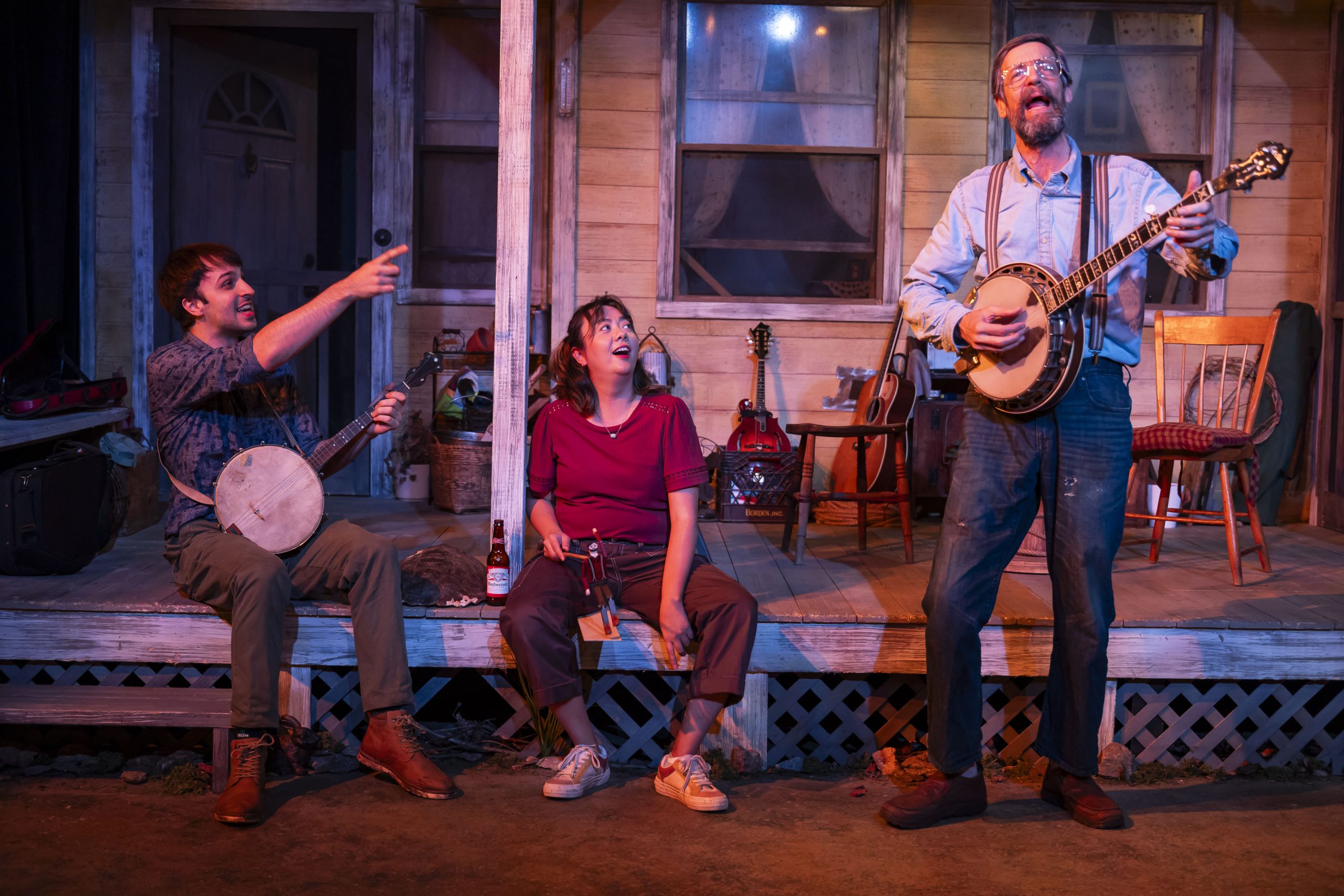
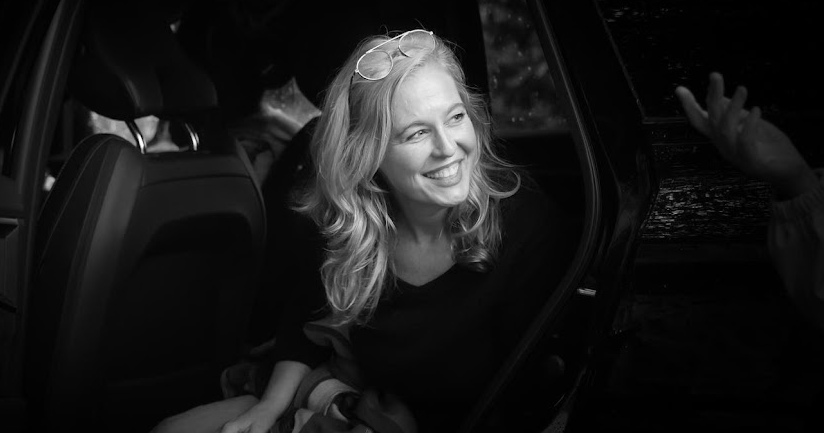
A fantastic new off-Broadway play, titled The Porch on Windy Hill: A New Play with Old Music, has been performed across the U.S. in Vermont, Pennsylvania, and Illinois, before landing at Urban Stages on West 30th Street in New York City where it’s currently playing until October 12, 2025. Written by Sherry Stregack Lutken, Lisa Helmi Johanson, Morgan Morse, and David M. Lutken, and directed by Sherry Lutken, The Porch on Windy Hill was born during the pandemic, when Sherry Lutken found herself having extensive conversations with one of her closest childhood friends, one who happens to be biracial, about their personal perspective and experiences. Sherry Lutken’s formal idea coalesced around April 2021 and the first full performance took place that September in Ivoryton, Connecticut.
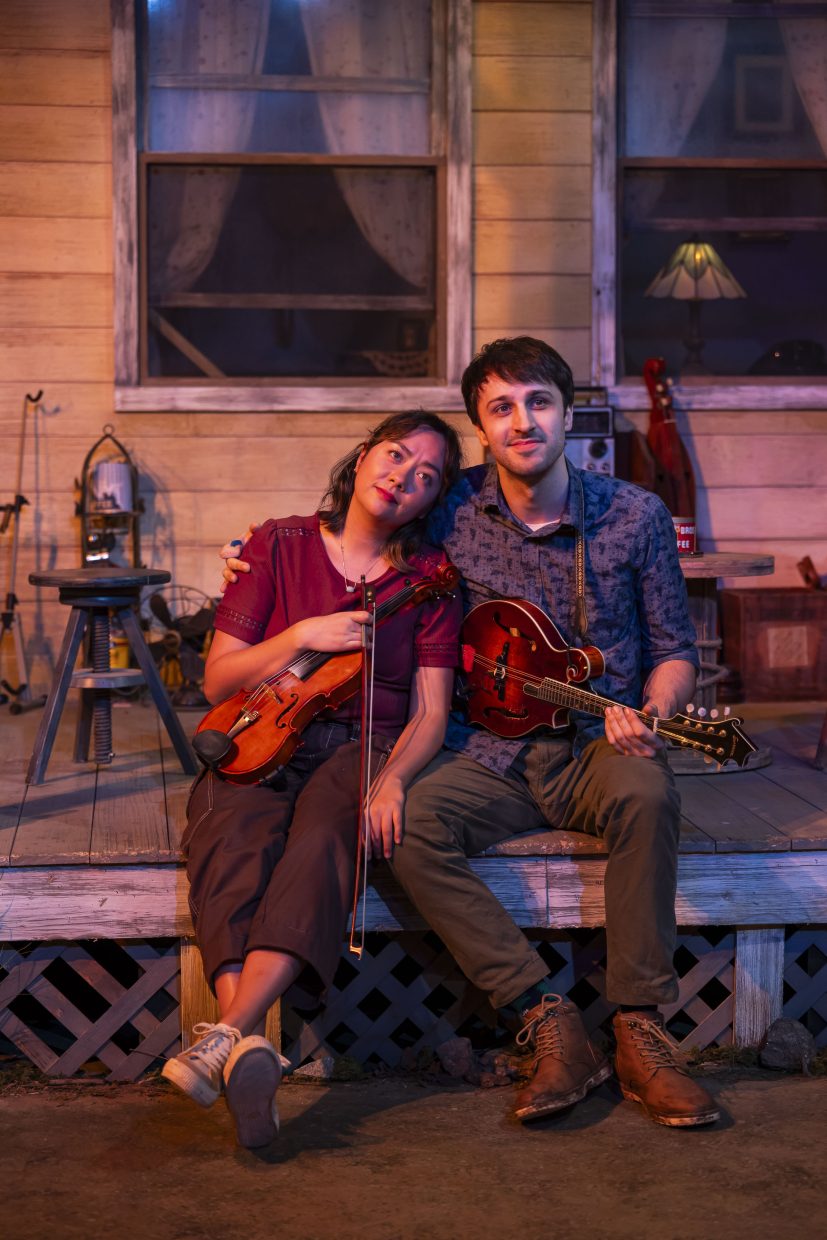
The show centers on Mira, a biracial Korean-American classical violinist, and her boyfriend Beckett, a Ph.D. student passionate about the history and connections of folk music in America, as the couple leave their isolated apartment in Brooklyn and head for the lively pickin’ parties and folk festivals in Atlanta, Georgia. When their navigations and a fussy van engine take them on a detour into the Blue Ridge Mountains of North Carolina, a pit stop leads to a run-in with Mira’s estranged white grandfather Edgar, and Mira and Beck both find more than they bargained for. The encounter goes on to change the three characters in incredibly profound ways.
The music serves as a beautiful and powerful reflection of the many emotions that run high throughout the play, as well as a story-rich catalyst that fills in the blanks of who these people are, what they know and don’t know about one another, and, of course, why Mira and her grandfather grew apart after being so close during her childhood.
The boldness of The Porch on Windy Hill comes from its many contrasts and complements. The story unfolds entirely on the front porch of Edgar’s North Carolina home, which sits in the shadow of an unseen Mount Mitchell. David Lutken, Morgan Morse, and Tora Nogami Alexander – who play Edgar, Beckett, and Mira respectively – move in, about, and out of the setting in very natural ways. A tension rises between Mira and Edgar for most of the first half and the confined space only heightens the impact of the actors’ moods on the audience. The discomfort, though, isn’t just social anxiety. The core narrative mysteries and tensions of Porch are tied to its real world relatability around the ways different folks view race, politics, and in this story especially, folk music.
The first half of the play is also music-heavy, with an abundance of different folk tunes showcasing Lutken, Morgan, and Alexander’s skills on a potpourri of instruments from banjo to guitar to violin to the Chinese erhu, to dulcimer – an instrument that’s key to the story and one special aspect of the cross-generational bond between Mira, her mother, and Edgar. Over the course of the show, Edgar’s home becomes part pickin’ stage and part time capsule for Mira and Edgar to rekindle their long-lost connection. This isn’t without its thorny moments, which peak at the revelation that Mira and Edgar’s estrangement comes from trauma she experienced as a child when her cousin cruelly called her a racial slur, only for her grandfather to turn a blind eye to the incident. The subsequent chasm that formed left Mira and Edgar unsure of how to even begin addressing their discomfort, before their musical connection – and a bit of moonshine – helped to clear the air and start to mend decades-old wounds.
The Porch on Windy Hill isn’t about safe spaces. It isn’t about breaking into folk song to comedically cut the tension, and it isn’t about being a modern PSA for Asian-Americans. But what it does do is give its audiences a reminder of what it means to share space with people who don’t hold a carbon copy of one’s own views. It also gives permission to express anger, hurt, and confusion over the unique pain that comes with discrimination and ignorance of others’ lived experiences.
These characters think, react, question, demand, and forgive in wholly believable fashion. The Porch on Windy Hill gets and keeps you invested. From the first time Mira, Beck, and Edgar play “Little Old Log Cabin in the Lane” together to the moment Mira walks off saying, “Kamsahamnida” – “thank you” in Korean – to Edgar, before he goes inside to finally call Mira’s parents. It’s everything a stellar musical is: thought provoking, entertaining, emotionally stirring, and something that imparts a feeling of growth. The depth of personal stories that hold The Porch together make this play ideal for partnering with the legacy-laden nature of folk music.
David Lutken, Sherry Lutken, Morgan Morse, and Tora Nogami Alexander jumped on a group call and spoke with BGS about the multi-layered nuance behind The Porch on Windy Hill and how all the aspects of the play, from the conflicts to the specificity of the music utilized – even the story behind one made up fiddle convention! – had meaning and purpose to enhance the impact of the characters and the story.
What drove the decision to set Porch on the Windy Hill in the mountains of North Carolina, as opposed to another part of Appalachia or even a completely different part of the U.S.?
David M. Lutken: [Porch on The Windy Hill] could be set in many different parts of the United States, but [choosing North Carolina] had to do with several things. The music that I have been most familiar with all my life kind of emanates from a little bit of bottleneck down in the southeastern United States. And also it had to do with the specific instrument – the dulcimer – being something that comes from the Appalachian region, even though its earlier ancestors come from different places as well.
But it had to do with that, with instrumentation, the draw of the entire Appalachian region of the United States, and the metaphor in the show of Mount Mitchell and the highest point in all of the Appalachian region of the United States and all of those things stated there. I have to say, the fact that North Carolina is a decidedly “purple” place these days also has to do with it, particularly Western North Carolina, where you have places like Asheville that are very, very liberal, surrounded by counties that are very conservative, which happens in many other parts of the United States. But all of those things together I would say, pointed me [toward choosing North Carolina as the play’s setting.]
Morgan Morse: I’ll add one last very silly reason that influenced our decision, which is just geography. We have this couple, which is traveling from the East Coast, and they’re on their way to Atlanta, [Georgia], and that’s their next goal. So in general, we were also looking to find a location that sat pretty nicely between those two places.
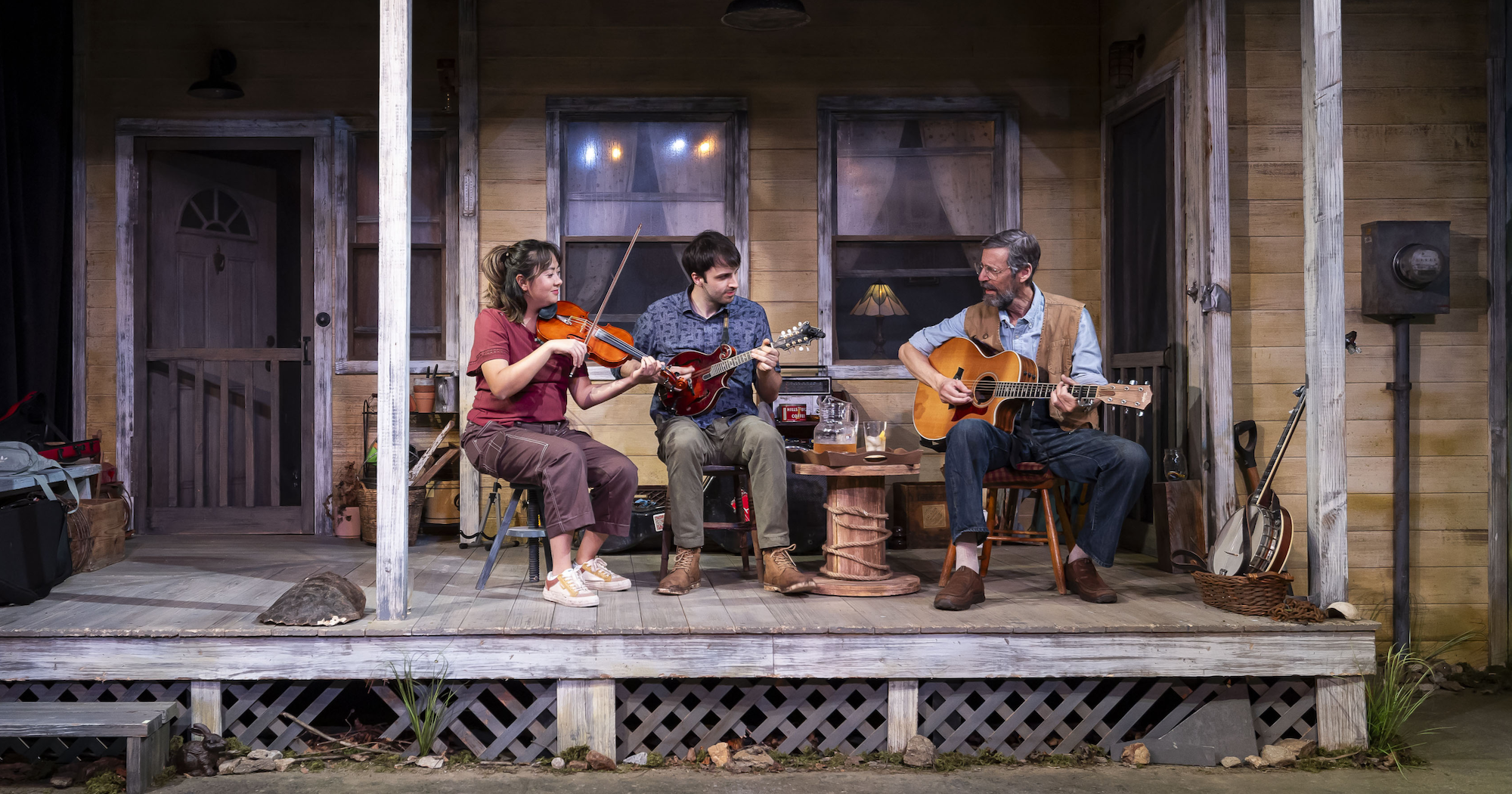
(L to R) Morgan Morse, Tora Nogami Alexander, and David M. Lutken perform ‘The Porch on Windy Hill.’ Photo by Ben Hider.
When it came to determining how the music of the show would not only link the characters and the scenes together but also keep them together, how did you discern the balance of realism, optimism, idealism, and cynicism in the pickin’ performance scenes – particularly the early ones when Mira hesitates to participate – especially given how uncertain and outright tense the characters’ interactions become over the course of the play?
Tora Nogami Alexander: That is the most difficult part of the play and that is the thing that we focused on the most, with me being sort of the new addition to this version of this play. We practiced a lot of this music before we really dug into how the performance would translate. And so, as we were in the real meat of the rehearsals, [director] Sherry [Lutken] was really, really helpful in crafting the balance of the emotional baggage that Mira has and that everybody has within the play.
For me, what’s awesome about doing this play and what’s really fun for me, is that I do think I discover something new every time I do it. Every night, I really listen to my partners and we all listen to each other. It might change every day – how certain things hit us, how we process things. The bones are there but it’s been really interesting to try and tightrope that every night because it is a little bit different every single night, which is exciting and cool. Working with Sherry, she was so helpful in translating it because she’s watching the play and so she’s able to give us tools to help tell a story in a way that people can understand.
MM: Because there are so many emotions sitting under the surface in the first act, especially the first half of the first act, you want to strike a balance of making sure that it’s coming through without feeling like you’re overselling everything that’s happening underneath. So, throughout the results of that – Tora said “tightrope,” that was a word that we used a lot during rehearsals – especially for the character of Mira, she is figuring out what she wants from this situation and she’s figuring out how comfortable she is, how much she wants to engage. It’s something that Tora [does] so beautifully and it’s so fun to watch every night to see exactly how [the emotions] are hitting her and how she translates that to the way she plays [her violin].
DML: Well, the interesting part to me has been Tora’s ability to convey things musically. We set out to make a musical play where the music is a part of the dialogue and the ability to express vulnerability and frustration and a spectrum of emotions without opening your mouth, just playing violin, or even the erhu, or the other things that we all play. But particularly for Miss Alexander, I think that’s a unique talent of hers, and a unique thing to this show, particularly the first half of the first act. That’s a big part of what is happening with the music; it’s [songs] that certainly [Morse and Alexander] are familiar with, and they’re having to play them in a really weird situation.
You all mention in another interview that you wanted music that was “intrinsic rather than performative.” That the songs “aren’t decorative.” That said, the folk songs selected for Porch On The Windy Hill seem like they aren’t exclusive in their ability to convey or heighten the specific emotions desired in a scene. As such, what is it about the songs in the play that make each of them essential in a way other folk songs are not?
MM: On one hand, I can tell you all the reasons why these particular songs ended up there. And I do think that they work very well and they serve very specific purposes. At the same time, you’re kind of right that there are a billion other folk songs that could also fit into those slots. To me, that’s actually the amazing thing: American folk songs cover so many themes and some of them are universal themes and that’s what was so cool about putting these songs into the show.
There’s consideration like, “We need a fast song here.” “We need a slow song here.” “We need a song with this particular mood.” “Okay, we want to break up the flow of things by having an instrumental, what instrumental can we have?” So there’s those kinds of nuts and bolts and there’s the little ways in which, even though these songs were not written for the show, they still managed to reference and inform the action within their lyrics as well, because we’re singing about these universal things like love and loss and family and travel and childhood.
The question is, “What’s going to move these characters in this moment?” Whether that’s moving them emotionally or moving them forward story-wise. And sometimes it’s something like the history or the context of this song that can lead to a really interesting conversation. There’s a couple moments like that in the show, where the history of the song [being played] then becomes a catalyst for conversation between the characters and that leads to explorations of the themes of the show in that discussion because they’re all intertwined: the music, the country, and all those various things.
At a certain point, Beck abruptly recalls from where he recognized Edgar’s name. It was on a specific live recording of the 1972 Charlestown Fiddlers’ Convention, where Edgar is credited as performing with the likes of Roscoe Holcomb, Ola Belle Reed, Lily May Ledford. What was the inspiration behind this fictional recording and why select Holcomb, Reed, and Ledford as the artists meant to be Edgar’s connection to the real world?
DLM: I had met Bascom Lamar Lunsford on a couple of occasions when I was a boy and went to the Asheville Folk Festival regularly in the late 1960s. The others, Roscoe Holcomb and Ola Belle Reed, I will confess they had partly to do with Edgar’s politics. I was trying to keep Edgar a bit ambiguous in his set-in-his-ways old guy [personality] and make him a little bit more open-minded.
The particular selections we chose for the fictional Charlestown Fiddler’s Convention of 1972 were to try to make something that sounded real and give it a little bit of a historical novel perspective, and also to raise Edgar’s banjo playing – elevate it greater than mine could ever be – and to make it so that he would have been in on something like that if it indeed had existed. And with West Virginia being a little bit different from Virginia in its history, and also the history of music there, we just tried to pile on the old-time music references without skewing too much in one direction or the other. In terms of picking for the Bill Monroe Bean Blossom Festival or the Newport Folk Festival, if you know what I mean. So it was really just to put all of that together in a little bit of a historical novel sense and also to paint things with a little bit of an open minded brush.
Over the course of scene five to scene seven, the show moves from the American folk song, “Mole in the Ground,” to the Korean children’s mountain rabbit folk song, “Santokki (산토끼),” and finally the murder ballad “Pretty Polly,” which brings the unique sound of the Chinese erhu from the former into the latter and prompts a conversation about musical traditionalism – which instruments “fit” in a pickin’ party and which don’t.
What are your thoughts on Edgar’s view on the sounds that belong at a pickin’ party or jam? Furthermore, what do each of you think of as the central quality that makes something “folk” music and, in what way do you think people who may share Edgar’s view might be persuaded to consider a wider scope of sonic acceptance?
DLM: Well, I wish you had been at our last post-show hootenanny. Morgan, Tora, Hubby Jenkins of the Carolina Chocolate Drops, and a couple other folks were there and we all did a version of [Chappell Roan’s] “Pink Pony Club.”
It’s instrumentation, it’s sonic qualities of what’s going on, and it’s also the people who are doing it that are all part of how music becomes what it is. I personally am all for the erhu and the tuba and the bagpipes at a hootenanny all playing “Pink Pony Club,” because, it’s as Louis Armstrong said, “All music is folk music. I don’t see no horses listening to it.”
MM: I’m very much in the same boat. And it’s a very, for lack of a better term, fiddly question because it’s another one of these moments where it’s like, “Okay, [Edgar’s] got an open-minded streak about him but he still has limitations, you know?” Like, “Don’t bring an electric guitar, don’t play stuff out of your computer.” So there’s that technological line, which I think you could make an interesting argument for in this day and age, that this technological line maybe shouldn’t exist as much as it does.
You can make the argument that the kind of musicians who could really be considered to be making folk music at this point, and who definitely share a lot in common with the evolution of American folk music, are those who write hip-hop and rap. It’s the same kind of communal development where all of these different people are getting together for essentially, jams, where they’re taking things that they know and they’re remixing them, they’re learning from each other, and advancing with each other. So, you know, I’d be curious to have somebody come in with a little turntable to a hootenanny one time – that could be fun!
TNA: Folk music has to do with people and folk music exists everywhere, not just here. So yes, you know, mixing it up doesn’t seem too crazy to me, since organically it’s what would happen as our world gets more globalized.
Tora Nogami Alexander and Morgan Morse perform an intimate moment during ‘The Porch on Windy Hill.’ Photo by Ben Hider.
When Edgar, Beck, and Mira all exchange heated words with each other and Mira eventually picks up her mother’s dulcimer to play “My Horses Ain’t Hungry,” she’s obviously coming down from a tense and vulnerable place. What combination of emotions is Mira leaning into when she turns to the dulcimer and this song for a short reprieve and, as an actor, what kinds of thoughts and/or experiences are you calling upon to bring out the expression Mira is feeling at that moment?
TNA: In that moment, I think a lot about Elmira, [Mira’s grandmother]. I think a lot about her grandmother and the relationship of her grandmother and Mira’s mother. And I think about that relationship a lot during that song. For me, I think that moment is basically when all the shit blows up, it sucks, and Mira’s in this place where she’s finally alone and working through what happened. But [she’s] also realizing, through this song – one that was her mom’s favorite song and that maybe Mira learned from her grandma – that [it] wonderfully encapsulates the whole story. That [Mira’s] mom needed to get out of North Carolina and she chose the life she did for whatever reason. For me, that moment is sort of thinking about the mom-and-grandma relationship, how they got there. That also is why it leads to Mira calling her mom. She’s thinking through this song and then realizing that she needs to tell someone about it, someone who understands, and that would be her mom.
Sherry Lutken: I think for me, sort of what we talked about is that the dulcimer is the embodiment, in some ways, of Elmira – this sort of ghostly figure that hangs over the play and is there and ever present. They keep talking about her, they keep going back to her. That moment is very much about the matriarchy.
Mira’s surrounded by men the entire show and so the dulcimer and that line of women – of her mother, her grandmother, and the women before who are the reason for Mira’s birth – they mean that emotionally. That’s what I think Tora captures so beautifully and what that moment really embodies, that need to reach out to her mother even though she doesn’t really know what to say, even though she’s in a moment of flux, and even though she knows it’s going to be an upsetting thing. Still, she wants to talk. She’s not gonna let her mother evade the subject anymore. And she’s not gonna let Edgar avoid talking about it anymore – it’s time. That’s a wonderful moment of decisiveness. We get to see Mira’s decisiveness and this is a moment of the emotion really informing what she does next and the choices that she makes in the moment.
Given that the polarization of the U.S. has only become more aggravated since Porch On The Windy Hill was first performed in 2021, how much and in what ways would you say the impact of the story’s vision for self-reflection, forgiveness, and understanding has been affected?
DLM: When we were talking on opening night, Lisa’s [Helmi Johanson] husband was there with us at the party and he said it was ironic that what was written in 2021 has now become a period piece in several ways, because things have changed.
SL: Our relationship to the pandemic and to that time has changed. It’s amazing how quickly we forget that when we were in it, we thought we would never get out of it. We would never get to move forward because we were all stuck and it felt like forever. And now everything has changed. I think the thing for me is that, yes, the play rings differently now, but it’s still such a universal story. I think everyone can see themselves in each one of these characters in some small way, if they’re open to it. I think the play lends itself to self-reflection and also what we still want is the idea that there is hope and that there is a possibility of seeing each other’s humanity.
MM: I completely agree. I think it’s very easy right now to feel like there is no hope and that the wounds are just too deep. And whether it’s realistic or not, whether or not you think it’s idealistic or not, I think the thing that’s wonderful about the show is that it does open up a space where reconciliation is possible. Growth is possible. Forgiveness is possible. Owning up to your mistakes is possible, which is something that we’re missing a lot right now.
That and I think being really willing to admit that one is wrong and to take accountability for those things as well. I think stories like Porch on the Windy Hill do exist in the world and also I want more of them to exist in our world. So it’s a wish for how I think the world is in some ways and very much for how I wish the world could be.
The last time Mipso were our Artist of the Month it was 2023, in the run-up to their release of Book of Fools. At that time, I wrote our article unveiling the group as our artists-of-honor with the central conceit of that writing a straightforward but relatively groundbreaking plank in the band’s foundational mission as musicians:
“…[Mipso] aren’t defined by their ambitions; and their ambitions don’t seem to ever be conflated with conquering anything. Instead, this is a band building something.”
Over 13 years, six studio albums, hundreds of millions of streams, and more than 1200 shows, that fact remained true. No matter the shifting sands of their music making, industry successes, and the natural ebb and flow of more than a decade touring and creating together – even in moments of uncertainty, growing pains, and stress – it was always clear, at every juncture, that this band wasn’t just trying to climb industry and corporate ladders toward success. They were building something, not just building towards something.
A few months ago, the group of Wood Robinson, Libby Rodenbough, Jacob Sharp, and Joseph Terrell announced their Farewell For Now Tour and a deliberate and intentional stepping away from the band that was the gravitational center of their lives from their college days into their 30s. Fans and peers around the globe were devastated and saddened. But, with that stalwart keystone at the center of their artistry, it was immediately clear Mipso aren’t abandoning anything. Or walking away from something that will wither, wilt, or die away without them. The “something” they’ve been building has, gratefully, been built to last without themselves or their egos at its core. Their songs, their mission, and their impact are structurally sound, unwavering in the face of the purposeful uncertainty of the band’s next new era.
Mipso perform with Sean Trischka on drums and percussion and special guest fiddler Stephanie Coleman in NYC during their Farewell For Now Tour. Photo by Elliot Crotteau.
Mipso’s final studio recording, the gutting, emotional, and convicting “Singing Song” (released in August) wasn’t originally meant to be such a well-fitting final track from the group. But, whether coincidentally, fatefully, or aptly, it finds in its crosshairs the exact pathway through which Mipso’s legacy can and will live on with or without the band acting as their own life support system.
“Singing Song” imagines a not so far-fetched reality in which songbirds are going extinct in the accelerating climate crisis and humans are assigned birdsongs to help keep alive by singing, refusing to let their avian melodies die, go silent, or be forgotten. It becomes the role of the community itself to hold memories, together, and move into the future with our pasts to help guide and inform of what’s to come.
This is what Mipso have built for us. And they have built it for the eons. Their music will live on in each of us, as we carry their melodies – “Louise” and “Carolina Rolling By” and “People Change” and “Coming Down the Mountain” and so many more – with us into our collective uncertain future. Mipso were never building a mine or a factory or a quarry by which they could extract all the resources they could from us. No, they built us a home. Joist by joist, shingle by shingle. And now, though they may be moving out for a time, we’ve all been invited to maintain this idyllic Carolina mountain shack they’ve gifted to us.
A parting such as this begs the question, “Who will sing for Mipso?” but the answer is immediately obvious and indelible: All of us. Because this band, this impeccable string folk foursome, has never been solely about the people who make it up. It’s always been a community far greater than the simple sum of its parts or only made up of the folks on stage.
Midway through their Farewell For Now Tour, BGS connected with Mipso via Zoom for an in-depth round-table discussion about their decisions to put the band “on the shelf” for a little while. Our conversation was full of intention, nostalgia, and a remarkable variety of ways to look into the future for redemption and renewal.
I wanted to start by having y’all talk a little bit about how you feel about how your mission as a group – prioritizing art and community and building something instead of going somewhere – has informed this decision to pause the band. Whether it’s been stated overtly or has been the undercurrent behind what you’ve all done, that mission is clearly informing this decision as well.
I think some people see this farewell as a switch being turned off and a new thing happening after an old thing goes, but I don’t see it that way at all. I see this as an extension of what you have always been doing, being intentional and deliberate with the group and its purposes. So I wonder what your reactions might be to that, or if you have thoughts about that as we’re talking about this next era that you’re entering together?
Libby Rodenbough: Yeah, I agree with that. I feel like what we’re trying to do here is protect intentionality rather than letting this slow creep of unintentionality take over what we’re doing. It almost feels like that’s the natural inertia of the world, to let anxiety run things for you.
I see this as trying to protect the preciousness of how we’ve done it for so long from an anxious orientation, which I really feel is just like the way the world wants you to think about everything.
Joseph Terrell: That was a beautiful way to put it, Justin. Thank you. And also thanks for being one of our friends and pals and loved ones in this corner of the world for so long. I appreciate the way you’ve just explained us to us. That’s actually very helpful.
I think there are all kinds of “supposed tos” that we allow to rule our lives and tell us what to do next. And this decision, I think, for us to put the band on the shelf for a while is very much a deliberate decision that comes from years of conversation. It’s an attempt to do what we really want to do, on purpose, based on our love for each other and what we’ve built together – as opposed to what’s expected of us or what we are “supposed to do.”
Jacob Sharp: I think there were moments where we did make decisions based on what we thought we should do. We had the benefit of being able to trust each other when we heard from one or many people that it didn’t feel right. Like, we flirted with Nashville, we flirted with content creation and all these things that people are telling us you need to lean into in the industry, you need to lean into online.
There’s an element of this decision right now, of us having realized that something that used to feel really good and obvious was less so in the current version of it. Looking around, I’ve said in different ways that it’s like it’s a blessing to feel full and to be content with that.
All of us are very full on what we’ve been able to do and how we’ve been able to do it. And as we, over the last year and a half, talked about this in different ways and tried different things, it was easy to imagine how it would be irreversibly not good if we kept going down the path that didn’t involve us – in some of this vision that you’re recognizing that has been in different ways at our core throughout.
Wood Robinson: I think that, as we’ve let this decision percolate over [time], we’ve thought through this idea of putting it on the shelf for a little while – probably the first time we genuinely talked about it was on our Europe tour from hell, and there have been many different feelings at many different times. …
You might as well have a really fulfilling and intentional process of arriving at a conclusion that you actually feel good about. And the beautiful thing about music is that it isn’t as if we’re going away. Everyone has links to our entire 15 years of music making on their phones at any time.
When you remove the impetus of an end goal, it immediately becomes so clear that none of this is a zero-sum game, right? None of this is black and white or binary – “We’re done now. We can’t ever do that again.” … These songs, this catalog, this thing that you’ve created together, it has a life that isn’t dependent on all of you continuing to do this the same way that you’ve always done it. And that longevity, that we’re foregrounding right now, I think that is gonna be built on that same foundation of intention.
WR: I’m currently working in conservation and over this past weekend I drove down from Salt Lake City to Zion [National Park], around it, and then back, which was a lot of driving. That’s neither here nor there. I’m very used to that. But I re-listened to the most recent season of Scene On Radio about capitalism. My favorite episode of that is really talking about that [Donella] Meadows book from the ‘70s, The Limits to Growth. It was a very poignant moment of thinking [about how] the growth virus infects everything.
If the only way of thinking of a future for any entity is for it to grow indefinitely, even if you don’t know what it’s supposed to grow into, that’s cancer. If the primary goal of a group is to make music together, is to make beautiful art together, putting it away for a while does nothing to impede that. Maybe the growth mindset really infects that. I was chewing on that when I finished the series and it weighed heavy, but it also reinforced my feeling really good about this decision.
LR: I don’t know if it’s coincidental, Wood, or if we talked about it, but I just finished that season of Scene On Radio as well and I loved that episode. It makes you wonder then, what’s the alternative to growth? To infinite growth.
I feel like the world shows us that it’s death and rebirth. Like death is the natural way for things to go. I think we have a culture that – in a way [is] not unrelated to this cancerous growth mindset – is really afraid of death. Really afraid of talking about death, thinking about death, having rituals about death. Not to be like dramatic or morbid about what we’re doing, but death happens in the natural world every fall.
It’s not necessarily tragic and it’s not world-ending. Conversely, it’s essential for life. I think that saying goodbye to something – I said this at one of our shows in this first little run – but saying goodbye to something is a really good practice, because it’s how I want to go through my life, generally. It’s how I want to relate to life itself, too. That death is part of what makes things beautiful and meaningful.
I didn’t even need to say what I was gonna say, ’cause you just said it! [Laughs] How helpful it is to think about infinite growth as being unsustainable through the lens of nature and ecosystems – what an excellent model. Looking out the windows, stepping outside, literally grounding ourselves in our natural surroundings shows us how stasis, maintenance, renewal, all of those things are equally productive as working 40, 70, 80 hours a week and driving thousands of miles. Just “being” is a lesson that we can all learn.
This connection, the death and renewal of nature and the seasons, it’s making me think of “Singing Song” and it’s making me think of the contours of “Singing Song” being about nature, about environment, and about the Rachel Carson of it all. But also how the song applies to where y’all are at with Mipso at this stage.
Talking about the infinite growth mindset and how it’s pretty well antithetical to how the earth actually works and how we all work as biological beings, the way that y’all draw on nature and the environment to convey the message of “Singing Song” feels so apropos. Can you talk about the song a little bit and can you talk about how, for y’all, if it bumps into or up against any of these things we’re already talking about here?
WR: Obviously, “Singing Song” is about a not-quite-hypothetical world in which all of the birds die and everyone is tasked with singing the song of a bird so that their memory lives on as a ghost among us forever and ever. It wasn’t intended to be quite so on the nose to be the last song that we released before we went away and people were tasked with singing our memories forever and ever. But it really worked out to be a little on the nose there.
I think that there is a real beauty in memory and in the fact that every person is just a little spirit that enters the world and then leaves. Then there are little wisps of that spirit in memories, in people that continued after them until those people’s memories go away. That impermanence becomes permanent in a very poetic way. We haven’t really talked so much outwardly about how that song really worked out well for this moment, but I think that in the context of what we’re talking about now, the conclusion of something, gives it a lot more meaning.
Sometimes I think about how I really love the Marvel universe because it never ends. [Laughs] That feels like a drug to me. I don’t like that I like that. But the world just keeps on building and building and it feels like there’s no intention, because it can’t be let to rest. The reason that it can’t be let to rest is the very growth that we’re talking about.
And sometimes I think about bands who keep on being on tour for 60 years playing the same songs and that just can’t not be sad to me. Always wanting to relive the moments of the past that somehow, like a little bit of morphine, give us meaning in a moment.
JT: I think, at our best, we were doing something we’ve done together that is beautiful in its uniqueness, four people making something that we couldn’t have made on our own together. I’m really proud of us that we’ve never phoned-in the live shows. While it’s easy to be cynical about the music industry part of stuff nowadays, I don’t think we’ve ever been cynical about music making. I really don’t think it’s a stretch to say that concerts, at their best – not just ours – but the spaces that we can create with other people live together in a room, human bodies sweating together. It really is a sacred thing.
Partly this is us being able to say, “Hey, this has been so special and I love you guys and I love what we’ve built. And we wanna do other stuff for a while now.” That attitude has allowed this tour, I think, to be a place where we can really be appreciative and grateful.
We did a few acoustic shows on the last run, just the four of us on stage, and it was really fun. We haven’t done that in a while. We’re standing close together and we’re listening to each other. I like playing with all kinds of people and I love [that] every time I play with new musicians, I’ll learn something. But also, with these four people together, I have this kind of home feeling of just rightness and intuition that I really love. I’m glad we’re able to celebrate that.
“Singing Song” also makes me think of “Who Will Sing For Me?” and the idea of, “Who will sing for Mipso?” Who will carry on the songs of Mipso now? It’s such an easy question to answer, because so many of these songs are so important to so many people.
This tour is a bit of a family reunion, you guys have had some really great special guests, you’ve had and will have some really great openers. You talked a little bit about that feeling of home, never wanting to phone it in for the live shows, and doing the acoustic sets – how has it felt on the Farewell For Now Tour so far? How are audience reactions and what are the takeaways for y’all as you are going through this tour?
LR: It makes me think about how I feel ambivalent about the idea of having a wedding, but if I was gonna have one – I’m single by the way [Laughs] – but if I was gonna have one, I think a lot of the motivation would be to get people together. So, in some ways, I see this tour as just an occasion. It’s an occasion for getting together, an occasion for thinking about the past together. And it’s been an occasion for me to look through all my old photos and try to make sense of my many overlapping memories of tours, of the same cities in geographic regions, and certainly an occasion to get our friends together and play songs.
When you’re doing tours interminably, it doesn’t feel like you can really make an ask of people as easily. But if you’re like, “Hey, this is maybe the last time we’re ever gonna play,” it’s kind of a trump card on people’s schedules. [Laughs] In the same way as getting married, we at least maintain the fiction that it only happens once in every life.
JS: One funny thing, Justin, was we have known this was coming for a long time and our fans have, too. We announced it a number of months ago, but night one of each of these shows is really specific. Like, to what city and what venue we’re playing. There’s a reason.
Night one [of the tour] was in Seattle, a place that we all really love and have had great times at Tractor Tavern, one of our favorite venues. We came out loose, joking, irreverent. And our fans were so sad. Not all of them, but they were having this moment of sadness. It was one funny thing that we have talked about in the intervening days, is we need to try and rectify the difference between where our emotional space is and where certain crowds are, because there is an element of this where it’s a gift to ourselves and also we hope it’s a gift for our fans.
‘Cause we know what it feels like or what it would feel like to know you weren’t gonna see your potentially favorite band again. If we are that for anybody, we want them to have this moment to commune one more time with us and the other people in their community that connect with the music and with the songs themselves.
It’s been funny to feel this emotional responsibility of occupying both the reality of where we’re at with it emotionally and also where we might imagine other people are – both in the music and the presence and how we talk about it. But it is that nature of it being, to Joseph’s point, the sacred space that we’ve gotten to occupy together a lot more than we could have ever imagined. It is like this final gift that we’re giving to ourselves of getting to do it within a very definite and intentional manner for this final month.
Maybe I’m putting carts before horses – never done that before in my life – but as you guys are looking to the future, what is Mipso potentially gonna look like over the next 13 years? Is it maybe going to be like Nickel Creek or Bonny Light Horseman or boygenius? We get a record cycle maybe once every few years, a sold-out tour.
As you are looking to the future, do you have any sort of sense of what the models are that you’re looking at or what sort of rhythm you might picture as a best case scenario for how Mipso might be a part of your individual constellations of creativity as you move forward? Have you had any discussions about that?
JS: Yeah, we don’t know. I think the point of taking a break is to be able to see that question clearly, because when you’re so in-the-rhythm as we were, it was a given that there was always another tour and it was a given that you prioritize Mipso creatively, timewise. That was the spoken and unspoken contract for the majority of our adult lives.
I think of it now as like Mipso became this drug, like our phones do. I want to be rewired from that, I want to be away from it long enough that I can know why I’m picking up the phone, why I’m picking up the Mipso, why I’m thinking about these songs. And for that answer and the meaning behind it to be the “why” of if we would ever do it again.
But of course, it’s funny, as soon as you announce a farewell tour promoters are like, “Great, can we add something next weekend? What about this festival next year? Here’s a reunion tour.” We think we need a pretty long break to know if and why we would do it again.
JT: I’m proud of us for not having figured that out yet, because it wouldn’t be a true stepping away if we had that plan in place.
The one idea I do [love] is that if we get The Onlies and like Palmyra and a couple of other groups that, on a rotating basis over the next 10 years, we can always have an active Mipso going made up of some of them and they could just kinda keep it going on the road without us.
WR: Yeah, I feel like if we had an answer to that [question] it would be destroying the point of the tour itself, at least for my own part. I think the point is to be open to it, but not planning anything. I don’t think that any of us are absolutely adamant that we never play music together as the four of us in a public setting again. To say that we’re putting it away, but we’re actually gonna start a festival next summer, would feel disingenuous to the people that are having strong emotions about it right now.
LR: I would say honest openness – an honest relationship with the lack of control that we have over the future – that’s becoming central to my life. Philosophy has become central over the last few years. It’s not only that I like being open, I do like the feeling of it. I like relinquishing control, but I also believe that it is true. And I also believe that a great deal of unhappiness comes from people trying to exert control over things they have no control over. They wanna control outcomes. That’s not possible. I don’t think that’s a human ability. So I think we’re really trying to love our humanness and not try to impose superpowers that we don’t have.
Mipso take a bow after the close of their NYC stop on their Farewell For Now Tour. Photo by Elliot Crotteau.
I know all of you have been working on other projects, other music – other projects in your lives that aren’t music as well. As we’re thinking about what’s next, as we put Mipso away for a little while, what’s filling you up? What’s exciting you? When you wake up in the morning, what is the thing that you’re ready to pour yourself into, bring to the world, and have that energy reflected back at you – in the same way as when you were getting Mipso up and running and started?
LR: I think, when I wake up here at Rare Bird [Farm], where I have a cabin where I live on my own, I usually don’t have to do anything first thing in the morning. I just start strumming the guitar and singing lines. It just feels like there will never be an end to the pleasure of doing that.
And I think I might even love it more now that I’m not thinking about an album cycle at all. It’s very motivating to me to just think all I’m doing, like the whole cycle, is contained in this moment. Something filtering through me and I sing it and it goes out into the ether.
JT: [To Jacob and Wood] Come on, you guys have really obvious answers to this.
JS: Okay, Wood and I both have wives that are pregnant, Justin!
Oh my god, congratulations! We’re gonna get Mipso second gen.
JS: Thank you!
Yeah, what’s next? My year has been so defined by change – unexpected, forced, and then chosen – that I’m excited for stability and for building a home in my former home, North Carolina, again, but in a very different way. And for the first time ever to not be looking at multiple years of calendars filled with tours and the ideas of tours.
I’m welcoming all the insecurities that have already started to creep up because of that. And I’m looking forward to finding answers about how I’m different than maybe I thought I was in the absence of this ecosystem, this rhythm of life, and with the baby in tow and how that changes the type of music I wanna make. And with whom.
I imagine letting the moss grow over the rolling stone that is not rolling anymore. Like what a novel feeling. We’ll watch it grow.
LR: That sounds so soft.
Wait, what is my identity if I’m not traveling constantly? If I don’t live in airports and hotels? Will people care about me? Will I be remembered? And then, you see the little inchworm on the moss and you’re like, “Oh, that’s all that matters anyway.”
JS: Yeah, you don’t have to answer those questions when you’re always filling the space with something else. I’m eager for some answers in that space.
JT: I was just outside while you’re asking that question – I’ve never had a dog before. I’ve never lived with an animal that I took care of. I love her so much. My other three bandmates have all done that, been through that phase a little bit more than I have. But I just moved back to North Carolina, too, and I’m feeling a little bit of that homey warmth. I’m so excited to plant some persimmon trees and to finish building this house that I’ve been working on for a few years.
That really does get me so excited to wake up and work on that. That’s the place that I can make music and have people over and really feel at home. It’s a version of that homey life that we haven’t really had as much of an opportunity to do for whatever, 12 years.
WR: I’m in a similar space to Jacob with there being a crazy amount of changes. But one thing that I have really come to terms with, that I recognize about myself, is that I really like being exhausted at the end of the day from a lot of work. From a lot of either physical or emotional work that feels like I made not forward motion in the sense of going for growth like I said, but forward motion.
So in conservation [work] I feel very fulfilled, because there is a tangible aspect of protection and feeling like I’m fighting a deliberate and pronounced fight for the future of that. Hopefully my kid inherits that. I always knew that I liked being tired at the end of the day, but I’m really excited to recognize a sort of routine that is within a smaller world than Mipso inhabited, but with a real, pronounced, and just fight that I’m fighting within it.
I feel a lot of gratitude right now for getting to be a small, small star in the constellation of Mipso in so many different ways over the years. And honestly, it will always be one of the things I’m most proud of to be misattributed as a Mipso member in 2017 by the Raleigh News & Observer. Huge moment for us all. [Laughs] That’s going on my bio for the rest of my life!
JS: Justin, I would say likewise to you. Now that we’re actively in the present nostalgia of saying goodbye to different cities and songs and motions together, the thing that’s hardest for me to imagine fully saying goodbye to is the built-in excuse of seeing this wide community that’s spread across the world. That we’ve built together with frequency and getting catch-ups on your life and hearing reflections on how you understand things that have happened to us that you’ve heard about or seen in the music or the shows.
That’s something I value so much and you’ve been a treasured part of that, so thank you. I really appreciate that.
JT: Totally. Thank you, Justin. One of our most trusted narrators over the last many years. Thank you for playing that role for others.
Photo Credit: Photos courtesy of Mipso, shot by Elliot Crotteau.
Tift Merritt never thought she’d end up back in her hometown of Raleigh, North Carolina. For about 15 years she toured through America and Europe to support a number of exceptional albums, particularly 2004’s Tambourine. Released on Lost Highway Records, that R&B-influenced LP earned a GRAMMY nomination and elevated her profile among audiences who admired the detail in her songwriting and appreciated her hard-to-define musical style.
After nine years of living in New York City, Merritt wrote her ticket home in 2016 and welcomed a daughter, Jean, that same year. Following the release of a studio album in 2017, Merritt largely stepped away from performing to pursue other ambitions, including the renovation of a historic hotel called the Gables Motel Lodge in Raleigh and working as a practitioner-in-residence at Duke University in Durham, North Carolina.
“I think we have this sort of unnatural expectation of what performing life is, what creative life is, and you can’t flower all the time,” Merritt tells BGS. “So, it’s been really nice to be away. And it feels really fun to be doing some gigs and be back.”
Merritt’s new album, Time and Patience, gracefully shines a light on her musical moments from two decades ago. Most of the recordings are homemade demos; four others are studio outtakes from the Tambourine sessions. A 20th anniversary edition of Tambourine has also been reissued on vinyl.
Ahead of her first AmericanaFest appearance in more than a decade, Merritt reminisced about writing the title track of her new collection, hearing Dolly Parton’s music as a kid, and the personal decision she considers “one of the best things that ever happened.”
I’ve read that your dog, Lucy, was watching you as you recorded these demos in your kitchen. What was it like to have her with you? Was it a little bit of companionship?
Tift Merritt: Oh yeah! At the time, I lived on a farm outside of Chapel Hill in North Carolina. My boyfriend went on a trip and I stayed home to get down to writing, because I’m a Capricorn in that way. [Laughs] At that point, I had had Lucy for almost 10 years and she was used to staring at me and staring at my notebooks. But she was such a good girl and we had a lot of years where I had a great writing routine when I wasn’t on the road. I’d be writing, then taking walks, then writing… It’s interesting to think back about those days when that’s all I had to do. [Laughs] I didn’t have somebody else to take care of! What did I do with all those hours?!
What was the goal in recording these demos? Were you trying to get someone to listen, or was somebody interested in you already?
I had already done Bramble Rose [in 2002] and the label told me to go home and write a hit. But they didn’t want to spend any money for me going to the studio. Those recordings are what I sent my label and my manager. That was the big audition.
Wow, that’s a tall order: “Go home and write a hit.” How did you receive that?
You know, I was 27 years old and I realized the precarity of the position that I was in. Someone had ambitions for me, which was a really good thing. It’s a lot better than people not having ambitions for you. At the same time, I was very determined to keep my integrity. I always wanted to be a career artist. I didn’t have aspirations to have big hits. I didn’t have aspirations that were purely commercial.
I would try to be very determined to just do excellent work in my own voice. They also told me that I was not allowed to be an Americana artist, because that didn’t really exist at that time and there was no money in it. You know, it was just a weird time. It was a weird time to be a woman in that industry. It still is, it always is. And certainly, a young woman. I mean, nobody trusted me.
What did they not trust?
My judgment, my writing, my band, how I dressed myself, that I knew how I wanted my picture to appear. None of it. It was always a struggle and part of that is because I have strong artistic opinions, I’m sensitive, and I’m not stupid. I came out of a very rigorous writing program and to walk into Nashville where it’s like, “Oh no, it’s not a hit,” I’m like, “That’s not criticism I can do anything with.” Again, I was glad that people had ambitions for me, but [I was told] my songs aren’t good enough. My band wasn’t good enough. And that sort of added up to, I’m not good enough.
The label would trust [the album’s producer] George Drakoulias, but they wouldn’t trust me. And this is not an unusual story: “You don’t trust an artist! And you certainly don’t trust an artist who thinks they’re a writer!” I think there was very much a power dynamic at that time, where you separate the singer from the band, and you separate the singer from the song, and you can get them to do what you want to do. I didn’t want to do any of that.
Your band was such an important part of your sound. How did you put them together?
Well, I was married to the drummer and I didn’t want to be slick Nashville. We were all North Carolina people. We came up together, cutting our teeth in clubs. The label did not want my band to play on Tambourine. And so that band was Mike Campbell, Neal Casal, Maria McKee, and Don Heffington. I trusted George enough to surround me with people who were all friends of Maria McKee, basically, and spoke the same language as I did.
Being from North Carolina, did you grow up around bluegrass? Or did that influence your musical direction at all?
I think the Everly Brothers and harmonies and acoustic instruments did. I wasn’t totally into bluegrass. I was more into songs. My dad had an extremely eclectic record collection, a lot of which was influenced by the radio, which was eclectic at that point. He had Aretha Franklin and Bob Dylan and Dolly Parton and all sorts of stuff. He was real song-oriented and kind of a folkie himself. Lots of Dylan songs, lots of finger picking. So, in some way, I would say that I’m more of a folk musician because I learned to play from my father by ear and he learned by picking out the songs that he heard that he loved. They were all that sort of “touch your heart” kind of thing.
Were there any musicians whose melodies inspired you?
I can remember singing Dolly Parton songs with my dad, driving carpool. And she always has such amazing melodies. There were some amazing pivotal records for me, like Emmylou Harris’ Quarter Moon in a Ten Cent Town and Bonnie Raitt, Bonnie Raitt. Also, as a writer, those early Joni Mitchell records. She is so creative, melodically and with the guitar. It’s never boring.
I always think I’m a much better writer than I am a musician. I try to bring, first, a rigor to what I’m trying to say in words, that it’s something worth saying. And then I try to do the same to the melody, so it’s something worth hearing. It’s not necessarily something fancy, but it’s something interesting and layered.
How old were you when you picked up the guitar?
I started picking it up from my dad, probably at 12 or 13, when all the boys were starting to do it. It was like [in an unimpressed voice], “Oh my God, I can do that, too.” Probably in my middle teens is when I really got into it. I didn’t think I could sing. I didn’t think people would come to a show or anything like that. I just loved doing it and I thought I would be a writer.
When did that shift for you?
In my early 20s. I started a band and we had some sparks kind of quick. That was really lucky. We were in the right place at the right time in Chapel Hill. And then I just didn’t stop getting gigs… until I did!
Have you played a lot over the last nine years?
I toured with my daughter for the first two years and then I said, “You know what, kiddo? This isn’t enough for you.” I thought she deserved roots. At the time, that felt like a big failure, like I hadn’t turned a corner where I’d get a bus and a nanny and make all of that doable. Seven years later, I think it was one of the best things that ever happened. Because I was able to – for the first time in my adult life – not be on the road and not be trying to fit into the creativity that is pretty narrow that the record industry offers. I mean, it’s the “three minutes and 30 seconds.”
So, I ended up doing a lot of other things that made me feel like I was more of an artist, rather than less of one. I’ve also had this incredible time raising my daughter. We actually just did our first real tour together in Europe and she loved it! I mean, I’ve jumped out here and there and done shows, but my focus has been on other things, mainly my daughter and figuring out how to take care of us.
On the song “Time and Patience,” there’s a glimmer of hope. It’s like you’re saying to yourself, “Hang in there. You can do this.” And there’s a verse where you’re telling somebody else, “I believe in you, too.” Do you remember what was going on in your life at that moment?
I do! I remember very, very much so and I do remember writing that song to myself about how frustrated I was, that nothing I was writing was a hit. I often get insomnia, especially when I’m writing. Like, I can’t get it out of my head. And I really did see the sun come up and I got up and I wrote that song, and then I made grits. Grits are such a good thing when you’ve had insomnia and go back to bed!
It’s funny because my dad has always loved that song. I am not somebody who looks back a lot. I’d much rather look forward. But it’s funny to hear that song now, where I was kind of trying to get myself through something really specific. And now, I’m in a place where my life is not at all what I imagined it to be. But it’s actually better than I imagined it to be and I couldn’t have imagined it. That feels like the timing is special. Maybe that was one of those songs that I didn’t really understand then that I understand a lot better now.
We’ve said it before, we’ll say it again: Earl Scruggs Music Festival is a one-of-a-kind event. BGS is incredibly excited to return for our fourth consecutive year of partnership with ESMF. As we’re packing our bags for Mill Spring, North Carolina, and making our festival plans and short lists we can’t wait to be back in the foothills on Earl Scruggs’ home turf celebrating bluegrass, old-time, country, and Americana of the highest order.
Held each year over Labor Day weekend at the gorgeous and luxurious Tryon International Equestrian Center, ESMF is co-presented by Tryon International, the Earl Scruggs Music Center – located just down the road in Shelby, the county seat near Earl’s hometown of Boiling Springs – and WNCW. This year, headliners include the Wood Brothers, the War and Treaty, Alison Krauss & Union Station, the Del McCoury Band, and a very special performance by the Nitty Gritty Dirt Band to wrap up the stellar weekend. Of course, there’s plenty more amazing music from across the roots music spectrum set for the weekend, too (see the lineup below), plus plenty of great workshops and panels, jam sessions, and more.
The BGS team spends a lot of time attending, programming for, and covering roots music festivals, so it takes a lot for events to stand out from the crowd. With their lovely grounds, thoughtful footprint, excellent vendors, eclectic and traditional lineup, and all of the many connections this event has – with the Scruggs family, the surrounding area, and the artful communities of North Carolina, South Carolina, and the entire Appalachian and Southeastern region – ESMF continues to raise the bar for bluegrass festivals.
Below, check out a quick list of bands, musicians, and artists we can’t wait to catch at Earl Scruggs Music Festival this year. And make plans to join us – whether this year or in the future! – at one of the most enjoyable bluegrass festivals on the scene today.
Shawn Camp & Verlon Thompson: Songs & Stories of Guy Clark
It’s always a treat when these two longtime collaborators and co-writers get together to pay tribute to their friend, mentor, and hero, the late great Guy Clark. As evidenced by this Suwannee Springfest video from 15 years ago, Camp and Thompson have been performing their Songs & Stories of Guy Clark show in some format for quite a while now, but this feels like a particularly timely chance to catch the pair performing from their repertoire of co-writes with Clark and sharing stories of their times collaborating and creating with the songwriting legend. Camp’s upcoming album, The Ghost of Sis Draper, features songs that he wrote with Clark – including one also penned with Thompson – and revisits the fantastic based-on-a-true-story narrative of a folk hero fiddler by the name of Sis Draper. We can’t wait to catch Camp, Thompson, and as many Sis Draper songs as possible.
Saturday, August 20, Silver Spoon Saloon, 12 pm to 1 pm, “The Silver Spoon Sessions with Craig Havighurst” Saturday, August 30, Foggy Mountain Stage, 6 pm to 7 pm.
Allison de Groot & Tatiana Hargreaves
These days, sometimes the best bluegrass you can find is old-time. This incredible duo often falls into that category directly, with endless drive, expansive pocket, and a penchant for listening, responding, and following each other that’s nearly familial. We’ve caught de Groot & Hargreaves shows countless times and still never tire of these two instrumentalists, singers, and writers unspooling musical moments together and reweaving them in realtime. Though de Groot hails from Canada and Hargreaves grew up in the Pacific Northwest, this is one of ESMF’s acts whose music, and the traditions that have made it, is most deeply rooted in this lush artistic region of the world – Western North Carolina.
Saturday, August 30, Legends Stage, 9 am to 10:30 am, “Bluegrass Over Easy Breakfast.” Saturday, August 30, Foggy Mountain Stage, 2 pm to 3 pm.
Healing the Hollers featuring Unspoken Tradition
Western North Carolina-based bluegrass band Unspoken Tradition will host a special livestream and concert at ESMF on Saturday, August 30, featuring performances by Josh Goforth, Lance Mills, Laura Boosinger, Nest of Singing Birds, Zoe & Cloyd, and more. Healing the Hollers will shine a spotlight on the impacts and devastation of Hurricane Helene and the ongoing efforts of folks in the region – like each of the artists and bands on the show bill – to keep rebuilding their communities, neighborhoods, hollers, and homes. BGS is proud to be promoting Healing the Hollers, as well, and we’ll even be carrying the livestream of the set on our Facebook page. There’s plenty of work still to be done to heal and move forward after Hurricane Helene, but with a roster of artists like these and a community like that which surrounds ESMF, we know we’ll all get it done together. That’s the exact kind of Resilience Unspoken Tradition are talking about on their brand new album – which we hope we’ll hear from during Healing the Hollers, too.
Oh, the places she’ll go! Award-winning fiddler, singer, and songwriter Bronwyn Keith-Hynes has not slowed down for a moment since her time in Molly Tuttle’s GRAMMY-winning ensemble, Golden Highway, came to a close earlier this summer. She’s got a packed tour schedule of sold-out or nearly sold-out dates across the country, rapidly building an engaged and energetic fan base behind her style of jamgrass built on a trad foundation. It feels like, in many ways, we’ve gotten to watch Keith-Hynes “grow up” as an individual artist so each time we get a chance to catch her band live, we enjoy marking the leaps and bounds she’s taken since the last time. She’s sure to impress and inspire yet again – and who knows what impeccable pickers she’ll have out on the road with her, too!
Saturday, August 30, Foggy Mountain Stage, 7:45 pm to 9 pm.
Alison Krauss & Union Station Ft. Jerry Douglas
If you haven’t gotten to catch Alison Krauss & Union Station on their most extensive headlining tour in nearly fifteen years, Earl Scruggs Music Festival is your chance! With just over four weeks left in their continent-spanning Arcadia Tour, we’re the lucky ones for being able to catch the iconic band and their iconic songs at Tryon International. Social media videos from the tour show quite a few fan favorite tracks have made the set list alongside the bevy of new material from their brand new album, Arcadia. Veteran bluegrass picker and vocalist Russell Moore, who was just tapped this year to join the group, is certainly holding his own on this gig of a lifetime. We can’t wait for our evening with AKUS in North Carolina!
Saturday, August 30, Flint Hill Stage, 9 pm to 10:30 pm.
Heartbroken that the one and only Nitty Gritty Dirt Band are on their farewell tour at the moment? Us too! With only a handful of dates left in their All The Good Times: The Farewell Tour, the existential woe is creeping in fast. The best way to stave off the end-of-an-era scaries is to be there at ESMF for their headlining set, the culmination not only of a superlative festival weekend, but of a decades-spanning career of a seminal string band who took Earl Scruggs’ legacy places it wouldn’t have ever gone without them. There could be no better way to cap the main stage at Earl Scruggs Music Festival this year than with NGDB. Of all the “must-see” happenings at this year’s event, this set is truly top of the list. Once in a lifetime occurrences happen every year at ESMF.
Sunday, August 31, Flint Hill Stage, 7:45 pm to 9:15 pm.
Sister Sadie
You have not one but two chances not to miss this bluegrass supergroup at Earl Scruggs Music Festival this year. Fresh off the release of their new album, All Will Be Well, Sister Sadie are sounding better than ever – and these are IBMA Award-winning veterans, right here. Their new album is full of emotion, contemplation, and redemption while at the same time it’s just… plain fun. They strike a deft balance between heartfelt songwriting, gut-wrenching narratives, hair-raising harmonies, and bluegrass virtuosity that will make you hoot, holler, and dance. We can’t ever get enough of Sister Sadie, so you may catch us on the barricade for both of their ESMF appearances.
Friday, August 29, Flint Hill Stage, 5 pm to 6:30 pm. Friday, August 29, Foggy Mountain Stage, 10 pm to 11:30 pm.
When you’ve been on the roots music beat like we have for more than 12 years, festival season isn’t just about festivals – it’s like a mobile family reunion. We can’t wait to reunite with our old pals Andrew and Emily – and in North Carolina, too! – for Watchhouse at ESMF. Like Earl Scruggs himself, Watchhouse carefully and intentionally synthesize so many different textures and inspirations from North Carolinian folk music through their own creativity and songcraft, creating something totally brand new that’s still deeply rooted in tradition and the region. That’s just one small reason why they’re a perfect lineup selection for this amazing festival. We’re geared up and ready to hear new music from their new album, Rituals, during the weekend. See you there!
Sunday, August 31, Silver Spoon Saloon, 3:30 pm to 4:30 pm, “The Silver Spoon Sessions with Craig Havighurst” Sunday, August 31, Flint Hill Stage, 6 pm to 7:15 pm.
Blending blues, Southern rock, alt-country, and jam band music, the Wood Brothers have an eclectic and often psychedelic approach to roots music that’s all their own. They pop up along the roots music genre spectrum with ease at every waypoint, from string band folk to grungy, hard rock and roll – like the most exciting game of musical aesthetic whack-a-mole you’ll ever play. There’s something for every kind of listener in the Wood Brothers’ catalog of music and their brand new album, Puff of Smoke, is as entrancing and diverting as ever. We’ll be camped out in the grandstand for this set, for sure!
Friday, August 29, Flint Hill Stage, 9 pm to 10:30 pm.
These bands and artists listed above are truly just the tip of the iceberg for everything that’s going on this year at Earl Scruggs Music Festival. You also won’t want to miss Town Mountain, Sam Bush, Sierra Hull, the John Hartford Fiddle Tune Project, Tony Trischka’s EarlJam, Fireside Collective, the Earls of Leicester, the Del McCoury Band, and still many more.
Check out the full schedule of panels, chats, performances, and acts here on the ESMF website and make plans to join us this year or in the future in Mill Spring, North Carolina, for a lovely weekend of bluegrass and roots music.
Lead image: Tanya Tucker performs on the Flint Hill Stage during ESMF 2024, shot by Jess Maples.
We find ourselves at a proverbial crossroads in Southern Appalachia. Our land battered by the devastation of a hurricane, scorched by scores of wildfires; ancient rivers, swelled by floodwaters, carving new courses through the landscape. Yet the land and its peoples persist. As artists, we are the guardians of the stories of the people in our communities – stories of hope and love, of loss and desperation, of a community rising above tragic circumstance. Stories of Resilience.
On our new album, we reflect in song about what it means to meet the moment with music that both binds our wounds and demonstrates our healing. In bearing witness to this time and place, we recognize that the path forward is not just survival – it is the conscious choice to innovate, to adapt in the face of adversity. It is in that choice that we find meaning, and renewal.
The songs on this playlist refer to the theme of resilience or have a connection to specific songs on our album of the same name. We wanted to share the work of some of the other artists that wrote the material and/or inspired the songs we recorded. Check out and follow these folks – especially if they are new names. Their catalogs are terrific discoveries and their work is excellent! – Unspoken Tradition
“Linemen” – Zoe & Cloyd
John Cloyd Miller is the author of the song “Weary Town” from our album. Zoe & Cloyd are longtime friends and Western North Carolina natives who experienced the ravages of hurricane Helene in their neighborhood. “Linemen” is a tribute to the heroes of the rescue and recovery effort as they were on the front lines of restoring power to the region. God bless these Linemen!
“Katie and Burl” – Acoustic Syndicate
We wanted to share the original version of this song that we re-recorded for our album Resilience. Acoustic Syndicate is a seminal North Carolina fusion-grass band and writer-guitarist Steve McMurray is a dear friend.
“Dust Bowl Children” – Alison Krauss & Union Station
One of our favorite songs and artists! A story of trials, tribulations, and resilience from another point in history.
“Papertown” – Balsam Range
Western North Carolina native Milan Miller wrote this song as well as one from our album called “Weeds Don’t Wither.” This is the true story of the North Carolina mountain town of Canton and its paper mill that was the heart of the town’s industry. The mill has since been closed, adding an extra layer of disparity to the story.
“Alleghenies” – Saravanan Sankaran
From our bass player’s solo album Back To Bassics. It’s one Sav wrote about his Western Pennsylvania mountain home! This is a mainstay of our live set.
“Weary Town” – Unspoken Tradition
This song’s theme is at the center of our new album. It holds new meaning for us in the wake of the great flood disaster that came to our Western North Carolina home. When we play it live, we dedicate it to the city of Asheville and the resilient people of WNC.
“Back in Yonder’s World” – Norman Blake & Tony Rice
This song! And the album it’s from, Norman Blake & Tony Rice 2, is a “desert island” album for us.
“Margie” – Danny Paisley & The Southern Grass
This artist is one of our biggest influences, especially for Sav. We were thrilled and honored to have Danny join us on “I’ll Break Out Again Tonight” as a featured vocalist!
“Moments” – Unspoken Tradition
One of the first singles we released from the new album. Written by the album’s producer, Jon Weisberger, it embodies the sincerity of appreciating the subtle moments in life.
“I’m In a Hurry (And Don’t Know Why)” – Alabama
This country-rock hit was a radio staple in its time. We thought it would make a great bluegrass song. To hear our version, listen to our Mixtape below or, better yet, check it out on the new album!
Photo Credit: Sandlin Gaither
This website uses cookies to improve your experience. We'll assume you're ok with this, but you can opt-out if you wish.AcceptRejectRead More
Privacy & Cookies Policy
Privacy Overview
This website uses cookies to improve your experience while you navigate through the website. Out of these, the cookies that are categorized as necessary are stored on your browser as they are essential for the working of basic functionalities of the website. We also use third-party cookies that help us analyze and understand how you use this website. These cookies will be stored in your browser only with your consent. You also have the option to opt-out of these cookies. But opting out of some of these cookies may affect your browsing experience.
Necessary cookies are absolutely essential for the website to function properly. This category only includes cookies that ensures basic functionalities and security features of the website. These cookies do not store any personal information.
Any cookies that may not be particularly necessary for the website to function and is used specifically to collect user personal data via analytics, ads, other embedded contents are termed as non-necessary cookies. It is mandatory to procure user consent prior to running these cookies on your website.