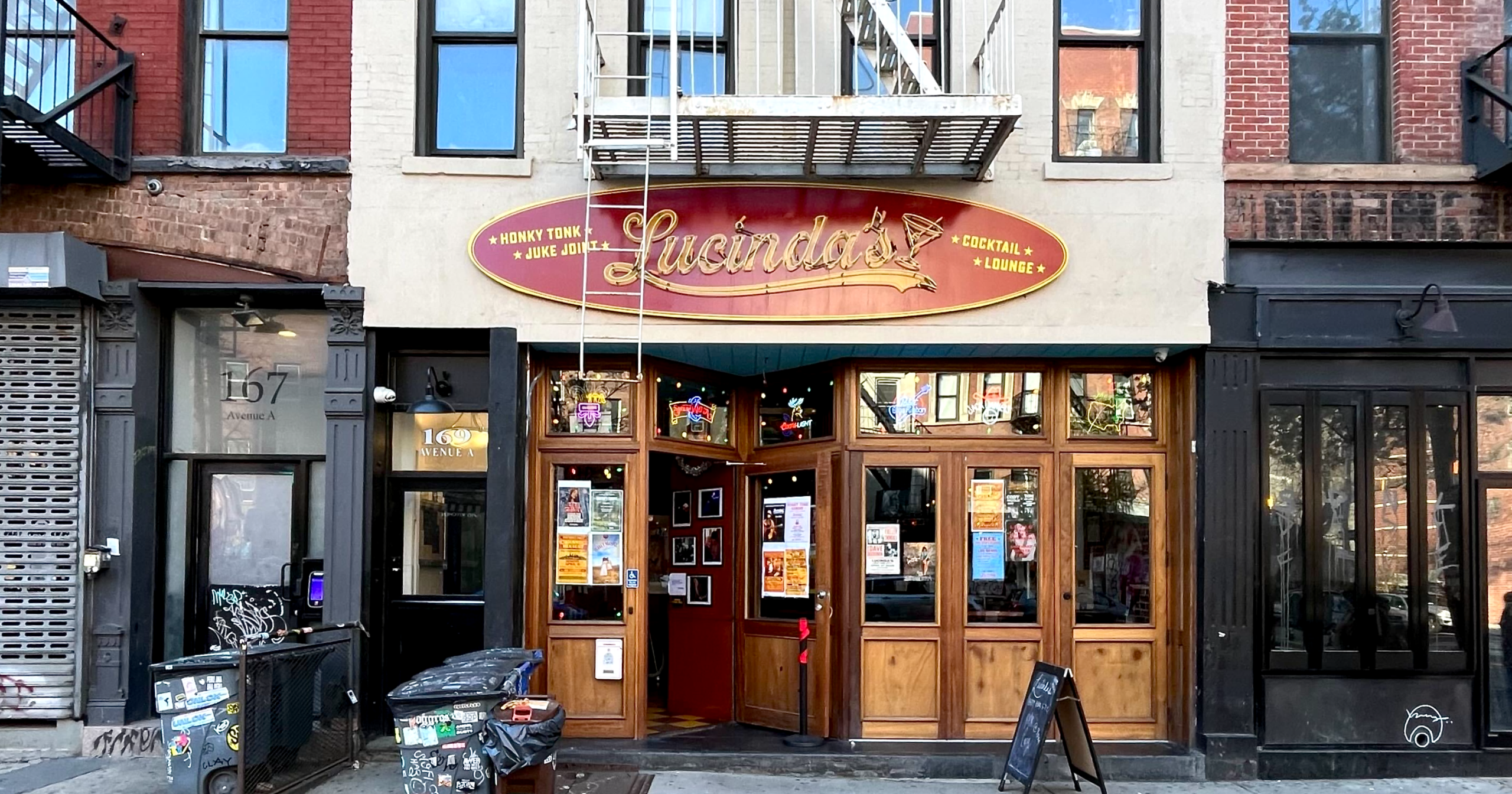
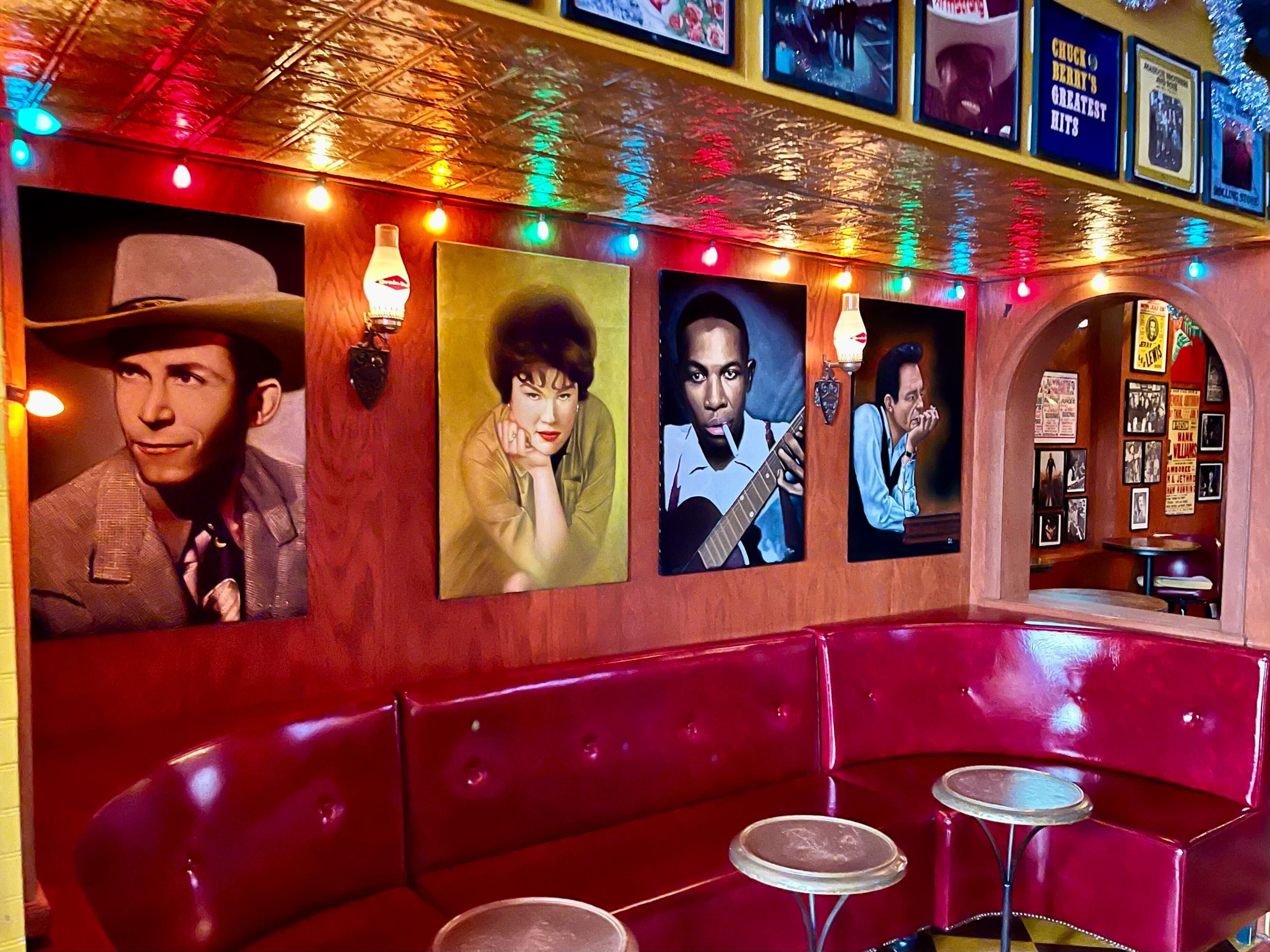
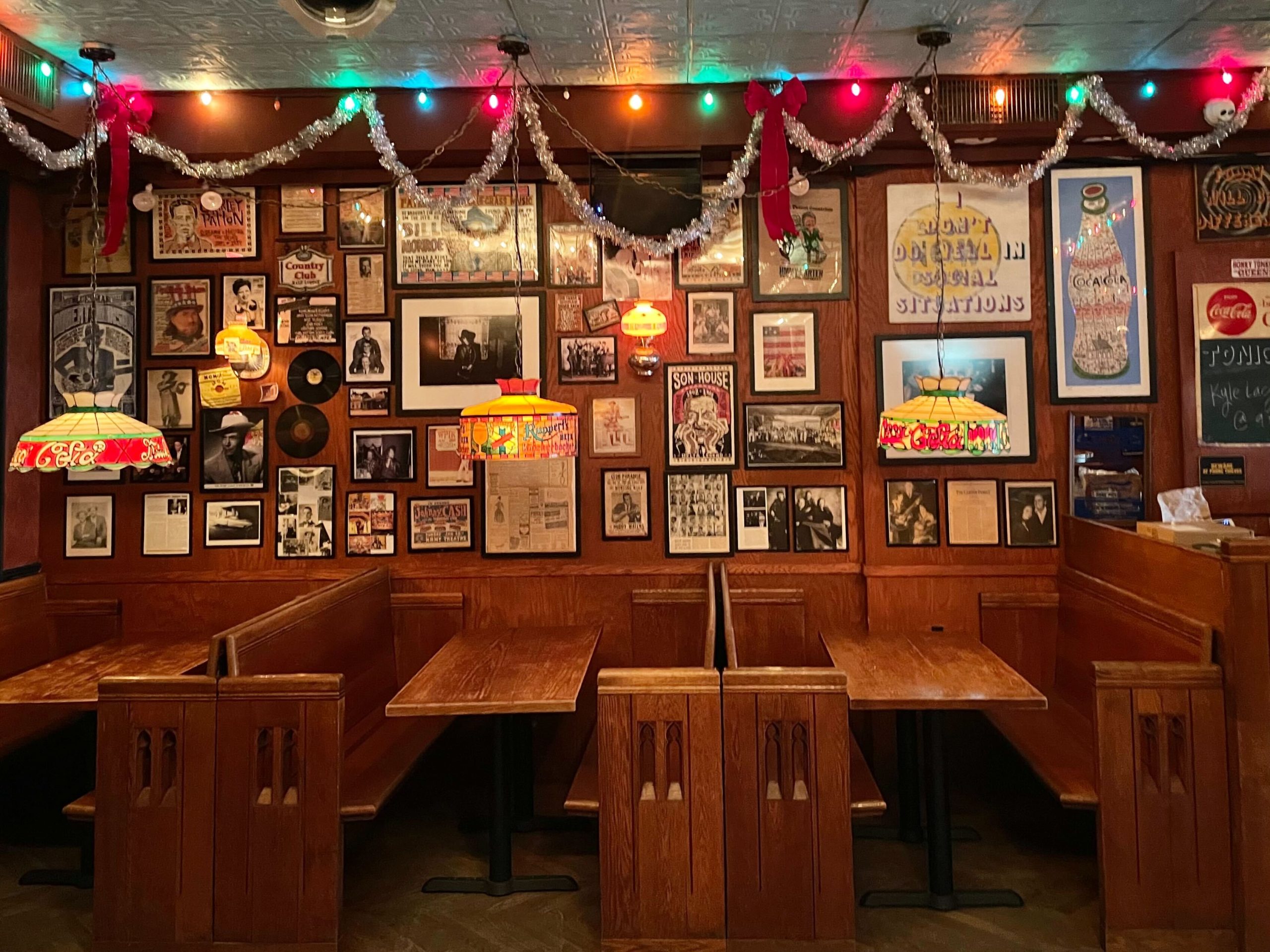
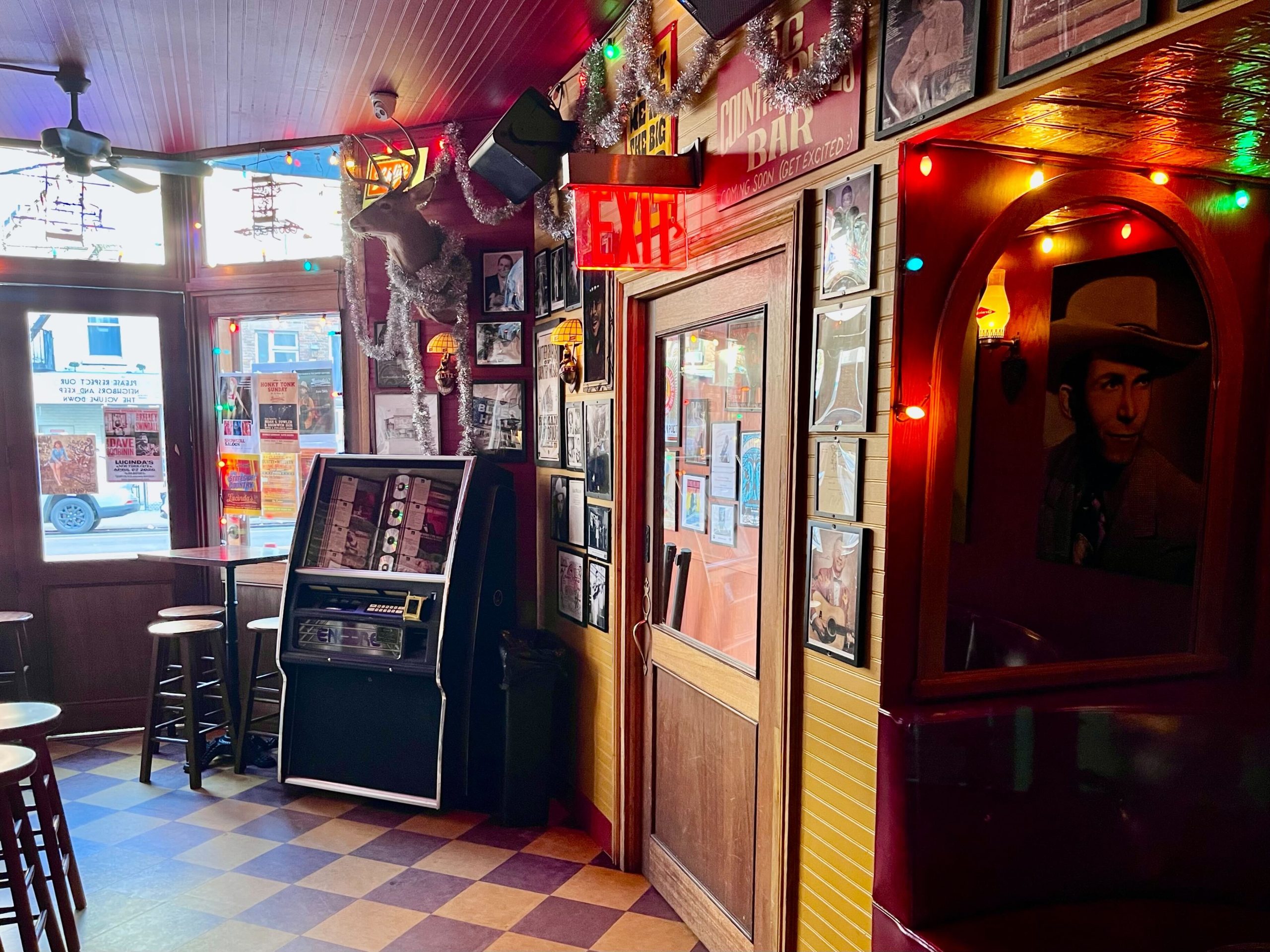
(Editor’s Note: Enjoy our tour of New York City honky-tonk, juke joint, and cocktail lounge Lucinda’s as a special postlogue to our Artist of the Month coverage of Lucinda Williams during March 2026.)
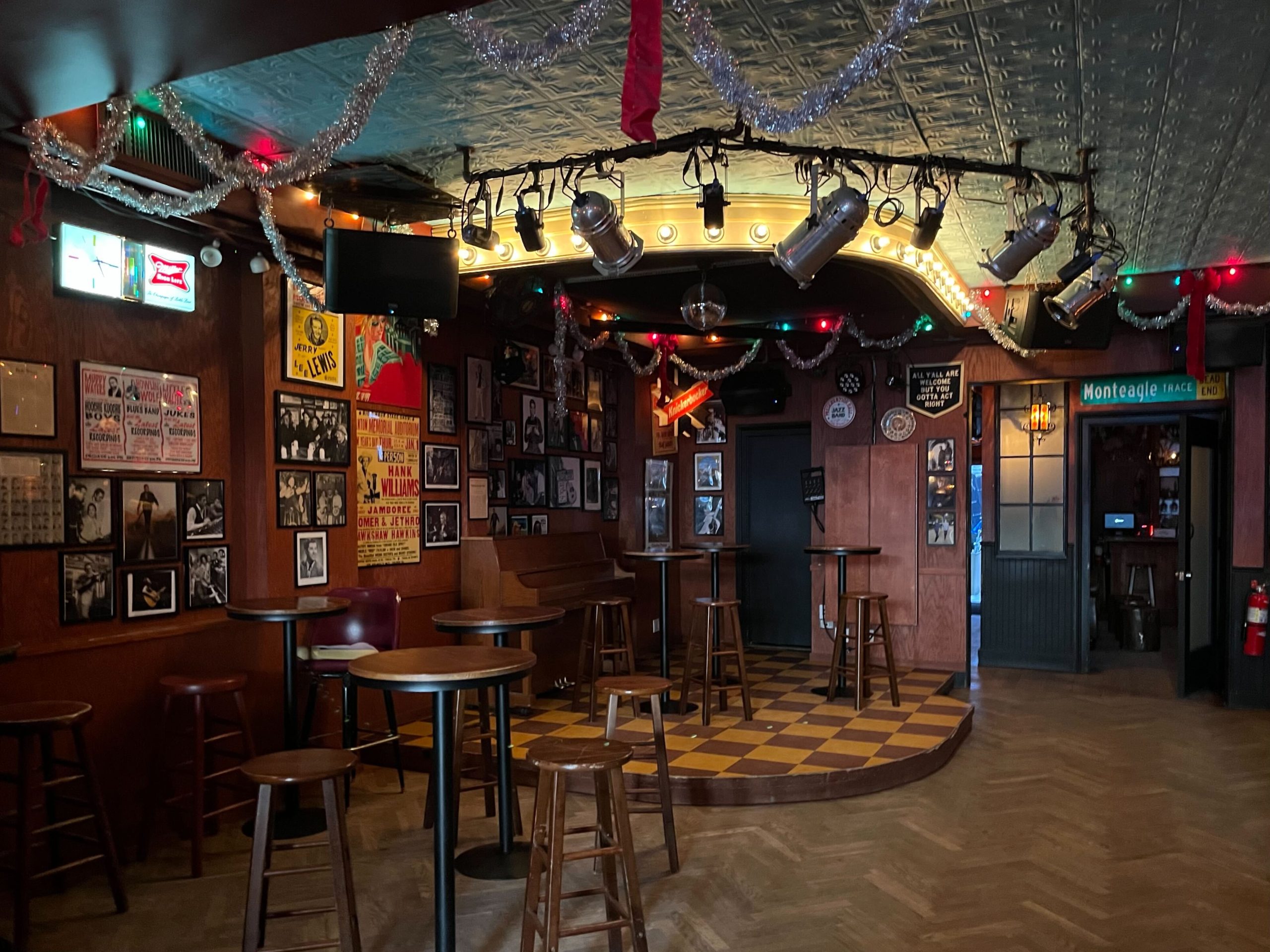
It’s the first springtime Sunday in Manhattan and after a bitter winter, the East Village is humming with human activity. Around the corner from the throng of Tompkins Square Park, where Girl Scouts hawk cookies and roller hockey players clatter their sticks and skates, tumbles of acoustic guitar spill from a storefront, attracting curious passers-by. Some folks pause and lean toward the open windows, and a few cross the threshold to meet wafts of fresh popcorn. Welcome to Lucinda’s.
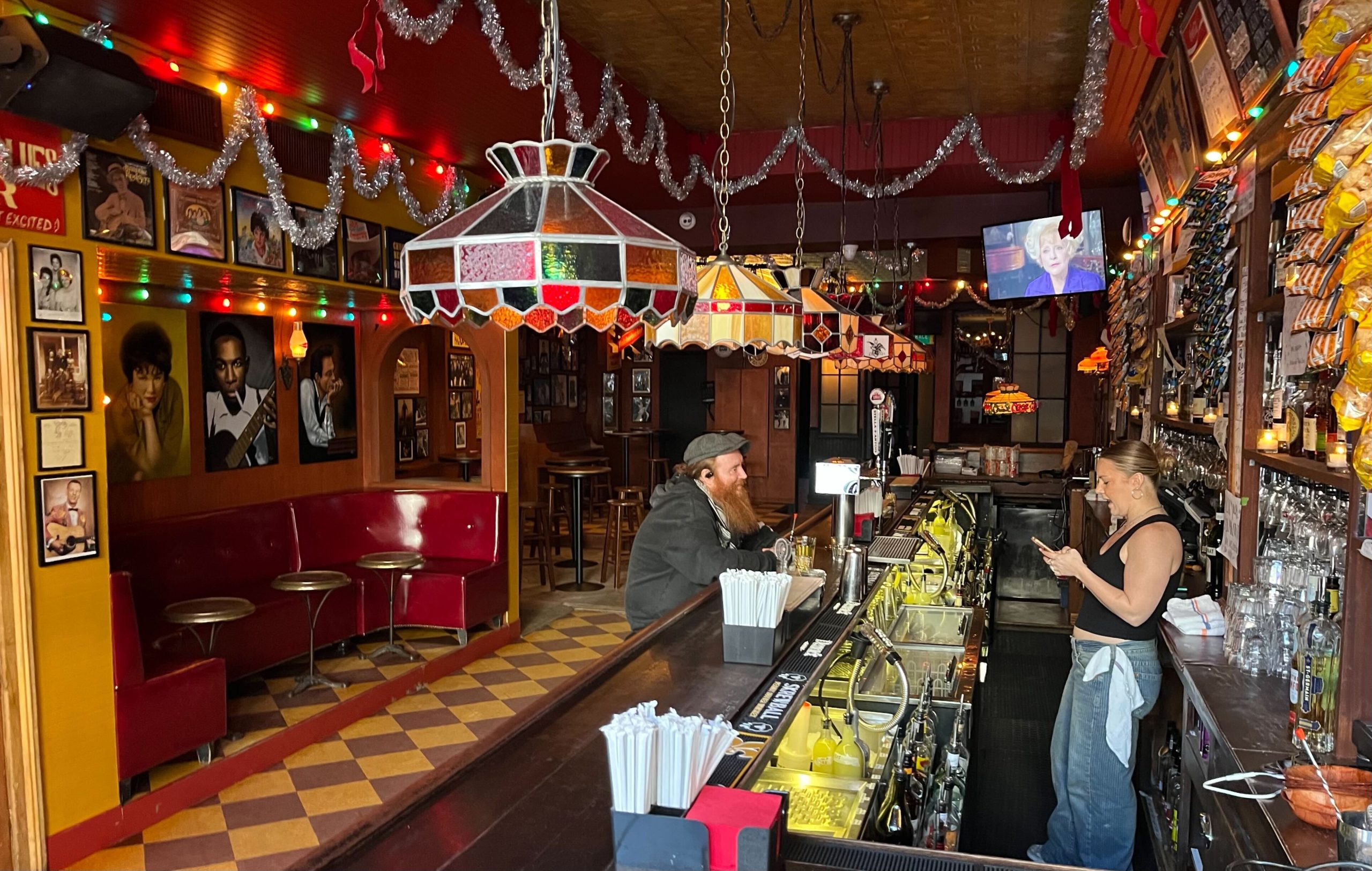
The bar’s tin ceiling interior is catnip to music history aficionados and Americana-kitsch collectors alike, the walls hung with poster prints, vintage memorabilia, and velvet paintings (among them Kitty Wells, Robert Johnson, and Elvis Presley shaking hands with Jesus Christ). There’s a jukebox ready to sling beloved feels-good-to-feel-bad hits, and peanut figurines with Jimmy Carter grinning and holding court over the liquor. These accoutrements all play second fiddle to the spot’s main attraction: live music meant for casual socializing every day of the week.
This robust programming – along with some of the bar’s most prized decorative items – is the work of Kelley Swindall, a musician and New Yorker of 20 years who grew up in Stone Mountain, Georgia. She takes pride in a large round aluminum Coca-Cola sign, an item on “permanent loan” from her family and one of several wall-hung nods to Georgia’s most lucrative liquid export. She’s more proud of filling a void in New York City nightlife. “There’s a lot of Southern people in the city that went to SEC schools that want to have some Southern culture again, like college football, or listening to music that they love and don’t normally hear in New York,” Swindall says.
Though the city has a handful of country-themed, sometimes Western-leaning bars – Williamsburg’s hootin-hollerin Skinny Dennis, the self-explanatory Honky Tonkin’ in Queens, the West Village’s Tex-Mex-y Cowgirl – Swindall wanted to develop a place to celebrate the early country, blues, folk, and other vernacular music that shaped generations of American song. She yearned for the sort of places she knew growing up and got to know as a touring musician, rooms where casual live music fosters socializing instead of hampering it. “That’s what the juke joints and honky-tonks were back in the day – it was live music as the soundtrack of the evening, but you were hanging out, drinking, dancing, and socializing,” Swindall says.
Swindall found a business partner in Laura McCarthy, who has a storied history of her own at 169 Avenue A running prior venues Brownies and Coney Island Baby. The pair found a namesake and patron saint of sorts in Lucinda Williams, with whom they connected through mutual friends. Williams agreed to endorse the place, her multi-stranded artistry anchoring the team’s vision for honoring the deep musical roots of the American South. She christened the stage with a set as part of the bar’s opening-night festivities last July.
On a Saturday night, Lucinda’s is rollicking, packed front to back with revelers before some New Yorkers have even gone to dinner. There’s college basketball on one TV, and The Best Little Whorehouse in Texas on the other. I want to mill around and make conversation, but the bar is thick with boisterous, overlapping shouts converging with mid-1990s Tim McGraw and Shania Twain songs that radiate in my bones.
The mission of Lucinda’s is evidently working. With my elbows pinned to my sides, I chat with Emily from Texas and two girls who rolled up for one of several birthday gatherings in progress. After his friend paws at my unattended leftover garlic knots, Gavin, an Irish ex-pat and country music fan, tells me it’s his first time at Lucinda’s after hearing about it on TikTok. “We were in the neighborhood, and we wanted to come in. We already had plans somewhere else, and we made it our business to come back here,” he says, enthralled with the room’s unique decor. I don’t get a chance to ask his thoughts on the Dolly Parton or Johnny Cash bathrooms before he peels off with drinks in each hand.
Spirits are high, but by Lucinda’s standards, the fun has barely started: a few musicians are shouldering their way through to the corner stage. Nightly music programming is a staple at Lucinda’s, which Swindall accomplishes with standing residencies and open mics alongside other ticketed events. There’s a loose structure week to week; weekends are for the big sing-along bands, Sunday evenings are for classic country, and bluegrass and some old-time are on Tuesdays. “I was an artist first, and I still am, so I wanted to focus on the kind of music that I’m into,” Swindall says, adding that Thursday night is for two-stepping.
The Sunday open mics are a binding force to Lucinda’s operating concepts. Sign-ups start at 1 p.m. every Sunday, running through the afternoon until another outfit takes the stage for the evening. There are some gentle guidelines (no covers, no backing tracks), aimed toward bringing a pleasant and equitable atmosphere to the gatherings. Swindall prioritizes the artists’ experiences at these weekly forays, remembering open mics as essential to her relationship-building and development as a young musician.
“It’s more important to have people able to come in and play their songs, everyone listen, rather than have a thriving bar culture that day,” she says. Drawing further on her artist’s perspective, Swindall fosters the open mic knowing the challenges of getting a foothold in bigger booking circuits. “A lot of places, they don’t want to book you unless you can bring a crowd or you can show them live footage. It’s really great to give people an avenue to get comfortable on stage and get feedback for their songs,” Swindall says.
Moreover, the shindigs help Swindall expand her pool for her month-to-month bookings, strengthening the network of relationships that are essential to the arts-forward community that McCarthy and Swindall hope to nourish.
Almost a full year in, Swindall is eyeing a steady growth pattern. She worked her way up to music every night of the week and now sometimes has two shows a night; she’s starting to entertain ideas for a small festival. “From a bar point of view, there’s so much to do,” she says.
The space isn’t zoned for a kitchen, but Swindall wants to figure out some kind of food element; in the meantime, patrons can bring in takeout or ask a bartender nicely for a Moon Pie, a bag of Zapp’s chips, or a bowl of popcorn. Swindall will stay busy as she aims to make Lucinda’s even more of a place for the “all” in “y’all.”
Stop in, sit down, shake loose. Connect with a song, or maybe a stranger.
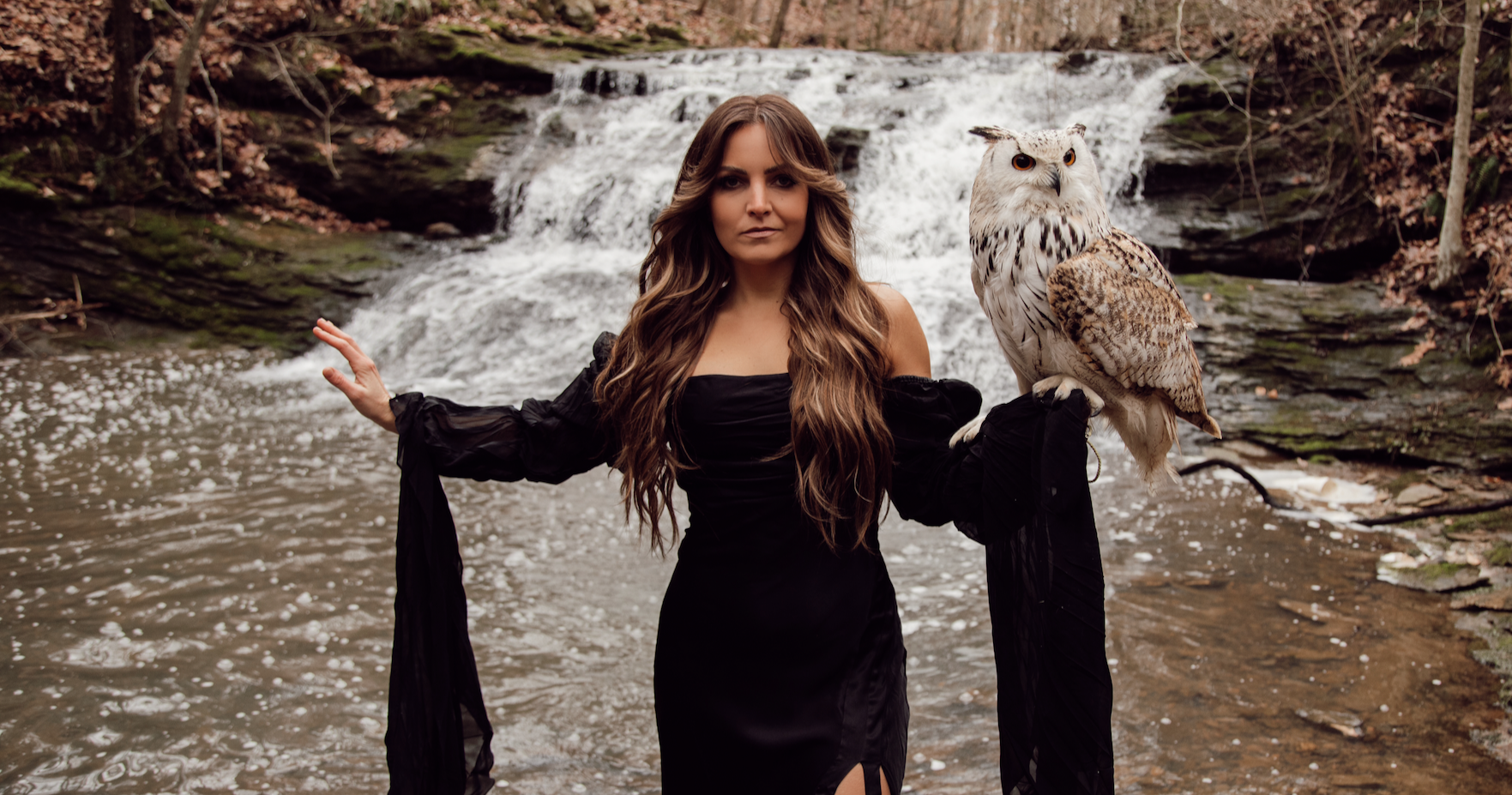
After writing with Dan Auerbach for her 2021 debut, Real Me, and with Sturgill Simpson on 2023’s Kentucky Blue, Brit Taylor instead looked in-house to bring her latest effort, Land Of The Forgotten, to life.
Cue up her husband, Adam Chaffins. Taylor not only co-wrote seven of the album’s 11 songs with Chaffins, but asked him to produce the record, as well – his second straight after doing the same for Kentucky Bluegrassed (2024) as well. Together the two homed in on tunes rich in working class and Appalachian themes that push back and occasionally lean into narratives about the region and its people.
From the hillbilly manifestations of “Broke No More” to throwing all your ex’s possessions out on the curb (“All For Sale”), to the resilience of mountain folk (“Land Of The Forgotten”) and infidelity with the bottle (“Warning You Whiskey”), Taylor shows that Appalachia is much more than just a footnote or only worth mentioning when things go sideways.
“It puts a lighthearted spin on some of the tougher things about life,” says Taylor. “Not to make light of difficult times, but to remind us two things can exist at one time. And, [remind us] not to forget to take a look at the bright side too, and to not take it all so seriously.
“There’s a lot of awful things happening in the world that we need to be aware of and need to do what we can to change, but dwelling on it and ignoring all the good things around us in the process doesn’t help anyone.”
On the eve of the album’s March 6 release, Taylor spoke with BGS about motherhood, outsider perceptions of Appalachia, black sheep, and more.
Leading up to Land Of The Forgotten’s release you mentioned achieving a sound with this project that you’ve been trying to attain since first moving to Nashville in 2007. What was it you captured and how were you able to do it?
Brit Taylor: Just that bluegrass influence on country, particularly the late ‘80s sound of The Judds, Ricky Skaggs, and Patty Loveless. When I go back and listen to those things I noticed they’re all very acoustic driven. At some point all of that became really unpopular – fiddle, steel, and mandolin all went out of style for a while. We had a lot of fiddle on the last record, but [we’re] incorporating those instruments more than ever before on this album, which gave it a very “back to my roots” feel.
Everything, down to how this record is mixed, turned out just the way I wanted it to. A lot of it’s because Adam grew up [just over an hour away] in Louisa, [Kentucky] – so we listened to the same radio stations and the same types of Appalachian country music. Us understanding each other so well musically is what made this all click.
I know that most of the album wasn’t written with bluegrass in mind, but I find it interesting that you say this album is more bluegrass-y than Kentucky Bluegrassed. Are there any key differences between the two?
Even those bluegrassed versions weren’t “actual” bluegrass songs, because they still had drums on them. We made that record to showcase bluegrass versions of those country songs. We weren’t really shooting for a country record with that one, but the goal with Land Of The Forgotten has very much been to make a country record, but one that’s heavily influenced by bluegrass instrumentation similar to anything from Patty Loveless to Lee Ann Womack when she sings “Does My Ring Burn Your Finger.” On those songs you could strip the drums out and they would feel right at home as bluegrass songs even though they all come from country-leaning records.
You just touched on Patty Loveless (Emory Gordy) and Lee Ann Womack (Frank Liddell), both of whom recorded frequently with their husbands as producers as well. Tell me about that connection, both with them and your husband Adam, and how each informed the project?
It started out with me just making a giant playlist of songs I love that were all over the map with no goal in mind. But as I started listening to it I began noticing a lot of similarities between the songs on it, whether they were from Willie Nelson, Ricky Skaggs, Dwight [Yoakam], Patty [Loveless], or Lee Ann Womack. Then I noticed that a lot of them were produced by Emory Gordy or Frank Liddell, whether it was Lee Ann Womack or the Pistol Annies.
From there, I went to Adam and told him, “These are the things that I love – I need you to be my Frank and Emory.” [Laughs] They’re two of my favorites, and just so happened to have worked with their wives, so it made so much sense for me to do the same. Adam knows me better than anybody else and hears me sing in a billion different places. He just knows me, just like [Emory and Frank] knew their wives and knew what they wanted and how to get it as well as pushing and encouraging them at the same time.
Another family tie to this record is that it’s released only a few months after the birth of your first child, Beulah. What was it like bringing this project to market while also going through that experience?
We cut the record last January, and at that point I was not pregnant yet. We’d been talking about wanting a kid for a really long time, and this record came out exactly the way I wanted it to. When we found out about the pregnancy I was like, “I need to be as fearless about the personal decisions in my life as I am about music, and stop letting the stigmas about what the industry thinks of women with kids dictate the way that I live my life.” Or else I’m going to run out of time to get the things done that I want. So we just decided to take a leap of faith and it’s all worked out, as it often does when you trust the universe, that it has your back, and that everything’s going to be okay.
It was so much fun starting out the year cutting that record and then going on tour with the Nitty Gritty Dirt Band and Adam was with me. It was while in St. Augustine, Florida, doing that when we found out we were pregnant. I started back with them on another leg of the tour in July and showed up with a big belly, and it was so fun! I did that entire tour with no shoes. Jeff Hanna was always cracking up because I was just barefoot and pregnant on tour. [Laughs] It’s been really empowering to know that you can have it all, you just have to be brave and stop listening to the limitations that other people would like to put on you all the time.
Of all your albums so far, Land Of The Forgotten has some of my favorite wordplay. A prime example is “Warning You Whiskey,” a drinking song disguised as a ballad about an unfaithful lover. How did the idea for that one come about?
I love when songs have a twist or they’re not quite what you think they are. I also love a good story, so when my husband and I sat down with Adam Wright and he started telling us about this idea for a song called “Warning You Whiskey,” that sounds like you’re talking about a woman at first. I loved it from the beginning. We worked out the music and got that first verse and chorus written so fast that it wrote itself.
When we got to the second verse, I remember sitting there looking at both of them saying, “Man, I really want to kick this whiskey bottle’s butt!” [Laughs] Then my husband blurted out, “I’ll grip my hand around your long, skinny neck” and I just lost it. I jumped out of my chair because I was laughing so hard. Then Adam Wright popped out a line, I did the next, and within five minutes we had the entire thing written.
It reminded me so much of something Loretta Lynn would write and makes me think of women in my family that I’ve observed growing up. My mamaw really fought hard in the beginning of her relationship with my papaw, with him drinking, and she stuck by his side. Sometimes all he needed was a butt whoopin’. She’d just stand by his side and helped him through everything.
In the past you also haven’t hesitated to write a catchy song about getting through the daily grind, like “Rich Little Girls.” This album has two: “Lately I’ve Been Thinkin’” and “Around and Around.” Is there anything beyond that ties the ones on this record together?
“Around and Around” is just about life in general. It’s funny because everybody expected us to tie a really pretty bow on it in the bridge, but we just didn’t, because sometimes that’s how life is – we just keep spinning and spinning. Sometimes we figure out how to get out of the rat race and sometimes we don’t. The song is an observation of this girl who is finally becoming self-aware enough of her circumstances to stand outside of them and decide if she wants to change them or not.
As for “Lately I’ve Been Thinkin’,” it’s definitely inspired by the music industry. We were actually writing a different song that’s going to be on Adam’s record, but in the middle of writing [we] began talking about one of the award shows taking place that week, how much we hated it and all of the butt-kissing that goes on at them. Then [my husband] said, “Lately I’ve been thinking, I don’t like much stuff” and Adam Wright started cracking up. It was so funny because it all just started from a conversation. By the end of it, we all were like, “Well, it’s really not that bad. We get to sit here and write songs. We actually have it pretty good.”
It seems like many of the songs on Land Of The Forgotten originated from spontaneous writing moments. Is that a regular occurrence for you?
Those are my favorite songs. When the three of us write, we never sit down and think we’re gonna write a song for a specific person today. We just write what’s in the room, what’s moving us, and what we’re feeling. That usually ends up being something out of conversation and is oftentimes funny, because the three of us have the same sense of humor and [same] kind of outlook on life. I know a lot of people can get a bad taste in their mouth about co-writing and how like “white-coat” it can be, but when you find your tribe and you find your people, it’s awesome. It’s so much fun.
Earlier you discussed how distinctly Appalachian this record is. In my opinion, one of the best embodiments of that is the title track, “Land Of The Forgotten.” Was there a specific moment or place that inspired it?
I don’t remember if I wrote the song around when the floods happened, but I remember writing the hook down when all the floods happened back in my native Knott County in 2022. I feel like that’s the only time that we’re remembered, when tragedy strikes, and then we’re just kind of forgotten again until somebody can make fun of us. A lot of people have negative perceptions of what they think Eastern Kentucky or what hillbilly is, but it’s nothing like what people think. It’s about resilience, and strength, and honor, and family, and beauty, and folklore. Appalachia is so beautiful and so misunderstood.
I’ll spend the rest of my life trying to write a song as good as Darrell Scott’s “You’ll Never Leave Harlan Alive.” I don’t know if I did that with this song by any means, but that’s always the goal when trying to write about home. I think that’s probably why I’ve never had a song about Appalachia. I’ve had a song about Kentucky in general, but it was more of a love story. I’ve tried to write it a million times, but I finally did one that I’m proud of, and that’s “Land Of The Forgotten.” When we put all these songs together, it quickly became a lot of stories about blue-collar life, surviving, and just how hard it is right now in this economy. Through that, “Land Of The Forgotten” became the theme of the record without even trying.
One of the album’s more lighthearted moments comes on “Crazy Leaf,” which sees you ruminating on that one black sheep we all have in our family. How did that one come to be?
When we sat down to write that – my husband, Jeremy Bussey and I – we started talking about all the crazy people we had in our families. It was Bussey who had the idea for the title, “Crazy Leaf,” which is a combination of these characters from our families into one song. But we didn’t want to pick on anybody too hard or put too much truth in there that you hurt somebody’s feelings.
My favorite thing was when I played it for my mom, and there’s that baptism line – “He got baptized for the fifth time, because the first four didn’t work” – where my mom said, “Your mammy used to say that if the water was too cold in the creek, the baptism wouldn’t take.” [Laughs] But in all honesty, it’s probably me – I’m the crazy leaf in my family.
From “Crazy Leaf” to motherhood and bringing this album to life with your husband as producer, Land Of The Forgotten has a whole lot to do with family. That won’t change anytime soon either with you and Adam going on a co-headlining tour together this spring. What are you most excited for about that?
I could not be more excited to be able to travel with Adam and for both of us to be able to do our own sets. We both work together a lot, but we’re still two individual artists as well, which I think confuses people sometimes. People will ask, “What’s your band name?” I’ll have to say, “No, I’m Brit Taylor and this is Adam Chaffins.” Maybe we’ll do a band thing eventually.
I’m also nervous because we’ll have the baby on the road for the first time, but that’ll also be really fun too. I can’t wait to show her pictures one day. I’ll be taking her on tour with me this summer out west with Nitty Gritty Dirt Band, too. She was in my belly through all those tours last year, so it’s gonna be so fun to have her on the road this time. My goal is to one day be touring bigger venues on a bus with my entire family there so we can travel the world together – that’s the dream.
What has the process of bringing Land Of The Forgotten to life taught you about yourself?
It’s a continuation of what everything keeps teaching me, which is that I just need to trust my gut and stop second-guessing things all the time. Adam has been a huge help with that. I feel like I can be hard on myself and always assume that somebody else knows better than me because they’ve got more experience. I don’t know if the creative process works that way. I think it only works when you’re true to yourself, and that’s something that isn’t always easy for me as a people pleaser and somebody that doubts herself a lot. So just learning to stand in my own truth and stand in my power and be confident in myself.
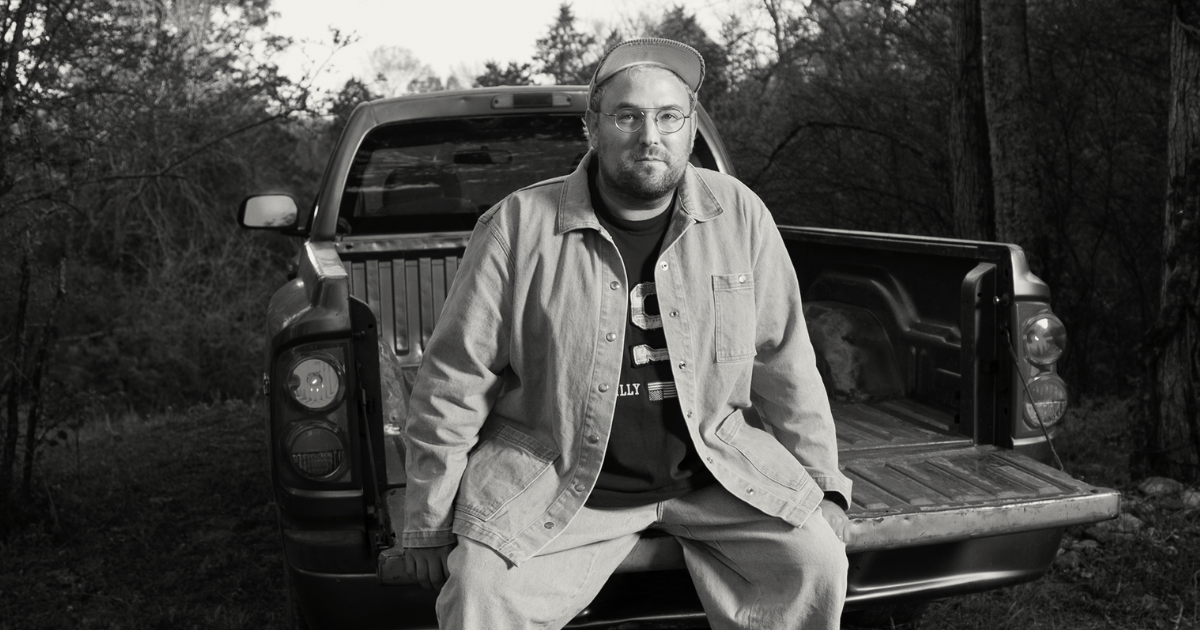
“I don’t know when I became an activist,” MORGXN admits. “I’m just a human being who sings from the heart, but my heart is very broken by the world that we are currently living in.”
The singer-songwriter lived in Los Angeles for 10 years before moving back home to Nashville in 2022. “The minute I came back to Nashville, I ran into a guy once. He was like, ‘I only see you at the Capitol singing,’” he recalls. “When I moved back, they were trying to ban drag queens. They were trying to ban women’s access to health care.”
Most recently, he took to the Tennessee State Capitol to protest bills against same-sex marriage. “This is how rights get tested: one state, one bill, one ‘exception,’ and suddenly the floor moves under all of us,” he wrote on Instagram.
“I don’t even think about it as activism. I think about it as humanity. We are more alike as human beings than the media, the news, and politicians would want you to believe,” he explains. “It breaks my heart. If you have listened to this album, there are songs about love and the human experience. The album is for anybody bold enough to live as who they are in the middle of the heartland.
“That is what I hope people get from this album. I hope they feel less alone in their activism… I wouldn’t even use the word activism. I hope they feel less alone in their humanity, period.”
On March 6, MORGXN released a deluxe edition of his album, HEARTLAND, and while it pulls from country music, he wouldn’t exactly label it as such. “I don’t care what genre you tell me it is. I care that I’m speaking something that is true to me, and that’s how I make music,” he says. “I don’t make music outside in.
“I make music inside out. I find what’s inside, and I try to bring it outside,” he continues. “And the heartland is a place that is normally not reserved for people like me and you. And yet, living in the heartland, I see that everyone belongs in the heartland. The heartland is a space for everybody, and I want to reclaim the heartland for everybody.”
Good Country hopped on a Zoom call with MORGXN a week before the album’s release and chatted about collaborations with Tenille Townes and Maggie Rose, the meaning of community, the political divide in country, and the hardest lessons he’s learned since coming out as gay at 19 years old.
What are some of your favorite lyrics on the album?
MORGXN: “GOD CODED” is maybe the most important song I’ve ever written, whether or not most people hear the song – it’s not a radio song. But it is probably the most important song I’ve ever ushered into being. I have no problem with god or religion. I have a huge problem when people use god and religion as a weapon of their hate.
“WILLOW” I wrote for my friend’s daughter who has cerebral palsy, so that she knows that she is a bright light. Already that song has inspired other people, which really means that she has inspired other people. It’s hard for me to choose… “MIGRATION” is about losing my dog. I don’t have a favorite lyric – it’s like choosing a child. [Laughs]
Okay, here’s my funniest favorite line, “EVERGREENS.” The first line: “Tell me your sign/ And I’ll tell you mine/ And I’ll tell you if we’ll be okay.” I think that’s funny, because if I’m dating somebody, I will be like, “What is your sign?” And I’m going to decide right away if we’re even going to be compatible, which is maybe absolutely chaotic, but I love it.
With the deluxe edition of HEARTLAND you have several collaborators, including Tenille Townes, Ruby Amanfu, and Maggie Rose. How did you choose who you wanted, and what did they bring to the table?
Collaboration is like water to me. You know, I have many liquids here on my table. I am a gay man, so I have tons of liquid everywhere around – iced coffee is always a yes. Collaboration is also like breathing to me. When I think about making music, “the bible” to me is Willie Nelson and “On the Road Again.” The life I love is making music with my friends, and I can’t wait to get on the road again. That is how I think about music.
When I moved to Nashville, there were voices that I saw popping up that were saying really important things, like [Tenille Townes’] “Jersey on the Wall.” They were saying messages that really resonated with me inside of a space that is still not reserved for people like me.
I came here in 2022, which was 11 years after this manager told me I would never make it in music as an openly gay person. In Nashville, there was a thing bubbling up, but it was like you were reserved for this sideshow experience. You can be gay, but only during June, only when there’s a tent for you to stand under. That’s not how I believe in love or life or humanity. I reached out to several people wanting to create. Truth be told, I have people in my DMs who are massive artists, who love what I’m doing, but who can’t align with who I am because it will hurt their fan base. That’s insane. That’s 2026 for you.
But artists like Tenille Townes, Maggie Rose, Ruby Amanfu, Katie Pruitt – who’s obviously a queer beacon – and Langhorne Slim, they were people who were brave enough to collaborate outside of what is the norm for them. I’m really honored that they’re helping me create this version of the heartland where everyone gets to live.
With Tenille, “HEAVEN KNOWS” was the first song we ever wrote together. It was actually the day we met. The song has this sort of inner child: Why do we even keep trying in a world that feels so hard? Why do you love when your heart has been broken so many times? Why do you keep making music when it feels like the music industry is as crazy as ever? And why do you keep being a good person in a world that is hell-bent on trying to make you feel like you are an abomination? I try because I care. I love so deeply, you know.
Having grown up in Nashville, what did community mean to you then, before you came out at 19?
The one thing I’ll say about being queer in America – maybe anywhere in the world – is you’re forced to create community, and sometimes family, when that is not a given for you. I was very lucky that my family was… more confused and scared than they were not accepting. But my husband’s journey with his community – he grew up evangelical and his community kicked him out. He was going to be a pastor, going to seminary, and once he came out, he was kicked out of the church. I didn’t have that experience … but family to me widened the moment I came out. The idea that family was not just the people you were born into, but it is the people and friends and lovers who you collect along the way that were missing for me as a kid. Growing up here, I had a hard time fitting in, because everything I did stood out.
I played the Bluebird [Cafe] last night with Molly Tuttle, Maggie Rose, Liz Longley, and Ketch [Secor] from Old Crow Medicine Show. I’m sitting there singing “MY REVIVAL” – and I’ll cry thinking about this, but it’s like I’m sitting there singing [that song]. My husband is over here and the whole room is singing along with me. I have painted nails, singing my song at the Bluebird with legends. I’m the co-chair of the diversity committee for the Recording Academy in the Nashville chapter. I don’t know if I’ve “made it,” because I don’t think making it is even like the goal here. I want a career and a life, not a moment in time. That’s “making it” to me. For the closeted gay boy who was scared to ever reveal who he truly is, that’s my revival. There’s retribution. There’s deep healing, and there’s tons of gratitude, as well.
The divide in country music right now between people who are willing to sacrifice a fan base and those who aren’t is always widening. It’s cool to see who has come forward to make their voices heard.
Country music is three chords and the truth. That’s still the bible, but it has lost its way. There is a real ricochet happening where people are afraid to be truthful, because truth can sear and truth can be very quiet but very powerful. Nashville is at a breaking point. It’s a small town. We are growing by leaps and bounds. There’s a real deciding line between: do we make this a city for everybody or do we make this a city for the select few? That’s the same for country music, folk, Americana, and gospel.
“HEARTLAND,” the song, definitely pulls on gospel, folk, Americana, and pop, for sure, but it also pulls on country because it’s a story. I thought I’d see my name in lights. I thought that my life would be this flashy thing. It’s not. I fell in love with a man, and we have a farm, and we’re building a life together. That’s love to me. It’s a story. It’s my story. It’s real. So, it’s country; it’s folk; it’s Americana; it’s gospel. Now, will any of those genres accept me? I have no idea.
But the people on my album have accepted me for who I am and love me for who I am. And that, I think, is what the heartland is all about. You know, love thy neighbor. What happened to that?
You turn 39 this year, which happens to be 20 years since you came out. Was there any significance in releasing HEARTLAND (Deluxe Version) this year?
It’s funny. Titles of an album are like mystery buckets. I actually have a title for my next album and I’m so excited about it. Prince once said that he’s like two albums ahead of whatever’s commercially released. And I love that for him. I’m one album ahead of what is commercially released. Album titles visit me like a fever dream. Even HEARTLAND – the song, I gotta call out Josh Dorr, the co-writer on that song, who had a number one with Blake Shelton this year with “Texas.” He’s a legitimate country songwriter. Not even legitimate country songwriters would take a session with somebody like me and it takes guts to do that.
I haven’t thought about how it’s 20 years since I came out, but it makes a lot of sense. I have a song called “home.” When people were like, “Where is home?” I would be like, “Well, anywhere but Nashville, Tennessee, because that place would never accept a person like me.” Now, to be making a life here, building a farm, hosting Pride on our farm, there is something beautiful in that. It may have taken 20 years, but I’m home. It’s beautiful. I hadn’t really thought about time like that.
When we wrote “HEARTLAND,” I wrote it on the piano that I grew up on. There’s always ghosts in the bones of old instruments, but it’s safe where my heart lands. It’s the heartland, but it’s also where my heart gets to land safely. That’s the kind of love and belonging I wish for everybody. I’m not somebody who believes that you have to be in a relationship to be happy, or that you have to be married to be happy. That’s bullshit. That’s heteronormative, capitalist nonsense. You can find belonging amongst community, friends, and lovers. Does your heart have a place to hang its hat? That’s home.
What have been the hardest lessons you’ve learned over two decades?
The thing that comes up in my head is: it’s not over ‘til the fat lady sings. I’ve been a fat lady so… [Laughs] It will fall apart, and that’s okay. The true story is what happens when you pick yourself back up and keep going.
I’m far less interested in talking to somebody who’s never moved across the country once. I can’t really relate to you. If you’ve never sold all your belongings and moved somewhere at least twice, we might not have a lot of similar things to relate to. It doesn’t have to be grand moves. My husband has lived in a bunch of places in Nashville, has not left Nashville, but he’s lived a lot of life. You have to have lost everything once, probably twice, and hopefully that’s it. But it’s really about how you pick yourself back up at the bottom, and keep trying again.
Whether you think it’s good or not, it won’t last, and that’s okay. There’s beauty and grace in that. I have a friend, Kristen Griffith[-VanderYacht], who’s a [floral designer] – I think he’s now in Detroit – and he’s gone through a lot. He was on the Drew Barrymore Show, and the guest host was asking, “How do you keep flowers alive for longer?” Kristen grabbed his hand and he was like, “Here’s the thing, lean in close, I want you to hear this: they’re not meant to last. They’re meant to be beautiful for the moment that they’re there, and you’re meant to appreciate them in all their glory, and then you’re meant to let it go.”
That is really hard. That is maybe [informing] some of the themes about my next album, actually. It’s loving and letting go. Life is not linear. It’s not meant to be. Cherish all of the beauty, because nothing lasts forever. And there’s a ton of freedom in that sentence.
Lots of people are taking a shine to Boy Golden lately. Radio stations in Canada sent his populist pop single, “Suffer,” to the top of the modern rock chart. He produced William Prince’s 2025 album, Further from the Country, which recently received a Juno nomination in the Contemporary Roots Album category. And he’s among the new additions to the esteemed Telluride Bluegrass Festival lineup in June.
Offstage, Boy Golden is Winnipeg-based musician Liam Duncan. (His mother’s maiden name is Goulden, so he conjured the stage name Boy Golden.) In addition to jumping across genres, he’s also crossing the Canadian/American border this spring, with dozens of U.S. tour dates to promote his new album, The Best of Our Possible Lives. Duncan recorded the project in Los Angeles with fellow Winnipeg guitarist Austin Parachoniak, producer Robbie Lackritz, and cream of the crop LA studio players.
Duncan called in to Good Country to talk about making the new record, though the conversation also gravitated toward his abiding love for bluegrass music.
“Suffer” has been a big hit for you in Canada. What do you remember about trying to get “Suffer” to sound the way you wanted it to sound? Was it hard to come up with that song?
Boy Golden: No, that was a quick one. I sat down and wrote it all in one chunk. I remember it taking about an hour, maybe. But then I did make several demos of it, and throughout that process, I did edit it a fair bit and experimented with different lyrics and arrangements. By the time I got to the studio, I was really confident in the foundation, the bare bones of it. I could trust the musicians there, and they nailed it.
On that song, Pino Palladino plays the bass, which is really cool because he’s a legend, and then Abe Rounds is on the drum kit and he’s a really great drummer and musician. We had a few drummers we were thinking about asking, but I listened to Abe’s solo album – which is called The Freedom to Make Mistakes – and his percussive sensibilities on percussion instruments, beyond just the drum kit, were so spot on. It made it an easy decision, because I really wanted a lot of percussion on this album.
Why is that?
A lot of records that I love have a lot of percussion, first off. I was listening to a lot of Ry Cooder. I was listening to a lot of Paul Simon. The percussion on those records is fantastic. But also I was thinking about the first record I made as Boy Golden and I really went overboard with the percussion on that album. I hadn’t listened to it in years, I was in a store in Portland, and the guy running the store put on my song while I was in there. I was like, “Oh gosh, this is really great!” [Laughs]
I went back and listened to the record and I was like, “I should do that again,” because the records that I made between that first one and this one were way more stripped back. I made both of them on different types of 8-track tape machines so there’s just not as much room to go crazy with it. And I knew I was gonna have the freedom to do anything on this record.
The album before this one [For Eden] had a lot of banjo. Are you still grabbing the banjo from time to time?
Oh, yeah. I made a demo yesterday that has a bunch of banjo on it. And I spent the Christmas holidays just shedding some old-time, which is a really fun thing to do and does not bother my family much!
When did you pick up the banjo originally?
When did I pick up the banjo… 2020? 2019? Somewhere in there. It wasn’t, like, always a thing, but I’ve always loved bluegrass, and I’ve always listened to a fair bit of bluegrass, but I was just in a big phase. And I think part of it was, I was like, “I am never going to be a good enough guitar player to really play bluegrass, so maybe I should try a different instrument.”
You included “The Year Clayton Delaney Died” on that first record. Is Tom T. Hall somebody that you gravitated toward?
Yeah, particularly his bluegrass record, The Magnificent Music Machine. It’s such a good album! Something I love about that album is, a lot of bluegrass is pretty dry, and that record is not. It just sounds like a bunch of people playing in a big room, like maybe a church or something. I don’t know how it was recorded, but I love the energy on that record.
What are some of your other favorite bluegrass records?
My favorite bluegrass records are the Bluegrass Album Band’s Volumes I through III. [Laughs] They’re my favorite. I love a lot of what’s going on in the old-time scene right now, like Nora Brown and Stephanie Coleman. And I love playing music acoustically with friends. I love sharing songs that way. I grew up going to the Winnipeg Folk Festival, and that was where I was first exposed to bluegrass, and it has been a lifelong love. And I feel like it does make its way into my music, even though I write kind of pop songs or something. I like to produce in all sorts of different ways, but on each song on this album, I tried to have at least one element that felt distinctly rooted in roots, whether that was a guitar part or a banjo part or a pedal steel or whatever. I just tried to always have some sort of grounding in the roots.
Reading up on you, I found that you were a Gillian Welch fan.
Yeah, I saw Gillian and Dave for the first time this [past] year at Winnipeg Folk Fest. It was very emotional for me. I cried a lot because I had a friend pass away right before we made this record. We had made a record together, me and this friend, and one of the songs was called “I Dream an Ocean,” which was inspired by “I Dream a Highway.” We would just bond over those records so much. … I could cry right now thinking about listening to Gillian and Dave when he was here. It was super affecting and really gorgeous.
I’ve enjoyed the videos that you put out so far and I think visuals must be really important to you. Can you talk about the concept of the video for “Cowboy Dreams”?
Yeah. I had a couple pretty specific visual references. One of them was the Brazilian tune “Águas De Março,” which has a great video you can find of Elis Regina and Antônio Jovian duetting that song together on an old stereo capsule mic. You can put [that mic] off-axis and then you can both sing into it. Anyways, it’s just a really beautiful video, and I love watching it because they have such chemistry. Me and my friend Cat [Clyde] have a great creative chemistry as well. We wrote that song together and made the demo together. So, I thought we could basically steal that concept and make it a little more cinematic by putting a 360-degree dolly camera around it. I love that shot.
The other one was a killer Sade video that’s all in black and white, and she’s galloping on a horse bareback, which is beyond my skill level, and it’s just so cool. Cat’s a really good rider. I was not a great rider. I’m still not a great rider, but I took a bunch of riding lessons leading up to that video shoot and got myself to the point where I could gallop comfortably. The ranch where we shot the horse stuff is run by some friends of mine, and they gave me, like, a Cadillac of a horse, so it was super easy.
You’re riding a horse in that video and you’re in Lake Winnipeg on your album cover. I’m assuming you’re pretty outdoorsy. Do you like the great outdoors?
I do, yeah. Yes sir. There are references to the natural world in my writing a fair bit.
Say you’ve got a free afternoon, what would you do?
Well, right now in the winter, I go cross country skiing. I go a couple times a week, usually. And I love cross country skiing, because it’s very meditative once you get into the flow and if the conditions are good – kick, glide, kick, glide. … And you can get into the woods with it, which is what I like about it. I mean, you can’t downhill ski where I live, because it’s just flat, but on cross country, you don’t need a lift pass. You don’t have to pay any money, usually. Maybe a trail fee of like $5 but once you get going, you can get onto this trail and you’re in the woods in the middle of winter. It’s a pretty special experience, not something everyone gets to enjoy, or even maybe realizes is as wonderful as it is. You know, to be out in the woods in the middle of winter, it’s sweet. And in the summer, I like to hike. I like to backpack.
That reminds me of the song “Blue Hills” from one of your past records. That one seems more of a country-leaning song to me. What inspired you to write that song?
I was thinking about being in high school actually. The town I grew up in is called Brandon and Brandon famously has hills [laughs] in Manitoba and they’re called the Blue Hills of Brandon, ostensibly because from a distance, they kind of look blue, I guess. And I was under the impression when I wrote that song that I had a great aunt or some ancestor who had written an old song called “The Blue Hills of Brandon.” I found out later from my dad that I must have made that up, because I don’t! That person who wrote that song is not my ancestor.
But either way, at the time, I thought she was, so I was like, “I’m gonna write my own version,” which I thought would be really special. I was thinking about high school, I was thinking about my late grandma and grandpa. Thinking about how those really early memories of love are so tangible, no matter how old you get. That’s why I say, “It’s the only thing I know to be true.” It’s like, that early love just was true.
When did the spark start for you as a songwriter?
I always wanted to write songs, but I was really blocked until I was about 21 or 22. And then I had a relationship end. It’s a common story, and I think I was so heartbroken that I didn’t really care if I wrote anything bad. And then it was like a spiritual revelation for me.
Had you been on stage a lot before that moment?
Yeah, I toured with my high school band all over. We played over 600 shows together. I’ve been in some sort of band with friends since I was like 14, so it’s been a lifelong thing. But I kind of thought I would just be a producer. To be honest, I never really thought I’d end up doing this.
When did you turn the corner? When did you decide, “All right, let’s make it happen”?
I guess when I had enough songs. And then I made a record that came out under my own name, which you can’t really find anymore. And then I came up with the Boy Golden character and idea and had a bunch of songs that I felt like were in the Boy Golden world. And ever since it’s been an obsession.
Photo Credit: Best of Our Possible Lives album cover
It’s common these days to wring hands over the many ways powerful tech companies have meddled, without permission, in how we discover and listen to music (among other things). It’s just as common to fearfully declare that music’s good old days are past and gone. But after 20 years as a working band, we know that the strength of community through music is much more enduring; and we see it all the time.
There is no greater force than a group of people who are ready to share a joyful experience. It doesn’t matter if they’re gathering to jam, attend a concert, or anything else. People in community can create strong connections in a heartbeat, under almost any circumstances, and music is a powerful vehicle for it. Some days it feels harder than others to find that spark, but it’s always there if we come together and dig for it. Every day the pressure grows to strip the things we all have made and love for parts, but collectively we can raise our voices and push back. As a band, we’re choosing to resist that force and to keep building things. Together.
This playlist features artists that we feel musical and professional kinship with, bands that have been around and are well into their careers. The songs we chose come from albums that are worth spending time with over and over again. These folks have played lots and lots of gigs and revel in the energy of a great show as much as we do. You’ll also find some music from our 9th studio album, The Steel Wheels, too. Music that we made together in a room. – The Steel Wheels
“Easy” – The Steel Wheels
A breezy song with a swirling fiddle intro and a big question at its heart. We live in the future now, with the entire world available to us on the other side of our screens. So why are we lonelier than ever? If everything is supposed to be easy, why does it all feel so hard?
“Talk Is Cheap” – Dr. Dog
Because they inspired me with one incredible Bristol Rhythm & Roots Reunion set probably 15 years ago. Their old amps, their confident trailblazing of their sound that was clearly referential and respectful – but not chasing what a lot of other bands were chasing.
“Los Angeles” – Big Thief
An artist’s job is to remain open and soft to the world and to distill all that pain and joy into work that transmits emotion across space and time. Somehow, Big Thief seems to only become less jaded with time, maintaining curiosity and exploration as part of their creative process.
“Go Back” – The Steel Wheels
All deep relationships come with joy and with pain. To be rid of one you would also lose the other. It’s part of lived experience, this is a reminder to embrace all of it. True connection is worth it.
“Waiting For The Sun” – The Jayhawks
The Jayhawks are a band that prove you can continue to forge your own way and make it through the highs and lows. I was still really just a kid when I discovered them through some older cats I was playing with at the time. Son Volt and Wilco were very much in the alt-country scene and the Jayhawks just had something a bit different going on.
“Worried About The Weather” – Greensky Bluegrass
I love the way this song pivots between the anxiety of pushing forward through uncertainty and the breezy delight of taking a moment to enjoy the journey. There’s momentum to both things and “Weather” has tons of it.
“Keep On Dancing” – The Steel Wheels
Let’s take a break from responsibilities to just see ourselves and each other. Don’t forget to breathe and to appreciate the unadorned peace that can fill the spaces between us.
“I And Love And You” – The Avett Brothers
Even a track like this, one full of solitary stillness, shows the Avetts’ songs are packed with other people. They always remind me that I’m not as alone as I often feel. You can sense the presence of old partners and family throughout this song even though the speaker is alone in their car.
“Valerie” – The Brothers Comatose
These guys are everybody’s friends. Maybe the acoustic Dawes? I don’t know. We’ve known them a long time and they keep bringing joy and fun with warmth and grounded songs that don’t rely too heavily on bluegrass tropes.
“Sway / Endless Highway (Pt. 2)” – Watchhouse
Watchhouse invest deep thought into every lyric and intention into every note without ever seeming to overthink their process or get held back by previous work. “Sway / Endless Highway (Pt. 2)” demonstrates how the band is constantly in conversation, transitioning between tempos and driving down into a deep groove with a breeziness that belies the technical mastery of their acoustic instruments. At a Watchhouse show, the crowd will hang on every note and every silence, sharing a reverence for the song with the band.
“Slow Rise (to the middle)” – The Wood Brothers
Oliver, Chris, and Jano seem to be propelled forward by some groove force that penetrates everything they do and they invite listeners to join in on the funky joy. Their track “Slow Rise (to the middle)” tips a hat to their musical journey. To be in an audience is to get lost in the moment, only to occasionally remind yourself how wild it is that all the sounds coming from the stage emanate from just three musicians.
“Way Down Yonder ” – Chatham County Line
I first heard Chatham County Line when I opened for them at The Livery in Benton Harbor, Michigan, with a jamgrass band I was in, probably 20 years ago. They were tight and had their act together. I was blown away by their professionalism and it made a big impact on me. I will never forget that moment and I’m still inspired by their creativity and longevity as a band.
With a folk singer’s heart and a rock star’s swagger, Lucinda Williams gets it right on World’s Gone Wrong. Produced by Ray Kennedy and Tom Overby and released January 23, 2026, the topical album shows no love for the current president; instead, Williams turns to the musicians in her band, R&B legend Mavis Staples, and even a Bob Marley classic to put her own beliefs front and center.
As protesters take to the streets across America, Williams is reaching people where they live by maintaining an impressive tour schedule, just as she’s done for the last four or five decades.
BGS caught up with Williams for an Artist of the Month interview by phone, in motion and outspoken.
First off, I just want to say I love the electric guitar on this record.
Lucinda Williams: Yeah, I’ve got two of the best in my band, Doug Pettibone and Marc Ford. Marc was in the Black Crowes before and Doug’s been with me for a while. The two of them just play off of each other. They’re really great when you see the band live.
Thanks for saying that. I’ll pass that on! I’ve always managed to find really good guitar players to work with me. It’s important to me, having a good guitar sound in the band, both live and on the record.
This record’s got that live energy, which is hard to capture on an album. What were the sessions like putting this album together?
Wow! You’ve said all the right stuff that I want to hear! I love you! [Laughs] But like you said, it’s hard to get the recording to reflect that. That’s why I’m so excited that came across, but I always record live for the most part. … We’re all situated in that part of the studio where we’re recording, but the vocals are isolated, just for the sake of convenience, so we don’t have to worry about the [tracking band] bleeding in, in case there’s a mistake. But it has that live feel, because we’re not putting down certain things and then coming in later. The drummer is not coming in separately and putting the drum track down, that kind of thing. We’re putting down the basic track all at the same time, together.
I would be playing guitar normally, but since I had my stroke about five years ago, I’m struggling with it. That hasn’t come back all the way yet, unfortunately. Which makes it even more challenging, because normally I would set up the vibe and the feel on acoustic rhythm guitar, and then the guys would follow me and fall in behind me. So, now one of the other guitar players has to fill in for me. And even though they’re both great guitar players, nobody’s going to do a rhythm thing exactly like I do. That’s a little bit of a challenge right now, but we managed to pull it off somehow.
You’ve had so many musicians that have worked with you over the years. When it’s time to hire somebody in the studio or in your band, what qualities are you looking for?
Probably just being aware of different styles of music. I can’t read or write music, so for me to have to discuss something to another musician, I usually use a reference of another artist. And I might say, “I want to play this song kind of like Clifton Chenier,” like a zydeco thing. And if they don’t know who that is, it’s hard for me to describe it musically. So, the easiest and best way is just [bringing up] the sound of another style of music and using an artist to describe that.
What was on your mind as you were writing the song, “The World’s Gone Wrong”?
Well, what do you think? What’s going on right now, every single damn day. There’s some other crazy piece of news surrounding the so-called King of the United States. Or he wants to be king. He wants to name the Kennedy Center after himself. That stuff builds up in your mind, and after a while it’s therapeutic to sit down and write a song about it. Just get it out of your system. … I just remember, every single day there’d be something on the news, in the newspaper, on TV or somewhere online. You couldn’t get away from it. It was pervasive. It was just on my mind a lot, of course, and still is.
This might be venturing out a little bit, but it seemed like a love song too, because these two people in the song are leaning on each other.
Yeah, I’m glad you brought that up. I’m glad you saw that in there. I think it’s an interesting way of dealing with the political unrest, by painting a picture of a regular, everyday couple and what they’re going through. So you can express it that way.
I’ll shift it over to “Low Life,” because I feel like I’m sitting at that bar with you when I listen to that song. And I also like those bars where you can be anonymous and no one really knows you. When you’re out on tour, do you look for places like that?
Yeah, the guys and me will look for a cool little place to maybe go hang out after the show. It’s hard to find one, though, where they won’t know who we are, because then they’ll want to come up and talk and stuff. A lot of times the guys will go somewhere and I’ll be like, “I want to go! Take me! Take me!” And they’ll go, “Lu, you’re not going to want to go, because it’s going to be swamped with fans and everybody’s going to want to talk to you,” and all that. Then I get all disappointed because I can’t go. [Laughs] So I’d just stay on the bus.
We end up hanging out on the bus more often than not. That becomes our little bar. I like to fraternize with the band guys after we do a show. I like to bond with them a little bit on the tour bus.
I noticed you’re going on the road with the band Heart in March. When that offer came through, what made you think, “Yeah, I’ll do that.”
Well, turns out they were fans of my music, which I wasn’t aware of, and I guess their people reached out to my people… or my person [laughs] and wanted to take me out with them. Ann and Nancy Wilson are just two of the nicest people ever, real down to earth. We went out and already did some shows with them not too long ago. It seemed like with their fans and my fans, there was kind of an overlap there. It seemed to work musically as a bill.
I don’t think enough has been said about Nancy’s playing. I caught a documentary a while back on the music scene in Seattle back in the day, and with Heart a lot of people don’t realize they were there then, right when Nirvana was around. They were a little bit different, but I hadn’t realized how proficient Nancy was on the electric guitar and I was just sitting there watching it like, “Oh my God!” And Ann’s voice – they’ve got what it takes, that’s for sure.
You’re back out on the road, you’ve got this new album, and I’m sure there are a lot of other things in the works. What are you enjoying most about this stage of your career?
Being able to go out and do shows with artists like Heart. I got to go out and do shows with a tour featuring Bob Dylan and Van Morrison. I got to go out and do shows with the Allman Brothers. I’ve met so many fantastic, legendary artists over the years who like my music. And some might be a surprise. I was surprised, actually.
Like, Joey Ramone was a fan. David Byrne is a fan. Robert Plant is a big fan and I’ve done quite a few shows with him. So that’s been a big boost. Those probably have been the highlights of my career, being able to connect with those kinds of artists. The people I listened to when I was starting out and looked up to.
It was interesting to hear you include “So Much Trouble in the World” on this record. What did you like most about Bob Marley’s original version of that song?
First of all, I feel like that song was ahead of his time and it still rings true today. It’s still so fresh and could have been written yesterday. It’s still relevant. People still love the song. It’s got a great melody. Nobody can do it like Bob Marley did, though. I was a little self-conscious about that when we cut that song, because I was thinking, “What are people going to think? Me covering a Bob Marley song?” Like, “What does she think she’s doing?” But it’s a great song to play live. And like I said, it’s so much about what’s going on right now.
Having Mavis Staples on that recording is such a treat. What did she bring to the track?
She just added a whole extra level of soul, and thought, and everything. And we didn’t tell her what to sing or how to do anything. We didn’t give her parts to do or anything like that. We just showed her where the vocal booth was. You know, “Here’s the microphone,” turn it on, and she just let it rip. We’re so grateful to have her on there. And every single person I’ve done an interview with has mentioned her. Like, “What’s this about Mavis Staples on the record? How did you get her in the studio?” and all this. Everybody’s so excited to hear her on there.
I also wanted to ask you about “Too Far to Turn Around.” It feels like something we could sing at a protest march, but it’s kind of like a meditation, too.
Yeah. Thank you so much. I love hearing you say that, because that’s what I had in mind when I was writing it. Exactly that. I was thinking about songs like “We Shall Overcome” and everybody singing it together and holding hands. Because I experienced that myself back in the ‘60s. When I was a teenager, I used to go to all these marches and demonstrations. And music was the thing that kind of brought people together back then.
Those kinds of songs like “We Shall Overcome” were being sung and Bob Dylan was writing all those amazing protest songs like “Masters of War,” which I used to sing. I’d get my guitar, go to these things, and sometimes they’d ask me to sing. I’d do those kinds of songs, like Joan Baez and all. I mean, there was just a gamut of great folk singers. That’s what they used to call us! I kind of wish that would come back. Just call it folk music. The people’s music.
Continue exploring our Artist of the Month coverage of Lucinda Williams here.
Located inside the historic Wang Theatre and founded by the Boch Center, the Folk Americana Roots Hall of Fame is Boston’s premier cultural and educational initiative dedicated to celebrating America’s rich musical heritage. Since its launch in 2019, FARHOF has honored the artists, songs, and movements that have shaped folk, Americana, and roots music while creating immersive exhibits, educational programming, and live experiences that connect audiences to the stories behind the sound. Guided by iconic artists and industry leaders, the Hall exists to honor the past, celebrate the present, and nurture the future of these genres.
On March 24, 2026, FARHOF will host its 2026 Induction Celebration at the Wang Theatre, an unforgettable evening recognizing the artists and industry leaders who helped build the foundation of folk, Americana, and roots music. This year’s honorees, whose collective achievements include 30 GRAMMY Awards and countless other accolades, represent the influence and ongoing evolution of the genres we preserve.
Our playlist theme, Roots That Built the Hall, celebrates the legacy and influence of this year’s inductees. Each song reflects the innovation and cultural impact of the artists who shaped Folk and Roots music, reminding us why this music endures and continues to inspire. – Denise Arellano, The Boch Center
“(I’m Your) Hoochie Coochie Man” – Muddy Waters
Muddy Waters electrified the Delta blues and carried it into the urban North, shaping the sound of modern roots music. This track demonstrates that blues roots continue to inspire folk and Americana, exemplifying the music and legacy the Folk Americana Roots Hall of Fame celebrates.
“Chain of Fools” – Aretha Franklin
Aretha’s voice bridges gospel, soul, and rhythm & blues, reminding us that roots music is inseparable from the Black musical traditions that shaped America. Her artistry embodies FARHOF’s mission to celebrate music as both cultural expression and social force.
“Suzanne” – Leonard Cohen
With poetic lyricism and folk instrumentation, Cohen represents the storytelling tradition central to folk music. His work highlights how intimate songwriting can shape national culture and influence generations to come.
“Make Me A Pallet On Your Floor” – Mississippi John Hurt
Hurt’s fingerpicking style and oral storytelling roots in this country blues standard echo the preserved histories and rare artifacts celebrated within FARHOF’s exhibits.
“My Journey To The Sky” – Sister Rosetta Tharpe
Blending gospel and the electric guitar, Sister Rosetta Tharpe helped lay the groundwork for rock ‘n’ roll. Her inclusion reflects FARHOF’s commitment to honoring artists whose innovations continue to ripple across genres.
“Running on Empty” – Jackson Browne
A pillar of folk and Americana, Browne captures the restless spirit of life on the road. His songs blend roots traditions with raw, lived experience, shaping the sound and soul of a generation.
“Both Sides Now” – Judy Collins
A defining voice of the 1960s folk revival, Collins helped bring reflective and socially aware songwriting to the mainstream. Her work showcases the genre’s power to spark dialogue and deepen cultural understanding.
“Harvest Moon” – Neil Young
Young’s blending of folk intimacy and country influence illustrates the fluid evolution of roots music. Songs like this show how tradition can feel timeless while still speaking to contemporary audiences.
“The Last Thing on My Mind” – Tom Paxton
Paxton’s songwriting embodies the heart of the folk process, simple melodies carrying profound emotional truth. His legacy reinforces FARHOF’s mission to preserve the craft of storytelling through song.
“Urge for Going” – Tom Rush
Rush played a pivotal role in championing emerging songwriters and expanding the Boston folk scene. His work connects directly to FARHOF’s educational spirit by nurturing future generations while honoring those who paved the way.
“Go Down Sunshine” – Odetta
Odetta’s commanding voice became a soundtrack to the Civil Rights Movement, proving music’s power to inspire social change. Her artistry ties directly to FARHOF’s belief that folk and roots music are not just entertainment, but vessels for justice, unity, and cultural preservation.
“All I Want” – Joni Mitchell
Joni Mitchell’s intricate songwriting and emotional clarity helped redefine the possibilities of folk music in the 1970s. “All I Want” is built upon the deeply personal storytelling that continues to influence generations of artists, embodying FARHOF’s commitment to honoring innovation within tradition.
“Tear the Fascists Down” – Woody Guthrie
Woody Guthrie stands as one of the foundational voices of American folk music, using song as a vehicle for social conscience and collective resilience. This track underscores how roots music has amplified the voices of working people and movements for justice, a legacy FARHOF preserves.
“Black Betty” – Lead Belly
Lead Belly’s recordings carried traditional work songs and prison chants into the American mainstream, ensuring these stories were not lost to time. “Black Betty” represents the oral traditions and lived histories that form the foundation of roots music and the cultural preservation FARHOF continues to strive for.
“It Ain’t Me Babe” – Joan Baez
Joan Baez helped bring folk music into the national spotlight during a pivotal era of cultural change. Her interpretation of this song reflects the genre’s spirit of independence and social awareness, qualities that continue to shape the folk and Americana traditions celebrated within the Hall.
Graphics courtesy of the Folk Americana Roots Hall of Fame.
Happy Friday! We have new music for you to enjoy and, as always, You Gotta Hear This.
To start us off, Chicago Farmer (singer-songwriter Cody Diekhoff), shares a nostalgic and stripped-down country song, “The Twenty Dollar Bill,” that pays tribute to his grandparents and the “family roots” that he takes with him wherever he goes. The track is from his brand new album, Homeaid, which is out today. Kentuckian country singer, songwriter, and artist Brit Taylor has a new album today as well, Land of the Forgotten. To celebrate, we’re sharing “Done Pretending,” a song from the project co-written by Taylor, Adam Wright, and Jon Decious that decries relationships that are all “take” and no “give.”
There’s plenty of excellent guitar picking included here, too. Bryan Sutton returns to the roundup, this time with blues guitarist Joe Bonamassa in tow. The pair duet on Bill Monroe’s “Blue Night,” acoustic and electric guitars in shred-tastic dialogue on the classic number. The track comes from Sutton’s upcoming duets album, From Roots to Branches. Then, bluegrass and Americana flatpicker Trey Hensley calls on his friend and fellow guitarist Molly Tuttle for his new single, “Going and Gone.” Hensley penned the song with Bobby Starnes and features the bluesy, breakneck picking for which he has become known.
To wrap up, we have a new music video featuring lush and groovin’ Americana from YARN, a genre blurring-and-blending outfit that has been performing and recording for more than 20 years. For a song considering existence, fate, and the rat race at large, “Might as Well Be King” has an exquisite, gritty vibe – an excellent harbinger for the group’s new album, Saturday Night Sermon, arriving in April.
Whether your tastes lean towards bluegrass, blues, country, or Americana – You Gotta Hear This!
Chicago Farmer, “The Twenty Dollar Bill”
Artist:Chicago Farmer Hometown: Delavan, Illinois Song: “The Twenty Dollar Bill” Album:Homeaid Release Date: March 6, 2026 Label: LoHi Records
In Their Words: “When I was in high school my grandma started giving me a $5 bill to keep in my shoe for emergencies. When I told her I was going to be a musician she upped it to a $10. When I told her I was moving to Chicago she said, ‘You’re going to need a $20.’
“My grandfather lived pretty much his whole life in the same farmhouse that he grew up in. He was a storyteller from a small town and sharp as a tack. Grandma was a city girl, she grew in Peoria, Illinois. The home of Richard Pryor. She rode the city bus and had street smarts. Together, there wasn’t much they didn’t know or couldn’t fix or remedy. Grandpa passed away a few years ago just shy of 102. Grandma will be 98 this summer. They’re farmers, they’re veterans, and they’re my family roots that I take with me wherever I go. In song and in my heart. This song is for them.” – Cody Diekhoff, Chicago Farmer
Trey Hensley, “Going and Gone” Featuring Molly Tuttle
Artist:Trey Hensley Hometown: Jonesborough, Tennessee Song: “Going and Gone” featuring Molly Tuttle Album:Can’t Outrun The Blues Release Date: March 6, 2026 (album) Label: Pinecastle Records
In Their Words: “I wrote ‘Going and Gone’ with Bobby Starnes the same day that he and I wrote ‘Can’t Outrun the Blues.’ And I immediately loved both of those songs. It’s one of those story songs that just falls together and paints a picture without spelling out every detail. ‘Going and Gone’ was the first song we recorded for the project – and I was thrilled to get my friend and one of my favorite guitar players and singer-songwriters, Molly Tuttle, to join in on guitar and vocals. We had a blast getting to work together in the studio and I think that comes through in the final recording!” – Trey Hensley
Bryan Sutton, “Blue Night” with Joe Bonamassa
Artist:Bryan Sutton Hometown: Nashville, Tennessee Song: “Blue Night” with Joe Bonamassa Album:From Roots to Branches Release Date: March 6, 2026 (single) Label: Mountain Home Music Company
In Their Words: “I couldn’t be more thrilled to have Joe Bonamassa on this duets project. I’ve been a fan of his for a long time. I wasn’t sure what he would play when we cut this song, because all of this was acoustic. I love that he played electric guitar. I love the fact that it’s a different kind of song for this record and being able to interpret an old Bill Monroe song like this was just really, really fun.” – Bryan Sutton
Track Credits: Bryan Sutton – Acoustic guitar, vocal Joe Bonamassa – Electric guitar
Brit Taylor, “Done Pretending”
Artist:Brit Taylor Hometown: Hindman, Kentucky Song: “Done Pretending” Album:Land of the Forgotten Release Date: March 6, 2026 Label: RidgeTone Records, distributed by Thirty Tigers
In Their Words: “I wrote this tune with Adam Wright and Jon Decious – two of the most clever humans I know.
“I don’t know if other women have ever felt this way, but I have been in more than a few relationships that were a whole lot of take and basically no give. Then I realized that once you’ve given all you can give and done all you can do, you reach a point where there’s nothing left. No sadness, no anger, no regret – you are just done. That’s where the character is at in this song. She’s basically emotionless about it. She’s just done and she’s at peace with it.” – Brit Taylor
YARN, “Might As Well Be King”
Artist:YARN Hometown: New York City, New York Song: “Might As Well Be King” Album:Saturday Night Sermon Release Date: March 6, 2026 (single); April 24, 2026 (album) Label: 333 Entertainment
In Their Words: “Let the good times roll. We don’t know why we’re here or how any of this existence even works. Is it all fated? Is it all free will? So many folks in competition with each other fighting over some made up ‘green god,’ because they’re taught that is the way. But, it’s entirely up to us as individuals to define our own way. Nothing is law, there are no rules, this is whatever we make it. So the point of this song is nothing more than, don’t put too much stock in these ridiculous systems we’ve created. Have fun being human, embrace your human form and being able to do whatever you want with it; it doesn’t last long.” – Blake Christiana
Track Credits: Blake Christiana – Lead vocals, guitar Andy Thomas – Lead guitar, backing vocals Rick Bugel – Bass Robert Bonhomme – Drums Damian Calcagne – Hammond B3
Photo Credit: Brit Taylor by Sammy Hearn; Trey Hensley by Cora Wagoner.
Among the 78 bands performing for thousands of fans at San Francisco’s 25th annual Hardly Strictly Bluegrass, our nation’s foremost Americana festival, in October of 2025, one of the largest audiences had gathered for Lucinda Williams. She took the main stage in the afternoon clad in a leather suit, studs on the hem of her pants. The groove from the band and her lyrics landed with resonant pounding, like the drop of a heavy set of books on a table. After more than 50 years of performing, her sound still hits.
Lucinda Williams grasped brilliance in 1998 with Car Wheels On A Gravel Road, but this was not some isolated incident. She has pursued the craft of album-making expertly for her entire career, and fans flock to her because there is always something more to scratch up. The singularity of her writing rings at a higher frequency today in our shallow digitized world. I see her current position in our culture to be similar to that of poet-songwriter Leonard Cohen in his final chapter. When she sings, we listeners get to grasp at something real, and we crave what Lucinda offers; intimate corporeal love, the palette of Southern backroads alongside broken-down juke joints, honest bewilderment at the state of the world while still loving it.
When I was 26, I set out on a road trip to trace Lucinda’s origins. Being a songwriter, I wanted to determine what I could do to strive and bloom, like she did. So I left California driving my 1995 Ford F-250. From Texas to Tennessee, I dug up characters from Lucinda’s early days. I was most interested in finding people who had worked with her in the beginning of her career.
In Jackson, Mississippi, I spent a day at Malaco Studios where Lucinda made her first record Ramblin’ On My Mind. While listening to outtakes, I happened upon the first-ever originals she recorded but never released. In those reel-to-reel tapes that had been sitting untouched in a concrete vault, I heard a voice from four decades ago that was clear and bold. Wolf Stephenson was the engineer from that session and he told me that in 1978 Lucinda was a resolute and present woman: “[In] day-to-day life, she was just as footloose and like she was on stage. And really there wasn’t much difference in sitting here talking [with her] or being on stage, very natural.”
In Austin, Texas, I was shocked to learn that well-known guitarist Charlie Sexton had played with Lucinda when he was just 11 and she was 26. At the Hole in the Wall where a booker once cancelled Lucinda’s gig because there were “too many girl singers that month,” Charlie and I discussed how he has learned from Lucinda as a writer. He reflected on his early impressions of her and told me, “…There’s no doubt that Lucinda was always going to be unique… I mean, she’s like a regional writer in a way… she’s the Flannery O’Connor of that era of singer-songwriter.”
Lucinda’s parents raised her in an extraordinary community. Her father Miller Williams was a professor, a translator, and a poet. He and his wife were descendants of humble traveling Methodist ministers with meager finances, but by the time their first daughter Lucinda was a teen, the family sat in the company of Nobel Prize-winning authors. Miller’s genuine passion for literature gave him the conviction to invite figures like Charles Bukowski and indeed Flannery O’Connor into his circle of friends and acquaintances. He hosted literary parties in the family’s Arkansas home. After drinks were served, Miller read some of his new poems out loud, and a young Lucinda sat and strummed her latest songs. Writers of the highest caliber listened at attention. Some of these writers gave Lucinda feedback. Perhaps just as important was that these writers also imparted genuine encouragement to Lucinda and told her that in spite of all of the suffering and uncertainties involved in being an artist, it was still a worthwhile pursuit in life.
Along my road trip I also discovered how committed Lucinda has been to her art over the decades. I spoke at length with some of the musicians and engineers that worked on Car Wheels On A Gravel Road. I learned from Lucinda’s recollections that when you have that itching worry that a sound just isn’t right on an album, you have to wrestle with the process to find the right timbre, the right soundscape that will thrill you. I found that a songwriter has to embrace change, even if they’re unsure of the career consequences. I found that artists can’t just make the same album over and over again. Well… they can, but they probably shouldn’t. A songwriter has to keep seeking out that sound, that story that pulls at their soul’s musical corners, like Lucinda did.
Lucinda’s latest release, World’s Gone Wrong, is a continuation of the directness I’ve known her for. She conveys her truth with her language of simplicity. So often in our era, bathed in a slurry of news and trends, opinions from artists can feel glued-on. But that’s not the case with Lucinda. She conveys her frustrations with the state of the world from a genuine and honest place and, when she sings, I believe her. As with so much of her writing, in her latest album I feel like I’m reading a book, inhabiting the imagined place of the viewer and the subject.
The characters in Lucinda’s songs are alive, bleeding, imperfect, and desirously wanting. We benefit from the chance to continue paying attention to the words she writes.
If you’d like to learn all about how I retraced the roots of Lucinda Williams, check out Finding Lucinda, my podcast released in partnership with the BGS Podcast Network. You can also watch the documentary film Finding Lucinda on AppleTV, Youtube and more.
Stay tuned as BGS and Good Country celebrate Lucinda Williams as Artist of the Month throughout March. Enjoy our Essential Lucinda Williams playlist below and check out an exclusive interview with Williams here. Plus, we’ll be diving into the BGS archives for all things Lu and exploring our favorite covers of her songs by other artists, too. Follow along right here on BGS and on social media for more.
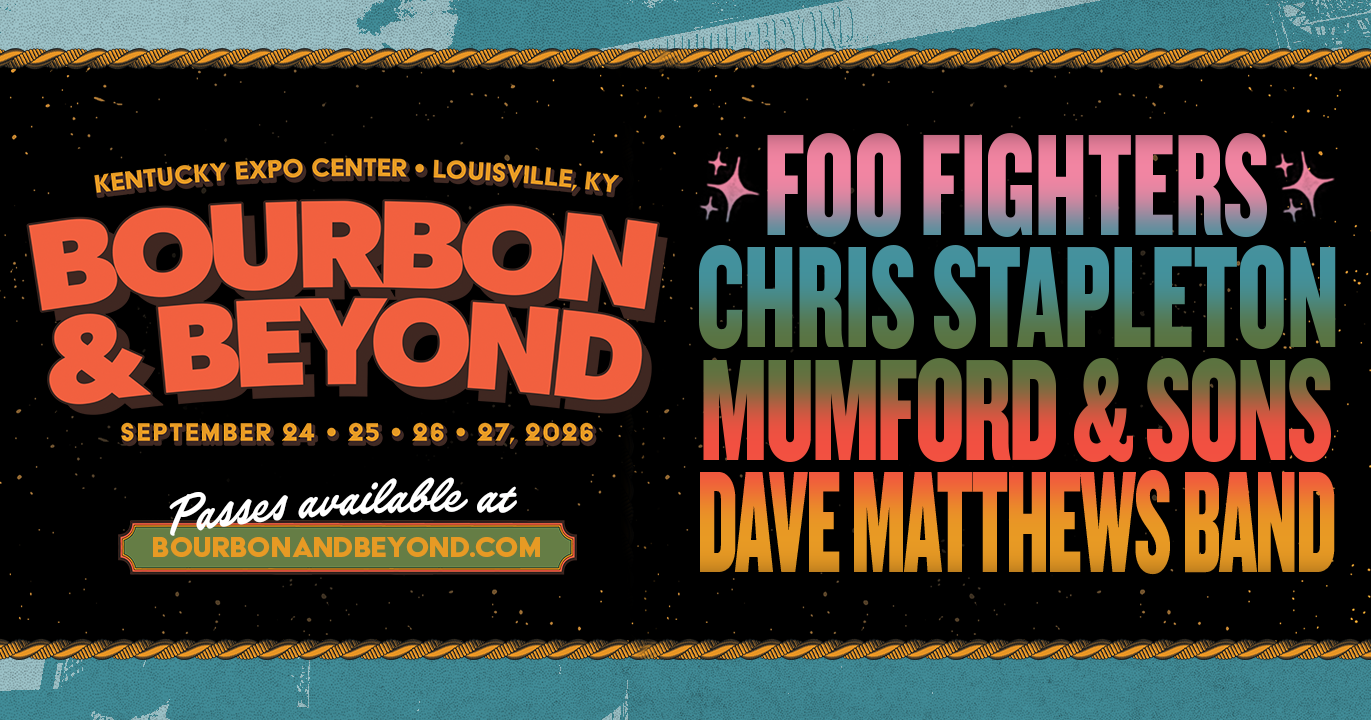
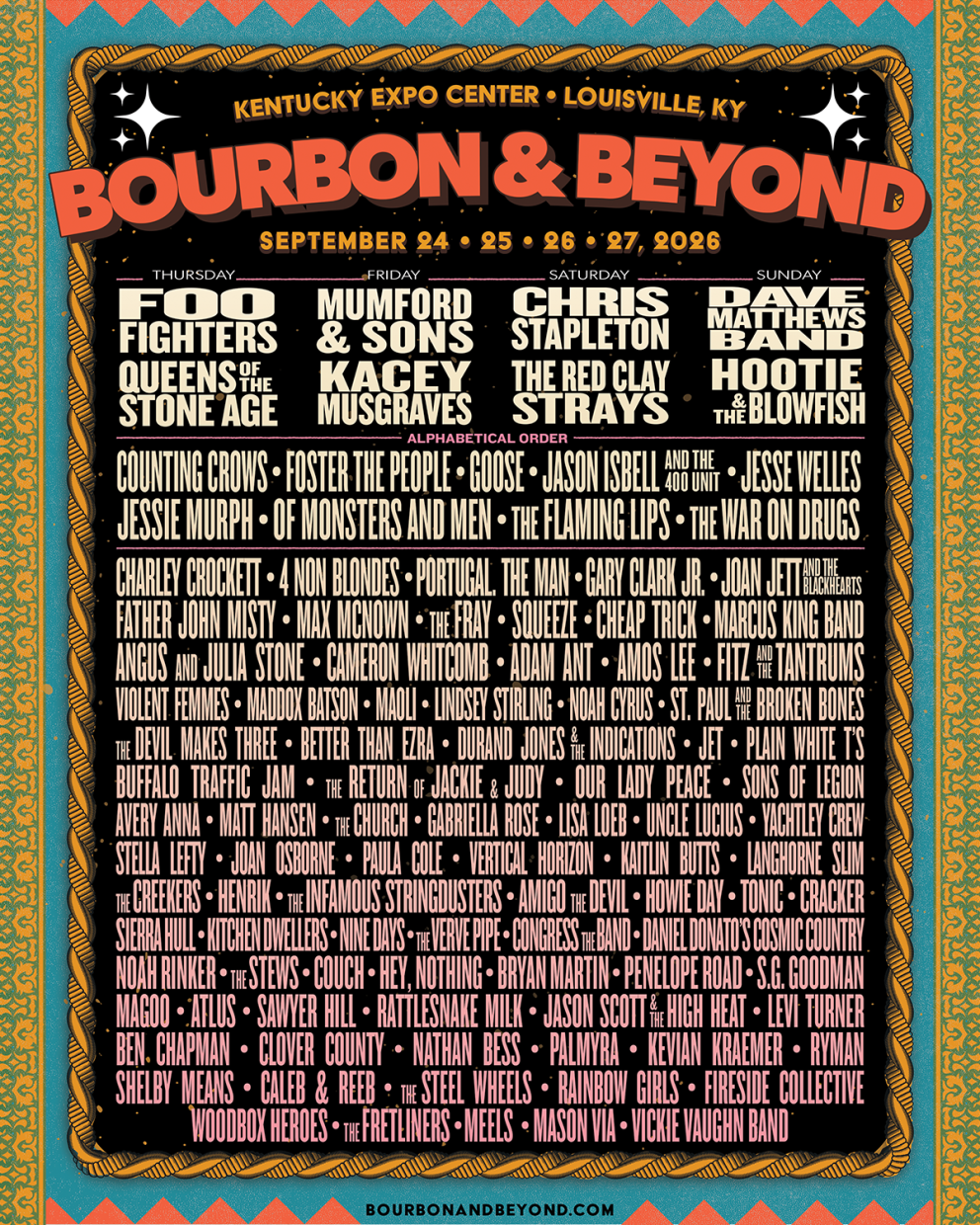
Danny Wimmer Presents has announced the full lineup for the 2026 edition of Bourbon & Beyond, the world’s largest music and bourbon festival. Held September 24-27 at the Kentucky Expo Center in Louisville, Kentucky, the hugely popular event – which attracted more than 200,000 attendees in 2025 and boasted more than $40 million in local economic impact that year alone – will include headline performances by Foo Fighters, Queens of the Stone Age, Mumford & Sons, Kacey Musgraves, Chris Stapleton, the Red Clay Strays, Dave Matthews Band, and Hootie & the Blowfish. Passes are on sale now; view the full lineup poster below.
For our eighth consecutive year, BGS will return to Bourbon & Beyond to curate and present the Bluegrass Situation Stage inside the mouthwatering Kroger Big Bourbon Bar tent. Over four days, Thursday to Sunday, the BGS Stage will include performances by some of the most exciting and buzzworthy bands in bluegrass, Americana, jamgrass, and folk. Headlining acts on our stage will include mandolinist and GRAMMY nominee Sierra Hull, psychedelic jamgrassers Kitchen Dwellers, our current February Artist of the Monththe Infamous Stringdusters, and the expansive sonic universe of Daniel Donato’s Cosmic Country. Other performers on the BGS Stage include Wood Box Heroes, Magoo, Shelby Means, Rainbow Girls, Meels, Caleb & Reeb, and many more. See our full BGS Stage lineup below.
Though we tend to stay close to our own stage during Bourbon & Beyond – we’re partial, what can we say! – each year the DWP team does an excellent job of spreading roots music, country, bluegrass, and Americana across the event’s five stages. This year, we’re excited to catch performances by so many of the artists and musicians included on the lineup, from Charley Crockett, the Red Clay Strays, Mumford & Sons, and Kacey Musgraves to Langhorne Slim, Maoli, Paula Cole, Kaitlin Butts, Clover County, S.G. Goodman, the Devil Makes Three, Palmyra, Amos Lee, Max McNown, and many more. Plus, we’ll be sure to catch Kentuckian viral sensations the Creekers while on-site.
Music isn’t the only draw, of course, as bourbon, food, and fellowship are equally tempting alongside the superlative roster of bands and artists. Hundreds of bourbon labels from dozens of distilleries will be on sale or available for tastings as well as impeccable food by local chefs and celebrity culinary personalities. Catch cooking and beverage demonstrations at the Fork & Flask stage curated by Kroger or enjoy bourbon panels and workshops at the Bourbon Experience. Our team, partial to tiki vibes and tiki drinks, will be sure to stop by the Jim Beam Black Tiki Barrel Bar over the course of the weekend, as well.
BGS has been proud to partner with Bourbon & Beyond and Danny Wimmer Presents ever since the festival’s very first iteration more than eight years ago. We are so excited to return to Louisville to celebrate bluegrass, roots music, bourbon – and beyond! – with you all in 2026. Buy your passes now and check out our full BGS Stage lineup below. We’ll see you at the Big Bourbon Bar in September.
The 2026 Bourbon & Beyond Bluegrass Situation Stage Lineup
Thursday, September 24
Wood Box Heroes Mason Via Magoo Sierra Hull
Friday, September 25
Fireside Collective Rainbow Girls Shelby Means Kitchen Dwellers
Saturday, September 26
The Fretliners Meels The Infamous Stringdusters
Sunday, September 27
Vickie Vaughn Band Caleb & Reeb The Steel Wheels Daniel Donato’s Cosmic Country
All artwork courtesy of Bourbon & Beyond and Danny Wimmer Presents.
This website uses cookies to improve your experience. We'll assume you're ok with this, but you can opt-out if you wish.AcceptRejectRead More
Privacy & Cookies Policy
Privacy Overview
This website uses cookies to improve your experience while you navigate through the website. Out of these, the cookies that are categorized as necessary are stored on your browser as they are essential for the working of basic functionalities of the website. We also use third-party cookies that help us analyze and understand how you use this website. These cookies will be stored in your browser only with your consent. You also have the option to opt-out of these cookies. But opting out of some of these cookies may affect your browsing experience.
Necessary cookies are absolutely essential for the website to function properly. This category only includes cookies that ensures basic functionalities and security features of the website. These cookies do not store any personal information.
Any cookies that may not be particularly necessary for the website to function and is used specifically to collect user personal data via analytics, ads, other embedded contents are termed as non-necessary cookies. It is mandatory to procure user consent prior to running these cookies on your website.