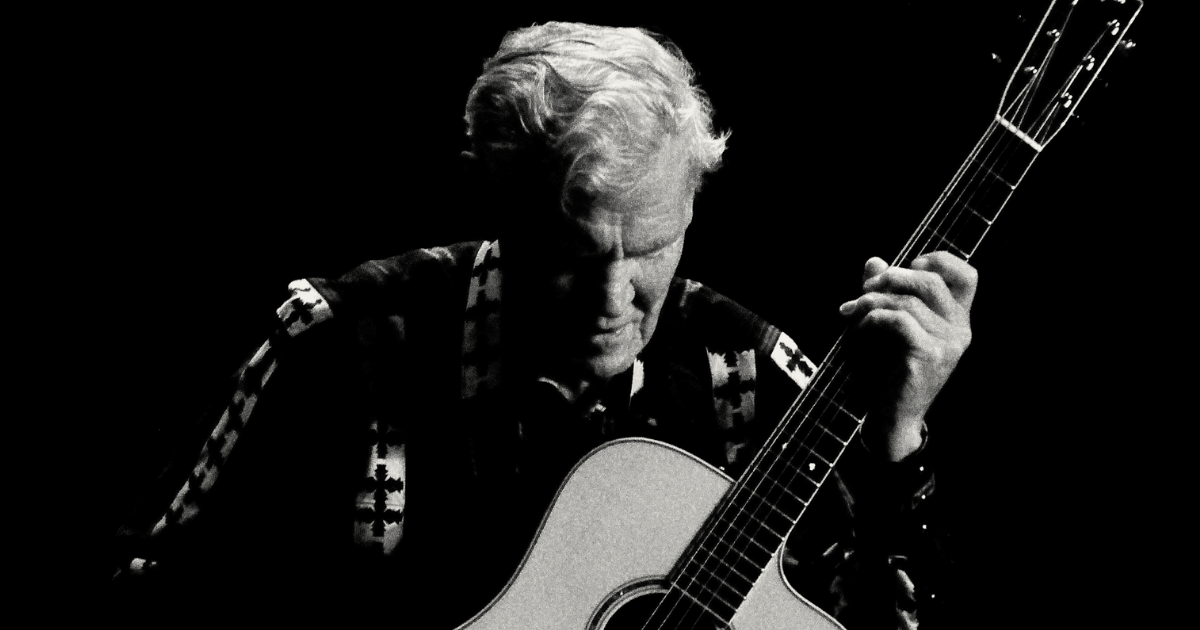
The Five Pillars of Doc Watson’s Legacy

What a difference a Doc made.

Lots of people would like to think their lives have made a difference – whether through their family life, or work, or some sort of creative endeavor.

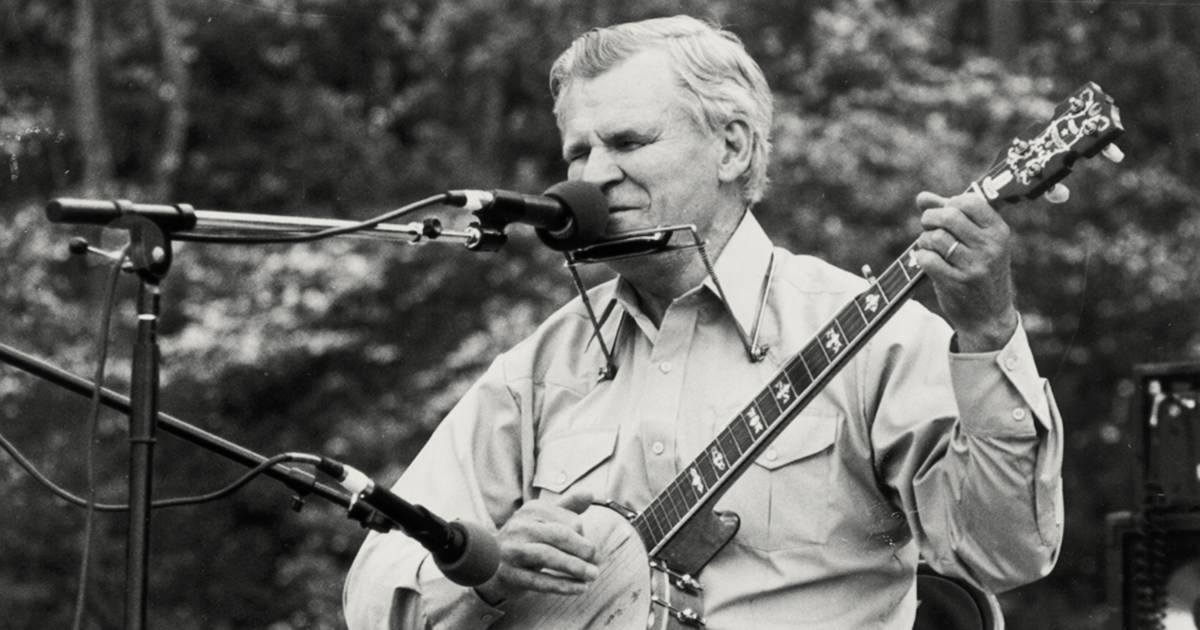
However, even to approach the enduring heritage of the great musician Arthel “Doc” Watson, a person would have to achieve lifetime landmarks as imposing as the North Carolina Appalachian mountains that were his home. During a lifespan from his birth in 1923 until his death in 2012, Watson created a legacy of music, folklore, and goodwill that no one has entirely equaled.

First a little background: Arthel Lane Watson was born March 3, 1923, near Deep Gap – he is not from Asheville – in Western North Carolina. An audience member suggested the nickname “Doc” when his given name was found less than compelling for an entertainer.

His life story before and after becoming an admired folk musician has been often told, notably in Doc Watson: A Life in Music, a 2025 biography by Eddie Huffman published by the University of North Carolina Press.

Blind since infancy, Watson started to develop life skills and musical ability from an early age. He learned both formal and popular styles when sent to the state’s school for the blind in Raleigh at about age 10.

The boy was consumed by music and persistent in getting better at it. Watson had learned both the rudiments of harmonica and a few banjo tunes from his father, General Watson, before he went off to Raleigh. While living within the strict environment of the school for the blind, Watson learned braille and grew familiar with classical and church styles of music taught there. Perhaps as strong an influence as that education was fellow student Paul Montgomery, the talented friend from whom he learned guitar chords. Young Watson and Montgomery, later a well-known Raleigh pianist and children’s show host, shared enthusiasm for the popular music of the day, including jazz and big-band sounds.

His parents, Annie and General Watson, taught the boy skills of growing crops and basic carpentry, and he contributed to the family despite his blindness.

After years of mostly local performances back in Western North Carolina, it wasn’t until the early 1960s, when East Coast musician and historian Ralph Rinzler tuned into and promoted his far-reaching ability as a singer and picker, that Watson’s name gained national, then international attention.

According to an account at the Blue Ridge Heritage Area website Watson recorded over 50 albums and was honored with “the National Medal of Arts, a National Heritage Fellowship, the North Carolina Folk Heritage Award, seven GRAMMY Awards, and a GRAMMY Lifetime Achievement Award.”

As fans know, Doc Watson contained multitudes of skills, a breadth of ability that inspired this list of the five pillars of his musical and artistic legacy.

The King Flatpicker

Watson largely created the challenging fiddle-inspired guitar style that led many followers along a flatpicking trail.

It was during the 1950s, when playing an electric Gibson Les Paul in the local Jack Williams Band, that Watson developed a style that would transform the way the guitar was played in folk and bluegrass music.

Generally, earlier acoustic guitarists in roots-derived styles used a flatpick to create basic “boom-chuck” back up, perhaps throwing in some fills and Jimmie-Rodgers-style bass runs.

But when dancers at Williams’s gigs wanted music for square-dancing, Watson worked up single-note versions of fast fiddle tunes such as “June Apple” and “Bill Cheatham” on his Les Paul. This approach enables lead guitar pickers to achieve the same flowing, rapid attack that fiddlers used for tunes, many of which had come over from the British Isles in past generations.

It’s not possible to say that Doc Watson was the first guitarist to flatpick fiddle tunes. After all, it wasn’t until Watson emerged as a folk artist in the 1960s that the broader music scene caught on to his musicianship. And high achievers such as Arthur Smith on “Guitar Boogie,” Don Reno on “Country Boy Rock ‘n’ Roll,” and Bill Napier on the Stanley Brothers’ “Mountain Dew” – along with some jazz and blues players – all recorded hot-licks acoustic soloing before Watson did. Joe Maphis was also cranking out ultra-fast flatpicking numbers in the 1950s.

But it was Watson’s 1960s performances that created a precedent for a wave of guitarists who had to muscle up to the speed and dexterity he displayed.

A long line of guitarists at the top of the field – from Clarence White to Tony Rice, from Bryan Sutton to Billy Strings – all show Watson’s clear influence not just in recreating fiddle tunes, but also in rapid-fire picking and clean sound on a broad range of material.

Player and educator Alan Barnosky wrote in “An Exploration of Doc Watson’s Innovative and Joyful Guitar Stylings” for Acoustic Guitar in 2023 about the spread of this kind of playing.

“Watson amazed folk fans in the early 1960s by taking tunes typically reserved for the fiddle and reworking them for the acoustic with speed, clarity, and flash,” he wrote. “He never claimed to be the first to play fiddle tunes on a guitar, but for the majority of listeners at the time it was an entirely novel and groundbreaking approach.”

Another world-class, tradition-based player, Earl Scruggs, praised Watson’s adaptation of fiddle tunes as the two were joined by Ricky Skaggs for the 2003 The Three Pickers performance and album.

“He was the first man I ever heard on the guitar that was fooling with tunes like that,” Scruggs said in a Three Pickers introduction. “You had all these good G-C-D pickers – that’s chord positions – but I had never heard anybody that actually took over a lead like a banjo or a fiddle or a mandolin and do those tunes. He could do it.

“And what amazed me about Doc Watson’s picking, and still does, is he’s got that – I call it ‘mountain sound’ to his picking, and he’s one of the best to keep it in that mode of sound.”

New generations of players have immersed themselves in Watson’s style. When I interviewed him for a Bluegrass Unlimited article, leading guitar picker and multi-instrumentalist Bryan Sutton talked about being captivated by Watson’s playing during Sutton’s youth on Western North Carolina.

“Doc and Dan Crary were the first great influences on me,” he said. “Doc Watson was one of the first professional musicians/guitar players that I ever saw. He doesn’t live too far from Asheville, so I saw him play some different festivals and at Maggie Valley. So, he was the first one to really catch my ear as far as what you could do with the flatpick.

“My right hand – it may not as much anymore – but I remember at one time it was kind of like Doc’s. It’s kind of like the way Sam Bush plays, using the whole forearm and wrist involved in the playing, whereas with jazz players or Tony Rice it’s more of a wrist thing. I think I’ve got a little bit of both now.”

Billy Strings, the artist who’s likely doing the most to promote Watson’s legacy in the 21st century, sounded almost evangelical during a September 2025 interview for NPR’s Fresh Air.

“He’s like the ground upon which I stand, you know?” Strings said. “My dad played his music all around the house growing up. And by the time I could play guitar, you know, 5, 6 years old, I was learning those tunes, too. I might’ve been able to play some of them before I knew how to tie my shoes or something, you know?

“It was like, I was learning how to speak and talk and walk, and I was learning all these Doc Watson tunes at the same time. And it was just, like, a religion in my house, you know? His music is just – it’s the best.”

To see some of the top pickers in the field paying tribute, check out this video shot at the Merle Watson Memorial Festival – what would become MerleFest – in Wilkesboro, North Carolina, in 1992.

A Model Fingerpicker

From his first albums on, Watson regularly also played guitar with a thumbpick and index finger. As he noted with his customary self-deprecating humor in the DVD “Doc’s Guitar: Fingerpicking & Flatpicking,” “See, I just play with one finger and a thumb. I don’t use the sensible three-finger method that you should use on finger-style guitar.” (Watch below.)

Watson sounded great with that approach, making finger-picked tunes such as “Deep River Blues,” “Nashville Blues,” “Omie Wise,” and “Doc’s Guitar” fan favorites and objects of long study. For every striving guitarist who practiced hard on his fiddle-tune adaptations, plenty of pickers also worked on showcases such as “Windy and Warm,” with its alternating bass, pull-offs, note bending, and a jazzy minor sixth chord at its conclusion.

Watson’s fingerpicking often showed off his acquaintance with diverse approaches, as in “Deep River Blues,” with an E diminished as its second chord. It also illustrates the way he put his touch on existing pieces such as 1933’s “Big River Blues” by the Delmore Brothers, who played with flatpicks.

“There were two guitars, a tenor – a little four-string, and the regular flattop, and I never could get my guitar to sound like both of theirs did,” Watson said. “Then I began to hear brother Merle Travis, the late Merle Travis, on the radio. And I thought, Now, wait a minute. If I can steal me a lick off brother Travis, maybe I can learn ‘Deep River Blues.’”

Multi-talented Kentuckian Merle Travis (1917-1983) popularized a style in which the thumb plays an alternating bass on the guitar’s lower strings while picking the melody on treble strings. Watson also studied the work of the great guitarist Chet Atkins. The picking buddies released the album Reflections in 1980.

The centuries-old, transatlantic ballad “Georgie” would have once been sung unaccompanied, leaving Watson and others free to craft a brand new style of guitar back up. With no clear precedent on guitar, he might employ the flowing, almost classical patterns that became popular among folk revivalists.

And fingerpicking became the tool Watson used to play the blues that he loved and drew on so deeply, music he followed from the time he heard Mississippi John Hurt on the family’s disc player in childhood.

In the end, there’s no easy way to pin down the many elements Watson brought to his picking, musical points of view that enriched his listeners along the way.

A Standout Singer

Doc Watson’s vocal abilities don’t generally get as much attention as his top-drawer chops as an instrumentalist. However, he was also a tuneful singer with a natural, angelic mountain baritone.

Watson came along during an era when rougher-voiced vocalists such as Hobart Smith, Dock Boggs, and his picking buddy Clarence Ashley represented mountain singing to a growing audience. And Watson’s less mannered style likely contributed to acceptance among listeners less familiar with the high lonesome sound. His direct vocal approach was often heard in performances with no instrumental backing.

It’s useful to remember that Watson also enjoyed the smooth country vocalist Eddy Arnold so much that his son Merle Eddy Arnold was named not just after fingerpicker Merle Travis, but also for Arnold.

Tunes from the Tennessee Plowboy’s repertoire such as “Tennessee Stud,” “I Couldn’t Believe It Was True,” and “Anytime” also showed up in Watson’s repertoire. These were only a few examples of the eclectic side of Watson’s vocal approach, with emphasis on great material over genre labels.

Given his broad taste, Watson at times put some extra grit into his singing on a number such as “Blue Suede Shoes” from his Jack Williams days of the 1950s, later a concert favorite. But more often he sang songs straight, even on one like “Nights in White Satin,” a 1967 pop hit by British rockers the Moody Blues. With waltz-time guitar and plain singing, Watson makes the song come across as relevant to himself and listeners as songs by the Delmore Brothers and Jimmie Rodgers.

Watson’s first memories of vocal music came in church, and he prized the straightforward, no-vibrato sounds that carved such songs in his memory.

“If you love music, you have to listen from the time you’re big enough to notice music,” he told me when recording his 1991 GRAMMY-winning CD On Praying Ground.

“If you’re looking for old-time material in songs, those old songs that you heard when you were young were the easiest to put down.”

From his first commercial recordings on, Watson featured gospel numbers such as the a cappella version of “Talk About Suffering” from 1964 and “Down in the Valley to Pray” from 1966. Both radiate belief and unornamented clarity.

More recent listeners may know the latter song as “Down in the River to Pray,” as it was opportunistically relabeled to match a scene in the 2000 hit film, O Brother, Where Art Thou?.

Always A Song Man

Doc Watson had an impressively broad range of musical interests, perhaps markedly so, given the period in which he came along.

Country or folk music didn’t start appearing on commercial records until Watson was about two years old. In childhood he listened to down-home picking as well as church and gospel songs. It wasn’t until the 1930s that the family owned a radio that let them hear music beyond their 78-rpm record collection.

Virtually every great musician is a song collector at heart. And like Bob Dylan, Watson took on songs from tradition and added new elements. Take the mournful ballad “Omie Wise,” based on a North Carolina murder from the early 19th century.

In the 1920s notable old-time artists G.B. Grayson and Clarence Ashley recorded it with modal accompaniment that was neither truly major nor minor. When Watson recorded in the 1960s, he ventured into folky, arpeggiated picking that put it squarely into minor-chord territory, opening up the song to young folkies who couldn’t play fiddle like Grayson or banjo like Ashley.

In fact, Watson’s playing on “Omie Wise” occupied the same guitar realm as folk star Joan Baez’s playing on “East Virginia” and other traditional songs.


He also tuned into compositions by folk musicians Bob Dylan (“Don’t Think Twice It’s All Right), Tom Paxton (“The Last Thing on My Mind,” “Leavin’ London,” and “Bottle of Wine”), and Townes Van Zandt (“If I Needed You”).

Watson isn’t chiefly known as a songwriter, but he enjoyed notable success with “Your Lone Journey,” which he wrote with wife Rosa Lee. The starry duo of Led Zeppelin frontman Robert Plant and bluegrass’s own Alison Krauss released it as “Your Long Journey,” leading to what biographer Huffman called significant royalties for the family.

Watson’s greatest legacy in songs may have come with the wealth of lasting favorites – just a few are “Deep River Blues,” “I Am a Pilgrim,” “Banks of the Ohio,” “House Carpenter,” and “Shady Grove” – that made their way into the folk, old-time and bluegrass repertoire and could otherwise have been forgotten.

Ambassador for the Old-Time Way

This role for Watson may be the hardest to pin down, as it overlaps with almost all the others. By cleaving to his Appalachian heritage while also making the most of decades of change, Doc Watson was able to introduce countless fans to a rich, living culture.

“I don’t live in the past,” Watson told me in 1991. “I still burn wood in a furnace at the house, but I have heat ducts and a blower on it just like an oil furnace.

“I love to burn wood and I love to split wood. There’s a few of the old-timey things I love to do. I like good dried-apple pie and I like ‘leather britches’ beans.

“And I like to be at home, dadburn it. I hate the road.”

Watson’s long career of traveling to take his music to listeners, often in the company of his beloved son, Merle, nourished their taste for music that he built upon sold timbers of musical tradition.

Wade Smith, a legendary Tar Heel lawyer, told me once about his first experience of hearing Watson, at a small coffeehouse in downtown Raleigh in 1965.

“What word would I choose to describe how I felt?” Smith said for a later Raleigh News & Observer story. “Electrified, stunned at the speed of his fingers and the way he played single strings, and the clarity of the sound. Each note was like a piece of gold, so amazing.

“We stayed to the last note. When we left, I remember thinking that I had never heard anything like it and that in some way I had been changed by it, that I was in an altered state of existence.”

Watson’s national and international impact becomes more impressive given that he wasn’t heard outside his North Carolina stomping grounds until his late 30s. That’s when he honed his broad range of expertise into a mountain-based style that captivated and often amazed listeners at first hearing.

When the Society for American Music, a distinguished non-profit scholarly and educational organization, made Watson an honorary member in 2012, musicologist and musician Greg Reish paid tribute to Watson’s broad impact.

“As I discovered more of America’s traditional musical styles through my teenage years, Doc Watson always seemed to be at the core, an entrée into both older and newer styles,” Reish wrote. “Through Doc’s music I found my way to the pre-war music of the Carter Family, Jimmie Rodgers, and the Skillet Lickers; to the first-generation bluegrass of Bill Monroe and Flatt & Scruggs; to the classic country of Merle Travis, Chet Atkins, and Eddy Arnold; to the country blues of John Hurt and Frank Hutchison; and to the contemporary and progressive flatpicking of Clarence White, Norman Blake, and Tony Rice.”

Huffman’s book quotes the great bluegrass musician Roland White as he talked about the way his guitarist brother Clarence was caught up in Watson’s flatpicking after hearing him at California’s Ash Grove club.

“After seeing Doc, his picking became an obsession, an everyday part of everyday life. To play music and practice every day. Whether we played gigs or not, he was always playing music.”

Sixty years after White’s epiphany, Doc Watson’s music continues to gain and inspire new followers, whether through the picking and testimony of contemporary players such as Sutton and Springs, or through his own dozens of albums and videos. His legacy of tradition and innovation still flows like one of the ancient streams that nourish his cherished mountainsides.


Thomas Goldsmith is an award-winning journalist based in Tennessee and North Carolina. In addition to producing many hundreds of articles for newspapers and magazines, he edited The Bluegrass Reader and authored Earl Scruggs and Foggy Mountain Breakdown: The Making of an American Classic, both for the University of Illinois Press.

Lead image courtesy of MerleFest.

Explore more of our Doc in December Artist of the Month series here.
50 Years of the Paisley Family Business

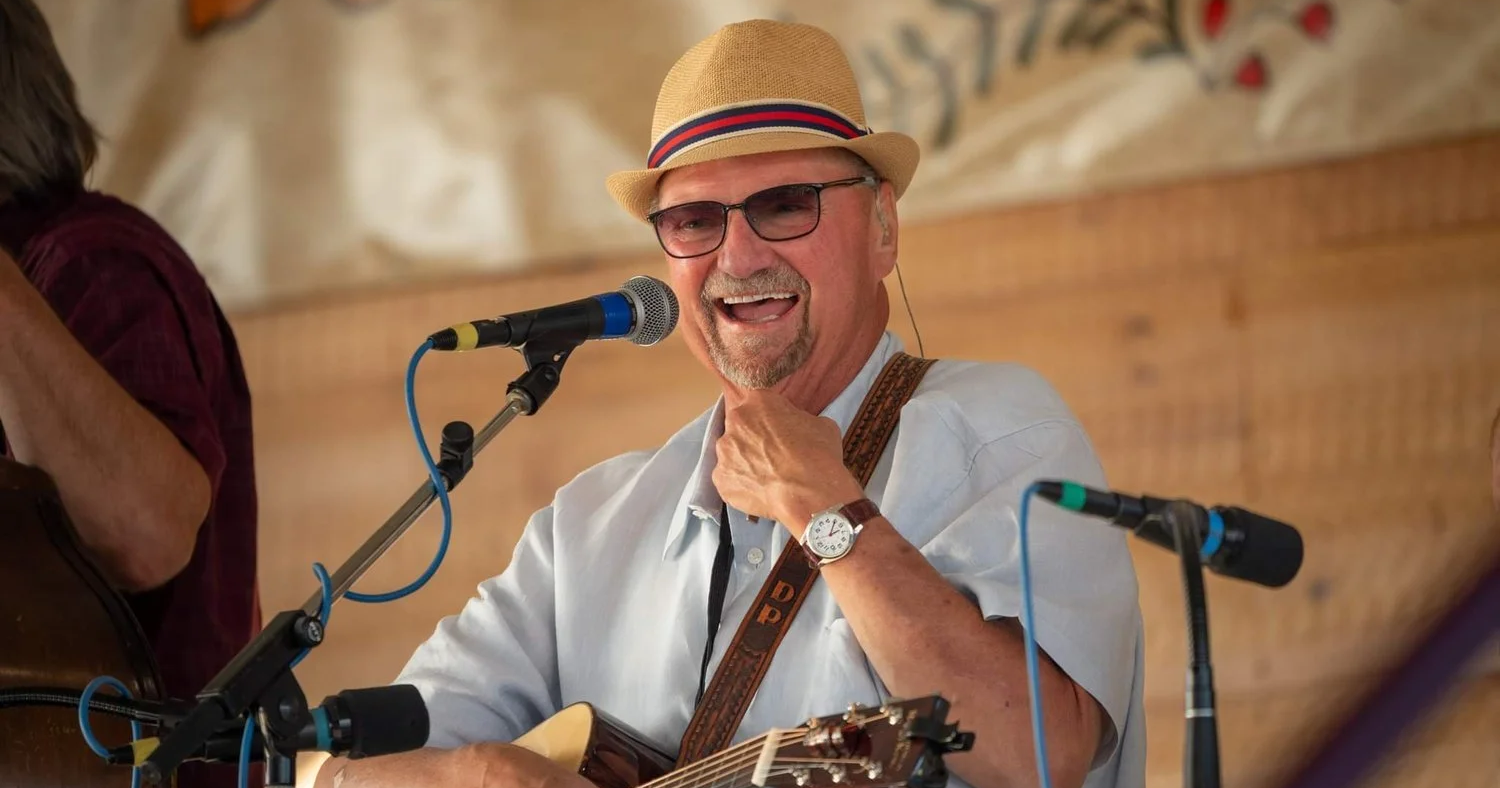
Danny Paisley is a quintessential bluegrass tradesman. He began playing music around the age of 10 and soon after was sneaking into bars and clubs with his dad Bob Paisley, Ted Lundy, and their band, the Southern Grass. Danny was already gigging and touring at the age of 13, and now, five decades later, he’s enjoyed 21 years at the helm of the Southern Grass – with the next generation of Lundys, T.J. and Bobby, and the next generation of Paisleys, his son Ryan, in tow.

Danny learned the bluegrass ropes from his father, crafting and carrying on a traditional sound that draws directly from Bob’s musical foundation but also sounds distinct and personal. When Bob passed away in 2004, Danny had already taken over some of the leadership roles in the band while the elder Paisley had been battling cancer. Danny was determined to continue the group’s legacy, and over the last two decades he’s honored that legacy while consciously expanding it. Along the way, he’s earned four IBMA Awards for Male Vocalist of the Year, while he and the Southern Grass were awarded Song of the Year in 2009 for “Don’t Throw Mama’s Flowers Away.”

His 2025 album, released in May on Pinecastle Records, finds Paisley continuing that expansion, looking for new challenges and focusing in on a fresh sonic sparkle. Bluegrass State of Mind would sound like a straight-ahead traditional bluegrass album to a layperson, but to devoted fans of the Southern Grass, it’s a much more Americana-steeped and forward-looking endeavor. The usual five-piece lineup is augmented by Dobro, snare drum (gasp!), and a healthy dose of “what if we tried… this?” all across the project.

The result is charming, engaging, and downright excellent – it’s one of the finest bluegrass albums of the year, to be sure – showcasing how Paisley’s longevity is built upon a keystone of innovation and looking to the future, rather than being entrenched in the past. For someone who sounds entirely dyed in the wool and is held up by chair-snapping traditionalists as well as jamgrassy rebels, any level of “coloring outside the lines” of the genre would be remarkable. But Paisley isn’t stopping at new challenges and fresh sparkles; he wants to take his Bluegrass State of Mind to as many brand new audiences as he can find.

Fifty years into his career, Paisley is not resting on the assumption that he can keep performing and plying his trade by doing the same ol’ same ol’. No, Danny Paisley & the Southern Grass are still committed to bringing the bluegrass they love and hold dear to anyone and everyone who may enjoy it, by showing folks this kind of music can be for everyone. All the while, he’ll be turning over plenty of new leaves and passing along the family business in real time, too.

We caught up with Paisley at the Industrial Strength Bluegrass Festival in Wilmington, Ohio, between sets, when he and his son Ryan sat down with BGS to chat about his most recent album, what he wants to accomplish next, and the absolute unforgivable sacrilege of including drums on Bluegrass State of Mind.

Right on the album cover for your latest project it says, “Celebrating 50 years of bluegrass music.” To me, you’re a bluegrass tradesman. It’s very clearly your trade, it’s what you’ve done your whole life, and it runs in the family. It began with your father, Bob, and is continuing in the next generation with your son, Ryan. Can you talk a little bit about the meaning that you’re holding right now at 50 years, as you put together this record and were thinking about that anniversary, and that longevity?

Danny Paisley: I didn’t want to do a record rehashing old favorites. I kept hearing different songs and I kept saying, “I want to try this,” just for me to try this new approach. A “new challenge.” We recorded it and some of ’em were not standard Danny Paisley-type songs, but I felt they were awful good songs and I wanted to try it.

So Ryan and I worked it out, and he come up with a different approach for some of the tenor lines I would’ve sang previously. Now Ryan is singing them, so that added a different flavor. We just tried to sparkle the music, just to tweak it.

We added a Dobro for the first time, only ’cause I kept hearing it through so many of the songs. I’m more of a fan of the newer approach to Dobro than the older school. Mike Auldridge was the one that turned me [onto it], the way he was getting tones out of a Dobro.

You’re 50 years into doing this and have such an established sound as your own frontman, your own bandleader. People see you as so solidly traditional, but for you, five decades in, it’s clearly still important for you to turn over new leaves, to find that sparkle you’re describing.

Because I was feeling… maybe I was [feeling] stale, and after my health issues, I felt I really need to do this – for maybe a couple years, now. I regret that I didn’t try it [sooner]. So I tried it and I loved it. Had a great time, had a great producer [Greg Cole] and great help with Ryan and his influence and I think it’s a great CD. Different approach.

You’re still looking for new challenges and you’re looking forward. Obviously, with this record, with the way that you operate as a musician and a creative, you aren’t just somebody that’s like a lot of bluegrass people, with one foot in the past, one foot in the future.

Right.

Looking ahead – ’cause it seems like you’re looking ahead right now – what are the goals you haven’t done yet? Or the bucket list items you haven’t checked off yet?

I want to take our band – and this is a real goal – to reach other audiences. I think there’s a real audience and a real needing, almost, at some of the more jammy festivals. And we’ve done ’em and I’ve realized it really works well, presenting a straight-out, hardcore bluegrass band. We pick out songs that sort of go to that crowd, but we just play ’em in our style and we try to keep it upbeat, just to draw people in for a new audience.

I know the music has gotta move on. I’m a firm believer of it. We revere the past, but we look to the future – and I’m in that category. I look to the future, but I love the past. I don’t want to dishonor it, ’cause it’s the music I love and feel. It’s what’s inside of me. That’s the music I love.

So that’s my goal. I want to bring it out [to new audiences], and I really feel in today’s world, you’ll have to adapt things, but I really wanna make it traditional bluegrass. There’s a real audience for sincere, true bluegrass.

It makes me think of how we have Molly Tuttle, Billy Strings, and Sierra Ferrell–

Exactly.

All who are, at their core, traditionalists. So they’re shining a light on the folks who sound like you. I definitely think there’s space for a band like you in that constellation.

And Billy loves hardcore bluegrass! But he made it an event. People will pay money for an event. He puts it right down in their faces with some straight-out bluegrass, and it’s great.

Our mutual friend Jon Weisberger always talks about how one of the most valuable things you can do as a bluegrass band is to be the most traditional bluegrass band in a non-traditional space. The music can stand out for what it really is and doesn’t fade into the grayness of it all being the same.

There’s so many traditionalists who don’t want any variation, which I respect. We all do. I wanna revere that. But we also gotta realize these people, young folks today, are not coming into the music. With all the outside influences and modern day [stuff], Facebook and all the different Instagrams. [Laughs] They’re not coming into the music the same way. We need to respect that and bring it to them and bring them in.

We can’t expect some young person that’s just getting into music, that’s 18 or 19, to be really drawn in by singing another cabin song. We sing cabin songs, but we can’t [only do that]. And we’ve all had heartbroke and there’s a world of songs about heartbroke. Your lover has passed or left you, boohoo! We have to present it in a fresh way. And meet people where they’re at, for sure. That’s the best line, that’s truly it. And I’m a firm believer in that.

I fully believe in the intrinsic charm of bluegrass. I think everybody’s a fan, they just don’t know it yet. So if you can reach them with music that doesn’t show them or tell them that they’re not allowed to like bluegrass, it happens. Bluegrass can feel exclusive. Or it can feel like, “Oh, that’s music for other people, not for me.”

“Not me,” yeah! Or, “I’m afraid.” “I’m not sure that’s good enough, or that I would be accepted.” Or, “I hear it, but I don’t really want people to know I like it.” Because that stereotype has to go! It has to move on. It’s music for everyone. I don’t care what kind of music you’re in, music is for everyone. And you have to accept that or live in your little corner of the world and think everybody else is wrong.

I’ll probably get in trouble for that. [Laughs]

No, no! But speaking of traditionalism and traditionalists… so, bluegrass drums, huh? [Laughs]

Uh huh! [Laughs]

You’ve got bluegrass drums on the album. And what a lot of people don’t know – maybe our audience on BGS will know – but a lot of people don’t know that bluegrass drums are a traditional bluegrass instrument. I hear the “sparkle” and the difference in these songs, but I also still hear you. It sounds like your personality.

What my approach and my thought is, is I want it to still be me. I’ve had some people criticize it and say they didn’t appreciate that drum. Why? ‘Cause it was listed? [Laughs] It’s there to add some rhythm. And it was only there for a little sparkle, a little snap. And a little rhythm. If you didn’t really know it was there and we didn’t tell you, you probably wouldn’t know it. There’s nothing wrong with that, no. Drums are in a lot of bluegrass.

Exactly. We could list the folks who’ve had drums: Bill Monroe, Jimmy Martin, the Osborne Brothers, J.D. Crowe – the list goes on and on and on.

For you, as a traditionalist, straight-down-the-middle bluegrasser, this album is a few clicks towards Americana. But if you played this album for an Americana audience, it would just sound like traditional bluegrass.

It would be traditional bluegrass, yeah. I’m gonna draw those people in. That’s my goal.

The album sounds so warm and live. You know how bluegrass records nowadays, especially the ones made especially for satellite radio, all sound really compressed. They sound canned and sometimes stale. This album feels really warm and live and fresh.

I think ’cause they all want radio airplay. They have a certain– I don’t know the technical way [to describe it], but sometimes you start compressing the music too tightly. You miss guys like Jimmy Martin who threw his voice real up there and really stood out on a certain line. He popped –I call it popping – he’d pop his voice and stuff. It might have been there, but then they compress it with the recording or the engineering. I try to not let that get too overtaken in the music, even in straight bluegrass, ’cause that adds energy and life.

I do wanna talk about some of the songs on the album. I love these three in the middle: “Diagnosis Broken Heart,” “Two Old Church Pews,” and “Cream in My Coffee.” Let’s start with “Diagnosis Broken Heart,” ’cause that one, I think the sparkle and the challenge you’ve been talking about is there.

We had it recorded and I didn’t really like it. I felt it didn’t really work. So we redid it after we had it all done and mastered, we redid it. That’s a different approach for me. I said, “Let that sink in.” And after it sunk into me, I go, “No, I don’t wanna do it that way. I’m gonna go back and just sing it my way.” And that’s what I did. Then that one, we added the snare. I wanted a little pop – and the groove on that one is great. We brought the tempo up and that one worked.

The most challenging song was “Cream in My Coffee.” David Stewart wrote it along with some other gentlemen and David kept saying, “I want you to do this. I hear this.” And I kept saying, “I do too, but I don’t know if I can.” And so there’s your challenge!

So I did it and it wasn’t right. We’re in the studio and David Stewart’s there and he’s telling me how to do it and I’m not doing it the way I hear it. I’m listening to the way he’s singing it and I go, “I can’t really do it that way.” I’m listening back and forth. Finally, David comes in the studio and he says, “Think of a marching band.” We did a take and next thing I know he’s standing in the [control] room while I’m doing the vocal and he’s in there marching. [Laughs]

More people come and say, “I never thought you would record the song like that,” but I love it. I said that was a challenge, but it was a good challenge.

I also wanted to talk about “Two Old Church Pews.” Can you tell me about where that song came from? That line about how a church is wherever you are, that really resonated.

That was the major part of that song that grabbed me! That song was pitched to me by Brink Brinkman and Daryl Mosley. They sent it and I immediately said, “This is beautiful.” I said, “This wraps up basically how I feel.” You can talk to your deity wherever you are. Some people need to go to church. Some people just go out, have a quiet moment, and sit in the yard or a quiet spot in the house. That’s how I believe. And the two old church pews were [the singer’s] church. He took ’em home and he sat there and he would talk to the Lord in that way.

That’s how I feel and it’s a beautiful song. It rings thanks to Ryan and Greg. It come out excellent. And that’s probably the most traditional feeling, one of the new songs on that CD.

I love the text painting of it. It really feels like you’re seeing the imagery.

That’s what I tried with my singing. Tried to present that way. And the wording of it was excellent. That’s a once in a lifetime song.


Photo Credit: Shot by Rob Wasilewski, courtesy of the artist.

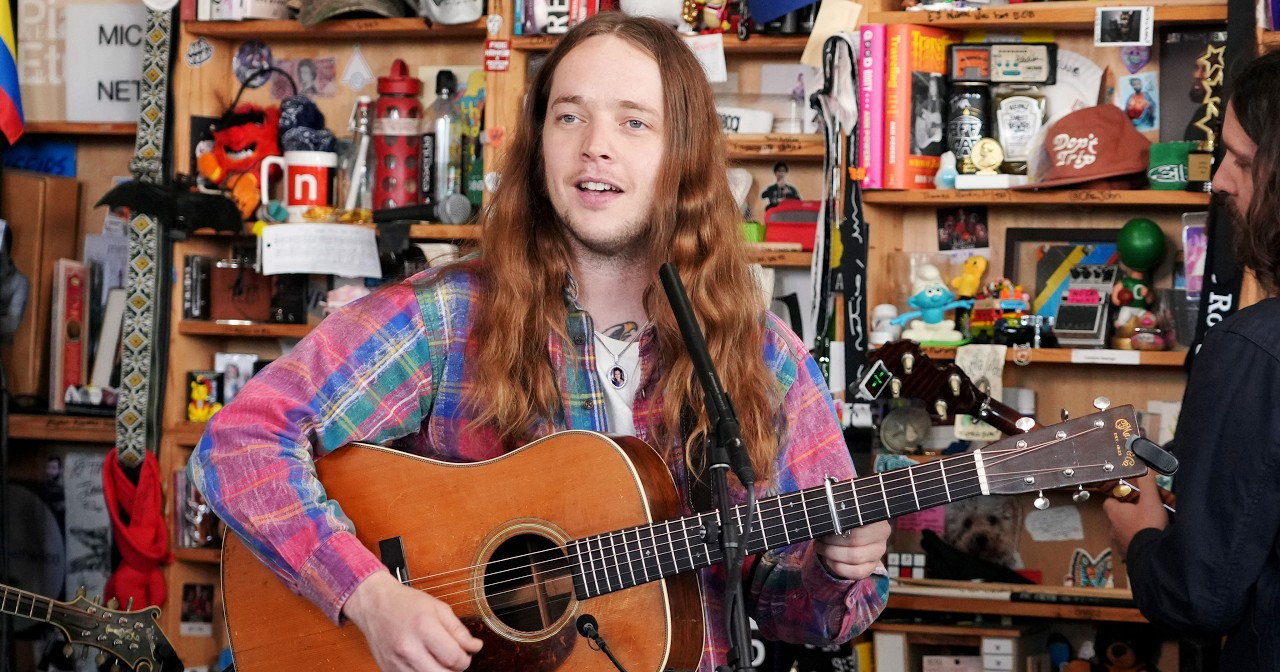
Watch Billy Strings Perform His First Ever Tiny Desk Concert

NPR Music brought all of us an early holiday gift – skipping placing it under the tree entirely – when they released Billy Strings’ first ever Tiny Desk Concert on December 10. With his touring band of Jarrod Walker (mandolin), Royal Masat (bass), Alex Hargreaves (fiddle), and Billy Failing (banjo) circled up around him, Strings performed three tracks from his GRAMMY-nominated 2024 album Highway Prayers as well as a fan favorite, “Red Daisy,” from 2021’s Renewal, which kicked off the set. Watch above.

Bluegrass is perfectly suited to the stripped-down, acoustic Tiny Desk setting of course, the genre seemingly designed for just these sorts of informal contexts, with listeners gathered around and that high lonesome sound cutting above. Still, the NPR Music staff gush in their post of the concert about Strings’ sonic instincts in the space. “It’s rare these days for an artist to ask for fewer microphones,” they write in their description of the mini set, “but after warming up in our space, Billy Strings did just that.”

Strings and his band routinely step away from their pedal boards, pick ups, and instrument and vocal mics even on the biggest arena stages in the country, so it’s no surprise they leaned further into the cozy and informal vibes of NPR’s Tiny Desk, dancing around the single center microphone while certain instruments are augmented slightly by clip-on condensers.

No matter the heights to which this group ascends, they never forget their unassuming bluegrass roots. Strings is noticeably excited and humbled to take his turn behind the Tiny Desk. “We’ve been lucky to play a lot of cool venues,” Strings says during his set. “But this one’s different. It has that same soul to it because — I’ve seen so many amazing performances that happened right here and I kind of believe that love and spirit kind of soaks into this environment, so just standing here feels like a special thing.”

Though, like all Tiny Desk performers, they only perform a handful of tracks, Billy Strings and his band did indeed accomplish a very special thing with their debut Tiny Desk Concert.

Highway Prayers is nominated for a GRAMMY for Best Bluegrass Album at the 2026 GRAMMY Awards to be held in February in Los Angeles. We spoke to Strings around the release of the project in 2024, when he was our Artist of the Month.


Artist of the Month:
Doc in December

For the past few years, as the music industry goes quiet, spooling itself down for a two-week sleep over the Christmas and New Year’s holidays, the team here at BGS has taken the opportunity to utilize December to spotlight a few of our heroes. We began the series with Dylan in December in 2018 and followed up the success of that nontraditional “Artist of the Month” pick in following years with Dolly in December, Del in December, Dawg in December, and last year’s incredibly popular Dead in December.

What better way to spend a cozy, holiday-filled, wintry month than celebrating some of the legends – artists, songwriters, musicians, and bands – that have made our roots music scene what it is today? This year, it’s clear who our December Artist of the Month should be: “Doc” Arthel Watson, himself.

Born in Deep Gap, North Carolina, in the heart of Appalachia in 1923, Doc Watson started playing guitar – and other instruments, too – as a child. Doc lost his vision in his youth, but would go on to become one of the most important American guitarists in history even with his disability. His position in modern roots music, especially in bluegrass, old-time, and folk, is canon. He is a legend to any and all, from the diehard lifelong acolytes to the recently initiated neonates. He’s one of our Americana music figures who tends to get lost, like the forest for its trees, within his own ubiquity and universal adoration. But no matter from which angle you drill down into his career, discography, artistry, and legacy there’s always more to find. To explore. And to enjoy, of course.

Over the course of December, we’ll be doing just that. Our writers and contributors will offer new articles considering Doc’s songs and output and his career as an American guitar hero. And, how even after his passing in 2012, he continues to be a definitional stylist on flat-top, flatpicked guitar. But don’t sell him short, either. Though most known for his fiddle tunes, folk songs, and old-time and bluegrass licks, Watson was accomplished in many genres across the roots continuum; he dabbled in and conquered sounds from hillbilly and rockabilly, electric guitars, blues, ragtime, fingerstyle, chicken pickin’, and more. He collaborated with artists from well within his own circle and far outside it – sonically, socially, and geographically. Watson was incredibly dynamic, a characteristic that has contributed greatly to his lasting, ongoing appeal.

We will also be dipping back into our BGS archives to share past features, playlists, and articles about Doc, and his son Merle; about his festival MerleFest, which continues to this day; and about the albums and offerings celebrating the 100th anniversary of his birth that were released in 2023. Truthfully, there’s nearly an endless supply of BGS content that touches on, focuses on, or mentions Doc. Because of course there is – these genres we all love and hold dear wouldn’t be what they are today without him.

You also won’t want to miss perhaps the most exciting aspect of our Doc in December Artist of the Month celebration. In 2023, BGS was invited to Bryan Sutton’s Blue Ridge Guitar Camp in Brevard, North Carolina. Sutton, alongside his friend and peer Billy Strings, is one of the most prominent proselytizers for Watson in the 21st century, so it’s no surprise his annual camp just up the mountains from Watson’s hometown of Deep Gap is usually dripping with Doc’s music.

That year, one of Doc’s most famous guitars, “Ol’ Hoss” – a 1968 G-50 Gallagher Guitar Watson played in the late ’60s and early ’70s and on many recordings – was also at the Blue Ridge Guitar Camp. The instrument was one of the first of a few Gallaghers that Doc owned. BGS made the trip to Brevard to capture special video performances and interviews with many of the event’s instructors and pickers, each of whom played Doc tunes and shared stories and memories while picking Ol’ Hoss. It was a magical week in the mountains. Now, for the very first time, we’re making select songs from these tapings available in a new series, the Ol’ Hoss Sessions. Three sessions pulled from the shoot celebrates Doc in December and features Bryan Sutton, Courtney Hartman, and will also feature Billy Strings. Stay tuned as we share those videos right here on BGS and on our YouTube channel throughout the month.

It’s not that Doc Watson is underappreciated or underrated, or that he needs any of the visibility that being a BGS Artist of the Month might afford. In our neck of the woods, seemingly everyone knows and loves Doc Watson already. But with so many folks and institutions shouting Watson’s praises from the rooftops lately – artists like Sutton, Strings, and a host of guitar pickers and roots musicians from across our community and scene; the folks who put on and attend MerleFest; the communities of Boone and Deep Gap, North Carolina; projects like I Am a Pilgrim: Doc Watson at 100 – it’s clear there’s always more to learn, love, and enjoy about Arthel Lane Watson.

Get started with Doc in December with our Essential Doc Watson Playlist, below. Plus, follow along right here on BGS and on social media as we share Doc Watson content throughout the month. We’ll have a new feature on Watson’s status as American guitar hero, and you can see our YouTube playlist of his incredible musical collaborations here. Plus, of course, our very special Ol’ Hoss Sessions, exclusively available right here on the Bluegrass Situation. (Watch Bryan Sutton here. Watch Courtney Hartman here.) Plus, we’ll be combing through the BGS archives for everything Doc Watson for y’all to enjoy. Buckle up for a mighty month of guitar pickin’ glory, it’s Doc in December!


Lead image courtesy of MerleFest.

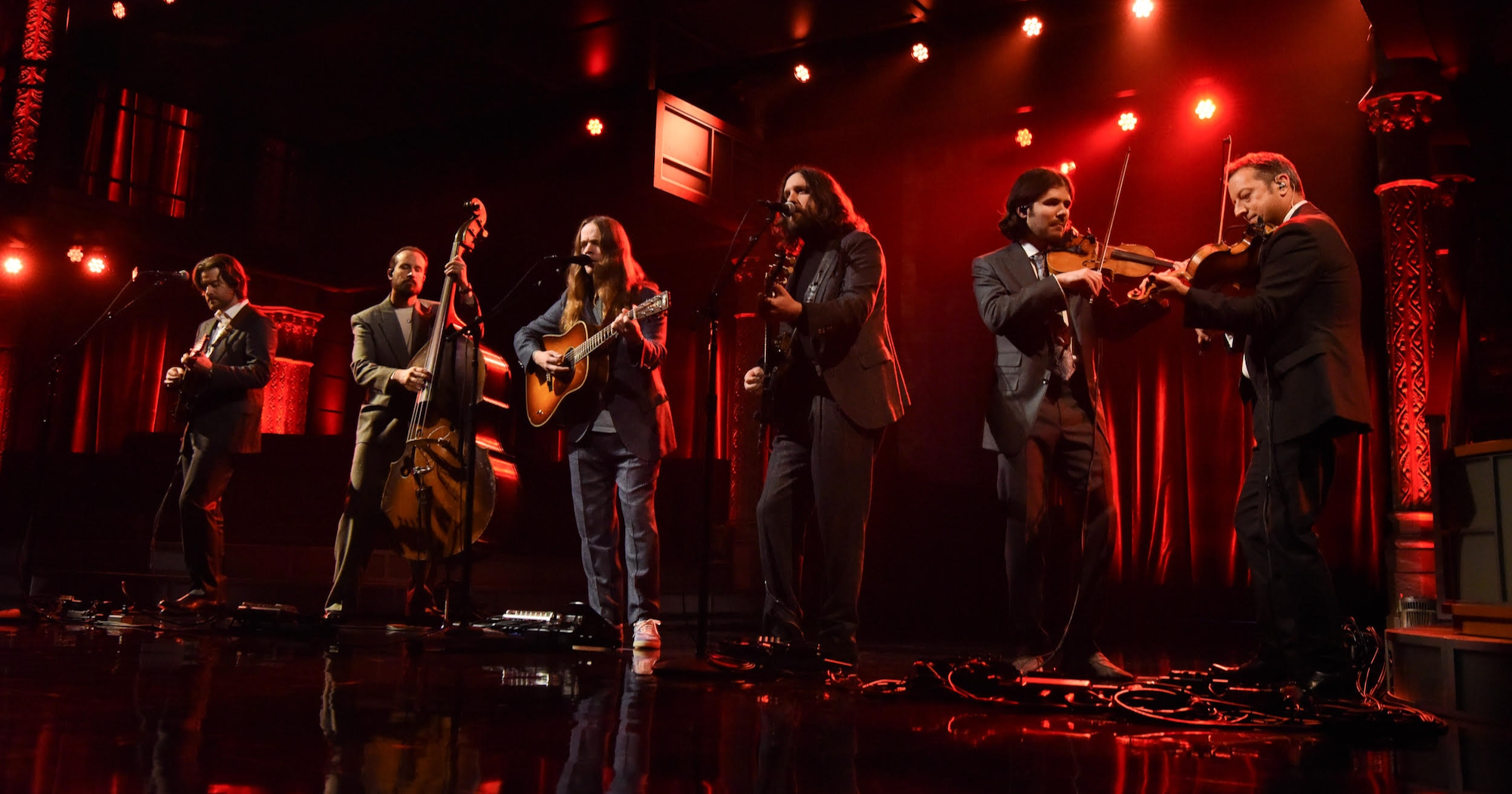
Watch Billy Strings Perform on The Late Show with Stephen Colbert

On Thursday, November 20, 2025, Billy Strings and his band returned to The Late Show with Stephen Colbert for another exciting bluegrass performance broadcast over the television airwaves. Strings’ 2024 album, Highway Prayers, was recently announced as a GRAMMY nominee for the Best Bluegrass Album award at the upcoming 2026 GRAMMY Awards, which will be held in early February. On Colbert, the group performed “Leaning on a Travelin’ Song” off the project to celebrate the LP’s nomination. (Watch above.) It’s Strings’ eighth GRAMMY nomination since 2020 and, if he wins in 2026, will be his third trophy for Best Bluegrass Album.

The band, which includes Jarrod Walker (mandolin), Royal Masat (bass), Billy Failing (banjo), and Alex Hargreaves (fiddle), were joined by fellow Best Bluegrass Album nominee Jason Carter for a twin-fiddle arrangement of “Leaning on a Travelin’ Song.” (Carter is GRAMMY-nominated with Michael Cleveland for their debut duo album, Carter & Cleveland.) Carter guested on the track on Highway Prayers, as well, supplying delicious twin fiddle and reprises his album role on the Colbert stage. The song begins with mournful a cappella three-part vocals and dramatic guitar strums before kicking into time with the lush, burning fiddling of Hargreaves and Carter.

As Nickel Creek’s Sara Watkins put it in a comment on Instagram, “Yes sirs!! Nothing like some singin’ twin fiddles on National Television!” We and the many other commenters and viewers on the internet agree. Strings and his cohort sound excellent, offering warm, lively, and crisp, fresh-sounding bluegrass to millions over the television airwaves. The world could always use more twin fiddle, and it certainly always craves more Billy Strings.

We spoke to Billy Strings about Highway Prayers while celebrating the album’s release last fall when he was BGS Artist of the Month. Check out that interview here.


Photo Credit: Scott Kowalchyk for The Late Show with Stephen Colbert.

See the Nominees for the 2026 GRAMMY Awards

The nominees for the 2026 GRAMMY Awards have been announced by the Recording Academy, looking ahead to “Music’s Biggest Night” on Sunday, February 1, 2026 at the Crypto.com Arena in Los Angeles, California. The primetime show will be broadcast live on CBS and will stream live and on demand on Paramount+.

Legends, icons, familiar names, and first-time nominees can all be found across the 95 GRAMMY categories that have been unveiled. In the Country & American Roots Music field, standouts include Tyler Childers (4 nominations), Lainey Wilson (3 nominations), Sierra Hull (4 nominations, including Best Instrumental Composition), Jesse Welles (4 nominations), and I’m With Her (3 nominations). Alison Krauss & Union Station, who released their first album in 14 years, Arcadia, earlier this year, have been nominated twice for 2026, bringing Krauss’ total number of nominations across her career to 46. Krauss is one of the most-nominated and most-awarded artists in GRAMMY history.

Unsurprisingly, one of those nominations for Krauss & Union Station finds Arcadia in the running for Best Bluegrass Album. The LP will compete with Carter & Cleveland by Jason Carter & Michael Cleveland, A Tip Toe High Wire by Sierra Hull, Outrun by the SteelDriversand Highway Prayers by Billy Strings for the Best Bluegrass Album gramophone. (This year, Best Bluegrass Album is Strings’ sole nomination.)

In country, for the first time Best Country Album has been split into two constituent categories, Best Contemporary Country Album and Best Traditional Country Album. Kelsea Ballerini, Tyler Childers, Eric Church, Jelly Roll, and Miranda Lambert will vie for Best Contemporary Country Album this year, while Charley Crockett, Margo Price, and Zach Top find themselves nominated for Best Traditional Country Album – with father-and-son Willie and Lukas Nelson nominated as well, pitted against each other for the very first time.

Outside of the Country & American Roots Music field, roots musicians are represented far and wide. Béla Fleck, Edmar Castañeda, and Antonio Sánchez’s BEATrio self-titled record is nominated for Best Contemporary Instrumental Album. Dan Auerbach is up for Producer of the Year (Non-Classical). Elton John and Brandi Carlile are nominated for Best Traditional Pop Vocal Album and Best Song Written For Visual Media. Plus, Sinners, the phenomenal and horrifying Ryan Coogler film steeped in various roots music traditions, has racked up five nominations across categories and fields.

It’s certainly an exciting roster of nominees for the 2026 GRAMMY Awards! Below, find the complete list of nominations from the Country & American Roots Music field, plus select categories featuring roots musicians, artists, and projects from across the various other GRAMMY fields and categories.

The 68th Annual GRAMMY Awards will take place on Sunday, February 1, 2026.

Country & American Roots Music

Best Country Solo Performance

“Nose On The Grindstone” – Tyler Childers
“Good News” – Shaboozey
“Bad As I Used To Be” – Chris Stapleton
“I Never Lie” – Zach Top
“Somewhere Over Laredo” – Lainey Wilson

Best Country Duo/Group Performance

“A Song To Sing” – Miranda Lambert, Chris Stapleton
“Trailblazer” – Reba McEntire, Miranda Lambert, Lainey Wilson
“Love Me Like You Used To Do” – Margo Price, Tyler Childers
“Amen” – Shaboozey, Jelly Roll
“Honky Tonk Hall Of Fame” – George Strait, Chris Stapleton

Best Country Song

“Bitin’ List” – Tyler Childers, songwriter. (Tyler Childers)
“Good News” –  Michael Ross Pollack, Sam Elliot Roman, Jacob Torrey, songwriters. (Shaboozey)
“I Never Lie” – Carson Chamberlain, Tim Nichols, Zach Top, songwriters. (Zach Top)
“Somewhere Over Laredo” – Andy Albert, Trannie Anderson, Dallas Wilson, Lainey Wilson, songwriters. (Lainey Wilson)
“A Song To Sing” – Jenee Fleenor, Jesse Frasure, Miranda Lambert, Chris Stapleton, songwriters. (Miranda Lambert, Chris Stapleton)

Best Traditional Country Album

Dollar A Day – Charley Crockett
American Romance – Lukas Nelson
Oh What A Beautiful World – Willie Nelson
Hard Headed Woman – Margo Price
Ain’t In It For My Health – Zach Top

Best Contemporary Country Album

Patterns – Kelsea Ballerini
Snipe Hunter – Tyler Childers
Evangeline Vs. The Machine – Eric Church
Beautifully Broken – Jelly Roll
Postcards From Texas – Miranda Lambert

Best American Roots Performance

“LONELY AVENUE” – Jon Batiste, Featuring Randy Newman
“Ancient Light” – I’m With Her
“Crimson And Clay” – Jason Isbell
“Richmond On The James” – Alison Krauss & Union Station
“Beautiful Strangers” – Mavis Staples

Best Americana Performance

“Boom” – Sierra Hull
“Poison In My Well” – Maggie Rose, Grace Potter
“Godspeed” – Mavis Staples
“That’s Gonna Leave A Mark” – Molly Tuttle
“Horses” – Jesse Welles

Best American Roots Song

“Ancient Light” – Sarah Jarosz, Aoife O’Donovan, Sara Watkins, songwriters. (I’m With Her)
“BIG MONEY” – Jon Batiste, Mike Elizondo, Steve McEwan, songwriters. (Jon Batiste)
“Foxes In The Snow” – Jason Isbell, songwriter. (Jason Isbell)
“Middle” – Jesse Welles, songwriter. (Jesse Welles)
“Spitfire” – Sierra Hull, songwriter. (Sierra Hull)

Best Americana Album

BIG MONEY – Jon Batiste
Bloom – Larkin Poe
Last Leaf On The Tree – Willie Nelson
So Long Little Miss Sunshine – Molly Tuttle
Middle – Jesse Welles

Best Bluegrass Album

Carter & Cleveland – Michael Cleveland & Jason Carter
A Tip Toe High Wire – Sierra Hull
Arcadia – Alison Krauss & Union Station
Outrun – The SteelDrivers
Highway Prayers – Billy Strings

Best Traditional Blues Album

Ain’t Done With The Blues – Buddy Guy
Room On The Porch – Taj Mahal & Keb’ Mo’
One Hour Mama: The Blues Of Victoria Spivey – Maria Muldaur
Look Out Highway – Charlie Musselwhite
Young Fashioned Ways – Kenny Wayne Shepherd & Bobby Rush

Best Contemporary Blues Album

Breakthrough – Joe Bonamassa
Paper Doll – Samantha Fish
A Tribute To LJK – Eric Gales
Preacher Kids – Robert Randolph
Family – Southern Avenue

Best Folk Album

What Did The Blackbird Say To The Crow – Rhiannon Giddens & Justin Robinson
Crown Of Roses – Patty Griffin
Wild And Clear And Blue – I’m With Her
Foxes In The Snow – Jason Isbell
Under The Powerlines (April 24 – September 24) – Jesse Welles

Best Regional Roots Music Album

Live At Vaughan’s – Corey Henry & The Treme Funktet
For Fat Man – Preservation Brass & Preservation Hall Jazz Band
Church Of New Orleans – Kyle Roussel
Second Line Sunday – Trombone Shorty And New Breed Brass Band
A Tribute To The King Of Zydeco – Various Artists

General Field

Producer of the Year (Non-Classical)

Dan Auerbach
Cirkut
Dijon
Blake Mills
Sounwave

Jazz, Traditional Pop, Contemporary Instrumental & Musical Theater

Best Jazz Performance

“Noble Rise” – Lakecia Benjamin, Featuring Immanuel Wilkins & Mark Whitfield
“Windows – Live” – Chick Corea, Christian McBride & Brian Blade
“Peace Of Mind / Dreams Come True” – Samara Joy
“Four” – Michael Mayo
“All Stars Lead To You – Live” –  Nicole Zuraitis, Dan Pugach, Tom Scott, Idan Morim, Keyon Harrold & Rachel Eckroth

Best Jazz Instrumental Album

Trilogy 3 (Live) – Chick Corea, Christian McBride & Brian Blade
Southern Nights – Sullivan Fortner, Featuring Peter Washington & Marcus Gilmore
Belonging – Branford Marsalis Quartet
Spirit Fall – John Patitucci, Featuring Chris Potter & Brian Blade
Fasten Up – Yellowjackets

Best Alternative Jazz Album

honey from a winter stone – Ambrose Akinmusire
Keys To The City Volume One – Robert Glasper
Ride into the Sun – Brad Mehldau
LIVE-ACTION – Nate Smith
Blues Blood – Immanuel Wilkins

Best Traditional Pop Vocal Album

Wintersongs – Laila Biali
The Gift Of Love – Jennifer Hudson
Who Believes In Angels? – Elton John & Brandi Carlile
Harlequin – Lady Gaga
A Matter Of Time – Laufey
The Secret Of Life: Partners, Volume 2 – Barbra Streisand

Best Contemporary Instrumental Album

Brightside – ARKAI
Ones & Twos – Gerald Clayton
BEATrio – Béla Fleck, Edmar Castañeda, Antonio Sánchez
Just Us – Bob James & Dave Koz
Shayan – Charu Suri

Gospel & Contemporary Christian Music

Best Roots Gospel Album

I Will Not Be Moved (Live) – The Brooklyn Tabernacle Choir
Then Came The Morning – Gaither Vocal Band
Praise & Worship: More Than A Hollow Hallelujah – The Isaacs
Good Answers – Karen Peck & New River
Back To My Roots – Candi Staton

Latin, Global, Reggae & New Age, Ambient, or Chant

Best Música Mexicana Album (Including Tejano)

MALA MÍA – Fuerza Regida, Grupo Frontera
Y Lo Que Viene – Grupo Frontera
Sin Rodeos – Paola Jara
Palabra De To’s (Seca) – Carín León
Bobby Pulido & Friends Una Tuya Y Una Mía – Por La Puerta Grande (En Vivo) – Bobby Pulido

Best Global Music Performance

“EoO” – Bad Bunny
“Cantando en el Camino” – Ciro Hurtado
“JERUSALEMA” – Angélique Kidjo
“Inmigrante Y Que?” – Yeisy Rojas
“Shrini’s Dream (Live)” – Shakti
“Daybreak” – Anoushka Shankar, Featuring Alam Khan, Sarathy Korwar

Children’s, Comedy, Audio Books, Visual Media & Music Video/Film

Best Song Written For Visual Media

“As Alive As You Need Me To Be” [From TRON: Ares] – Trent Reznor & Atticus Ross, songwriters. (Nine Inch Nails)
“Golden” [From KPop Demon Hunters] – EJAE & Mark Sonnenblick, songwriters. (HUNTR/X: EJAE, Audrey Nuna, REI AMI)
“I Lied to You” [From Sinners] – Ludwig Göransson & Raphael Saadiq, songwriters. (Miles Caton)
“Never Too Late” [From Elton John: Never Too Late] – Brandi Carlile, Elton John, Bernie Taupin & Andrew Watt, songwriters. (Elton John, Brandi Carlile)
“Pale, Pale Moon” [From Sinners] – Ludwig Göransson & Brittany Howard, songwriters. (Jayme Lawson)
“Sinners” [From Sinners] – Leonard Denisenko, Rodarius Green, Travis Harrington, Tarkan Kozluklu, Kyris Mingo & Darius
Povilinus, songwriters. (Rod Wave)

Production, Engineering, Composition & Arrangement

Best Instrumental Composition

“First Snow” – Remy Le Boeuf, composer. (Nordkraft Big Band, Remy Le Boeuf & Danielle Wertz)
“Live Life This Day: Movement I” – Miho Hazama, composer. (Miho Hazama, Danish Radio Big Band & Danish National Symphony Orchestra)
“Lord, That’s A Long Way” – Sierra Hull, composer. (Sierra Hull)
“Opening” – Zain Effendi, composer. (Zain Effendi)
“Train To Emerald City” – John Powell & Stephen Schwartz, composers (John Powell & Stephen Schwartz)
“Why You Here / Before The Sun Went Down” – Ludwig Göransson, composer. (Ludwig Göransson, Featuring Miles Caton)


Photo Credit: Tyler Childers by Sam Waxman; Sierra Hull courtesy of the artist. 

25 Years of Greensky Bluegrass Connecting the Dots

On a recent afternoon, Paul Hoffman is standing in a parking lot in Harrisburg, Pennsylvania. Lead singer/mandolinist for Greensky Bluegrass, Hoffman is pacing around the backstage lot before the gig at XL Live that evening deep in reflection about questions posed over the phone – the core of which focus on the upcoming 25th anniversary of the groundbreaking jamgrass outfit. A while back, in the depths of rural New Hampshire, I interviewed Hoffman for another project and I asked him just what the original intent was behind Greensky Bluegrass.

“To play heavy metal music on acoustic instruments,” he replied, a sly grin emerging across his face.

Now, 25 years since its inception, Greensky Bluegrass has adhered directly to Hoffman’s sentiments. These days, the group has become a marquee live act, one which uses its string instruments to transcend all genres of music, whether bluegrass or blues, rock or country, funk or soul – or even heavy metal.

Case-in-point, the ensemble’s latest album, XXV, is not only an ode to a quarter-century of passion, purpose, and performance, but also a mile marker by which Greensky Bluegrass can measure their own road to the “here and now” – this realm where the passage of time doesn’t necessarily matter, only fleeting moments onstage with the ones you love do.

XXV brings together many of those dear friends and collaborators of Greensky – Sam Bush, Billy Strings, Lindsay Lou, Nathaniel Rateliff, Aoife O’Donovan, Holly Bowling, Ivan Neville, Natalie Cressman, and Jennifer Hartswick. Each of these special guests represent chapters of the band’s continued journey to something – somewhere, anywhere – that kind and curious folks congregate in the name of fellowship, compassion, and sonic joy.

With the starting line of Greensky Bluegrass being an impromptu Halloween gig in 2000 in Kalamazoo, Michigan, other pivotal dots pop up quickly along the way. Like the inevitable camaraderie between the group and other Michigan artists like Strings and Lou, who came up in the same scene and have supported each other ever since. Or, like Sam Bush himself – Bluegrass Hall of Famer and the symbolic face of the Telluride Bluegrass Festival – being featured on the project, reminding how the Telluride stage brought Greensky Bluegrass into the national spotlight when they won its famed band contest in 2006.

For Greensky, the friendships made along the way brought endless opportunities to play alongside one another at a show, a festival, or late-night jam. Opportunities that would always be too good to pass up – don’t forget, fun is the original point, and should remain so.

XXV is also a fresh snapshot of Greensky Bluegrass. The songs are pulled from across the entire timeline of the outfit, from their early days in Kalamazoo to the mountains of Colorado. From the bright lights of Nashville to the backroads of Southern Appalachia. From the blue skies of Anytown, U.S.A., to the sandy beaches of some international destination.

After 25 years, what remains is a band of genuine souls where gratitude is only matched by hunger and curiosity for what resides just around the next corner. Greensky Bluegrass, decades later, remain ready to surprise the listener and to carry on the pure intent that emerged those many years ago.

Now that this album’s coming out, whether consciously or subconsciously, the celebration of 25 years is currently underway. What’s been kind of rolling through your mind?

Hoffman: Primarily gratitude. I’d be remiss to not be grateful that we’ve been able to [do this for 25 years]. It’s a celebration, truly. It feels so cool. We’re doing [the anniversary shows] in our hometown and playing the [Wings Event Center in Kalamazoo] for the first time, which we’ve talked about since we were a very young band. And, you know, something interesting I’ve learned is how excited people are about this retrospective project. In true Greensky fashion, it’s this unique, hybrid idea. Like, “What if we did this? What if it took this turn? What if we recorded this and revamped this?”

We didn’t just make a new record, we stopped to reflect and commemorate in a way that was meaningful to us. And it seems like it’s translating. It’s not even out yet. It’s a unique perspective on gratitude that maybe I didn’t expect. [For XXV], I don’t want to say that it was easy or something. Because we did it pretty quickly and we didn’t have to write any material and we didn’t have to make huge choices about how to present it, because there already is an arrangement and an idea. But, in some cases, we did things differently because we could and we were not beholden to some authority on how it needs to go.

[The recording process] was so casual and creative in this really innocent way – “Let’s just record this and see what happens.” And we just kept recording stuff. We didn’t even know what we were going to do next. Every moment is monumental in some way or another, but 25 years is nothing to scoff at. And this all was birthed from, “What could we do?” With making new music and new albums, there’s a pressure to create something better than we’ve ever done. Or genuine to the brand we’ve created and to ourselves, but also exploratory enough [and] a departure from the norm enough that it’s new and exciting. It feels like such a relief to do [XXV], to approach creating new material from a different perspective.

How did you decide on the guests?

I wanted to find guests that celebrate our story, that are close to us and collaborators and such, but also elevated the material in some meaningful way. And there were real pleasant surprises along the way there.

What did it mean to have Billy and Lindsay on the record, seeing as all of you emerged from the same scene in Kalamazoo and have always supported each other?

I mean, to say that it was sort of obvious and natural is probably an understatement. We joked about why we chose “Reverend,” because Billy plays it [live]. But, I also feel it’s an important song. And for me as a writer, it’s kind of a landmark in my journey as a creative. But again, even though I knew [Billy] would crush it on the guitar solo, some of the phrasing choices he makes are subtly different than mine – I love it. And, man, I can’t stress enough, what a gift [“Reverend” is]. I wrote that song almost 20 years ago. It means something different to me now, and it has throughout my life singing that song.

You’ve always been a very sonically elusive band. Was that by design or just how things evolved?

I think that we just have a spirit to not be limited. So, if we want to emulate all the things we love – and we’d love a diverse amount of things, musical things – we honor the acoustic nature of our heritage as a band, but we want so much more. We want [things] to keep us interested and engaged. We’ve allowed ourselves that creative freedom to try anything. And we think we’ve jumped the shark many times. [Laughs]

With getting older, you also start having different perspectives on what you were creating and how you want to present it.

Yeah. You know, art is timeless in some ways, because you can change your opinion about it or the way you relate to it as you mature.

When you had mentioned that you guys “jumped the shark many times,” I think that’s one of the things I appreciate about Greensky – you’re not afraid to just take a leap.

It’s one of my favorite things about musicians I admire, too, are the ones that I watch struggle to either challenge themselves, push themselves, push their boundaries, or convey a message with emotion that’s challenging, you know? If you’re willing to make a mistake, if you’re willing to truly find the line of your capacity, you have to be willing to cross it to know where it is. I’ve always said – in my later maturity – that I wonder if I’ve crossed it too many times, and in sort of a noble quest with noble intentions. [Laughs]

That’s something I love about Billy’s playing a lot. Despite being one of the greatest guitar players I’ve ever seen, I’ve watched him up there grasping for things and struggling. Struggle doesn’t always have to have a negative [connotation]. To not struggle would be complicit and boring.

The upcoming Halloween shows in Kalamazoo are the official 25th anniversary of when the stars aligned, when you, Mike [Bont], and Dave [Bruzza] played together as Greensky for the first time.

When you started asking the question, my brain went to right about now, [25 years ago]. We met [a few] weeks before Halloween. I was a college freshman and I went to this bar called the Blue Dolphin, where there was a bluegrass open mic. I saw Dave and Bont play and approached them after the thing and was like, “Hey, I just bought a mandolin,” that I’d gotten in late August before moving to college. So, I’d only had it for four or five weeks.

I didn’t know what the hell I was doing at all or what bluegrass even was. I bought the mandolin because of David Grisman, who’s so bluegrass-adjacent that I didn’t know who Bill Monroe was. I knew “Shady Grove.” [All of] which is still just a remarkable thing for me to think about. Like, what hell would my life have been had I not made that choice [to play mandolin]? What a bizarre twist of fate and then here we are 25 years later.

So, you guys met and you said, “Let’s jam”?

Yeah. A couple days later, I showed up at Bont’s house for a rehearsal. Him and Dave would just get together and pick. They were both learning bluegrass. Everything was so casual and just for fun. They would have band practices where we would get together and learn songs and stuff. And I just showed up for the next one and then didn’t go away.

What was the name of that [open mic] band?

Greensky Bluegrass. They were already playing as Greensky Bluegrass, which was named by a friend of Dave’s that played mandolin with him a little bit for fun. It was a joke in jest, “Wouldn’t it be funny to have a bluegrass band named Greensky Bluegrass?”

I don’t think I ever knew that you guys were called Greensky before the official [2000] Halloween show.

Well, I mean, what is “official” is interesting to think about. They were already [Greensky]. It wasn’t their first open mic, either. So, the first time the three of us [“officially”] played was the Halloween show. But, I think I joined them at open mics for a week or two or something [before Halloween]. And Halloween was a party. There was a poster made for fun or something. We were on the bill. Dave was in another band called Seeds & Stems. It was a house party in a house that Dave lived in. [Laughs] A pretty wild party, if I may say so.

So, it was billed as Greensky Bluegrass?

“Billed” is still kind of generous. But, yeah, we played a set in the basement and in the living room. I think the living room upstairs was just acoustic and then the jam band played downstairs in the basement, like colleges do, you know? A couple days later, we played a show at a venue in town, Club Soda in Kalamazoo, that was kind of a legendary rock club through the ‘90s and stuff. It was small, but we played there on a triple bill November 5 or something, [just] days later. And that one, I [still] have the poster. I think that was our first paid show.

Were you doing covers or did [Dave and Mike] have originals, too?

They were playing just bluegrass standards for the most part. It’s funny, that [first] night [I met] Dave, he gave me CDs – Seldom Scene, Live at The Cellar Door, a Rounder Records bluegrass compilation, and a Bill Monroe live show. And [he] was like, “Listen to these. See you on Tuesday at Bont’s house.”

In hindsight, man, to be 18 and have that kind of freedom, you know what I mean? I’ve been recently jamming on electric guitar at my house by myself for fun. And I’ve been thinking, “I wonder if I could find some dads around to start a band with for just fun.” And that experience is so foreign to me now, because I’m so immersed in this thing that’s become my life.

Looking back on it, you kind of jumped into the deep end pretty quickly.

I didn’t take a mandolin lesson until COVID. [Laughs] I was self-taught, because I already knew how to play the guitar – “knew how to,” I use that a little loosely, too. Took some [music theory] classes in high school and college and I’m sort of classically trained. But, I was able to teach myself my own instrument for a really long time. I should have sooner harnessed the strength of learning from another, because when I took a lesson during COVID from a friend, I was like, “I should’ve done this a lot sooner.” [Laughs]

You know, so much of what I was learning in those early days was how to express myself as a writer and find my voice. That stuff always superseded my need for technical prowess. I think we all kind of share that sentiment, all five of us – how to present this passion piece is more important than how to do it. We took on this every-other-week gig and stuff like that [in Kalamazoo]. And the commitment to go play shows for the same crowd every other week inspired us to grow, because we needed to. We had that jam band sensibility of satiating the fans. What can we do next week that’ll keep people excited? What can we do that’s new? How can we make this better?

When you look back, you can see where the dots connect. But, when it’s happening in real time, you don’t realize what the domino effect is, where all of a sudden you’ve found yourself in this band that you’re still in 25 years later.

Yeah. I was 18 [when we started the band]. I’ve lived with Dave and Bont for 25 years of my life. I didn’t even live with my parents that long. [Laughs] I’ve spent 200+ days of [every] year of my life with those two guys for 25 years, and the other ones for many years, as well. It’s kind of wild. It’s so cool that we created this project, [which has become] just a celebration of our relationship and that’s so much more important than what it has become. We care about each other and we genuinely have a lot of aligned goals, artistically and personally. We’re still grinding for it, and I’m grateful for what we have.

I think we’ve been very successful. I feel less “grinding” now and more, “Let’s just go and have some fun and play some shows.” Play where people want us to play and not measure our success by how many tickets we sell. And I’m starting to learn that more now. It took 25 years for me to figure out that what we have is great. We’ve got something cool, let’s just keep doing it.

And that’s got to be a nice place to get to, because you don’t get to 25 years by accident. The fact the original three members are still there is amazing, because that story is not that common in the grand scheme of things in this industry.

Even in our culture. It’s not even [common] in business partnerships, families, friendships. And the reality of that – that I’m learning with age – is that relationships change and everything shouldn’t be measured by the testament of time. I want to find value in a moment that is for the sake of “now” and not some transactional [thing]. Like, if I’m nice to you “now,” then we’ll have this friendship that serves us both and we’ll be there for each other. All that kind of stuff is great, but I want to live in the moment.

I think what’s remarkable is that we’ve stayed together, because we’ve all grown and changed in similar ways and our journeys have aligned the whole time, or for the most of the time. We’ve veered away from each other and back to each other many times. But, when one of us has wanted something different, we’ve all kind of shared that desire. In a way, we’ve been able to all be very sincere to ourselves and grow and change together.

I don’t mean to speculate what other bands are like or anything like that, but I don’t have a lot of relationships in my life that have lasted this long. And not just people, but to things like food or activities I enjoy. The only thing maybe is the way I’ve worn my hair for 30 years. [Laughs] When we grow, our tastes change for all things. But, my [creative, intrinsic] tastes for these four other men have not changed.


Continue to explore our Artist of the Month content on Greensky Bluegrass here.

Photo Credit: Dylan Langille

Artist of the Month:
Greensky Bluegrass

Michigan music isn’t just Motown or the MC5, Bob Seger or (ugh) Kid Rock. While it’s seldom mentioned as a modern bluegrass hotbed, the Wolverine State has become an unlikely 21st century hub of the latter-day bluegrass offshoot jamgrass. And at the center of this upland strain of music is where you’ll find Greensky Bluegrass, a quintet that is our Artist of the Month for October.

The roots of jamgrass go back to the 1970s, when New Grass Revival took inspiration from the bluegrass adjacency of the Grateful Dead and other proto-Americana rock acts, injecting rock and roll overtones into their music. It was also during this period that Dead guitarist Jerry Garcia went back to his original folkie roots with 1975’s Old & In the Way, a super-session album that would stand as the top-selling bluegrass LP of all time until O Brother, Where Art Thou? a quarter-century later.

Fast-forward to the 1980s, when New Grass Revival banjo maestro Béla Fleck went in some truly idiosyncratic and worldly directions with his new group The Flecktones. Then came the 1990s-vintage H.O.R.D.E. Festival and a generation of bands like String Cheese Incident, Leftover Salmon, and Phish that further obliterated whatever boundary remained between bluegrass and rock.

That set the stage for Greensky Bluegrass, whose emergence in 2000 cued up another chapter of combining traditional bluegrass with rock-band theatrics (to the point of even including a bitchin’ onstage light show). Greensky originally formed as a trio of mandolinist/frontman Paul Hoffman, guitarist Dave Bruzza and banjo player Michael Arlen Bont, convening in the fall of 2000 after meeting at an open-mic show in Kalamazoo, Michigan.

Greensky had plenty of traditionalist bona fides, covering classic bluegrass pantheon cuts by the likes of Stanley Brothers, Charlie Poole, and Bill Monroe. But they’d cover the likes of Pink Floyd, Bruce Springsteen, Prince, Talking Heads, and (yes) the Grateful Dead, too. That has continued over the years as their lineup expanded to a quintet with the addition of resonator guitarist Anders Beck and bassist Michael Devol. As an indicator of their eclectic tendencies, one of the studio producers Greensky has worked with is Steve Berlin (who handled 2016’s Shouted, Written Down & Quoted), best-known as saxophonist of the acclaimed Latino rock band Los Lobos.

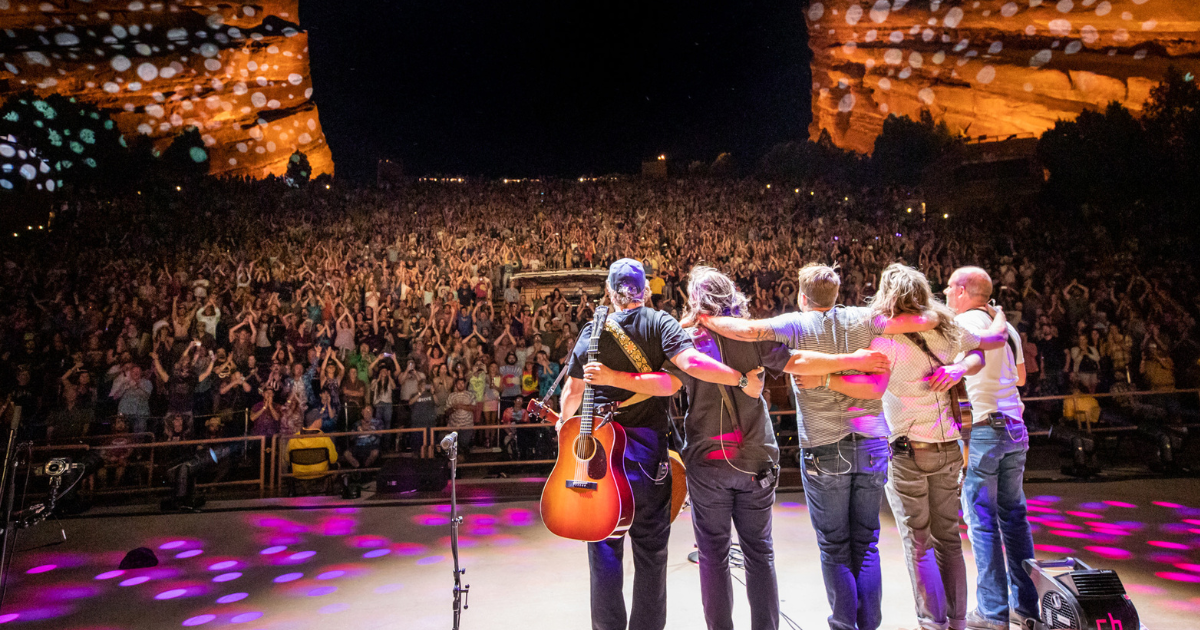
One big milestone of Greensky’s first decade came at Telluride, the storied annual bluegrass festival in Colorado, where they won the band contest in 2006. They’ve steadily built themselves up as a live draw playing bigger venues, becoming a major presence at Red Rocks, the Colorado amphitheater that is the high church of jamgrass. This September, Greensky played the 20th headlining show of their career at Red Rocks.

As they progressed, Greensky provided an inspirational example for younger acts following in their wake, most notably a young guitarist from their home state of Michigan. Born William Apostol in 1992 in the college town of Lansing, he adopted the stage name Billy Strings as a teenager. Greensky was well-established by then and served as Strings’ mentors, collaborating frequently and giving him a choice opening-act slot on a 2018 tour. Strings has gone on to become a worldwide arena-level star, something like the jamgrass genre’s Nirvana equivalent to Greensky’s Sonic Youth.

Fittingly, Strings is one of the cameo guests appearing on the new Greensky album, XXV, which marks the group’s 25-year anniversary with all kinds of star power. Nine of the album’s 13 tracks feature guest appearances from some of the top names in the field.

Sam Bush, a co-founder of the previously mentioned jamgrass pioneers New Grass Revival, opens the first track “Can’t Stop Now” with one of his trademark lightning-speed mandolin runs. Americana stars Nathaniel Rateliff and Aoife O’Donovan turn up to provide lead vocals on a couple of songs. Other tracks feature String Cheese Incident drummer Jason Hann, New Orleans scion Ivan Neville and, from Trey Anastasio Band’s horn section, trumpeter Jennifer Hartswick and trombonist Natalie Cressman. Among the guests with Michigan ties are Phil Lesh & Friends pianist Holly Bowling and, from the Great Lakes State supergroup Sweet Water Warblers, vocalist Lindsay Lou.

Greensky has always been more than willing to expand tunes out to epic, near-galactic dimensions, and XXV has more than enough sprawling solos to satisfy the pickiest of jamgrass fans. Most notable is the 14-plus minutes of “Last Winter in the Copper Country,” on which Bowling’s rippling piano takes center-stage. Bowling also stars on “Windshield,” a longtime Greensky favorite that appeared on the band’s 2014 album If Sorrows Swim in an arrangement of just her piano and Hoffman’s powerful bellow – the closest thing to operatic bluegrass this side of The Hillbenders’ bluegrass take on The Who’s Tommy. That’s only one of the songs from throughout the Greensky discography that they reprise in (sometimes drastically) rearranged form for XXV.

In anticipation of the new album’s release date, which is set for Halloween, check out our Essential Greensky Bluegrass playlist below. Plenty of further Greensky content is also on the way, including a feature interview with the group and plenty of excellent picks from the archives, as well. Follow along all month here on BGS and on our social media pages as we celebrate Greensky Bluegrass as our Artist of the Month.


Photo Credit: Dylan Langille

Daniel Donato Has Many Horizons in Sight, Literal and Metaphorical

Although names like Billy Strings and Sturgill Simpson currently corner the market at the intersection of country, jam bands, and bluegrass, rising star Daniel Donato has emerged in recent years with an out-of-this-world sound – and his newest project may be his best yet.

On Horizons (which released in August) the prodigy who as a child honed his skills on Guitar Hero and Nashville’s Lower Broadway turns a new page with an 11-song, hour-long compilation that brings his live and studio sounds together with drawn-out jams conjured up by his longtime bandmates from Cosmic Country – a moniker that describes both the group’s sonic and spiritual ethos.

“I want there to be a Cosmic Country sound where you can hear it right away, you can hear the first eight bars of any song and say, ‘That’s it!'” says Donato.

“Some of it is technical, like using the same microphones and the same studio as the last record. And some of it’s just in the way we approach it – and that’s something we get better at every time.”

Sitting on the back of his month-old tour bus affectionately referred to as “The Snowman” prior to a recent show in Lexington, Kentucky, Donato spoke to BGS about his Lower Broadway roots, creative freedom and restraints, and the catalysts for Cosmic Country.

We already touched upon your similarities with Billy Strings, but what about your parents’ influence – I know they played a big role in your musical foundation as well?

Daniel Donato: Everything when I was younger came from my parents. My father had a certain disposition for great rock and roll music like Pink Floyd, Stevie Ray Vaughan, and Led Zeppelin. But to be honest, I really don’t know where all of it comes from, because if you and I listen to a record we’re both going to hear it in different ways. For that reason I think a lot of this just comes from something that’s already dwelling within us and we’re just expressing from within that place.

For example, when I first heard Marty Robbins, I loved all the great guitar on it. And when I heard the Grateful Dead play “Big River” and make it eight minutes long in a really artistic and authentic way, I love that too. They’re all influences, but they start externally and creep inside you to the point that you take them with you everywhere you go and create from that place of soul, which is a combination of the body, the mind and the spirit.

Ever since I started playing guitar, I’ve always felt like I sounded like me and that “me” is constantly changing and revealing itself more and more. It’s like what Bob Dylan said – “I contain multitudes” – and it’s true. There are multitudes of self that just keep getting revealed through this authentic expression.

Was there a specific moment that served as the catalyst for you picking up the guitar and pursuing a career in music?

There have been many, but arguably the biggest was when I first saw the Don Kelley Band at Robert’s Western World and was in a state of shock – I’m getting goosebumps just thinking about it. That moment of hearing them and seeing how they interacted was amazing and was a big motivator in me wanting to do that too. It was a call to adventure and a reminder to believe I’m capable of anything, which is what ties all of these moments together.

That is not a self-assertive belief, that is a belief grounded in an authentic desire to make something beautiful so I can be of service. It was a big turning point in my life when I first started conceptualizing and receiving that, because then you can give it and then it turns into the cosmic circle of all things.

Some might perceive it as arrogance, but I think there’s a lot to be said for having the confidence to know what you’re doing is worthwhile and constantly chipping away to get better and reach your goals, whether that’s in a musical sense or wherever else life takes you.

I had already tried other forms of expression in my life before it, like sports. I also tried skateboarding and really loved video games like RuneScape, World of Warcraft, and chess. Even so, there were so many things I was bad at and I didn’t have beliefs that I could do them. But with music and the guitar, I could intuitively feel the potential I had with it and immediately locked in.

Artistry nowadays is parasocial on a lot of levels because of this immense amount of connectivity that we have on the various social platforms. [They] make it so anyone can get into the business of needing the world to give them permission to say something or express something real, when in reality the world does not need to give you permission for any of that. I’m not saying you should participate in any of the unspeakable, ungodly things we see happening to humans around the world, but if you want to express something artistically and you feel it’s true to you, then why should you need to get someone else’s approval to do that?

That idea to the mind is [like a] letter to the Pony Express – it needs to be delivered and it needs us to exist in flesh so we can externalize these internal values and expressions. It doesn’t need other people, it needs you, but at the same time it does bring people together – it’s so strange. It’s the thing that comes from most within an individual, but it’s also the thing that is the most unifying to an external community. It’s this weird “as above, so below” reflection that is purely righteous, so as I get older I feel I have more grace in relation to that particular part of existence.

The communal element seems to be a huge driving force behind not only your live show and fans, but this new record as well. Whereas some artists opt for a more straightforward studio approach, what made you want to emulate the energy from a gig on Horizons?

Cosmic Country records, to me, are like movies. The most enduring elements of certain movies that I love are the really long ones that have a very dynamic and rich storyline with a lot of drama and comedy in an attempt to scale the human experience. Like in A Fistful of Dollars, Django Unchained, or The Hateful Eight. The art is asking a lot of you during these three hour-long films, but it’ll give you a lot, too. There’s reciprocity there and our community is always willing to take the trip, which is equal parts liberating and terrifying. [Laughs]

If you were asked to write the score for a film, what would you want it to look like?

It would have to be a very truthful opportunity for me. I have always wanted to do that, even when I was really young. I always wondered where music and movies came from. But for now, we put out our records, and we play a lot of shows.

Speaking of the new album, you’ve been playing most of the songs on it live for a while now. What kept you from holding some or all of these songs back until the project’s official release, which it seems more and more singers are doing nowadays?

I like to look at our music as living music. It’s liberating in potential, but it’s also liberating because it gives you a framework to operate and create within. Every day of your life is different, so why wouldn’t the music that accommodates your life every day be different? These new songs are no different than a young child – they do better when they get to go out and be around people so they can grow spiritually.

That’s why it’s also important to share stories that everyone knows, which is why we incorporate a lot of covers into our shows and even recorded a volume called Cosmic Country & Western Songs in 2021. It gives people context and I love doing that. My favorite part of playing at Robert’s was we only played covers all those years so I’ve always loved making other’s songs my own – because if a song is good enough, you can play it with an original feeling.

But with Horizons every song I had my hand to the pen, even “Hangman’s Reel” – a traditional Celtic fiddle tune that the band and I fit into the Cosmic Country framework.

You’ve mentioned Robert’s Western World a couple times now. A couple weeks ago you returned there after making your headlining debut at the Ryman. What was that like?

We’ve done what’s never been done down on Broadway – going from cutting your teeth on the street corners and at places like Robert’s to topping a bill at the Ryman. It’s a common storyline for folks in Nashville to get their starts down here. Some go on to become songwriters, others become singers on stage and some become session musicians, but it all starts down on Broadway.

What I learned down there led me to getting in the door at Robert’s and leaving my blood and sweat on that floor there – like a dojo – before carrying us all the way to the Ryman. It was incredible getting to do a full headlining set up there and then going back home to where it all began at Robert’s and doing another set of music for their fans. We’re actually planning to release both soon as live recordings, so stay tuned!

With Horizons you placed parameters on how many times you’d go back to record and work on each song. With how open-ended so much of your creative process seems to be, what made you opt to place constraints there?

If your personality has a disposition for conscientiousness and open mindedness, it becomes that individual’s responsibility to see the trends of that because it can help optimize the way you engage with human relationships when creating projects. When we went and did Reflector we spent a lot of time on things we didn’t need to because I didn’t know better at the time.

When it came time to record Horizons I knew we could take half the amount of time to make it because we play it every night and shouldn’t need a bunch of tries to get it right. So I decided we’d just aim for three takes of a song to be more efficient. There’s a liberating faith that comes with knowing that’s good enough. If you know you have seven chances, you’re probably going to take seven – but we’re trying to work to ensure it only takes one.

You were talking earlier about creating living music, and stuff like this seems like it helps to keep what you do in the studio just as fresh as what you’re doing out on the road.

They’re two very different things. One’s a picture of a person and the other one’s a person. A picture can do a lot, but it’s not that person, especially when it comes to thinking about a picture of someone that you love who is no longer alive. Even then it’s not the same as them being in the room with you again to hug you.

For instance, I know that there will be a day where I have a gig and I won’t be able to call my dad to debrief – that’s gonna be a tough one. So the live thing is almost like a conveyor belt trying to make it an exact replica of what’s going on on the albums. There are people I see do that and I really respect how they do it because it’s authentic to them, but it was never for me.

How did your approach to bringing Horizons to life differ from how you tackled Reflector and other projects previously?

We had two years of intense experience constantly working on these songs between albums. It made me a different person on some level because I had a better idea of what to aim for and what not to aim that really allowed us to hit the bullseye this time compared to Reflector. And I’ll probably be saying the same thing again when the next record comes around, which will be a lot different than Horizons.

You just alluded to going a different direction with your next album. Someone else known for that who I know has heavily impacted your musical trajectory is Sturgill Simpson. How’d you get sent down the rabbit hole of his music?

Man, I remember when Sturgill Simpson worked at the Turnip Truck in the Gulch in Nashville, I would always see him there and thought nothing of it until one night when I was at The 5 Spot and heard him on stage singing for the first time. Then when Metamodern Sounds In Country Music came out I was in my friend Harrison’s basement. We had gone to Grimey’s to buy the record, we smoked some weed, turned it on, and listened with headphones on. It was and still is a defining moment in my listening experience of music – that record is so special.

Looking back I can see why Sturgill wanted to make a bunch of 180s, because from SOUND & FURY to Sailor’s Guide each album is its own thing. Most successful artists have one signature piece of work, like Tyler Childers’ Purgatory, Chris Stapleton’s Traveller, Tom Petty’s Wildflowers, the Grateful Dead’s Workingman’s Dead, or Neil Young’s Harvest. Unless you’re someone like Bob Dylan or Willie Nelson where you have over 100 albums out. There’s usually one record where you’re like, “that’s the one.” With cosmic country we don’t have that album yet, but I think Horizons could be it.

What has the process of bringing Horizons to life taught you about yourself?

The concept of a Horizons is two-fold. There’s a literal, geographical, physical, material horizon where the land meets the heavens. Then there’s the metaphorical one, and we’re always pushing the cosmic country horizon. But there’s also a psychological horizon where you’re meeting your potential that the sky is symbolic of.

As Alan Watts would say, “there’s a dance to those things,” and I feel that since we put out Horizons that the band and I are on the verge of new horizons. It truly is the dawn of a new day.


Photo Credit: Jason Stoltzfus

See the Winners of the 2025 IBMA Bluegrass Music Awards

Tonight, September 18, 2025, the International Bluegrass Music Association held their 36th Annual IBMA Bluegrass Music Awards at the Soldiers and Sailors Memorial Auditorium in Chattanooga, Tennessee – the organization’s first awards show presented in their new host city.

The IBMA Awards are designed to be peer-to-peer, voted on by the professional membership of the IBMA, performers, artists, industry professionals, broadcasters, and beyond. As a result, the show this year – which was hosted by the hilarious and talented duo of Steve Martin and Alison Brown – was an evening celebrating mutual admiration, mentorship, sharing, and the diverse ways all of this music’s creators celebrate tradition, and the innovation at its core. That phenomenon has been a hallmark of the IBMA Awards over all of their 36 years. Through the many categories there were a wide array of winners from across generations, styles, and levels of notoriety.

Bluegrass’s most prominent artist at the moment, Billy Strings, took home the night’s highest honor, Entertainer of the Year – his fourth such trophy. Alison Krauss, who recently returned to the road with a brand new album, Arcadia, for the first time in 14 years, received her fifth Female Vocalist of the Year award, her first since 1995. Jason Carter & Michael Cleveland received three awards for their superlative debut album together and its songs including Album of the Year, Song of the Year, and Collaborative Recording of the Year.

Women were represented in force across the many categories this year, remarkable given the sheer number of years where women nominees were absent entirely or merely counted in the single digits. Along with Krauss winning Female Vocalist women took home trophies in many more categories: Gospel Recording of the Year (Jaelee Roberts; writer, Kelsi Harrigill); Instrumental Recording of the Year (Kristin Scott Benson, Gena Britt, Alison Brown); Banjo Player of the Year (Kristin Scott Benson); Bass Player of the Year (Vickie Vaughn); Fiddle Player of the Year (Maddie Denton); and Mandolin Player of the Year (Sierra Hull).

During the IBMA Bluegrass Music Awards, the 2025 class of Bluegrass Music Hall of Fame inductees were honored with speeches, plaque presentations, and incredibly special musical performances. This year’s inductees include Hot Rize, The Bluegrass Cardinals, and Arnold Schultz, the first Black person to ever be elected to the hall, the association’s highest honor, since it was begun in 1991.

IBMA’s World of Bluegrass business conference and IBMA Bluegrass Live! festival continue in Chattanooga through Saturday, September 20. Get more information on the event and purchase tickets for Bluegrass Live! here. Below, check out all of the winners at this year’s 2025 IBMA Bluegrass Music Awards.

(Winners denoted in bold.)

ENTERTAINER OF THE YEAR 

Alison Krauss & Union Station
Appalachian Road Show
Billy Strings
East Nash Grass
The Del McCoury Band

SONG OF THE YEAR 

“5 Days Out, 2 Days Back” – Alison Brown, Steve Martin, Featuring Tim O’Brien
Songwriters: Steve Martin, Alison Brown
Producers: Alison Brown, Garry West
Label: Compass Records

“Big Wheels” – Authentic Unlimited
Songwriter: Jerry Cole
Producer: Authentic Unlimited
Label: Billy Blue Records

“Coal Dust Kisses” – The Grascals
Songwriters: Susanne Mumpower, Jerry Salley
Producer: The Grascals
Label: Mountain Home Music Company

“My Favorite Picture of You” – Darin & Brooke Aldridge
Songwriters: Darin Aldridge, Brooke Aldridge, Dennis Duff
Producers: Darin Aldridge, Mark Fain
Label: Billy Blue Records

“Outrun the Rain” – Jason Carter & Michael Cleveland
Songwriters: Terry Herd, Jimmy Yeary
Producers: Jason Carter, Michael Cleveland
Label: Fiddle Man Records

ALBUM OF THE YEAR 

Arcadia – Alison Krauss & Union Station
Producer: Alison Krauss & Union Station
Label: Down the Road Records

Carter & Cleveland – Jason Carter & Michael Cleveland
Producers: Jason Carter, Michael Cleveland
Label: Fiddle Man Records

Earl Jam – Tony Trischka
Producers: Tony Trischka, Lawson White
Label: Down the Road Records

Highway Prayers – Billy Strings
Producers: Billy Strings, Jon Brion
Label: Reprise Records

I Built a World – Bronwyn Keith-Hynes
Producers: Brent Truitt, Bronwyn Keith-Hynes
Label: Sugar Petunia Records

VOCAL GROUP OF THE YEAR 

Alison Krauss & Union Station
Authentic Unlimited
Blue Highway
Sister Sadie
The Del McCoury Band

INSTRUMENTAL GROUP OF THE YEAR 

Billy Strings
East Nash Grass
Michael Cleveland & Flamekeeper
Molly Tuttle & Golden Highway
The Travelin’ McCourys

GOSPEL RECORDING OF THE YEAR 

“Blue Collar Gospel” – Jerry Salley Featuring The Oak Ridge Boys
Songwriters: Rick Lang, Bill Whyte, Jerry Salley
Producer: Jerry Salley
Label: Billy Blue Records

“Dear Lord” – Darin & Brooke Aldridge
Songwriter: Daniel Davis
Producers: Darin Aldridge, Mark Fain
Label: Billy Blue Records

“Even Better When You Listen” – Joe Mullins & The Radio Ramblers
Songwriters: Rick Lang, Mark BonDurant
Producer: Joe Mullins & The Radio Ramblers
Label: Billy Blue Records

“He’s Gone” – Jaelee Roberts
Songwriter: Kelsi Harrigill
Producer: Byron House
Label: Mountain Home Music Company

“Wings of Love” – Authentic Unlimited
Songwriters: Jesse Brock, Stephen Burwell, Jerry Cole, Eli Johnston, John Meador
Producer: Authentic Unlimited
Label: Billy Blue Records

INSTRUMENTAL RECORDING OF THE YEAR 

“Bluegrass in the Backwoods” – Jason Carter & Michael Cleveland
Songwriter: Kenny Baker
Producers: Jason Carter, Michael Cleveland
Label: Fiddle Man Records

“The Drifter” – Danny Roberts
Songwriter: Danny Roberts
Producers: Danny Roberts, Andrea Roberts
Label: Mountain Home Music Company

“A Drive at Dusk” – Authentic Unlimited
Songwriter: Jesse Brock
Producer: Authentic Unlimited
Label: Billy Blue Records

“Kern County Breakdown” – Jason Carter & Michael Cleveland
Songwriter: Buck Owens, Don Rich
Producers: Jason Carter, Michael Cleveland
Label: Fiddle Man Records

“Ralph’s Banjo Special” – Kristin Scott Benson, Gena Britt, Alison Brown
Songwriter: Ralph Stanley
Producer: Alison Brown
Label: Compass Records

NEW ARTIST OF THE YEAR 

AJ Lee & Blue Summit
Bronwyn Keith-Hynes
Jason Carter
Red Camel Collective
Wyatt Ellis

COLLABORATIVE RECORDING OF THE YEAR 

“5 Days Out, 2 Days Back” – Alison Brown & Steve Martin Featuring Tim O’Brien
Songwriters: Steve Martin, Alison Brown
Producer: Alison Brown, Garry West
Label: Compass Records

“A Million Memories (A Song for Byron)” – Darin & Brooke Aldridge Featuring Vince Gill
Songwriter: Vince Gill
Producers: Darin Aldridge, Mark Fain
Label: Billy Blue Records

“Cora Is Gone” – Bobby Osborne & C.J. Lewandowski Featuring Rob McCoury, Billy Strings
Songwriter: Mac Odell
Producer: C.J. Lewandowski
Label: Turnberry Records

“Outrun the Rain” – Jason Carter & Michael Cleveland, Jaelee Roberts, Vince Gill
Songwriters: Terry Herd, Jimmy Yeary
Producers: Jason Carter, Michael Cleveland
Label: Fiddle Man Records

“Ralph’s Banjo Special” – Kristin Scott Benson, Gena Britt, Alison Brown
Songwriter: Ralph Stanley
Producer: Alison Brown
Label: Compass Records

MALE VOCALIST OF THE YEAR 

Billy Strings
Dan Tyminski
Del McCoury
Greg Blake
Russell Moore

FEMALE VOCALIST OF THE YEAR 

AJ Lee
Alison Krauss
Brooke Aldridge
Jaelee Roberts
Sierra Hull

BANJO PLAYER OF THE YEAR 

Alison Brown
Gena Britt
Kristin Scott Benson
Ron Block
Tony Trischka

BASS PLAYER OF THE YEAR 

Barry Bales
Mike Bub
Missy Raines
Todd Phillips
Vickie Vaughn

FIDDLE PLAYER OF THE YEAR 

Bronwyn Keith-Hynes
Jason Carter
Maddie Denton
Michael Cleveland
Stuart Duncan

RESOPHONIC GUITAR PLAYER OF THE YEAR 

Andy Hall
Jerry Douglas
Justin Moses
Matt Leadbetter
Rob Ickes

GUITAR PLAYER OF THE YEAR 

Billy Strings
Bryan Sutton
Cody Kilby
Molly Tuttle
Trey Hensley

MANDOLIN PLAYER OF THE YEAR 

Alan Bibey
Jesse Brock
Ronnie McCoury
Sam Bush
Sierra Hull

MUSIC VIDEO OF THE YEAR 

“5 Days Out, 2 Days Back” – Alison Brown & Steve Martin Featuring Tim O’Brien
Songwriters: Steve Martin, Alison Brown
Producer: Alison Brown, Garry West
Videographer: Joseph Spence
Label: Compass Records

“A Million Memories (A Song for Byron)” – Darin & Brooke Aldridge Featuring Vince Gill
Songwriter: Vince Gill
Producer: Jenny Gill
Videographer: Travis Flynn
Label: Billy Blue Records

“Big Wheels” – Authentic Unlimited
Songwriter: Jerry Cole
Producers: Bryce Free, Kyle Johnson
Videographer: Bryce Free
Label: Billy Blue Records

“Gallows Pole” – Appalachian Road Show
Songwriter: Traditional, arr. Barry Abernathy, Jim VanCleve, Darrell Webb
Producer: Steve Kinney
Videographer: Steve Kinney
Label: Billy Blue Records

“Tennessee Hound Dog” – The Grascals
Songwriter: Felice Bryant, Boudleaux Bryant
Producer: Ty Gilpin
Videographer: Nate Shuppert
Label: Mountain Home Music Company

“The Auctioneer” – The Kody Norris Show
Songwriters: Leroy Van Dyke, Buddy Black
Producer: James Gilley
Videographer: Nate Wiles
Label: Rebel Records


Photo Credit: Billy Strings by Dana Trippe; Jason Carter & Michael Cleveland by Emma McCoury.